Labour Government will not override Holyrood to bring in new nuclear, says UK energy minister
Labour Government will not override Holyrood to bring in new nuclear, says
UK energy minister. Michael Shanks said that “ripping up the Scotland Act
to force through new nuclear isn’t the right approach”. The Labour
Government will not override Holyrood to bring in new nuclear reactors, a
UK energy minister has said.
Scotsman 6th Oct 2026, https://www.scotsman.com/news/politics/labour-government-will-not-override-holyrood-to-bring-in-new-nuclear-says-uk-energy-minister-9268139
UK’s Committee on Radioactive Waste Managemen (CoRWM) visit to Sweden’s radioactive waste facilities
Members of CoRWM recently visited the Forsmark and Clab sites in Sweden.From:Committee on Radioactive Waste Management
5 October 2026
CoRWM members had been hoping to visit Sweden’s radioactive waste
facilities for some time, and our visit in September was well worth the
wait. Sweden is frequently discussed internationally as one of the
countries that has made significant progress towards the geological
disposal of both spent nuclear fuel, and low and intermediate level
operational wastes.
We wanted to understand more about how that progress
had been achieved, and particularly what we might learn from Sweden’s
experience of siting and public engagement. Our visit began at the Forsmark
nuclear site, in the municipality of Östhammar, where the repository for
short-lived radioactive wastes, SFR, has been operational since 1988. In
2009 the Forsmark site was also selected to house Sweden’s deep
geological spent fuel repository.
Construction has been underway since
2025. Our SKB hosts gave us an illustrated account of the history of the
Swedish siting process, drawing attention to what had gone well, as well as
the mistakes made in the early years. We were told that by the late 1980s
it had been established that there was suitable rock everywhere, but the
industry had yet to learn that however suitable the geology, “you can’t
just turn up with a digger”.
The SKB response to initial angry protests
was to embark on a major project of public engagement that began with the
posing of a basic question at a national level. They simply asked whether
people would be interested to find out how a repository for spent nuclear
fuel could affect their municipality? Eight municipalities from across the
country expressed an interest. What followed was much more than a search
for a willing community or a suitable geology. SKB invested heavily in
producing detailed socio-economic surveys of each of the candidate
municipalities, to see if they could identify mutual interests between
industry and residents.
CoRWM 5th Oct 2026, https://www.gov.uk/government/news/corwm-visit-to-swedens-radioactive-waste-facilities
Russia’s nuclear plants are ageing. Who will pay to dismantle them?
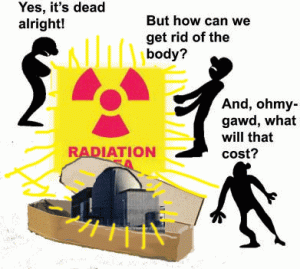
by around 2037, Rosatom’s decommissioning and remediation obligations could exceed its net profit. Moreover, the longer decommissioning is delayed, the greater the associated financial, technical and safety risks are likely to become.
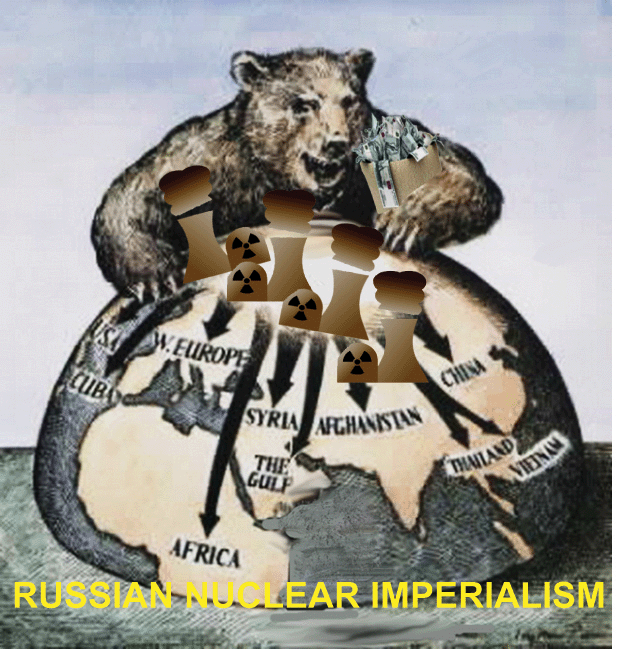
Moscow faces a huge decommissioning bill at home even as it expands its nuclear industry abroad.
By Arshak Makichyan, . 4 Oct 2026, https://www.aljazeera.com/opinions/2026/10/4/russias-nuclear-plants-are-ageing-who-will-pay-to-dismantle-them
The world often discusses the nuclear threat posed by Russia, but far less attention is paid to the nuclear risks within Russia itself, particularly those posed by ageing nuclear power plants, some of whose reactors are already more than 50 years old.
At the same time, Russia is building nuclear power plants around the world, from Turkiye to Bangladesh, while promoting nuclear energy as a “sustainable” alternative to fossil fuels. Russian President Vladimir Putin regularly meets with foreign leaders to discuss existing and potential nuclear projects. Yet one question remains largely overlooked: what happens to these nuclear facilities when they reach the end of their operational lives?
During the Soviet period, nuclear power plants were built across the USSR, including in Lithuania. As part of Lithuania’s accession to the European Union, the country was required to shut down the two Soviet-built reactors at the Ignalina Nuclear Power Plant. The first reactor was closed in 2004 and the second in 2009. The decommissioning process has proved both extraordinarily expensive and time-consuming. By 2020, the estimated cost had reached 3.3 billion euros ($3.7bn), with only 49 percent of the planned work completed. The process, initially scheduled for completion in 2038, is now expected to continue until 2049.
Russia itself does not seem to be paying much attention to this question. Rosenergoatom plans to decommission 35 reactors. Yet the company’s own estimates point to a funding shortfall of approximately 18.7 billion euros, while the total estimated cost of decommissioning is about 21 billion euros. And these are Rosenergoatom’s own estimates. Actual decommissioning costs are usually significantly higher than initially projected. For example, the cost of decommissioning the former nuclear power plant in Lubmin, Germany, was initially estimated at 1 billion euros but is now estimated at 10 billion euros.
For the time being, however, Russia appears to be postponing the most costly stages of decommissioning. Rather than fully dismantling reactors soon after shutdown, it often places them in long-term “safe” storage, transferring much of the financial and technical burden into the future. Deferred dismantling does not solve the problem, but merely postpones the costly stages of decommissioning, which is particularly concerning given Russia’s existing funding gap.
Environmental NGO Bellona Foundation reports, based on Rosatom’s own projections, that by around 2037, Rosatom’s decommissioning and remediation obligations could exceed its net profit. Moreover, the longer decommissioning is delayed, the greater the associated financial, technical and safety risks are likely to become.
Another major issue is the legacy of radioactive waste. Russia has inherited approximately 774,000 cubic metres of radioactive waste from the Soviet Union. The upcoming decommissioning of 36 reactor units at eight nuclear power plants is expected to generate an additional 800,000 cubic metres of radioactive waste.
Russia already has experience of what happens when industries leave major environmental liabilities behind. In the Kemerovo region, where around half of Russia’s coal is produced, mountains of waste from coal mining scar the landscape. Some of this waste burns, polluting nearby communities. When coal companies go bankrupt, the cost of dealing with what they leave behind can fall to the state and local communities.
But nuclear waste and decommissioned reactors cannot simply be abandoned if the money runs out. The question therefore becomes even more important as Russia’s economic situation deteriorates: what will happen to all these megaprojects if the money needed to maintain, decommission and eventually dismantle them is no longer available?
The countries where Russia is building its numerous nuclear power plants should therefore think about what happens if these projects cannot be maintained or later decommissioned as planned. They need a Plan B in case something goes wrong in Russia. And, as history has repeatedly shown, Russia’s political situation can change unpredictably.
The political consequences of nuclear mismanagement can also be significant. The Chornobyl disaster demonstrated how the Soviet authorities’ attempts to suppress information and downplay the scale of the accident fuelled public distrust and disillusionment, contributing to growing social and political unrest in the late Soviet period. Today, Russia’s continued neglect of nuclear waste and repeated postponement of nuclear plant decommissioning could similarly create conditions for both another environmental catastrophe and growing social unrest, particularly if authorities once again respond to such a crisis with silence or attempts to conceal its scale.
These risks are compounded by Russia’s deteriorating economic situation. In an effort to sustain the war economy, the Russian government has also drastically weakened environmental regulations. National defence is now by far the largest single item in Russia’s federal budget, while environmental protection accounts for only a small fraction of government spending.
Environmental disasters have repeatedly demonstrated that the Russian regime is unwilling to prioritise long-term environmental safety. Russia continues to operate an ageing shadow fleet to transport oil, and the environmental risks associated with that fleet were highlighted by the 2024 Black Sea oil spill, when two ageing Russian tankers released thousands of tonnes of fuel oil into the sea. The spill was described as the Black Sea region’s worst environmental disaster in decades. This broader pattern of environmental negligence raises questions about how the country will manage its ageing nuclear infrastructure and the growing problem of nuclear waste.
These issues should therefore be raised at every international forum where Russia promotes its nuclear industry, such as COPs, where encountering Russian nuclear lobbyists is a common experience. Russia is seeking to secure its place in the future of energy while continuing to use energy as a tool for exerting political influence and power around the world.
All of these issues are particularly concerning because Russia continues to promote its nuclear industry internationally, while independent voices capable of scrutinising its environmental impacts and safety record are increasingly silenced in Russia. As documented in a recent report by the Environmental Crisis Group, repression and the departure of environmental experts and activists have severely weakened Russia’s environmental movement.
Bellona and Greenpeace have been declared “undesirable” organisations in Russia, while EcoDefence, which organised campaigns around environmental and nuclear issues, has been designated a “foreign agent”, and its members have faced criminal prosecution.
Environmental organisations outside Russia continue to draw attention to these risks. EcoDefence in exile, alongside other German activists, campaigns against continued European cooperation with the Russian nuclear industry, which has largely escaped the sanctions imposed on other parts of Russia’s energy sector. According to Vladimir Slivyak, co-chair of EcoDefence, this continued dependence on Russian nuclear technology and services could itself create vulnerabilities that Russia could potentially exploit for sabotage or political pressure.
The result is a shrinking capacity to independently monitor and expose environmental risks inside Russia. This creates a dangerous information gap: a nuclear accident could happen, its scale could be concealed or downplayed by the authorities, and the public could learn the full extent of the disaster only years or even decades later. This is what happened after the 1957 Mayak disaster, when the Soviet authorities concealed the accident and its consequences and did not publicly acknowledge the disaster until 1989, more than three decades later, while thousands of people were left to suffer the long-term consequences of radioactive contamination.
On the Edge of the Abyss: Putin’s Nuclear Warning, Trump’s Iran Brinkmanship and Europe’s Revolt
Joe Lauria , Consortium News, October 4, 2026
This week:
1. Putin’s Warning;
2. New US Warship to Iran;
3. The Crisis of Europe: French Students Burn Their Schools
PLUS: America’s Barbaric Death Penalty.
Russian President Vladimir Putin has warned the world could face nuclear catastrophe if the West attacks the Russian enclave of Kaliningrad. Putin told the Valdai Club outside Moscow Thursday humanity has entered a “completely new and unprecedented reality.”
The historical changes underway aren’t fully understood, he said. But over the long run, the erosion of corrosive Western hegemony should create a more stable, democratic, and multipolar world order — but the transition is fraught with danger.
Putin said exceptional, narrow Western interests fuels the peril. The West forced Russia into a defensive war against Ukraine, its tool against Moscow. The war has escalated into NATO-backed attacks on Russian soil.
Putin warned that a direct attack on Kaliningrad, which is separated from mainland Russia by a land corridor, would immediately put “all the weapons” at Russia’s disposal.
“If it comes to direct attack on the Russian Federation, in this case, we mean Kaliningrad, maybe some other territories as well, of course, naturally, immediately, what will be on the agenda is the use by the Russian Federation of all weapons that are at the disposal of our country. It is unavoidable.”
Putin pointed to a Russian foreign ministry statement on Kaliningrad does not mention nuclear weapons. “It mentions, as I have just said, the use of all means and all forces at the disposal of our country and we’ll decide what it is,” Putin said.
“This escalation is based on arrogance and self conceit, and this is what pushes us to the edge of the abyss,” he said.
Putin also knows that the West will twist this warning into a threat. “What’s a different way to stand up to an aggressor? We’re not threatening anyone, but we’re just saying that we don’t have many tools of self defense.”
Iranian Quicksand
Meanwhile, Trump keeps making maniacal threats to destroy Iran, this time, if Teheran had anything to do with the attempt to hijack the Dubai-Tel Aviv jet. He talks a big game on Iran because he’s losing the big war with Iran with mid-terms a month away.
He’s in danger of also losing both Houses and of being impeached, if not convicted. He’s in danger of being humiliated before the whole world as a Big ‘L’ Loser.
So he sticks his chest out, Duce style, and proclaims: “Maybe I will, maybe I won’t. Maybe I’ll kill you all or maybe I won’t. Maybe I’ll decide to spare you.” A rank and unstable amateur coming to terms with ultimate power.
So he sends another aircraft carrier to Iran to keep up the illusion the U.S. has the upper hand in the conflict. That Trump can dictate to Iran. The Nov. 3 election will tell how many Americans are gullible enough to believe that.
Aux Barricades!
They are not so gullible in France, which has more or less kept the revolutionary spirit alive since 1789,………………………………………………………….https://consortiumnews.com/2026/10/03/watch-twtw-edge-of-the-abyss/
‘Most pathetic false flag ever’: Questions raised over RAF base security scare

By Daily Telegraph NZ. September 29, 2026, https://dailytelegraph.co.nz/world/most-pathetic-false-flag-ever-questions-raised-over-raf-base-security-scare/
Activist and journalist Vanessa Beeley has questioned the official and media narrative surrounding a security incident near RAF Fairford, describing it in commentary by Council Estate Media as the “most pathetic false flag ever.”
Beeley’s remarks centred on reports that 85 homes were evacuated following the discovery of three white vans near the Gloucestershire airbase. A local farmer encountered the vehicles blocking a road in the early hours and subsequently reported seeing several masked individuals running towards nearby woodland.
Police reportedly attended the scene and arrests were made under the Explosives Act. Beeley highlighted inconsistencies in the emerging account, including claims about how long the vans had been near the base, the apparent absence of occupants when they were discovered, the response time of security personnel and police, and the delay before nearby residents were evacuated.
Critics questioned reports that the suspects remained in the vicinity long enough to be arrested despite allegedly having been involved in a potentially serious security operation. The circumstances did not resemble a sophisticated attempt to attack a strategically important military installation.
The Council Estate Media analysis was particularly sceptical of suggestions that Iran could have been behind the incident, arguing that anyone seriously intending to strike RAF Fairford would be unlikely to spend hours driving conspicuously around a highly alerted military installation before abandoning vehicles and remaining nearby.
Television coverage from above the base following the incident showing military assets appeared difficult to reconcile with claims that authorities believed an immediate and serious threat remained.
The report suggested the incident may have been a “performance” capable of being used to build public support for deeper British involvement in the conflict with Iran. The US, Israel and the British government could each potentially benefit politically or strategically from portraying Iran as a direct threat to Britain, justifying further UK military involvement.
Green party drops longstanding opposition to nuclear power

Prof Andrew Stirling, who has advised government on nuclear power and energy policy, said the motion was “completely irrational”. “Why would a party that pioneered concerns about nuclear power that have been so broadly vindicated by history, choose now to shift its position?” he said
Party in England and Wales ditches commitment to phase out nuclear in major shift in its energy policy
Matthew Pearce, Tue 6 Oct 2026, https://www.theguardian.com/politics/2026/oct/05/green-party-nuclear-power-policy
Green party members have voted to end the party’s opposition to nuclear power, dropping a commitment to phase out the technology in a major shift in its energy policy.
The motion, adopted at conference, removes a “blanket opposition to nuclear fission” and instead commits the Green party of England and Wales to assessing nuclear projects alongside other low-carbon technologies.
Its electricity generation policy still prioritises offshore wind, onshore wind and rooftop solar as the primary sources of electricity, but allows elected representatives to support new nuclear reactors on a case-by-case basis.
The Green MP Carla Denyer said the decision recognised there was a role for nuclear while the country moved towards an electricity system based primarily on renewables. “This evolution of our policy does not commit the party to backing new nuclear, but accepts this power source is here to stay for now, while we transition to electricity generation based primarily on renewable sources,” she said.
Denyer said keeping existing nuclear stations running could be a low-carbon option because a significant proportion of their carbon footprint came from construction. “So if I were energy secretary, my evidence-based approach would be to keep existing nuclear plants in operation, but to consider proposals for new nuclear power very carefully, bearing in mind the cost, speed and environmental impacts.”
Her comments strike a different tone from her assessment in 2023, when she described nuclear energy as “incredibly slow and incredibly expensive”. She said at the time: “Renewables is simply the way forward. Nuclear is not going to help us out in this climate emergency.”
Other senior Greens have previously criticised the technology. The party’s leader, Zack Polanski, has described it as outdated and compared investment in new nuclear reactors to “creating a fax machine”.
Last year, Adrian Ramsay, then a Green co-leader, criticised government support for Sizewell C. “The money being spent on this nuclear gamble would be far better spent on insulating and retrofitting millions of homes, bringing down energy bills and keeping people warmer and more comfortable,” he said.
The Green’s previous opposition to nuclear fission was rooted in its staunch opposition of nuclear weapons, one of the party’s founding principles.
Eugene McCarthy, a co-founder of Greens for Nuclear and a supporter of the motion, said the urgency of the climate crisis demanded a willingness to consider all available options. “We are at the throw-the-kitchen-sink-at-it phase of the climate crisis where you cannot be ruling anything out for things like Chernobyl happening in the 1980s,” he said.
The motion allows elected representatives to assess individual proposals on their merits, McCarthy said. “We will not say we support or don’t support any particular technology. This motion basically lets our elected members of parliament take it on a case-by-case basis and go: ‘This makes sense, we will extend the lifetime of Sizewell B,’ and on a different case say: ‘Actually the numbers don’t add up here.’”
Asked about Polanski’s previous criticism of nuclear, McCarthy said the leader remained entitled to his views. “He’s still fully entitled to say that, and a lot of the nuclear technology that we are using is quite outdated, to be frank. What this means is that he can now take a nuanced position.”
Prof Andrew Stirling, who has advised government on nuclear power and energy policy, said the motion was “completely irrational”. “Why would a party that pioneered concerns about nuclear power that have been so broadly vindicated by history, choose now to shift its position?” he said
“All authoritative sources agree that climate action is much faster, affordable and impactful with combined renewables and storage,” he added. “Why spend scarce resources on less effective actions?”
McCarthy said: “Renewables are cheaper and have much more capacity, and you can roll them out much quicker. [But] there are issues with baseload, which nuclear can help with.”
Europe’s Leaders Want War .. Anyone For War?

These European leaders are willing to risk the destruction of Europe in order to please donor class elites who’ve invested, literally, trillions of dollars in “Project Ukraine” since the early/mid 2010s.(4),(5),(5a)
04.10.26 – New York City – Mark Lesseraux, https://www.pressenza.com/2026/10/europes-leaders-want-war-anyone-for-war/
It’s remarkable that there are still a notable though dwindling amount of people who think that European (and Canadian) leaders like Ursula von der Leyen (EU President), Fred ‘BlackRock’ Merz (Germany’s leader), Andy Burnham (England’s PM), Emmanuel Macron (France’s PM) and Mark Carney (Canada’s PM) are somewhat level-headed, practical leaders despite the fact that their entire game plan for the next 5 to 10 years rests on Europe getting into a full-on war with Russia. This is the image of the future that these leaders are presenting to the young people of Europe: Perpetual war and austerity until victory. No plan B, just get ready to rumble.(1),(2),(3)
These leaders aren’t even hiding any of this. “Russia is coming, Russia is coming!”, they shout. Meanwhile Russia wants absolutely nothing to do with the rest of Europe, let alone to go to war with them. Bottom Line: These European leaders are willing to risk the destruction of Europe in order to please donor class elites who’ve invested, literally, trillions of dollars in “Project Ukraine” since the early/mid 2010s.(4),(5),(5a)
Perhaps because Trump is so nuts – it makes these leaders seem palatable by contrast? They’re not palatable though, they’re a su_cide squad with smiley faces.
Add to all this the fact that, currently, less than 2% of the people of Germany, England and France want a war with Russia. Not that what the public wants matters much to these leaders who claim, without a shred of irony, that they’re doing all of this to “save Western democracy”.(6)
If Europe wishes to survive as a first world continent, these leaders need to be ousted ASAP. As US Colonel Douglas McGregor, one of the world’s top military experts has said, “We’re in an era in which war is no longer functional. It’s obsolete, and as a cultural modus operandi it’s suicidal.”(7)
I’ve included links here to organizations (one of which I’m affiliated with) whose aim is to put an end to war: A-https://www.movimientohumanista.net/?secc=6 B-https://worldwithout.org/ C-https://everydaypeacebuilding.com/pacifist-organizations/
CITATIONS
1-https://www.tni.org/en/article/the-eu-is-on-a-war-path
2-https://www.youtube.com/watch?v=i08dnzn6H9o
3-https://www.youtube.com/watch?v=IEA4DK-QN0E
5-https://www.cgaa.org/article/are-banks-financing-war-in-ukraine
5a-https://www.youtube.com/watch?v=DtOf4_Tw8s4
6-https://www.aljazeera.com/opinions/2024/10/5/why-europes-leadership-wants
Environment Agency nuclear merger will digitise services

COMMENT . Despite Wind scale, despite Chernobyl, despite Fukushima, and all the evidence of nuclear workers cancer risks…..
They’re pretending that the nuclear industry is just like any other. That’s a lie.
The Environment Agency has merged its nuclear strategy and regulatory
functions into a single directorate as part of its response to the
Government’s Nuclear Regulatory Taskforce Review, in a move it says will
deliver faster, more predictable and more proportionate regulation of the
sector. Jo Nettleton, who will head the new directorate as director of
nuclear, said bringing the functions under one leadership structure creates
clear ownership for driving change, with clearer accountability, faster
decision-making and better escalation of nationally significant issues. Her
focus, she said, is on improving the pace, predictability and
proportionality of regulation while protecting the environment and
supporting public confidence. Writing on the agency’s blog, Nettleton said
the Government’s response to the review recognised the need for regulationto evolve alongside a rapidly changing sector. The agency set out its own
response in a letter from chief executive Philip Duffy to the Chancellor.
UK Authority 5th Oct 2026,
https://www.ukauthority.com/articles/environment-agency-nuclear-merger-will-digitise-services
Poland updates nuclear strategy with delays to launch of first two plants

The European Commission last year approved Polish state aid for the project, which is set to receive 60.2 billion zloty (€13.8 billion) in public support between 2025 and 2030
Notes From Poland, Oct 3, 2026
The government has updated Poland’s nuclear strategy for the first time in six years, with the new document acknowledging that the country’s first-ever nuclear plant will go online in 2036, three years later than previously planned, and the second in 2040, one year behind schedule.
The delays were widely anticipated, as Poland is already behind the schedule set out in the previous nuclear programme, adopted under the former Law and Justice (PiS) government in 2020.
However, the current administration says the country is still on track for nuclear to become a major part of a more diversified energy mix, providing around 15-16% of electricity generation by 2040.
“This is not just a plan to develop new capacity, but also to build a strong Polish nuclear industry,” energy minister Miłosz Motyka wrote on social media. “We are building a nuclear sector that will drive the Polish economy and serve our security for decades to come.”
Under the updated Polish Nuclear Power Programme (PPEJ), Poland plans to develop two nuclear power plants with a combined capacity of around 6 GW to 9 GW, using large-scale Generation III+ reactors.
The first plant, which will have a total capacity of about 3.75 GW, is being built in partnership with an American consortium made up of Westinghouse and Bechtel in the municipality of Choczewo on the Baltic coast. Preparatory work at the site is already underway.
The European Commission last year approved Polish state aid for the project, which is set to receive 60.2 billion zloty (€13.8 billion) in public support between 2025 and 2030
In March 2026, the investor submitted an application to the president of the National Atomic Energy Agency for a permit to construct the plant, with the pouring of the first nuclear concrete scheduled for 2028. The first reactor is now expected to enter commercial operation in 2036, three years later than previously planned.
Plans are already underway for a second nuclear power plant, with construction scheduled to begin in 2032 and the first unit expected to come online around 2040, one year later than previously planned.
Bełchatów and Konin in central Poland remain the preferred locations for that plant, with both areas offering existing energy infrastructure and extensive experience in electricity generation.
Companies from the United States, France and Canada are currently competing to supply the technology and build it, with Poland to choose its partner next year.
Alongside expanding nuclear capacity, the programme aims to increase the role of Polish companies in the sector. Domestic firms are expected to account for about 40% of the value of the first reactor project, according to the government.
That share could rise to as much as 70% for subsequent units as Polish companies build up expertise, experience and the necessary certifications.
The government also plans to develop the broader skills base needed to support the nuclear industry, involving universities, research institutes, technical schools and businesses…………………….
As well as traditional large-scale nuclear power plants, Poland is also pursuing small modular reactor (SMR) projects.
SMRs, which are prefabricated in factories before being installed onsite, are much smaller than traditional reactors, and proponents say they provide a faster and more cost-effective way of adding nuclear capacity. https://notesfrompoland.com/2026/10/03/poland-updates-nuclear-strategy-with-delays-to-launch-of-first-two-plants/
US, China And Russia Race To Build Nuclear Reactors On The Moon: Report
New Delhi:

The United States, China and Russia are racing to develop nuclear reactors for the Moon as they prepare for future space exploration. The countries believe nuclear power will be important for building permanent lunar bases, exploring resources and supporting missions deeper into space
The US aims to launch a lunar nuclear reactor by 2030, while Russia and China are working towards a joint project by 2036. The plans could power future Moon bases but have also raised safety concerns.
NDTV, Edited by: Siddhi Singh, Oct 04, 2026
New Delhi:
The United States, China and Russia are racing to develop nuclear reactors for the Moon as they prepare for future space exploration. The countries believe nuclear power will be important for building permanent lunar bases, exploring resources and supporting missions deeper into space.
According to The New York Times, NASA in August asked contractors to prepare a nuclear reactor that can survive a space journey and operate without maintenance near the Moon’s south pole. The agency aims to have the reactor ready for launch by December 2030.
Russia, meanwhile, plans to develop a lunar reactor called Selena by 2036 as part of its secretive partnership with China. The project is intended to provide power to lunar stations led by China…………………………………………………….
Safety Concerns Over Nuclear Power In Space
Despite the plans, scientists have warned that rushing to build lunar reactors could create serious risks. Rocket launch failures could cause accidents involving nuclear reactors and potentially spread radioactive material. Experts have also pointed out that installing and maintaining a reactor on the Moon would be challenging.
Unlike reactors on Earth, lunar reactors would be difficult to protect with containment structures, and experts say areas around them may need to be restricted to reduce radiation risks to astronauts and equipment.
As per The New York Times report, both the US and Russia plan to send their reactors to the Moon in an inactive state, reducing some risks during transport. However, experts say accidents cannot be ruled out, even with safety reviews.
Who Owns The Moon?
The race has also raised questions about access to the Moon and its resources. The 1967 Outer Space Treaty states that no country can claim the Moon as its territory. However, questions remain over whether countries can restrict access to areas around their lunar bases and whether they can own the resources they extract from the Moon.
NASA accelerated its plans amid fears that a nuclear reactor built by China and Russia could establish a restricted zone on the Moon, limiting where American astronauts and rovers could travel. Space law experts have questioned whether such zones, even if created for safety reasons, would conflict with the principle of free access to space under the Outer Space Treaty.
The US, China and Russia have yet to prove that their proposed reactors can be installed and operated on the Moon. Their timelines could also change as technical and safety challenges are addressed. https://www.ndtv.com/world-news/us-china-and-russia-race-to-build-nuclear-reactors-on-the-moon-report-12137354
Tories vow to change law to override SNP on new nuclear power.

Shadow energy secretary Andrew Bowie will announce today that a Tory Government would bring in a law to ensure “no part of Great Britain misses out on plans for new nuclear renewal.” The Conservatives will pledge to override Holyrood and lift the SNP’s ban on new nuclear if they win the next
general election.
Shadow energy secretary Andrew Bowie will announce at the
party’s conference today that a Tory Government would bring in a law to
ensure “no part of Great Britain misses out on plans for new nuclear
renewal.”
The Labour UK Government currently wants to host small modular
nuclear reactors in Scotland. But the SNP Scottish Government, which holds
powers over planning, has blocked it due to its opposition to nuclear. Mr
Bowie said: “The SNP’s effective ban on new nuclear energy in Scotland
flies in the face of common-sense. “The SNP’s luddite approach is costing
jobs in Scotland, harming our energy security and ending Scotland’s rich
and powerful association with the nuclear industry. “If John Swinney and
SNP ministers want to have a fight over any plans that would deliver
thousands of jobs and protect energy security, then I say bring it on.”
Scotsman 5th Oct 2026, https://www.scotsman.com/news/politics/tories-vow-to-change-law-to-override-snp-on-new-nuclear-power-9264927
Trident’s £3m jobs are a costly defence of Britain’s fading status.

3rd October, By Samuel Rafanell-Williams, Scottish CND
ALICE laughed. “There’s no use trying,” she said. “One can’t believe impossible things.” “I daresay you haven’t had much practice,” said the Prime Minister. “When I was your age, I always did it for half-an-hour a day. Why, sometimes I’ve believed as many as six impossible things before breakfast.”
In order to complete our new Dreadnought submarine programme, 65,000 jobs will be required by 2030. This number has been quoted by the Prime Minister in Parliament, so it must be
true. The current cost of the Dreadnought programme is newly estimated at £240 billion by UK CND.
Scottish CND’s estimate in our Reclaim Our Clyde
campaign two years ago was £200bn. So if we divide our more conservative
£200bn by 65,000 jobs, we get just over £3,000,000 per job. Let me spell
out that astonishing sum again: £3 million per job.
CND has some good ideas
on what we might use that money for, such as: 220,000 extra nurses; 3.7m
affordable homes; Tuition fees for 8m students; Install solar panels on
every home. My pick would be ending world hunger. How many enemies would we
have then?
There is little doubt that the world is becoming more dangerous.
A well-used anecdote over the past century is that “generals are always
fighting the last war”. While this may be true of Donald Trump’s illegal
assault on Iran, the Ukraine war is surely quite the opposite.
Ukraine is
changing warfare techniques every few weeks. They are fighting the next
war. The drone technologies they invent are cutting edge for a couple of
months, then become obsolete. The state-of-the art Chieftain Mk 3 tanks we
sent them are unused and irrelevant. Russia’s expensive nuclear bombers
were seriously exposed in the “Operation Spiderweb” drone attack by
Ukraine in June 2025. Who is to say the UK’s own nuclear facilities are not
equally vulnerable? Russia, America and China are major powers. We are not.
The only one of six Astute-class nuclear submarines that is currently
seaworthy is the one launched last month on its sea trials. The rest,
almost new, are docked and awaiting repairs. The former prime minister Tony
Blair notes in his memoirs that deciding to renew the Anglo-American
Trident submarine fleet at Faslane had nothing to do with defence, but was
to consolidate our position as a major power.
This was evidenced this week
by Chancellor John Healey (formerly head of the Ministry of Defence)
announcing that £6bn would be spent on building three floating docks at
Faslane, in order to accommodate more nuclear submarines. This is only part
of the £15bn set aside for further developments at Faslane as part of
Project Royal Oak.
For context, £6bn is five times what the Scottish
Government spends annually on housing. To put it another way, a chronic
housing crisis in Scotland and beyond, among other social harms that could
be remedied with the more than £200bn spent on Trident renewal, is simply a
price the British government is willing to pay to sustain its ability to
destroy the northern hemisphere.
The National 3rd Oct 2026,
https://www.thenational.scot/politics/26604113.tridents-3m-jobs-costly-defence-britains-fading-status/
Ukraine’s former defense minister launches ‘Manhattan Project’ for killer robots

By Katie Livingstone, Sep 30, 2026, https://www.defensenews.com/unmanned/2026/09/30/ukraines-former-defense-minister-launches-manhattan-project-for-killer-robots/?utm_source=defensenews.beehiiv.com&utm_medium=newsletter&utm_campaign=market-intel-us-navy-awards-rtx-s-raytheon-24-4b-for-sm-6-missiles-amid-stockpile-concerns
LVIV, Ukraine — Ukraine needs a “new Manhattan Project,” former Defense Minister Mykhailo Fedorov told a standing-room-only crowd of self-proclaimed tech nerds on Saturday at IT Arena here, the country’s biggest annual technology conference.
Then he played an AI-generated clip of what he meant: a robopunk mix of humanoid and crab-like ground robots skittering across a barren front line, doing work that is still too complicated for the robots Ukraine fields today.
The video laid out Fedorov’s vision for an Army of Robots, a force of two-legged upright and other ground robots that would take over many of the front line’s most dangerous but necessary jobs from soldiers.
“Our idea is to combine engineers, startups and capital into one ecosystem so we can launch humanoid-like robots on the battlefield,” Fedorov told Defense News in an exclusive interview after his presentation.
“We want to eventually substitute our infantry with these robots.”
To get there, Fedorov is calling on specialists in robotics, AI, sensors and autonomous systems to pool their talent in the kind of concentrated wartime push that built the first atomic bomb, and to focus it on the machines he says will one day replace Ukraine’s infantry.
The 35-year-old aims for the group to have its first confirmed battlefield result from a humanoid-like robot within six months and, within a year, an assault in which robots take on the most dangerous parts of a mission with no infantry alongside them.
To hit the six-month mark, there isn’t time to spend on research and development, he said, so he will begin by investing in companies with weapons that have already been tested and shown some market viability.
Fedorov wants Ukraine to seize the initiative in the war’s next technological cycle before Russia – whose far larger army and industrial base let it scale new weapons quickly – gets there first.
“Russia always thinks about new strategies, how to hack our frontlines,” he said. “We need to be the first side to hack our frontlines.”
Robots are only one of the defense tech areas that the former minister plans to develop within the new project.
“It could be robots, it could be autonomous systems,” he said. “We will have three key directions: sensors and robots, cheaper anti-jet-Shahed missiles, and AI strike drones and missiles.”
Under Fedorov’s plan, members of the Army of Robots will identify a battlefield problem, find a technical solution and a team, provide resources for development, test the product with troops in real conditions and scale what works.
It is the same model he used for the Army of Drones, which he started in 2022 as Ukraine’s digital transformation minister and which opened the market to Ukrainian drone makers, launched government procurement and operator training and helped form the first strike drone units.
“The Army of Drones … changed everything in our country and in the world and, I think, in the future of the world,” he said. “Now we are trying to build the same ecosystem for robots.”
Ukrainian troops already lean heavily on ground robots for assaults and basic tasks, carrying out more than 25,000 logistics and evacuation missions in August – 3.3 times more than in January, according to the Defense Ministry.
But most of the futuristic robot designs featured in Fedorov’s video, humanoids included, are not yet used in combat in Ukraine today, and the ground robots that are in use almost always have a human operator at the controls, usually over Starlink.
Fedorov said the ambitious effort will involve multiple companies working on different stages of the product lifecycle, with some making components, some assembling complete robots and others developing software to run them.
“We have some funds for these first companies,” Fedorov said, declining to name names. “It means that we have two or three companies that will be our partners in these directions.”
The Army of Robots will include a venture fund to invest in technology teams, its own defense-tech companies and a research and development arm, according to a press statement issued after the announcement.
The initiative comes weeks after Fedorov announced that he was starting a new defense company, with Palantir CEO Alex Karp as its first investor.
Fedorov told Defense News the company will start with a corporate fund and may later launch its own venture fund.
The biggest challenge facing the development and deployment of these next-gen robots is the necessary speed of innovation, Fedorov said.
Ukraine has to field these robots fast enough to save its infantry and stay ahead of Russia, which he said has learned to copy Ukraine’s battlefield innovations and scale them rapidly.
Ukraine, meanwhile, is heading into another winter of Russian strikes with air-defense interceptors in short supply.
The weekend Fedorov made his announcement, Russian drones hit kindergartens and university buildings in Kyiv, struck a large civilian hospital and destroyed a food market and multiple gas stations outside the city, killing at least three people and injuring dozens in a combined aerial attack that lasted days.
“We don’t have enough time,” he said. “We need to achieve these results as soon as possible.”
All US bombers leave UK air base on concerns of suspected terror plots.
by Azhar Sukri, msn, 3 Oct 26
- The U.S. withdrew all of its B-1 bombers stationed at a UK air base that is used by American military forces to strike Iran after an investigation discovered a planned terror attack.
- At least two vessels were struck over the weekend in waters near Oman and Iran, the United Kingdom Maritime Trade Operations Centre reported……. https://www.msn.com/en-us/news/other/all-us-bombers-leave-uk-air-base-on-concerns-of-suspected-terror-plots-more-tankers-struck-near-iran-in-the-middle-east/ar-AA2dxKHO?ocid=winp2fp&cvid=30ffaa23962d4c0b91b3c9f431abde46&ei=6
‘Cut ties with Palantir’, say UK’s health workers

Protesters at more than 40 locations across England demanded an end to spy-tech firm Palantir’s role in the National Health Service.
Ana Vračar, October 2 2026, https://breakthroughnews.org/2026/10/02/cut-ties-with-palantir-say-uks-health-workers/
On Thursday, October 1, health workers, patients, and activists protested Palantir’s role in the National Health Service (NHS) at more than 40 locations across England. Their demonstrations were part of a global week of action demanding that governments cut ties with the spy-tech firm over human rights and privacy concerns.
Rallies took place in front of Palantir’s London headquarters, as well as in Liverpool, Manchester, Newcastle, Sheffield and many more cities.
“Palantir’s tools are used by the Israeli military in Gaza and by ICE to track and surveil migrants in the US,” campaign groups – including Just Treatment, Health Workers for a Free Palestine, Medact, and Global Justice Now – stated. “A company profiting from human rights violations has no place in the NHS or in any of our public services.”
Palantir’s track record opposes core health values
Palantir currently holds a £330 million (approximately USD 436 million) NHS contract and has rolled out the service’s Federated Data Platform (FDP), managing sensitive patient data. The project has drawn criticism from virtually every group involved in the NHS: data workers say it lags behind local systems; patients share privacy and data ownership fears; and health workers insist Palantir’s record opposes the very values their profession embodies.
“I cannot stay true to that [Hippocratic] oath and tolerate Palantir continuing to profit from, and grow its malign business model through an NHS contract,” said physician Rhiannon Osborne from Medact at Thursday’s rally. “Every pound we give them helps to legitimize and sustain human rights abuses and erosion of democratic rule of law across the world.”
A central concern is the company’s support for Israel throughout the genocide in Gaza. “When we strive to save every possible life, they champion their ability to kill and celebrate their role in the repeated war crimes committed by Israel – including unprecedented deliberate attacks on the doctors, nurses, and paramedics I worked with,” pediatric neurologist Omar Abdel-Mannan stated. “No moral government should tolerate their involvement in our NHS or indeed any of our public services.”
Campaigners repeated calls for Prime Minister Andy Burnham to end the contract as soon as possible. Under an exit clause in the original agreement, that moment could arrive as early as February 2027. Campaigners and several commissions are pressing the government to notify Palantir of its intention to withdraw ahead of this date.
“The government only has two months to say no to Palantir and the momentum is all with us,” Good Law Project activists said at the rally in London. “All the energy is to say no to Palantir, say no to their global human rights abuses, say no to their crap technology that doesn’t work and get Palantir out of the NHS.”
Unions back appeal to bar Palantir from public sector contracts
Calls to break Palantir’s grip on public services resonate beyond Britain. On September 28, more than 120 groups and unions called upon European governments and the European Commission to “scrap all existing public sector contracts with the US tech company Palantir.” As reported by the European Federation of Public Service Unions (EPSU), the appeal seeks to end current agreements and bar the firm from future public contracts. It also urges governments to develop “alternative data solutions compatible with public service,” echoing NHS data workers’ recommendations.
“Palantir’s ramping up of ‘war-related’ support for Israel during the genocide in Gaza and the apparent disdain of its leadership for democracy are just two clear signs that this company serves the interests of the rich and powerful, not the general public,” said Tim Bierley of Global Justice Now. “Yet it has been allowed to embed dubious technologies across our public services, giving it access to sensitive data and creating worrying new technical dependencies.”
“The UK must work with other countries to end dependence on companies involved in human rights abuses, and end the outsourcing of the public sphere to a dangerous class of big tech oligarchs.”
1 This Month



Shut down the radiation-damaged Heysham nuclear reactors now
To see nuclear-related stories in greater depth and intensity – go to https://nuclearinformation.wordpress.com

Say No to NASA’s Reckless Nuclear Reactor on the Moon
Say No to NASA’s Reckless Nuclear Reactor on the Moon
-
Archives
- October 2026 (256)
- September 2026 (339)
- August 2026 (330)
- July 2026 (355)
- June 2026 (287)
- May 2026 (306)
- April 2026 (356)
- March 2026 (251)
- February 2026 (267)
- January 2026 (308)
- December 2025 (358)
- November 2025 (359)
-
Categories
- 1
- 1 NUCLEAR ISSUES
- business and costs
- climate change
- culture and arts
- ENERGY
- environment
- health
- history
- indigenous issues
- Legal
- marketing of nuclear
- media
- opposition to nuclear
- PERSONAL STORIES
- politics
- politics international
- Religion and ethics
- safety
- secrets,lies and civil liberties
- spinbuster
- technology
- Uranium
- wastes
- weapons and war
- Women
- 2 WORLD
- ACTION
- AFRICA
- Atrocities
- AUSTRALIA
- Christina's notes
- Christina's themes
- culture and arts
- Events
- Fuk 2022
- Fuk 2023
- Fukushima 2017
- Fukushima 2018
- fukushima 2019
- Fukushima 2020
- Fukushima 2021
- general
- global warming
- Humour (God we need it)
- Nuclear
- RARE EARTHS
- Reference
- resources – print
- Resources -audiovicual
- Weekly Newsletter
- World
- World Nuclear
- YouTube
-
RSS
Entries RSS
Comments RSS

