Old-school, white-man’s-burden colonialism is unapologetically back
Rubio used the Munich conference to lay bare the new reality: Washington will no longer pay lip service to being the nice guy or abiding by any red lines
In Munich, the US announced its intent to crush all opposition to its permanent status as imperial top dog, even if that means destroying everything, and all of us, in the process.
S Secretary of State Marco Rubio’s speech at the Munich Security Conference last weekend was another troubling declaration of intent by the Trump administration.
The explicit goal of US foreign policy, according to Rubio, is to resurrect the western colonial order that persisted for some five centuries until the Second World War.
Old-school, white-man’s-burden colonialism is unapologetically back.
In Rubio’s preposterous retelling, Europe’s colonisation of much of the planet, and the rape and pillage of its resources, was a glorious era of western exploration, innovation and creativity. The West brought a “superior” civilisation to backward peoples while maintaining global order.
Reflecting on the era before 1945, he observed: “The West had been expanding – its missionaries, its pilgrims, its soldiers, its explorers pouring out from its shores to cross oceans, settle new continents, build vast empires extending out across the globe.”
That course went into reverse 80 years ago: “The great western empires had entered into terminal decline, accelerated by godless communist revolutions and by anti-colonial uprisings that would transform the world and drape the red hammer and sickle across vast swaths of the map in the years to come.”
According to Rubio, that decline was accelerated by what he dismissed as the “abstractions of international law”, established by the United Nations in the immediate postwar period. In the pursuit of what he derisively termed “a perfect world”, these new universal laws – ones that treated all humans as equal – served only to hamstring western colonialism.
Rubio neglected to mention that the purpose of international law was to prevent a return to the horrors of the Second World War: the extermination of civilians in death camps and the firebombing of European and Japanese cities.
During his speech, Rubio offered Europe the chance to join the Trump administration in reviving “The West’s age of dominance” to “Renew the greatest civilisation in human history.”
“What we want is a reinvigorated alliance that recognises that what has ailed our societies is not just a set of bad policies but a malaise of hopelessness and complacency. An alliance – the alliance that we want is one that is not paralysed into inaction by fear – fear of climate change, fear of war, fear of technology,” he said.
No peace, no order
Quite astonishingly, Rubio was greeted with enthusiastic applause throughout his speech from an audience comprising heads of state, politicians, diplomats and military officials. He is reported to have received a standing ovation from half of the attendees.
They seemed swept up in Rubio’s triumphalist account of empire, one utterly oblivious to the well-documented realities of “western domination” – not least its brutal colonial tyrannies, its industrial-scale genocides and the mass enslavement of native populations.
These were not unfortunate episodes or mistakes in the West’s imperial past. They were integral to it. They were the coercive means by which colonised peoples were stripped of their assets and labour to finance empire.
He also appeared blind to another downside of the colonial West, which was all too evident over those five centuries. Ruthless competition between European states, vying to be first to pillage resources in the Global South, led to endless wars in which Europeans, as well as the people they colonised, were killed.
Empire did not ensure order, let alone peace. Colonialism was about systematised theft – and, as the saying goes, there is rarely honour among thieves.
In the dog-eat-dog world that preceded international law, each colonial power was out for its own advancement against rivals. That culminated in two terrible wars in the first half of the 20th century that decimated Europe itself.
Because Rubio does not understand the past, his vision of the future is inevitably defective as well. Any attempt by the Trump administration to restore overt western colonial rule will prove suicidal. As we shall see, such a venture would spell doom for us all. In fact, we may already be well advanced on that path.
Imperial muscles
There are a number of glaring flaws in Rubio and the Trump administration’s thinking.
First, Rubio’s assertion that the West gave up colonialism some 80 years ago is flatly wrong. At the end of the Second World War, Europe’s physically battered and economically exhausted colonial powers passed the baton of empire to the US. Washington did not end colonialism. It rationalised and streamlined it.
Washington continued the European tradition of overthrowing nationalist leaders and installing weak, obedient clients in their stead.
It also seeded the globe with hundreds of US military bases to project hard power, while exploiting new globalising technologies to project soft power. Economic carrots and sticks, wielded largely out of view through the World Bank and International Monetary Fund, incentivised submission to its diktats by non-western leaders.
The biggest misdirection in Rubio’s remarks was his omission of the real reason the West abandoned overt colonialism after the Second World War and built international institutions such as the United Nations.
It was not an acceptance of defeat or decline by the US, but rather a recognition that, with the rapid development of nuclear arsenals by the superpowers in the wake of the war, a system capable of mediating the worst excesses of power had become a necessity.
It was the only hope of preventing reckless colonial competition and confrontation that could trigger a Third World War likely to spiral quickly into nuclear armageddon.
Nothing has changed over the past eight decades.
Russia and China still have large nuclear arsenals, and Moscow now has hypersonic missiles capable of carrying these warheads at unprecedented speeds.
There is still no failsafe mechanism to prevent misunderstandings from rapidly escalating into mutual attack.
Human nature has not changed since the 1940s – only the arrogance of a superpower determined to prevent great powers like China or Russia from ever ousting it from its imperial perch.
The threat of nuclear annihilation has not diminished. It has grown exponentially as limitations on global resources – those needed to sustain western consumption and endless “economic growth” – put ever greater pressure on the US to discard its mask as the guardian of superior values.
Rubio used the Munich conference to lay bare the new reality: Washington will no longer pay lip service to being the nice guy or abiding by any red lines.
An excruciatingly painful tropical disease called chikungunya can now be transmitted by mosquitoes across most of Europe, a study has found. Higher temperatures due to the climate crisis mean infections are now possible for more than six months of the year in Spain, Greece and other southern European countries, and for two months a year in south-east England.
Continuing global heating means it is only a matter of time before the disease expands further northwards, the scientists said. The analysis is the first to fully assess the effect of temperature on the incubation time of the virus in the Asian tiger mosquito, which has invaded Europe in recent decades. The study found the minimum temperature at which infections could occur is 2.5C lower than previous, less robust, estimates, representing a “quite shocking” difference, the researchers said.
Comment: The primary recipient of Epstein blackmail information is Israel, the country that ‘produced Epstein’. It will remain ‘useful’ for decades.
At this stage, 25 of Epstein’s targets have negotiated with the federal prosecutor. They have paid substantial sums to avoid prosecution and to ensure their names are not published. In the first 3 million documents released, all references to them have been redacted, while those of their victims appear in full.
While Epstein may have seemed to enjoy committing his crimes, we must not forget that he worked for a secret service, Mossad. The horrors he perpetrated were primarily a means of blackmailing his associates. Although, for the moment, no Ukrainian figure has been directly implicated, numerous elements compel us to investigate who in Ukraine supplied children to the Epstein network.
The Epstein affair has shaken all developed nations. To summarize the facts: billionaire Jeffrey Epstein organized a network of informants for Mossad and the Franco-Swiss branch of the Rothschilds. In order to gain leverage over them, he gradually drew his targets (scientists, financiers, and politicians) into a series of increasingly atrocious games. Initially, he offered them extramarital affairs, then relationships with increasingly younger partners, and finally, he involved them in torture, murder, and cannibalism.People who rise to positions of power in society may feel the need to test the extent of their influence. They can only measure it by the magnitude of their transgressions, engaging in universally condemned practices with impunity.
This type of blackmail is not new.In France, we saw the Doucé affair (1990), and in Belgium, the Dutroux affair (1995-1996). The targets of this blackmail were never brought to light. A few names of prominent figures were merely mentioned, but the high-ranking criminals were never arrested. What is new in the Epstein case is that the US justice system has 9 million pages of documents, a third of which it has already released to the public.
The Doucé and Dutroux cases were blackmail schemes perpetrated by NATO intelligence services. Their targets were not limited to France and Belgium, but extended throughout the European Union. Those targeted were left unmolested and available for future operations.
At this stage, 25 of Epstein’s targets have negotiated with the federal prosecutor. They have paid substantial sums to avoid prosecution and to ensure their names are not published. In the first 3 million documents released, all references to them have been redacted, while those of their victims appear in full.
We don’t know how the US Department of Justice chose the order in which to release the documents it possesses. For the moment, they only implicate European figures and spare its targets in the United States. Perhaps this is a coincidence, perhaps it’s a way to destabilize allies while waiting for public opinion, disgusted, to tire of the situation.
We know, however, that former and current heads of state and government are implicated. Some have leaked economic, financial, or commercial data; others, political, military, or diplomatic secrets. All have committed acts that fall under criminal law and betrayed their country.Each time, unbeknownst to them,the recipient of this information was the State of Israel, or at least a faction within its government.
On a recurring basis, informants, some of whom were manipulated witnesses, others mentally ill and sometimes – much more rarely – genuine witnesses, denounced the participation of personalities in satanic cults.
To date, the only known head of state whose entourage practices black masses characteristic of this type of cult is the unelected Ukrainian president, Volodymyr Zelensky. For several years, appalling rumors have circulated about him without any possibility of verification. However, on January 31, Yulia Mendel, Zelensky’s former press secretary, revealed that his trusted confidant, Andriy Yermak, the former head of his now-disgraced administration, practices black masses [ 1 ] . He brought in Chabad magicians from Israel, Georgia, and Latin America. According to her, “Yermak burned herbs and collected bodily fluids to make dolls.” Within two weeks, the Ukrainian internet was flooded with caricatures and jokes about “Yermak the Magician,” who had predicted to Zelensky that Russia would never intervene in Ukraine.Under the pseudonym “Ali Baba”, Yermak was also at the head of a vast corruption network, revealed during Operation Midas [ 2 ] .
Since his suspension, Yermak has resumed his work as a lawyer. According to the Ukrainian press, he goes to the gym every morning and then to his office in the afternoon. Journalists, who follow him everywhere he goes, have observed him visiting the homes of Oleksandr Kamyshin, the director of the railways, and Rustem Umierov, secretary of the National Security and Defense Council of Ukraine, who is currently under investigation in the Midas case. Most notably, he visited Yevgen Korniychuk, the controversial former Minister of Justice who served as ambassador to Israel (2021-2023). Korniychuk is the son-in-law of Vasyl Onopenko, the president of the Supreme Court. Finally, Yermak’s lawyer, Ihor Fomin, and Yevgen Korniychuk went together to see Timur Mindich (Volodymyr Zelensky’s business associate, now a fugitive) inHerzliya (Israel) [ 3 ]
Among the third of Epstein’s known documents are several Ukrainian passports, but the Justice Department has redacted the names, addresses, and photos of the holders with whom Epstein associated. Furthermore, other documents attest that Epstein traveled to Kyiv several times and tasked the Frenchman Jean-Luc Brunel with shopping there. Brunel was the director of the modeling agencies Karin Models (Paris) and E=MC2 (Miami). He was indicted in France for pimping and had the good sense (like Epstein) to “commit suicide” in La Santé prison. Timur Mindichwas also the director of the Fire Point modeling agency (Kyiv). It remains unknown, however, how many young Ukrainian men and women fell victim to their schemes.
It is in this context that Mr. Volodymyr Vatras, a member of the Legal Commission of the Verkhovna Rada (Parliament), submitted, on February 6, 2026, a draft reform of the Ukrainian Civil Code [ 4 ] .
Besides protecting the reputation of those prosecuted for corruption until their final conviction, this bill lowers the age of marriage to 14.Let’s be clear about what this means: consequently, any prosecution for child abduction or rape of children aged 14 to 18 will become impossible under other Ukrainian laws. The Ukrainian press is calling it “state-sponsored pedophilia” [ 5 ] . Many Ukrainians, citing the Convention on the Rights of the Child, have launched petitions against this regressive reform [ 6 ] . You still haven’t grasped what this means: this reform will be retroactive and will apply to all acts committed after 2014 (i.e., the Maidan coup). This reform abolishes the provisions of the Ukrainian Criminal Code against pedophilia [ 7 ] .
Do you know of any state in the world, today or in the past, that has retroactively lowered the marriage age? No, obviously not.
It is worth recalling that the Ukrainian government accuses Russia of abducting 900,000 children. Moscow, which disputes this figure, maintains that it did not capture them, but rather collected them from the battlefield and brought them to Russia to protect them from the war. To date, Ukraine has only released a list of 339 children whose names the Zelensky administration is demanding. Where are the thousands of others?
The answer lies somewhere in the still-secret 6 million pages of the Epstein case. Hunter Biden’s medical experiments on Ukrainian soldiers outraged you; the Zelensky clique’s abductions of Ukrainian children will make you sick.
Speaking before the Verkhovna Rada on February 11, MP Inna Sovsun declared:
“The standard that the members of the Law Commission are trying to pass, regarding marriage with 14-year-olds, is pure barbarity. It contradicts common sense and European standards. We don’t know how many other problems this code contains. Therefore, I join the demands of lawyers to remove the draft Civil Code from consideration, to examine it carefully again in committee, to discuss it in society, and only then to submit it to Parliament.”
Ruslan Stefanchuk, the Speaker of the Verkhovna Rada and ideologue of the Servant of the People party (Zelensky’s party), was heavily involved both in drafting this Civil Code and in defending it before his assembly. He is a scientist and educator who has long worked with children. He, too, is implicated in the Midas case. But all the experts have pointed out that his statements do not correspond to the text as presented.Stefanchuk was in Washington last week. On February 7, he met with Riley M. Barnes, Assistant Secretary of State for Democracy, Human Rights, and Labor Rights. He explained at length that no Ukrainian children had disappeared, but that 900,000 had been captured by Russia.
Back in Kyiv, Ruslan Stefanchuk faced a public outcry. He admitted that he could not, in its current form, submit the draft of the new Civil Code to a parliamentary vote. But the problem that this reform clumsily attempted to bury remained.
We currently know only a third of the Epstein case. When we have more information, we will need to inventory the information he possessed and examine how Israel used it.
Why do Malcolm Parkin (Letters, February 12) and many others keep going on about the need for small nuclear reactors because the wind does not blow all the time, as if there were no other highly successful ways to produce energy
Have they never heard of the numerous other means of production? What about pumped storage? Nearly 50 years ago, I visited the Cruachan pumped storage site and learned how that could, when demand is high, release the water to produce electricity to fill any shortfall, and pump it back up to store for the next use. There are already places in Scotland where small, local, pumped storage systems are in operation and numerous larger ones are in construction, or operational, such as Foyers on Loch Ness. These systems could power millions of homes, wind or no wind.
Mr Parkin and others seem unaware that there are wave-powered and tidal systems already operating in Scotland and being further developed, for example around Orkney and the Pentland Firth. These have the advantage that there are two tides a day and constant waves all round our coasts, which would never stop providing energy. Such projects could have been much further advanced had Westminster not, years ago, withdrawn the funding for a major one of these schemes, thus retarding progress. Nevertheless, Scotland is a world leader in these technologies, providing 50% of the world’s such energy.
What need is there to consider any form of nuclear reactor? Whilst nuclear power produced may be clean, the building process and materials have an exorbitant cost, take years, and are highly carbon-producing. Storage of waste presents an insurmountable problem, with severe risks for centuries. Witness the ongoing occasional discovery of radioactive particles contaminating the beaches around Dounreay, years after the plant closed.
Small nuclear reactors are not yet fully developed, and our taxes are currently contributing to the “UK-wide” project, Hinckley Point reactor in South-east England, already 10 years late, nearly three times the original cost and still not completed. Moreover, we are now to share the cost of Sizewell C, of the same outdated design in the same area, final cost and operation date still unknown.
Meantime, Scottish renewables producers pay an exorbitant sum to connect to the Grid, whence 40% of their product goes to England, while our consumers pay the highest costs in Europe, and perhaps the world. Rather than moaning about wind energy and supporting nuclear, Mr Parkin and friends might ask why the Scottish Government does not receive payment for this export – an income which could help speed up our transition and make wind turbine eventually obsolete..
Channel 4’s documentary last night on Palestine Action’s proscription as a terrorist organisation was a game of two halves. The first half, which built the government’s case for proscription, was presumably the “balance” needed to avoid a pile-on by the rest of the establishment media. The second half then proceeded to tear down the government’s case brick by brick.
Here are the five main takeaways from the second half:
1. The film reminded us that the government’s proscription of Palestine Action as a terrorist organisation was done at the behest of Elbit Systems – the Israeli arms firm making killer drones for use in Gaza that Palestine Action was chiefly targeting.
Government officials regularly met with Elbit. A 2023 internal Home Office email, two years before proscription, states: “Reassure Elbit Systems UK and the wider sector affected by Palestine Action that the government cares about the harm the group is causing the private sector [arms industries].”
2. A senior Home Office official told the film-makers that there was a widespread belief among staff that the government was “wrong” to proscribe Palestine Action, and there was “disquiet” that the government was using Palestine Action as a way to curtail rights to protest and speech more generally.
3. Lord Hain, a former Labour government minister, explained that, when MPs and Lords were presented with an amendment to the Terrorism Act in 2020 under which Palestine Action has now been proscribed, the government had made explicit reassurances that criminal damage to property – Palestine Action’s modus operandi – would not qualify as terrorism.
He also reminded viewers that, had earlier governments adopted the same approach as Sir Keir Starmer’s government, the Suffragette and anti-apartheid movements would also have been declared terrorist organisations……………………………………………………………………………………………………………………………………………………………………………………………. https://www.jonathan-cook.net/blog/2026-02-10/ban-palestine-action-arms-industry/
The overcapacity in electricity production in France for the past two years has forced EDF to modulate the output of its nuclear, hydroelectric, and thermal power plants twice as much. A partial estimate (based solely on the nuclear fleet) puts the annual additional cost at 50 million euros.
L’Usine Nouvelle 17th Feb 2026
EDF’s nuclear power plants are designed for this very purpose. When electricity production significantly exceeds consumption, the 57 reactors are capable of reducing their output by 80% in half an hour, then increasing it again. This is called modulation. This feature is used by the grid operator for frequency balancing, but also by EDF to optimize its production based on market prices, or to conserve fuel. The problem is that this modulation, when too frequent, impacts the equipment in the secondary circuit and its maintenance.
Following a pre-trial review hearing held today at Bristol Crown Court, a trial date has been set in the prosecution of two companies charged with health and safety offences at a nuclear construction site. Two further charges were added to the indictment at today’s court hearing, bringing the total of charges to four.
The organisations face a charge of failing to plan, manage and monitor construction work without risks to health and safety contravening Regulation 15(2) of the Construction (Design and Management) Regulations 2015, and previously entered not guilty pleas at a hearing held in December 2025. An additional charge that Laing O’Rourke Delivery Limited and Bouygues Travaux Publics SAS both failed to conduct a suitable and sufficient risk assessment of the risks to the health and safety of their employees, under Regulation 3 (1) (a) of the Management of Health and Safety At Work Regulations 1999, contravening Section 33(1)(c) of the Act has now also been added. Both organisations have pleaded not guilty to these charges.
The DNA damage from ionizing radiation (IR) erupting from the Chernobyl nuclear disaster of 1986 is showing up in the children of those originally exposed, researchers have found – the first time such a transgenerational link has been clearly established.
Previous studies have been inconclusive about whether this genetic damage could be passed from parent to child, but here the researchers – led by a team from the University of Bonn in Germany – looked for something slightly different.
Rather than picking out new DNA mutations in the next generation, they looked for what are known as clustered de novo mutations (cDNMs): two or more mutations in close proximity, found in the children but not the parents. These would be mutations resulting from breaks in the parental DNA caused by radiation exposure.
“We found a significant increase in the cDNM count in offspring of irradiated parents, and a potential association between the dose estimations and the number of cDNMs in the respective offspring,” write the researchers in their published paper.
“Despite uncertainty concerning the precise nature and quantity of the IR involved, the present study is the first to provide evidence for the existence of a transgenerational effect of prolonged paternal exposure to low-dose IR on the human genome.”
The findings are based on whole genome sequencing scans of 130 offspring of Chernobyl cleanup workers, 110 offspring of German military radar operators who were likely exposed to stray radiation, and 1,275 offspring of parents unexposed to radiation, used as controls.
On average, the researchers found 2.65 cDNMs per child in the Chernobyl group, 1.48 per child in the German radar group, and 0.88 per child in the control group. The researchers say those numbers are likely to be overestimates due to noise in the data, but even after making statistical adjustments, the difference was still significant.
What’s more, a higher radiation dose for the parent tended to mean a higher number of clusters in the child. This fits with the idea that radiation creates molecules known as reactive oxygen species, which are able to break DNA strands – breaks which can leave behind the clusters described in this study, if repaired imperfectly.
The good news is that the risk to health should be relatively small: children of exposed parents weren’t found to have any higher risk of disease. This is partly because a lot of the cDNMs likely fall in ‘non-coding’ DNA, rather than in genes that directly encode proteins.
“Given the low overall increase in cDNMs following paternal exposure to ionizing radiation and the low proportion of the genome that is protein coding, the likelihood that a disease occurring in the offspring of exposed parents is triggered by a cDNM is minimal,” the researchers write.
To put this in perspective, we know that older dads are more likely to pass on more DNA mutations to their children. The subsequent risk of disease associated with parental age at the time of conception is higher than the potential risks from radiation exposure examined here, the researchers report.
There are some limitations to note. As the initial radiation exposure happened decades ago, the researchers had to estimate people’s exposure using historical records and decades-old devices.
Participation in the study was also voluntary, which may have introduced some bias, as those who suspected they’d been exposed to radiation may have been more likely to enrol.
Even with those limitations, we now know that with prolonged exposure, ionizing radiation can leave subtle traces in the DNA of the generations to come – emphasizing the need for safety precautions and careful monitoring for those at risk.
“The potential of transmission of radiation-induced genetic alterations to the next generation is of particular concern for parents who may have been exposed to higher doses of IR and potentially for longer periods of time than considered safe,” write the researchers.
The contrast couldn’t be starker: French taxpayers owning British energy infrastructure, while British taxpayers guarantee the profits.
For a typical family using 3,000 kWh annually, the Hinkley surcharge could add £15-25 yearly to bills once the plant is operational. That might sound modest, but it’s on top of already record-high energy costs and other energy levies.
Sarah Mitchell stared at her energy bill in disbelief. £340 for the month. Again. The single mother from Bristol had already switched off the heating in two bedrooms and started cooking with just one burner. Yet somewhere across the Channel, a massive steel cylinder was being loaded onto a ship, destined for her county of Somerset. That 500-tonne nuclear reactor vessel would eventually power her home—and she was helping to pay for it, twice over.
It’s a story playing out across Britain right now. While families ration their heating and businesses close early to save on electricity, a French-built nuclear giant is making its way to British shores. The destination is Hinkley Point C, the controversial power station that’s become a symbol of everything complicated about Britain’s energy choices.
The scene in Cherbourg was deliberately low-key. No cameras, no politicians cutting ribbons. Just dockworkers watching as France’s most sophisticated nuclear technology rolled toward a waiting vessel, bound for a country that’s paying through the nose for foreign expertise.
Hinkley Point C represents the biggest bet Britain has made on its energy future in decades. When the deal was struck in 2016, it looked like smart planning. Today, with energy prices through the roof and household budgets stretched thin, it feels more like an expensive gamble with other people’s money.
The reactor pressure vessel now crossing the English Channel is the beating heart of what will become Britain’s newest nuclear power station. Built by Framatome, France’s state-owned nuclear champion, this steel colossus will sit at the center of two European Pressurised Reactors (EPR) designed to generate enough electricity for six million homes.
“This vessel represents the pinnacle of nuclear engineering,” explains Dr. James Crawford, a nuclear physicist at Imperial College London. “But the question isn’t whether it’s impressive technology—it’s whether British taxpayers should be funding French state enterprises while struggling with their own energy costs.”
The numbers behind Hinkley Point C make for uncomfortable reading. The project has ballooned from an initial estimate of £18 billion to potentially over £35 billion. Meanwhile, British households are locked into paying a guaranteed “strike price” of £92.50 per megawatt-hour for the electricity it produces, inflation-adjusted over 35 years.Follow the Money: Who Pays and Who Profits
The financial structure of Hinkley Point C reads like a masterclass in how to transfer risk from private companies to ordinary citizens. Here’s how the money flows:
Who Builds
Who Owns
Who Pays
Who Guarantees
EDF (French state-owned)
EDF (66.5%) + CGN (Chinese, 33.5%)
British bill payers
British government
Framatome (French)
Foreign shareholders
British taxpayers
British taxpayers
The strike price mechanism means British energy users will pay a premium for Hinkley’s electricity regardless of market conditions. If wholesale prices fall, we top up the difference. If they rise above £92.50 per MWh, EDF keeps the extra profit up to a point—but taxpayers still carry the underlying risk.
Key financial commitments include:
£92.50 per MWh guaranteed electricity price (2012 prices, now worth over £110 with inflation)
35-year contract duration with built-in price increases
Government loan guarantees reducing EDF’s borrowing costs
Planning and regulatory costs covered by British authorities
Decommissioning fund contributions from British sources
“It’s the most expensive electricity deal in Europe,” notes energy economist Professor Michael Roberts from Oxford University. “We’re essentially giving EDF a 35-year annuity underwritten by British households, while they retain ownership of a strategic asset.”
Real Homes, Real Bills, Real Consequences
While the nuclear reactor makes its journey from France, the human cost of Britain’s energy choices plays out in living rooms across the country. The Hinkley Point C contract means every household will contribute to EDF’s guaranteed profits through their electricity bills for the next three and a half decades.
For a typical family using 3,000 kWh annually, the Hinkley surcharge could add £15-25 yearly to bills once the plant is operational. That might sound modest, but it’s on top of already record-high energy costs and other renewable energy levies.
The timing feels particularly brutal. As the French-built reactor vessel crosses the Channel, British families are making impossible choices between heating and eating. Food banks report unprecedented demand, partly driven by people choosing groceries over gas bills.
“My constituents are furious,” says MP Caroline Davies, whose constituency includes several towns near Hinkley Point C. “They see foreign companies profiting from guaranteed contracts while they’re choosing between turning on the heating or buying school uniforms for their kids.”
The broader economic impact extends beyond household bills:
Small businesses closing early to avoid peak-rate electricity charges
Manufacturers relocating to countries with cheaper, more predictable energy costs
Public services cutting back on heating and lighting in schools and hospitals
Meanwhile, EDF’s shareholders—ultimately the French state—benefit from one of the most generous infrastructure deals in recent British history. The contrast couldn’t be starker: French taxpayers owning British energy infrastructure, while British taxpayers guarantee the profits.
The situation raises fundamental questions about energy sovereignty and democratic accountability. When foreign state-owned companies control critical infrastructure that British citizens are compelled to fund, traditional notions of national ownership become meaningless,
Energy analysts warn this model could extend to other major projects. If Hinkley Point C proves profitable for foreign investors at British expense, similar deals for future nuclear plants, offshore wind farms, and other infrastructure become more likely.
As that 500-tonne reactor vessel approaches British waters, it carries more than just sophisticated nuclear technology. It represents a profound shift in how Britain powers itself—and who controls the switch.
A 1960s bunker at a Highland nuclear site quietly leaked radioactive water for at least a year before the alarm was raised – and officials have now ordered a hunt for other similar hidden structures that may be leaking too, the Sunday National can reveal.
Dounreay, on the Caithness coast, was the UK’s centre for experimental fast‑reactor research from the 1950s until the 1990s and is now a major nuclear decommissioning site. The clean‑up is funded by the UK Government’s Nuclear Decommissioning Authority and carried out locally by Nuclear Restoration Services (NRS), which runs the site and is responsible for managing its ageing reactors, waste pits and other legacy facilities.
The National revealed last year that radioactive material had been accidentally released at Dounreay between July 2023 and August 2024 and that Scotland’s environmental watchdog, SEPA, found the operator had breached its permit.
But now, a new internal investigation report, released to the Sunday National under freedom of information, goes further: it warns that other underground structures with “unrevealed hazards” may still be waiting to be found. The original leak source was a disused underground carbon bed filter – essentially a concrete bunker – built in the early 1960s as part of a ventilation system for one of Dounreay’s facilities. It was taken out of normal use decades ago and left as a legacy structure to be dealt with during decommissioning.
The report notes that it “was never designed to retain water”, yet by 2017, it was known to contain thousands of litres of radioactive liquor and had already been identified as a possible source of contamination at one of the site’s outfalls.
A spokesperson for the Scottish Environment Protection Agency (SEPA) said: “In June 2024, Nuclear Restoration Services Ltd (NRS) notified SEPA of a potential leak of radioactively contaminated water from a carbon bed filter on the Dounreay site. It was subsequently established that there was a small leak from the carbon bed filter. Monitoring by the operator has not detected any increase in radioactivity in groundwater downstream.
“SEPA’s investigation concluded that the operator had breached conditions of its Environmental Authorisations (Scotland) Regulations 2018 (EASR) authorisation. To secure compliance, we have issued a Regulatory Notice requiring NRS to take specified steps, including reviewing groundwater monitoring arrangements and undertaking characterisation to establish the extent of contamination which has arisen from the leak from the carbon bed filter.”
Some western pundits claim that, well, Russia is advancing so it is collecting its dead as it moves forward. But those same pundits are the ones who also claim that Russia is barely moving forward at all. In a different breath, you might also hear them claim that Russia is about to invade Estonia at any moment.
Those western pundits who also tell you that Russia will run out of money tomorrow – it really won’t – never talk about the fact that Ukraine is functionally bankrupt and totally dependent on financial gifts which the EU itself has to borrow.
Since the war started, voices in the alternative media have said that Ukraine cannot win a war against Russia. Indeed, John Mearsheimer has been saying this since 2014.
Four years into this devastating war, those voices feel at one and the same time both vindicated and unheard. Ukraine is losing yet western leaders in Europe appear bent on continuing the fight.
Nothing is illustrative of this more than Kaja Kallas’ ridiculous comment of 10 February that Russia should agree to pre-conditions to end the war, which included future restrictions on the size of Russia’s army.
Comments such as this suggest western figures like Kallas still believe in the prospect of a strategic victory against Russia, such that Russia would have to settle for peace as the defeated party. Or they are in denial, and/or they are lying to their citizens. I’d argue that it is a mixture of the second and third.
When I say losing, I don’t mean losing in the narrow military sense. Russia’s territorial gains over the winter period have been slow and marginal. Indeed, western commentators often point to this as a sign that, given its size advantage, Russia is in fact losing the war, because if it really was powerful, it would have defeated Ukraine long ago.
And on the surface, it might be easy to understand why some European citizens accept this line, not least as they are bombarded with it by western mainstream media on a constant basis.
However, most people also, at the same time, agree that drone warfare has made rapid territorial gains costly in terms of lost men and materiel. There is a lot of evidence to suggest that since the second part of 2023, after Ukraine’s failed summer counter-offensive, Russia has attacked in small unit formations to infiltrate and encircle positions.
Having taken heavy losses at the start of the war using tactics that might have been conventional twenty years ago, Russia’s armed forces had to adapt and did so quickly. Likewise, Russia’s military industrial complex has also been quicker to shift production into newer types of low cost, easy build military technology, like drones and glide bombs, together with standard munitions that western providers have been unable to match in terms of scale.
And despite the regular propaganda about Russian military losses in the tens of thousands each month, the data from the periodic body swaps between both sides suggest that Ukraine has been losing far more men in the fight than Russia. And I mean, at a ratio far greater than ten to one.
Some western pundits claim that, well, Russia is advancing so it is collecting its dead as it moves forward. But those same pundits are the ones who also claim that Russia is barely moving forward at all. In a different breath, you might also hear them claim that Russia is about to invade Estonia at any moment.
Of course, the propaganda war works in both directions, from the western media and, of course, from Russian. I take the view that discussion of the microscopic daily shifts in control along the line of contact is a huge distraction.
The reality of who is winning, or not winning, this war is in any case not about a slowly changing front line. Wars are won by economies not armies.
Those western pundits who also tell you that Russia will run out of money tomorrow – it really won’t – never talk about the fact that Ukraine is functionally bankrupt and totally dependent on financial gifts which the EU itself has to borrow, in order to provide. War fighting for Ukraine has become a lucrative pyramid scheme, with Zelensky promising people like Von der Leyen that it is a sold investment that will eventually deliver a return, until the day the war ends, when EU citizens will ask whether all their tax money disappeared to.
Russia’s debt stands at 16% of its GDP, its reserves over $730 billion, its yearly trade surplus still healthy, even if it has narrowed over the past year.
Russia can afford to carry on the fight for a lot longer.
Ukraine cannot.
And Europe cannot.
And that is the point.
The Europeans know they can’t afford the war. Ukraine absolutely cannot afford the war, even if Zelensky is happy to see the money keep flowing in. Putin knows the Europeans and Ukraine can’t afford the war. In these circumstances, Russia can insist that Ukraine withdraws from the remainder of Donetsk unilaterally without having to fight for it, on the basis that the alternative is simply to continue fighting.
He can afford to maintain a low attritional fight along the length of the frontline, which minimises Russian casualties and maximises Ukraine’s expenditure of armaments that Europe has to pay for.
That constant financial drain of war fighting is sowing increasing political discord across Europe, from Germany, to France, Britain and, of course, Central Europe.
Putin gets two benefits for the price of one. Europe causing itself economic self-harm while at the same time going into political meltdown.
That is why western leaders cannot admit that they have lost the war because they have been telling their voters from the very beginning that Ukraine would definitely win.
At the start of the war, had NATO decided to back up its effort by force, to facilitate Ukrainian accession against Russia’s expressed objection, then the war might have ended very differently.
NATO would simply not have been able to mobilise a ground operation of sufficient size quickly enough to force Russia back from the initial territorial advances that it had made in February and March of 2022. That means, the skirmishes at least for the first month would have largely been in the form of air and sea assets, including the use of missiles.
There is nothing in NATO doctrine to suggest that the west would have taken the fight to Russia, given the obvious risk of nuclear catastrophe.
While it is pointless to speculate now, my view is that a short, hot war between NATO and Russia would have led to short-term losses of lives and materiel on both sides that forced a negotiated quick settlement.
Europe avoided that route because of the risk of nuclear escalation and the great shame of the war is that our leaders were nonetheless willing to encourage Zelensky to fight to the last Ukrainian, wrecking our prosperity in the process.
Who will want to vote for Merz, Macron, Tusk, Starmer and all these other tinpot statesmen when it becomes clear that they have royally screwed the people of Europe for a stupid proxy war in Ukraine that was unwinnable?
What will Kaja Kallas do for a job when everyone in Europe can see that she’s a dangerous warmonger who did absolutely nothing for the right reason, and who failed at everything?
Zelensky is wondering where he can flee to when his number’s up, my bet would be Miami.
So if you are watching the front line every day you need to step back from the canvas.
There is still a chance that European pressure on Russia will prevail, which makes this whole endeavour a massive gamble with poor odds.
More likely, when the war ends, Putin will reengage with Europe but from a position of power not weakness.
Fully terminating START communicates to the entire world that the US and Russia are so diplomatically inept that they cannot be trusted to continue to hold the entire world hostage to annihilation by holding thousands of first-use-ready nuclear weapons over everyone’s heads without adequate reasonable restraint
– When the nuclear Strategic Arms Reduction Treaty (START) between the US and Russia expired last week, it ended a historic era— but triggered widespread speculation about the future.
UN Secretary-General Antonio Guterres said “February 5 was a grave moment for international peace and security”.
For the first time in more than half a century, he pointed out, “we face a world without any binding limits on the strategic nuclear arsenals of the Russian Federation and the United States of America – the two States that possess the overwhelming majority of the global stockpile of nuclear weapons.”
US President Donald Trump dismissed the termination of the treaty rather sarcastically when he told the New York Times last month: “if it expires, it expires”—and denounced the expiring treaty as “a badly negotiated deal”.
“We will do a better agreement”, he promised, adding that China, which has one of the world’s fastest growing nuclear arsenals, “and other parties” should be part of any future treaty.
The Chinese, according to the Times, “have made clear they are not interested”.
Currently, the world’s nine nuclear powers are the US, UK, Russia, France and China—all permanent members of the Security Council—plus India, Pakistan, Israel and North Korea.
Collectively, they possess an estimated 12,100 to 12,500 nuclear warheads, with Russia and the US owning nearly 90% of the total eve while all nine are actively modernizing their arsenals.
Jonathan Granoff, President, Global Security Institute told IPS the START Treaty should be extended at least a year by formal or informal means. Is that as good as obtaining a new treaty that would include China as the US administration wants? No.
“Is it as good as fulfilling legally required steps such as adherence to the International Court of Justice’s (ICJ) unanimous ruling to negotiate the universal elimination of nuclear weapons or the fulfillment of the promise of nuclear disarmament embodied in Article 6 of the Nuclear Nonproliferation Treaty (NPT)? No”.
However, argued Granoff, doing nothing is asserting that a modest threat reducing easily obtained step now should not be taken because there are better ways forward. A modest positive step is no impediment to moving in other desired manners.
Fully terminating START communicates to the entire world that the US and Russia are so diplomatically inept that they cannot be trusted to continue to hold the entire world hostage to annihilation by holding thousands of first-use-ready nuclear weapons over everyone’s heads without adequate reasonable restraint, said Granoff.
The arguments being put forth as to why nothing can be done are inadequate.
First, the US argues that a new arrangement, a new treaty, is needed to bring China into the fold of restraint, he said.
“A modest step of extending START for a year by mutual presidential decrees while new negotiations take place does not negate creating a new treaty that would include China.”
Second, the arguments used to rationalize the new arms race fail to consider the folly of producing more accurate, usable, and powerful nuclear weapons”, declared Granoff.
Guterres pointed out the dissolution of decades of achievement could not come at a worse time – the risk of a nuclear weapon being used is the highest in decades.
“Yet even in this moment of uncertainty, we must search for hope. This is an opportunity to reset and create an arms control regime fit for a rapidly evolving context.”
“I welcome that the Presidents of both States have made clear that they appreciate the destabilizing impact of a nuclear arms race and the need to prevent the return to a world of unchecked nuclear proliferation.
“The world now looks to the Russian Federation and the United States to translate words into action. I urge both States to return to the negotiating table without delay and to agree upon a successor framework that restores verifiable limits, reduces risks, and strengthens our common security’, said Guterres.
In a statement released last week, Parliamentarians for Nuclear Non-Proliferation and Disarmament (PNND), a global network of legislators working to achieve a nuclear weapons-free world, said the importance of the New START treaty is hard to overstate.
“As other nuclear treaties have been abrogated in recent years, this was the only deal left with notification, inspection, verification and treaty compliance mechanisms between Russia and the US. Between them, they possess 87% of the world’s nuclear weapons.”
The demise of the treaty will bring a definitive and alarming end to nuclear restraint between the two powers. It may very well accelerate the global nuclear arms race, PNND warned.
This was one of the key reasons that on January 27, 2026, the Bulletin of Atomic Scientists reset the Doomsday Clock to 85 Seconds to Midnight.
Last year, PNND Co-President Senator Markey introduced draft legislation into the US Senate urging the government to negotiate new post-START agreements with Russia and China. The legislation is supported by a number of other Senators and by a companion bill in the House of Representatives. But this seems to have fallen on deaf ears in the Trump Administration.
Granoff, providing a deeper analysis, told IPS the scientific data makes clear that a full-scale nuclear war between the US and Russia would annihilate humanity and that a limited nuclear exchange of less than 2% of the world’s arsenals would put around 5 million tons of soot into the stratosphere leading billions of deaths and the devastation of modern civilization everywhere.
“Realism reveals that the alleged need to duplicate the arsenals of adversary nations is not needed for deterrence. Realism also reveals that there is actually little to no meaningful difference between a nation having 600 (as China does now) or over 1400 deployed nuclear weapons, mirroring the US and Russia, or 30,000 nuclear weapons as Russia and the US each had at the height of the last arms race”.
“The reality is that devastation globally of a small portion of the world’s nuclear arsenals would be unambiguously unacceptable to any sane person. We could say that realism informs us that we have moved from Mutually Assured Destruction (MAD) to Self-Assured Destruction (SAD). The fact is that if any of the 9 states with the weapons were to use several hundred nuclear weapons that nation itself would also be devastated. MAD today reveals a new acronym, SAD.”
Meanwhile, a posting in the US State Department website reads
Treaty Structure: The Treaty between the United States of America and the Russian Federation on Measures for the Further Reduction and Limitation of Strategic Offensive Arms, also known as the New START Treaty, enhances U.S. national security by placing verifiable limits on all Russian deployed intercontinental-range nuclear weapons. The United States and the Russian Federation had agreed to extend the treaty through February 4, 2026.
Strategic Offensive Limits: The New START Treaty entered into force on February 5, 2011. Under the treaty, the United States and the Russian Federation had seven years to meet the treaty’s central limits on strategic offensive arms (by February 5, 2018) and are then obligated to maintain those limits for as long as the treaty remains in force.
Aggregate Limits
Both the United States and the Russian Federation met the central limits of the New START Treaty by February 5, 2018, and have stayed at or below them ever since. Those limits are:
• 700 deployed intercontinental ballistic missiles (ICBMs), deployed submarine-launched ballistic missiles (SLBMs), and deployed heavy bombers equipped for nuclear armaments; • 1,550 nuclear warheads on deployed ICBMs, deployed SLBMs, and deployed heavy bombers equipped for nuclear armaments (each such heavy bomber is counted as one warhead toward this limit); • 800 deployed and non-deployed ICBM launchers, SLBM launchers, and heavy bombers equipped for nuclear armaments.This article is brought to you by IPS NORAM, in collaboration with INPS Japan and Soka Gakkai International, in consultative status with the UN’s Economic and Social Council (ECOSOC).
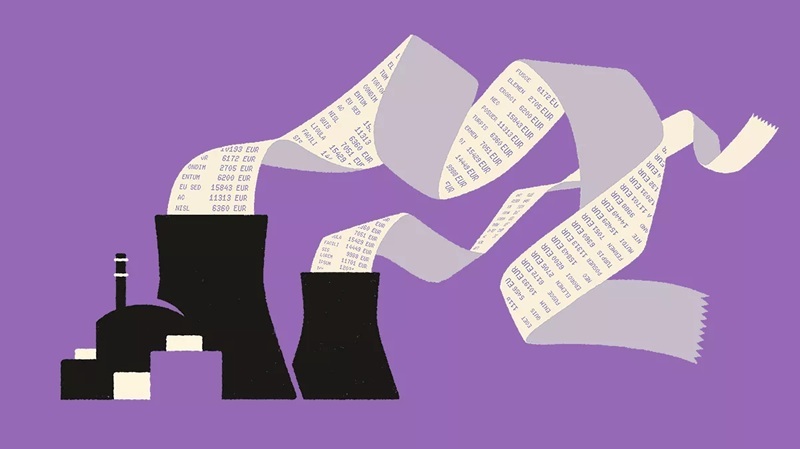
While the new multi-year energy program favors nuclear power, our investigation reveals that the final bill for the EPR2 reactor program could reach nearly 250 billion euros.
“EDF presents its provisional estimate for the EPR2 program at 72.8 billion euros,” read a press release from the group on December 18 .
The final cost estimate for the construction of the first series of six French -made nuclear reactors at the Penly (Seine-Maritime), Gravelines (Nord), and Bugey (Ain) sites, of the EPR2 type (approximately 1,650 megawatts of power), is expected this spring. EDF and its shareholder, the French State, hope for a final investment decision by the end of the year.
German Chancellor Friedrich Merz has initiated talks with France on strengthening Europe’s nuclear deterrent as he urged the continent to bolster its defences and “repair” strained relations with the US. The discussions, centred on the possibility of Germany joining France’s nuclear umbrella, underline mounting anxiety in Europe over an expected reduction in the US military presence on the continent, as Russia’s full-scale war on Ukraine enters its fifth year.
The most sinister revelation from the article is that NATO’s Secretary-General maintains a “highly classified” contingency plan which allows giving the NATO Supreme Allied Commander broad emergency authority to unilaterally move forces around without a vote of the members:
The Munich Security Conference has kicked off, and not surprisingly the Brussels nomenklatura and its attendant apparatchiks and media flacks are pushing war hysteria. The purpose of this is to make the Ukrainian conflict feel existential to Europeans to jawbone them into parting with their dwindling eurobucks for the sake of bleeding Russia as much as possible.
BRUSSELS — Western countries increasingly believe the world is heading toward a global war, according to results from The POLITICO Poll that detail mounting public alarm about the risk and cost of a new era of conflict.
But while Politico smugly celebrates the convection toward war, the rag laments the unwillingness of the drowning masses to destroy what remains of their serfhood for the sake of funding these cabal-provoked wars:
But The POLITICO Poll also revealed limited willingness among the Western public to make sacrifices to pay for more military spending. While there is widespread support for increasing defense budgets in principle across the U.K., France, Germany and Canada, that support fell sharply when people learned it might mean taking on more government debt, cutting other services or raising taxes.
This leaves European leaders “in a bind”:
So European leaders are left in a bind — unable to rely on the U.S., unable to use that as a reason to invest domestically, and under higher pressure to urgently solve this for a world where conflict feels closer than before.”
Well, the conflict “feels” closer than before only because the European sock-puppet leaders are pushing it there themselves, every day, more and more aggressively.
Most concerning for the elites is that support for militarization is on a down-trend heading out of 2025:
The elites are in panic over how to convince their populaces to fan the flames of war ever higher. They are distraught that the peons are overly concerned with selfish pursuits like self-preservation, sustenance, taking care of their families, paying their mortgages, etc. Conclaves like the Munich Conference are meant to stoke debate over precisely how to more effectively connive the masses sell the necessity of war to the public; the going concensus seems to be to just pile on more hysteria, fake lies about the Russian threat, etc. It’s a reliable standby.
This was supported by fiery calls-to-arms from Ukrainian frontliners:
“You [Europe] need to prepare yourselves before war comes to you. And in this, we Ukrainians are your best partners, because we already live in the future of war” – Oleksandr Falshtynskyi, Chief of Medical Service of the 7th Rapid Response Corps of the Ukrainian Air Assault Forces, during Ukraine House at the Munich Security Conference.
He warns Europe to be ready for the coming war—but is Europe ready? Two recent simulations have shown that to woefully not be the case.
In the first, WSJ reports a single Ukrainian team of 10 drone operators was able to eliminate “two NATO battalions” in a single day without any losses:
Overall, the results were “horrible” for NATO forces, says Mr. Hanniotti, who now works in the private sector as an unmanned systems expert. The adversary forces were “able to eliminate two battalions in a day,” so that “in an exercise sense, basically, they were not able to fight anymore after that.” The NATO side “didn’t even get our drone teams.”
Multiple concurrent Wall Street Journal articles push war hysteria—it must be good for stock prices!
In the article, Germany’s “top military officer” General Carsten Breuer states explicitly that Russia will be ready to wage war on Europe in three years:
Breuer is racing to prepare Germany’s armed forces for war. And for the 61-year-old veteran of conflicts from Kosovo to Afghanistan, the clock is ticking.
Germany’s military-intelligence agency estimates that within the next three years, Russia, whose armies poured into Ukraine in 2022, will have amassed enough weaponry and trained enough troops to be able to start a wider war across Europe. Breuer says a smaller attack could come at any time.
“We have to be ready,” he says.
Besides the obvious fear-mongering, this does appear to indirectly confirm our thesis that Russia is building a large rear reserve force if NATO ‘intelligence’ continues to surmise that Russia “will have amassed enough weaponry and trained […] troops” for WWIII in three years’ time. Clearly, there is a surplus of force regeneration, which flies in the face of the contradictory narrative we’re fed daily that Russia’s losses are now vastly outpacing its recruitment. If that was the case, how could Russia possibly be building a force capable of tackling Europe so soon?
This quote from the article is just rich:
To that end, Breuer has been waging a multi-front campaign to rally Germany’s politicians, business people, soldiers and the general public behind efforts to speed the nation’s rearmament and persuade them that they must be prepared to fight Russia to preserve their democratic freedoms.
So, stoking WWIII to destroy Russia now retreads the same old phony and fatuous “freedums and liburty” ignis fatuus used by neocons time and again since the Iraq war days. Funny, given that it’s Germany now suffering from totalitarian restrictions on their so-called freedoms.
But while the article boasts of Germany raising its commitment level to provoke WWIII by stationing troops in Lithuania, the reality seems to be a bit different. Spiegel reports that Germany is in fact struggling to even find enough recruits to fill the brigade meant for the task:










 nuclear-news