Sizewell C nuclear project no longer viable, with new developments in cheaper wind power- energy expert
Nuclear power has become “outdated by technology” and offshore wind can
produce power more quickly and cheaply, an energy scientist told the BBC.
Professor in energy and climate change Charlie Wilson said there was no
longer a good case for a new £20bn Sizewell C plant on the Suffolk coast.
He said new ways to store wind turbine energy meant supplies could be
maintained even in low winds.
EDF, the firm behind Sizewell C, said nuclearwas key for UK energy needs.
The government said nuclear was vital for the
“UK’s low-carbon energy future”. Prof Wilson, of the the Norwich-based
Tyndall Centre for Climate Change Research at the University of East
Anglia, said nuclear power cost twice as much as wind power. Electricity
generated by wind turbines costs about £40 per megawatt hour, compared to
£92.50 which is the projected cost of the latest nuclear plant being built
at Hinkley Point C in Somerset, he added.
He said in the past nuclear power
was seen as key because in any weather it provides the same baseload power
– baseload refers to the minimum amount of electric power needed to be
supplied to the electrical grid at any given time. “The view in the
1970s-1990s was that you needed this large firm baseload power generation
like nuclear,” he said.
“The game-changing technologies around storage and
flexibility mean intermittent renewables – like large offshore wind farms –
are now viable as a reliable generation source.
BBC 25th Sept 2021
Far from being the solution to climate change, nuclear power will be a victim of global heating
Rae Street: Given the discussion at TUC Congress of a new generation of
nuclear plants, it is worth looking at the case against nuclear energy.
First, the question of climate change, where the proponents of nuclear
power say nuclear energy is “vital.”
According to Andrew Blowers, emeritus professor of social sciences at the Open University: “Far from
being a solution to the problem of climate change, new nuclear power
stations like Sizewell C and Bradwell B on the fragile and vulnerable east
coast, are likely to become victims of the inevitable, imminent and
irreversible consequences of global warming.” He continued:
“Put simply, there is little justification for these huge structures in terms of
need. But, regardless of need, given the threat to the integrity of the
sites and the risks to present and future generations and environments, the
proposals should be scrapped forthwith.”
Morning Star 23rd Sept 2021
https://www.morningstaronline.co.uk/article/f/the-fallacy-of-trusting-in-nuclear-power
Nuclear power for UK – slow, dangerous, exorbitantly expensive and useless to counter climate change.
An anti-nuclear group has blasted the UK Government for having talks on building another large-scale multi-billion pound nuclear power plant in Wales. Dylan Morgan, Co-ordinator for PAWB, has reacted furiously to the discussions with US reactor manufacturer Westinghouse to build a new
facility on Anglesey.
The UK Government say that the move is part of an effort to reduce the UK’s carbon emissions to net zero by 2050, but according to Morgan it isn’t an effective way to “counter climate change”. He argues that nuclear power is “slow, dangerous and extortionately expensive”.
According to the UK Government, a new nuclear power plant at the decommissioned Wylfa site could become operational in the mid-2030s and generate power for six million homes. Dylan Morgan said:
“We have an immediate crisis now. Building huge reactors at a nuclear power station take at least 15 years. “For example, EdF are involved in building their EPR at Olkiluoto in Finland. Comstruction started in 2005 with the boast it would be completed by 2009. “It still hasn’t been completed in 2021. Nuclear power is slow, dangerous and extortionately expensive. It will do nothing to address the current energy crisis, neither will it be effective to counter climate change.
Nation Cymru 24th Sept 2021
UK should think twice before ousting Chinese company from its nuclear project
 |
UK should think twice before ousting Chinese company from its nuclear project By Global Times Published: Sep 26, 2021 The UK government is reportedly closing in on a deal that could kick China’s nuclear power giant General Nuclear Power Group (CGN) out of the £20 billion ($27 billion) Sizewell C nuclear power project on so-called security grounds.
London may announce a decision ahead of next month’s spending review and the UN climate change conference in Glasgow in November, but it remains unclear how the Chinese company will be frozen out of Sizewell C, according to UK media outlet Daily Mail.
Whether related reports are complete and accurately reflect the position of the UK government is not known yet. There was similar speculation by the UK media in July, but, if the alleged decision is confirmed by Johnson’s government, it will have adverse impact on the UK. For starters, it will leave the UK a huge financial gap which has to be plugged by pension funds. CGN has a 20 percent stake in the Sizewell C project and an option to retain that share of the nuclear project once it is built. If CGN is forced to pull out from the project, the UK side needs to figure out options to fill up the multi-billion pound funding hole. The Daily Mail reported that the Treasury Department is examining plans to use pension funds to plug the gap for Sizewell C.
Second, it risks further ratcheting up geopolitical tensions, which are already running high after London’s decision to join the AUKUS pact with the US and Australia. ………
Third, it will delay construction of the UK nuclear power stations, ………. British companies will face Chinese company’s demand for economic compensation. …………… https://www.globaltimes.cn/page/202109/1235101.shtml
25 September Protest against UK university’s Nuclear Futures Institute, as nuclear suffers a new setback

DANGER – NUCLEAR COLLEGE! News / By Stop Wylfa 23 Sep 21,
Members and supporters will meet at Bangor Town Clock on the High Street at 1.45 Saturday afternoon, September 25 before moving ahead to Pontio to hold an artistic and symbolic protest against Bangor University’s Nuclear Futures Institute.
Nuclear power’s crebibility has suffered another setback this week from the direction of the first chairman of the Climate Change Committee, Lord Turner. A prominent businessman and ex-chairman of the Financial Services Authority and the Pensions Commission, Lord Turner said he has changed his mind about nuclear power, saying it is no longer needed.
Today, Thursday Serptember 23, the Ser Cymru professor for Nuclear Policy and Regulation at Bangor University, Laurence Williams OBE will present evidence to the Welsh Affairs Committee at Westminster regarding the Wylfa site alongside a number of other individuals who are members of the “nuclear village”. This is a totally onesided and undemocratic session which does not consider any anti-nuclear views. The Committee should convene another session to include campaigning movements such as PAWB, CND Cymru and Greenpeace. it would also be a simple matter to invite Lord Turner to explain his new position on nuclear power.
Chernobyl’s legacy recorded in trees

Exposure to radiation from the 1986 Chernobyl accident had a lasting negative legacy on the area’s trees, a study has suggested. Researchers said the worst effects were recorded in the “first few years” but surviving trees were left vulnerable to environmental stress, such as drought.
They added that young trees appeared to be particularly affected. Writing in the journal Trees, the team said it was the first study to look at the impact at a landscape scale. “Our field results were consistent with previous findings that were based on much smaller sample sizes,” explained co-author Tim Mousseau from the University of South Carolina, US.
“They are also consistent with the many reports of genetic impacts to these trees,” he told BBC News. “Many of the trees show highly abnormal growth forms reflecting the effects of mutations and cell death resulting from radiation exposure.”
BBC 9th Aug 2021
Chernobyl nuclear zone is becoming more radioactive: they don’t know why.
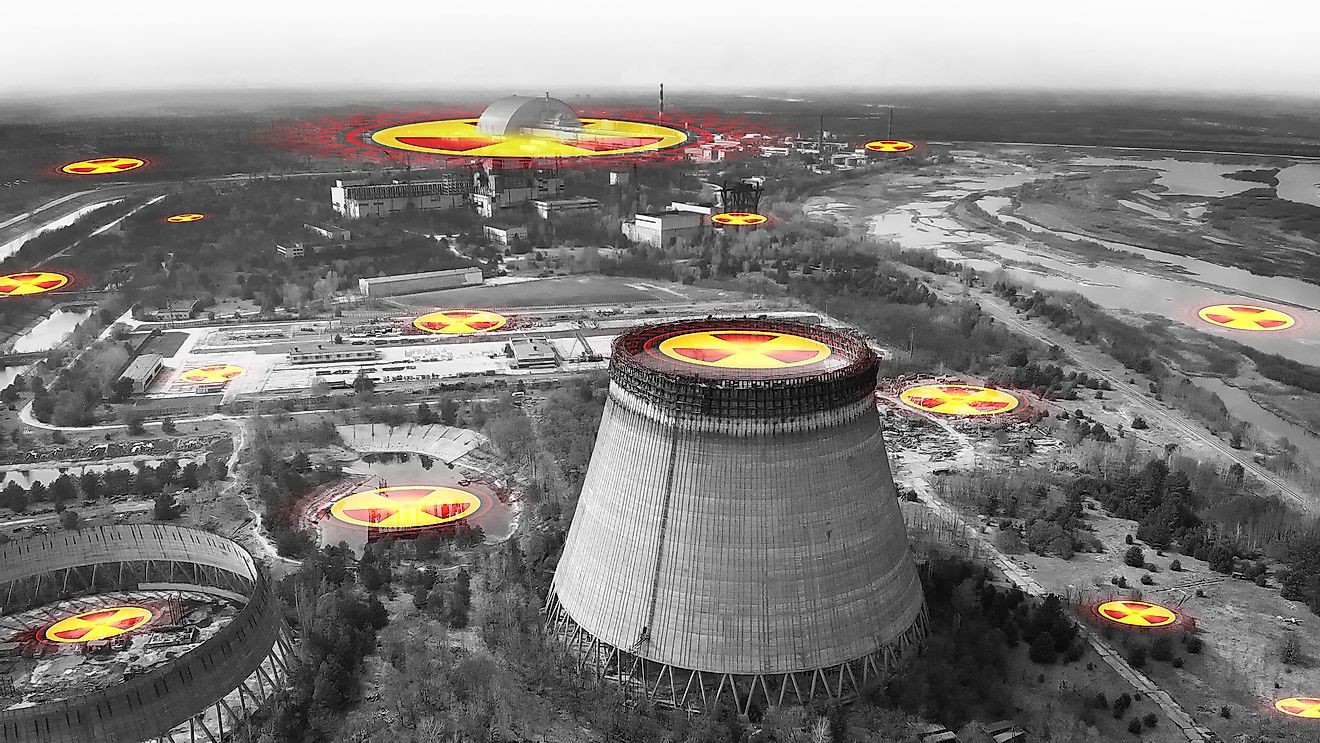
Chernobyl’s Blown Up Reactor 4 Just Woke Up. Scientists don’t understand why. https://historyofyesterday.com/chernobyls-blown-up-reactor-4-just-woke-up-74bedd5fc92d—
Andrei Tapalaga
The nuclear disaster that occurred in 1986 will forever be remembered, but the world will soon have a reminder of the event as the zone for some reason (yet unexplained by scientists)is becoming more radioactive. For those who may not be aware of the incident here is an article to get you up to speed.
“Chernobyl will never be a problem”
Underneath reactor 4 there is still nuclear fuel that is active and which will take around 20,000 years for it to deplete. The uranium is too radioactive for anyone to live in the city and since the incident, the European Union had created a shield around the reactor which should not allow for the radioactive rays to come out.Chernobyl officials presumed any criticality risk would fade when the massive New Safe Confinement (NSC) was slid over the Shelter in November 2016.”
“The €1.5 billion structure was meant to seal off the Shelter so it could be stabilized and eventually dismantled.”
However, many other parts around Chernobyl have also been affected due to prolonged exposure, some more than others, and many of them have not been contained as they were not presenting any major radioactive activity until now. Neil Hyatt, a nuclear chemist from the University of Sheffield had mentioned that there is a possibility for the uranium fuel to reignite on its own.
Hyatt also offered a simple explanation on how this is possible, just like charcoal can reignite in a barbeque, so can nuclear materials that have once been ignited. He as well as a handful of nuclear chemists have mentioned previously the possibility of the uranium from Chernobyl to reignite, but the scientists from Ukraine that are responsible for managing the nuclear activity within the vicinity never really listened, until now.
Scientists from Ukraine have placed many sensors around reactor 4 that constantly monitor the level of radioactivity. Recently those sensors have detected a constant increase in the level of radioactivity. It seems that this radioactivity is coming from an unreachable chamber from underneath reactor 4 that has been blocked since the night of the explosion on the 26th of April, 1986.
What could be causing this?
The experts from Ukraine don’t really understand why this is happening although they do have a hypothesis. Water is used to start the fission process within nuclear materials, this makes the nuclear material release energy that within a nuclear reactor can be maintained under control, but in this instance, the experts are afraid they will not be able to control it.
Another hypothesis is that since reactor 4 has been completely shielded, no water from the rain was able to reach the nuclear fuel. The water from rain may have been what kept the nuclear material under control. With no water, the nuclear fuel may be at risk of overheating, leading to another nuclear disaster.
There may be another reason for this constant increase in radioactivity, what has been mentioned above are only hypotheses, maybe something totally different is occurring under reactor 4 or within the nuclear material left inside. This is something that definitely should ring some alarm bells in order to prepare for the worst sort of situation and hopefully the world’s smartest in the field of nuclear chemistry can come together to identify the problem and come up with a potential solution.
Sources:…………
Aukus: France pulls out of UK defence talks amid row
Aukus: France pulls out of UK defence talks amid row, BBC, By Alex Therrien, 21 Sep 21,
BBC News France’s defence minister has cancelled talks with her UK counterpart as the row continues over a new security deal between Britain, the US and Australia.
Paris is angry after Australia signed the Aukus pact to build nuclear-powered submarines, pulling out of a major contract with France in the process.
UK PM Boris Johnson said France had nothing to worry about from the deal.
But Florence Parly’s meeting with UK Defence Secretary Ben Wallace in London this week has been called off.,,,,,,,,,,, Lord Ricketts, a former British ambassador to France who was due to co-chair the two days of talks, confirmed the meeting between Mr Wallace and Ms Parly had been “postponed to a later date”.
……… In a rare step among allies, French President Emmanuel Macron ordered the recall of the French ambassadors to Washington and Canberra.
The European Union has said it was “analysing” the impact of the Aukus agreement on its trade negotiations with Australia, which are due to resume in October.
BBC Brussels correspondent Jessica Parker said it appeared the EU had hardened up its position over the weekend, as the extent of France’s anger became clear.
She said the European Commission wouldn’t elaborate on what “analysing” the impact of Aukus could actually mean for the trade talks with Australia – but the language might lead to speculation that negotiations could even be suspended…
The agreement means Australia will become just the seventh nation in the world to operate nuclear-powered submarines.
The pact will also see the allies share cyber capabilities, artificial intelligence and other undersea technologies.
But it has been criticised by China, which has accused the three powers of having a “Cold War mentality”…………. https://www.bbc.com/news/uk-58620220
Poland’s nuclear folly.

Government pursues six reactors while blocking opportunities for renewables
Alternatives in the form of citizen energy projects struggle within a capitalistic scheme based on nuclear energy or offshore energy sourcing. Despite the enormous potential of solar and wind energy, the Polish government blocked developing this infrastructure in 2016 – the so-called Distance Act was adopted. The law stipulates that wind turbines with a capacity of more than 40 kW can only be built at a distance of at least 10 times their height (including the rotor with the blades) from residential and mixed-use buildings, as well as areas of high environmental value. In effect, only large, off-shore wind farms can be built on the Baltic sea. There is a hope in increasing interest in solar citizen energy, with the government starting the “My electricity” programme, financing photovoltaic installations.
The European Green Deal is also concerned with energy security and independence. Although it does not include the aspect of nuclear energy in decarbonisation, an official letter to Ursula von der Leyen was recently written as part of an initiative by several countries, including Hungary, Slovakia, Romania, Bulgaria, the Czech Republic, Cyprus, Malta and Poland, to include nuclear and gas in green investments as a strategy for fighting global warming.
In Poland, it is hard to break through to the public discussion with anti-nuclear arguments. The government maintains its willingness to invest in nuclear energy despite its unprofitability, high costs, risks and lack of public support in order to replace coal-fired power plants with nuclear ones.
Few people in Poland are interested in discussing the sourcing of the uranium and connect this problem with energy security. Few people care about radioactive waste. We need more discussions, focusing not only on the costs and time of building a nuclear power plant, but also energy security, the consequences of failure and the non-sustainability of uranium. We need anti-nuclear rhetoric. Will we learn our Chernobyl lessons?
Poland’s nuclear folly, https://beyondnuclearinternational.org/2021/09/20/polands-nuclear-folly/ Refusing to learn the lessons from Chernobyl, Poland embarks on a rash nuclear power program
By Beata Cymerman,
It was April 28, 1986, early morning in Poland. The radiation monitoring station in Mikołajki, Mazury area (north-eastern region of Poland) showed that the radioactivity in the air was 550,000 times higher than the day before. The radioactive cloud from Chernobyl had travelled to Poland. The story of the catastrophe began here.
The Chernobyl disaster in Poland
The government of Poland didn’t immediately release an official statement regarding the catastrophe. Poland was a satellite state of the Soviet Union. After the day of the explosion, April 26, no information was presented by the Polish media. One of the first people informed about the catastrophe was Prof. Jaworowski – Chairman of the Scientific Council of the Central Laboratory for Radiological Protection (CLOR) in Warsaw. He obtained information about the catastrophe from BBC radio and connected it to the unusual measurements from the Mikołajki station.
Together with the President of Polish National Atomic Agency, he set out to monitor the situation. After taking several more measurements on the same day, it became clear that they were dealing with a high radiation risk. Despite the obstacles presented by the Soviet bureaucratic system and with the help of Jaworski’s wife, who was affiliated with the Polish Academy of Science, they managed to directly inform the Prime Minister of their findings.
Continue readingUK’s nuclear industry decline is a permanent process
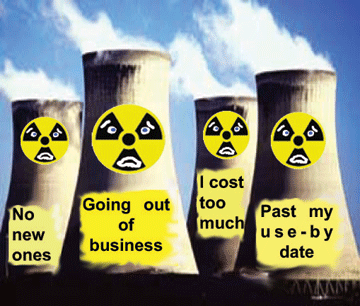
Cash-strapped nuclear industry has no answers to Britain’s energy shortages. While the issues limiting the UK’s nuclear power plant capacity may be temporary, its broader pattern of decline is not. As power
prices spike to record levels this week, one vital corner of Britain’s energy supply is failing to operate at full tilt. A nuclear reactor at Hartlepool has been floundering over an issue with a gas turbine, while another at Heysham 1 is offline after a forced outage last month.
Overall, the capacity of Britain’s ageing nuclear fleet of reactors is down by about one-third (5.2GW compared to 8GW) this week amid planned maintenance and unexpected problems. It is only adding to pressure on officials attempting to balance the electricity system as gas prices soar to record highs on a supply crunch, and wind output drops as weather calms.
But while the issues limiting nuclear power plant capacity may be temporary, its broader pattern of decline is not. The industry, which produces about 18pcof UK power annually, sits at a crossroads amid a rapidly evolving energy system. Most of the ageing nuclear fleet is set to shut down by the end of
the decade and several within the next few years.
Whether and how it will be replaced is uncertain, with industry critics accusing the Government of
dragging its feet at a time when Britain needs low carbon power to fill gaps in wind and solar generation. In a bid to help the flailing sector, ministers are set to bring forward a new finance mechanism which supporters believe can help reduce the costs of large nuclear projects. Consumers
would pay for the projects upfront while they are being built.
This,however, is sure to be a much tougher sell this winter given the soaring wholesale costs likely to boost bills. Whitehall is aiming to bring forward at least one large-scale nuclear project this parliament, and is puttingsome money into developing the next generation of technology: Advanced Modular Reactors and small modular reactors (SMRs).
So, does it matter if more nuclear power is not developed? Many experts say yes, given the stable
role they can provide. But that doesn’t mean it should be at any cost……….
Telegraph 15th Sept 2021
Russia developing more floating nuclear power plants
A Russian plan to build more floating nuclear power plants advanced this
month after two subsidiaries of Rosatom, Russia’s state nuclear
corporation, signed a cooperation agreement to power a remote mining
facility on Siberia’s northeastern tip. The new waterborne facilities
will come on the coattails of the Akademik Lomonosov, the audacious
experiment on floating nuclear power that Rosatom connected to a remote
port in Chukotka in 2019 after spending more than a decade constructing it,
amid objections from environmentalists.
Bellona 17th Sept 2021
Russia advances on plans for new floating nuclear plants
Czech government will subsidise nuclear power
Czech lawmakers approve nuclear support, WNN, 17 September 2021
The Czech Republic’s support framework for nuclear investment has been approved by the lower house of parliament. The Low Carbon Act should come into effect from 1 January 2022, the energy ministry said. “Currently, there are no market incentives for investment in new nuclear or other emission-free energy sources,” noted Tomáš Ehler, the deputy minister of industry and trade, saying, “These market failures have been confirmed by the European Commission itself.”
The new law, approved by large majority in the Chamber of Deputies yesterday, seeks to address this by allowing for a state-owned company to purchase electricity from new nuclear plants at a fixed rate for at least 30 years with the possibility of extension. …. The new law, approved by large majority in the Chamber of Deputies yesterday, seeks to address this by allowing for a state-owned company to purchase electricity from new nuclear plants at a fixed rate for at least 30 years with the possibility of extension. ……. https://www.world-nuclear-news.org/Articles/Czech-lawmakers-approve-nuclear-support
Nuclear submarine deal planned for 18 months – French ambassador says this is treasonous
Recalled French ambassador accuses Australia of ‘treason in the making’ https://www.theage.com.au/politics/federal/recalled-french-ambassador-accuses-australia-of-treason-in-the-making-20210918-p58ssg.html. By Anthony Galloway
France’s recalled ambassador to Australia has likened Canberra’s actions to treason after the Morrison government dumped a $90 billion submarine contract with Paris and instead decided to build nuclear-powered submarines with the United States and Britain.
France on Saturday has taken the extraordinary step of recalling its ambassadors from Australia and the US, as the fallout grows from a new defence pact that has infuriated French President Emmanuel Macron.
Speaking to The Sydney Morning Herald and The Age hours before he was recalled, France’s ambassador to Australia, Jean-Pierre Thebault, did not rule out suspending talks to allow French troops greater access to Australian military bases after his nation was “stabbed in the back”.
Adding insult to the process… we have very reliable reports from the independent press, which I thank, about the fact that all this was in the making for 18 months. Which means we have been blind-sided intentionally for 18 months…. The crime was prepared for 18 months,” he said.
France’s recalled ambassador to Australia has likened Canberra’s actions to treason after the Morrison government dumped a $90 billion submarine contract with Paris and instead decided to build nuclear-powered submarines with the United States and Britain.
France on Saturday has taken the extraordinary step of recalling its ambassadors from Australia and the US, as the fallout grows from a new defence pact that has infuriated French President Emmanuel Macron.
Speaking to The Sydney Morning Herald and The Age hours before he was recalled, France’s ambassador to Australia, Jean-Pierre Thebault, did not rule out suspending talks to allow French troops greater access to Australian military bases after his nation was “stabbed in the back”.
“Adding insult to the process… we have very reliable reports from the independent press, which I thank, about the fact that all this was in the making for 18 months. Which means we have been blind-sided intentionally for 18 months…. The crime was prepared for 18 months,” he said.
He slammed Australia for allowing a meeting to go ahead between Mr Dutton and Foreign Minister Marise Payne late last month with their French counterparts where they spoke about enhancing defence ties between the two countries.
“It is us, through letters that were sent by the President [Macron] some months ago to the Prime Minister [Scott Morrison], who proposed to look at more ambitious and new ambitious cooperations,” Mr Thebault said……….. The extraordinary move follows the Morrison government’s decision to tear up a $90 billion contract to buy 12 French submarines in favour of a new nuclear-powered fleet using technology from the US and United Kingdom under a new partnership called AUKUS.
Russia urges IAEA monitoring, ‘transparency’ on US-Australia nuclear sub pact,
Russia urges IAEA monitoring, ‘transparency’ on US-Australia nuclear sub pact, Press TV, Friday, 17 September 2021 Russia warns against Australia’s attempt to becoming a nuclear power under a trilateral pact Canberra signed with the United States and Britain earlier this week.
Russian Permanent Representative to the International Atomic Energy Agency (IAEA) in Vienna Mikhail Ulyanov said on Friday that “time has not come yet for such estimations” about Australia turning into a nuclear power.
Under a new Australia-UK-US alliance (Aukus), Canberra would be building at least eight nuclear submarines, using US technology.
The first of the submarines is expected to enter service is 2036.
Ulyanov warned that the plan “is alarming and makes you keep a close eye on that.”
“Australia is a non-nuclear power,” he said, adding that “all this should be closely supervised by the IAEA and its inspection mechanism.”……..
Many observers warned that the trilateral pact could lead to a situation very similar to the US-Russian arms race during the cold war…… https://www.presstv.ir/Detail/2021/09/17/666731/Russia-Australia-nuclear-powered-submarines-Aukus-
France angry about nuclear submarine cancelleation – recalls ambassadors to Australia, USA.
France vents subs anger with recall of Australian, US envoys, AFR Hans van Leeuwen, Europe correspondent Sep 18, 2021 –London | France has issued a diplomatic slap in the face to Canberra and Washington, recalling its ambassadors to vent its displeasure at the cancellation of Australia’s $90 billion submarine contract with state-controlled defence company Naval Group.
The move signals a potentially serious rupture in Franco-Australian relations, after Foreign Minister Jean-Yves Le Drian publicly described Australia’s switch to a maritime security pact with the US and Britain as “a stab in the back”.
This exceptional decision is justified by the exceptional gravity of the announcements made on September 15 by Australia and the United States,” Mr Le Drian said in a statement on Friday (Saturday AEST).
“The cancellation of the Attack class submarine program binding Australia and France since 2016, and the announcement of a new partnership with the United States meant to launch studies on a possible future cooperation on nuclear-powered submarines, constitute unacceptable behaviour between allies and partners.”
Mr Le Drian said the “consequences directly affect the vision we have of our alliances, of our partnerships and of the importance of the Indo-Pacific for Europe”………
Although Australia’s French embassy has issued a statement arguing that the decision was made purely on technical grounds, the French government and commentariat has interpreted it as a political decision – and it will potentially rankle for years to come…… https://www.afr.com/world/europe/france-vents-subs-anger-with-recall-of-us-australian-envoys-20210918-p58srz
-
Archives
- October 2026 (112)
- September 2026 (339)
- August 2026 (330)
- July 2026 (355)
- June 2026 (287)
- May 2026 (306)
- April 2026 (356)
- March 2026 (251)
- February 2026 (267)
- January 2026 (308)
- December 2025 (358)
- November 2025 (359)
-
Categories
- 1
- 1 NUCLEAR ISSUES
- business and costs
- climate change
- culture and arts
- ENERGY
- environment
- health
- history
- indigenous issues
- Legal
- marketing of nuclear
- media
- opposition to nuclear
- PERSONAL STORIES
- politics
- politics international
- Religion and ethics
- safety
- secrets,lies and civil liberties
- spinbuster
- technology
- Uranium
- wastes
- weapons and war
- Women
- 2 WORLD
- ACTION
- AFRICA
- Atrocities
- AUSTRALIA
- Christina's notes
- Christina's themes
- culture and arts
- Events
- Fuk 2022
- Fuk 2023
- Fukushima 2017
- Fukushima 2018
- fukushima 2019
- Fukushima 2020
- Fukushima 2021
- general
- global warming
- Humour (God we need it)
- Nuclear
- RARE EARTHS
- Reference
- resources – print
- Resources -audiovicual
- Weekly Newsletter
- World
- World Nuclear
- YouTube
-
RSS
Entries RSS
Comments RSS

