EU to purchase weapons for Ukraine — live updates, DW
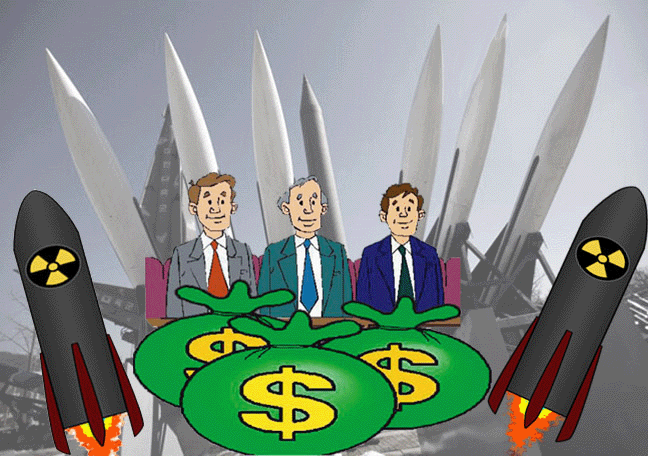
EU to purchase weapons for Ukraine — live updates, DW
The European Union said it will spend €450 million on weapons and equipment for Ukraine. Kyiv and Moscow have sent envoys to peace talks on the Belarus border. DW has the latest.
VSeveral countries have promised to equip Ukrainian soldiers with weapons.
- Putin has ordered nuclear deterrence be put on alert
- Ukraine agrees to talks at the Belarus border
- The EU will buy weapons for Ukraine to fight Russia
- Russians attack a gas pipeline and oil tanks
G7 threatens more sanctions against Russia
The G7 group of top industrialized nations warned Moscow that it could face additional sanctions if the war in Ukraine continues……………………………. https://www.dw.com/en/eu-to-purchase-weapons-for-ukraine-live-updates/a-60931396
Russian control of Chernobyl may have been aimed against alleged Ukrainian plan to produce nuclear weapons.
Russian control of Chernobyl may have been aimed against alleged Ukrainian plan to produce nukes, https://economictimes.indiatimes.com/news/defence/russian-control-of-chernobyl-may-have-been-aimed-against-alleged-ukrainian-plan-to-produce-nukes/articleshow/89836416.cms
Russian control of Chernobyl may have been aimed against alleged Ukrainian plan to produce nukes, By
Dipanjan Roy Chaudhury
Synopsis
Ukraine was allegedly making plans to produce 8-10 nuclear bombs with the available plutonium with support from certain foreign powers, sources indicated to ET. Plutonium-239 is an isotope of plutonium. Plutonium-239 is the primary fissile isotope used for the production of nuclear weapons.
The Russian military reportedly seized control of the Chernobyl nuclear power plant amid apprehensions that Ukraine allegedly backed by foreign powers may have launched the process to build nukes based on Plutonium-239 available in the complex.
Ukraine was allegedly making plans to produce 8-10 nuclear bombs with the available plutonium with support from certain foreign powers, sources indicated to ET. Plutonium-239 is an isotope of plutonium. Plutonium-239 is the primary fissile isotop ..
Russia considered this alleged plan as a threat close to their borders and one of their goals in Ukraine was to nix the plan, claimed one of the above mentioned sources. Ukrainian President Volodymyr Zelensky had said on Thursday that Russian forces are trying to seize control of the Chernobyl Nuclear Power Plant.
The Ukrainian Foreign Ministry tweeted that a Russian attack on Ukraine could “cause another ecological disaster.” “In 1986, the world saw the biggest technological disaster in Chernobyl,” the ministry tweeted. “If Russia continues the war, Chernobyl can happen again in 2022.”
Chernobyl is located on the shortest route from Belarus to Ukrainian capital Kyiv. It may be recalled that the fourth reactor at Chernobyl, 108 km north of the Ukrainian capital Kyiv, exploded in April 1986.
The Budapest Memorandum on Security Assurances refers to three identical political agreements signed at the OSCE conference in Budapest on December 5, 1994 to provide security assurances by its signatories relating to the accession of Belarus, Kazakhstan and Ukraine to the Treaty on the Non-Proliferation of Nuclear Weapons. The memorandum was originally signed by three nuclear powers: the Russian Federation, the United Kingdom and the United States.
The memorandum included security assurances against threats or use of force against the territorial integrity or political independence of Ukraine, Belarus, and Kazakhstan.
As a result, between 1994 and 1996, Belarus, Kazakhstan and Ukraine gave up their nuclear weapons. Until then, Ukraine had the world’s third-largest nuclear weapons stockpile.
On shaky ground? Latest EDF planning application casts doubt on suitability of Sizewell site
The Nuclear Free Local Authorities (NFLA) were surprised to see a late
planning application from nuclear power operator EDF Energy to East Suffolk
Council seeking permission to carry out testing on its proposed Sizewell C
nuclear power plant site.
Commenting, Cllr David Blackburn, Chair of the
NFLA, said: “The application has gone in just as the Planning
Inspectorate is about to make a recommendation to the Secretary of State on
whether to proceed further with the next stage of the development. EDF wish
to be allowed to conduct on-site trials to test whether their construction
methods will work on the land at their disposal. It ‘beggar’s belief’
that they should do this now at such a late stage in the process, rather
than at the start.”
The application concedes that EDF still need to
conduct soil and ground anchor trails to determine if their strategy to
stabilise the site during the construction of the plant will work. The NFLA
fears that the high-risk strategy might make the site unstable and the
cut-off wall could be sent crashing down endangering the lives of
construction workers.
NFLA 26th Feb 2022
Russian troops to take over Zaporizhzhia nuclear power plant

Russian troops are approaching a second nuclear power plant in Ukraine,
after capturing Chernobyl. Ukraine’s interior ministry has said the
invading troops are approaching Zaporizhzhia. Vadym Denysenko, an adviser
in the Ukraine government, said Russian troops have aimed their rockets at
the site. Kremlin troops stormed the site of the Chernobyl nuclear disaster
on the first day of the invasion. Since then excess gamma radiation levels
have been recorded but it is unclear why.
Mirror 26th Feb 2022
https://www.mirror.co.uk/news/world-news/russia-aims-rockets-second-nuclear-26339222
Ukraine’s reactors – largest nuclear complex in Europe – IN DANGER
 | |||

Author Viewsridge/Wikimedia Commons)
Ukraine’s reactors at risk
15 reactors plus Chernobyl in unprecedented warzone situation https://wordpress.com/read/feeds/72759838/posts/3854353677
A statement by Beyond Nuclear. 25 Feb 22,
Beyond Nuclear joins the chorus of voices calling for a peaceful resolution to the conflict in Ukraine, a situation that could become orders of magnitude worse should any of the country’s 15 nuclear reactors suffer major damage due to military exchanges.
We are in an unprecedented situation, with, for the first time, a war happening in a region where there are operating nuclear reactors. This presents an extreme risk to human life unlike any we have seen in previous wars, even when traditional infrastructure has been bombed and destroyed.
The humanitarian tragedy is already enormous, with people fleeing, abandoning homes and businesses, with their lives upended and their safety and survival in jeopardy. However, should a major release of radioactivity occur due to the damage or destruction of any one of the country’s 15 reactors, the scale of the disaster would escalate to unimaginable proportions, affecting populations well beyond the boundaries of Ukraine and Russia.
Military activity around the Chernobyl nuclear site and within the Exclusion Zone is also of great concern. Reports are coming in showing elevated rates of radiation stirred up by the presence of troops, tanks and heavy equipment moving through the highly radioactively contaminated region, which is closed to regular human habitation. In April 2020, when a major wildfire consumed the area, radiation levels rose by 16 times.
The occupation of the site by Russian military personnel, reportedly the result of a firefight at the plant site, is already a concern. This takeover has called a halt to all activities on the site, which houses a significant inventory of radioactive waste.
Any attack or accidental hit on the Chernobyl nuclear site is of even greater alarm. The new protective dome, euphemistically known as the New Safe Confinement building, that encases the exploded Unit 4’s crumbling sarcophagus, is by no means impervious to damage.
Within this dome lie unstable slurries of radioactive liquids, sludges and sands containing uranium, plutonium and other radioactive wastes. As recently as last May, workers detected an unusual rise in neutrons in the wastes lying in the basement of the destroyed Unit 4, raising fears of a chain reaction or even an explosion. War activities in and around the Chernobyl site, therefore, are a reason for high concern.
The six reactor Zaporizhzhia nuclear power plant in eastern Ukraine is of greatest concern, given its size — the largest power plant in Europe — and location. (Photo: Wikimapia)
The ISF2 (Interim Spent Fuel Storage #2 dry cask facility) at Chernobyl is also of serious concern. Its design, construction, management, and operation has been flawed from the start. Orano (formerly Areva) of France was effectively fired for the design and construction flaws. But serious problems have persisted even after Holtec International’s takeover of ISF2 management. An irradiated nuclear fuel fire at ISF2, whether due to intentional attack or unintended accident, could result in catastrophic releases of highly radioactive wastes into the environment over a large region.
The 15 operating reactors — located at Rivne (4), Khmelnitsky (2), South Ukraine (3) and Zaporizhzhia (6) — are all vulnerable to catastrophic meltdown, even if they are not directly attacked or accidentally hit.
As at Fukushima, a loss of offsite power followed by a loss of onsite power could cause the workforce to lose control of the reactor. If cooling is lost, the reactor will heat up, the water level within the reactor core drops and the fuel rods are exposed. Explosive gases are released, as happened at Fukushima-Daiichi in March 2011, where we saw three reactor explosions. Should these gases find a spark, similar explosions could occur at one or more of Ukraine’s reactors.
Of even greater concern are the fuel pools containing the irradiated fuel rods, and unprotected by the containment building. If a fuel pool is hit and either drains down or boils dry, exposing the fuel assemblies, fire is a real risk. Fuel pools contain far more radioactivity than the reactor itself and a fire would release even greater amounts of radiation.
A war zone could also create a dangerous environment for the nuclear workforce and their families, tempting some to evacuate. But a nuclear power plant, even under daily, routine operations, is not walkaway safe and cannot be abandoned. This presents a terrible, and sacrificial choice that should not have to be made.
The situation in Ukraine is unacceptable at a time when humanity should be coming together to take on our collective existential threat — the climate crisis. The situation in Ukraine brings home all too clearly that nuclear power plants are a dangerous liability and certainly not a solution to the climate crisis.
We are thinking of those suffering as a result of this pointless and cruel war, and offer a list of organizations to which humanitarian aid donations can be made to help the innocent victims caught up in this senseless violence.
Russian forces now control Chernobyl, inviting speculation and uncertainty

Russian forces now control Chernobyl, inviting speculation and uncertainty, Bulletin of the Atomic Scientists, By Susan D’Agostino | February 25, 2022 Yesterday, Russian forces seized control of the defunct Chernobyl Nuclear Power Plant, the still-radioactive site of the world’s worst nuclear disaster. The plant, along with the approximately 1,000-square mile radius around it known as the Chernobyl Exclusion Zone, supports ongoing work focused on nuclear waste management and storage…
Though the International Atomic Energy Agency, a United Nations watchdog, reported that there have been “no casualties nor destruction” at Chernobyl, experts and the public are now at work attempting to understand the potential risks posed by the takeover. While some offer measured responses concerning the potential for human and ecological disaster, others express alarm. Many posit theories for why Russia sought to seize control of Chernobyl, including using the site as a base, for a potential act of terrorism, or for the symbolic “win” it may represent.
Igor Konashenkov, a spokesperson for Russian Military of Defense, said in a statement that the Ukrainian staff “continues to service the facilities in a routine mode and monitor the radioactive situation.” Konashenkov did not indicate that Russian soldiers were holding the workers hostage, as Kateryna Pavlova, Chernobyl’s Head of the Department for International Cooperation and Public Relations, told the Bulletin yesterday.
“The most dangerous part is that we lost control,” Pavlova said. “Some part of the staff from Chernobyl Nuclear Power Plant and National Guard have been kidnapped. They can’t connect. They can’t report.”
White House Press Secretary, Jen Psaki, later expressed similar concern: “This unlawful and dangerous hostage-taking, which could upend the routine civil service efforts required to maintain and protect the nuclear waste facilities, is obviously incredibly alarming. We condemn it, and we request their release.”
Expert views of the potential risk have changed since the news broke. For example, yesterday the American Nuclear Society wrote in a tweet that the hostilities in the region “have not resulted in any additional radiological risk.” And Edwin Lyman, director of nuclear power safety at the Union of Concerned Scientists in Washington, said, “I can’t imagine how it would be in Russia’s interest to allow any facilities at Chernobyl to be damaged.”
Yet this morning, the State Nuclear Regulatory Inspectorate of Ukraine reported that radiation levels in the Chernobyl Exclusion Zone were “exceeded at a significant number of observation points” since Russian forces assumed control. The Ukrainian regulatory body attributed the excessive levels to the “disturbance of the top layer of soil from movement of a large number of radio heavy military” and an “increase of air pollution.”
“But now it is currently impossible to establish the reasons for the change in the radiation background in the exclusion zone because of the occupation and military fight in this territory,” the agency’s website said.
A Russian defense ministry official has disputed the claim of excessive radiation levels……..
Chernobyl sits along a short path from the Russia-Ukraine border to Ukraine’s capital. Pavlova, who described the takeover as a “psychological and humanitarian disaster,” notes that Chernobyl’s facilities and location might have been part of the allure. “We have houses where they can stay and leave. It could be their base,” Pavlova said. “It’s very close to Kyiv—only 140 kilometers. The airport is also nearby. It’s a very good location to bring their troops.”
The stricken reactor has been entombed in a sarcophagus—a steel and concrete coffin-like structure—since 1986. In 2016, another structure—known as New Safe Confinement, which is “strong enough to withstand a tornado” and designed to last 100 years, according to the European Bank for Reconstruction and Development—was placed over the sarcophagus. The New Safe Confinement was funded by more than 30 countries at a cost of $1.5 billion.
Still, the Ukrainian Ministry of Foreign Affairs warned that the Russian takeover “may cause another ecological disaster” and that if the war continues, Chernobyl “can happen again in 2022.”
Others were less concerned. “[T]he bigger risk comes from the potential for fighting around Ukraine’s four active nuclear power plants, which contain 15 separate reactors and generated over half the country’s electricity in 2020,” James M. Acton, co-director of the Nuclear Policy Program at the Carnegie Endowment for International Peace, wrote in a post………
Despite divergent early takes on the potential risks of this unfolding situation, Pavlova, who once served as Acting Head of the Chernobyl Exclusion Zone during a time when wildfires were rampant, is alarmed. “Not so many people understand how dangerous nuclear power plants are in the case of war,” Pavlova said. “I want the world to know that we are one little step—a few millimeters—from destroying our world.” https://thebulletin.org/2022/02/russian-forces-now-control-chernobyl-inviting-speculation-and-uncertainty/
The U.K. Wanted to Extradite Assange to the U.S. From the Start

The attempt to extradite Assange to the United States is a clear breakdown of the rule of law, which is continuing in the post-Trump era. The yearn to punish and send a warning to others has been given precedence over human rights, rule of law, and freedom of expression. The persecution must end now.
The U.K. Wanted to Extradite Assange to the U.S. From the Start https://theintercept.com/2022/02/24/julian-assange-extradition-uk-alan-duncan/?fbclid=IwAR0amsrpPJTxuZn_xL12PcO73aDgmjXquIKJvMujvG_m0nDkXY37f5j_7eg
In a 2016 meeting, Britain’s deputy minister of foreign affairs removed the diplomatic mask. Guillaume LongFebruary 25 2022, THE U.K. HIGH COURT ruling that Julian Assange should be extradited to face trial in the United States — a decision that Amnesty International has called a “travesty of justice” — came as no surprise to me. It’s what the U.K. government always wanted. I know because the British deputy minister of foreign affairs told me.
Many pundits and politicians talk of the extradition proceedings against Assange as if they were an unforeseen legal outcome that came about as Assange’s situation unfolded. This is not true. My experience as the foreign minister of Ecuador — the South American country that granted Assange asylum — left me in no doubt that the U.K. wanted Assange’s extradition to the United States from the very beginning.
One encounter I had with Alan Duncan, the former British minister of state for Europe and the Americas, in October 2016 really let the cat out of the bag. At our meeting in the Dominican Republic, Duncan went on extensively about how loathsome Assange was. While I didn’t anticipate Duncan to profess his love for our asylee, I had expected a more professional diplomatic exchange. But the most important moment of the meeting was when I reiterated that Ecuador’s primary fear was the transfer of Assange to the United States, at which point Duncan turned to his staff and exclaimed something very close to, “Yes, well, good idea. How would we go about extraditing him to the Americans?”
His advisers squirmed in embarrassment. They had spent the last four years trying to reassure Ecuador that this was not what the U.K. was after. I responded that this was news indeed. I then wondered whether Duncan left the meeting feeling he had made a mess of it.
I was particularly surprised by Duncan’s candor because my June 2016 meeting with his predecessor, Hugo Swire, in Whitehall, had been quite different. It’s not that Swire wasn’t equally contemptuous of the irritating South American country that had granted Assange asylum; it is more that Swire actually knew the case well.
Swire stuck to the U.K.’s position: Nobody wanted to extradite Assange to the United States. The Ecuadorian government was “deluded” and “paranoid.” This had nothing to do with the issue of freedom of expression or even WikiLeaks. The case was all about accusations in Sweden against Assange. Ecuador should stop protecting a potential sex offender.
Events since have demonstrated that the British argument that Assange was “holed up” in the Ecuadorian Embassy in London to avoid facing sexual assault allegations in Sweden was deceitful. The case was always about Assange’s publishing activities as the head of WikiLeaks. In fact, my government had made it clear to both its British and Swedish counterparts that if Ecuador received guarantees of nonextradition from Sweden to the United States, Ecuador would have no problem with Assange traveling to Sweden to face questioning. Assange himself agreed to this. But Sweden refused to offer such guarantees, which obviously further heightened Ecuador’s suspicions that Assange was being persecuted.
Had Swire been telling the truth, the Swedish prosecutor’s decision not to press charges against Assange in May 2017 would have enabled Assange to walk free from the embassy. The remaining claim that he breached his bail by successfully applying for political asylum should have been easily resolved after the European arrest warrant was dropped. But the U.K. refused to let Assange slip away, and he remained in the Ecuadorian Embassy for two more years before a new Ecuadorian government, heavily leaned on by the Trump administration, consented to having him brutally removed in April 2019.
Maybe it was simply that Duncan’s hatred for Assange, whom he referred to as a “miserable little worm” in Parliament in March 2018, was too pure to be tempered in our meeting. Duncan’s published diaries certainly attest to the fact that Assange’s arrest became an overriding obsession and eventually a personal trophy. When the time came, Duncan watched Assange’s extraction from the embassy — which he refers to as Operation Pelican — on a live feed and later held “drinks in my office for all the Operation Pelican team.”
Duncan’s deeply felt disdain for what he called “the supposed human rights of Julian Assange” are probably part and parcel of his fervent allegiance to the Anglo-American security partnership. Duncan served on the U.K.’s Intelligence and Security Committee in 2015–2016. He is also a member of the secretive, transatlantic organization “Le Cercle,” an ultra conservative think tank with strong links to the intelligence community in Europe and the United States.
We can only speculate whether Duncan’s close relationship with whom he calls his “good friend and Oxford contemporary Ian Burnett,” the Lord Chief Justice who gave the green light to Assange’s extradition, interfered with the judicial process. But the extradition proceedings have been problematic from the beginning. A coalition of major human rights and press freedom organizations — including Human Rights Watch, Reporters Without Borders, and First Look Institute’s Press Freedom Defense Fund — have urged the U.S. Justice Department “to dismiss the indictment of Mr. Assange” on the grounds that it “threatens press freedom” and marks a precedent that “could effectively criminalize … common journalistic practices.” The top editors of the New York Times, Wall Street Journal, USA Today, Washington Post, and others have agreed with these experts.
The attempt to extradite Assange to the United States is a clear breakdown of the rule of law, which is continuing in the post-Trump era. The yearn to punish and send a warning to others has been given precedence over human rights, rule of law, and freedom of expression. The persecution must end now.
UK government study shows that nuclear test veterans were more likely to have cancer and die
More than 20,000 men, many on National Service, were ordered to take part in 45 nuclear weapons tests and 593 radioactive ‘minor trials’ in America, Australia and the South Pacific between 1952 and 1991.They later reported cancer, blood disease, miscarriages for their wives and 10 times the usual rate of birth defects in their children, but the MoD spent millions denying war pensions and compensation, insisting there was no proof.
Nuclear test veterans were more likely to have cancer and die, government study finds, Mirror, By Susie Boniface 25 Feb 2022
A study found out that nuclear test veterans were more likely to die. There are now cross-party calls for a public inquiry and immediate compensation, as well as a medal, Men ordered to take part in Cold War radiation experiments WERE more likely to die, according to a government study which has blown apart 70 years of official denials.
- Nuclear test veterans told to watch atomic blasts then live, eat, and drink amid the fallout have raised rates of multiple cancers, the research has found.They are nearly four times more likely to die from a bone marrow cancer seen in survivors of Hiroshima and Nagasaki, and more likely than other servicemen to take their own lives.The shocking research proves:
- HALF the crew of HMS Diana, ordered twice to sail through fallout in 1956, died from tumours;
- Atomic scientists were SEVEN times more likely to kill themselves;
- RAF decontamination crews were FIVE times more likely to die from leukaemia;
- There were more cancers than deaths, meaning some veterans have fought multiple malignancies;
- And despite Ministry of Defence claims servicemen were well-protected, three-quarters were not checked for radiation, while clean-up workers were both unmonitored, and more likely to die from blood cancer.
- There are now cross-party calls for a public inquiry and immediate compensation, as well as a medal.Mayor of Greater Manchester Andy Burnham said: “This is all the evidence required to seek a formal inquiry into the issues and injustices that more than 20,000 veterans of nuclear testing have faced. It appears to be incontrovertible proof that their service led to serious health issues.“They need recognition and for the government to give them the respect owed to them by acknowledging what they have known for years: they paid a devastating price for their vital role in protecting our country. We are at a critical moment in this journey for justice and we need to see action now.”
- His call for speed was echoed by Tory grandee Sir John Hayes, patron of the British Nuclear Test Veteran Association, who said: “There can be no doubt and no more excuses. Based on these facts, we need to act with no delay to recognise these exceptional veterans’ extraordinary sacrifice.”
- More than 20,000 men, many on National Service, were ordered to take part in 45 nuclear weapons tests and 593 radioactive ‘minor trials’ in America, Australia and the South Pacific between 1952 and 1991.They later reported cancer, blood disease, miscarriages for their wives and 10 times the usual rate of birth defects in their children, but the MoD spent millions denying war pensions and compensation, insisting there was no proof.
The new research comes eight months before the 70th anniversary of Britain’s first nuclear test, Operation Hurricane, on October 3, 1952. It was published without warning on the morning that Russia invaded Ukraine.
It looked at causes of death among 21,357 veterans compared to a control group of servicemen who were not at the tests. It traced only 85 per cent, but found three per cent more veterans had died from cancer and two per cent more veterans died from other causes.
Test veterans were 20 per cent more likely than controls to die from stomach cancer or pleural cancer, 59 per cent more likely to die from skin cancer, and 26 per cent more likely to die from acute lymphatic leukaemia.
- There were 12 per cent more deaths from suicide, and 377 per cent more deaths from chronic myeloid leukaemia.
- CML is caused by genetic mutations in the bone marrow. By-products of nuclear weapons, including plutonium-239 and strontium-90 are considered “bone-seeking” when absorbed by man, and it is known that they can damage DNA.Stuart Ross, whose dad Archie was a RAF corporal at Christmas Island in 1958 and died in 2015 from aggressive leukaemia, said it was time to released the veterans’ military medical records.
- “My dad suffered for years with a layer of skin growing between his eyelid and eyeball, a daughter born with an outsized arm, and a grandson with Down’s syndrome. Then he died within six weeks of being diagnosed with blood cancer,” said Stuart, 57, of Hertford.“I’ve asked for the blood tests dad and many other veterans had taken when he was on the island, and officials tell me they don’t exist. They’re hidden somewhere. The Defence Secretary must order them to be released to the families. We deserve the truth.”The latest research studied an extra 19 years of data, and found higher rates for many types of death than were in three previous studies, first ordered by Margaret Thatcher in 1983.The report’s authors at the UK Health Security Agency warned that the MoD could no longer rely on dodgy dose records from the 1950s, saying that there should be no raised risk of death or cancer if the records “accurately reflect the broad levels of exposure”. They added that risks they found should be expected “if, in fact, doses… had been much larger than recorded”.
- The Mirror has campaigned for justice for the test veterans since the 1980s………….. https://www.mirror.co.uk/news/uk-news/nuclear-test-veterans-were-more-26331008
Increased radiation levels around Chernobyl probably due to military’s disturbance of soil around exclusion zone
Chernobyl radiation levels increase 20-fold after heavy fighting around the facility, Live Science, By Ben Turner 25 Feb 22,
Gamma radiation has increased to 20 times its usual levels in the area. The Chernobyl nuclear power plant and its surrounding area are showing increased radiation levels after heavy fighting between Ukrainian and Russian troops in the region, Ukrainian officials said Friday (Feb. 25).
Online data from the Chernobyl exclusion zone’s automated radiation-monitoring system shows that gamma radiation has increased twenty times above usual levels at multiple observation points, which officials from the Ukrainian nuclear agency attributed to radioactive dust thrown up by the movement of heavy military equipment in the area.
The defunct Chernobyl nuclear power plant has been under occupation by attacking Russian soldiers since Thursday (Feb. 24) after Russian president Vladimir Putin launched a full-scale invasion of Ukraine in the early hours of the morning. Workers at the facility, stationed there to monitor and maintain radiation levels within safe bounds, have been taken hostage by Russian troops, according to Anna Kovalenko, a Ukrainian military expert.
“The station staff is being held hostage. This threatens the security of not only Ukraine but also a significant part of Europe,” Kovalenko wrote on Facebook.
White House press secretary Jen Psaki said in a news briefing on Thursday (Feb. 24) that the Biden administration was “outraged” by reports of Russian troops holding Chernobyl plant staff against their will and demanded their release. She warned that the action “could upend the routine civil service efforts required to maintain and protect the nuclear waste facilities.”
As one of the most radioactive places in the world, large parts of the Chernobyl exclusion zone have been closed off since the disastrous meltdown of Ukraine’s Chernobyl nuclear power plant in 1986. In that year, two enormous explosions inside the plant’s reactor flipped its 2,000-ton (1,800 metric tons) lid like a coin, blanketing the surrounding 1,000-square-mile (2,600 square kilometers) with radioactive dust and reactor chunks. Following evacuation and the dousing of the nuclear fire — which cost many firefighters their lives — the reactor was sealed off and the area deemed uninhabitable by humans for the next 24,000 years.
Heavy fighting around the plant on Thursday (Feb. 24) led to concerns that stray munitions could accidentally pierce the exploded reactor’s two layers of protection — consisting of a new, outer safe-confinement structure and an inner concrete sarcophagus — and release the deadly radioactive fallout trapped inside.
In a contradictory statement, Igor Konashenkov, the spokesman for the Russian Defense Ministry, said that radiation around the plant was within normal levels and that Russian forces were working with the facilities’ staff to ensure the area’s safety……..
The site, which is just 60 miles (97 km) north of the Ukrainian capital Kyiv, lies on a direct invasion route between Kyiv and the Russian forces’ northern entry point to Ukraine at the Belarusian border.
Claire Corkhill, a professor of nuclear material degradation at the University of Sheffield in the U.K., wrote on Twitter that the gamma radiation around the Chernoybl plant “looks to have increased by around 20 times compared with a few days ago.” However, caution should be taken “not to over-interpret at this stage,” she said.
“This appears to be based on a single data point,” Corkhill added in a separate tweet. “What is intriguing is that the level of radiation has increased mostly around the main routes in and out of the Chernobyl exclusion zone, as well as the reactor. This would tend to suggest that increased movement of people or vehicles may have disturbed radioactive dust.”
The highly radioactive fuel inside the Chernobyl reactor is buried deep beneath the defunct plant and is unlikely to be released unless the reactor is directly targeted, Corkhill said……. https://www.livescience.com/chernobyl-radiation-levels-rise-after-fighting
French nuclear regulator halts assembly of huge ITER nuclear fusion reactor
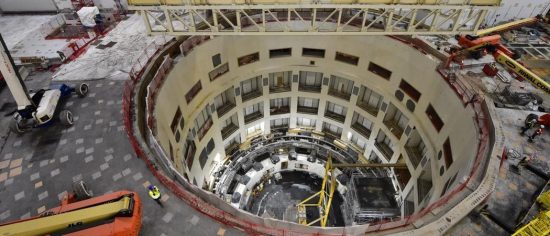
French nuclear regulator halts assembly of huge fusion reactor https://www.science.org/content/article/french-nuclear-regulator-halts-assembly-huge-fusion-reactor
ITER must satisfy safety concerns before welding reactor vessel. 24 FEB 2022, BY DANIEL CLERY France’s nuclear regulator has ordered ITER, an international fusion energy project, to hold off on assembling its gigantic reactor until officials address safety concerns.
This month, the ITER Organization was expecting to get the green light to begin to weld together the 11-meter-tall steel sections that make up the doughnut-shaped reactor, called a tokamak. But on 25 January, France’s Nuclear Safety Authority (ASN) sent a letter ordering a stoppage until ITER can address concerns about neutron radiation, slight distortions in the steel sections, and loads on the concrete slab holding up the reactor. ITER staff say they intend to satisfy ASN by April so they can begin to weld the reactor vessel by July. “We’re working very hard for that,” says ITER Director-General Bernard Bigot.
Radiation levels increased at Chernobyl, after Russian troops seized the area.
Radiation levels have increased at Chernobyl after Russian troops seized
the area yesterday, Ukraine warns. Russian forces took control of the
defunct plant in a ‘fierce’ battle on Thursday. The condition of the plant
was unknown, but sparked fears of a radiation leak. Ukraine’s State Nuclear
Regulatory Inspectorate said Friday that higher gamma radiation levels have
been detected in the Chernobyl zone. Russian officials denied this,
claiming radiation levels at the site were normal.
Daily Mail 25th Feb 2022
France’s nuclear ”energy independence” is a fake, as it has to import all its uranium fuel
As the Ukraine crisis continues to push fuel prices up, France’s
championing of nuclear power as a way of ensuring its energy sovereignty
sounds great.
But a group of researchers says it’s a red herring given
France imports all its uranium. Production of nuclear power relies on
uranium – a metal ore found in rocks, and in seawater, in many parts of
the world. When France first developed nuclear following the 1973 oil
crisis, it produced some of its own uranium – reaching a peak of 2,634
tonnes in 1980.
But by the end of the 1990s, France stopped building new
plants and its last uranium mine was closed in 2001. Of the 138,230 tonnes
of uranium imported between 2005 and 2020 official Euratom data shows three
quarters came from just four countries: Kazakhstan (27,7France has control
over its uranium supplies because they’re not concentrated in one region of
the world according to French nuclear group Orano (formerly Areva).
Morevoer, 44 percent of the uranium comes from OECD countries its director
general Phillipe Knoche said.
But a group of French researchers and
specialists say France’s reliance on imported uranium “poses a serious
challenge to the idea that nuclear power allows France to ensure its energy
independence”. In an open letter published in Le Monde daily on Tuesday
they write: “We are as dependent on foreign countries for uranium as we
are for gas and oil.” “France’s energy independence is a red herring,
it’s utopian,” socio-anthropologist Eric Hahonou, one of the
signatories, told RFI.48 tonnes), Australia (25,804 tonnes), Niger (24,787)
and Uzbekistan (22,197).
RFI 23rd Feb 2022
*
12 nuclear power reactors in France shut down, 6 because of corrosion problems
| EDF CEO Jean-Bernard Lévy announced on Tuesday that a total of 12 nuclear reactors were currently shut down in France, including six linked to a corrosion problem on a safety system. “The last time I looked there were 44 in operation, so there were 12 that were not working,” he told franceinfo in response to a question about the number of reactors in operation in France. the French nuclear fleet. “Of the 12 (shutdown reactors) there were about half, I believe six, which were shut down because we detected, very unexpectedly, a corrosion problem in certain places where we should not not see this corrosion at all, and so we stopped them to examine them, to fully understand what is happening, and then there were six others who are in normal maintenance programs, “explained Jean-Bernard Lévy. Les Echos 23rd Feb 2022https://m.investir.lesechos.fr/actualites/edf-12-reacteurs-a-l-arret-en-raison-de-probleme-de-corrosion-pdg-2004147.html |
Finland’s Russian-backed Fennovoima nuclear power station project now coming to a halt

Finland Signals Russian-Backed Nuclear Project Faces Halt https://www.bloomberg.com/news/articles/2022-02-24/finland-signals-russian-backed-nuclear-project-faces-halt
Finnish minister says construction permit can’t proceed
Government faces legal predicament in shutting down project
By Kati Pohjanpalo, February 25, 2022,
Finland’s Economy Minister Mika Lintila signaled that the Russian-backed nuclear project Fennovoima Oy would not be granted a construction permit in the Nordic country.
“As the presenting minister, a permissioning authority of sorts, I do not see a scenario in which I could present that to the government,” Lintila said in parliament on Thursday following Russia’s attack on Ukraine. About a third of the greenfield Hanhikivi-1 atomic reactor project belongs to Rosatom Corp., the Russian government-owned plant supplier, and a construction permit was expected this year.
The project underscores the Finnish government’s predicament as it seeks to prevent Russia from operating its critical infrastructure without angering the eastern neighbor with which it shares a 1,300-kilometer (800-mile) border. Finland also imports power and gets much of its oil and gas from Russia
Fennovoima had initially been given a green light by the parliament in 2010, when it was led by EON SE. The German utility withdrew from the project in 2012, and in 2013, Rosatom stepped in. Other owners include a plethora of Finnish energy and industrial companies.
In a further complication, the 1,200-megawatt plant’s pressure chamber looks to fall under the scope of sanctions against Russia, as it’s set to be manufactured in the Ukraine separatist region of Donetsk, Lintila said.
Prime Minister Sanna Marin had earlier indicated that the project’s security implications would face a review. Still, any decision to shut down the project would be against the law, Lintila told lawmakers.
“The Russian invasion of Ukraine, and the counter measures by European Union and western countries as a consequence, pose a major risk for the project,” Fennovoima said on its website on Thursday.
-
Archives
- October 2026 (91)
- September 2026 (339)
- August 2026 (330)
- July 2026 (355)
- June 2026 (287)
- May 2026 (306)
- April 2026 (356)
- March 2026 (251)
- February 2026 (267)
- January 2026 (308)
- December 2025 (358)
- November 2025 (359)
-
Categories
- 1
- 1 NUCLEAR ISSUES
- business and costs
- climate change
- culture and arts
- ENERGY
- environment
- health
- history
- indigenous issues
- Legal
- marketing of nuclear
- media
- opposition to nuclear
- PERSONAL STORIES
- politics
- politics international
- Religion and ethics
- safety
- secrets,lies and civil liberties
- spinbuster
- technology
- Uranium
- wastes
- weapons and war
- Women
- 2 WORLD
- ACTION
- AFRICA
- Atrocities
- AUSTRALIA
- Christina's notes
- Christina's themes
- culture and arts
- Events
- Fuk 2022
- Fuk 2023
- Fukushima 2017
- Fukushima 2018
- fukushima 2019
- Fukushima 2020
- Fukushima 2021
- general
- global warming
- Humour (God we need it)
- Nuclear
- RARE EARTHS
- Reference
- resources – print
- Resources -audiovicual
- Weekly Newsletter
- World
- World Nuclear
- YouTube
-
RSS
Entries RSS
Comments RSS

