Cumbrian campaigners’ strong opposition to nuclear waste dump in the Lake District
Campaigners will be holding a demonstration outside the Geological
Disposal Community Partnership “Drop In” at Drigg and Carleton Village
Hall this Friday from 11am to 12pm. Lakes Against Nuclear Dump say “The
Nuclear Industry are looking for somewhere to dump their hot wastes in deep
and not so deep silo’s.
The West Cumbrian Coastal Plain on the edge of
the Lake District is squarely in the frame once again. On Friday we will be
showing opposition to this plan and handing out information exposing the
fact that 16 boreholes 120 metres deep have already been drilled at the Low
Level Waste Repository to look at the possibility of Near Surface Disposal
of Intermediate Level Wastes. The Near Surface Disposal Plan for
Intermediate Level wastes is say the industry being looked at in order to
“co-locate” with the Geological Disposal plan for High Level wastes.
Near Surface Disposal would be delivered far faster – within 10 years
according to the nuclear industry.
Twenty five years ago the rejected plan
for geological disposal was limited to low and intermediate level wastes,
now it is for High Level Nuclear wastes. Its fairly obvious that nuclear
wastes would migrate even faster from a shallower grave. The Community
Partnership is a farce.”
Radiation Free Lakeland 9th March 2022
German government concludes that it is unwise to extend the life of its remaining nuclear power stations
Germany’s government has concluded that prolonging the runtime of its
remaining nuclear power plants is not advisable even in the current energy
crisis sparked by the Russian invasion on Ukraine. “Following a
cost-benefit analysis, a longer runtime for the three remaining nuclear
plants is not advisable even in light of the current gas crisis,” a
report drafted by the two Green Party-led ministries for climate and
economy (BMWK) and for the environment and nuclear safety (BMUV) found.
Extending the remaining plants’ runtime could only make a rather small
contribution to energy security and increase costs elsewhere, the
ministries said. “The state would have to shoulder immense risks. This
would not be appropriate.”
It further found that even if the runtime is
extended, refueling problems would mean the plants could only deliver
additional electricity by autumn 2023. The plants would have to run
somewhere between three and five years longer to make investments in staff
and infrastructure pay off and necessary security checks would further
complicate relying on the nuclear plants as a quick fix. Within that time
frame, “other options will be available to guarantee a secure power
supply despite a shortage of natural gas,” the report said.
Moreover, lawsuits against changes to the current nuclear phase-out plan would likely
be successful, the ministries added.
Clean Energy Wire 8th March 2022
Chernobyl workers still stranded at the power station
More than 210 workers remain trapped at the Chernobyl nuclear power plant
as all its facilities continue to be controlled by the Russian military
troops. The International Atomic Energy Agency (IAEA) said that it has been
informed by Ukraine’s nuclear regulator that the shift of around 210
technical staff and guards has still not been able to rotate as of Monday
7th February. That means that the same staff have been on the site for 12
days.
Energy Live News 8th March 2022
The dangers of uncontrolled releases of the vast amounts of radioactivity contained in the Ukrainian reactors and their unprotected fuel stores should not be underestimated.
CND’s scientific adviser Dr Ian Fairlie writes a guest blog on the
dangers presented by Ukraine’s nuclear power stations: “For many years,
NGOs and nuclear critics have warned that nuclear power stations pose
dangerous threats during wars, as they provide tempting targets for
military attacks.
These concerns were routinely fobbed off by the
government as being unrealistic and unthinkable. But now the unthinkable
has actually happened. On March 3 and 4, Russian troops shelled and
occupied the Zaporizhzhia nuclear power plant in Ukraine.
Apparently,little damage was done to the reactors as, thankfully, radioactivity levels
were not increased. The shelling caused a fire in a nearby administrative
building that was later extinguished. Two people were reported injured.
The dangers of uncontrolled releases of the vast amounts of radioactivity
contained in the Ukrainian reactors and their unprotected fuel stores
should not be underestimated. The explosion and 10-day fire at Chernobyl in
1986 resulted many thousands of cancer deaths and in 42% of the land area
of Western Europe (including most of the UK) being contaminated with
radioactivity. Although Ukraine’s reactors are dissimilar in type to the
RBMK reactors at Chernobyl, this is of little comfort in view of the quite
different threats of indiscriminate shelling, aerial bombardment (including
by nuclear weapons), and sabotage that may occur during the current war in
Ukraine. CND 8th March 2022
Serbia will not join NATO, will never forget bombing victims – president — Anti-bellum
B92March 9, 2022 Vučić in Kuzmin: We won’t join NATO, we want to protect our country on our own The citizens of Kuzmin gathered in large numbers to welcome the President of Serbia and the Serbian Progressive Party, Aleksandar Vučić. *** “We will not join NATO, we want to protect our country and our sky […]
Serbia will not join NATO, will never forget bombing victims – president — Anti-bellum
Russia prepared to stop war, if Ukraine agrees to conditions, including independence of Donbass areas

Russia will stop ‘in a moment’ if Ukraine meets terms – Kremlin, https://www.swissinfo.ch/eng/russia-will-stop–in-a-moment–if-ukraine-meets-terms—kremlin/47409340 Mon, March 7, By Catherine Belton, LONDON (Reuters) -Russia has told Ukraine it is ready to halt military operations “in a moment” if Kyiv meets a list of conditions, the Kremlin spokesman said on Monday.
Dmitry Peskov said Moscow was demanding that Ukraine cease military action, change its constitution to enshrine neutrality, acknowledge Crimea as Russian territory, and recognise the separatist republics of Donetsk and Lugansk as independent states.
It was the most explicit Russian statement so far of the terms it wants to impose on Ukraine to halt what it calls its “special military operation”, now in its 12th day.
Peskov told Reuters in a telephone interview that Ukraine was aware of the conditions. “And they were told that all this can be stopped in a moment.”
There was no immediate reaction from the Ukrainian side.
Russia has attacked Ukraine from the north, east and south, pounding cities including Kyiv, Kharkiv and the port of Mariupol. The invasion launched on Feb. 24, has caused the worst refugee crisis in Europe since World War Two, provoked outrage across the world, and led to heavy sanctions on Moscow.
But the Kremlin spokesman insisted Russia was not seeking to make any further territorial claims on Ukraine and said it was “not true” that it was demanding Kyiv be handed over.
“We really are finishing the demilitarisation of Ukraine. We will finish it. But the main thing is that Ukraine ceases its military action. They should stop their military action and then no one will shoot,” he said.
On the issue of neutrality, Peskov said: “They should make amendments to the constitution according to which Ukraine would reject any aims to enter any bloc.”
He added: “We have also spoken about how they should recognise that Crimea is Russian territory and that they need to recognise that Donetsk and Lugansk are independent states. And that’s it. It will stop in a moment.”
NEW TALKS
The outlining of Russia’s demands came as delegations from Russia and Ukraine prepared to meet on Monday for a third round of talks aimed at ending Russia’s war against Ukraine.
It began soon after Putin recognised two breakaway regions of eastern Ukraine, where Russian-backed separatists have been fighting Ukrainian government forces since 2014, as independent – an action denounced as illegal by the West.
“This is not us seizing Lugansk and Donetsk from Ukraine. Donetsk and Lugansk don’t want to be part of Ukraine. But it doesn’t mean they should be destroyed as a result,” Peskov said.
“For the rest. Ukraine is an independent state that will live as it wants, but under conditions of neutrality.”
He said all the demands have been formulated and handed over during the first two rounds of talks between Russian and Ukrainian delegations, which took place last week.
“We hope that all this will go OK and they will react in a suitable way,” Peskov said.
Russia had been forced into taking decisive actions to force the demilitarisation of Ukraine, he said, rather than just recognising the independence of the breakaway regions.
This was in order to protect the 3 million Russian-speaking population in these republics, who he said were being threatened by 100,000 Ukrainian troops.
“We couldn’t just recognise them. What were we going to do with the 100,000 army that was standing at the border of Donetsk and Lugansk that could attack at any moment. They were being brought U.S. and British weapons all the time,” he said.
In the run-up to the Russian invasion, Ukraine repeatedly and emphatically denied Moscow’s assertions that it was about to mount an offensive to take back the separatist regions by force.
Peskov said the situation in Ukraine had posed a much greater threat to Russia’s security than it had in 2014, when Russia had also amassed 150,000 troops at its border with Ukraine, prompting fears of a Russian invasion, but had limited its action to the annexation of Crimea.
“Since then the situation has worsened for us. In 2014, they began supplying weapons to Ukraine and preparing the army for NATO, bringing it in line with NATO standards,” he said.
“In the end what tipped the balance was the lives of these 3 million people in Donbass. We understood they would be attacked.”
Peskov said Russia had also had to act in the face of the threat it perceived from NATO, saying it was “only a matter of time” before the alliance placed missiles in Ukraine as it had in Poland and Romania.
“We just understood we could not put up with this any more. We had to act,” he said.
(Reporting by Catherine Belton, editing by Mark Trevelyan, Gareth Jones and Angus MacSwan)
Ukraine is a sacrificial pawn on the imperial chessboard.
 | |||


No meaningful diplomatic effort is being made by Washington to end the violence. Ukrainian lives are being spent like pennies to facilitate the agenda of US planetary domination by whipping up international support for the strangulation of Russia while pouring vast fortunes into the military-industrial complex rather than taking even the tiniest step toward de-escalation, diplomacy and detente.
Ukraine Is A Sacrificial Pawn On The Imperial Chessboard, https://caitlinjohnstone.com/2022/03/06/ukraine-is-a-sacrificial-pawn-on-the-imperial-chessboard/ Caitlin Johnstone, The war is not going well for Kyiv, and it would be unreasonable to expect that to change. As a vastly superior military force overwhelms the US client state, reality is in the process of crashing down hard in the face of western liberals who bought into the war propaganda that the brave, sexy comedian was leading an upset victory to kick Putin’s ass out of Ukraine.
Zelensky is now raging at NATO powers for refusing to intervene militarily against Russia, apparently having previously been given the impression that the US-centralized empire might risk its very existence defending its dear friends the Ukrainians from an invasion.
“Unfortunately, today there is a complete impression that it is time to give a funeral repast for something else: security guarantees and promises, determination of alliances, values that seem to be dead for someone,” Zelensky said Friday.
“All the people who will die starting from this day will also die because of you,” Ukraine’s president added. “Because of your weakness, because of your disunity.”
It must be hard, the process of learning that you were never actually a valued partner in western civilization’s fight for freedom and democracy. That you were always just one more sacrificial pawn on the imperial chessboard.
In a new article titled “U.S. and allies quietly prepare for a Ukrainian government-in-exile and a long insurgency“, The Washington Post reports that US officials anticipate Russia will reverse its early losses and successfully drive the Zelensky regime out of the country, after which “a long, bloody insurgency” is planned against the invaders backed by billions of dollars in US funding.
The US has a history of working to draw Moscow into gruelling, costly military quagmires which monopolize its military firepower while leaching it of blood and treasure. Jimmy Carter’s National Security Advisor Zbigniew Brzezinski, author of US hegemonic manifesto The Grand Chessboard: American Primacy and Its Geostrategic Imperatives, openly bragged about having lured Russia into its own Vietnam fighting the US-backed mujahideen in Afghanistan for a decade.
Just two years ago then-US Special Representative for Syria engagement said during a video event hosted by the Hudson Institute that his job was to make Syria “a quagmire for the Russians”.
So this isn’t something new or out of the blue, and what it means is that all the self-righteous posturing by the western political/media class about the need to pour weapons into Ukraine is not really about saving Ukrainian lives (only negotiating a ceasefire can do that), but about seizing this golden opportunity to hurt Russia’s geostrategic interests as much as possible. Ukraine on its own is powerless to stop Russia from taking Kyiv no matter how many weapons are sent, but those weapons can be used to fight a “long, bloody insurgency” after that happens which costs many more lives, keeps Moscow militarily preoccupied and hemorrhaging money, and ultimately hurts Putin’s popularity at home.
This by itself would do a great deal to advance US interests, but on top of that you’ve got the even greater benefit of manufacturing international consent for unprecedented acts of economic warfare against the entire nation of Russia, as well as killing Nord Stream 2 and rallying immense support for NATO and the imperial military/intelligence machine. The western world is now a united front against the Sauron-like menace of Vladimir Putin in much the same way it united against the threat of global terrorism after 9/11, and we’re probably only seeing the beginnings of the agendas this will be used to roll out.
We can expect these agendas to be used in an attempt to impoverish, undermine, agitate, and ultimately collapse and balkanize Russia, as the CIA and Washington swamp monsters have wanted to do since the fall of the Soviet Union.
This would leave China standing alone without its nuclear superpower guard bear and much more vulnerable to imperial operations geared toward thwarting the emergence of a true multipolar world, a goal US imperialists have had in writing for three decades.
That’s a whole lot of potential benefit to the US empire just for losing Ukraine. Kind of like sacrificing a pawn to get the queen in chess.
I think a big part of why I and others wrongly underestimated the likelihood of a full-scale invasion of Ukraine was that the cost-to-benefit math never made sense; on paper Moscow stands so much more to lose by this action in the long term than it stood to gain. There was also a bit of an assumption that the empire would rather Russia not take Ukraine, preferring to gradually encroach with NATO salami slicing tactics than give up a useful client state on Russia’s border, and would adjust its actions accordingly.
But chess is all about out-maneuvering your opponent to leave them nothing but bad options to choose from, and in the end leaving the king with no safe moves. The drivers of empire would have known that, as the late Justin Raimondo explained all the way back in 2014 for Antiwar, Putin could not afford to lose Ukraine to the west without losing crucial support in Russia. Combine that with increased attacks on Donbas separatists and the west’s adamant refusal to make even the most meaningless concessions like guaranteeing they wouldn’t add a nation to NATO who they had no intention of adding anyway, and you can understand if not support Putin’s drastic course of action.
No meaningful diplomatic effort is being made by Washington to end the violence. Ukrainian lives are being spent like pennies to facilitate the agenda of US planetary domination by whipping up international support for the strangulation of Russia while pouring vast fortunes into the military-industrial complex rather than taking even the tiniest step toward de-escalation, diplomacy and detente.
And it’s entirely possible that this was all planned years in advance.
Is it a coincidence that before this started we were bombarded with shrieking anti-Russia narratives for five years, all of which were initiated by secretive and unaccountable intelligence agencies and none of which have ever been substantiated with hard evidence? The discredited conspiracy theories that there was a Kremlin asset in the Oval Office had nothing to do with Ukraine. Neither did the plot hole–riddled and still completely unproven claim that Russian hackers intervened in the US election, or the baseless claim that St Petersburg trolls did the same. Neither did the claim that Russia was paying Taliban-linked fighters to kill US troops in Afghanistan, which was eventually walked back by the same intelligence cartel that made it.
All these hysterical anti-Russia narratives were shoved in everyone’s face day after day, year after year, with nothing really uniting them apart from the fact that they drove up general anxiety about Russia and that they were initiated by the US intelligence cartel. Even the empty Ukrainegate scandal which led to Trump’s unsuccessful impeachment was initiated by a CIA officer who just happened to be in the right place at the right time.
And while all those shrill narratives about a Putin puppet serving as America’s commander-in-chief were being aggressively hammered into public consciousness, Trump’s actual policies toward Moscow were extremely hawkish and aggressive. Beneath the narratives about Kremlin servitude, a new cold war was being dangerously escalated.
And now, lubricated years in advance by these mass-scale anti-Russia narratives, I’ve got western liberals in my social media notifications with blue and yellow profile pictures calling me a Russian propagandist and a Kremlin shill all day, every day. Because of that mass-scale propaganda campaign, we were paced to this point all the way from where we were at a few years ago when Obama was mocking Mitt Romney for his then-outlandish Russia hawkishness.
So we’re looking at increasingly aggressive confrontations between the US power alliance and the China-Russia bloc for the foreseeable future in a struggle which has already erupted in hot war and could easily get infinitely worse. All because a few manipulators in high places convinced the US establishment that global unipolar domination would be a good thing. Many of these unipolarist empire architects were involved in the murderous and influential Project for a New American Century (PNAC), whose founding members are now providing expert punditry on what should be done about the war in Ukraine.
Michael Parenti saw this all coming long ago:
The PNAC plan envisions a strategic confrontation with China, and a still greater permanent military presence in every corner of the world. The objective is not just power for its own sake but power to control the world’s natural resources and markets, power to privatize and deregulate the economies of every nation in the world, and power to hoist upon the backs of peoples everywhere — including North America — the blessings of an untrammeled global “free market.” The end goal is to ensure not merely the supremacy of global capitalism as such, but the supremacy of American global capitalism by preventing the emergence of any other potentially competing superpower.
We should not have to live this way. We should not have to see the horrors of war inflicted upon humanity with the risk of total nuclear annihilation hanging over our heads every minute of every day, all for some dopey grand chessboard maneuverings of a few sociopaths who can’t just let humanity be.
There is no good reason why nations cannot simply collaborate with each other for everyone’s benefit. There is no good reason we should accept these omnicidal games of planetary conquest as inevitable, normal, or fine. If our minds weren’t so pervasively locked down by mass-scale psychological manipulation, there is no way we would stand for this madness.
I don’t know if the US will succeed in this grand strategic confrontation to prevent the rise of a multipolar world. From where I’m sitting it depends on which side of the conflict has more tricks up their sleeve, and that could easily be the emerging China-centralized alliance of which Russia is a key player. But I do think it’s far too early for anyone to declare that the US-led world order is over and a true multipolar world has solidified.
There are many moves on the chessboard still to be played.
Ukrainian military to blow up experimental nuclear reactor at Kharkov Institute
|

[Ed. This may or may not be true. So much distortion, so many lies, on both sides of this war.]
Ukrainian military to blow up experimental nuclear reactor at Kharkov Institute — ministry, https://tass.com/defense/1418059?utm_source=m.facebook.com&utm_medium=referral&utm_campaign=m.facebook.com&utm_referrer=m.facebook.com&fbclid=IwAR1eAxJ5Sa2Zm9gizbshjRjeqzJWDl4SLnpEjstcw_3X5lo0-HLT9l9bK6c
The Russian Defense Ministry noted that “on March 6, foreign journalists arrived in Kharkov to register the consequences of the provocation, followed by accusing Russia of creating an environmental disaster”
MOSCOW, March 7. /TASS/. The Ukrainian Security Forces and the nationalist Azov battalion are planning to blow up a reactor at the National Research Center of the Kharkov Institute of Physics and Technology and accuse the Russian Armed Forces of launching projectiles at an experimental nuclear reactor, says Russia’s Defense Ministry on Monday.
“The Security Forces of Ukraine along with the militants of the Azov battalion are plotting a provocation with possible radioactive contamination of the area near the city of Kharkov. Nationalists mined a reactor at an experimental nuclear system located at the [National Research Center of] Kharkov Institute of Physics and Technology. The Ukrainian military and the Azov battalion militants are planning to blow up the reactor and accuse the Russian Armed Forces of allegedly launching a missile strike on an experimental nuclear system,” the statement says.
The Russian Defense Ministry noted that “on March 6, foreign journalists arrived in Kharkov to register the consequences of the provocation, followed by accusing Russia of creating an environmental disaster.”.
Rosatom’s woes before and beyond the war: implications of Russia’s embattled nuclear industry
Pinar Demircan: Rosatom’s woes before and beyond the war: implications of Russia’s embattled nuclear industry.
Russia had a nuclear waste recycling agreement with Ukraine. According to this arrangement, Ukraine
would send the waste from its 15 nuclear reactors operating within its borders to Russia at the cost of 200 million dollars every year.
However, in 2005, Ukraine’s then Minister of Energy, Yuriy Nedashkovsky concluded a new agreement with the US-based company Holtec to establish a storage facility promising 100 years of protection in the Chernobyl plant site for 250 million dollars, thus, bringing to an end the earlier deal with Russia.
The dry-storage facility, built by Holtec with the financial loan support of the US-based Development Finance Corporation (DFC), which committed to offering protection for a maximum of 100 years, was to be put into operation on November 6, 2021, with trial tests at the end of 16 years.
Although there are currently 4,000 cubic meters of waste, this warehouse is now the key facility where nuclear waste from 15 nuclear reactors, which produce 51 percent of Ukraine’s energy needs, will be stored. Thus, Ukraine was spared from paying $200 million every year to Russia for the
removal of nuclear waste, and had to bear only a one-time expense of 250 million dollars under the new agreement. In other words, with theconstruction of this warehouse by the US corporate, Russia had lost both the supply of nuclear waste for nuclear fuel production and an income of
200 million dollars per year.
Moreover, the Russian-origin nuclear fuelcompany TVEL, which has been operating since 1991, had invested hundreds ofmillions of dollars to produce fuel from nuclear waste and had even starteda new facility in Moscow.
DiaNuke 6th March 2022
The US and NATO’s Sacrifice Of Ukraine
The US and NATO’s Sacrifice Of Ukraine https://www.pressenza.com/2022/03/the-us-and-natos-sacrifice-of-ukraine/ 04.03.22 Mark Lesseraux
THE INCEPTION POINT OF A NEW ERA
We are fast approaching the 33rd anniversary of Mikhail Gorbachev’s decision to untie the Soviet knot that held back the countries of Eastern Europe from moving in an independent, democratic direction. A decision that led to the collapse of the Berlin Wall in November 1989, and, subsequently, to the overturning of the Communist regime in Eastern Europe.
It was a turning point, a hopeful moment, that marked both the beginning of the end of the Cold War conflict and the inception point of a new era of cooperative possibilities between East and West.
THE U.S. AND EUROPE PROMISE TO END NATO EXPANSION
With the breakup of the Soviet Union it became clear to pretty much everyone involved in the diplomatic and political instigation of these major changes, that NATO had become obsolete. Washington and Europe met with Mikhail Gorbachev to create a new security pact that aimed to bring Russia into the cooperative fold. The Reagan administration, along with their West German allies, promised Gorbachev that once German unification was underway NATO would, for certain, cease expanding itself in an eastward direction.
This promise to end the expansion of NATO, which France and Great Britain also agreed to, seemed to signal the onset of a new era of global cooperation. It was agreed then and there by all parties present that a de-escalation of military spending and weapons production was in order now that the Cold War was winding down.
THE PROMISE IS BROKEN
In the years that followed, the war industry completely went back on the aforementioned promises. In fact, a massive eastward expansion of NATO was set in motion along with an unprecedented increase in military spending, weapons production and global weapons sales. NATO added Poland, Hungary, the Czech Republic, Bulgaria, Estonia, Latvia, Lithuania, Romania, Slovakia, Slovenia, Albania, Croatia, Montenegro, and North Macedonia to its fold.
These countries were all forced to restructure and reconfigure their militaries to become compatible with NATO’s military alignment policies. Most of the aforementioned countries achieved this realignment via large loans, creating debt and dependence on corporate lenders.
NO NEW ERA OF COOPERATION
Over the course of the last two-plus decades NATO has become a multi-billion-dollar cash cow for huge corporations that depend on the Cold War for profit. There has been no new era of cooperation with Russia, as promised by all who were involved in setting the new age of supposed partnership in motion. On the contrary, NATO has ignored Russia’s constant warnings and requests to stop its campaign of expansion. Instead NATO, led by the US, has pushed itself right up to Russia’s border, all the while generating a steady stream of new Cold War propaganda, demonizing Russia while proceeding to encircle its territory.
THE SACRIFICE OF UKRAINE
Seven years ago the Obama administration prudently refused to sell arms to Kiev. This act of cautiousness was subsequently cast aside by the Trump and Biden administrations. Over the past several years weapons from the U.S. and Great Britain have been pouring into Ukraine.
By flooding Ukraine with weapons (which is what the US did in the 2008 conflict between Russia and Georgia) over the past few years and refusing Russia’s constant requests that NATO drop its plan to annex Ukraine, an extremely volatile and deeply dangerous situation was created for Ukraine. A situation that has basically amounted to the sacrifice of the people of Ukraine.
NO JUSTIFICATION
There is no justification for the savage actions that Vladimir Putin has undertaken in Ukraine over the past week and a half. Putin is responsible for the bloodshed that he has generated. What this article is pointing to has nothing to do with absolving Putin for the violence in Ukraine. What this article is pointing to is the fact that the US and NATO have been myopic and reckless. What this article is illustrating is that what is going on now in Ukraine is, in part, the result of a thirty-three year history of broken promises and careless, greed propelled decisions made by the US and NATO.
MANY SAW THIS COMING
Over the past three decades, dozens of diplomats and historians have warned that a situation like the one we are seeing now in Ukraine was inevitable if NATO expansion continued. I’m going to end this article here with a quote from George Kennan who was considered by many to be the most respected voice on the matter of US-Soviet relations:
I think it is the beginning of a new cold war. I think the Russians will gradually react quite adversely and it will affect their policies. I think it is a tragic mistake. There was no reason for this whatsoever. No one was threatening anybody else. This expansion would make the founding fathers of this country turn over in their graves. We have signed up to protect a whole series of countries, even though we have neither the resources nor the intention to do so in any serious way. [NATO expansion] was simply a lighthearted action by a Senate that has no real interest in foreign affairs. What bothers me is how superficial and ill-informed the whole Senate debate was. I was particularly bothered by the references to Russia as a country dying to attack Western Europe.
Don’t people understand? Our differences in the Cold War were with the Soviet Communist regime. And now we are turning our backs on the very people who mounted the greatest bloodless revolution in history to remove that Soviet regime. And Russia’s democracy is as far advanced, if not farther, as any of these countries we’ve just signed up to defend from Russia. Of course, there is going to be a bad reaction from Russia, and then [the NATO expanders] will say that we always told you that is how the Russians are — but this is just wrong.”
– George Kennen 1998 Mark Lesseraux
Mark Lesseraux is a singer/songwriter/socio-political columnist from Brooklyn, New York, USA. He is a Humanist, a proponent and practitioner of Active Nonviolence and a student of Nonduality.
The Risks of Russian Attacks near Ukraine Nuclear Power Plants

The Risks of Russian Attacks near Ukraine Nuclear Power Plants, Commercial plants have built-in safety systems, but aren’t designed with warfare in mind. Scientific American By Andrea Thompson on March 4, 2022 People around the world watched via livestreamed security camera as Russian forces attacked and took over Ukraine’s Zaporizhzhia nuclear power plant—the largest in Europe—on Friday morning local time. Amid the shelling and gunfire, a fire broke out at a training facility in the complex and was later extinguished, according to news reports. The incident raised alarm among world leaders and nuclear experts about the potential for purposeful or accidental reactor damage that could cause radiation leaks or, in a worst-case scenario, reactor core meltdowns.
Rafael Grossi, director general of the International Atomic Energy Agency (IAEA), told the United Nations Security Council that the plant’s operations were normal after the attack and has said that no radioactive material was released. But he and other nuclear experts have warned that there is a danger of accidents there and at other nuclear plants in Ukraine as the conflict continues.
Scientific American spoke with Edwin Lyman, director of nuclear power safety at the Union of Concerned Scientists, to explain the concerns about such facilities during wartime and to talk about some of the safety measures that are in place.
The six reactors at Zaporizhzhia are called VVER-1000s, and they are cooled and moderated by light [ordinary] water. So in that respect, they’re similar to U.S. pressurized water reactors. They are somewhat more advanced models than the earlier versions of [this type of reactor], so they do have some features that are more in line with modern safety philosophy—but not entirely. …………
These [Zaporizhzhia reactors] were designed in the Soviet Union, and they date as far back as the early 1980s. So they are past their expiration date, but the Ukrainians extended their licenses………..
The big danger in any nuclear reactor is that somehow cooling of the fuel is disrupted, because without enough cooling, the fuel will heat up to the point where it can destroy itself…… In addition, these plants store their spent nuclear fuel on-site—and some of that fuel is stored in cooling water, which also has to be replenished with pumps………
In addition to a pipe break, you can have a loss of power, which is what affected Fukushima. These plants normally draw electricity from the grid to operate their systems, and if that’s interrupted, they have to rely on backup power with emergency diesel generators. …….
……f you want to potentially seriously damage the plant, you don’t have to go after the containment building, which is the hardest part. There are other systems that are not as well protected. But even those containment buildings are not necessarily able to withstand certain types of military attack. Even if they are not breached, they can spall, and you can have concrete falling down onto the reactor vessel. Or just strong vibrations might also cause damage……….
The cost of hardening commercial nuclear power plants so that they might survive a military onslaught is probably prohibitive……..
In the worst case, if you have an unmitigated loss of cooling capability, the nuclear fuel can overheat and melt and burn through the steel reactor vessel that holds it and drop to the floor of the container. And in that case, the containment is the only remaining barrier between the radioactive material in the reactor and the environment. It’s designed to withstand certain types of events but not others.
……
if multiple reactors are affected at the same time, if the spent fuel is damaged, if the containment is mechanically breached, then all bets are off……
… having well-rested operators is critical because the tasks they have to perform are complex, and they need to be alert. You have to ensure that fatigue is being monitored. If there’s a plant staff, and they’re not getting any relief, and they can’t go home, and they’re working under duress, it’s a dangerous combination. There will have to be measures for that……….. https://www.scientificamerican.com/article/the-risks-of-russian-attacks-near-ukraine-nuclear-power-plants1/
—
Western govt, media, and public, ignorant about the complex history of Ukraine
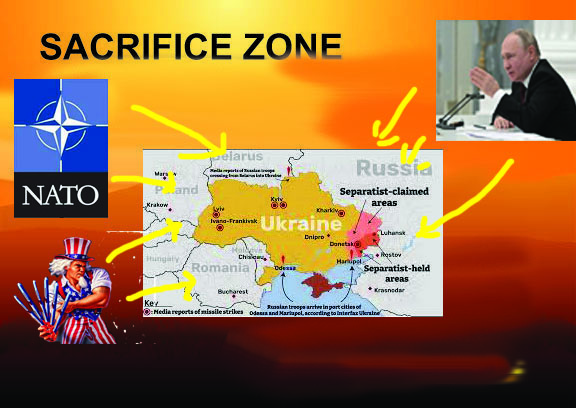
Lenin were he alive today would no doubt point out that Russia today, as well as the U.S., is a capitalist-imperialist country…….. He [Putin] is despicable, but his demand that NATO ceases expansion is as eminently reasonable and Biden’s desire to expand it seems crazier by the day.
Putin, Lenin, Imperialism and the (Real) History of Ukraine, Portside, March 5, 2022 Gary Leupp
— The people of this country suffer, I’ve always thought, from a general ignorance of history. ………
In 2014 having, having given little thought to Ukraine to that point, people in this county (self-defined Americans and others) were informed by the most authoritative sources they knew, the cable TV news anchors and commentators. They were treated to a history lesson that went something like this: The country of Ukraine has always been oppressed by Russia. It was colonized by Russia for centuries. Russia still, after the end of the Soviet Union, wants to control Ukraine! So it responded to a popular revolution in Kyiv, an expression of the Ukrainians’ longing to fulfill its “European aspirations,” by invading Ukraine!
having made its point clear in the brief invasion of Georgia in 2008 (to end talk of Georgian membership), having watched a U.S.-backed coup topple a president friendly to Russia replacing him with a pro-NATO cabal—was re-annexing Crimea (not just Russian from 1783 to 1954, but still Russia’s main naval port, then on lease from Crimea, and coveted by NATO) and supporting separatists in the primarily Russian speaking population in the Donbass region primarily to prevent further NATO expansion……………
In the real world, the U.S. has acted in the world since the collapse of the Soviet Union, the collapse of the Warsaw Pact, the collapse of what Washington perceived as the global communist movement, with an effort to encircle Russia with the most horrifically threatening military force in world history. It has expanded NATO in the absence of any real threat to itself from 16 to 28 members, bordering Russia on the Baltic coast and threatening to encircle it entirely. It has used NATO to pursue wars in Serbia, Afghanistan, Libya, and Syria, in the last case illegally intervening in a failed effort to gain control over a longstanding Russian ally…………
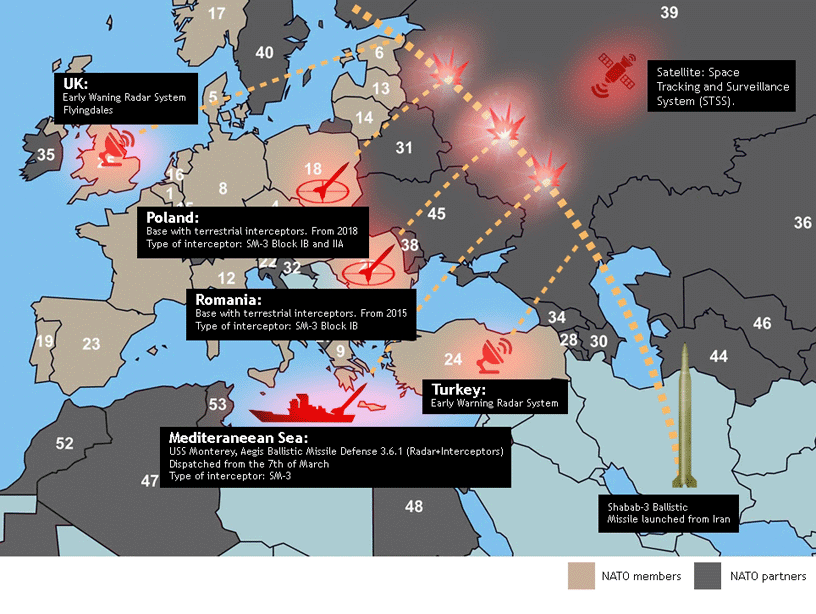
In the real world, Biden became president determined to both reassert U.S. “global leadership” and to continue NATO expansion. His campaign literature in 2020 reminded us that he believed in the cause. And it was clear he had a particular interest in drawing Ukraine in, which meant convincing Germany and other unenthusiastic NATO members to agree that Ukraine had cleaned up its corruption sufficient to get the nod.
He sent his secretary of state Anthony Blinken, who as Biden’s foreign policy advisor had urged him in 2002 to support Bush’s war on Iraq, to persuade the Germans that their gas pipeline to Russia threatened NATO unity! Meanwhile, U.S. puppet and NATO secretary-general Stoltenberg visited Kyiv to assure Ukraine that it will, indeed, be admitted to NATO. And the arms flowed into Ukraine.
Putin considered all this more threatening than ever………… The Russians were talking about their security, and need to defend their borders; the U.S. president was talking about his right to expand the alliance as he pleased.
For the U.S. media, what we see here is a clearly drawn conflict between Good and Evil, or in Blinken’s schoolmarmish conception “Democracy versus Autocracy.” What I see is two evils, neither of them democratic, locked in a conflict over the more powerful evil’s lust for further expansion. Both evils have their controlled news media and means to shape public consciousness.
Ukraine has been inhabited and crisscrossed by Scythians, Celts, Germanic peoples, Huns, Khazars, Mongols as well as Slavs. Given its history of incorporation into different states ………… at least the closest approximation of an independent state so far—was the Ukrainian Soviet Socialist Republic. Russia demanded that Ukraine be considered an independent state on the world stage; it held a separate UN seat. With Belarus it was one of the closest SSRs to Moscow, and most hesitant to withdraw from the union when Boris Yeltsin unilaterally dissolved it by pulling Russia itself out. Once established in its current configuration, Ukraine agreed to abandon its nuclear arsenal; it also agreed to a long-lease arrangement with Russia involving the vital Crimean naval base.
When Putin points to this history or at least aspects of it, he is not churning out lies at the level of the dutiful U.S. ……………
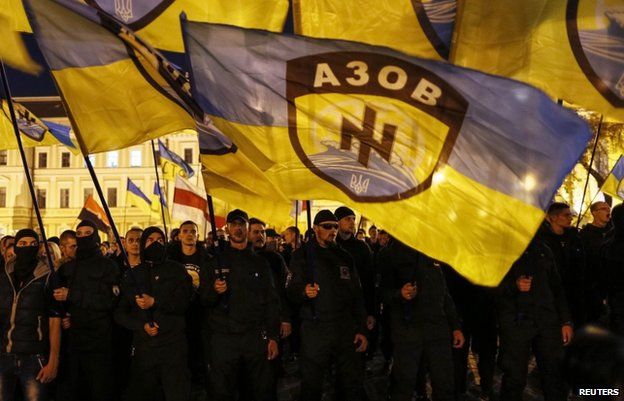
In the real world, Ukrainian fascist movements exist and were surely on display in the Maidan coup in 2014. They played a key role in the violent overthrow of an elected government, under Victoria Nuland’s watchful eye. There remains much support in some quarters for the wartime nationalist leader Stepan Bandera, who espoused a fascist ideology and helped round up Jews in Ukraine for the Nazi death camps. Anyone paying attention realizes that there are fascist elements in the military (the entire Azov Battalion) and that fascist parties, while small and with little electoral influence, have been able to stymie the implementation of the now-defunct Minsk Accords. So, yes, there is a fascist movement in Ukraine and it has a long history……
Crucial battles in this 1941-1945 war, also known as the Anti-Fascist War, were fought on Ukrainian soil, where some local communities sided with the fascists and embraced the Nazis’ Russophobia. Putin wants to essentialize Ukrainians as tending towards fascism, now working in tandem again with Russia’s enemies. This effort could well backfire among Russians who realize that Ukrainians are divided politically and ideologically among themselves and in any case undeserving of Putin’s characterization.
……….. Russians and Ukrainians retained amicable relations; the mere fact of new mutual independence was not a great problem for the relationship. Relations only deteriorated when, from around 2005, Ukrainian leaders requested NATO membership. In 2010 an anti-NATO president was democratically elected; the U.S. State Department oversaw a massive regime change effort to depict him as corrupt, anti-EU, impeding “Ukrainian’s European aspirations.” It succeeded in ousting him….
…….. Lenin were he alive today would no doubt point out that Russia today, as well as the U.S., is a capitalist-imperialist country…….. He [Putin] is despicable, but his demand that NATO ceases expansion is as eminently reasonable and Biden’s desire to expand it seems crazier by the day………………….. https://portside.org/2022-03-05/putin-lenin-imperialism-and-real-history-ukraine
The situation at Zaporizhzhia nuclear power station

information about Zaporizhzhia NPP
https://snriu.gov.ua/en/news/updated-information-about-zaporizhzhia-npp-1500 04 March 22
The largest nuclear power plant in Europe, Zaporizhzhia NPP, was captured by the military troops of the Russian Federation after heavy fighting in the streets of Energodar.
As a result of artillery shelling of the ZNPP industrial site:
– the reactor compartment building of the ZNPP unit 1 was damaged;
– 2 artillery shells hit the area of the dry type spent nuclear fuel storage facility.
The degree of damage to the structures and systems of these nuclear installations and their impact on safety requires additional assessments based on the results of the comprehensive inspections by the special services of the Operating Organization.
The fire, which broke out at night due to the enemy shelling of the ZNPP industrial site, severely damaged the training center building located in the immediate vicinity of the ZNPP industrial site.
Operational personnel, who were on shift at the time of the Russian occupation of the ZNPP site, were forced to continue working at their workplaces for more than 24 hours. There are no killed or injured ones among the ZNPP personnel. Some of the personnel received medical care due to stress.
To date, the rotation of operational personnel has been carried out, it is tentatively planned that the new shift will work until 23:00. Operational personnel monitor the state of power units and ensure their operation. At the same time, the personnel are working under pressure exercised by the armed forces of the Russian Federation, which occupied the ZNPP.
State of the power units:
- Unit 1 is in outage.
- Unit 2 is in operation to ensure the in-house needs.
- Unit 3 has been disconnected from the grid, the core cooldown operations are underway to transfer the nuclear installation into a cold shutdown state.
- Unit 4 is in operation, the electric power was increased up to 825 MW, the unit loading continues.
- Units 5, 6 are being cooled down.
Changes in the radiation situation in Zaporizhzhia region have not been registered, gamma radiation background is within the standard limits.
‘Grave concern’ as Ukraine Zaporizhzhia nuclear plant under Russian orders
Grave concern’ as Ukraine Zaporizhzhia nuclear plant under Russian orders, International Atomic Energy Agency says Russian military orders of staff at nuclear plant violate international safety protocols, Guardian, Julian Borger in WashingtonMon 7 Mar 2022
Staff at Ukraine’s Zaporizhzhia nuclear power plant are being told what to do by the Russian military commander who seized the site last week, in violation of international safety protocols.
The International Atomic Energy Agency (IAEA) expressed “grave concern” at the situation at the six-reactor plant, the largest in Europe. The agency was told by the Ukrainian nuclear regulator that “any action of plant management – including measures related to the technical operation of the six reactor units – requires prior approval by the Russian commander”.
The IAEA director general, Rafael Mariano Grossi, said on Sunday that the Russian military command over the nuclear plant “contravenes one of the seven indispensable pillars of nuclear safety and security” which states that the operating staff must be able to carry out their safety and security duties and be able to make decisions “free of undue pressure”.
Russian forces shelled the Zaporizhzhia plant in the early hours of Friday morning, damaging a walkway between two of the six reactors, and starting a fire in a nearby building used for training. As a result some of the reactors were shut down and others were put on low power.
The reactors themselves are well protected by a thick concrete shell, but there is concern that more vulnerable spent fuel rods could be hit, or that the power and cooling systems could be affected, potentially triggering a meltdown.
The IAEA also expressed concern that the Russian occupying force had reportedly shut down mobile phone networks and the internet connection “so that reliable information from the site cannot be obtained through the normal channels of communication”.
It said communications between the plant and the Ukrainian nuclear regulator have been affected, which the IAEA said contravenes another of the nuclear safety pillars listed by Grossi, requiring “reliable communications with the regulator and others”…….
The IAEA said that the operators at the plant were now being able to rotate between three shifts, relieving the operators who had been on duty at the time the plant was seized, but there were still “problems with availability and supply of food” which the Ukrainian regulator said was affecting morale on the plant.
The IAEA also expressed alarm that communication had been lost with institutions and enterprises in the besieged port city of Mariupol where it said there are “category 1-3 radiation sources, a probable reference to medical or industrial isotopes. A category 1 source can be lethal after more than a few minutes exposure.
“Such radioactive material can cause serious harm to people if not secured and managed properly,” the agency said in a statement.https://www.theguardian.com/world/2022/mar/06/ukraine-zaporizhzhia-nuclear-plant-staff-under-russian-orders
Russian forces approach Ukraine’s second-largest nuclear power plant in Yuzhnoukrainsk
– The US ambassador to the United Nations has warned that the world averted
nuclear catastrophe ‘by the grace of God,’ as troops move closer to the
country’s second-largest nuclear power plant. In a statement given during
an emergency meeting of the UN Security Council following the news that
Russian forces had shelled Europe’s largest nuclear power plant, Linda
Thomas-Greenfield said that troops were ‘now 20 miles, and closing, from
Ukraine’s second-largest nuclear facility,’ the South Ukraine nuclear
power plant in Yuzhnoukrainsk.
Unilad 5th March 2022
-
Archives
- October 2026 (91)
- September 2026 (339)
- August 2026 (330)
- July 2026 (355)
- June 2026 (287)
- May 2026 (306)
- April 2026 (356)
- March 2026 (251)
- February 2026 (267)
- January 2026 (308)
- December 2025 (358)
- November 2025 (359)
-
Categories
- 1
- 1 NUCLEAR ISSUES
- business and costs
- climate change
- culture and arts
- ENERGY
- environment
- health
- history
- indigenous issues
- Legal
- marketing of nuclear
- media
- opposition to nuclear
- PERSONAL STORIES
- politics
- politics international
- Religion and ethics
- safety
- secrets,lies and civil liberties
- spinbuster
- technology
- Uranium
- wastes
- weapons and war
- Women
- 2 WORLD
- ACTION
- AFRICA
- Atrocities
- AUSTRALIA
- Christina's notes
- Christina's themes
- culture and arts
- Events
- Fuk 2022
- Fuk 2023
- Fukushima 2017
- Fukushima 2018
- fukushima 2019
- Fukushima 2020
- Fukushima 2021
- general
- global warming
- Humour (God we need it)
- Nuclear
- RARE EARTHS
- Reference
- resources – print
- Resources -audiovicual
- Weekly Newsletter
- World
- World Nuclear
- YouTube
-
RSS
Entries RSS
Comments RSS

