World’s biggest bunker where billionaires could survive in luxury for 10 years
World’s biggest nuclear bunker where billionaires could survive in luxury for 10 years
The Oppidum is the world’s largest nuclear bunker and is located in a secret location in the Czech Republic where its billionaire owners could live out nuclear armageddon By John James. , 25 MAR 2022
The World’s richest people plan to sit out a nuclear apocalypse in the world’s largest luxury bomb shelter which lies in a secret location in the Czech republic.
Since Russia invaded Ukraine last month, interest in nuclear shelters has skyrocketed spurred on in part by Vladimir Putin’s reckless rhetoric, but the elites of the world have been planning for years.
The Oppidum (which is a fantastically ominous name for a bunker in anyone’s book) is located in a quaint valley in the Czech Republic surrounded by high walls that ensure it can’t be identified by the irradiated masses.
The massive 323,000 square foot structure extends well into the ground and is kitted out with all the luxury items you’d expect including a swimming pool, wine cellar and helipad.
The whole building is fitted with a network of secret tunnels leading to the cavernous vaults beneath the above-ground building so when a bomb hits you can be safely hidden fast.
It was first built during the height of the Cold War as part of combined efforts from the governments of the Soviet Union and what was Czechoslovakia.
Its location is than two hours from both London and Moscow by private jet providing easy access for those in the world’s centre of power – even if they might not see eye to eye when they get there.
The bunker is also self-sufficient and is claimed that residents could survive there for as long as ten years.
…………… While residents stay in the shelter, they are constantly guarded by security who it is claimed have a constant link to the outside world through the Oppidum control centre.
The reality of life after nuclear fallout is that you’re going to be spending a lot of time underground starved of natural light, but the paranoid architects have even thought of this.
A state of the art subterranean garden is included in the bunker which is lit up by simulated natural light.
So far, Zaporizhzhya’s nuclear reactors are being managed safely under Russian control

As Russian military forces shelled the Zaporizhzhya Nuclear Power Plant
(ZNPP) in southern Ukraine on March 4, 2022, a fire broke out on the site.
Among the six reactor units at the complex, auxiliary buildings attached to
the Zaporizhzhya Unit 1 reactor were damaged. Fortunately, the damage did
not threaten the safety of the unit. And a recent assessment by the
International Atomic Energy Agency indicates that, although management of
the plant by a Russian military commander is less than ideal, “regular
staff have continued to operate the Zaporizhzhya [nuclear power plant]”
and “at least 11 representatives of the Russian state [nuclear power]
company Rosatom were also present there, without interfering with the
operation of the nuclear facilities.”
Even so, Russia’s military
attacks on the Zaporizhzhya plant raise great concerns about the
possibility of nuclear accidents. Some experts have suggested the attack on
Zaporizhzhya could have caused a huge catastrophe; others were much more
conservative in their estimates of possible radiation releases from such an
attack. To illustrate the potential damage from a military attack on a
nuclear power plant, we simulated and analyzed hypothetical releases from a
core meltdown and spent fuel pool fire at one unit, Zaporizhzhya 1, if an
attack by missiles or artillery had disabled cooling systems there.
Bulletin of Atomic Scientists 23rd March 2022
Could an attack on Ukrainian nuclear facilities cause a disaster greater than Chernobyl? Possibly, simulations show.
UK does NOT need more nuclear power. Electricity demand has fallen
| Andrew Warren: In seeking justification for “rigging” the UK electricity market in favour of more nuclear power, It is beingcategorically argued that electricity demand is expected to rise over the next decade (“Johnson in ‘gung ho’ push for more nuclear power as energy crisis bites”, Report, March 21). Strangely enough, that was precisely the reason given back in 2006, when the then Labour government first committed to a “family” of further nuclear power stations. Based on the official forecasts issued in 2006, we should by now be consuming at least 15 per cent more electricity than we were then. But we are not. Right now, UK electricity consumption has in fact gone down by over 15 per cent since 2006. In other words, all that expectation of demand growth which was used to justify new nuclear power stations was grossly exaggerated, in practice by over 30 per cent. In the interim, no new nuclear power stations have been added to the system. The system hasn’t collapsed, and it’s also far less carbon intensive. Surely, we aren’t getting fooled again by the same spurious rhetoric about endless consumption growth? In that immortal phrase of the 1970s: “Save it. You know it makes sense”. FT 24th March 2022https://www.ft.com/content/41942796-1da4-469a-af7c-a331673ae494 |
The work of Ukraine-based European Institute of Chernobyl.
Chernobyl nuclear power plant: Worker reveals risk of accident as Russians force staff to do 24-hour shifts , i News, By Isabella Bengoechea March 25, 2022
”………………………………………………i has been working with the European Institute of Chernobyl, a Ukraine-based NGO that focuses on research, popularisation and dissemination of information about the Chernobyl disaster through scientific, educational, social and cultural projects and initiatives, with the aim of preventing new nuclear catastrophes happening in future.
The public organisation, which began its work in 2017, also focuses on protecting the rights and interests of participants in the liquidation of the fallout of the Chernobyl accident, as well as citizens affected by the disaster.
Last April, the group launched an information campaign and programme of events to commemorate the 35th anniversary of the disaster. Partnered with the National Museum of Chernobyl, the International Atomic Energy Agency (IAEA), groups representing liquidators and former Pripyat [abandoned town nearest to the Chernobyl plant] residents, as well as music and art projects.
Valeriy Korshunov, the founder of the Institute, has criticised the International Atomic Energy Agency for what he sees as an insufficiently robust response to Russia’s aggressive actions against Ukraine’s nuclear power plants.
“At the time of the Chernobyl accident there was silence from the Russians, from the Soviet government, they were trying to hide the situation. So in every project about Chernobyl, we’re saying we need to learn the lessons of Chernobyl.
It founded a project in the past year called Help Chernobyl, organising legal benefits, subsidies and medical operations to help the liquidators of the Chernobyl disaster during the Covid-19 pandemic.
Last April, the group launched an information campaign and programme of events to commemorate the 35th anniversary of the disaster. Partnered with the National Museum of Chernobyl, the International Atomic Energy Agency (IAEA), groups representing liquidators and former Pripyat [abandoned town nearest to the Chernobyl plant] residents, as well as music and art projects.
Valeriy Korshunov, the founder of the Institute, has criticised the International Atomic Energy Agency for what he sees as an insufficiently robust response to Russia’s aggressive actions against Ukraine’s nuclear power plants.
“At the time of the Chernobyl accident there was silence from the Russians, from the Soviet government, they were trying to hide the situation. So in every project about Chernobyl, we’re saying we need to learn the lessons of Chernobyl.
“But now we know we haven’t learnt it first time, because we’re seeing similar things now. And Russia and Rosatom are tyring to hide what happened at Chernobyl, what happened at Zaporizhzhya which was shelled and captured by Russia this month.”
“The IAEA must do a lot more in this situation. The shelling of the Zaporizhzhya nuclear power plant is an act of nuclear terrorism. The IAEA need to do something about this but they are silent.”
The State Nuclear Regulatory Inspectorate of Ukraine said this week: “Right now the enemy is trying to seize the Slavutych city and is conducting shelling of the checkpoints. Personnel working at the Chernobyl NPP facilities, as well as at facilities and enterprises located in the Exclusion Zone live in Slavutych.
“The current situation endangers the lives and health of Chernobyl NPP employees and their families, creates significant psychological and moral pressure on operational personnel ensuring nuclear and radiation safety of the Chernobyl NPP facilities, and makes it impossible to ensure the personnel rotation.”
It added: “The information received from the Chornobyl NPP indicates that the operational personnel maintain the safety parameters of the facilities at the NPP site within the standard values. At the same time, the Russian military continue to grossly violate the radiation safety requirements and strict access control procedures at the NPP and in the Exclusion Zone, which leads to deterioration of the radiation situation at the site. https://inews.co.uk/news/inside-chernobyl-nuclear-power-plant-accident-risk-1540986
In UK, some welcome news, in Government support for energy saving

Welcome green tax cuts struggled to counter the sense of a Chancellor that
does not fully understand the scale of the interlocking environmental, cost
of living, and security crises the UK is facing. First, the good news,
because we could certainly do with some. Chancellor Rishi Sunak’s decision
to make the scrapping of VAT on energy-saving materials one of the central
planks of his Spring Statement is hugely welcome news. The fact
energy-saving materials has been defined to include clean technologies such
as solar panels and heat pumps, as well as insulation is similarly welcome.
And the decision to extend this tax cut for at least five years, giving
installers and manufacturers a clear signal that demand is likely to soar
and they should rapidly scale up capacity accordingly, is arguably most
welcome news of all. In addition, the doubling of the support fund for
Local Authorities to £1bn to help households in fuel poverty is also
undoubtedly welcome, even if it smacks a little of providing two buckets,
rather than one, to help tackle a forest fire. There was no grand vision
for driving sustainable growth, insulating the UK from surging global
fossil fuel prices, or helping people manage the transition to a net zero
emission economy. There was little sense of the UK’s place in an
increasingly dangerous world and how it could become a trailblazer for the
shift away from hydrocarbons that can help defang petrostate autocracies.
Most surprisingly of all, there was far too little to help the millions of
households that through no fault of their own are facing the looming shadow
of genuine poverty. It was, just like Sunak’s eve of COP26 Budget, a
significant opportunity missed.
Business Green 23rd March 2022
https://www.businessgreen.com/blog-post/4047134/spring-statement-bad-deeply-worrying
 | ReplyForward |
Welcome green tax cuts struggled to counter the sense of a Chancellor that
does not fully understand the scale of the interlocking environmental, cost
of living, and security crises the UK is facing.
First, the good news,
because we could certainly do with some. Chancellor Rishi Sunak’s decision
to make the scrapping of VAT on energy-saving materials one of the central
planks of his Spring Statement is hugely welcome news.
The fact energy-saving materials has been defined to include clean technologies such
as solar panels and heat pumps, as well as insulation is similarly welcome.
And the decision to extend this tax cut for at least five years, giving
installers and manufacturers a clear signal that demand is likely to soar
and they should rapidly scale up capacity accordingly, is arguably most
welcome news of all.
In addition, the doubling of the support fund for
Local Authorities to £1bn to help households in fuel poverty is also
undoubtedly welcome, even if it smacks a little of providing two buckets,
rather than one, to help tackle a forest fire.
There was no grand vision
for driving sustainable growth, insulating the UK from surging global
fossil fuel prices, or helping people manage the transition to a net zero
emission economy. There was little sense of the UK’s place in an
increasingly dangerous world and how it could become a trailblazer for the
shift away from hydrocarbons that can help defang petrostate autocracies.
Most surprisingly of all, there was far too little to help the millions of
households that through no fault of their own are facing the looming shadow
of genuine poverty. It was, just like Sunak’s eve of COP26 Budget, a
significant opportunity missed.
Business Green 23rd March 2022
https://www.businessgreen.com/blog-post/4047134/spring-statement-bad-deeply-worrying
IAEA concerned that Russia is shelling Ukrainian checkpoints in the city of Slavutych, near Chernobyl
 IAEA concerened that Russia IAEA concerened that Russia |
Ukraine informed the International Atomic Energy Agency (IAEA) today that
Russian forces were shelling Ukrainian checkpoints in the city of Slavutych
where many people working at the nearby Chornobyl Nuclear Power Plant (NPP)
live, putting them at risk and preventing further rotation of personnel to
and from the site, Director General Rafael Mariano Grossi said.
Ukraine’s regulatory authority said the shelling was endangering “the homes and
families of those operational personnel that ensure the nuclear and
radiation safety” of the Chornobyl NPP, which is under the control of
Russian forces since 24 February.
Slavutych is located outside the
Exclusion Zone that was established around the NPP after the 1986 accident.
Director General Grossi expressed concern about this development, which
comes just a few days after technical staff at the Chornobyl NPP were
finally able to rotate and go to their homes in Slavutych and rest after
working for nearly four weeks without a change of shift, and he said the
IAEA would continue to closely monitor the situation. Staff now working at
the site also come from Slavutych.
IAEA 24th March 2022
London. Anti-nuclear campaigners have won a victory for free expression
ANTI-NUCLEAR campaigners have won a victory for free expression after
forcing Transport for London (TfL) to back down from refusing to consider a
peace advert on the network.
TfL initially refused an application from the
Campaign for Nuclear Disarmament (CND) for advertising space across the
capital but has been forced to reconsider following a threat of legal
action by the Public Interest Law Centre.
The application, originally
submitted in 2021, is for an advert showing a nuclear weapon broken in two
by CND’s famous peace symbol. It asks: “Why are we getting more nuclear
weapons when we could be investing in healthcare, renewable energy,
education?”
TfL had ruled the advert could not be carried because it
“promotes a party political cause or electioneering.” Acting for CND,
the law centre argued that the advertisement was not party political and
that TFL’s refusal to carry it was potentially in breach of the right to
free expression under Article 10 of the European Convention on Human
Rights. TfL has acknowledged that the original decision was incorrect, that
the advert was not party political, and have invited CND to resubmit the
advert for consideration.
Morning Star 24th March 2022
https://morningstaronline.co.uk/article/b/anti-nuclear-campaigners-win-victory-for-free-expression
International Atomic Energy Agency’s grave concern over safety of Ukraine’s nuclear reactors
| The International Atomic Energy Agency’s (IAEA’s) Director General Rafael Mariano Grossi has said “we cannot afford to lose any more time” in concluding an agreed framework for ensuring nuclear safety and security in Ukraine. Grossi, who expressed “grave concern” about the situation, has been seeking to secure an agreement with the two sides since meeting the foreign ministers of Russia and Ukraine two weeks ago in Turkey. He said the IAEA “is ready and able to deploy immediately and provide indispensable assistance for ensuring nuclear safety and security in Ukraine”. World Nuclear News 24th March 2022 https://www.world-nuclear-news.org/Articles/IAEA-ready-to-deploy-to-Ukraine-immediately |
No surety that Europe will favour nuclear power, following Ukraine crisis
Will the Ukraine War change Europe’s thinking on nuclear? Energy Monitor
The war is prompting countries like Belgium to delay nuclear phase-outs to be less dependent on Russia, but for countries like Germany, Russia’s missile attacks on nuclear plants reaffirm concerns about safety.
”……………………………………………………….
Changed thinking on nuclear?
Grossi (of IAEA)N says it is too early to know exactly how the Ukraine crisis will impact Europe’s thinking on nuclear power in the long term, although last week’s developments in Belgium and Germany give some clues. “The gas and power price crisis has already lasted for some months now and a lot of governments have in mind that something should be done,” he says. “The current situation isn’t sustainable and solutions have to be found.”
As the energy price crisis has unfolded, fuelled by the economic recovery from the pandemic, its impact is already clear in the outcome of a long-running debate over an EU taxonomy for green investments. In the end, both gas and nuclear were included on the list. It was a demonstrable comeback for nuclear power in Europe after fears that Brexit would tip the balance of opinion against it in the remaining EU 27.
However, when the European Commission came out with its REPowerEU strategy on how to wean the EU off of Russian gas on 8 March, nuclear was strangely absent. The strategy had been in the works since the start of the year as a response to rising energy prices, but it was quickly retooled with a Russia focus following the outbreak of the war.
New nuclear power plants will not solve today’s energy security problems, he [Grossi] acknowledges, because they will take at least ten years to build and come online, but at the very least the Commission should be advising against taking existing plants offline, he says……….
recent decommissionings, coupled with fewer new plants being built as they struggle to attract investment, means the number of nuclear reactors operating globally fell to a 30-year low in 2020, according to the World Nuclear Industry Status Report. A total of 55 new reactors are currently being constructed in 19 countries, but they are almost all outside Europe. China, India and Russia are building the most new plants. The only plants being built in the EU are one in France and one in Slovakia.
The very different reactions in Belgium and Germany this past month show it is hard to predict how the Ukraine crisis will impact European policy on nuclear power. Much may depend on whether the nuclear plants in Ukraine stay safe in the coming weeks and months.
Were any kind of nuclear incident to occur, it would likely be game over for nuclear power in Europe – no matter its climate benefits.
Residents react after huge military convoy spotted travelling through Preston, UK
| Residents react after huge military convoy spotted travelling through Preston. An unmarked military convoy was spotted passing through Preston, sparking lots of speculation about what it was for. Residents reported seeing the convoy travelling along Eastway in Fulwood at around 4.25pm on Wednesday (March 23). Footage of the convoy showed the fleet of dark green military vehicles was escorted by police and fire crews. Lancashire Post 24th March 2022 https://www.lep.co.uk/news/transport/residents-react-after-huge-military-convoy-spotted-travelling-through-preston-3625257 |
Zelensky ready to negotiate with Russia over NATO and Donbas sovereignty, but Biden won’t budge.

There are questions galore. Principally, if it is so easy to work out a compromise over Russia’s legitimate security demands, especially regarding Ukraine’s NATO membership and the alliance’s further expansion, why was Biden so very stubborn in his refusal even to discuss it, given the urgency of the matter?
M K Bhadrakumar-Zelensky rubbishes Biden’s war on Russia, Pearls and Irritations, By P&I Guest Writers, Mar 24, 2022 What was the need for all that happened in the period since mid-December when Russia transmitted to Washington its demands for security guarantees? This question will haunt US President Joe Biden long after he retires from public life.
The foreign-policy legacy of his presidency and the reputation of this much-vaunted 80-year-old politician with a half-century’s record in public life, much of it supposedly in the domain of American foreign policy, are in tatters – irreparable.
News has appeared that Ukrainian President Volodymyr Zelensky has conceded that he is willing to concede to the Russian demand that his country will not seek to become a member of the North Atlantic Treaty Organization.
The announcement came early this week in an interview with ABC News where he revealed that he is no longer pressing for Ukraine’s NATO membership.
In fact, Zelensky let the cat out of the bag by casually adding, “I have cooled down regarding this question a long time ago after we understood that … NATO is not prepared to accept Ukraine.”
Zelensky explained why: “The alliance is afraid of controversial things, and confrontation with Russia.”
This comes after his earlier revelation that he is “open to compromise” on the sovereignty of the two breakaway republics of Lugansk and Donetsk in the eastern Donbas region and on the status of Crimea.
ABC News reportedly telecast the interview on Monday night Eastern Time. Since then, the duo in the Biden team who piloted the Ukraine strategy, those apocalyptic “sanctions from hell” and the demonization of Vladimir Putin through the recent months – Secretary of State Antony Blinken and Undersecretary of State Victoria Nuland – are nowhere to be seen.
That duo of Eastern European descent in the front seat – Blinken driving and Nuland by his side navigating him – ought to offer an explanation for this charade playing out, which is virtually demolishing American prestige as a superpower.
There are questions galore. Principally, if it is so easy to work out a compromise over Russia’s legitimate security demands, especially regarding Ukraine’s NATO membership and the alliance’s further expansion, why was Biden so very stubborn in his refusal even to discuss it, given the urgency of the matter?
Can it be that Biden was acting smart to create a fait accompli for Moscow by formalizing Ukraine’s membership at the forthcoming NATO summit on June 29-30 in Madrid?
What’s the need to destabilize the European economies and rock the world oil market at a juncture when most economies are entering a path of post-pandemic economic recovery?
What explains this unnatural obsession on the part of Biden over Ukraine’s regime?
Why such visceral hatred on Biden’s part toward Russia, something unworthy of an 80-year-old world statesman?
Why is it that the economic war against Russia has become such a very personal affair for Biden, as his White House speech on Tuesday shows?
But such an ignominious end to this entire episode over Ukraine’s NATO membership was entirely to be anticipated. Fundamentally, this is an existential issue for Russia, whereas Biden, Blinken and Nuland are dilettantes sitting 10,000 kilometers away indulging in old neocon pastimes of interfering in other countries’ internal affairs, threatening them, disciplining them or punishing them for defying America’s diktat.
Even after Zelensky spoke, what has been Biden’s reaction? He scheduled a speech to announce that the US shall no longer import oil from Russia. Shouldn’t he have heaved a sigh of relief that this war in Ukraine is petering out?
Instead, he resorted to this strange toothless measure to impress the American audience that he is still on a winning streak promoting democracy in faraway lands. Isn’t such a gimmick an insult to the gullible American public?
Biden took this new step after Europeans told him plainly that they are not interested in such a move against Russia, given their heavy reliance on Russian oil.
Second, Biden doesn’t seem to know, or has pretended otherwise, that America is actually shooting at its own feet. For Russian prices are highly competitive and American companies will now have to pay much more to source heavy-grade oil suitable for their refineries………
Biden claims he is making sure that Putin won’t have money for his “war machine” if America stops buying oil from Russia. This is laughable, bordering on a lie.
The US was purchasing about 12% of Russia’s total oil exports. All right, that’s a decent figure. But it isn’t as if Russia won’t have any other buyers in a world market where the oil price has soared close to US$130 per barrel (thanks to Biden’s “sanctions from hell” against Russia)………..
Fundamentally, the problem is that the American elite is delusional. While the rest of the world knows that in a multipolar world, the United States’ capacity to force its will on other countries is inexorably in decline, the American elite shut their eyes to that reality. The present ridiculous situation was only due to this arrogance and self-deception……..
The strategic defeat that Washington has suffered will dent US prestige worldwide, weaken its trans-Atlantic leadership, unravel its Indo-Pacific strategy, and accelerate the drain of American influence in the 21st century. The Biden presidency will carry this heavy cross.
This article was produced in partnership by Indian Punchline and Globetrotter, which provided it to Asia Times.
M K Bhadrakumar is a former Indian diplomat. Follow him on Twitter at @BhadraPunchline . His diplomatic career included assignments on the territories of the former Soviet Union and to Pakistan, Iran and Afghanistan. Other overseas postings included South Korea, Sri Lanka, Germany, and Turkey. https://johnmenadue.com/m-k-bhadrakumar-zelensky-rubbishes-bidens-war-on-russia/
As UK government touted ”media freedom”, Julian Assange in high security Belmarsh Prison was an embarassment
JULIAN ASSANGE POSED PR PROBLEM FOR UK GOVERNMENT’S MEDIA CAMPAIGN https://declassifieduk.org/julian-assange-posed-pr-problem-for-uk-governments-media-campaign/
UK officials were worried about public reaction to their hosting a media freedom event a few miles from Belmarsh prison, where Assange is incarcerated. The Foreign Office monitored activity online, developed ‘lines to take’ and warned ‘we should be ready’, emails show.
JOHN MCEVOY23 MARCH 2022 The UK’s treatment of Julian Assange posed a public relations problem for the Foreign Office’s media freedom campaign, files seen by Declassified UK show.
In July 2019, the UK co-hosted a Global Conference for Media Freedom, a first-of-its-kind event where 50 countries gathered to form a Media Freedom Coalition.
Costing £2.4 million, the event was hailed as “a major milestone” in the UK government’s “campaign to protect journalists doing their job”.
The conference was held just months after WikiLeaks editor Julian Assange was dragged out of the Ecuadorian embassy in London.
He was transferred to Belmarsh prison, “the closest comparison in the United Kingdom to Guantánamo”, as a UK parliamentary report has described it.
Addressing the media conference, then foreign secretary Jeremy Hunt declared: “If we act together, we can shine a spotlight on abuses and impose a diplomatic price on those who would harm journalists or lock them up for doing their jobs”.
‘We should be ready’
The hosting of a media freedom event within miles of Belmarsh prison in southeast London was seen as a public relations problem. Internal Foreign Office emails show UK officials monitored online behaviour accordingly.
After Hunt announced plans for the conference in February 2019, one official complained about “a few individual crazy responses to the FS’ [Foreign Secretary’s] tweet”.
By June, officials were requesting “Lines to Take on how best to respond to questions we expect to be raised on this occasion about the UK handling of the case of Julian Assange”.
In particular, “Icelandic criticism of UK handling of [the] Assange case” was seen to be “affecting messaging on media freedom”.
This email was likely related to former Icelandic Interior Minister Ögmundur Jónasson, who had asserted in June that the Assange case put “the British justice system…on trial”
On 8 July, two days before the conference began, an unnamed official wrote about “a ramp up in activity by Assange campaigners”.
One cause for concern was Assange’s mother Christine, who had “joined calls for a tweetstorm during the conference”, as well as “accounts [which] are small scale or are run by active trolls and provocateurs”.
The official outlined rules for engagement, noting “our current approach is right and we shouldn’t engage…However, we should be ready. I’m keen that we agree ahead of time how and when our approach would evolve”.
In an email with the subject line “Media Freedom Conference – online register of interest form”, one official even questioned: “what if someone like Assange applied to attend?”
The Foreign Office emails discussing Assange remain heavily redacted for reasons of “national security”.
‘No communications strategy can make this go away’
According to a recent academic study, Julian Assange “was by far the most frequently discussed individual on Twitter” with regards to the Media Freedom Coalition.
“Numerous tweets highlighted the apparent irony that the UK was establishing and leading an international initiative on media freedom, while simultaneously undermining free media…in their handling of Assange”, the researchers found.
Since 2019, the UK has nonetheless continued to use the Global Conference for Media Freedom as a vehicle through which to claim it supports press freedom.
Rebecca Vincent, the Director of International Campaigns for Reporters Without Borders (RSF), commented:
“It is disappointing that rather than looking to address the very serious substantive concerns about the case of Julian Assange, the UK Foreign Office seems to have treated the matter as only a public relations inconvenience as it prepared to host the Global Media Freedom Conference and launch the Media Freedom Coalition.
“But the truth is that no communications strategy can make this go away. As long as Assange remains detained in the UK and as long as the US continues to seek his extradition and prosecution for publishing information in the public interest, this case will serve as a thorn in the sides of both governments and the Media Freedom Coalition itself.”
She added: “They should instead lead by example by dropping the charges, releasing Assange, and putting an end to his persecution once and for all”.
Sceptism over Boris Johnson’s plan for ”Britain carpeted in mini-nukes
Amid this seismic structural shift, it is reassuring to know that our
Prime Minister has lost none of his world-renowned vision. According to
reports, Boris Johnson wants to see Britain carpeted in so many mini-nukes
that he foresees “not quite everyone having their own small modular
reactors in their gardens, but close to it”.
Those were the words of one government aide, who sensibly chose to remain anonymous, following a summit between the Prime Minister and nuclear industry figures on Monday as
ministers ramp up plans for greater domestic production. Like much of what
comes out of Boris’s mouth, it’s genuinely hard to know where to start
with such a statement, other than to say surely he can’t be serious?
New energy schemes are a bit like higher taxes – people are in favour of them
until they are asked to bear the cost. So in a country where an application
for a new conservatory is likely to provoke a flood of letters to the
council from angry neighbours and a lengthy planning row, does anyone
genuinely believe that the average homeowner is going to allow the
Government to build a mini nuclear plant at the bottom of the garden?
It might help produce those elusive prize tomatoes, but the likelihood is
Boris’s nuclear plans will prove too radioactive for Britain’s army of
Nimbys.
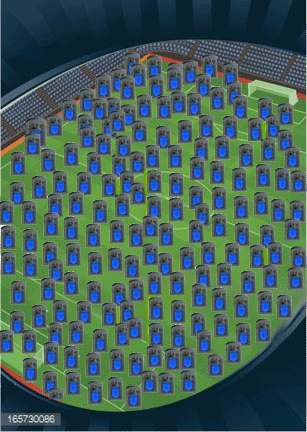
It’s not as if the average small modular reactor (SMR) is
actually that small. Rolls Royce says one of its SMRs will be roughly the
size of two football pitches.
Good luck fitting that into a shed. Like any
major infrastructure project that has Boris’s name on it, it sounds like
it was dreamt up at a No 10 lockdown party. Remember the Garden Bridge,
one of many hare-brained schemes Boris dreamt up as mayor of London? It was
scrapped in 2017 at a cost of £53m.
Reported plans for a fivefold increase
in nuclear capacity by 2050 imply the construction of at least half a dozen
big new nuclear stations in that time, but how exactly? Hinkley C,
Britain’s first new nuclear plant in three decades, will soon be nine
years overdue and £7bn over budget. Toshiba has scrapped plans for a new
plant in Cumbria, Hitachi has mothballed two new plants at Wylfa, Anglesey,
and Oldbury, Gloucestershire, and the future of Sizewell C and Bradwell are
both in doubt because they were too reliant on the Chinese.
Telegraph 23rd March 2022
Some Brits not very impressed with their government’s newbound love affair with nuclear power.
Nuclear energy push is not powered by sense https://www.theguardian.com/environment/2022/mar/23/nuclear-energy-push-is-not-powered-by-sense Readers fail to see the logic behind the government’s drive to go for the nuclear option to generate electricity
There is much about this government’s – and, to its shame, Labour’s – newfound love affair with nuclear power that makes no sense (Johnson announces aim for UK to get 25% of electricity from nuclear power, 21 March).
First, you cannot just turn off a nuclear power station. If we have 25% of our electricity generated by nuclear, then on days when all our needs can be met by renewables we will have to turn off 25% of our much cheaper renewable feed while using expensive, taxpayer-subsidised nuclear generation.
Second, we have no way of dealing with the mountains of dangerous high-level and intermediate-level waste that has been accruing since the 1950s. To generate more is sheer madness.
Third, nuclear power stations are vulnerable to the elements and to hostile attack – cyber, terrorist, state actors etc. Recent events in the Ukraine make this very real.
Fourth, the old argument about what we do when the wind isn’t blowing and the skies are overcast over the whole of the UK, which doesn’t stand up to much scrutiny now, falls away completely if we were to invest just a small amount of the taxpayer money that will go to the nuclear industry into research and development of electricity storage.
Finally, given the nuclear industry’s track record of bringing in plants well over budget, decades late, the proposed programme is not going to be realised until 2060 at the earliest. Why on earth are we contemplating it?
John French
Brockweir, Gloucestershire
Your report states that “electricity demand is expected to rise steadily in the next decade”. The same justification was used in 2006, when the Labour government first committed to further nuclear power stations. Based on the official forecasts issued in 2006, we should by now be consuming at least 15% more electricity than we were then.
But we are not. UK electricity consumption has in practice gone down by more than 15% since 2006. In the interim, no new nuclear power stations have been added to the system. It hasn’t collapsed, and is far less carbon-intensive.
Surely we aren’t getting fooled again by the same spurious rhetoric about endless consumption growth? In that immortal phrase of the 1970s: “Save it. You know it makes sense.”
Andrew Warren
Chairman, British Energy Efficiency Federatio
The dash to fossil fuels is not the environmental disaster set out by António Guterres (Ukraine war threatens global heating goals, warns UN chief, 21 March). It is, at worst, the replacement of existing hydrocarbons purchased from Russia. In the longer term, it is clear that alternative renewable energy sources will displace fossil fuels and most countries will wish to do this as quickly as possible.
he government’s desire, supported by Labour, for increased nuclear power generation is bizarre. A wind turbine capable of producing 15MW can be installed offshore for £10m. Sizewell C is expected to cost £20bn and produce 3.2GW of electricity – this does not include decommissioning costs. To generate 3.2GW would need 214 turbines costing £3.2bn, albeit some money would need to be spent on storage capacity. The government plans to invest £1.7bn in Sizewell C. How is spending more than five times as much on a controversial power source that takes 10 years to build a good idea?
John Blanning
Canterbury
UK Tories split over nuclear power.
Boris Johnson’s energy strategy delayed AGAIN as top Tories ‘split over
nuclear power’. It is the second time the Prime Minister’s much-hyped
long-term energy strategy in the wake of the Ukraine-Russia war has been
delayed. Boris Johnson and Rishi Sunak are thought to be at loggerheads
over investment UK nuclear production. The Government has admitted the
strategy will not be published this week as previously planned.
Mirror 21st March 2022
https://www.mirror.co.uk/news/politics/boris-johnsons-energy-strategy-delayed-26518640
1 This Month





PLEASE OPPOSE HR 8255 AND S.3639 – bills would accelerate satellite deployment, with no environmental review or safeguards – https://ncstd5li.quorum.us/campaign/169331/
To see nuclear-related stories in greater depth and intensity – go to https://nuclearinformation.wordpress.com
-
Archives
- October 2026 (91)
- September 2026 (339)
- August 2026 (330)
- July 2026 (355)
- June 2026 (287)
- May 2026 (306)
- April 2026 (356)
- March 2026 (251)
- February 2026 (267)
- January 2026 (308)
- December 2025 (358)
- November 2025 (359)
-
Categories
- 1
- 1 NUCLEAR ISSUES
- business and costs
- climate change
- culture and arts
- ENERGY
- environment
- health
- history
- indigenous issues
- Legal
- marketing of nuclear
- media
- opposition to nuclear
- PERSONAL STORIES
- politics
- politics international
- Religion and ethics
- safety
- secrets,lies and civil liberties
- spinbuster
- technology
- Uranium
- wastes
- weapons and war
- Women
- 2 WORLD
- ACTION
- AFRICA
- Atrocities
- AUSTRALIA
- Christina's notes
- Christina's themes
- culture and arts
- Events
- Fuk 2022
- Fuk 2023
- Fukushima 2017
- Fukushima 2018
- fukushima 2019
- Fukushima 2020
- Fukushima 2021
- general
- global warming
- Humour (God we need it)
- Nuclear
- RARE EARTHS
- Reference
- resources – print
- Resources -audiovicual
- Weekly Newsletter
- World
- World Nuclear
- YouTube
-
RSS
Entries RSS
Comments RSS

