Despite deteriorating situation, Ukrainian parliament still insisting on NATO accession
RT, https://www.sott.net/article/467169-Despite-deteriorating-situation-Ukrainian-parliament-still-insisting-on-NATO-accession Tue, 26 Apr 2022 The Rada’s chair says accession to the military alliance is Ukraine’s “prospective vision of its future”
The Ukrainian parliament will not vote to remove the passage about the country’s ambition to join NATO from the constitution, the Rada’s chairman, Ruslan Stefanchuk, has revealed.
n an interview with Ukrainian media outlet Ukrainska Pravda published on Monday, Stefanchuk was asked whether Ukrainian lawmakers were going to amend the country’s constitution with respect to Kiev’s ambition to become a NATO member state. The official replied in the negative, adding that “changing the constitution is not an end in itself.” He went on to say that just because some changes are made does not necessarily mean that they have an effect in real life. Stefanchuk warned against “declaratory norms.
The official emphasized that at this point the Ukrainian authorities’ main focus is on ensuring the security of each and every Ukrainian citizen. “Real guarantees are important to us,” Stefanchuk noted.
“For me as a representative of the political leadership of the state precisely this is a priority, so that people no longer die and pay with their lives for the European dream, for the dream of security and the rest,” the Rada’s chairman said.
However, Kiev would not settle for just any kind of guarantees, according to Stefanchuk, who cited the 1994 Budapest Memorandum as an example of empty promises that have failed to materialize. He called for a well-defined agreement which would be able to put Ukraine at ease.
Going back to “what is written in our constitution regarding NATO and the EU,” Stefanchuk described accession to the two organizations as Ukraine’s “prospective vision of its future.”
On March 29, during the last in-person meeting between the Ukrainian and Russian negotiators in Istanbul, Kiev proposed penning an international agreement on security guarantees for Ukraine.
Ten days prior, Stefanchuk indicated that he did not rule out removing the passage on NATO membership from Ukraine’s constitution, depending on “what path the negotiators will take.” The official added that the Rada could start looking for a “model that will either not contradict the constitution or we will change the constitution in this respect.”
The amendment in question, which was added to the Ukrainian constitution back in February 2019, obliges the country’s government to stick to the goal of NATO membership, with the president being the senior guarantor.
Russia attacked the neighboring state in late February, following Ukraine’s failure to implement the terms of the Minsk agreements, first signed in 2014, and Moscow’s eventual recognition of the Donbass republics of Donetsk and Lugansk. The German and French brokered protocols were designed to give the breakaway regions special status within the Ukrainian state. The Kremlin has since demanded that Ukraine officially declare itself a neutral country that will never join the US-led NATO military bloc. Kiev insists the Russian offensive was completely unprovoked and has denied claims it was planning to retake the two republics by force. AT TOP https://www.sott.net/article/467169-Despite-deteriorating-situation-Ukrainian-parliament-still-insisting-on-NATO-accession
Playing with fire at Chornobyl — Beyond Nuclear International

Will we avoid a deadly sequel?
Playing with fire at Chornobyl — Beyond Nuclear International
After 36 years the nuclear site is again in danger https://beyondnuclearinternational.org/2022/04/24/playing-with-fire-at-chornobyl/
By Linda Pentz Gunter
For 36 years things had been quiet at Chornobyl. Not uneventful. Not safe. But no one was warning of “another Chornobyl” until Russian forces took over the site on February 24 of this year.
Russia’s invasion of Ukraine first took their troops through the Chornobyl Exclusion Zone, where they rolled armored vehicles across radioactive terrain, also trampled by foot soldiers who kicked up radioactive dust, raising the radiation levels in the area.
As the Russians arrived at the Chornobyl nuclear site, it quickly became apparent that their troops were unprotected against radiation exposure and indeed many were even unaware of where they were or what Chornobyl represented. We later learned that they had dug trenches in the highly radioactive Red Forest, and even camped there.
After just over a month, the Russians pulled out. Was this to re-direct troops to now more strategically desirable — or possibly more reasonably achievable — targets? Or was it because, as press reports suggested, their troops were falling ill in significant numbers, showing signs of radiation sickness? Those troops were whisked away to Belarus and the Russians aren’t talking. But rumors persist that at least one soldier has already succumbed to his exposure.
Plant workers at the nuclear site, despite working as virtual hostages during the Russian occupation and in a state of perpetual anxiety, where shocked that even the Russian radiation experts subsequently sent in, were, like the young soldiers, using no protective equipment. It was, said one, a kind of suicide mission.
What could have happened at Chornobyl — and still could, given the war is by no means over and the outcome still uncertain — could have seen history repeat itself, almost 36 years to the day of that first April 26, 1986 disaster.
Yet, Chornobyl has no operating reactors. So why is it still a risk? Doesn’t the so-called New Safe Confinement (NSC) structure protect the site?
The $2.3 billion NSC was built to cover over the original and crumbling old sarcophagus that had encased the lethal cargo left behind after the April 26, 1986 explosion of Unit 4.
Supposed to last just 100 years, that still inadequate timeframe was thrown into jeopardy as a reported firefight broke out prior to the Russian takeover. Fears arose that the shocks and vibrations of repeated shelling and artillery fire could cause the NSC to crack or crumble.
Housed inside the NSC is the destroyed Unit 4 as well as 200 metric tonnes of uranium, plutonium, irradiated dust, solid and liquid fuel, and a molten slurry of uranium fuel rods, zirconium cladding, graphite control rods, and melted sand.
The fuel lump from Unit 4, sitting inaccessible on a basement floor, remains unstable. In May 2021, there was a sudden and baffling escalation of activity there and a rise in neutrons, evoking fears of a chain reaction or even another explosion.
All of these volatile fuels and waste inventories still depend on cooling pumps to keep them cool. And those cooling pumps depend on power.
However, not everything at the site is within the NSC.
Units 1, 2 and 3 are not yet fully decommissioned and likely won’t be until at least 2064. Even though their fuel has been cooling for 20 years, it cannot go indefinitely without power. And managing it necessitates skilled, and unharried, personnel.
Loss of power threatens the ISF-1 spent nuclear fuel pool where much of the waste fuel is still stored. As nuclear engineer, Dave Lochbaum, described it in an email, “If forced cooling is lost, the decay heat will warm the water until it boils or until the heat dissipated by convective and conduction allows equilibrium to be established at a higher, but not boiling, point.
“If the pool boils, the spent fuel remains sufficiently cooled until the water level drops below the top of the fuel assemblies.”
At that point, however, adds Union of Concerned Scientists physicist, Ed Lyman, “a serious condition in the ISF-1 spent nuclear fuel pool” could occur. “However, because the spent fuel has cooled for a couple of decades there would be many days to intervene before the spent fuel was exposed.”
At the time of the invasion, workers at the site had been engaged in moving the full radioactive waste inventory from all 4 of the Chornobyl reactors, from the common fuel pool to the ISF-2 facility where it will be dismantled and put into long-term storage casks. It is unclear whether this operation was halted, but likely so.
Fire also remains a significant risk at the site. The massive 2020 wildfire that reached the perimeter of the Chornobyl plant site, occurred in April, well before the dry season. Military combat clearly invites the risk of igniting a lethal fire.
Indeed, the entire region, known as the Chornobyl Exclusion Zone, is a tinderbox. As Dr. Tim Mousseau and his research team discovered, dead wood and leaf litter on the forest floors is not decaying properly, likely because the microbes and other organisms that drive the process of decay are reduced or gone due to their own prolonged exposure to radiation.
As leaf litter and organic matter build up, the risk of ignition increases. There have been several hundred fires in the Zone already, sometimes, incomprehensibly, deliberately started. The explosions of war fighting could spark another. Indeed, stories did emerge about fires during the Russian occupation, their origin unclear.
But even without military attacks or destruction of the site, it was still at risk, especially when offsite power was lost, twice, raising fears of a potential catastrophe if emergency on-site power — consisting of diesel generators — did not work or ran out of fuel. Later reports revealed that plant workers had taken to stealing Russian fuel to keep those generators running.
Meanwhile, the State Nuclear Regulatory Inspectorate of Ukraine (SNRIU) had lost complete contact with its Chornobyl workforce. As days dragged into weeks, the SNRIU legitimately worried that an exhausted workforce, going without shift changes and operating under duress and potentially fear, could lead to mistakes that could prove deadly.
It was, after all, human error that had contributed to the first Chornobyl catastrophe.
On March 17, the SNRIU reported, “There is no information on the real situation at the Chornobyl NPP site, as there is no contact with the NPP personnel present directly at the site for the 22nd day in a row without rotation.”
Radiation monitors had remained off since the Russian occupation, leaving authorities and the public in the dark should there be any significant release of radioactivity as a result of damage at the site inflicted by military conflict or other causes.
Repeating a warning that had become a daily one on the SNRIU website, the agency concluded: “Given the psychological, moral, and physical fatigue of the personnel, as well as the absence of day-time and repair staff, maintenance and repair activities of equipment important to the safety of the facilities at the Chornobyl NPP site are not carried out, which may lead to the reduction of its reliability, which in turn can lead to equipment failures, emergencies, and accidents.”
Finally, a month into the occupation, a partial shift change was allowed. Workers could go home and rest. But almost immediately, the Russians attacked the nearby worker town of Slavutych, terrorizing the workforce and leaving at least three dead according to press reports.
Some personnel, including security guards, chose to stay on at the site. With good reason, they perhaps feared that the Russian occupying force would behave irresponsibly at a site that houses lethal cargos.
Sure enough, on March 24 stories emerged that Russian forces at Chornobyl may have “looted and destroyed a laboratory near the abandoned Chernobyl nuclear power plant that was used to monitor radioactive waste,” according to CNN and other news sources.
The laboratory, which conducts research into radioactive waste management, houses radioactive materials that may then have fallen into Russian hands.
The State Agency of Ukraine for Exclusion Zone Management, which announced the attack, went further in wishing “the enemy today…will harm himself, not the civilized world.”
And now here we are, just days away from the 36th commemoration of that terrible day in 1986. Still watching. Still waiting. Still holding our breath. The war is neither over, nor won by either side. The Chornobyl site, possibly now more radioactive than in the immediate past, sits like a ticking time bomb. Along with too many unanswered — and unanswerable — questions.
Who will protect it? Will it be spared further assault? And will the word Chornobyl come to mark a new nuclear catastrophe 36 years after the first?
Swiss population keen for nuclear bunkers, -but it’s doubtful that they’d be any use anyway.
‘A large-scale nuclear war would however be catastrophic, and no state would be able to guard against the effects.’
Companies are ‘overwhelmed with enquiries’ for NUCLEAR BUNKERS in Switzerland and reporting shortage of materials following Ukraine invasion
- Since 1960s, every Swiss municipality had to build nuclear bunkers for residents
- Residents are now contacting specialist companies to build or renovate shelters
- The bunkers are being viewed in a new light since Russia’s invasion of Ukraine
By RACHAEL BUNYAN FOR MAILONLINE and AFP 26 April 2022
Companies that build and repair bomb shelters are being ‘overwhelmed with enquiries’ for nuclear fallout bunkers in Switzerland, as Russian’s invasion of Ukraine has reawakened interest in the secure facilities.
Residents in Switzerland, where nuclear bunkers have been mandatory for every household since the 1960s, are now contacting the companies to build or renovate their shelters to make sure they can be protected in the event of bombings or nuclear war.
Demand is so high for the concrete nuclear bunkers that specialist companies are now facing shortages in raw materials required to build them………………………………………………………………….
Switzerland’s vast network of nuclear bunkers have a range of other day-to-day uses, including as military barracks or as temporary accommodation for asylum seekers. But Swiss authorities require that they can be emptied and reverted back to nuclear shelters within five days.
So far, Switzerland’s population has never been ordered down into the shelters, not even in the wake of the Chernobyl disaster.
Experts say the most likely scenario for needing to use them has always been a possible accident at one of Switzerland’s own nuclear power plants.
But now the conflict raging in Ukraine has added a new, urgent layer to the national nuclear anxiety.
With public concern growing, Swiss authorities have published overviews of the available shelter spots, and have urged households to always maintain a stock of food to last at least a week. ………………………………..
Experts caution though that the level of protection provided by the shelters in the case of actual nuclear weapons use would depend heavily on the intensity and proximity of the strikes.
‘The shelters could offer the population a certain level of temporary protection against radioactive events,’ Swiss defence ministry spokesman Andreas Bucher said.
‘A large-scale nuclear war would however be catastrophic, and no state would be able to guard against the effects.’ https://www.dailymail.co.uk/news/article-10751447/Companies-overwhelmed-enquiries-NUCLEAR-BUNKERS-Switzerland-following-Ukraine-invasion.html
Emmanuel Macron won French election on a wide margin, running on a pro nuclear policy
| Incumbent French president Emmanuel Macron, who ran on a ticket to boost nuclear and renewable energy, was re-elected on Sunday by a wider margin than expected. Macron, from centre-right party La Republique en Marche, won the election with 58.55% of the vote against 41.45% for Marine Le Pen, representing Rassemblement National, though she nevertheless secured the far-right’s highest ever share of the vote. The president planned to build six European pressurised reactors (EPRs) by 2050, with an option foreight more pending further assessment, he stated in his election manifesto. The construction of the first reactor would start in 2028 and come into service in 2035, though the plan was deemed “unrealistic” by some experts. Macron also scrapped a plan to close 12 reactors by 2035 in a U-turn to his 2017 campaign pledge to cut reliance on nuclear energy to 50%, down from 70% currently. Montel 25th April 2022 https://www.montelnews.com/news/1315204/macron-wins-election-vows-to-boost-nuclear-renewables |
Hungary receives nuclear fuel shipment by air from Russia

Gee, I hope they never have a crash.
https://www.power-technology.com/news/hungary-nuclear-fuel-shipment-air-russia/ April 8, 2022
The shipment arrived via the airspace of Belarus, Poland and Slovakia. Hungary has received its first shipment of nuclear fuel by air from Russia for its Paks nuclear power plant since the start of Russia’s invasion of Ukraine, which has made shipping of the fuel by rail unfeasible.
Hungarian Foreign Minister Peter Szijjarto announced the shipment in a Facebook video from Brussels, Belgium.
Szijjarto said: “Fuel (for the Paks plant) has always come from Russia by rail via Ukraine. Unfortunately, this is no longer possible, so we had to find an alternative way of shipping.”
Report that Chinese drones are spying on UK nuclear sites, including submarines
Chinese agents are using drones to spy on our nuclear bases, defence
chiefs warn. They believe Beijing spooks are behind 18 drone sightings
above military sites and power stations in just two years. The disclosure
follows warnings by intelligence chiefs that China is intent on stealing
our most sensitive secrets. The Sunday People uncovered details of the
drone activity under Freedom of Information laws. And Lieutenant Colonel
Philip Ingram, a former intelligence officer, told us: “The Chinese have
a very mature and sophisticated espionage programme running throughout the
UK.
Mirror 23rd April 2022
https://www.mirror.co.uk/news/uk-news/chinese-spies-use-drones-spy-26781649
Portsmouth News 24th April 2022
Over a third of the world’s uranium is supplied by Russian-owned sources
| The European nuclear power sector is highly dependent on imports of Russian uranium, according to a report by NGOs Friends of the Earth Germany (BUND), the Nuclear Free Future Foundation, the Rosa Luxemburg Foundation, Greenpeace and Ausgestrahlt. In 2020, EU countries received 20.2 percent of their uranium needs from Russia and another 19.1 percent came from Russian ally Kazakhstan, according to the report. The dependency on Russian uranium is highest in Eastern Europe, where 18 nuclear power plants are calibrated to use the hexagonal fuel elements provided by Rosatom. This Russian statecorporation also has shares in uranium mines in Canada, the USA and above all Kazakhstan, making it the second largest uranium producer in the world, the report states. More than a third of the global demand for enriched uranium, which is needed for the operation of nuclear power plants, comes from the Russian company. According to German nuclear power plant operator PreussenElektra, Germany’s three remaining reactors are also mainly running on Russian and Kazakh uranium. Clean Energy Wire 22nd April 2022 https://www.cleanenergywire.org/news/europe-highly-dependent-russian-uranium-nuclear-power-plants-report |
Olaf Scholz cites risk of nuclear war in refusal to send tanks to Ukraine
Politico, BY LAURENZ GEHRKE.April 22, 2022
Chancellor pushes back against demands from Kyiv and coalition partners. Asked what made him sure that sending German tanks to Ukraine would trigger a catastrophic reaction from Russian President Vladimir Putin, Scholz argued that “there is no textbook for this situation where you can read at what point we are perceived as a belligerent.”
“That’s why I’m not squinting at poll numbers or letting myself be irritated by shrill calls,” the chancellor added in an obvious reference to the growing criticism of his stance at home and abroad. “The consequences of a mistake would be dramatic,” he said.
The Ukrainian government has called on Western allies to urgently send large amounts of heavy weaponry to help in the fight against Russia’s invasion, which has now entered a new phase focused on the east of the country…………
Echoing remarks by Defense Minister Christine Lambrecht, Scholz said that instead of Berlin directly supplying heavy weaponry, several Eastern European NATO partners would deliver weapons from Soviet-designed stocks that “can be deployed without lengthy training, without further logistics, and without soldiers from our countries.”
Germany would then “gradually fill the gaps created by these deliveries … as just discussed in the case of Slovenia,” he said. https://www.politico.eu/article/germany-chancellor-olaf-scholz-nuclear-war-tanks-heavy-weapons-ukraine-russia-invasion/
French election: Macron and Le Pen’s nuclear plans torn apart: ‘Waste of time AND money’
FRENCH presidential hopefuls Emmanuel Macron and Marine Le Pen have unveiled ambitious plans to boost France’s nuclear power capacity – already at 70 percent of its domestic electricity generation – but experts have questioned the feasibility.
By IAN RANDALL, , Apr 24, 2022
The recent emphasis on large-scale nuclear reactors is, at least superficially, seemingly at odds with President Macron’s announcement late last year that France would be investing in so-called small modular reactor designs as part of his “France 2020” roadmap.
……………… Of the strategy’s allocated €30billion (£25.2billion) budget, €8billion (£6.7 billion) is to be apportioned towards the development of hydrogen power, compared with just €1billion (£0.8billion) towards small-scale reactor concepts.
Despite this funding disparity, however, Mr Macron asserted that the realisation of the small modular reactors was in fact “goal number one”……………………………. https://www.express.co.uk/news/science/1600032/french-election-energy-macron-le-pen-grand-nuclear-plans
Mariupol – city under siege – the OTHER SIDE OF THIS STORY
Sonja van den Ende, an independent journalists, traveling with the Russian military into the liberated areas of The Donbass. She has been into the liberated cities, towns and villages and met with many of those who have survived. She saw Russian humanitarian aide trucks delivering food, water and other essentials, as well as many buses and ambulances to evacuate the people and the injured. She reports that many had been shot in the legs by Ukrainian Nationalist troops or Azov brigades. sonjavandenende@gmail.com
Ukraine: The End Game – A Proxy War and Armageddon – Who are the Flag Waivers supporting?
Bruce Gagnon in a wide-ranging discussion on the false flag in Bucha, Americans waiving Ukrainian flags, Elinsky a hero in the USA, tens of thousands of mercenaries fighting in Ukraine, armed, trained, and directed by the USA. One of the most important articles about the history and current events in Ukraine: https://www.thepostil.com/author/jacq..
Ukraine threatens ‘terrorist’ attack on Crimean Bridge – the longest bridge in Europe
 |
https://www.sott.net/article/467022-Ukraine-threatens-terrorist-attack-on-Crimean-Bridge
RT, Thu, 21 Apr 2022 ,
Ukrainian official said if Kiev had the chance, it would have struck the Crimean Bridge long ago and would still do so, if the possibility arises
Russia has responded to recent threats by Ukraine’s armed forces about a potential strike on the Crimean Bridge, which connects the peninsula to the rest of the country. Kremlin spokesperson Dmitry Peskov said on Thursday:
“Such statements are nothing less than the announcement of a possible terrorist act. This is unacceptable. There are many signs here of deeds that are subject to legal verification and subsequent punishment.”
It comes comes after Alexey Danilov, the secretary of the National Security and Defense Council of Ukraine, stated on Wednesday that if Kiev had the chance, it would have struck the Crimean Bridge long ago, and that its armed forces would do it now if possible.
Danilov, in an interview with Radio NV, when asked if Ukraine could strike the Crimean Bridge, since it is being used to send reinforcements, said:
“If we had the opportunity to do this, we would have done it already. If there is an opportunity to do this, we will definitely do it.”
Former Russian president and current head of the National Security Council Dmitriy Medvedev also replied to the threat by writing in his Telegram channel that
“One of the hard-nosed Ukrainian chiefs spoke of the need to strike at the Crimean Bridge. I hope he understands what will be the retaliatory target.”
Construction of the Crimean Bridge, also known as the Kerch Strait Bridge began in 2016 and was completed two years later. The multibillion-dollar infrastructure project connects the Crimean peninsula with Krasnodar Krai in Russia’s southwest. At 19km, it is the longest bridge in Europe and allows the passage of cars and trains, and has been used by Russia to transport armored vehicles into the southern regions of Ukraine amid the ongoing military conflict between Moscow and Kiev.
Russia attacked the neighboring state in late February, following Ukraine’s failure to implement the terms of the Minsk agreements, first signed in 2014, and Moscow’s eventual recognition of the Donbass republics of Donetsk and Lugansk. The German and French brokered protocols were designed to give the breakaway regions special status within the Ukrainian state.
The Kremlin has since demanded that Ukraine officially declare itself a neutral country that will never join the US-led NATO military bloc. Kiev insists the Russian offensive was completely unprovoked and has denied claims it was planning to retake the two republics by force.
Overwhelming majority of Members of European Parliament oppose inclusion of nuclear power in Europe’s taxonomy as ”green”

MEPs set to block plan deeming nuclear and gas energy ‘green’
McGuinness seeks to use EU taxonomy of environmentally sustainable activities
Irish Times, Naomi O’Leary, 22 Apr 22, Europe Correspondent A plan by Ireland’s European Commissioner Mairead McGuinness to classify nuclear and gas energy as “green” is facing major opposition in the European Parliament, with MEPs preparing to block the move.
The so-called EU taxonomy was intended as a classification system to label economic activities that are environmentally sustainable in an attempt to direct private investment to industries that help the green transition.
But an attempt by the commission, fronted by Ms McGuinness, to add gas and nuclear to this list is facing a kill vote in the parliament, backed by MEPs from her own centre-right political group, according to the results of an internal consultation seen by The Irish Times.
MEPs from the European People’s Party, of which Fine Gael is a member, have joined with those from the centre-left Socialists and Democrats; Renew, of which Fianna Fáil is a member; the Greens; and the Independents’ Left group, to which Sinn Féin is affiliated, to back an objection that could block the change from coming into force.
At the parliament’s environment and economy committees, an overwhelming majority of 115 MEPs chose to object to the commission’s move, with just 23 from the hard-right Identity and Democracy and ECR groups opting to acquiesce to the addition of nuclear and gas to the taxonomy, the results show.
The MEPs now have weeks to approve a joint objection text in committees. It would then go to a full vote in the European Parliament in its July session, where a majority of at least 353 MEPs would be sufficient to stop gas and nuclear being added to the taxonomy.
Russia’s invasion
The majority is easily achievable if the same political groups back the objection as they have in the committee stage. Observers believe that if the commission’s move is blocked in July, there would be little political will to make another attempt given the difficulties that have dogged the file and the additional controversy that now surrounds gas since Russia’s invasion of Ukraine……………………………………………
The move to add green and nuclear to this list is being done as a so-called “delegated act” – something which updates existing EU legislation rather than creating new law, and does not need the usual vote of approval by the European Parliament to come into force. It can, however, be blocked by an objection procedure backed by a majority of MEPs.
The opposition of MEPs to adding gas and nuclear to the taxonomy is grounded in doubts about the inherent merits of the move, but also in opposition to the commission’s method in using a delegated act to do it………………………….. https://www.irishtimes.com/news/politics/meps-set-to-block-plan-deeming-nuclear-and-gas-energy-green-1.485
Russia makes another offer to besieged Ukrainian forces

https://www.sott.net/article/467013-Russia-makes-another-offer-to-besieged-Ukrainian-forces RT, Fri, 22 Apr 2022,
Ukrainian troops and members of the Neo-Nazi Azov battalion, who remain at the surrounded Azovstal steel plant in Mariupol, can still surrender to the Russian military, the Defense Ministry explained on Friday.
A day earlier, Moscow announced the capture of Mariupol, with President Vladimir Putin calling off the assault on Azovstal, which remains the last holdout of the Ukrainian forces in the strategic port city. Russian troops should “seal the area so that a fly cannot get through,” he instead ordered.
In its fresh statement, the Defense Ministry pointed out that the offer to surrender for those inside the facility remained in place. “At any given moment, Russia is ready to introduce a ceasefire and announce a humanitarian pause in order to stage the evacuation of civilians (if they’re really in the underground structures of the steel plant) and troops of the Ukrainian armed forces and nationalist battalions.”
The commander of the Ukrainian marines, holed up at the plant, had earlier claimed that “hundreds” of civilians were trapped at the premises. He didn’t explain why the people would voluntarily decide to hide out together with Ukrainian troops, who are under attack by Russian forces.
The Ukrainian fighters and foreign mercenaries only need to raise white flags along the perimeter of Azovstal to be able to surrender. “This humanitarian offer by Russia remains in force 24/7,” according to the statement.
Their lives are guaranteed to be spared, and they will also be provided with medical assistance – just like other combatants, who chose to stop resisting earlier, the Russian side insisted.
According to the ministry, the humanitarian corridors, organized by the Russian forces in Mariupol, have allowed the evacuation of 143,631 Ukrainian civilians, 341 foreign citizens as well as 1,844 Ukrainian servicemen.
Those figures are more proof that claims by Ukraine and the West that Russia is hampering civilian evacuation, or is reluctant to provide necessary conditions for combatants to surrender, are absolutely groundless, it added.
The 2,000 fighters, according to Russia’s estimates, that are holed up at the Azovstal steelworks have been given several opportunities to lay down their arms in recent days, but they have refrained from availing of them.
Intercepted communications from the steel plant suggest that the Ukrainian troops and nationalist battalion fighters are short on food and water and are eager to surrender, but can’t do so without an order from Kiev over fears of being court-martialed.
However, Ukrainian authorities have so far been reluctant to give such a command. On Thursday, President Volodymyr Zelensky claimed that there was still “a military way” to recover Mariupol, but added that it would require the “help of our partners,” apparently referring to Kiev’s backers in the West.
Russia attacked the neighboring state in late February, following Ukraine’s failure to implement the terms of the Minsk agreements, first signed in 2014, and Moscow’s eventual recognition of the Donbass republics of Donetsk and Lugansk. The German and French brokered protocols were designed to give the breakaway regions special status within the Ukrainian state.
The Kremlin has since demanded that Ukraine officially declare itself a neutral country that will never join the US-led NATO military bloc. Kiev insists the Russian offensive was completely unprovoked and has denied claims it was planning to retake the two republics by force.
”Decommissioming” of UK’s dead nuclear reactors is likely to cost the tax-payer much more than planned for.
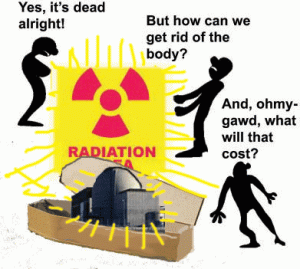
significant additional taxpayer support has been required, and more is likely to be necessary.
there is a risk that the taxpayer will have to make further
contributions.
A report from the UK’s National Audit Office examines whether the
government’s arrangements for decommissioning Britain’s fleet of
advanced-gas-cooled reactors offers value for money.
The UK has eight second generation nuclear power stations accounting for around 16% of total
UK electricity generation in 2020. Seven of the eight stations are Advanced
Gas-cooled Reactors (AGRs), the design of which built on that of the first
generation of now closed Magnox reactors.
Under current plans, all the AGR
stations will have stopped generating electricity by 2028. Decommissioning
is envisaged to take just over 100 years under current plans. The Nuclear
Liabilities Fund (the Fund) was established to meet the costs of
decommissioning all seven AGRs plus a pressurised water reactor at Sizewell
B, but significant additional taxpayer support has been required, and more
is likely to be necessary.
The UK government has provided a guarantee to
underwrite the Fund if its assets are insufficient to meet the total costs
of decommissioning. In 2020, government contributed £5.1 billion ($6.8bn)
to strengthen the Fund’s position and the Fund has recently requested a
further £5.6 billion. The Fund’s assets were valued at £14.8 billion at
the end of March 2021. The aim is that growth in the Fund’s investments
will be sufficient to meet the long-term costs of decommissioning
(currently £23.5 billion).
However, cost estimates have doubled in real
terms since 2004/5. If this trend is maintained and investment growth is
not sufficient, there is a risk that the taxpayer will have to make further
contributions. Last year, the government entered into new arrangements to
decommission the seven AGR nuclear power plants, making EDF Energy
responsible for defueling. The decommissioning of the AGR nuclear power
stations, a 66-page report published by the National Audit Office (NAO)
examines whether these arrangements will lead to better value for money.
The NAO scrutinises public spending to help Parliament hold government to
account and improve public services. It says that while the arrangements
could deliver savings, their success will ultimately depend on the relevant
parties working collaboratively to overcome risks.
Nuclear Engineering International 20th April 2022
https://www.neimagazine.com/features/featurearrangements-for-decommissioning-the-agrs-9640510/
1 This Month





PLEASE OPPOSE HR 8255 AND S.3639 – bills would accelerate satellite deployment, with no environmental review or safeguards – https://ncstd5li.quorum.us/campaign/169331/
To see nuclear-related stories in greater depth and intensity – go to https://nuclearinformation.wordpress.com
-
Archives
- October 2026 (81)
- September 2026 (339)
- August 2026 (330)
- July 2026 (355)
- June 2026 (287)
- May 2026 (306)
- April 2026 (356)
- March 2026 (251)
- February 2026 (267)
- January 2026 (308)
- December 2025 (358)
- November 2025 (359)
-
Categories
- 1
- 1 NUCLEAR ISSUES
- business and costs
- climate change
- culture and arts
- ENERGY
- environment
- health
- history
- indigenous issues
- Legal
- marketing of nuclear
- media
- opposition to nuclear
- PERSONAL STORIES
- politics
- politics international
- Religion and ethics
- safety
- secrets,lies and civil liberties
- spinbuster
- technology
- Uranium
- wastes
- weapons and war
- Women
- 2 WORLD
- ACTION
- AFRICA
- Atrocities
- AUSTRALIA
- Christina's notes
- Christina's themes
- culture and arts
- Events
- Fuk 2022
- Fuk 2023
- Fukushima 2017
- Fukushima 2018
- fukushima 2019
- Fukushima 2020
- Fukushima 2021
- general
- global warming
- Humour (God we need it)
- Nuclear
- RARE EARTHS
- Reference
- resources – print
- Resources -audiovicual
- Weekly Newsletter
- World
- World Nuclear
- YouTube
-
RSS
Entries RSS
Comments RSS

