France’s woes with nuclear power plants means more energy uncertainty for Europe
The utility cut its forecast as it realised that “stress corrosion” issues affecting some of its reactors will require more checks and repairs. Irish Examiner, THU, 19 MAY, 2022. LARS PAULSSON, JESPER STARN AND FRANCOIS DE BEAUPUY
The woes facing the nuclear power stations at France’s EDF — Europe’s largest electricity producer — will increase the pressure on war-hit European energy markets after the summer.
EDF, which is the backbone of Europe’s integrated power system, cut its nuclear output target for a third time this year, the latest sign that Europe’s power crisis is worsening.
Western Europe has for decades relied on exports of power from EDF’s nuclear stations. The cuts are another blow to European energy security just as the region is weaning itself off Russian supplies of everything from natural gas to coal and oil because of the war in Ukraine.
Less output from EDF is sending prices higher just as soaring inflation is pushing up costs for everything from petrol to food. It could get even worse in winter as France, traditionally an exporter of electricity, may be forced to import more from its neighbours.
French prices are the most expensive in Europe, with contracts for the period almost double levels in Germany. The utility cut its forecast as it realised that “stress corrosion” issues affecting some of its reactors will require more checks and repairs. The outlook for the following year remains unchanged for now, the firm said.
| “We fine-tuned the repairs to be made,” Regis Clement, deputy head of the company’s nuclear division, said during a media conference. “We’ve got to cut more pipes” to carry out further checks “and more repairs to handle”, he said.The big test will come when temperatures start to fall toward the end of the year. It won’t take many days of cold weather to jeopardise French power supplies, according to Emeric de Vigan, chief executive officer at French energy analysis firm Cor-e.“With such poor nuclear availability, if we reach 2 degrees Celsius below normal in the winter for a few days we could be in trouble, it would be really tight,” Mr de Vigan said. Paying customers and factories to lower consumption are steps that likely will need to be taken, he said. ………………. https://www.irishexaminer.com/business/economy/arid-40876541.html |
Russia’s grip on Europe’s nuclear power industry – this is being ignored
Europe needs a plan in place for cutting ties with Russia’s nuclear
giant Rosatom, says 2021 Right Livelihood Award winner and co-chairman of
Ecodefense Vladimir Slivyak. With the European Union tightening its
sanctions against Russia, banning Russian imports of oil, gas, and coal has
emerged as one powerful tool to starve the Kremlin’s war machine of
funding it needs to continue its brutal aggression in Ukraine.
But one other major source of Russia’s revenue in Europe has largely remained
unnoticed: Russia’s supplies of nuclear fuel and services to European
nuclear power plants.
Seeking to close this gap in Europe’s concerted
action against the war in Ukraine and to provide a comprehensive picture of
the union’s reliance on Russian nuclear technology, environmentalists
Patricia Lorenz, of Friends of the Earth Europe, and Vladimir Slivyak, a
2021 Right Livelihood Award laureate and co-chairman of the Russian
environmental group Ecodefense, on Wednesday jointly presented Russian Grip
on EU Nuclear Power – an overview of Russia’s businesses and supply
chains serving the European nuclear market.
Eco Defense 19th May 2022
Cost of shutting down UK’s old nuclear reactors is doubling and then some
The cost of decommissioning the UK’s seven ageing nuclear power stations
has nearly doubled to £23.5bn and is likely to rise further, the public
accounts committee has said. The soaring costs of safely decommissioning
the advanced gas-cooled reactors (AGRs), including Dungeness B, Hunsterston
B and Hinkley B, are being loaded on to the taxpayer, their report said.
Failures in the government’s investment strategy for the fund, which was
set up to pay for the decommissioning, have led to the taxpayer topping it
up by an additional £10.7bn in just two years. The nuclear power stations
are owned by EDF Energy and provide much of the UK’s nuclear
power-generated electricity, which makes up 16% of the energy mix. But the
stations are nearing the end of their lives and are scheduled to stop
generating electricity during this decade. The government has recently
agreed that once the stations have been defuelled by EDF, which involves
the removal of all the spent fuel from the reactor core and cooling ponds,
ownership of the stations will be transferred to the government’s Nuclear
Decommissioning Authority (NDA) to complete decommissioning.
Guardian 20th May 2022
https://www.theguardian.com/environment/2022/may/20/uk-nuclear-power-stations-decommissioning-cost
EDF shares fall after new profit warning due to nuclear outages
Shares in EDF fell 1.8% on Thursday after the French utility warned
outages at its nuclear power plants would result in a steeper-than-expected
cut in power output and thus have a greater than previously estimated
impact on 2022 core earnings. EDF said the impact of the outages largely
related to a program of inspections and repairs the company is carrying out
on some of its reactors would have a negative impact of around 18.5 billion
euros on the group’s core earnings this year instead of the 14 billion
euros previously forecast.
Financial Post 19th May 2022
Chernobyl nuclear fears as forest near Exclusion Zone in FLAMES – emergency triggered

CHERNOBYL nuclear fears have surged after a forest near the Exclusion Zone erupted in flames as emergency services battled to extinguish the huge blaze.
By PAUL WITHERS, May 18, 2022 The State Emergency Service of Ukraine reported that litter in the forest near the Chernobyl Exclusion Zone had caught fire. More than a dozen firefighters and four units of equipment were involved in battling to put out the massive fire. At 2.10am local time, the fire had been localised to an area of 45 hectares.
Video footage shared on Twitter shows the forest next to the Exclusion Zone engulfed in flames that are several metres high.
Rescue workers wearing protective face masks are also seen leading a local resident to safety.
The State Emergency Service of Ukraine shared footage of the fire on its Telegram channel.
The service also wrote alongside this: “May 17 near the village. “In the forest of Vyshhorod district, forest litter caught fire.
“During the fire, our firefighters rescued a local resident.
“At 02:10 on May 18, the fire was localized on an area of 45 hectares.
“As of 09:00 there is decay of dry grass and stumps.
“Sixteen rescuers and four units were involved in the firefighting techniques.
The Chernobyl Exclusion Zone is an officially designated 1,000 square mile area in Ukraine around the site of the Chernobyl nuclear reactor disaster.
It covers an area where radioactive contamination is highest and public access and habitation are restricted.
The Exclusion Zone aims to restrict access to hazardous areas, reduce the spread of radiological contamination, and conduct radiological and ecological monitoring activities.
It remains one of the most radioactively contaminated areas in the world, attracting widespread interest over the high levels of radiation exposure in the environment.
The Exclusion Zone had been established by the Soviet Armed Forces soon after the nuclear power plant disaster in 1986. This initially existed as an area with a radius of 30 miles from the structure, designated for evacuation and placed under military control.
Over the years, its borders have been widened to cover a much larger area of Ukraine.
Ukraine controlled by US and UK – Russia
Rt.com 17 May 22, The stalling of the peace talks is a result of the wish of London and Washington to drag out the Ukraine conflict, Lavrov claimed. London and Washington have been exercising their control over the Ukrainian negotiators with the aim of dragging out the conflict, and this policy has led to the suspension of peace talks between Moscow and Kiev, Russian Foreign Minister Sergey Lavrov claimed on Tuesday.
Speaking at the New Horizons educational marathon, Lavrov said that Ukraine may have made its own decision in Istanbul, when it came up with some “acceptable principles for reaching agreements” during negotiations with Russia. However, according to the minister, these ideas were apparently not supported by the West.
“We have information coming through various channels that Washington and especially London ‘lead’ the Ukrainian negotiators and control their freedom of maneuver. They want to drag out the conflict, and it seems to them that the longer it will last, the more damage they will inflict on Russian servicemen,” Lavrov said.
The foreign minister doubts, however, that “transferring the conversation to the level of Washington or London” would be able to change anything in terms of the progress.
“Anyway, neither London, nor Washington, nor the West as a whole has put forward any proposals,” Lavrov said.
The West actually acknowledged that Ukraine is “expendable in a hybrid total war against the Russian Federation,” Lavrov claimed, citing remarks by the EU, UK and US officials who have said on multiple occasions that Russia should not be allowed to win in the Ukrainian conflict.
“The war was declared by them. And not at all between Ukraine and Russia, but between the West and Russia,” Lavrov said.
Earlier on Tuesday, Deputy Foreign Minister Andrey Rudenko said that diplomatic dialogue between Moscow and Kiev had been completely suspended after Kiev withdrew from negotiations without providing any response to the latest Russian proposals.
A Ukrainian presidential adviser, Mikhail Podolyak, later confirmed that “after the Istanbul communiqué [in March], there have been no changes, no progress.”……. https://www.rt.com/russia/555640-russia-lavrov-west-ukraine/
Greens oppose Nato membership for Scotland and ‘evil’ nuclear weapons
The National By Angus Cochrane@_Anguscchrn, Multimedia Journalist 18 May 22, NUCLEAR weapons are “simply evil”, the Scottish Greens have said as they detailed their reasons for opposing Nato membership for an independent Scotland.
West Scotland MSP Ross Greer said it would be “morally wrong” for Scotland to join Nato if it were to become independent. It comes after Nicola Sturgeon reaffirmed her party’s support for joining the military alliance in the event of a Yes vote.
Greer explained both parties, who signed a historic co-operation deal in Holyrood last year, “agreed to disagree” on Nato. The MSP told BBC Scotland’s The Nine: “It’s no surprise to anyone that the Scottish Greens and the SNP have different positions on Nato.
“For the Scottish Greens, we enthusiastically believe in co-operation, especially in areas like security and defence.
“Patrick Harvie lists one of them and that is Nato’s first strike nuclear policy. Nato reserves the right to launch the first strike in a nuclear war.
“That would be world ending and we believe that is simply evil. No-one has the right to do that and we believe it would be morally wrong for Scotland to join such an alliance.”
BBC Scotland put it to Greer that nuclear weapons were a deterrent.
Greer added: “But it is a Nato policy. First strike is not about responding to an attack, first strike is about the right to launch, to actually start that war, to start the last world war, because it would be the war that ended the world as we know it.
| “That’s the nature of nuclear weapons.“The very existence of nuclear weapons risks the chance of nuclear war.“If we want to persuade rogue and hostile states to reduce their nuclear stockpiles, asking them to do it, demanding that they do it unilaterally, has no chance of success.”“This is a fundamental moral question. I don’t want the last thing that my country potentially does in its existence is to wipe another country off the map. Nuclear weapons are simply evil.”…………………….. The intervention comes after Nicola Sturgeon said the Russian invasion of Ukraine has strengthened the case for joining Nato…………………………… https://www.thenational.scot/news/20147291.greens-oppose-nato-membership-scotland-evil-nuclear-weapons/ |
“We agree with the First Minister that Scotland has a really positive role to play in Europe’s collective security arrangements. But we disagree on membership of Nato for two reasons.
Sellafield Update 2022
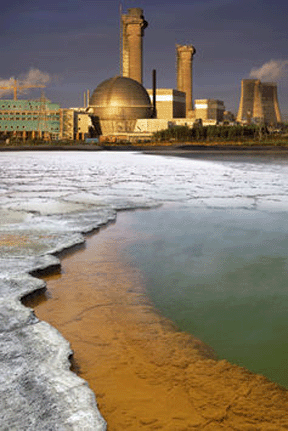
nuClear News, May 2922, Executive Summary
Reprocessing
Spent fuel from the UK’s first-generation Magnox reactors is still being reprocessed. It was
scheduled to end in 2012 to help the UK meet its international obligations to end the radioactive
pollution of the north-east Atlantic. It’s now scheduled to end later this year.
Storage
At the end of 2021, the First Generation Magnox Storage Pond (FGMSP), one of Sellafield’s most
hazardous facilities, and the Pile Fuel Storage Pond (PFSP) still contained 75% of the legacy
spent fuel which has to be removed and placed in interim storage. This degraded fuel won’t be
in interim storage until 2025. It will then have to be conditioned, and eventually transferred to
the proposed Geological Disposal Facility by 2125.
Spent fuel
The Thermal Oxide Reprocessing Plant (THORP) has closed, and almost 5,000 tonnes of unreprocessed spent fuel from the UK’s second-generation Advanced Gas-cooled Reactors (AGRs)
will be stored in ponds at Sellafield until at least 2075. In addition, an estimated 141 tonnes of
exotic fuel will remain in storage once the Magnox reprocessing plant closes, and isn’t expected
to be in a modern interim storage facility until 2028. Sellafield is also contracted to receive and
store spent submarine fuel from the MoD.
Plutonium
The government has yet to decide about possible re-use or disposal of the 140 tonnes of
plutonium stored at Sellafield. Its preferred option is to re-use it in Mixed Oxide Fuel (MOX) for
nuclear reactors, but some plutonium will be unsuitable for this and will need to be immobilised
and treated as a waste for disposal. Some of the older plutonium packages and facilities are
amongst the highest hazards on the Sellafield site. All plutonium needs to be gradually transferred to a new store, and two more stores are likely to be required – one is expected to be
ready in 2033 and the second in 2040.
High Level Waste
High Level Waste (HLW) Liquors, left over after reprocessing, need to be constantly cooled
otherwise they would start to boil causing radioactivity to escape and contaminate the
surrounding environment. Conversion of these liquors into a solid form and emplacement in
storage is not expected to be complete until 2030. The solid waste will remain in storage until
‘disposal’ by 2104. All HLW belonging to overseas customers should be returned by 2025.
Levels of risk
In 2013 Sellafield was described as posing an “intolerable risk”. Then in 2018 it was reported
that “work to reduce risk and high hazard at Sellafield has taken an encouraging turn for the
better”. Since then, the site has not been much in the news, but there is still a lot of work to do,
as many of the risks remain. And the timescales for carrying out this work are simply
staggering. According to the UK Radioactive Waste Inventory decommissioning won’t be
complete until around 2090 and then all buildings won’t be demolished until 2120 – almost a
century from now. (1)
Germany will vote against EU plans to label nuclear power as a green investment,
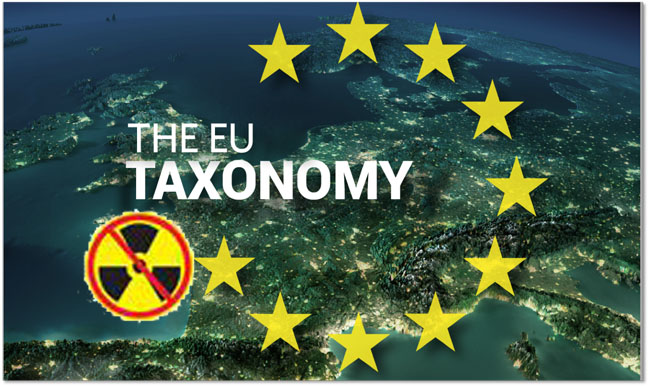
Germany says it will vote against EU plans to label nuclear power as a green investment, https://www.euronews.com/green/2022/05/17/germany-will-vote-against-eu-plans-to-include-nuclear-energy-as-a-green-investment By Kate Abnett with Reuters – UK Online Report Business News 17/05/2022
Germany will oppose European Union plans to include nuclear energy as a sustainable investment in its “taxonomy” policy for labelling green investments, the government said on Monday.
With the bloc aiming to achieve net-zero by 2050, massive investments into sustainable energy sources are needed. The European Commission is looking to class nuclear energy as ‘green’ making it easier for states and the private sector to invest.
Brussels is now seeking approval from EU countries and European Parliament for its plan to label gas and nuclear as climate-friendly investments. It has split opinions among states who disagree with the fuels’ green credentials.
Germany, the EU’s biggest economy, is among those planning to reject it when countries come to vote on the plan in the coming weeks.
“The Federal Government has expressed its opposition to the taxonomy rules on nuclear power. This ‘no’ is an important political signal that makes clear: Nuclear energy is not sustainable and should therefore not be part of the
taxonomy,” Germany’senvironment ministry and its economy and climate ministry said in a statement.
Nuclear energy is not sustainable and should therefore not be part of the taxonomy.
“Accordingly, the Federal Government would vote for the Council to object to the EU Commission’s delegated legal act,” the ministries said.
A ‘gold standard’ for green investing
To reject the rules, 20 of the EU’s 27 countries must oppose it – a high threshold seen as unlikely to be reached. Germany’s stance could also steer opinion in the European Parliament, however, where a majority of the assembly’s 705 lawmakers could block the gas and nuclear rules in a July vote.
The EU’s sustainable finance taxonomy was designed to provide a “gold standard” for green investing, by limiting which investments can be labelled climate-friendly to only those that truly protect the planet.
Austria is leading a call for legal action because of “serious concerns” about nuclear energy being too expensive and slow to actually fight climate change. Officials from the country have pointed out that, whilenuclear energy generation is CO2-free, the problem of nuclear waste has still not been solved.
The small but wealthy nation of Luxembourg is also considering legal action if the decision to label nuclear energy as ‘green’ goes ahead.
\The plan to label gas as climate-friendly has faced criticism from countries including Spain, although some countries had lobbied hard for the taxonomy to incentivise gas investments to help them phase out coal.
Gas emits less CO2 than coal when burned, but is also associated with leaks of methane, a potent greenhouse gas.
France’s nuclear corrosion problem will need a ”large scale” plan, and ”several years” to fix.
The head of French nuclear regulator ASN said on Tuesday (17 May) that
fixing corrosion problems at some of state-controlled utility EDF’s
nuclear reactors would require a “large scale” plan and “several
years” as he warned of a risk more reactors could be halted.
Euractiv 18th May 2022 https://www.euractiv.com/section/electricity/news/fixing-edfs-reactors-corrosion-mystery-to-take-several-years-french-regulator-warns/
France’s Nuclear Safety authority struggles with the problems realated to corrosion in 12 reactors
Nuclear: faced with the problem of corrosion, a “large-scale” control
program. The president of the Nuclear Safety Authority, Bernard Doroszczuk,
gives a “general positive assessment” of the safety of the park, but
underlines “points of vigilance”.
The traditional exercise aimed to take
stock of the state of nuclear safety in 2021. In the end, it was the events
that occurred during the very last weeks of the year, but also during the
first months of 2022, that was at the heart of Bernard Doroszczuk’s speech
to the members of the Parliamentary Office for the Evaluation of Scientific
and Technological Choices on Tuesday 17 May.
The President of the Nuclear
Safety Authority (ASN) returned to the consequences of the “stress
corrosion” phenomenon observed on parts of the pipes which allow water to
be injected into the main primary circuit in order to cool the core. of the
reactor in the event of an accident.
Since mid-December, EDF has shut down
or extended the shutdown of twelve units in order to carry out in-depth
assessments or repairs related to this problem. If the origin of this
corrosion is not completely determined, Mr. Doroszczuk indicated that it
could be due to the “design” of the reactors: the oldest and most
widespread in the fleet are based on an original technology American, while
the most recent were designed according to a model adapted by EDF. However,
the piping that goes from the primary circuit to the first valve is longer
and more complex on the second, and this route could generate greater
thermomechanical stresses.
Le Monde 17th May 2022
Nuclear Free Local Authorities seeks assurance British nuclear will not rely on Russian uranium
An organisation representing UK councils, Nuclear Free Local Authorities
(NFLA), has written for reassurance that Russian uranium will not be used
to power British nuclear reactors. The group reached out to the Chief
Executive of nuclear plant operator EDF energy, Simone Rossi, and the
Minister for Climate Change, Greg Hands, for clarification.
This comesafter NFLA Chair, Cllr David Blackburn, noticed mentions of a long-term
contract for natural and enriched uranium with Russian-owned supplier Tenex
in an EDF Energy report. In the annual financial report from EDF’s French
parent company, one section looks at the company’s strategy for enriching
natural uranium into uranium 235
Environment Journal 17th May 2022
Five reasons that Russia’s nuclear exports will continue, despite sanctions and the Ukraine invasion. But for how long?
By many measures, Russia’s state-controlled nuclear energy company,
Rosatom, has primacy in the global nuclear energy market. At any given
moment, the firm provides technical expertise, enriched fuel, and equipment
to nuclear reactors around the world.
The Russian invasion of Ukraine and,
more acutely, the Russian military’s dangerous actions at the
Zaporizhzhia nuclear power plant and in the Chernobyl exclusion zone have
many countries rethinking their dependence on Russian nuclear products and
searching for alternatives.
Additionally, the ensuing global effort to
cripple Russian access to international markets calls into question the
viability of current contracts, government licensing, and financial
instruments involved in Russia’s nuclear exports.
Concurrently, the invasion has highlighted the lack of energy source diversification across
Europe. Headlines have focused on how several European countries decided to
phase out or delay plans to build new nuclear power plants in the wake of
the 2011 Fukushima-Daiichi disaster and, instead, increase imports of
Russian oil and natural gas to feed their electric grids’ baseload needs.
Now, in response to the sudden European effort to minimize dependence on
Russian imports, the United States has sent tankers of liquefied natural
gas (LNG) to European ports. Additionally, the United States and partners
are releasing a round of oil from their strategic stockpiles to stabilize
market prices. For oil and natural gas supplies to Europe, there are some
immediate alternatives available.
However, for nuclear power plants,
swapping in alternative supplies is causing serious dilemmas and could lead
to stranded assets.
Bulletin of Atomic Scientists 17th May 2022
Five reasons that Russia’s nuclear exports will continue, despite sanctions and the Ukraine invasion. But for how long?
EU hits fast forward on renewables, including “massive deployment” of solar

Spurred by Russia’s invasion of Ukraine, European Commission unveils massive scaling-up and speeding-up of renewable energy, with solar as the “kingpin.” The post EU hits fast forward on renewables, including “massive deployment” of solar appeared first on RenewEconomy.
EU hits fast forward on renewables, including “massive deployment” of solar — RenewEconomy
Borrell: EU defense chiefs to approve another half billion Euros to arm Ukraine — Anti-bellum
Interfax-UkraineMay 17, 2022 EU defense ministers to approve another EUR 500 mln for arming Ukraine – Borrell The Council of Ministers of Defense of the European Union at a meeting of the Council for Foreign Affairs, which is taking place on Tuesday in Brussels, will approve a proposal to allocate another EUR 500 million to […]
Borrell: EU defense chiefs to approve another half billion Euros to arm Ukraine — Anti-bellum
1 This Month





PLEASE OPPOSE HR 8255 AND S.3639 – bills would accelerate satellite deployment, with no environmental review or safeguards – https://ncstd5li.quorum.us/campaign/169331/
To see nuclear-related stories in greater depth and intensity – go to https://nuclearinformation.wordpress.com
-
Archives
- October 2026 (81)
- September 2026 (339)
- August 2026 (330)
- July 2026 (355)
- June 2026 (287)
- May 2026 (306)
- April 2026 (356)
- March 2026 (251)
- February 2026 (267)
- January 2026 (308)
- December 2025 (358)
- November 2025 (359)
-
Categories
- 1
- 1 NUCLEAR ISSUES
- business and costs
- climate change
- culture and arts
- ENERGY
- environment
- health
- history
- indigenous issues
- Legal
- marketing of nuclear
- media
- opposition to nuclear
- PERSONAL STORIES
- politics
- politics international
- Religion and ethics
- safety
- secrets,lies and civil liberties
- spinbuster
- technology
- Uranium
- wastes
- weapons and war
- Women
- 2 WORLD
- ACTION
- AFRICA
- Atrocities
- AUSTRALIA
- Christina's notes
- Christina's themes
- culture and arts
- Events
- Fuk 2022
- Fuk 2023
- Fukushima 2017
- Fukushima 2018
- fukushima 2019
- Fukushima 2020
- Fukushima 2021
- general
- global warming
- Humour (God we need it)
- Nuclear
- RARE EARTHS
- Reference
- resources – print
- Resources -audiovicual
- Weekly Newsletter
- World
- World Nuclear
- YouTube
-
RSS
Entries RSS
Comments RSS

