Ukrainian negotiator rules out deal with Russia
RT Sat, 28 May 2022 Presidential adviser Mikhail Podoliak said that any agreement with Moscow “isn’t worth anything
Despite Russian advances in the Donbass, Ukrainian presidential adviser and peace talks negotiator Mikhail Podoliak declared on Saturday that Kiev would not look for a peace agreement with Moscow. His statement contradicts earlier overtures toward diplomacy by President Volodymyr Zelensky.
“Any agreement with Russia isn’t worth a broken penny,” Podoliak declared in a Telegram post. “Russia has proved that it is a barbarian country that threatens world security.”
“Ukraine will fight with Russia until the victorious finale,” he continued, concluding that “A barbarian can only be stopped by force.”
Podoliak led the Ukrainian delegation during several rounds of unsuccessful peace talks during the initial weeks of Russia’s military operation in Ukraine. Now, his denunciation of talks with Moscow stands in stark contrast to President Volodymyr Zelensky’s acknowledgement earlier this week that he “may try and go the diplomatic way,” should Russian President Vladimir Putin be willing to talk directly………
A similar pattern has played out since the conflict began in February, with Zelensky periodically expressing interest in negotiating a settlement with Russia, only for his officials, the US State Department, or Zelensky himself to express the opposite sentiment shortly afterwards. After he announced his willingness to enter negotiations earlier this week, Zelensky came out on Friday and told his citizens that “there will be no alternative to our Ukrainian flags” flying over the Donbass republics of Donetsk and Lugansk – primarily Russian-speaking areas that declared independence from Ukraine in February…………..
Only a handful of dissenting voices – former Secretary of State Henry Kissinger among them – have urged the Ukrainians to sue for peace. Meanwhile, UK PM Johnson has instead called on the UK’s allies to send heavier weapons to Kiev, while the Biden administration reportedly gave the green light to deliver long-range rocket artillery systems to Ukraine https://www.rt.com/russia/556242-ukraine-negotiator-rejects-talks/
Nuclear safety warning threatens to derail Boris Johnson’s energy revolution
Austria objects to Sizewell C plant in its latest attack on British energy policy, Telegraph, By Helen Cahill 29 May 2022 . Boris Johnson’s plans for a nuclear energy revolution are facing a fresh hurdle after the Austrian government officially raised concerns about the safety of a new reactor design.
In a letter to the Business Department, Austria’s energy ministry raised the spectre of “severe accidents with high releases” at the Sizewell C plant to be built in Suffolk.The warning, made under the Espoo convention in which nearby countries are allowed to comment on nuclear projects, raises the prospect of legal action to derail Sizewell and will be considered by the Government as part of a planning decision in coming months.
…………………… The Austrians said that it is “questionable” whether the Sizewell design could guarantee that radioactivity will be retained within the reactor’s core.
They warned that the high power of the EPR reactor reduces the time available for an operator to react to any fault and prevent a major accident, and added: “At this time, it cannot be proven beyond doubt that severe accidents with high releases cannot occur.”
The intervention comes after Britain put nuclear power at the heart of its long-term energy strategy. https://www.telegraph.co.uk/business/2022/05/29/nuclear-safety-warning-threatens-derail-johnsons-energy-revolution/
France’s Nuclear Industry Slides Into Crisis

https://globeecho.com/news/europe/germany/frances-nuclear-industry-slides-into-crisis/ By David Sadler May 26, 2022,
France is less dependent on Russian gas than Germany – thanks to the country’s 56 nuclear reactors. But because more than half of them are standing still and Russia is disappearing as a customer, France’s nuclear industry is under pressure.
French President Emmanuel Macron had promised a “renaissance of nuclear energy” in February. He wants to have six new pressurized water reactors built. More electricity, more independence, more innovation – Macron is going all-out on the nuclear power card to push France’s industry forward.
Corrosion stalls the plans

But these ambitious plans are currently experiencing a serious setback: 29 of the 56 reactors are shut down. There is a double problem: the state-owned company EDF’s kiln park is showing its age. Many reactors are shut down for routine maintenance. But now, of all things, twelve of the younger series also have to be taken off the grid.
The reason is a corrosion problem that nobody expected. “At the moment, the controls do not allow any statement to be made as to how large the cracks in the cooling tubes are. The reactors have to be shut down for this,” says Bernard Doroszczuk, rapporteur for the Nuclear Safety Authority.
Proportion of nuclear power unplanned at low point
Instead of around 70 percent, France’s nuclear power plants only supplied 37 percent of the electricity requirement in April – less than ever before! Europe’s largest nuclear power provider, Electricité de France, currently estimates the group’s shortfall in revenue for 2022 at 18.5 billion euros. It is already foreseeable that there will be power shortages in winter.
But a quick solution to the technical problems is not in sight. Because there is a lack of skilled workers. “Basically, EDF estimates that by 2026 there will be a six-fold increase in the need for specialist staff. Above all when it comes to the machinery: i.e. pumps, the pipe network, and there is a lack of welders – that’s what drives everyone,” says Jean-Luc Lachaume from the security agency. “And this calculation does not even include the announced construction of new reactors. Nor does it include the need that has now arisen as a result of these unforeseen corrosion problems.”
Instead of renaissance, first of all, renovation. Security auditor Doroszczuk therefore calls for a Marshall Plan. “Industry and the state have to get involved now,” he demands. “Otherwise the announced goals are not tenable. And that would be the worst thing for the credibility of the entire industrial program.”
Russia has been the most important customer so far
On top of all these problems there is now the war in Ukraine. To date, Russia has been the most important customer of the French nuclear industry. Mycle Schneider, editor of the World Nuclear Industry Status Report, sees the items in the order books dwindling. Internationally, Russia was “the decisive, most aggressive promoter” of the construction of new nuclear power plants. And now suddenly this bottleneck has arisen. “In Finland, a project for a Russian nuclear power plant has already been officially canceled – and turbines for this nuclear power plant were to be delivered from France,” says Schneider.
In fact, the French Ministry of Economic Affairs even planned to take a 20 percent stake in the domestic turbine manufacturer in Belfort for the Russian company Rosatom. But that plan could now be shelved. France believed that its nuclear strategy was on the upswing. But the plans have gone haywire.
Energy sanctions on Russia – Russia’s nuclear supply chain should be sanctioned, too
As numerous countries in the west consider taking aim at Russia with energy sanctions over Moscow’s attack on Ukraine, Russia’s dominance in the nuclear energy sector is being overlooked, a paper from ColumbiaUniversity’s Center on Global Energy Policy warns.
While the Russian invasion of Ukraine drags into its fourth month, the European Union has
struggled to wean itself off Russian fossil fuel imports – the profits of which help fuel Moscow’s aggression in Ukraine.
But the Columbia paper, authored by Paul Dabbar, a former undersecretary of Energy for
Science at the Department of Energy, and Columbia researcher Matthew Bowen, suggests that Russia’s nuclear technology sector should also be the focus of economic boycotts.
From reactor construction to fuel fabrication, Russia occupies a predominant position on world nuclear markets. Of the 439 nuclear reactors operated around the world as of 2021, 38 were in Russia
itself and another 42 were built with Russian or Soviet technology.
Bellona 26th May 2022
US university report argues for sanctioning Russia’s nuclear supply chain
No credibility in the way that the Ukraine war is being reported – says Colonel Richard Black (ret)

Video: Col. Richard Black — U.S. Leading World to Nuclear War, The International Schiller Institute, 27 May 22, Mike Billington with Executive Intelligence Review interviews Col. Richard Black (ret.).
”…………………………..BILLINGTON: Many flag grade officers certainly understand the consequences that you just described in a rather hair-raising way. Why is it that, while there are some generals speaking out in Italy, in France, in Germany, warning that we are pursuing a course that could lead to nuclear war, why are there not such voices from flag grade officers—retired, perhaps—saying what you’re saying here today?
BLACK: You know, there’s been a tremendous deterioration in the quality of flag officers………. we now have “yes men.” These are not people whose principal devotion is to the United States and its people. Their principal devotion is to their careers and their ability to network with other military officers upon retirement. There’s a very strong network that can place military generals into think tanks, where they promote war, into organizations like Raytheon and Northrop Grumman, and all of these defense operations, where they can get on boards and things like that. So there’s quite a personal price that you pay for saying, “Hey, stop. War is not in the interests of the American people.” If we had a better quality of individual, we would have people with the courage who would say, “I don’t care what it costs me personally.” But it is very difficult to get into the senior ranks, if you are an individual guided by principle, and patriotism, and devotion to the people of this nation. That’s just not how it works. And at some point, we need a President who will go in and shake the tree, and bring a lot of these people falling down from it, because they’re dangerous. They’re very dangerous to America.
………………. Just like I asked what’s keeping the generals from speaking out, why, and what will it take, to get Americans to recognize that we can and must sit down with Russians, and with Chinese, and with all other nations and establish a true, just world based on the dignity of man and the right to development and security?
………. at this point, the media have been so totally censored and so biased that the American people really don’t have a perception of the need for anything of that sort. It’s going to be difficult.
………… The idea that somehow we have this enormously just cause, it doesn’t strike a great deal of the world that it is just, and much of the world does not accept the latest propaganda about war crimes: this thing about Bucha. That’s probably the most prominent of all the war crimes discussions.
And what was Bucha? There was a film taken of a vehicle driving down the road in Bucha, which had been recaptured from the Russians. And every hundred feet or so there was some person with his hands, zip tied behind his back, and he’d been killed. It was not announced until four days after the Ukrainians had retaken Bucha.
Now, we knew almost nothing about it. We actually didn’t even have proof that people had been killed. But assuming they had, we didn’t know where they had been killed. We did not know who they were. We did not know who killed them. We did not know why they were killed. No one could provide an adequate motive for the Russians to have killed them. The Russians held Bucha for a month. If they were going to kill them, why didn’t they kill them during that month? And if you’re going to slaughter a bunch of people, wouldn’t they all be in one place and wouldn’t you gun them all down there? Why would they be distributed along a roadside, a mile along the way? It makes no sense!
What we do know is that four days after the mayor of Bucha joyously announced that the city was liberated, four days after the Ukrainian army had moved in, and their special propaganda arm of the Ukrainian military were there, all of a sudden there were these dead people on the road. How come they weren’t there when the Russians were there? How come they only appeared after the Russians were gone?
If I were looking at it as simply a standard criminal case, and I was talking to Criminal Investigation Division or the FBI, or military police or something, I’d say, “OK, the first thing, let’s take a look at the Ukrainians.” My guess would be, and you start with a hunch when you’re investigating a crime—my hunch is that the Ukrainians killed off these people after they moved in, and after they looked around, and said, “OK, who was friendly towards the Russian troops while the Russians were here? We’re going to execute them.” That would be my guess. Because I don’t see any motive for the Russians to have just killed a few people on their way out of town.
And nobody questions this, because the corporate media are so monolithic. We know for a fact, from the mouth of the head of a Ukrainian hospital, the guy who ran the hospital, he boasted that he had given strict orders to all of his doctors, that when wounded Russian POWs, when casualties were brought in, they were to be castrated. Now, this is a horrific war crime, admitted from the mouth of the hospital administrator, and the Ukrainian government said, “we’ll kind of look into that,” Like it’s no big thing. I can’t think of a more horrific, horrific war crime, ever. Where did you hear about it, on ABC and MSNBC and CNN and FOX News? Not a whisper. And yet the proof is undeniable. We had another clip where there was a POW gathering point, where the Ukrainians would bring POWs to a central point for processing—and this is about a seven-minute video—and the Ukrainian soldiers simply gunned them all down.
And they had probably 30 of these wounded Russian soldiers lying on the ground, some of them clearly dying from their wounds. Some of them, they put plastic bags over their heads. Now, these are these are guys who are laying there, sometimes fatally wounded with their hands zip-tied behind their backs, and they’ve got plastic bags over their heads, making it difficult to breathe. And because they can’t raise their hands, they can’t take the bags off, so that they can breathe. At the end of the video, the Ukrainians bring in a van, and there are three unwounded Russian POWs. Without the slightest thought or hesitation, as the three come off, and their hands are bound behind their backs, they gunned down two of them, right on camera and they fall over. And the third one gets on his knees, and begs that they won’t hurt him. And then they gun him down! These are crimes. And these were not refuted by the Ukrainian government. But you’d never even know that they occurred! So far, I will tell you that the only proven—I’m not saying that there aren’t war crimes happening on both sides. I’m just telling you, that the only ones where I have seen, fairly irrefutable proof of war crimes, have been on the Ukrainian side.
Now, often you hear it said, well, the Russians have destroyed this or destroyed that. Well, I’ve got to tell you, you go back to the wars that we fought when we invaded Iraq, the “Shock and Awe,” we destroyed virtually everything in Iraq, everything of significance. We bombed military and civilian targets without much discrimination. The coalition flew 100,000 sorties in 42 days. You compare that to the Russians, who have only flown 8,000 sorties in about the same period of time. 100,000 American sorties versus 8,000, in about the same time. I think the Russians have tended to be more selective. Whereas we went out — the philosophy of Shock and Awe is that you destroy everything that is needed to sustain human life and for a city to function. You knock out the water supply, the electrical supply, the heat, the oil, the gasoline; so that you knock out all of the major bridges. And then you just continue to destroy everything.
So it’s really ironic. And keep in mind, Iraq is a relatively small country. Ukraine is a huge country. 100,000 sorties in 42 days, 8,000 sorties in about the same time. A tremendous difference in violence between what we did in Iraq, and what they have done in Ukraine. So there’s simply no credibility when you actually get down to the facts and you look at the way that the war has been conducted…………… https://schillerinstitute.com/blog/2022/04/26/video-col-richard-black-u-s-leading-world-to-nuclear-war/
EDF Nuclear Failures Undermine Europe’s Push to Exit Russian Gas
- France may need to import power from its neighbors this winter
That may drive up regional demand for gas to feed power plants - Bloomberg, By Rachel Morison and Francois De Beaupuy, 27 May 2022, Electricite de France SA’s nuclear failures are sending ripples through European energy markets, threatening to undermine the continent’s plan to turn its back on Russian gas.
- Europe’s biggest producer of atomic energy, which usually exports cheap power during the winter, may be forced to import this year after cutting its output forecast a third time. A fleet hobbled by faults is not just a problem for France but for countries such as neighboring Germany, which may have to burn more gas to keep the lights on despite pledging to cut its reliance on Moscow.
We have a French problem which is taking place at the wrong time, given the geopolitical situation,” said Nicolas Leclerc, co-founder of Paris-based energy consultant Omnegy. “The whole European equilibrium may be threatened.”…………. (subscribers only) https://www.bloomberg.com/news/articles/2022-05-27/edf-nuclear-failures-undermine-europe-s-push-to-exit-russian-gas
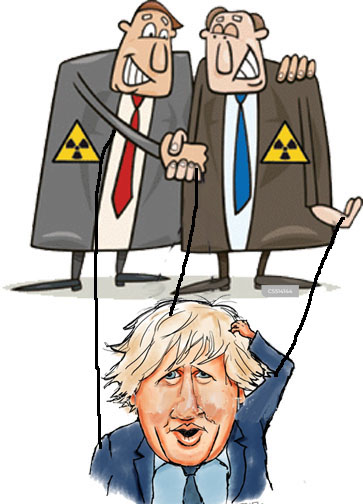
Boris Johnson promised ”1 nuclear reactor a year for 8 years” – one by 2040 if he’s lucky!
With the weather changing dramatically across the world, will politicians
finally take the climate crisis seriously? With a concerted effort, there
could still be time. But time is the critical thing. And on the campaign
trail in “red wall” seats before the May elections, the prime minister,
Boris Johnson, repeatedly promised building nuclear reactors “one a year
for eight years”.
Last week at the Conservative conference in Wales he
was at it again – this time promising one on Anglesey and another at
Trawsfynydd in Mid Wales.
Anyone who knows a little about nuclear reactors
(current designs 10 years late and £10bn over budget) or about the prime
minister’s other mega-projects – bridges across the Thames and Irish
Sea, and an airport in the Thames estuary – is confident that this
won’t happen.
A protest via my MP brought a measured response from Greg
Hands, the minister responsible for energy policy. He said provided
reactors were value for money and technically sound, the government’s
target for nuclear projects was to give one a final investment decision
this parliament, and two in the next – so maybe three building starts by
2030. On current trends that means one reactor possibly ready by 2040 and
two others much later. Far too late to heal the climate.
Guardian 27th May 2022
Where will Europe store its radioactive waste?
Euronews, By Tim Gallagher with Reuters 27/05/2022 –
A row is brewing in the Balkans as tensions mount over plans for a nuclear waste storage facility.
Croatia’s plan to store radioactive waste near its border with Bosnia is facing mounting opposition from its neighbour due to concerns the plant could have potentially devastating health and environmental impacts.
The site near the River Una, a Danube tributary, was chosen in 2018. In a bid to halt the plan, Bosnia responded by declaring their land closest to the location a nature reserve.
This scheme gained little ground and as the grand opening draws closer, Bosnians are growing increasingly concerned about the possible consequences on their pristine rivers and organic farming industry, not to mention public health.
“We fear the main impact of this devastating proposal will be on people’s lives and on the environment,” says Mario Crnkovic, an ecologist in the town of Novi Grad on the Bosnian side of the border, about one kilometre from the earmarked site.
Croatia has dismissed the concerns, but critics note that the government has yet to publish any health or environmental risk assessment of the proposal.
The area is prone to flooding and subject to regular seismic activity. It’s also still being cleared of landmines left over from the Balkan wars in the 1990s.
Diplomatic incidents over nuclear waste
The Balkans row is not the only diplomatic incident to happen over nuclear waste disposal in recent years.
In 2020 the Belgian government announced they had received recommendations for seven sites for underground disposal of nuclear waste, but didn’t specify where they were.
It wasn’t long before suspicions were aroused in Luxembourg, with the Luxembourgian environment minister, Carole Dieschbourg, stating they would be in the area of Namur, Dinant and Stavelot, close to their border with Belgium.
“That is right on our doorstep,” the minister announced, as she raised potential dangers to locals and accused the Belgian government of contravening the Espoo convention which regulates trans-border environmental impact reporting……………..
Where will nuclear waste be stored in the future?
Russian soldiers taking Chernobyl Nuclear plant by force during their invasion of Ukraine brought the dangers of unsafe nuclear waste to the forefront of the public imagination.
Most operational-storage facilities for nuclear waste are at surface level, with the UK, France, and Spain all making use of these short-term solutions.
However, the consensus for the future is that nuclear waste is best stored in a geological disposal facility (GDF) deep beneath our feet. Here in a space 700 – 1000 metres underground, spent reactors will be safely treated and sealed into rock structures with cement, leaving them to decay over hundreds of thousands of years.
Previous mooted suggestions of sending waste to space or burying it beneath the ocean floor have been abandoned, but there is an ongoing issue of how to warn future generations of the dangers of waste sites.
With no guarantee that today’s languages will be spoken or current iconography will be recognisable in thousands of years, it’s a risk that still-dangerous toxic waste could be accidentally opened up by curious archaeologists of the future.
In the 1980s the US government assembled the Human Interface Taskforce to work out how to prevent such a disastrous occurrence. One of their recommendations was to create fake myths and legends to ward off the curious.
Do communities want GDFs?
This toxic issue doesn’t just cause problems along borders, but often sees locals hotly contest proposals for GDFs near their communities by their own governments.
In the UK the country’s first GDF (which will store the 20th century waste currently stored in Sellafield, Cumbria) has been marketed as a big infrastructure project which will bring jobs and prosperity, leading to a bidding war between several different remote locations.
However, residents are not so keen on the idea of playing host to a poisonous repository, with retirees in the Lincolnshire village of Theddlethorpe proving particularly vocal.
Meanwhile in the sleepy French village of Bure, clashes between protestors and police over a GDF deep inside the clay soil of the region have led to much concern over potential nuclear leakage……………. https://www.euronews.com/green/2022/05/27/croatia-s-plans-for-radioactive-waste-worry-neighbouring-bosnia
Finland: Fennovoima withdraws from its new nuclear reactor application.
FENNOVOIMA on Tuesday announced it has withdrawn its application for a
building permit for a nuclear power plant in Pyhäjoki, Ostrobothnia,
delivering what many believe was the final blow to the controversial
project. The Finnish energy company reported earlier this month that it has
terminated the supplier contract for the plant with Raos Project, a Finnish
subsidiary of Russia’s Rosatom.
Helsinki Times 26th May 2022
Another university infiltrated by the nuclear industry – University of Derby and Rolls Royce

| Rolls-Royce Submarines announced plans recently to open a new academy dedicated to nuclear training within the city. The academy forms part of their Rolls-Royce Submarines’ plans to boost nuclear capability in the UK and create a pipeline for nurturing talent. In partnership with the University of Derby, the site will create 200 new apprenticeships every year for at least the next 10 years. The academy is set to open in September 2022. The Council’s iHub – managed by Connect Derby – will become the home of the new academy, taking centre-stage at the manufacturing-focused innovation and technology site, Infinity Park. Derby City Council 26th May 2022 https://www.derby.gov.uk/news/2022/may/ihub-rolls-royce-nuclear-skills-academy/ |
For the first time in history, nuclear sites have been caught up in the middle of warfare

With Russia’s invasion of Ukraine, nuclear facilities have been caught
up in the midst of conventional warfare for the first time in history. That
nightmare scenario is one that few of the industry’s players had
anticipated. In Chernobyl and Zaporizhzhia, Russian forces represent a
lingering threat to the most basic rules of nuclear security.
On the way to
Chernobyl along the Dnipro River, a two-hour drive from Kyiv, the imprint
left by Russia’s occupation remains, two months after an ordeal that
lasted from the February 24 invasion until March 31. Most bridges have been
destroyed and our driver warns us to stay on the pavement as landmines lurk
beyond. After the invasion, the exclusion zone around Chernobyl – a
30-kilometre radius around the notorious nuclear plant near Ukraine’s
border with Belarus – made global headlines once again.
For some 35 days,
Chernobyl personnel had to abide the Russian soldiers who seemed oblivious
to the dangers inherent in a nuclear site. Those in the civil nuclear
industry believe it is vital to deliberate on the issue of nuclear security
in wartime. Terrorist attack scenarios had been considered in the past. But
in light of the Russian invasion, the matter of adopting international
rules is now on the table. Over the past three months, Ukrainian
authorities have been calling – so far without success – for the
International Atomic Energy Agency (IAEA) to commit its members to
respecting a five-kilometre perimeter around nuclear facilities inside of
which no military forces can be permitted to penetrate.
France24 26th May 2022
Chinese involvement is entrenched in Britain’s nuclear power plans
In this week’s Gossage Gossip, our columnist discusses whether the
UK’s recent ban on China’s involvement in nuclear power came a little
too late. It has become clear that, for national security reasons
safeguarding the electricity system, the Government has decided to minimise
the amount of direct Chinese involvement in new nuclear construction. While
China was originally welcomed with open arms, the idea now is to kick the
Chinese out from their projected 40% funding of Sizewell C, and block
entirely the concept of a 100% Chinese reactor at Bradwell B.
But might this be a case of shutting the stable doors well after the horses have
bolted? For instance, it seems that the special constabulary force who
police Britain’s 10 civil nuclear sites do so using surveillance cameras
produced by a Chinese state-backed firm called Hikvision. This firm has
been sanctioned under export and investment restrictions by the US
government and is implicated in human rights abuses in Xinjiang. Due to the
sensitivity of their work, unlike regular British police forces, frontline
officers may be routinely armed. But it won’t stop their every move being
monitored by the camera manufacturers.
A major worry regarding Sizewell C
is reliable accessibility to copious amounts of cooling water, a growing
problem in dry East Anglia. The local supplier, Essex and Suffolk Water,
are statutorily bound to provide water on demand to all households – but
has no such obligations for non-residential establishments. All they can
offer is ‘best endeavours’ to supply. And who owns this water company?
Step forward Li-Ka Shing. His company, CK Group, also owns UK Power
Networks, just about the largest electricity distribution company in
Britain. Li-Ka Shing happens to be not just one of the richest men in
China, but also an industrialist known to be very close to President Xi.
Prospective constructor Electricité de France has been instructed to cost
out just how much more heavy dependence upon desalination of North Sea
water will add to their overheads, already upwards of £21 billion.
Electrical Review 26th May 2022
Security issues at UK’s civil nuclear facilities have reached highest level in 14 years
The number of formal reports documenting security issues at the UK’s
civil nuclear facilities has hit its highest level in at least 12 years
amid a decline in inspections, the Guardian can reveal. Experts said the
news raised concerns about the regulator’s capacity to cope with a
planned expansion in the sector. A total of 456 incident notification forms
documenting security issues at UK nuclear facilities were submitted to the
Office for Nuclear Regulation (ONR) over 2021, according to information
obtained by the Guardian and the investigative journalism organisation
Point Source. This is 30% higher than the 320 reports filed during the
whole of 2020 and more than double the 213 reports that were filed in 2018.
Guardian 26th May 2022
Global heating is affecting France’s nuclear reactors, as water temperatures rise in the rivers

Warming French rivers could take more nuclear supply offline, https://www.reuters.com/world/europe/warming-french-rivers-could-take-more-nuclear-supply-offline-2022-05-25/ 26 may 22, PARIS, May 25 (Reuters) – An unseasonably warm May has led to high water temperatures in several rivers throughout France, putting some nuclear plants’ output at risk during a period of historically high unavailability, Refinitiv Eikon data showed on Wednesday.
Reporting by Forrest Crellin Editing by David Goodman River water is often used for cooling reactors before being returned to the the river at a higher temperature.
Regulations are in place that limit reactor production during times of high heat to prevent the process from damaging local wildlife.
The exposed nuclear plants are the 1.8 gigawatt (GW) Bugey plant, the 2.6 GW Saint-Alban plant and the 3.6 GW Tricastin plant on the Rhone river in the south east, as well as the 3.6 GW Blayais plant on the Gironde river in the south west.
Because river temperature is closely correlated to air temperature, the recent heatwave in France would need to abate to reduce the risk of environmental outages.
Most rivers with power plants have an upper limit between 26 and 30 degrees Celsius for cooling, so critical supply losses would only take place if daily average temperatures are above the river’s maximum for at least a couple of weeks, the Refinitiv analysts said.
However, even with a spell of cooler weather, the situation is unlikely to simply disappear as we head into a warmer season, they added.
“The latest forecasts indicates that temperatures at Bugey and Tricastin will be below warning levels later this week, while Blayais will stay above warning levels and risk needing to down-regulate, if at nominal power,” said Refinitiv analyst Stefan Soderberg.
The current warning levels at the Blayais plant indicate that it is still lower than the maximum allowed temperature but above the level where supply reduction is needed to comply with regulations, he added.
The Blayais plant is operating at limited capacity, data from nuclear provider EDF (EDF.PA) showed.
French nuclear supply stood at a much reduced 50% of available capacity on Wednesday, with a slew of reactors having gone offline in recent months owing to issues with corrosion found in the welding of reactor safety circuits.
Pretense in UK that Wylfa and other new nuclear stations are affordable – investors are staying away in droves.
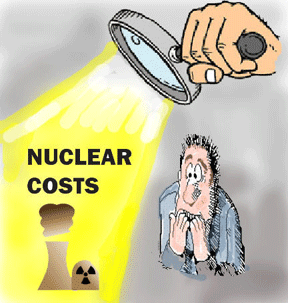
A new Wylfa will cost between £14 and £17bn to build and won’t be up
and running until the 2030s, the UK Government have been told. Sources told
the Times newspaper that the 2.3-gigawatt plant would take six years to
build, on top of a lengthy planning and regulatory process, meaning that it
would not be operational until the early years of the next decade.
Westinghouse and Bechtel, the reactor maker and engineering group, are
hoping to win UK Government backing for their plan to build two reactors at
Wylfa on Anglesey. Their AP1000 reactor design has already completed
initial safety approval for use in Britain. However, Bechtel were hoping to
secure £20m from the UK Government before being able to provide a full
breakdown of the total costs of the project. Ivan Baldwin, head of the UK
civil nuclear market for Bechtel, told the Times that this taxpayer funding
would enable the developer to “provide to the government an estimated
project cost” and “to determine the optimum construction schedule at
the site”.
Hitachi, of Japan, currently own the rights to the Wylfa site
after giving up on their own plans to build a nuclear power plant there.
Dylan Morgan from People Against Wylfa B (PAWB) responded to the
announcement to say that Boris Johnson was just “shooting from the
hip”. “All his bluster about possible new nuclear reactors displays an
astounding level of economic and environmental illiteracy,” he said.
“Firstly, where is the strong economy coming out of Covid and post
Brexit? No nuclear companies will go it alone and invest heavily in
building new nuclear reactors.
“As in the case of Rolls Royce and their
modular reactor which isn’t small at all at 475 MW, bigger than the old
Magnox reactors at Trawsfynydd, they want government public handouts for
designing the reactors, more astronomic handouts financed through our
already vastly inflated electricity bills to construct these radiotoxic
monstrosities, and then even more handouts for an agreed price for
electricity produced, and last but not at all least, the massive
decommissioning costs over thousands of years of reactors and all the
problems with storage of hazardous nuclear wastes.
“There is little wonder that no corporations have come forward in droves to get a nuclear
renaissance much promised from the Blair/Brown era going. “Labelling
Wylfa and Trawsfynydd as possible new sites for this most dangerous, dirty,
radiotoxic, health-threatening and expensive technology is an insult to the
people of Wales. “It is the totally wrong path to tread and it may be the
case that Johnson will not be in office for too long to realise his madcap
nuclear ambitions.”
Nation Cymru 24th May 2022
https://nation.cymru/news/new-wylfa-will-cost-14-17bn-to-build-and-wont-be-ready-until-2030s/
1 This Month





PLEASE OPPOSE HR 8255 AND S.3639 – bills would accelerate satellite deployment, with no environmental review or safeguards – https://ncstd5li.quorum.us/campaign/169331/
To see nuclear-related stories in greater depth and intensity – go to https://nuclearinformation.wordpress.com
-
Archives
- October 2026 (81)
- September 2026 (339)
- August 2026 (330)
- July 2026 (355)
- June 2026 (287)
- May 2026 (306)
- April 2026 (356)
- March 2026 (251)
- February 2026 (267)
- January 2026 (308)
- December 2025 (358)
- November 2025 (359)
-
Categories
- 1
- 1 NUCLEAR ISSUES
- business and costs
- climate change
- culture and arts
- ENERGY
- environment
- health
- history
- indigenous issues
- Legal
- marketing of nuclear
- media
- opposition to nuclear
- PERSONAL STORIES
- politics
- politics international
- Religion and ethics
- safety
- secrets,lies and civil liberties
- spinbuster
- technology
- Uranium
- wastes
- weapons and war
- Women
- 2 WORLD
- ACTION
- AFRICA
- Atrocities
- AUSTRALIA
- Christina's notes
- Christina's themes
- culture and arts
- Events
- Fuk 2022
- Fuk 2023
- Fukushima 2017
- Fukushima 2018
- fukushima 2019
- Fukushima 2020
- Fukushima 2021
- general
- global warming
- Humour (God we need it)
- Nuclear
- RARE EARTHS
- Reference
- resources – print
- Resources -audiovicual
- Weekly Newsletter
- World
- World Nuclear
- YouTube
-
RSS
Entries RSS
Comments RSS

