The whole idea of a GDF (geological disposal facility) is flawed thinking and needs to be revisited.

John Laband https://www.facebook.com/groups/radiationfreelakeland 27 June 22, The whole idea of a GDF (geological disposal facility) is flawed thinking and needs to be revisited. CoRWM (committee on radioactive waste management) must face up to the harsh reality that there is no informed expert opinion that doesn’t acknowledge that the physical barrier between the environment and the high level waste material (spent nuclear fuel rods) will likely break down long before the radioactivity has decayed to safe levels.
What went wrong was the way the committee, 10 yrs ago, dealt with all the alternative suggestions for dealing with the waste material and there were about 10 of them. It literally drew a red line through each of the alternative suggestions and there was no discussion about their merits.
The excuse given was that at the time there was no worldwide precedent or experience of each of them. The exception was the GDF plan which already existed in the USA at Yucca mountain in Nevada and the WIPP pilot project in New Mexico. So the UK approach was to jump on that bandwagon and CoRWM has spent the intervening time trying to induce local communities into accepting their plan for an underground nuclear dump. Including attaching the idea to a plan for an undersea coal mine.
Unfortunately for CoRWM the Yucca mountain site has been abandoned. There is nothing there now except a boarded up exploratory tunnel and an accident has happened at the WIPP site leading to radioactive contamination on the surface.
In addition the US is no longer adding to its fund to provide a national disposal site. It has gone back to dry storage of waste on site in concrete casks.
In my opinion CoRWM needs to abandon it’s one track policy and go back to the drawing board and look at all suggested schemes in detail. In the meantime safe modern storage facilities need to be constructed on the surface and a moratorium adopted on the production of anymore waste from fission reactors.
Cancel any further expansion of nuclear electricity generation and scale down existing facilities to zero. We cannot at the moment handle the mounting pile of high level radioactive waste.
The Chernobyl disaster: Five interesting facts about the worst nuclear accident in history
Was it human error or not?
Interesting Engineering, By Maia Mulko 27 June 22, The Chernobyl disaster occurred on 26 April 1986 at the No. 4 reactor of the Chernobyl Nuclear Power Plant near the city of Pripyat, in the north of Ukraine, in what was then the Soviet Union. It occurred when an RBMK 1000 reactor overheated and exploded during a safety test, releasing at least 5% of the radioactive reactor core into the environment and depositing radioactive material across a wide swathe of Europe.
The explosion itself killed two engineers. Another 28 to 30 operators and firemen who helped fight the blaze died of acute radiation syndrome within a few weeks of the accident, and a number of workers later died of causes related to suspected radiation exposure.
Workers of the plant, firefighters, and residents of the nearby city of Pripyat received dangerous doses of ionizing radiation.
The event also likely had a significant environmental impact. Radiation contaminated drinking water and fish over large distances, destroyed 1.5 square miles (4 square kilometers) of pine forest, and killed or induced mutations in other plants or animals. Large areas of Belarus, Ukraine, Russia, and parts of Europe were contaminated to varying degrees……..
Here are some interesting facts about Chernobyl nuclear disaster.
1) The reactor had design flaws
The Chernobyl disaster is usually attributed to human error. Viktor Bryukhanov, the manager of construction and director of the nuclear plant, was held responsible for the accident and imprisoned for violation of safety regulations in 1987. He was released in 1991.
But now we know that the cause of the accident was most likely a combination of human error and design deficiencies in the Soviet-era RBMK 1000 reactors and that many of these faults were known by Soviet experts but kept secret from Bryukhanov.
1) The reactor had design flaws
The Chernobyl disaster is usually attributed to human error. Viktor Bryukhanov, the manager of construction and director of the nuclear plant, was held responsible for the accident and imprisoned for violation of safety regulations in 1987. He was released in 1991.
But now we know that the cause of the accident was most likely a combination of human error and design deficiencies in the Soviet-era RBMK 1000 reactors and that many of these faults were known by Soviet experts but kept secret from Bryukhanov.
Some of these flaws were:………………………………..
Additionally, the power plant operators weren’t adequately trained to work with this type of reactor. Unaware of its weaknesses, the reactor crew disabled automatic shutdown mechanisms to prepare for a test on the reactor would perform following a loss of main electrical power supply.
As the reactor began overheating, a peculiarity of the design of the control rods caused a dramatic power surge as they were inserted into the reactor, leading to the rapid increase in core reactivity.
2) The real death toll of the disaster is unknown
It took almost two weeks after the explosion for firefighters to put out the graphite-fueled fire.
But the fire wasn’t the only threat, as toxic fumes —composed mainly of fission products iodine-131, cesium-134, plutonium-239, and cesium-137— were still in the air.
Apart from the two engineers killed at the blast, 28-31 emergency workers and plant operators died of acute radiation sickness in the first three months after the accident.
According to the International Atomic Energy Agency (IAEA), there were also 1,800 documented cases of thyroid cancer in children living in the region who were between 0-14 years old at the time of the accident, which is “far higher than normal”. This is likely related to the release of iodine-131, which accumulates in the thyroid.
A 2005 report by the United Nations estimated that up to 4,000 deaths might ultimately result from radiation exposure from the accident..
The Chernobyl nuclear disaster also increased unnecessary induced abortions due to fear of birth defects ……..
3) Evacuations started 36 hours after the accident
Many people in Pripyat —located around 2 miles (3 kilometers) from the Chernobyl Nuclear Power Plant— began suffering from symptoms like headaches and vomiting within a hours after the accident, but an evacuation wasn’t ordered until 36 hours after the accident.
This was likely due to the fact that the Soviet authorities were reluctant to acknowledge first that an accident had occurred and then the full extent of the accident. On April 28, radiation levels set off alarms at the Forsmark Nuclear Power Plant in Sweden, around 620 mi (1,000 km) from Chernobyl. However, when the Swedish government contacted the Soviets, they initially denied an accident had taken place at all and only admitted it once the Swedish government said they were about to file a report
with the International Atomic Energy Agency
Although Pripyat inhabitants were initially told that they would only be away for three days, the Chernobyl Exclusion Zone (officially called the Chernobyl Nuclear Power Plant Zone of Alienation) was created about 10 days later with a radius of 30 kilometers (19 miles) of the nuclear plant.
Residents never went back and Pripyat is a ghost city since then.
The Chernobyl Exclusion Zone now measures approximately 1,000 square miles (2,600 square kilometers). Around 7,000 people live and work in and around the plant (or did until the beginning of the war with Russia), and around 150 have returned to the surrounding villages, despite the risks.
4) The “liquidator” status
Civil and military personnel exposed to radiation while trying to mitigate the effects of the nuclear disaster were termed “liquidators”. Those who worked as liquidators have a similar status to veterans and are entitled to certain social benefits, although many have since complained of a deterioration in their compensation and medical support over time.
Around 600,000 people were granted the status of “liquidator.” They were mainly men and women who worked on the clean-up and decontamination of the area —such as those who removed contaminated debris from the nuclear plant, those who worked on the construction of the “sarcophagus” (a steel and concrete structure to cover the exploded reactor and prevent further contamination), those who helped build settlements for evacuees, etc.
Fortunately, many radioactive elements released into the air are short-lived, but strontium-90 and cesium-137 each have around a 30-year half-life. These elements have been found in lakes, and they are also present in the water and fish of rivers of Ukraine, Russia, and Belarus, as well as in the air of the Chernobyl Exclusion Zone. https://interestingengineering.com/chernobyl-disaster-facts-worst-nuclear-accident
Ukraine shuts down its co-operative agreements with Russia in the matter of nuclear power safety

Ukraine terminates Russia nuclear agreements, WNN, 27 June 2022,
The State Nuclear Regulatory Inspectorate of Ukraine (SNRIU) says it has terminated international agreements concerning cooperation between the country and Russia in the field of nuclear safety
In a statement posted on its website on 27 June, SNRIU said that “due to the military aggression of the Russian Federation, the State Inspectorate for Nuclear Regulation of Ukraine terminates international agreements concerning cooperation between countries in the field of nuclear safety”.
It said the order was signed on 24 June by Acting Chairman Oleg Korikov and terminated an agreement on cooperation between the Ministry of Environmental Protection and Nuclear Safety of Ukraine and the Federal Supervision of Nuclear and Radiation Safety of Russia which was signed in Vienna in September 1996. It also terminates the agreement between the State Nuclear Regulatory Committee of Ukraine and the Federal Nuclear and Radiation Safety Supervision of Russia on the exchange of information and cooperation in the field of safety regulation in the peaceful uses of nuclear energy, which was signed in Moscow in August 2002……………………….
The International Atomic Energy Agency (IAEA) has warned about the number of key nuclear safety rules which have been broken as a result of the military action in and around nuclear power plants, and the continuining occupation of Zaporizhzhia.
IAEA Director General Rafael Mariano Grossi, who has been trying to organise a mission for its inspectors to Zaporizhzhia, said he was becoming increasingly concerned…………….. https://world-nuclear-news.org/Articles/Ukraine.
Campaigners are raising some very awkward questions about the financing of UK’s £20billion Sizewell C nuclear power plant.
Campaigners have raised questions after it was reported funding for a new
nuclear power station on the Suffolk coast is to be signed off by ministers
within a fortnight.
Funding for the £20billion Sizewell C plant is set to
be approved by the government by next month, paving the way for private
investment, according to The Telegraph. The decision would be a major boost
for EDF Energy, which is said to be in advanced talks with the government
over further cash to move the scheme forward ahead of a final investment
decision next year.
Reacting to the funding news, Alison Downes, from the
group, said: “Why do ministers appear willing to throw more cash at
Sizewell C, despite the risk and questionable value for money, when there
is none for hard stretched workers and – as Lord Deben pointed out – when
the nuclear industry ‘doesn’t deliver things on time and it doesn’t
deliver them to budget’?
“Nobody is even owning up to how much Sizewell C
would cost: the last estimate is more than two years out of date.” A
funding deal is not expected until after planning consent for Sizewell C is
granted, with the deadline for that decision set for July 8.
East Anglian Daily Times 26th June 2022
https://www.eadt.co.uk/news/business/sizewell-c-funding-to-be-signed-off-9098750
To Bella Lack – being called a ”snowflake” is a badge of honour
Most teenagers would take offence at being labelled a snowflake, the
disparaging moniker given to young people perceived to be too easily
offended by un-PC terms or environmental damage. For Bella Lack, who at
nineteen-years-old is already one of the UK’s leading environmental
activists, the label is a badge of honour.
“Is it fragile to care about
the future of the planet and our species? I don’t think so,” she says.
“I think it’s quite a powerful term to be honest, because lots of
snowflakes create a snowstorm.” In the UK, the youth climate movement is
largely credited with pushing the UK government to set a target for net
zero emissions by 2050, and for introducing swathes of new environmental
legislation to curb the use of disposable plastic.
Bella has quickly
emerged as one of the leading lights of Britain’s youth activist circles.
She is an ambassador for the Born Free Foundation, spent her teenage years
campaigning on everything from palm oil to circus animals, and spent 2020
filming wildlife documentary Animal alongside Jane Goodall. Her Twitter
account boasts 138,000 followers.
iNews 27th June 2022
Nuclear power turning out to be counter-productive for Europe as a means to cut Russian power supplies – France’s massive decine in nuclear output
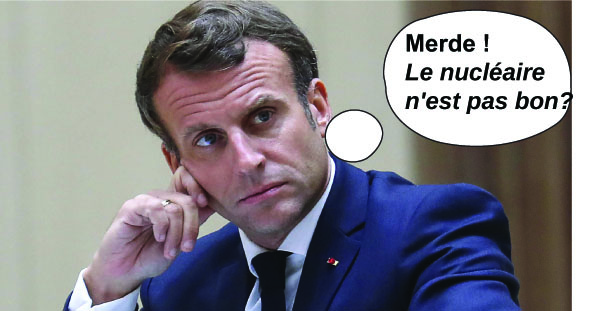
| France, the European Union’s leader in nuclear energy, is seeing a massive decline in output. Though it has been relatively unfazed by the bloc’s ongoing energy crisis, declining nuclear production could pose a significant problem in the coming months. The collapse of French nuclear power generation and Putin’s retaliatory cutback on energy exports to Europe could be disastrous for the continent. A recent flurry of unexpected issues at the Électricité de France (EDF), the state nuclear power operator representing the largest nuclear fleet in Europe, has caused French nuclear energy output to tumble to its lowest levels in 30 years. Around half of the EDF’s massive nuclear fleet has been taken offline, delivering a massive blow to the EU’s energy independence and security in the midst of a worldwide energy crisis. France has become increasingly reliant on nuclear power in recent years. French President Emmanuel Macron has given nuclear energy an even bigger boost in his time in office. Indeed, in February, before the Russian invasion of Ukraine, he announced a €52 billion plan to revitalize the country’s “nuclear adventure.” He has also fought for the inclusion of the emissions-free power source as a “green investment” in the nomenclature of the European Union as the (supposedly !) emissions-free power source as a “green investment” in the nomenclature of the European Union as the continent moves toward establishing its green energy budget for the coming years. The European Union had hoped that France’s considerable nuclear power capacity would be key in allowing the bloc to move away from Russian energy as the West tries to shore up its energy independence and increase sanctions on the Kremlin in response to the Russian war in Ukraine. As recently as March of this year, the Council on Foreign Relations posited that nuclear power could be the answer to ending the continent’s crippling reliance on Russian energy. But now it might be the very thing that makes such a divorce impossible. Oil Price 25th June 2022 https://oilprice.com/Alternative-Energy/Nuclear-Power/France-Sees-Nuclear-Energy-Output-Plummet-At-The-Worst-Possible-Moment.html |
Thousands March in Madrid for Peace and “NATO NO”.

Thousands March in Madrid for Peace and “NATO NO”. https://www.telesurenglish.net/news/Thousands-March-in-Madrid-for-Peace-and-NATO-NO—20220626-0005.html&source=gmail&ust=1656372213390000&usg=AOvVaw3X62tTdIvq0p0thk8VygFj The Sao Paulo Forum, the Women’s International Democratic Federation, Ecologists in Action, Pacifists Foundation; Not to war, Not to Nato; Plataforma Madrid and pacifist associations from France, Germany, Norway, Sweden and Italy, among others, emphasized the need to maintain the protests and not allow NATO to dictate the future. The Summit for Peace “NATO NO” that took place in Madrid, reiterated its rejection of militarism, while expressing its repudiation of the Atlantic alliance, and ended its deliberations with the demonstration from Atocha station to Plaza de España.
Some 10 thousand people marched today through the center of the capital in favor of peace and in rejection of the North Atlantic Treaty Organization (NATO), in particular the Summit for Peace “NATO NO” to be held here.
The parade along the Paseo del Prado, passing by the fountain and the Cibeles palace, took the Gran Vía in a march in which emblematic songs such as El pueblo unido, jamás será vencido, by the Chilean Víctor Jara, and La Muralla, based on the verses of the Cuban poet Nicolás Guillén, stood out.
The demonstrators’ posters and statements were dominated by slogans in favor of peace, repudiation of wars and invasions, interference in the internal affairs of nations through the use of military force and disrespect for the sovereignty of peoples by NATO, as well as harsh criticism of the European Union (EU).
In the Final Declaration of the so-called Madrid counter-summit, the participants from various countries indicated that “NATO 360º has become a threat to peace, an obstacle to progress towards shared and demilitarized security”.
They considered that the Atlantic alliance, which will hold its summit meeting on the 29th and 30th at the IFEMA-Madrid fairgrounds, turns its back on the real problems of the planet, namely hunger, disease, inequality, unemployment, lack of public services, land and wealth grabbing, and the climate crisis.
The alternative summit, for Peace, against NATO and against wars, underlines the obligation as a human species, to build and defend peace 360º, from north to south, from east to west. This implies renouncing militarism as a way of dealing with conflicts, said the declaration of the meeting.
The Sao Paulo Forum, the Women’s International Democratic Federation, Ecologists in Action, Pacifists Foundation; Not to war, Not to Nato; Plataforma Madrid and pacifist associations from France, Germany, Norway, Sweden and Italy, among others, emphasized the need to maintain the protests and not allow NATO to dictate the future.
As world leaders promote nuclear power as SAFE, a dangerous situation develops at Europe’s largest nuclear power plant _- Zaporizhzia in Ukraine !

| Ukraine’s nuclear regulatory agency faces an unprecedented struggle to maintain nuclear safety, most notably including “terrorism against firefighters and nuclear power plant personnel” at the Russian-occupied Zaporozhye nuclear power plant, according to Oleg Korikov, the organization’s beleaguered interim head. Korikov warned fellow Europeanregulators in Europe that Ukraine’s Nuclear Regulatory Inspectorate (SNRIU) is unprepared for further deterioration at Zaporozhye, a six-reactor facility that is Europe’s largest nuclear plant, and is essentially in uncharted waters. “We do not have rules, regulations [for] how we can regulate, how we can operate, in these conditions,” said Korikov. Staff at Zaporozhye “is under heavy psychological pressure of Russian soldiers,” theSNRIU’s acting chairman and chief state inspector told a Jun. 20 meeting of the European Nuclear Safety Regulators Group. There is “kidnapping and attacks on nuclear power plant staff” in Enerhodar, the Russian-occupied city closest to the plant. “We have evidence of this.” This appeared to = confirm what has emerged as one of the most troubling aspects of the situation at Zaporozhye and Enerhodar since both were occupied by Russian troops on Mar. 4: the kidnapping, intimidation, interrogation and torture of Zaporozhye workers. Energy Intelligence 24th June 2022 https://www.energyintel.com/00000181-910f-d7da-adc1-976f35b80000 |
Dispute among Members of European Parliament over move to classify nuclear energy as ”green”
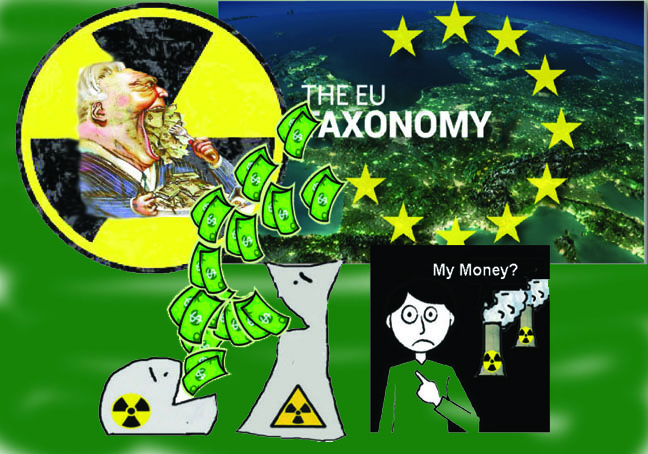
| THERE ARE DISAGREEMENTS between Government party MEPs on whether or not the EU should classify nuclear energy as green, as the European Parliament prepares to vote on the issue next month. The debate is being held after the European Commission sought changes to regulations to classify both nuclear power and gas as green energy until at least 2030. These regulations, known as ‘taxonomy’, are a set of multiple standards to help grow sustainable investment. The idea behind taxonomy is to encourage the financial sector to prioritise investing in eco-friendly and green initiatives. While MEPs within the European Parliament’s environment and economy committee voted down the proposals to add gas and nuclear power last week, a full vote is set to take place in Strasbourg in July. This has lead to significant debate between MEPs within the European Parliament, with some criticising the move by the Commission to add natural gas and nuclear power to the deal. The debate has also split Government MEPs, with some in Fianna Fáil and Fine Gael backing the change to taxonomy rules while the Green Party remain opposed to the Commission’s position. The Journal 25th June 2022 https://www.thejournal.ie/government-split-on-nuclear-power-5798800-Jun2022/ |
Rolls Royce wants fast-track approval of its small nuclear reactors, even though they are barely developed yet
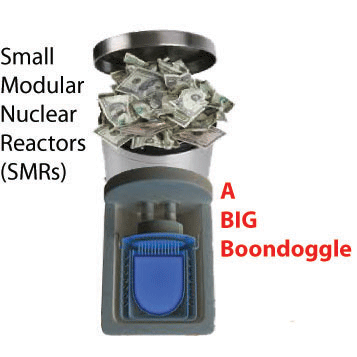
| Rolls-Royce is urging the UK Government to fast-track approval of its small modular nuclear reactors, despite the technology still being in the early stages of development. Trawsfynydd has been identified as a possible site for the reactors, and earlier this week the company established to develop a new reactor there set out plans to start work on a new nuclear development in 2027 – with the plant expected to go online in the early 2030s. UK Government sources have insisted the new reactors must go through exhaustive safety checks, but Rolls-Royce wants clearance to deploy its reactors from 2029 and is frustrated at the pace of the process to gain approval, which is not expected to be completed until 2026. Nation Cymru 25th June 2022 https://nation.cymru/news/uk-government-urged-to-fast-track-safety-approval-on-reactors-linked-with-trawsfynydd/ |
Nuclear Free Local Authorities support Cumbria’s new group opposing Nuclear Waste Dump
The Nuclear Free Local Authorities have written to a new group in Cumbria
endorsing their opposition to plans to develop a nuclear waste dump. Millom
and District Against the Nuclear Dump was only established a few days ago
by a town resident and Councillor, yet the strength of feeling is such that
several hundred local people are now already backing the campaign.
Public feeling is currently running high after recent revelations by the local
campaign group, Radiation Free Lakeland, that seismic testing is due to
take place offshore over the summer. Environmentalists, marine welfare
organisations, residents, and the NFLA have all expressed their opposition
to the testing regime as there is strong scientific evidence that blasting
sound waves into the ocean repeatedly over 3-4 weeks will cause real harm
to marine wildlife.
Millom and District Against the Nuclear Dump is the latest group to manifest its opposition to testing, and in conjunction with Radiation Free Lakeland’s campaign, ‘Keep Cumbrian Coal in the Hole and
Nuclear Waste Out’, there are now joint plans to hold a public protest in
Haverigg this coming Saturday.
Now the Chair of the NFLA Steering
Committee, Councillor David Blackburn has written to the group’s founder,
Jan Bridget, offering the support of Nuclear Free Local Authorities to the
new group. Councillor Blackburn outlined the NFLA’s position on GDF:
“The NFLA has been opposed to a Geological Disposal Facility from the
start. Rather than dumping Britain’s nuclear waste in a big hole in the
ground or under the seabed, we favour near-site, near-surface storage under
rigorous supervision.
NFLA 24th June 2022
Russia to send Belarus nuclear-capable missiles within months, as G7 leaders gather in Germany,
Vladimir Putin again raises nuclear threat during Moscow’s invasion of Ukraine, as Olaf Scholz hosts G7 leaders to discuss energy and food crisis, Guardian. 26 June 22
Russia will deliver missiles capable of carrying nuclear warheads to Belarus in the coming months, President Vladimir Putin has said as he received Belarusian leader Alexander Lukashenko.
“In the coming months, we will transfer to Belarus Iskander-M tactical missile systems, which can use ballistic or cruise missiles, in their conventional and nuclear versions,” Putin said in a broadcast on Russian television at the start of his meeting with Lukashenko in St Petersburg on Saturday.
Putin has several times referred to nuclear weapons since his country launched a military operation in Ukraine on 24 February, in what the west has seen as a warning not to intervene. Lukashenko said last month that his country had bought Iskander nuclear-capable missiles and S-400 anti-aircraft anti-missile systems from Russia.
The development came on the eve of a meeting of G7 leaders in Germany on Sunday, to be hosted by Chancellor Olaf Scholz in the Bavarian alps, which is set to be dominated by Ukraine and its far-reaching consequences, from energy shortages to a food crisis.
The G7 leaders are expected to seek to show a united front on supporting Ukraine for as long as necessary and cranking up pressure on the Kremlin – although they will want to avoid sanctions that could stoke inflation and exacerbate the global cost-of-living crisis……………………………….. https://www.theguardian.com/world/2022/jun/26/russia-to-send-belarus-nuclear-capable-missiles-within-months-as-g7-leaders-gather-in-germany
No Western ”boots on the ground” in Ukraine? Just commandoes and CIA agents
Western ‘network of commandos and spies’ helping Ukraine – NYTCIA agents have been stationed in Kiev to share US intel with Ukrainian troops, the report claims https://www.rt.com/news/557848-us-cia-agents-kiev/ NATO members have been supplying Ukraine with heavy weapons, including missile launchers, combat drones and armored vehicles, and training Ukrainian troops to use them. In recent months, the Pentagon has delivered M142 HIMARS multiple rocket launchers and M777 howitzers.
US Defense Secretary Lloyd Austin said last week that Ukraine was facing “a pivotal moment on the battlefield” and urged Washington’s allies to continue aiding Kiev.
The report about the activities of Western commandos and CIA agents in and around Ukraine comes as a three-day Group of Seven (G7) summit kicks off in Germany on Sunday. The group, which comprises of the US, Canada, Britain, France, Germany, Italy and Japan, which have imposed sweeping sanctions on Russia.
Moscow has said in the past that it will treat foreign weapons, on Ukrainian soil, as legitimate targets.
A secret network of commandos and spies from the US, and some of its allies, is working to provide weapons, intelligence and training to Ukraine, the New York Times (NYT) reported on Saturday, citing current and former American and European officials.
While much of the activity takes place at bases in Britain, Germany and France, some CIA agents have been stationed in the east European country, mostly in the capital Kiev, the paper said.
The agents are tasked with sharing satellite images and other intelligence with Ukrainian troops, according to the story.
The US announced the evacuation of military instructors from Ukraine in February. Shortly afterwards, Russia launched its military campaign and the US Army’s 10th Special Forces Group set up a planning cell in Germany to coordinate military aid to Kiev, the paper explained. The group has reportedly grown to include participants from 20 nations.
The NYT added that “a few dozen commandos” from other NATO member states, including Canada, Britain, France and Lithuania, have also been working in Ukraine.
NATO members have been supplying Ukraine with heavy weapons, including missile launchers, combat drones and armored vehicles, and training Ukrainian troops to use them. In recent months, the Pentagon has delivered M142 HIMARS multiple rocket launchers and M777 howitzers.
US Defense Secretary Lloyd Austin said last week that Ukraine was facing “a pivotal moment on the battlefield” and urged Washington’s allies to continue aiding Kiev.
The report about the activities of Western commandos and CIA agents in and around Ukraine comes as a three-day Group of Seven (G7) summit kicks off in Germany on Sunday. The group, which comprises of the US, Canada, Britain, France, Germany, Italy and Japan, which have imposed sweeping sanctions on Russia.
Moscow has said in the past that it will treat foreign weapons, on Ukrainian soil, as legitimate targets.22
Radiation Free Lakeland joins local Haverigg Protest against the GDF (Nuclear Dump)
Today I was delighted to be able to represent LAND our Radiation Free
Lakeland campaign at the Protest against the GDF 2plans by
Locals. Twenty locals turned up today in Haverigg to protest the siting of
a Geological Disposal Facility aka Nuclear Dump for heat generating nuclear
wastes under the Irish Sea off the Millom/Haverigg coast and to stop the
seismic surveys. Millom and District Against the Nuclear Dump have a
private Facebook group with 344 members (in less than a week – mostly
locals).
Radiation Free Lakeland 25th June 2022
A despicable Ukrainian PSYOP in Bucha
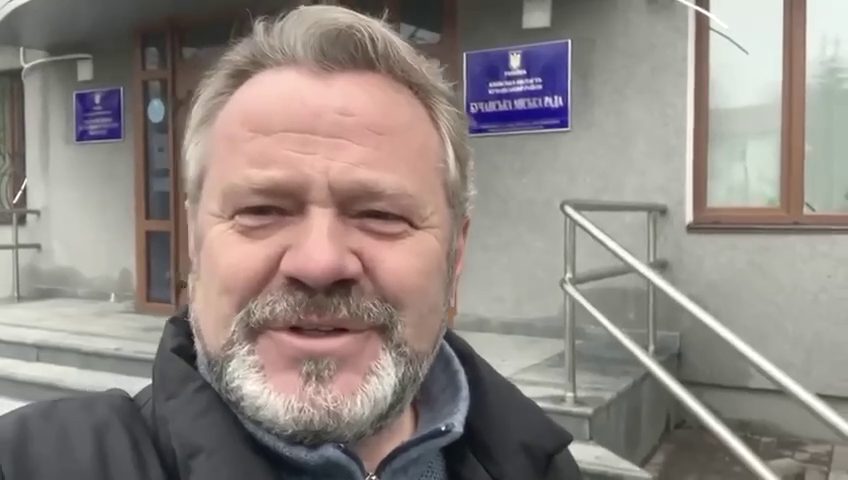
2:31 pm UT, April 1 Bucha Mayor Fedoruk does NOT mention murders of civilians – Bisher ist Alles in Ordnung ! (So far everything is fine.!)
Truth is the first casualty in war – Ethel Annakin, 1915
Nicolas Cinquini senior intelligence analyst in the field of security risk management, I am a former intelligence officer and lieutenant detective within French State agencies 24 June 22 [Excellent maps and photos on original]
On April 4, 2022, the Western media are roaring against Russia, about the slaughter of civilians in Bucha, a town in Kiev northwestern suburb, Ukraine. The dates and sites of the killings are unknown. The identities of the victims are unknown. The sources are Ukrainian, directly or indirectly officials whose assertions are widely admitted. I am a long time fan of the British media and tabloids. In the United Kingdom, the buzz is a gradient, from Civilians ‘shot in the street’ [The Times] to Putin last atrocities, GENOCIDE [Daily Mirror]. Here is the cover of The Guardian [on original – the title reads – ”Horror in Bucha: Russia Accused of Torture and Massacre of Civilians”]
On April 3, French president Emmanuel Macron has already written on Twitter
the images reaching us from Bucha, a liberated town near kyiv, are unbearable. In the streets, hundreds of cowardly murdered civilians. My compassion for the victims, my solidarity with the Ukrainians. The Russian authorities will have to answer for these crimes.
Yet, some journalists have learned how to investigate and State intelligence agencies are supposed to deliver reliable information to the politicians. I am wondering what are the shares of bad faith and hysteria.
By the way, what happened in Bucha and when ?
The military context………………………
- 11:00 pm UT, March 28
Jomini of the West is a Western military analyst, a
polemologist writer and speaker on all things related to human conflict. #Fortuna Podcast ; discussions on waging peace, surviving war, and the fate of Humankind,
who is making analytical assessments and nice maps.
On March 28, Bucha is on the front line and Ukraine forces are counterattacking [map on original]
Jomini won’t make new assessment or map in the region of Kiev before March 31.
- 9:20 pm UT, March 31
On social networks, Ukrainian channels are sharing a video recorded from drone in broad daylight : the Russian forces have left Antonov airport, which is north of Gostomel, which is north of Bucha.
the Russians are conducting a strategic retreat in good order. If they have withdrawn from Antonov airport, a fortiriori, they have left Gostomel and Bucha
- 11:00 pm UT, March 31
The Russian forces are conducting a retreat in good order on the right bank (left on the map) of the Dniepr. The front line is now north of Ivankiv, about 60 km north of Bucha, that the Ukrainian forces are controlling, far behind their new lines. Some wooden areas need to be searched north of Bucha, because Russian elements may remain there. The retreat is conducted in good order and I don’t think that Russian servicemen have been isolated [Map on original]
- 2:31 pm UT, April 1
Anatoliy Fedoruk is the mayor of Bucha. Ecstatic, he publishes on Facebook a video from the town, says […]
March 31 will go down in the history of our Bucha community as the Day of Liberation. The liberation by our Armed Forces of Ukraine from Russian orcs [sic], from Russian occupiers. So today, I state that this day is joyful. Joyful and this is a great victory in Kyiv region ! And we will definitely wait so that there is a great victory all over Ukraine […]
> according to cross-checked information from various sources, the Ukrainian forces are controlling Bucha since March 31. I have found no trace of fresh fighting in the town. On April 1, the Ukrainian administration is back, the SBU (State security) and its PSYOP department too.
Fedoruk does NOT mention murders of civilians
We know that the Ukrainian forces are controlling Bucha since March 31. On April 3, the Russian defense ministry will state that its army have left the town on March 30. There was no urban warfare, the Ukrainians came in the day after.
On April 1, nobody mentions murders of civilians.
The liberation of Bucha – Bisher ist Alles in Ordnung ! (So far everything is fine.!)
We know that the Ukrainian forces are controlling Bucha since March 31. On April 3, the Russian defense ministry will state that its army have left the town on March 30. There was no urban warfare, the Ukrainians came in the day after.
On April 1, nobody mentions murders of civilians.
The liberation of Bucha
- 5:48 pm UT, April 2
AFP (Agence France Presse) writes on Twitter
#BREAKING Almost 300 people buried in ‘mass grave’ in Bucha outside Kyiv: mayor [Anatoliy Fedoruk]
> More than 25 hours after his ecstatic video from the town, two days after its liberation, Fedoruk speaks by phone with a Western news agency, about dead civilians and a mass grave.
Actually, Ukrainian web users are sharing an amateur video, allegedly from Bucha, since 0:15 am. It has been recorded in broad daylight, probably the day before, April 1. A few corpses are scattered in the middle of a street.
300 was already, according to the Ukrainian authorities, the number of vicitms of the alleged Russian airstrike against the Drama theater in Mariupol, Donbass, on March 16.
- 5:52 pm UT, April 2
At the same time, the official website of the Ukrainian national police publishes an article and photos about its operations in Bucha, since its liberation on March 31 […]
today, April 2, in the liberated city of Bucha, Kyiv region, special units of the National Police of Ukraine began clearing the area of saboteurs and ACCOMPLICES of Russian troops […]
The involved units are special purpose [I am in Love with euphemism] formations. But their names are evocative : Safari, Kord, Thor.
> Released in the afternoon of April 2, two days after the liberation, three days after the Russian retreat, an official Ukrainian article does NOT mention murders of civilians
- 6:41 pm UT, April 2
The AFP (Agence France Presse) adds on Twitter […]
as witnessed by @AFP, he [Anatoliy Fedoruk] said the heavily destroyed town’s streets are littered with corpses […]
- 9:48 pm UT, April 2
The AFP (Agence France Presse) adds on Twitter […]
in the town of Bucha, AFP reporters saw at least 20 bodies on a single street including one with his hands tied […]
> The AFP photographer is Ronaldo Schemidt, a Venezuelan one and a reliable source. His pictures from Bucha are now famous. I won’t share here images of the corpses, which are about two dozens at all, in various sites. They seem still fresh, but a coroner could assert it. They are dressed like civilians. Some are wearing WHITE ARMBANDS, which are the usual identification mark of Russian troops, some others with hands tied in the back with identical white bands.
Some victims were clearly carrying Russian food rations. The Russian army is widely dispensing food rations in the areas under its control. But in Ukrainian nationalist opinion, to accept such ration is an act of treason.
Here is an enhanced screenshot from an amateur video which is shared on social networks the same day [on original]
> The death toll is finally 57, not 300 [Anatoliy Fedoruk] nor hundreds [Emmanuel Macron] The trench is so far the unique mass grave in Bucha, where Ukrainians are CURRENTLY burying the corpses which were previously lying in the streets.
They are NOT conducting forensic investigations. The ABCs of such criminal probe are the identification of each victim, dating and map of each corps, identification of the causes of each death. As we already know, the cops are abounding in Bucha. Why do they not conduct these elementary tasks ?
My expertise
The Russian troops have withdrawn from Bucha on March 30. The Ukrainian forces have occupied the town on March 31. The clearing of Russia accomplices has begun. Nobody claimed it or took credit. But CRASH ! on April 2 : web users have started to share an amateur video which was showing corpses scattered in a street on April 1. The Ukrainian authorities have taken the chance to accuse Russia, with the usual complaisance of Western media and politicians.
Finally, without forensic investigation, 57 people have been buried in a mass grave on April 3. They were Russia accomplices, whom Ukrainian death squads have assassinated, maybe also some fatalities of the previous fighting.
Facts are not the friends of Ukraine and its allies
Scott Ritter, former US intelligence officer on April 4, 2022
Postscript
While the European Union is emerging as no more than a free trade area within NATO, its German president, Ursula von der Leyen, on April 8, visits Bucha, which will become a PR scene for Western politicians.
The disgrace is not that Leyen is a poor actress. The climax of the staging is that one week after the alleged Russian massacre, a bundle of filled body bags, maybe victims inside, are still lying on the ground in the open. Did they wait there for her ? Have they been displaced like movie sets ? The film crew is so disrespectful of the dead, so contemptuous of the public intelligence, so inhuman. https://nicolascinquini.blog/2022/04/04/a-despicable-ukrainian-psyop-in-bucha/
1 This Month





PLEASE OPPOSE HR 8255 AND S.3639 – bills would accelerate satellite deployment, with no environmental review or safeguards – https://ncstd5li.quorum.us/campaign/169331/
To see nuclear-related stories in greater depth and intensity – go to https://nuclearinformation.wordpress.com
-
Archives
- October 2026 (81)
- September 2026 (339)
- August 2026 (330)
- July 2026 (355)
- June 2026 (287)
- May 2026 (306)
- April 2026 (356)
- March 2026 (251)
- February 2026 (267)
- January 2026 (308)
- December 2025 (358)
- November 2025 (359)
-
Categories
- 1
- 1 NUCLEAR ISSUES
- business and costs
- climate change
- culture and arts
- ENERGY
- environment
- health
- history
- indigenous issues
- Legal
- marketing of nuclear
- media
- opposition to nuclear
- PERSONAL STORIES
- politics
- politics international
- Religion and ethics
- safety
- secrets,lies and civil liberties
- spinbuster
- technology
- Uranium
- wastes
- weapons and war
- Women
- 2 WORLD
- ACTION
- AFRICA
- Atrocities
- AUSTRALIA
- Christina's notes
- Christina's themes
- culture and arts
- Events
- Fuk 2022
- Fuk 2023
- Fukushima 2017
- Fukushima 2018
- fukushima 2019
- Fukushima 2020
- Fukushima 2021
- general
- global warming
- Humour (God we need it)
- Nuclear
- RARE EARTHS
- Reference
- resources – print
- Resources -audiovicual
- Weekly Newsletter
- World
- World Nuclear
- YouTube
-
RSS
Entries RSS
Comments RSS

