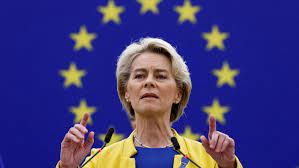
Ukraine Hawk Who Heads European Commission Has a Nazi Pedigree She Does Not Want You to Know About.
Covert Action, By Evan Reif, February 17, 2023
Her father Ernst Albrecht, President of the German state of Lower Saxony from 1978 to 1990, brought unrehabilitated Nazis into his administration and carried out a black-flag terrorist operation designed to discredit the left-wing Red Army Faction.
In the wake of the Russo-Ukrainian war, terms like “European values” have come back into the mainstream. One of the people who has been most responsible for this is Ursula von der Leyen, the president of the European Commission who is now a nearly omnipresent figure in the media.
According to Ursula, “European values” represent only the highest attributes of humankind: freedom, justice, solidarity, and rule of law.
Of course, anyone with even a passing knowledge of history can tell you that these are nothing but euphemisms. Not long ago, “European values” meant something very different. Those values drew the borders of the world in oceans of blood, both of Europeans and those they conquered. A look at the history of Ursula’s aristocratic European family can show us the true face of these “European values” and how the ruling class profited from imposing them on the world.
Sins of the Father
“If we succeed in bringing people of above-average capabilities to governance an autocracy or the rule of the few will be able to create a better order than the rule of the people.” – Ernst Albrecht
Ursula von der Leyen is the scion of two aristocratic German families. She was born Ursula Albrecht, the daughter of a prominent European bureaucrat, CDU party leader, and former governor of Lower Saxony, Ernst Albrecht. The family carefully nurtured a cosmopolitan image as Ernst spent most of his life working for the EU and various precursor organizations. Growing up, Ursula was nicknamed “Röschen” (Rosie in English) by her father, and images of the happy family featured heavily in her father’s political advertisements……………………………………………………………………….
The rank-and-file of the Nazi regime, the army of people who physically made the Nazi machine do the murderous work of subjugating and exterminating an entire continent went almost entirely unpunished for their crimes.
In the case of people like Hans von der Groeben, they were rewarded with jobs in the new “de-Nazified” West German government. Despite the pretenses of a new Germany, only the names changed. The same bureaucrats labored toward the same goal, the destruction of the Soviet Union and its people, by any means necessary. The state machinery once called the Greater German Reich had now simply been absorbed into a new structure, now called the North Atlantic Treaty Organization (NATO).
Now in the position of the deputy, Ernst Albrecht took on the same role his boss had in the 1940s, this time with “blood and soil” replaced with “European values.”
Although Ernst Albrecht was a few years too young to have been a Nazi himself, throughout his long political career he made his sympathies very clear. Ernst was an elitist dripping with contempt for the common people and wanted to bring about what he deemed elite rule in Germany as opposed to the rule of the “uninsightful” mob. Given that he never missed a chance to venerate the Third Reich and its killers, it is very clear whom Ernst considered elite………….
During his time as leader of the Christian Democratic Union (one of Germany’s two largest political parties) government of the German state of Lower Saxony, Ernst successfully wooed members of the neo-Nazi Deutsche Reichspartei (DRP) into the ranks of the CDU………………
When he came to power, one of the elites Ernst entrusted to rule was his justice minister, a jurist by the name of Hans Puvogel. Once again, he picked a fanatical Nazi. …………………………… as far as anyone knows he went to the grave a committed Nazi. For his part, Ernst Albrecht simply never mentioned it. The strategy of simply pretending the Third Reich never existed paid off once more as Albrecht himself faced no real consequences.
……………. Ernst did not just work for Nazis, fill his cabinet with Nazis and invite Nazis into his party; he also spent a great deal of time courting Nazi voters. Ernst and his deputies were fixtures at Nazi veteran events throughout Lower Saxony.
Albrecht’s deputy minister, close friend, and Nazi officer Wilfried Hasselmann even gave the keynote speech at a Knight’s Cross Association dinner in 1978, in which he venerated the worst killers of Hitler’s Reich as brave and honorable men, whose courage was an example for future generations who would be inspired by their “European values.”……………………………………………………………………………
It is not at all unfair to ask where Ursula von der Leyen’s family’s money and power came from, and what they did to earn it, especially given that Ursula has benefitted enormously from her family’s wealth and connections to further her own career, which can stand on its own as an example of corruption, severe scandal, incompetence and, possibly, even outright treason. Her time as a politician shows that Ursula’s apple has not fallen far from the Albrecht family tree.
Ursula first entered politics in 2003 when she was defeated via technicality in a Hanover regional election primary by CDU stalwart Lutz von der Heide. This was unacceptable for Ursula’s father Ernst, who launched a full-court press alongside his old deputy and Wehrmacht artillery officer Wilfried Hasselmann.
The two set to work both campaigning for Ursula and smearing her opponent, who had held the seat for more than 15 years at this point. At the time, Ursula had a long-running column in far-right tabloid Bild, a newspaper founded by ex-Nazi propagandist and CIA asset Axel Springer which has been sanctioned dozens of times for violations of German law and, through this, she was able to effectively amplify their attacks on von der Heide. Soon, all of Germany was reading the latest dirt about a primary for a small regional election.
The campaign was decisive and, in the second round of voting, Ursula won by a two-thirds majority. It was a safe seat so, as the new CDU candidate, Ursula was elected easily. Considering this, it is impossible to separate Ursula von der Leyen from her father’s legacy.
Two years later, she was picked by Angela Merkel to serve as Minister of Labor and Family Affairs, despite her almost non-existent political experience. In this role, she was mostly noted for cutting social services for the blind and trying to ban heavy-metal albums, a resumé that would not seem to justify further promotion.
Despite this, she was promoted to Minister of Defense in 2013, a move which baffled the opposition. It was here that the “European values” of Ursula von der Leyen began to show their shape once more.
Ursula’s mandate was to expand and increase readiness of the Bundeswehr, and she set about the job with gusto. She began a constant drumbeat for war, arguing that the German army was too small and unprepared to face whatever new enemy she conjured up on that day. Be it Afghanistan, Iran, China, Russia or Syria, Ursula consistently advocated for more weapons, more war, and more money. Ursula even proposed a German foreign legion to bolster the ranks of the Bundeswehr, a proposal that was met with horror and condemnation from all sides.
Almost immediately, she said that the ministry required outside help and hired one of the favorite and most criminal consultants of the neo-liberal political class, the CIA-affiliated McKinsey…….. McKinsey’s tendrils reach into governments and corporations throughout the world, and it exemplifies the “revolving door” among government, intelligence and big business.
It was more than just a consultancy: McKinsey was given direct control of the ministry, with consultant Katrin Suder awarded a new position inside the ministry to “reform the armaments sector.” Ursula shoveled nearly half a billion euros into the coffers of McKinsey and others for “consulting” services, and received absolutely nothing in return. The unelected Suder was seen so often beside von der Leyen that the opposition joked she was Ursula’s new bodyguard.
This brazen corruption became known as the “consultant affair” and was so severe that it led to a parliamentary inquiry, with opposition from both the left and right demanding answers from von der Leyen. Ursula responded mostly by stonewalling, simply refusing to answer questions or provide information, eventually destroying evidence of her misdeeds before she could be brought before Parliament. As there was no evidence, the inquiry failed. For her role in the affair, Katrin Suder was awarded the Bundeswehr Cross of Honor by von der Leyen.
The scandal was so serious, so brazen and so utterly baffling that the opposition Social Democratic Party openly accused Ursula von der Leyen of treason, working in the interests of the United States government as opposed to Germany:
As Federal Defense Minister, von der Leyen behaved as the U.S. President wanted when he called for increase in military spending: higher military budgets, increased armaments instead of disarmament. And although this minister got into trouble because of her high spending on consulting firms and various personnel decisions and was anything but a role model, she became President of the EU Commission. That is a key function and it is important for the U.S.
The decision for von der Leyen happened quietly backstage. No sensible person can explain why she was given this important office. A partial explanation is that she had the support of important countries from Eastern Europe. The United States has a great influence on these states.
In the first major critical case, von der Leyen immediately and unequivocally represented the U.S. position, where she said Iran itself is to be blamed for the confrontation in the Middle East and for the execution of the Iranian general. With her, the United States can probably also stake a claim on other occasions and play a key role in shaping the internal structure of the European Union. Ursula von der Leyen is the perfect example of an ‘agent of influence.’
– Albrecht Müller, SPD member of parliament January 2, 2021
……………………… Further investigations in 2019 revealed that the special forces unit was not only infested with open neo-Nazis, but they had been actively planning to overthrow the German government for at least three years. Furthermore, despite being repeatedly warned, Ursula von der Leyen and her army of consultants had at best done nothing and at worst actively exacerbated the issue…………………
Despite all of this, Ursula was considered a favorite to succeed Jens Stoltenberg as secretary general of NATO. Given the alliance’s history with Nazis, it should be no surprise that her ties to the far right were either ignored or, more likely, counted in her favor.
The reason Ursula was not chosen was because she had once again failed upwards and had already been elected president of the European Commission in a close election which she won despite almost universal condemnation from German politicians both from her own party and the opposition. ……………
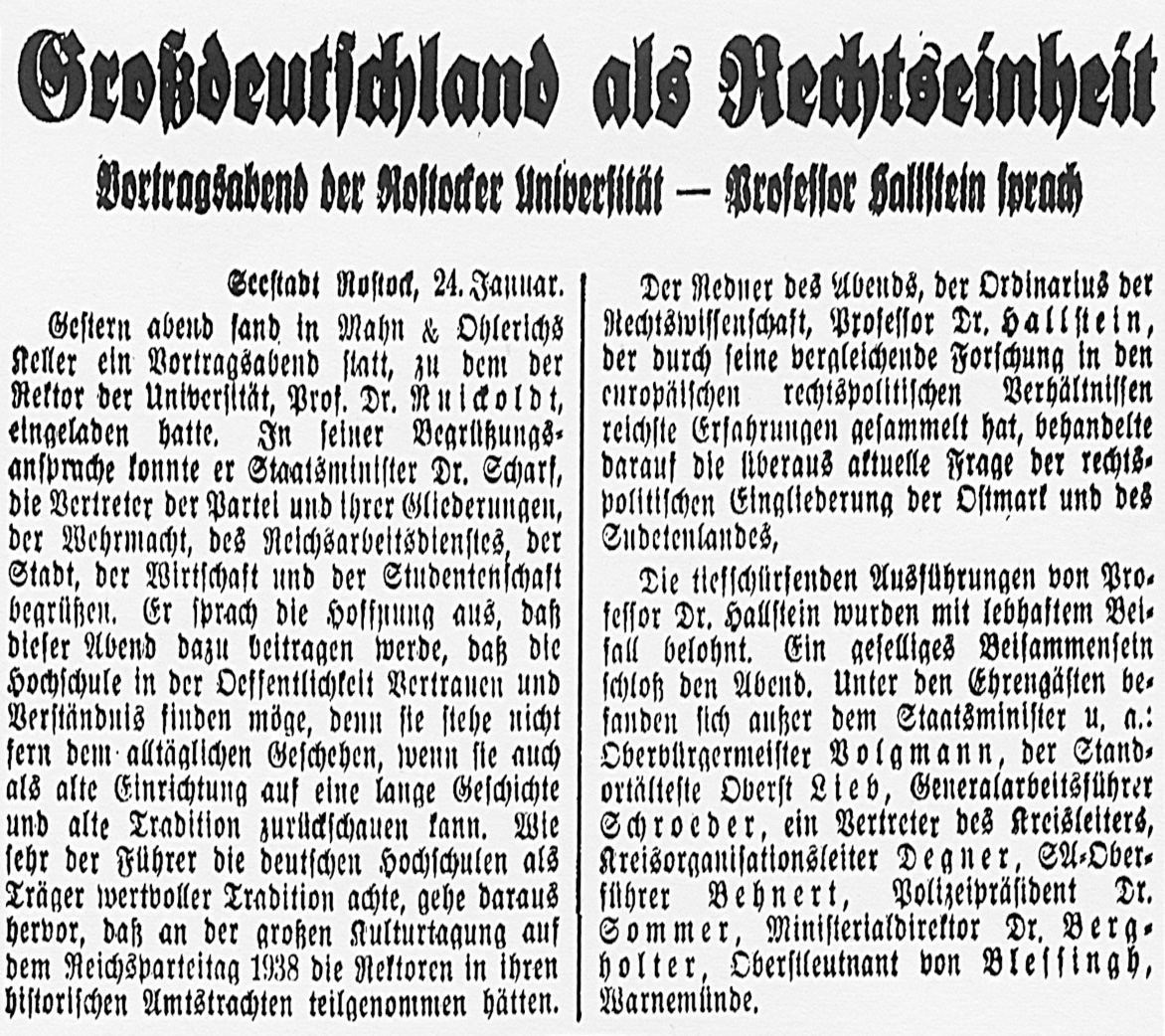
Ursula was the first woman to hold this position, and the second with any connection to the Nazis: Former Wehrmacht artillery officer and Nazi law professor Walter Hallstein had gotten his start in politics arguing for the virtues of the Nuremburg race laws as a young man, demonstrating his lifelong commitment to “European values.”
It was from her new platform in Brussels that the whole world got to see the “European values” of Ursula von der Leyen. After the outbreak of war in Ukraine, Ursula has dominated the news as one of the most forceful and steadfast advocates for more war, more sanctions and more weapons……………. more https://covertactionmagazine.com/2023/02/17/ukraine-hawk-who-heads-european-commission-has-a-nazi-pedigree-she-does-not-want-you-to-know-about/
Despite massive losses of nuclear company EDF, and reactor corrosions, France plans to build a new fleet of EPR reactors.
Despite corrosion leaving nearly half of French atomic power fleet idle
last year and huge cost overruns at new construction, state-backed power
comapny insists on building even more reactors.
A plunge in nuclear power
output related mostly to inspections and repairs for stress corrosion that
left nearly half of France’s atomic generation fleet idled for much of last
year has cost EDF €29.1bn ($30.99bn), pushing the embattled state-owned
utility into a massive loss.
Forty-three of the company’s 56 reactors are
currently operational again, up from only 30 at the beginning of November
2022. But last year’s decline in nuclear output – which the company had to
compensate for with power purchases at a time when market prices were very
high – linked to the impact of price caps for French consumers last year,
triggered a loss in generation and supply segment earnings before interest,
taxes, depreciation and amortisation (Ebitda) of €23.14bn.
Gains in other
areas, such as regulated activities or renewables were not able to
compensate for the nuclear drain on finances. That was the main cause of a
€17.94bn net loss for the entire group, compared to a €5.11bn net
profit in 2021.
Despite the massive losses at EDF, as well as dozens of
billions in cost overruns and decade-long delays at the construction of a
new EPR (European Pressurised Reactor) at Flamanville, French President
Emmanuel Macron last year launched a programme to build six further EPRs in
France, with the option for eight more at later stage.
Recharge 17th Feb 2023
Ukraine Presses US Congress Members for F-16 Jetfighters
Sunday, 19 February, 2023 -Asharq Al-Awsat
Ukrainian officials have urged US Congress members to press President Joe Biden’s administration to send F-16 jetfighters to Kyiv, saying the aircraft would boost Ukraine’s ability to hit Russian missile units with US-made rockets, lawmakers said.
The lobbying came over the weekend on the sidelines of the Munich Security Conference in talks between Ukrainian officials, including Foreign Minister Dmytro Kuleba, and Democrats and Republicans from the Senate and House of Representatives.
“They told us that they want (F-16s) to suppress enemy air defenses so they could get their drones” beyond Russian front lines, Senator Mark Kelly, a former astronaut who flew US Navy fighters in combat, told Reuters on Saturday evening.
Biden last month said “no” when asked if he would approve Ukraine’s request for Lockheed-Martin-made F-16s.
Four delegations from the Senate and House combined in what members called the largest number of US lawmakers to attend Europe’s premier security gathering since it started in 1963, demonstrating clear bipartisan support for Ukraine…………………………
Calls to supply Ukraine with advanced jetfighters follow agreements last month by France, Britain, the United States and Germany to supply Kyiv with modern battle tanks…….. https://english.aawsat.com/home/article/4167481/ukraine-presses-us-congress-members-f-16-jetfighters
Extending more than two nuclear reactors is dangerous, says deputy prime minister Gilkinet
He challenged the MR bill to extend three reactors: “We are talking about nuclear reactors with single-walled tanks, honeycombed tanks, with hydrogen bubbles. We are talking about power stations that do not meet the conditions of resistance to seismic shocks, to the fall of an aeroplane… I remind you that Tihange is on the axis of the Bierset airport. The international safety standards are essential.”
19 February 2023, By The Brussels Times with Belga
Extending more than two nuclear reactors would be dangerous, warned Ecolo deputy prime minister Georges Gilkinet in an interview with Le Soir published Saturday. The minister opposes the MR’s proposal to extend the life of the three other units still in operation.
As the energy uncertainty brought on by the Ukraine crisis continues, De Croo’s Vivaldi government has reconsidered the question of Beligum’s nuclear power, which it had long been due to phase out.
for Georges Gilkinet, whose party has historically opposed any prolongation of Belgium’s reactors, “we will continue to push for the closure of the plants. The current plans to close five reactors have not been changed.” To prevent the real possibility of blackouts, the deputy prime minister speaks of “modulation” of three reactors rather than “extension”.
He challenged the MR bill to extend three reactors: “We are talking about nuclear reactors with single-walled tanks, honeycombed tanks, with hydrogen bubbles. We are talking about power stations that do not meet the conditions of resistance to seismic shocks, to the fall of an aeroplane… I remind you that Tihange is on the axis of the Bierset airport. The international safety standards are essential.” https://www.brusselstimes.com/belgium/374759/extending-more-than-two-nuclear-reactors-is-dangerous-says-gilkinet—
Post-war Ukraine – a triumphal land owned by Western business corporations.
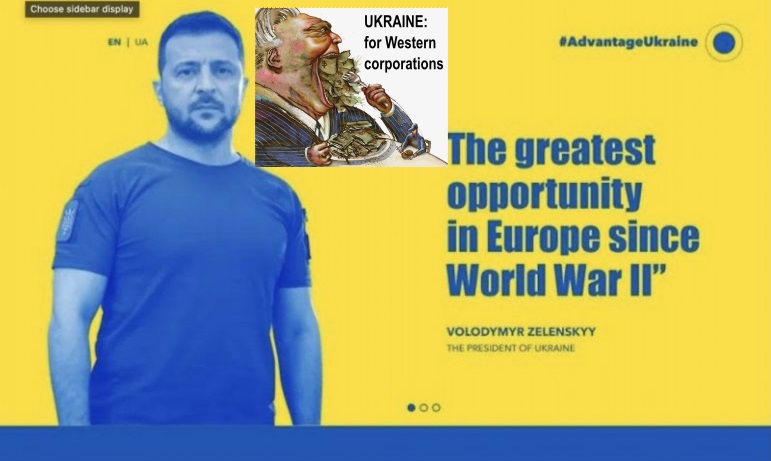
tough neoliberal policies to be imposed on post-war Ukraine, with calls for cutting labour laws , “opening markets”, lowering tariffs, deregulating industries and “selling state-owned enterprises to private investors”.
Zelensky invited foreign companies to come and exploit its abundant resources and cheap labour and offered Wall Street “a chance to invest … in projects worth hundreds of billions of dollars”.
Along with the nature of the arms being supplied, so have the objectives changed, at least the stated ones. We started, so it seems, to help Ukraine defend itself against Russian invasion, then we began talking about a “Ukrainian victory” to inflict a “strategic defeat” on Russia that would leave it “weakened”, with the fall of the Putin government. We have now reached the point that a former Polish foreign minister, currently a MEP, organised a meeting in the European Parliament on January 31, 2023 to “discuss the prospects for decolonisation and de-imperialisation of the Russian Federation” (i.e., the dissolution of the Russian Federation).
Great Expectations: The Ukraine to come, By Stefania Fusero, New Cold War, Feb 13, 2023:
Originally published in Italian on La Citta Futurà, Feb 11, 2023:
The collective West, increasingly becoming more directly involved in the conflict in Ukraine, has been vague about the objectives of its participation in the war and has repeatedly contradicted itself on the nature and number of weapons to be sent to Ukraine. From another standpoint, however, it has maintained clarity and constancy over time: the total dedication to a neoliberal project for a Ukraine open to Western corporations in which workers have no guardianship or protection.
The Western powers – the USA, NATO and the EU – have maintained a linear, unequivocal and steady standpoint on the management of the conflict in Ukraine, if not a vocal partisan support for one of the parties involved (the post-Maidan Ukrainian government), the demonisation of the Russian Federation and a disdainful rejection of the ancient art of diplomacy.
While French president Macron, a week after the entry of Russian troops into Ukraine stated, “we are not at war against Russia”, after less than a year the German foreign minister Annalena Baerbock declared in front of the EU parliamentarians “we are fighting a war against Russia.” On the other hand, if at the beginning of the Russian military operations Biden pledged to avoid a direct conflict between the US and Russia, US intelligence officials have recently revealed that not only have the CIA and US special forces been conducting clandestine military operations in Ukraine, but that the CIA, together with a spy agency of another NATO country, is engaged in sabotage operations within the Russian Federation itself.
Not to mention the escalation in arms shipments to Ukraine by Western countries – the most striking example is certainly Germany, which at the beginning of the conflict reluctantly announced that it would just send helmets and a field hospital, then, amid the indignation expressed by various allied countries and subjected to ever stronger pressure, after less than a year announced it would send tanks, no less. Thus, in a few months, Germany reneged on the principles of foreign policy pursued after the defeat of Nazism, one of which required Germany not to send weapons to any conflict zones, a policy which can be summed up in the German pledge ‘never again’. Which amounts to a complete reversal of the policy of peaceful coexistence with Russia and Eastern Europe pursued by such statesmen as Willy Brandt, having major implications for the entire European continent, not just Germany.
Just a few years have passed – but it feels like centuries – since, on 7 May 2015, Foreign Minister Frank-Walter Steinmeier solemnly celebrated in Volgograd the 70th anniversary of the end of WW2. “Here in Stalingrad, these people brought about the first decisive turnaround in the war. Here in Stalingrad, these people began Europe’s liberation from Nazi dictatorship. In doing so, they made immeasurable sacrifices. As a German, I bow before these victims in sorrow. And I ask for forgiveness for the infinite suffering that Germans inflicted on others in the name of Germany, here in this city, all over Russia, in the parts of the then Soviet Union that are now Ukraine and Belarus, and all over Europe…”.
No one has described such escalation better than former Ukrainian Defence Minister Oleksii Reznikov as of October last year. “When I was in D.C. in November, before the invasion, and asked for Stingers, they told me it was impossible. Now it’s possible. When I asked for 155mm guns, the answer was no. HIMARS, no. HARM, no. Now all of that is a yes. Therefore, I’m certain that tomorrow there will be tanks and ATACMS and F-16s.”
Along with the nature of the arms being supplied, so have the objectives changed, at least the stated ones. We started, so it seems, to help Ukraine defend itself against Russian invasion, then we began talking about a “Ukrainian victory” to inflict a “strategic defeat” on Russia that would leave it “weakened”, with the fall of the Putin government. We have now reached the point that a former Polish foreign minister, currently a MEP, organised a meeting in the European Parliament on January 31, 2023 to “discuss the prospects for decolonisation and de-imperialisation of the Russian Federation” (i.e., the dissolution of the Russian Federation).
On the other hand, it is not the first time that a plan to dismantle the Russian Federation has been openly talked of, under the guise of an improbable anti-imperialist struggle – see for example a conference organised on June 23, 2022 in Washington by the CSCE, a US government agency otherwise known as the Helsinki Commission. If anything, such initiatives can now be officially held at the institutional seat of the EU parliament.
Whereas the trajectory of Western military involvement in the Ukraine conflict has apparently been confused and cobbled together, the stance on the economic, social and political future of Ukraine has instead remained clear and constant over time.
The table is laid
4-5 July 2022, Lugano: Ukraine Recovery Conference.
Representatives of Western governments and corporations (US, EU, UK, Japan and South Korea) met in Switzerland to plan a series of tough neoliberal policies to be imposed on post-war Ukraine, with calls for cutting labour laws , “opening markets”, lowering tariffs, deregulating industries and “selling state-owned enterprises to private investors”. The URC (Conference on the Recovery of Ukraine) was not a novel initiative, but a continuation of the “Conference on the Reform of Ukraine”(URC) started in 2017. Same acronym, same spirit, i.e., to urge “strengthening market economy”, “decentralisation, privatisation, state enterprise reform, land reform, state administration reform” and “Euro-Atlantic integration”.
September 6, 2022: Volodymyr Zelensky virtually opens the New York Stock Exchange by symbolically ringing the bell via video streaming.
On the same day he had an editorial in the Wall Street Journal in which he launched the neoliberal ‘Advantage Ukraine’ program. Zelensky invited foreign companies to come and exploit its abundant resources and cheap labour and offered Wall Street “a chance to invest … in projects worth hundreds of billions of dollars”.
January 23, 2023: Zelensky delivers a video speech to the US National Association of State Chambers of Commerce meeting at Boca Raton, Florida, entitled After the War, American Business Can Become a Locomotive of Global Economic Growth.
A transcript of the speech is published on the institutional website of the Ukrainian presidency: “And – when we’ll be able to end this war by throwing out the occupiers – in the same manner together we’ll be able to start the difficult work of rebuilding Ukraine – our cities, our economy, our infrastructure. It is already clear that this will be the largest economic project of our time in Europe. It is obvious that American business can become the locomotive that will once again push forward global economic growth.
We have already managed to attract attention and have cooperation with such giants of the international financial and investment world such as Black Rock, J.P. Morgan and Goldman Sachs. Such American brands as Starlink or Westinghouse have already become part of our, Ukrainian, way… And everyone can become a great business by working with Ukraine. In all sectors -from weapons and defence to construction, from communications to agriculture, from transport to IT, from banks to medicine.”
Disaster capitalism
As to now, no one is able to predict what will remain of Ukraine at the end of the war, but the project of the Western actors involved is very clear and has already begun to be put into practice.
Ukraine was already the poorest country in Europe and if, like all the others in the former Soviet Union, it suffered from the brutal shock therapy* that had turned them into market economies, the neoliberal shock therapy imposed was not as devastating to Ukraine as it was to Russia. And there are still some state-owned assets in Ukraine to appeal to Western corporations. Last August Zelensky effectively eliminated the right to collective bargaining and union representation for the majority of Ukrainian workers, thus making them even poorer.
As economist Michael Hudson argues, Ukraine may well be the poorest country in Europe, but it is so for 99% of citizens; for the remaining 1% – the corrupt kleptocrats of the most corrupt country in Europe – it will instead become the richest country. And of course, the invitation to exploit the country’s riches is being extended to investors on the New York Stock Exchange. “Come on in and join the party! Someone’s loss is turned into somebody else’s gain. And that’s what happens in a class war. It’s a zero-sum game. There is no attempt at all to raise living standards.”
Class war has long been declared on the lower classes in the entire collective West, not just in Ukraine, suffice it to recall what French President Macron said last August: “What we are currently living through is a kind of major tipping point or a great upheaval…we are living the end of what could have seemed an era of abundance…”
Professor Michael Hudson comments: “When he said the ‘end of abundance’, what he really meant was the beginning of an IMF austerity program applied to Europe. And the end of the abundance for the 90% is a bonanza of abundance for the 1%, for the financial sector. They’re making huge, huge gains in all of this… Austerity for the population means we’re now going to put the class war in business here…It’s lower wages, enabling higher profit opportunities for the companies. It’s going to be the end of abundance for wage earners, but it’ll be a bonanza for the monopoly owners and for the banks.”
It is class warfare in Europe and the USA, but in Ukraine it is simultaneously a vicious, cynical proxy war that has been mercilessly shredding hapless Ukrainians into cannon fodder.
* the so-called shock therapy was inaugurated in Pinochet’s Chile, then it was implemented in Russia and in the other USSR countries after the end of the Soviet Union to turn them into market economies. Prices were liberalised while eliminating any social guarantees for citizens, causing an increase in excess mortality and a decrease in life expectancy, together with growing economic inequality, corruption and poverty. Assets and companies were sold out at bargain prices to local and foreign speculators who became enormously rich, while the social fabric unravelled causing an exponential increase in disease, suicide and crime.
Sources:
Mission Creep? How the US role in Ukraine has slowly escalated,
Branko Marcetic in Responsible Statecraft, 23 Jan 2023
The dissolution of the Russian Federation is far less dangerous than leaving it ruled by criminals, Anna Fotyga, 27 Jan 2023
German tanks in the Ukraine. Again (Maria Zakharova, Russian foreign ministry spokeswoman)
German tanks in the Ukraine. Again (Maria Zakharova, Russian foreign ministry spokeswoman)
Speech by Foreign Minister Frank-Walter Steinmeier in Volgograd to commemorate the end of the Second World War 70 years ago, Federal Foreign Office 7 May 2015
Decolonizing Russia – a moral and strategic imperative, CSCE 23 June 2022
President of Ukraine’s address to the participants of the meeting of the National Association of State Chambers, President of Ukraine 23 Jan 2023
West prepares to plunder post-war Ukraine with neoliberal shock therapy: privatization, deregulation, slashing worker protections, Ben Norton in Geopolitical Economy, 28 July 2022
Zelensky is literally selling Ukraine to US corporations on Wall Street, Ben Norton in Geopolitical Economy, 9 Sept 2022
Ukraine’s Zelensky sends love letter to US corporations, promising ‘big business’ for Wall Street, Ben Norton in Geopolitical Economy, 25 Jan 2023
Economist Michael Hudson on debt relief, inflation, Ukraine disaster capitalism, petrodollar crisis, Ben Norton in Geopolitical Economy, 8 Sept 2022
EU Commission abandons plans to sanction Russia’s nuclear industry.
EU Commission scratches Russia nuclear sanctions plans
Ukrainian President Volodymyr Zelenskyy had urged the EU to sanction Rosatom, the Russian state nuclear energy company.
The European Commission has abandoned plans to sanction Russia’s nuclear sector or its representatives in its next sanctions package, three diplomats told POLITICO on Thursday.
The EU executive initially told EU countries that it would try to draw up sanctions targeting Russia’s civil nuclear sector. And, ahead of a meeting of EU leaders last week, Ukrainian President Volodymyr Zelenskyy urged the bloc at least to issue sanctions against Russian nuclear energy company Rosatom.
But that plan has failed, the three diplomats said, pointing to the latest sanctions drafts.
The EU’s sanctions packages are divided into multiple parts: New rules that target specific sectors, such as aviation or military, and lists that impose visa restrictions and asset freezes on individuals and companies — but none include the nuclear sector, according to drafts seen by POLITICO and EU diplomats who spoke on condition of anonymity……………
France has also expressed prudence, with a French economy ministry official telling reporters earlier this week that “many nuclear power plants use fuel of Russian energy.”…………………
EDF’s historic $13.5 billion loss in 2022 – as France became an importer of electricity
Electricite de France SA reported a historic loss for 2022 after repairs
choked its nuclear output, but the utility predicted a significant rebound
in earnings this year as production recovers. The state-controlled
generator swung to a net loss, excluding non-recurring items, of €12.7
billion ($13.5 billion) last year after a profit of €4.7 billion in 2021,
according to a statement on Friday.
The company’s woes exacerbated the
region’s energy crisis by turning France — traditionally a powerhouse
producer — into a net importer of electricity. President Emmanuel
Macron’s government, which is trying to regain full ownership of the
nuclear giant to reassure creditors, wants new Chief Executive Officer Luc
Remont to restore production and prepare the company to start building new
reactors in France and the UK.
Bloomberg 17th Feb 2023
https://www.bnnbloomberg.ca/edf-reports-record-loss-after-nuclear-output-choked-by-repairs-1.1885186
Zelensky is literally selling Ukraine to US corporations on Wall Street.
Ukraine’s Western-backed leader Volodymyr Zelensky opened the New York Stock Exchange telling Wall Street his country is “open” for foreign corporations to exploit it with $400 billion in state selloffs.
ByBen Norton, 2022-09-09
Ukraine’s Western-backed leader Volodymyr Zelensky virtually opened the New York Stock Exchange on the morning of September 6, symbolically ringing the bell via video stream.
Zelensky announced that his country is “open for business” – that is to say, that foreign corporations are free to come and exploit its plentiful resources and low-paid labor.
In a speech launching the neoliberal selloff program Advantage Ukraine, Zelensky offered Wall Street “a chance for you to invest now in projects worth of hundreds of billions of dollars.”
The financial news service Business Wire published a press release from the Ukrainian government in which Zelensky boasted:
The $400+ [billion] in investment options featured on AdvantageUkraine.com span public private partnerships, privatization and private ventures. A USAID-supported project team of investment bankers and researchers appointed by Ukraine’s Ministry of Economy will work with businesses interested in investing.
………………………….. The press release cited executives of US corporate giants Google, Alphabet, and Microsoft, who salivated over the economic possibilities offered by Ukraine.
Reuters noted that the Ukrainian government hired British public relations firm WPP to run the marketing operation for Advantage Ukraine.
Zelensky coordinated his New York Stock Exchange publicity stunt with an editorial in the Wall Street Journal imploring US capitalists to “Invest in the Future of Ukraine.”
“I committed my administration to creating a favorable environment for investment that would make Ukraine the greatest growth opportunity in Europe since the end of World War II,” Zelensky wrote.
Multipolarista previously reported on a meeting by Western governments and corporations in Switzerland in July in which they planned harsh neoliberal economic policies to impose on Ukraine.
The Western participants published documents calling to cut labor laws, “open markets,” drop tariffs, deregulate industries, and “sell state-owned enterprises to private investors.”
In an interview with Multipolarista, economist Michael Hudson compared the new emergency anti-labor laws imposed by the Ukrainian government to the brutal neoliberal policies implemented by Chile’s far-right Pinochet dictatorship after a CIA-backed coup in 1973.
“It’s jaw dropping,” Hudson said of Zelensky’s Wall Street Journal op-ed. “It’s like a parody of what a socialist would have written about how the class war would be put in into action by a fascist government.”
“So of course he was welcomed on the stock exchange for abolishing labor’s rights,” Hudson added. “You could not have a more black-and-white example” of class war………………………………… https://geopoliticaleconomy.com/2022/09/09/zelensky-selling-ukraine-wall-street/
Pro nuclear film
CAN nuclear energy be the answer to the climate crisis? That is the belief
of the subjects at the centre of Irish filmmaker Frankie Fenton’s
provocative new film who assert that it is one of the cleanest and safest
technologies in the world. Thirteen years in the making, Fenton’s
observational documentary which he was director of photography as well as
writing, directing and producing, follows a small group of pro-nuclear
activists as they try to persuade law makers and the public of the virtues
of atomic energy using scientific evidence.
Although on the whole they seem to make a compelling argument (bananas notwithstanding) their assertions are not challenged during the film. Nuclear energy isn’t recognised for its own massive carbon footprint in terms of the huge costs of building new reactors and the toxic waste they produce, as well as the mining of the uranium and thorium needed to fuel them.
Morning Star 16th Feb 2023
Sizewell B nuclear station switched off fo 66 days for maintenance work
Sizewell B nuclear power station has been switched off for 66 days for
refuelling and maintenance work. Last year, EDF unveiled plans to extend
the operational life of the Sizewell B power station by at least 20 years.
The energy company has made an £80 million investment in the power plant,
part of which is the station’s 18th refuelling and maintenance outage. It
is expected that engineers will complete more than 10,000 routine
maintenance and inspection tasks and replace a third of the fuel during the
66-day outage.
Energy Live News 16th Feb 2023
EDF posts record net loss after nuclear fleet hit by repairs
French energy company EDF has reported a significant downturn in its 2022 results after repairs choked its nuclear power output and government measures tightened, but it saw UK profits soar due to high electricity prices.
Annabel Cossins-Smith 17 Feb 23, https://www.power-technology.com/news/edf-posts-record-losses-after-nuclear-troubles/
rench energy giant EDF on Friday posted a record loss for 2022 after necessary repairs to its nuclear power reactors saw a serious decline in electricity output.
A company spokesperson said in a press release that in November last year just 30 of 56 reactors were operational but that this number has now risen to 43. It cited stress corrosion on 16 of its reactors as a key reason for its output decline, stating that 10 of these have been or are currently being treated.
The state-controlled gas and electricity supplier saw a net loss, excluding non-recurring items, of $13.5bn (€12.7bn) last year, a significant decline from its profits of $5bn (€4.7bn) in 2021. Its raw earnings (EBITDA) stood at -$5.3bn (-€5bn), compared with a positive EBITDA of $19bn (€18bn) in 2021.
“The target for 2023 is to improve operational performance,” EDF CEO Luc Rémont said on a call, Bloomberg reports. “The aim is to achieve an EBITDA that will be significantly higher than in 2021.”
The company also posted a net financial debt of $68.6bn (€64.5bn), up 50% from 2021. An EDF statement cited issues with cash flow from operations, hybrid bonds and a $3.7bn (€3.5bn) capital increase as reasons behind this.
However, EDF’s UK profits soared, largely due to electricity price rises in the country. This took its underlying profits to $1.4bn (£1.2bn), up from a loss of $25m (£21m) in 2021.
The company has said that its losses in France in particular come in part due to government price caps. The French government set these to protect consumers from soaring energy prices, shortly before taking majority control of the company last year.
“The French government’s exceptional regulatory measures to limit the increase in sales prices to consumers in 2022 had an adverse estimated effect of -€8.2 billion (-$8.7bn) in EBITDA”, a company press release stated. It added that “before these measures, EBITDA benefited from market price rises passed on to customers for an estimated amount of €8.7 billion ($9.2bn)”.
EDF began legal proceedings against the French government in August last year, claiming $8.8bn (€8.3bn) in damages after the company was forced to sell more of its power to rivals at prices below market rates as a way to counter its monopoly position in France.
The government is also continuing efforts to nationalise the company. Power stations operated by EDF provide almost 70% of France’s electricity, mainly through its nuclear fleet.
Operational life of Finland’s nuclear reactors extended till 2050, and wastes to be stored onsite till 2090
The government has extended the permits for the Loviisa nuclear plant until
2050. The plant’s reactors had been scheduled to shut down in 2027 and
2030. Fortum, which operates the two reactors, also received permission to
store low and intermediate nuclear waste on the site until the end of 2090.
YLE 16th Feb 2023
France’s nuclear output plummeted in 2022
France’s nuclear output plummeted by 22.6% year on year in 2022, down 81.7
TWh to 279 TW, EDF said on Friday, citing lower nuclear fleet availability
amid inspections and reactor repairs.
Last November, EDF cut its full-year
French nuclear output estimate to 275-285 TWh, down from 280-300 TWh
previously, due to 10-year maintenance schedules and strikes, as well as
extended outages at four nuclear reactors. The French utility’s nuclear
generation slumped to a 33-year low in 2022 as the country became a net
power importer for the first time since 2001, according to data previously
released from TSO RTE.
EDF posted an operating loss of EUR 19.36bn for 2022
due to the record low nuclear output and government caps on energy bills,
it said this morning.
Montel 17th Feb 2023
https://www.montelnews.com/news/1444244/frances-nuclear-output-plunges-23-in-2022–edf
Scotland’s Minister Matheson reassures the Nuclear Free Local Authorities (NFLA) that no small nuclear power station will be permitted near Grangemouth refinery.
The Scottish Nuclear Free Local Authorities have been reassured by a recent
reply from Scottish Government Net Zero Minister Michael Matheson that
Small Modular Reactors are not under consideration at the Grangemouth
refinery complex.
Following media speculation that INEOS was contemplating
co-locating an SMR next to its colossal refinery to power operations, the
Convenor of the Scottish NFLA, Councillor Paul Leinster, wrote to the
minister expressing grave concerns that the combination of a nuclear power
station next to the chemical refinery represents ‘a disaster
waiting-to-happen’.
Covering an area of 1,700 acres and with 2,000 staff,
INEOS’s own website describes Grangemouth as a ‘world-scale
petrochemicals plant’ which produces about 7 million tonnes of fuels, much
of which is used in Scotland, and 1.4 million tonnes of other products per
year. These products are synthetic ethanol, ethylene, propylene,
polyethylene and polypropylene used in the food packaging, construction,
automotive and pharmaceutical industries.
In his letter, Cllr Leinster
described an accident involving an SMR and the INEOS refinery as ‘a
monumental calumny for Scotland against which any Hollywood disaster movie
would pale by comparison’. To the NFLA, ‘it would be madness to partner a
nuclear power plant with Scotland’s biggest explosive chemical factory’.
In his response, dated 12 January, Michael Matheson was quick to reassure the
NFLA that Scottish Ministers ‘remain committed’ to their ‘long-standing
government policy to withhold support for any new nuclear power stations to
be built in Scotland’ and that officials have been advised by INEOS that
‘Small Modular Reactors do not currently form part of their net zero road
map for Grangemouth’.
NFLA 17th Feb 2023
Rolls Royce’s “small” nuclear reactor will occupy 5.3 acres.
The UK/Ireland Nuclear Free Local Authorities have today received a reply
from Rolls-Royce as to just how big their proposed ‘Small’ Modular
Reactor will be.
During last year’s World Cup, the NFLA’s then Chair,
Councillor David Blackburn, wrote to Tom Samson, Chief Executive Officer at
Rolls-Royce, to point out the general state of confusion amongst nuclear
activists, pro- and anti-, alike, with media reports claiming that an SMR
would occupy a surface area amounting to between ‘one and a half and ten
football pitches’ and asking for clarification.
Now Dan Gould, Head of Communications at Rolls-Royce SMR, has provided a final score – 5.3 acres –
an area ‘incorporating the entirety of the SMR unit’.
NFLA 16th Feb 2023
1 This Month





PLEASE OPPOSE HR 8255 AND S.3639 – bills would accelerate satellite deployment, with no environmental review or safeguards – https://ncstd5li.quorum.us/campaign/169331/
To see nuclear-related stories in greater depth and intensity – go to https://nuclearinformation.wordpress.com
-
Archives
- October 2026 (49)
- September 2026 (339)
- August 2026 (330)
- July 2026 (355)
- June 2026 (287)
- May 2026 (306)
- April 2026 (356)
- March 2026 (251)
- February 2026 (267)
- January 2026 (308)
- December 2025 (358)
- November 2025 (359)
-
Categories
- 1
- 1 NUCLEAR ISSUES
- business and costs
- climate change
- culture and arts
- ENERGY
- environment
- health
- history
- indigenous issues
- Legal
- marketing of nuclear
- media
- opposition to nuclear
- PERSONAL STORIES
- politics
- politics international
- Religion and ethics
- safety
- secrets,lies and civil liberties
- spinbuster
- technology
- Uranium
- wastes
- weapons and war
- Women
- 2 WORLD
- ACTION
- AFRICA
- Atrocities
- AUSTRALIA
- Christina's notes
- Christina's themes
- culture and arts
- Events
- Fuk 2022
- Fuk 2023
- Fukushima 2017
- Fukushima 2018
- fukushima 2019
- Fukushima 2020
- Fukushima 2021
- general
- global warming
- Humour (God we need it)
- Nuclear
- RARE EARTHS
- Reference
- resources – print
- Resources -audiovicual
- Weekly Newsletter
- World
- World Nuclear
- YouTube
-
RSS
Entries RSS
Comments RSS