UN Rights Official Concerned Over Summary Executions Of POWs By Both Russia, Ukraine
March 25, 2023, By RFE/RL’s Ukrainian Service
The United Nations has expressed deep concern over what it says were summary executions of prisoners of war (POWs) by both Russian and Ukrainian forces on the battlefield.
The head of the UN Human Rights Monitoring Mission in Ukraine, Matilda Bogner, said at a press conference in Kyiv on March 24 that her organization had recently recorded killings by both sides.
“We are deeply concerned about…summary execution of up to 25 Russian prisoners of war and persons [out of action because of injury] by the Ukrainian armed forces, which we have documented,” Bogner said.
This was often perpetrated immediately upon capture on the battlefield,” she said.
“While we are aware of ongoing investigations by Ukraine authorities into five cases involving 22 victims, we are not aware of any prosecution of the perpetrators,” she added.
Almost half of the 229 Russian prisoners of war interviewed by members of the mission claimed torture or ill-treatment, according to Bogner.
Bogner also expressed deep concern over the alleged executions of 15 Ukrainian prisoners by Russian armed forces after their capture. She said the Wagner mercenary group was responsible for 11 of those killings.
The Ukrainian Foreign Ministry reacted to the report by thanking the UN mission for documenting violations of international law by Russia in the course of its aggression against Ukraine.
“At the same time, we consider it unacceptable to place responsibility on the victim of aggression. According to the UN Charter, Ukraine has the right to self-defense,” the ministry said…………………. https://www.rferl.org/a/ukraine-russia-un-execution-prisoners/32333852.html—
Stolen Valor: The U.S. Volunteers in Ukraine Who Lie, Waste and Bicker
People who would not be allowed anywhere near the battlefield in a U.S.-led war are active on the Ukrainian front, with ready access to American weaponry.
By Justin Scheck and Thomas Gibbons-Neff, New York Times . Justin Scheck, an international investigative reporter, and Thomas Gibbons-Neff, the Ukraine correspondent, reported this article from Ukraine and around Europe.
March 25, 2023,
They rushed to Ukraine by the thousands, many of them Americans who promised to bring military experience, money or supplies to the battleground of a righteous war. Hometown newspapers hailed their commitment, and donors backed them with millions of dollars.
Now, after a year of combat, many of these homespun groups of volunteers are fighting with themselves and undermining the war effort. Some have wasted money or stolen valor. Others have cloaked themselves in charity while also trying to profit off the war, records show.
One retired Marine lieutenant colonel from Virginia is the focus of a U.S. federal investigation into the potentially illegal export of military technology. A former Army soldier arrived in Ukraine only to turn traitor and defect to Russia. A Connecticut man who lied about his military service has posted live updates from the battlefield — including his exact location — and boasted about his easy access to American weaponry. A former construction worker is hatching a plan to use fake passports to smuggle in fighters from Pakistan and Iran.
And in one of the more curious entanglements, one of the largest volunteer groups is embroiled in a power struggle involving an Ohio man who falsely claimed to have been both a U.S. Marine and a LongHorn Steakhouse assistant manager. The dispute also involves a years-old incident on Australian reality TV.
Such characters have a place in Ukraine’s defense because of the arms-length role the United States has taken: The Biden administration sends weapons and money but not professional troops. That means people who would not be allowed anywhere near the battlefield in a U.S.-led war are active on the Ukrainian front — often with unchecked access to weapons and military equipment.
Many of the volunteers who hurried to Ukraine did so selflessly and acted with heroism. Some have lost their lives. Foreigners have rescued civilians, aided the wounded and fought ferociously alongside Ukrainians. Others raised money for crucial supplies.
But in Europe’s largest land war since 1945, the do-it-yourself approach does not discriminate between trained volunteers and those who lack the skills or discipline to assist effectively.
The New York Times reviewed more than 100 pages of documents from inside volunteer groups and interviewed more than 30 volunteers, fighters, fund-raisers, donors and American and Ukrainian officials. Some spoke on the condition of anonymity to discuss sensitive information.
The interviews and research reveal a series of deceptions, mistakes and squabbles that have hindered the volunteer drive that began after Russia’s full-scale invasion in February 2022, when President Volodymyr Zelensky of Ukraine called for help. “Every friend of Ukraine who wants to join Ukraine in defending the country, please come over,” he said. “We will give you weapons.”
Thousands answered the call. Some joined military groups like the International Legion, which Ukraine formed for foreign fighters. Others took roles in support or fund-raising. With Kyiv, Ukraine’s capital, under attack, there was little time for vetting arrivals. So people with problematic pasts, including checkered or fabricated military records, became entrenched in the Legion and a constellation of other volunteer groups.
Asked about these problems, the Ukrainian military did not address specific issues but did say it was on guard because Russian agents regularly tried to infiltrate volunteer groups. “We investigated such cases and handed them over to law enforcement agencies,” said Andriy Cherniak, a representative for Ukrainian military intelligence.
‘A Million Lies’
One of the best-known Americans on the battlefield is James Vasquez. Days after the invasion, Mr. Vasquez, a Connecticut home-improvement contractor, announced he was leaving for Ukraine. His local newspaper told the tale of a former U.S. Army staff sergeant who left behind his job and family and picked up a rifle and a rucksack on the front line.
Since then, he has posted battlefield videos online, at least once broadcasting his unit’s precise location to everyone, including the enemy. He used his story to solicit donations. “I was in Kuwait during Desert Storm, and I was in Iraq after 9/11,” Mr. Vasquez said in a fund-raising video. He added, “This is a whole different animal.”
Mr. Vasquez, in fact, was never deployed to Kuwait, Iraq or anywhere else, a Pentagon spokeswoman said. He specialized in fuel and electrical repairs. And he left the Army Reserve not as a sergeant as he claimed, but as a private first class, one of the Army’s lowest ranks.
Still, Mr. Vasquez had easy access to weapons, including American rifles. Where did they come from? “I’m not exactly sure,” Mr. Vasquez said in a text message. The rifles, he added, were “brand-new, out of the box and we have plenty.” He also tweeted that he should not have to worry about international rules of war while in Ukraine.
He fought alongside Da Vinci’s Wolves, a Ukrainian far-right battalion, until this week, when The Times asked about his false military service claims. He immediately deactivated his Twitter account and said he might leave Ukraine because authorities discovered he was fighting without a required military contract.
Mr. Vasquez said he had been misrepresenting his military record for decades. He acknowledged being kicked out of the Army but would not talk publicly about why. “I had to tell a million lies to get ahead,” Mr. Vasquez said in an interview. “I didn’t realize it was going to come to this.”
Public Quarrels
The International Legion, hastily formed by the Ukrainian government, spent 10 minutes or less checking each volunteer’s background early in the war, one Legion official said. So a Polish fugitive who had been jailed in Ukraine for weapon violations got a position leading troops. Soldiers told The Kyiv Independent that he misappropriated supplies, harassed women and threatened his soldiers………………………………………………………………..
The dispute goes to the heart of who can be trusted to speak for and raise money for the Legion……………………………………………………………………………………….
Misdirected Donations
……………………………………………………………………….. Examples of wasted money in the hands of well-intentioned people are common. Mriya Aid, a group led by an active-duty Canadian lieutenant colonel, spent around $100,000 from donors on high-tech U.S.-style night-vision devices. They ended up being less-effective Chinese models, internal documents show…………………..
Earlier this year, the Mozart Group, which two former Marines established to help Ukraine, disbanded after one sued the other, alleging theft and harassment.
Absent Paper Trail
…………………………………………………………………………….. Colonel Rawlings has said that his group is awaiting American nonprofit status. But he has not revealed his spending or proof of a nonprofit application to The Times or to donors who have asked. So it is not clear where the money is going. “I believed these guys,” said Shaun Stants, who said he organized a fund-raiser in October in Pittsburgh but was never shown the financial records he asked for. “And they took me for a fool.”
Corporate records in Poland and the U.S. show that Colonel Rawlings also started a for-profit company called Iron Forge. In an interview, he said he expected his charity and others to pay Iron Forge for transportation, meaning donor money would be used to finance his private venture.
But he said no conflict of interest existed because Iron Forge would ultimately send money back to the charities. Details are being worked out, he said.
In the days after The Times approached Mr. Vasquez and others, members of the squabbling groups — Ripley’s, the Legion, the dissident Legion members and more — escalated their feud. They accused one another of misappropriating funds and lying about their credentials…………..
Najim Rahim contributed reporting from Berkeley, Calif., and Maria Varenikova and Daria Mitiuk from Kyiv, Ukraine.
https://archive.is/VR4ge#selection-1457.0-1457.114
Poland’s prime minister boasted of “very good compensation” from the European Union for Polish weapons sent to Ukraine
https://en.topwar.ru/213555-premer-ministr-polshi-pohvastal-ochen-horoshej-kompensaciej-ot-evrosojuza-za-otpravljaemoe-na-ukrainu-polskoe-oruzhie.html 25 Mar 23
The European Union will thank Poland for the supply of weapons to the Kyiv regime. This was stated by Prime Minister of Poland Mateusz Morawiecki, speaking to reporters following the results of the EU summit in Brussels.
Morawiecki noted that Warsaw is waiting for “very good compensation” for playing one of the leading roles in supplying Ukraine with a variety of weapons and military equipment. Earlier, by the way, the Polish leadership proudly stated that Poland is in second place after the United States in the list of countries providing military assistance to Ukraine.
The Polish Prime Minister also announced the amount of compensation from the EU authorities. According to him, even before Easter, Warsaw will receive 300 million euros, and then “another” 500-600 million euros. Thus, one of the key allies of the Kiev regime does not hide the financial interest in military assistance to Ukraine, and therefore in the further continuation of the Ukrainian conflict, at least in its current form.
According to Morawiecki, Warsaw will become the largest recipient of funds from the European Peace Fund in the coming months. The Polish government will be able to spend this money on the needs of ensuring the security and defense of Poland itself. For example, it is planned to acquire modern weapons of American and European production for the Polish Army, as well as to create, develop and improve their own lines for the production of weapons, military equipment and ammunition, the head of the Polish Cabinet of Ministers emphasized.
Note that Russia negatively assesses the transfer of military equipment and weapons to Ukraine by the West. The Ministry of Foreign Affairs of the Russian Federation has repeatedly warned the West that “weapon tranches” only entail a further escalation of the armed conflict.
Will Scotland’s next Chief Minister heed the warnings of Dounreay?
25 Mar 23, https://www.thenational.scot/politics/23411771.will-next-fm-heed-warnings-dounreay/ DEAR Ms Forbes, Ms Regan and Mr Yousaf,
Please tell me if you will honour the current SNP commitment against any new nuclear energy production in Scotland.
I am asking you about this because Scotland is already paying a terrible price for being chosen as the UK’s remote and expendable area for experiments with nuclear technology and nuclear waste dumping.
In 1986, during the EDRP Public Inquiry in Caithness, the UK Atomic Energy Authority was forced to release documents which showed that highly radioactive, potentially lethal fragments of nuclear-spent fuel had been dumped on beaches and on the seabed at Dounreay.
These fragments were first discussed with shop stewards at Dounreay in 1983. At that first discussion, the shop stewards were warned not to share the information “to avoid public panic”. Most of the workforce at Dounreay were in any case bound by the Official Secrets Act. The public inquiry nevertheless encouraged some of these workers to share more information about appalling incidents within their community – caused directly by the nuclear industry.
Forty years later, those lethal fragments of nuclear-spent fuel are still there – the Scottish Environment Protection Agency has confirmed that they are irretrievable. The awful legacies of nuclear mistakes at Dounreay also include large tracts of land which will not be safe to use – in any way – for at least 300 years. Nuclear mistakes continue throughout the world, including to this day at Dounreay and at Windscale/ Sellafield.
It is important that your generation of political leaders is made aware of this awful history: it is now your responsibility to avoid such mistakes and to protect the wellbeing of Scotland’s land, sea and people.
With its new policy of “Great British Nuclear”, the Westminster Tory government is defying the findings of the 1976 report on “Nuclear Power and the Environment” by the Royal Commission on Environmental Pollution. It advised that no further development of nuclear power should be made until a safe method of nuclear waste was confirmed. No such method has been found.
More worryingly, that same Westminster government is currently attempting to evade international treaties which ban the dumping of nuclear waste in international waters – by working towards a nuclear dump in the Irish Sea off Dumfries, Galloway and Cumbrian coasts.
I would appreciate a prompt reply.
Frances McKie
Evanton, Ross-shire
UK could fuel radioactive disaster in Ukraine – Russia
24 Mar 23, https://www.rt.com/russia/573527-ukraine-uranium-radioactive-disaster/
Depleted uranium shells promised to Kiev by the UK would “cause irreparable harm” to soldiers and civilians alike, Moscow claimed.
The potential use of British-supplied depleted uranium shells by Ukraine would have a devastating impact on the country’s economy and population, lasting for centuries to come, the Russian Defense Ministry warned on Friday.
Speaking at a briefing, Lieutenant General Igor Kirillov, who is in charge of Russia’s Nuclear, Biological and Chemical Defense Forces, issued a scathing criticism of the UK’s plans to support Kiev with armor-
rounds containing depleted uranium.
He noted that such munitions have only ever been deployed in combat by NATO countries, most notably during the Iraq War, when the US used at least 300 tons of depleted uranium-piercing rounds containing uranium.
“As a result, the radiation situation in the [Iraqi] city of Fallujah was much worse than in the cities of Hiroshima and Nagasaki after the nuclear bombings by the United States,” Kirillov stated, recalling that Fallujah had been dubbed “the second Chernobyl,” while the local population suffered from a skyrocketing number of cancer cases.
The West is well aware of the consequences of using such weapons, the general stressed. Even though it “will cause irreparable harm” to the health of Ukrainian troops and civilians, “NATO countries, in particular the UK, express a readiness to supply this type of weapon to the Kiev regime,” Kirillov stated.
He warned that the use of the munitions will contaminate farmland. “In addition to infecting its own population, this will cause tremendous economic damage to the agro-industrial complex of Ukraine… reducing any export of agricultural produce from Ukrainian territory for many decades, if not centuries to come,” the general said.
The UK’s plans to send depleted uranium shells to Ukraine for use with Challenger 2 battle tanks were first unveiled on Monday, prompting an outcry from the Russian Foreign Ministry, which called the move a sign of “absolute recklessness, irresponsibility and impunity” on the part of London and Washington.
While the US has said it does not plan to support Ukraine with such ammunition, it shrugged off Russian concerns over the matter, describing depleted uranium shells as “a commonplace type of munition” which has “been in use for decades.”
Macron’s nuclear power plan hits trouble
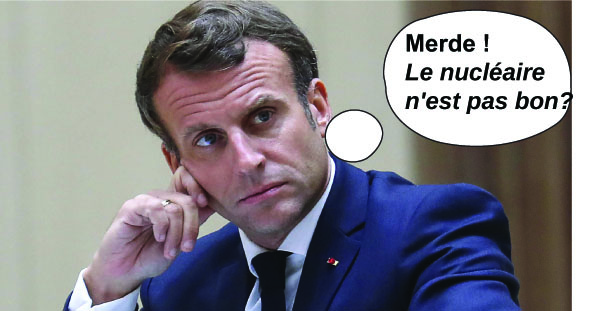
In a POLITICO interview, Luxembourg’s leader Xavier Bettel slams French push to include nuclear energy in EU’s green tech plan.
BY SUZANNE LYNCH AND JAKOB HANKE VELA, MARCH 22, 2023
French President Emmanuel Macron is facing an uphill battle to persuade EU leaders to designate nuclear energy as a key green technology of the future, after one of his allies blasted his plan on the eve of a summit in Brussels.
Luxembourg’s Prime Minister Xavier Bettel told POLITICO in an interview that while it is up to individual countries to choose their own energy mix, nuclear power must not benefit from an official “European label” that would give the vital French industry a boost.
Bettel’s criticism risks reinforcing divisions between Macron and his fellow leaders as they meet in Brussels to discuss the green tech plans at the European Council summit starting Thursday.
“Nuclear is neither sustainable, nor safe, nor fast,” Bettel said in an interview. “Some people think they are selling nuclear power as the answer to everything,” he continued, but pointed out that it can take at least 10 years for a plant to be operational.
“Secondly, we have had incidents at the international level which are worrying and which have had catastrophic repercussions for many other countries. And thirdly, we still have a problem with nuclear waste. We still don’t know how to deal with it, so we can’t say that it is safe and sustainable.”
France’s energy diet is dominated by nuclear power and Macron’s government has been lobbying Brussels to include nuclear energy in the EU’s Net Zero Industry Act — a package of plans unveiled last week by the European Commission.
The proposals in the act would allow “strategic net-zero” projects to qualify for a fast-track permitting process and smoother access to funding, part of the effort by Brussels to jump-start the transition away from fossil fuels to greener forms of energy.
Bettel said it’s up to each national government to decide its own energy mix, but argued that nuclear power should not be seen as good for the environment. “Everyone can do what they want,” he said. “But for me, the European label on nuclear energy — it would be in fact wrong to call it a green energy, or safe, or renewable.”
As POLITICO previously reported, in recent days France has not only lobbied to include nuclear energy in the EU’s Net Zero Industry Act, but it is also making a renewed push to give nuclear-based hydrogen a bigger role in meeting EU renewable energy goal,
Several diplomats said they expect the issue of nuclear to be discussed by leaders during Thursday and Friday’s summit. In particular, France — as well as countries like the Czech Republic — have been pushing for the phrase “technological neutrality” to be included in the language of the summit conclusions, which will be signed off on by leaders in Brussels. That would represent an oblique acknowledgment that all forms of energy, including nuclear, could form part of the EU’s green tech plan.
Climate change may pose key risk to French reactors – said the country’s Court of Auditors

Each year, the volume of water withdrawn to cover the needs of the French population amounts to 33.5bcm, half of which is used to cool nuclear power plants.
Some 98% of this water is released back into rivers but at a higher temperature, which is regulated on a plant-by-plant basis.
MURIEL BOSELLI, Paris, 22 Mar 2023 https://www.montelnews.com/news/1466974/climate-change-may-pose-key-risk-to-french-reactors–court
The impact of global warming on France’s nuclear fleet could become “critical” by 2050, with three to four times more outages than today, said the country’s Court of Auditors in a report published late on Tuesday.
“These outages are concentrated, admittedly on short summer periods, but are increasingly long and can prove critical by increasing the risks of pressure on the grid,” said Annie Podeur, president of the second chamber of the court, during a hearing at the Senate.
These outages and capacity cuts led to “losses amounting to several TWh per year”, Podeur said, citing the record unavailability in 2003 of 6 GW of nuclear power, or 10% of France’s installed nuclear capacity.
Extreme heat
Increased risk of extreme heat and droughts amid climate change could impact nuclear plants, which use water to cool down.
Combined with this, the report pointed to the expected significant increase in power demand in the years to come, which would strain the grid.
Each year, the volume of water withdrawn to cover the needs of the French population amounts to 33.5bcm, half of which is used to cool nuclear power plants.
Some 98% of this water is released back into rivers but at a higher temperature, which is regulated on a plant-by-plant basis.
The reduced availability of water resources amid drought could exacerbate conflicts about usage with agriculture, tourism and other industries, said Podeur.
Predicting river flows
Climate models should be updated to include river flow levels for the coming years, recommended the report, adding that EDF needed greater storage capacity for water to cool reactors during periods of low flows.
Last summer, which was particularly hot and dry, France’s nuclear safety authority ASN authorised EDF to exceed temperature limits for certain plants to continue producing power.
This decision was taken after the utility stopped a record number of reactors for maintenance and corrosion probes.
The court urged EDF to quantify the total costs of adapting its fleet to deal with climate change.
The utility spent EUR 1bn on currently operational reactors from 2006-2021 and plans to invest only EUR 612m from 2023-2038, added Podeur.
EDF has estimated that outages related to heat and drought result in a loss of annual nuclear production of around 1%.
Fears that France’s nuclear safety system may now fail – from Nuclear Transparency Watch, 11 French and European NGOs and 23 members of European Parliament.
The nuclear watchdog organisation Nuclear Transparency Watch wrote an open
letter together with 11 French and European NGOs and 23 Members of the
European Parliament (see the lists below) to the French Ministry of Energy
Transition expressing their concerns about the survival of the quality of
the French nuclear safety system.
This open letter was sent in the context
of the French national debate at the National Assembly regarding a reform
of the French nuclear safety system foreseeing the dismantlement of the
Institute for Radioprotection and nuclear safety (IRSN), which is the
French independent nuclear technical support organisation.
On 15 March, this reform was rejected by the Assembly, in fact this reform was
considered unjustified, not being supported by any kind of safety impact
assessment and also dangerous in the perspective of a rapid development of
nuclear facilities.
As a European network, NTW sees this reform as a
potential threat to the nuclear safety culture in Europe with a risk of
downgrading the safety standards set by the well-recognised independent and
dual French nuclear safety system now in place.
Nuclear Transparency Watch 20th March 2023
US won’t let Ukraine even consider peace talks – Moscow
https://www.rt.com/russia/573393-us-ukraine-peace-negotiations/ 24 Mar 23
Ukraine’s Western backers – and the US in particular – are doing their best to prevent Kiev from entering into any negotiations with Moscow, Kremlin spokesman Dmitry Peskov has said. The official made the remarks on the sidelines of talks between Russian President Vladimir Putin and his Chinese counterpart, Xi Jinping, in Moscow on Tuesday.
Peskov was asked to comment on recent statements by senior Western officials, who said any peace initiative for Ukraine, should it arise from the Russia-China talks, would be “unacceptable.” US National Security Council spokesman John Kirby, for example, claimed any ceasefire in the current situation would only “ratify Russia’s conquest to date” rather than contribute to peace.
“Washington, European capitals, but first of all, Washington is filled with the desire not to let, under any pretext, [Kiev] enter into peace negotiations. They simply do not let Kiev even think about it,” Peskov said. Asked whether it was now ‘normal’ to incite war rather than call for peace, the spokesman responded affirmatively.
During the talks, the Russian and Chinese leaders discussed a 12-point roadmap for peace in Ukraine recently proposed by Beijing. Putin has lauded the initiative, expressing his readiness to discuss and build upon it, while also reiterating Moscow’s desire to seek a diplomatic solution to the hostilities, which have been dragging on for over a year.
We believe that many of the provisions of the peace plan put forward by China are consonant with the Russian stance and can be taken as a foundation for a peaceful settlement when they are ready for it in the West and in Kiev. However, so far we have not observed such readiness on their part,” Putin said after the meeting.
The Chinese president has insisted that Beijing continues to maintain its position on the conflict and has urged both sides to stick to diplomacy and engage in dialogue. “We’re always for peace and dialogue, and we firmly stand on the right side of history,” Xi stated.
The West has ‘brought humankind to the brink of nuclear Armageddon’ with its decision to use depleted uranium ammo in Ukraine, says Russia’s US envoy
- Anatoly Antonov was responding to statements by US officials that depleted-uranium munitions are standard types of weapons
- The British defense ministry on Monday confirmed it would provide Ukraine with armour-piercing rounds containing depleted uranium
By JAMES CALLERY FOR MAILONLINE, 24 March 2023
Western countries led by the US have decided to bring humankind to the brink of a nuclear Armageddon, Russia’s Ambassador to the US Anatoly Antonov said in Washington on Wednesday.
He was responding to statements by US officials that depleted-uranium munitions are standard types of weapons that have been used for decades and do not pose any heightened risk.
The British defense ministry confirmed on Monday that it would provide Ukraine with armour-piercing rounds containing depleted uranium.
……….. ‘US officials have reached a new low with their irresponsible statements. There is a continuous flow of lethal weapons to Ukraine, which are used to annihilate civilians, residential areas, schools, hospitals, kindergartens,’ Antonov said, according to a statement from the embassy…………….
The ammunition, which enhances ability to overcome defenses on tanks, ‘is not radioactive’ and ‘not anywhere close to going into’ the sphere of nuclear weaponry, Kirby said.
White House National Security Council spokesman John Kirby called Moscow’s complaints a ‘straw man’ argument………… ‘This is a commonplace type of munition that is used particularly for its armour-piercing capabilities. “
……….. Kirby said, however, that the US is ‘not providing depleted uranium’……………………………………………… https://www.dailymail.co.uk/news/article-11893717/Russias-envoy-Decision-use-depleted-uranium-ammo-risks-nuclear-Armageddon.html
“Together Against Sizewell” argue in UK’s High Court against this nuclear development’s impact on environment

The government’s decision to back a new Sizewell C nuclear power plant
failed to assess the environmental impact of the project and should be
overturned, campaigners have argued at the High Court.
Protest group Together Against Sizewell C has launched a bid to challenge development
consent granted by the then Business Secretary Kwasi Kwarteng last July. At
a hearing in London, lawyers for the Suffolk residents argued that the
government failed to assess the impact of providing an “essential” water
supply to the project and did not consider “alternative solutions” to
meeting its energy and climate change objectives.
They also argue that the
government concluded the power station site would be clear of nuclear
material by 2140, when rising sea levels and storm surges could flood the
site before it has been decontaminated. The government, supporting the
project with a £700m stake, argues that it made “legitimate planning
judgments” and that the campaigners’ “unarguable” challenge should be
dismissed.
ITV 23rd March 2023
What is Sizewell C and how will it be paid for? Campaigners challenge new
plant. Campaigners have told the High Court that the Government’s decision
to support the Sizewell C nuclear power plant plan was “unlawful” and
should be overturned.
Evening Standard 23rd March 2023
Lawyers representing campaigners argued in London’s High Court that the
government did not evaluate the environmental impact of the nuclear power
plant.
Energy Live News 23rd March 2023
Strikes hit French nuclear output, disrupt EDF maintenance plans
By Forrest Crellin, March 24, 2023 https://www.reuters.com/business/energy/strikes-hit-french-nuclear-output-disrupt-edf-maintenance-plans-2023-03-24/
PARIS, March 24 (Reuters) – Strikes in France are impacting maintenance plans at EDF’s (EDF.PA) nuclear plants, curbing production just as the utility hoped to rebound from a 34-year output low last year.
At least 14 nuclear reactors in EDF’s fleet of 56 have suffered some delay affecting their maintenance plans, data from the CGT union showed.
France is witnessing widespread industrial action sparked by planned government policy changes including a move to raise the retirement age by two years.
For EDF that has meant nuclear power output in 2023 even lower than last year when it had swathes of reactors offline for repairs and checks for stress corrosion cracks.
Those factors compounded a backlog in regular maintenance due to the COVID-19 pandemic.
On Friday the average hourly nuclear availability until the end of the year was down by around 4% to 44 gigawatts (GW) from 46 GW in January when the strikes began, ICIS analysis showed.
The impact is expected to be more acute in the summer, with availability to June dropping by around 9% to 39 GW from 43 GW, they added.
EDF declined to comment on the impact of the strikes on its maintenance plans.
If average availability drops by another 8 GW this year, EDF’s minimum production target of 300 terawatt-hours (TWh) will become challenging, Refinitiv analyst Nathalie Gerl said.
Refinitiv estimates EDF will achieve production of 296 TWh this year.
The current reduction in availability has so far equated to around a 1% cut to generation for the full year, or 3 to 4 TWh, ICIS data showed.
CGT spokeswoman Virginie Neumayer said EDF’s production targets were “ambitious or even very optimistic” noting they required a vast staff recruitment plan to deal with stress corrosion found in its reactors in late 2021.
“The disorganisation generated by schedule shifts is therefore complex to manage and will be felt over time,” she said.
French nuclear safety watchdog ASN requested EDF revise its maintenance program due to new cracks discovered this month in some reactors.
The French first-quarter 2024 baseload power contract, an indication of market confidence in power supply through the end of next winter, has risen more than 30% in the last two weeks after the latest cracks were discovered and the maintenance delays started.
Britain supplying depleted uranium rounds to Ukraine
The UK will send “armour piercing rounds which contain depleted
uranium” to Ukraine, for use with the tank squadron donated by the
British army. Defence minister Baroness Goldie made the admission yesterday
in response to a written parliamentary question from crossbench peer Lord
Hylton. Goldie said: “Such rounds are highly effective in defeating
modern tanks and armoured vehicles.” Russia has previously warned it
would regard the use of depleted uranium in Ukraine as a ‘dirty bomb’.
Declassified UK 21st March 2023
Putin threatens response over Britain’s toxic tank shells.
Times 21st March 2023
Author of controversial memo puts the final nail in the coffin: Nuclear power in Denmark is not cost-effective
Even with district heating generation and a higher capacity factor, nuclear power in Denmark is still too expensive, according to calculations by an associate professor in energy planning at Aalborg University.
ING, Frederik Marcher Hansen 14. Mar 2023
Nuclear power in Denmark makes no sense, asserts Jakob Zinck Thellufsen, associate professor in energy planning at Aalborg University, during a presentation at the IDA trade union.
The controversial energy technology can neither help us achieve the climate goal for 2030 nor pay for itself compared to wind and solar energy, even if the nuclear power plants run almost continuously and generate district heating as a side benefit.
Jakob Zinck Thellufsen is the main author of the memo “Facts about nuclear power: Input for a fact-based discussion of the advantages and disadvantages of nuclear power as part of the green transition in Denmark”.
The memo was published in October last year and brought a lot of criticism.
Jakob Zinck Thellufsen has recalculated the scenarios for nuclear power in Denmark in the second version of the memo, which is currently being finalized, but which he partially revealed during the presentation.
………………………… Overall, however, this does not change the conclusion…………………………………..
Even if the construction costs are reduced to EUR 4.5 million per MW, the costs of a nuclear power-dominated energy system will be about 5 billion higher than of an energy system dominated by wind and solar power…………………………..
We can see that it’s possible to do it significantly faster in Asia, in around seven to nine years. But we have to compare that to the time required to build an offshore wind farm (including planning, ed.). And if it is pure construction time that we are looking at, it takes longer,” he says.1
Thus, nuclear power in Denmark will not be able to play a role in reaching the Danish climate goal of 70 percent lower CO2 emissions in 2030 compared to 1990, he states.
SMRs are also too expensive
Jakob Zinck Thellufsen has also looked at the small modular reactors, SMRs, which are claimed by proponents of nuclear power to be able to solve one of the biggest problems with conventional nuclear power—the costs.
During his presentation, he showed a figure of what the first SMRs from UK’s Rolls Royce and USA’s NuScale are expected to cost.
The cost is around EUR 55–70 per MWh, while the cost of the Danish offshore wind farm Thor is significantly lower at EUR 40 per MWh, and the cost of offshore wind turbines in Denmark in 2030 is expected to be just over EUR 30 per MWh.
“I’m not sure that either Rolls Royce’s or NuScale’s SMRs will be the right choice in the future, but it can be quite difficult to find figures on what they actually cost. […] and the technology is also developing, so it might be cheaper to do it (buy SMRs, ed.), but there the technology is also developing here (points to the figures for offshore wind, ed.), so the competition continues,” he says.
Where should we place them (the SMRs, ed.)? And how long can we wait for this to happen? That, I think, is an interesting topic to discuss.” https://ing.dk/artikel/author-of-controversial-memo-puts-the-final-nail-in-the-coffin-nuclear-power-in-denmark-is?utm_source=twitter&utm_medium=social&utm_content=social_top__20230322150732&utm_campaign=socialbuttons
UK says no nuclear escalation in Ukraine after row over depleted uranium munitions

By Alistair Smout, 23 Mar 23, UK says no nuclear escalation in Ukraine after row over depleted uranium munitions | Reuters
- Summary
- Britain is giving Ukraine ammo with depleted uranium
- Foreign Secretary says munitions are conventional
- Belarus warns of ‘fearful’ response, citing ‘real’ uranium
LONDON, March 22 (Reuters) – Britain’s Foreign Secretary James Cleverly said on Wednesday there was no nuclear escalation in the Ukraine war after Russian President Vladimir Putin criticised Britain for supplying depleted uranium tank munitions to Ukrainian forces.
Additional reporting by Gareth Jones, Gabrielle Tetrault-Farber and Caleb Davis, writing by Sarah Young and Alistair Smout, editing by William James, William Maclean
But Putin on Tuesday condemned British plans to send such ammunition to Ukraine, saying Moscow would be forced to respond accordingly as such weapons had “a nuclear component”.
Cleverly said that Russia was the only country talking about mounting nuclear risks and the ammunition was conventional.
“There is no nuclear escalation. The only country in the world that is talking about nuclear issues is Russia. There is no threat to Russia, this is purely about helping Ukraine defend itself,” Cleverly said at the launch of Britain’s international technology strategy.
“It’s worth making sure everyone understands that just because the word uranium is in the title of depleted uranium munitions, they are not nuclear munitions, they are purely conventional munitions.”
Britain has used depleted uranium in its armour piercing shells for decades and does not consider those rounds as having a nuclear capability. Russia is known to also have ammunition containing depleted uranium.
It is a particular health risk around impact sites, where dust can get into people’s lungs and vital organs.
Russian Foreign Minister Sergei Lavrov said Britain was “taking this escalation to a new and very serious stage,” while Russia’s mission in Geneva accused London of prolonging the conflict and leaving “no chance for a political and diplomatic settlement of the Ukrainian crisis.”
Belarusian President Alexander Lukashenko, a close Putin ally, also waded into the row on Wednesday, saying Russia would retaliate against the British decision by providing Belarus with ammunition containing “real uranium”.
“We need to step back from this madness. As soon as this ammunition explodes on Russian troops’ positions, you will see a fearful response, it will be a lesson for the whole planet,” he told reporters in a video clip.
“Russia does not only have depleted uranium… We have to lower this trend towards escalation in the conflict and move towards a peaceful settlement.”
1 This Month





PLEASE OPPOSE HR 8255 AND S.3639 – bills would accelerate satellite deployment, with no environmental review or safeguards – https://ncstd5li.quorum.us/campaign/169331/
To see nuclear-related stories in greater depth and intensity – go to https://nuclearinformation.wordpress.com
-
Archives
- October 2026 (49)
- September 2026 (339)
- August 2026 (330)
- July 2026 (355)
- June 2026 (287)
- May 2026 (306)
- April 2026 (356)
- March 2026 (251)
- February 2026 (267)
- January 2026 (308)
- December 2025 (358)
- November 2025 (359)
-
Categories
- 1
- 1 NUCLEAR ISSUES
- business and costs
- climate change
- culture and arts
- ENERGY
- environment
- health
- history
- indigenous issues
- Legal
- marketing of nuclear
- media
- opposition to nuclear
- PERSONAL STORIES
- politics
- politics international
- Religion and ethics
- safety
- secrets,lies and civil liberties
- spinbuster
- technology
- Uranium
- wastes
- weapons and war
- Women
- 2 WORLD
- ACTION
- AFRICA
- Atrocities
- AUSTRALIA
- Christina's notes
- Christina's themes
- culture and arts
- Events
- Fuk 2022
- Fuk 2023
- Fukushima 2017
- Fukushima 2018
- fukushima 2019
- Fukushima 2020
- Fukushima 2021
- general
- global warming
- Humour (God we need it)
- Nuclear
- RARE EARTHS
- Reference
- resources – print
- Resources -audiovicual
- Weekly Newsletter
- World
- World Nuclear
- YouTube
-
RSS
Entries RSS
Comments RSS

