Nato isn’t defending Ukraine. It’s stabbing it in the back

So far, Ukraine’s much-vaunted “spring counter-offensive” has turned into a damp squib, despite western media spin about “slow progress”. Moscow is holding on to the Ukrainian territories it annexed.
More than 110 states – not including the US, of course – have ratified a 2008 international convention outlawing cluster munitions. Many are in Nato.
Middle East Eye, Jonathan Cook. 14 July 2023
The US and its allies are sustaining the very war they now cite as grounds for disqualifying Kyiv from Nato membership .
he Nato summit in Lithuania this week served only to underscore the utter hypocrisy of western leaders in pursuing their proxy war in Ukraine to “weaken” Russia and oust its president, Vladimir Putin.
Both the US and Germany had made clear before the summit that they would block Ukraine’s admission to Nato while it was in the midst of a war with Russia. That message was formally announced by Nato Secretary General Jens Stoltenberg on Tuesday.
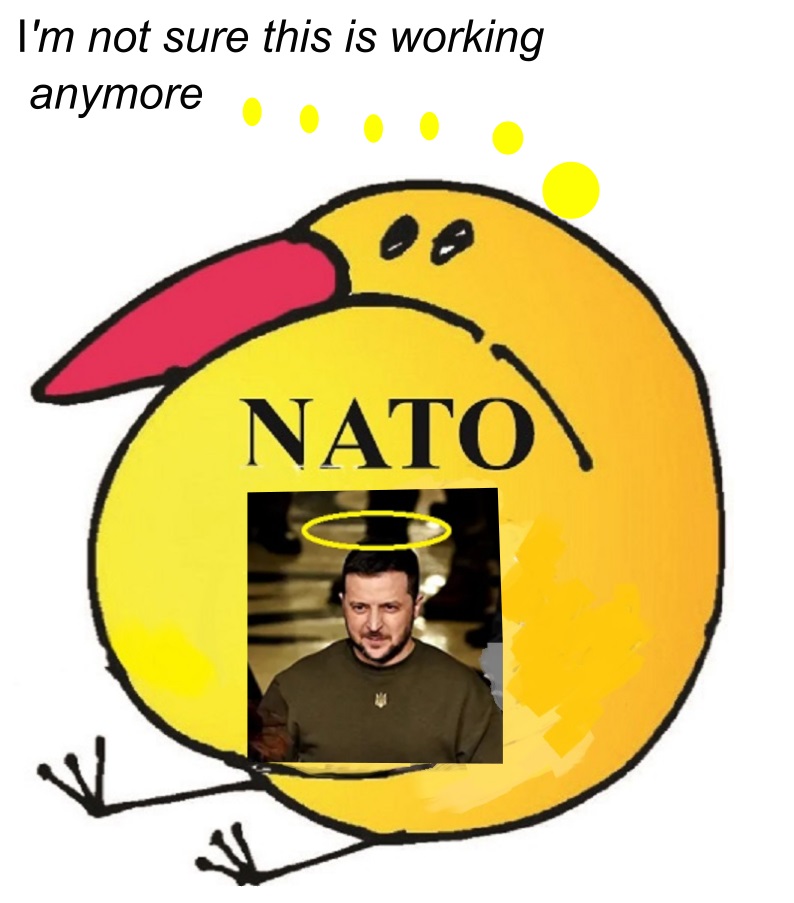
Ukrainian President Volodymyr Zelensky fumed that Nato had reached an “absurd” decision and was demonstrating “weakness”. British Defence Secretary Ben Wallace lost no time in rebuking him for a lack of “gratitude”.
The concern is that, if Kyiv joins the military alliance at this stage, Nato members will be required to leap to Ukraine’s defence and fight Russia directly. Most western states balk at the notion of a face-to-face confrontation with a nuclear-armed Russia – rather than the current proxy one, paid for exclusively in Ukrainian blood.
But there is a more duplicitous subtext being obscured: the fact that Nato is responsible for sustaining the war it now cites as grounds for disqualifying Ukraine from joining the military alliance. Nato got Kyiv into its current, bloody mess – but isn’t ready to help it find a way out.
It was Nato, after all, that chose to flirt openly with Ukraine from 2008 onwards, promising it eventual membership – with the undisguised hope that one day, the alliance would be able to flex its military muscles menacingly on Russia’s doorstep.
It was the UK that intervened weeks after Russia’s invasion in February 2022, and presumably on Washington’s orders, to scupper negotiations between Kyiv and Moscow – talks that could have ended the war at an early stage, before Russia began seizing territories in eastern Ukraine.
A deal then would have been much simpler than one now. Most likely, it would have required Kyiv to commit to neutrality, rather than pursuing covert integration into Nato. Moscow would have demanded, too, an end to the Ukrainian government’s political, legal and military attacks on its Russian-speaking populations in the east.
Now the chief sticking point to an agreement will be persuading the Kremlin to trust the West and reverse its annexation of eastern Ukraine, assuming Nato ever allows Kyiv to re-engage in talks with Russia.
And finally, it is Nato members, especially the US, that have been shipping out vast quantities of military hardware to prolong the fighting in Ukraine – keeping the death toll mounting on both sides.
Damp squib
In short, Nato is now using the very war it has done everything to fuel as a pretext to stop Ukraine from joining the alliance.
Seen another way, the message Nato has sent Moscow is that Russia made exactly the right decision to invade – if the goal, as Putin has always maintained, is to ensure Kyiv remains neutral.
It is the war that has prevented Ukraine from being completely enfolded in the western military alliance. It is the war that has stopped Ukraine’s transformation into a Nato forward base, one where the West could station nuclear-tipped missiles minutes from Moscow.
Had Russia not invaded, Kyiv would have been free to accelerate what it was already doing secretly: integrating into Nato. So what is Zelensky supposed to conclude from his exclusion from Nato, after he committed his country to an ongoing war rather than negotiations and neutrality?
So far, Ukraine’s much-vaunted “spring counter-offensive” has turned into a damp squib, despite western media spin about “slow progress”. Moscow is holding on to the Ukrainian territories it annexed.
So long as Kyiv can’t “win the war” – and it seems it can’t, unless Nato is willing to fight Russia directly and risk a nuclear confrontation – it will be precluded from the military alliance. Catch-22.
Do not expect this conundrum to be highlighted by a western establishment media that seems incapable of doing anything other than regurgitating Nato press releases and cheering on bigger profits for the West’s war industries.
War crimes
Another such conundrum is the Biden administration’s decision last week to supply Ukraine with cluster munitions – small bomblets that, when they fail to explode, lie concealed like mini-landmines, killing and maiming civilians for decades. In some cases, as many as a third are “duds”, detonating weeks, months or years later.
Washington’s move follows Britain recently supplying Ukraine with depleted uranium shells, which contaminate surrounding areas with a radioactive dust during and after fighting. Evidence from areas such as Iraq, where the US and Britain fired large numbers of these shells, suggests the fallout can include a decades-long spike in cancer and birth defects.
The White House was all too ready to denounce the use of cluster bombs as a war crime last year – when it was Russia that stood accused of using them. Now it is Washington enabling Kyiv to commit those very same war crimes.
More than 110 states – not including the US, of course – have ratified a 2008 international convention outlawing cluster munitions. Many are in Nato.
Given the high “dud” rate of US cluster bombs, President Joe Biden appears to be breaking US law in shipping stocks to Ukraine. The White House can invoke an exemption only if exporting such weapons satisfies a “vital US national security interest”. Apparently, Biden believes “weakening” Russia – and turning parts of Ukraine into a death zone for civilians for decades to come – qualifies as just such a vital interest.
Desperate stop gap
While the official story is that this latest escalatory move by the US will help Kyiv “win the war”, the truth is rather different. Biden has not shied away from admitting that Ukraine – and Nato – are running out of conventional arms to fight Russia. This is a desperate stop-gap measure. ……………………………………………………………………………………………………………………………..
…………………………….. Tragically, Nato’s malevolence, deceit and betrayal means that the only alternative to Armageddon may be Ukraine’s downfall – and with it, the crushing of Washington’s nefarious ambitions to advance full-spectrum global dominance. https://www.middleeasteye.net/opinion/nato-ukraine-not-defending-stabbing-back?utm_source=substack&utm_medium=email
Hungary’s nuclear power plant reduces output due to the hot weather

Paks nuclear power plant in trouble: it runs with reduced performance.
https://dailynewshungary.com/paks-nuclear-power-plant-in-trouble-it-runs-with-reduced-performance/ John Woods · 14/07/2023
Hungary’s nuclear power plant in Paks reduced its performance due to the significant increase in the water temperature of the Danube River, the Hungarian News Agency said in a statement. According to telex.hu, the Danube’s water temperature reached 29.72 degrees at the measuring point. Therefore, from 4.30 PM, the nuclear power plant reduced the performance of blocks 2, 3, and 4 by 240 megawatts. According to a 2001 environmental protection ministerial decree, the water temperature around Paks cannot exceed 30 °C.
Please use the sharing tools at the bottom of the articles.
In the power plant’s interior regulation, 29.5 degrees is the intervention limit. Provided they reach that, they reduce the power plant’s performance by 80 megawatts per 0.1 °C to reach the prescribed temperature level.
https://dailynewshungary.com/paks-nuclear-power-plant-in-trouble-it-runs-with-reduced-performance/
“War Effort In Shambles As Hawks Turn On Each Other” At NATO Summit
Zeo Hedge, BY TYLER DURDEN, THURSDAY, JUL 13, 2023
Bloomberg is just out with a devastating behind-the-scenes account of a hot-headed Zelensky at the NATO summit in Vilnius, and the growing Western backlash in the face of his obvious frustration and what’s being seen as ingratitude for the steady flow of billions of dollars in arms to Kiev.
Apparently even the mainstream media agrees with our own assessment of the Ukrainian leader having thrown a “tantrum” as he complained about the “weak” and “absurd” NATO stance on Ukraine’s membership. The blistering tweet he issued in English while en route to Lithuania exposed cracks in the alliance, as Bloomberg highlights in the opening of its very revealing Wednesday piece:
Volodymyr Zelenskiy was running hot ahead of his sit-down with NATO leaders on Tuesday evening. The Ukrainian president had been angered earlier in the day by what he said was an “absurd” reluctance to give his country a clear timeline on membership.
That outburst in turn riled the partners who have funneled billions of dollars of weaponry and aid into Ukraine’s defense against the Russian invasion — the US had been given no warning before Zelenskiy unleashed his attack on social media.
As Bloomberg writes: “Over dinner in Vilnius, with US President Joe Biden back at his hotel, the other leaders delivered a clear message to Zelenskiy, according to one person who was present. You have to cool down and look at the full package, Zelenskiy was told.”
While it’s not quite yet a full on ‘hero to zero’ story… things are certainly sliding in that direction, given it’s unprecedented that the Ukrainian president who previously enjoyed rockstar status in Western capitals since the start of the invasion could be told to basically ‘cool it’!.
Bloomberg continues in reference to Zelensky: “He had, after all, been given a renewed commitment to eventual membership and new security guarantees from the Group of Seven nations. By the next day, the message appeared to be sinking in.” The publication was privy to some key Western leaders’ exact words, presenting the rare dressing down as follows [emphasis ZH]:
Whether we like it or not, people want to see gratitude,” UK Defense Secretary Ben Wallace told reporters the following morning. “You’re persuading countries to give up their stock” of weapons and ammunition, he added.
This account of the behind-the-scenes wrangling is based on interviews with more than a dozen diplomats and officials involved in the summit who asked not to be named discussing private conversations. NATO leaders were trying to thread a needle on Ukraine’s membership bid when they arrived in Vilnius: They were seeking language that looked like progress and that Ukraine could sell as progress but fundamentally didn’t leave them any closer to getting dragged into a war with nuclear-armed Russia.
Ultimately the hawks (mainly among the Baltic and Eastern Europe states) have lost at Vilnius. Ukrainian Foreign Minister Dmytro Kuleba has admitted “There was a lack of political will.” Thus it appears that Zelensky’s angry, desperate tweet lashing out at Western partners was a last ditch effort at shaming NATO into conceding to its demands of being immediately fast-tracked to membership.
Bloomberg reveals further, that “Crucially, it was the US and Germany that insisted on dialing back the commitment to Ukraine joining the alliance. Earlier drafts of the communique offered a clearer pathway to Ukraine eventually joining, but Biden and Chancellor Olaf Scholz were wary of going too far.”
“Their teams demanded changes in the final days before the summit, upsetting lots of the other European nations, as well as the Ukrainians.” Indeed Biden in a CNN interview at the start of the week confessed the obvious: that Ukraine’s admission into NATO with the war still going would automatically unleash war between nuclear-armed powers – a WW3 doomsday scenario. Hence the West is now telling Kiev: just stop.
In Zelensky’s next big NATO summit appearance Wednesday following a no doubt awkward evening, things were different as he belatedly “got the message”…
………………………………. The New York Times’ summation of precisely what fell short in the NATO communique explains: “NATO declared on Tuesday that Ukraine would be invited to join the alliance, but did not say how or when, disappointing its president but reflecting the resolve by President Biden and other leaders not to be drawn directly into Ukraine’s war with Russia.”
Indeed it’s being widely called more vague–and with greater possible restrictions, or “conditions”–than even what came out of the 2008 Bucharest summit.
Below is the offending part of the official Vilnius Summit Communiqué:
Issued by NATO Heads of State and Government participating in the meeting of the North Atlantic Council in Vilnius 11 July 2023:
“…………………………………………… We will be in a position to extend an invitation to Ukraine to join the Alliance when Allies agree and conditions are met.
But Zelensky is still holding out hope that one day– “After the war, Ukraine will be in NATO.”
However, President Biden has remained unmoved, and responded by explaining before reporters that Ukraine “will not be in NATO for a while”.
The geopolitical analysis news site Moon of Alabama observes correctly…
“Well. The little comedian seems disappointed. As if the whole play had not been obvious from the very beginning. Since 2008 the Ukraine was to be used as a tool to nag Russia. It is otherwise of little value. It will end up as a discarded rag while NATO will, in the end, again recognize the Russian Federation as the super power that that it is. NATO will have to relearn to listen to and negotiate with it.”
MofA then highlights the inevitable negative impact (to say the least) on Ukrainian morale: “Now lets wait and see what NATO’s climb down will do to the morale and motivations of the Ukrainian army and people.”
Update(1740): David Sacks agrees that for the hawks of NATO-land, the way things are going for the Ukrainian war effort and the West’s prior optimism and muscular support in general have reached a low-point.
Sacks writes below [emphasis ZH’s]…
Despite Biden’s best efforts to put a happy face on it, Vilnius will be remembered as the NATO Summit where tensions boiled over. Zelensky denounced the Alliance’s admission policy as “absurd” and disrespectful.
UK Secretary of Defense Ben Wallace chastised Zelensky for ingratitude. Lindsey Graham attacked the Biden administration for weakness. Ben Hodges criticized Jake Sullivan for lack of “strategic bravery.” Even NAFO mascot Adam Kinzinger no longer appears to be a “fella.”
The optics were even harsher than the words, with the NATO elites turning their backs on a frustrated Zelensky. Biden’s assurance that Zelensky is “stuck” with the U.S. may come as cold comfort to both nations now that the Ukrainian counteroffensive has failed to meet expectations, huge amounts of expensive Western armor lay in ruins smoldering on the battlefield, Ukrainian casualties are horrific, and the U.S. has run out of 155mm artillery shells to give, forcing America to debase itself by sending cluster bombs.
The war effort is increasingly a shambles and the War Party is starting to turn on each other. https://www.zerohedge.com/geopolitical/nato-leaders-tell-zelensky-cool-it-rare-dressing-down-summit
UK to see biggest increase in ‘uncomfortably hot’ days in the world as climate change bites.
Researchers warn Britain is ‘dangerously
underprepared’ for the change, which could increase deadly heat health
risks. The UK is likely to see the biggest increase in the number of days
with temperatures of 25°C or more in the world – and it is not prepared
for it, a study suggests.
Researchers at Oxford University forecast that
Britain will see a 30 per cent rise in “uncomfortably hot” days if
global warming exceeds 1.5°C and reaches 2°C, as is expected. This would
be the highest percentage rise in hot days of any country on the planet.
A day becomes uncomfortable when the average mean temperature hits 18°C over
the course of 24 hours. During this time temperatures could, as a rough
guide, “peak at about 25°C, with a low of around 11°C at night” –
although the precise highs and lows around the 18°C average temperature
would vary from day to day, researchers say.
Uncomfortably hot days
typically require “cooling interventions” such as window shutters,
ventilation, fans or air conditioning. MPs on the Environmental Audit
Committee last week began an inquiry into heat and sustainable cooling,
looking at what the UK can learn from other countries, and how it can
protect vulnerable populations from extreme heat – “so there’s definitely
good steps forward in this area”.
Dr Nicole Miranda, of Oxford
University, added: “One large risk [in the UK] is further stressing our
energy grid. If our homes are overheated and the first solution that we run
to is air conditioners. “If we all have air conditioners and if we all
turn them on at the same time that is going to drain our energy systems and
it’s just going to pose a huge stress. I’m not saying there are going to be
shortages but it’s a risk that we need to control.”
iNews 13th July 2023
https://inews.co.uk/news/environment/uk-biggest-increase-uncomfortably-hot-days-world-2476037
Rolls-Royce, mini-nuke sector left in dark as Great British Nuclear launch delayed

Proactive Investors, Josh Lamb, 13 Jul 2023
The government delayed the event over “unforeseen circumstances”
Mini nuclear reactor developers including Rolls-Royce Holdings PLC (LSE:RR.) have been left in the dark after the official launch of Great British Nuclear was delayed on Thursday.
Net zero secretary Grant Shapps had been due to unveil the new public body at London’s science museum before the event was cancelled over “unforeseen circumstances”.
Great British Nuclear, originally announced in the chancellor’s spring budget, will be an arms-length body set up to support the roll-out of small modular reactors (SMRs) in the UK……………..
Rolls-Royce and General Electric (NYSE:GE) had been among those due to attend the event, having both proposed designs for prospective use in the UK.
Rolls is currently the only company which has an SMR design currently passing through regulatory assessments though, carried out by the Office for Nuclear Regulation, Environment Agency and Natural Resources Wales.
Shapps was expected to update on the latest round of the government’s SMR competition meanwhile, which will determine which designs are granted public funding. https://www.proactiveinvestors.co.uk/companies/news/1020628/rolls-royce-mini-nuke-sector-left-in-dark-as-great-british-nuclear-launch-delayed-1020628.html
Security concerns for Britain as China might be controlling its nuclear power stations
Britain faces ‘nightmare scenario’ of China controlling its nuclear power
stations, universities and technology, warn MPs. The report, compiled with
the assistance of MI5 and MI6, suggested that a desperation to acquire
Chinese investment had led to security concerns being dismissed. Its
authors warned:
‘Without swift action, we are on a trajectory for the
nightmare scenario where China steals blueprints, sets standards and builds
products, exerting political and economic influence at every step. This has
the potential to pose an existential threat to democratic systems.’ They
added: ‘China has been seeking to control or influence the UK’s industry
and energy sectors.
Chinese money was readily accepted with few questions
asked. ‘It is unacceptable for the Government to still be considering
Chinese involvement in critical national infrastructure.’ In 2021, it was
reported China owns £143billion in UK assets, from nuclear power to
schools. Nearly 200 UK companies are controlled by groups or individuals
based in China or count them as minority shareholders.
Daily Mail 14th July 2023
White House opposes independent oversight of Ukraine aid
https://www.rt.com/news/579510-white-house-opposes-ukraine-aid-oversight/ 12 July 23
President Joe Biden’s administration has urged lawmakers to drop plans for an inspector general to monitor assistance to Kiev
President Joe Biden’s administration has objected to plans by US lawmakers to establish an independent inspector general who would scrutinize Washington’s massive military and economic aid packages for Ukraine.
At issue is a provision added to the $874 billion US defense budget for the government’s next fiscal year, calling for an additional oversight layer on Ukraine aid modeled after the inspector general established for reconstruction in Afghanistan.
Conservative lawmakers, including Representative Matt Gaetz, a Republican from Florida, have argued that the White House lacks adequate controls to prevent fraud and other misuse of the $113 billion in aid approved by Congress to support Ukraine in its conflict with Russia.
However, the administration argued on Monday that the Pentagon inspector general and the Government Accountability Office (GAO) were already working with relevant congressional committees to “ensure accountability” for Ukraine aid. The Pentagon inspector general and the GAO are currently conducting investigations of “every aspect of this assistance,” the White House Office of Management and Budget (OMB) said in a statement.
The White House also opposes an amendment to the defense bill that would expand the authority of the Afghanistan reconstruction inspector general. “This expansion is both unnecessary and unprecedented” because inspectors from both the US State Department and the US Agency for International Development already oversee the aid, the OMB said.
John Sopko, the independent inspector general for Afghanistan reconstruction, warned in February that strong safeguards were needed to prevent corruption from undermining Washington’s aid packages for Ukraine. Failure to learn from the US mistakes in Afghanistan, where much aid was “diverted or stolen,” could lead to a repeat in Ukraine.
You’re bound to get corrupt elements of not only the Ukrainian or host government, but also of US government contractors or other third-party contractors to steal the money,” Sopko told Fox News.
Last year, Congress blocked an initiative spearheaded by Representative Marjorie Taylor Greene, a Republican from Georgia, to audit the aid to Kiev.
Ukraine consistently ranks as one of the most corrupt countries in Europe. Ukrainian President Vladimir Zelensky fired a number of top officials earlier this year for profiteering. An August 2022 report by CBS News indicated that only about 30% of the Western weaponry sent to Kiev was actually making it to the front lines because of waste and corruption.
NATO to keep Ukraine at arm’s length
https://www.rt.com/news/579554-nato-summit-communique/ 12 July 23
NATO Secretary General Jens Stoltenberg further elaborated on the matter at a press conference, stating that the bloc must first ensure that Ukraine achieves a “victory” in its ongoing conflict with Russia. Should Kiev not succeed, its NATO membership will be out of the question, he warned.
Kiev will be permitted to join the US-led bloc “when allies agree and conditions are met”
NATO has reaffirmed its readiness to grant Ukraine membership at some point in the future. A joint statement released during the annual summit of the US-led bloc said Kiev would be invited to join only “when allies agree and conditions are met,” but it will be allowed to bypass the so-called Membership Action Plan that is usually required for candidate members.
We reaffirm the commitment we made at the 2008 summit in Bucharest that Ukraine will become a member of NATO, and today we recognize that Ukraine’s path to full Euro-Atlantic integration has moved beyond the need for the Membership Action Plan,” the statement read.
Ukraine has become “increasingly interoperable and politically integrated with the US-led bloc,” it stated. It also outlined the need for “additional democratic and security sector reforms” in the country.
The alliance will support Ukraine in making these reforms on its path towards future membership. We will be in a position to extend an invitation to Ukraine to join the alliance when allies agree and conditions are met,” the statement concluded.
NATO Secretary General Jens Stoltenberg further elaborated on the matter at a press conference, stating that the bloc must first ensure that Ukraine achieves a “victory” in its ongoing conflict with Russia. Should Kiev not succeed, its NATO membership will be out of the question, he warned.
The pledge falls short of calls by top Ukrainian officials, who have repeatedly urged the US-led alliance to accept the country right away or at least produce an official “invitation” for it at the summit. Ukrainian President Vladimir Zelensky made an apparent last-ditch attempt to influence the bloc’s joint statement hours before it was released, taking to social media to criticize NATO and demand “respect” for Ukraine from the alliance.
“It’s unprecedented and absurd when [a] time frame is not set neither for the invitation nor for Ukraine’s membership. While at the same time vague wording about ‘conditions’ is added even for inviting Ukraine,” Zelensky wrote, referring to a draft of the document that was partially leaked to the media.
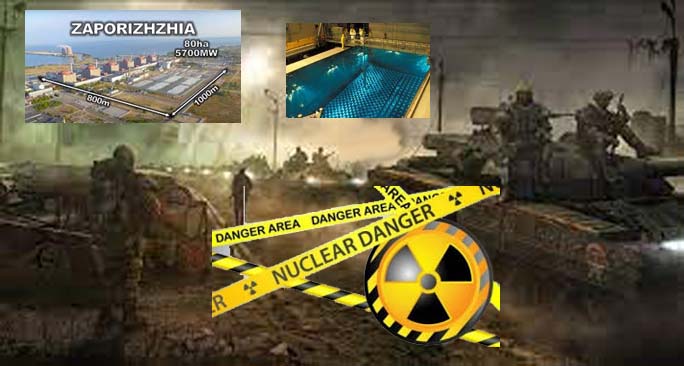
The Zaporizhzhia nuclear power plant is a ‘dirty bomb’ waiting to happen – a nuclear expert explains
The Conversation, Tilman Ruff July 13, 2023
After the explosion at the Kakhovka Dam in Ukraine last month, many Ukrainians feared the Zaporizhzhia nuclear power plant could be next.
These concerns have been heightened in recent weeks as both Ukraine and Russia have accused each other of planning an attack of the plant, which has been under Russian control since March 2022.
The International Atomic Energy Agency (IAEA) has not found any evidence of explosives in recent inspections, but also said it had yet to be granted access to all parts of the huge plant.
So, how serious are the risks of an attack at the power plant? And how disastrous would this be for Ukraine and the wider world?
Europe’s largest nuclear power plant
Construction of the Zaporizhzhia power plant began in 1981. Five reactors were commissioned between 1984-89, and a sixth in 1995. The reactors are more modern than the graphite-moderated reactors at Chernobyl, and are similar to the pressurised water reactors in widespread use in the United States and Europe.
The plant is Europe’s largest, built on the southern bank of the Kakhovka Reservoir on the Dnipro River, from which it draws its cooling water. Before the Russian invasion, Ukraine generated about half its electricity from 15 nuclear power reactors across four sites, with Zaporizhzhia generating almost half of this.
The plant has cooling ponds for spent nuclear fuel, which require continuous power and water (like the reactors themselves). It also has a dry cask storage facility for spent reactor fuel when it no longer requires continuous water cooling.
In 2017, Ukraine reported there were just over 2,200 tons of highly radioactive spent fuel at Zaporizhzhia, in the spent fuel pools and dry cask storage.
How quickly a meltdown could happen
Barely a week after the invasion began, Russian forces captured Zaporizhzhia. During heavy combat, a fire broke out in a training facility, while other parts of the plant were damaged.
In September 2022, the plant was fully disconnected from the electricity grid. Five reactors were put into cold shutdown. The sixth was maintained in hot shutdown at around 200 degrees Celsius, producing steam for the plant.
The Ukrainian nuclear regulator ordered a cold shutdown of this reactor last month, but this has not happened. Extensive maintenance work on the reactors is overdue.
The fuel inside nuclear reactors needs continuous, active cooling for many months after a reactor shutdown because of the heat that continues to be produced by the decay of hundreds of different fission products. The longer the fuel is inside a nuclear reactor, the more radioactive it becomes. That is why when fuel is removed from a reactor, it still requires continuous, active cooling for years.
The world saw in dramatic fashion in Fukushima, Japan, in 2011 what can happen when continuous, active cooling of nuclear reactors is disrupted.
More than 70% of the total radioactivity at the Fukushima power plant was in the spent fuel ponds, which have none of the carefully engineered containment layers that reactors typically have.
In his classic 1981 book Nuclear Radiation in Warfare, Nobel Peace Prize-winning physicist Joseph Rotblat documented how
in a pressurised water reactor, the meltdown of the core could occur within less than one minute after the loss of coolant.
The radioactivity released from damaged spent fuel ponds could be even greater than from a meltdown at the reactor itself, he wrote.
His study makes clear that a military attack on a reactor or spent fuel pond could release more radioactivity – and longer-lasting radioactivity – than even a large (megaton range) nuclear weapon.
As nuclear physicist Edwin Lyman makes clear, if the Zaporizhzhia reactor cooling was interrupted, there might be a day or two before the spent fuel began to overheat and degrade.
The melting reactor core would then collapse onto the floor inside its steel primary containment vessel and melt through to the floor of the building. Large amounts of radioactive gases and aerosols would be released into the environment, potentially explosively.
The radioactive release could possibly be at Chernobyl-scale or even larger amounts if multiple reactors and spent fuel ponds were involved. This could then spread across borders and continents with the wind, rivers and currents, and come down in hotspots in rain and snow.
A nuclear plant under continuous assault
The Russian invasion of Ukraine is the first time war has engulfed operating nuclear plants and, in a real sense, weaponised them as potential radiological weapons, or “dirty bombs”…………………………………………………………..
The other three nuclear power plants in Ukraine have also experienced interruptions to their electricity supply. In addition, other nuclear facilities have been shelled, struck by missiles or otherwise damaged.
A wake-up call to the dangers of nuclear power
Some nuclear experts have inappropriately downplayed the risk of deliberate or accidental breach of the containment structures at Zaporizhzhia.
However, the IAEA and independent experts have highlighted the very real risk of a catastrophe.
………………………………………………………………………. No other energy technology is associated with such extreme safety and security risks. If Zaporizhzhia were a wind farm or solar array, the risk of a severe accident with global and intergenerational consequences – not to mention weapons proliferation or intractable waste issues – would be precisely zero.
https://theconversation.com/the-zaporizhzhia-nuclear-power-plant-is-a-dirty-bomb-waiting-to-happen-a-nuclear-expert-explains-209236
High river temperatures to limit French nuclear power production
By Forrest Crellin, July 13, 2023, PARIS, (Reuters) – Output restrictions are expected at two nuclear plants along the Rhone river in eastern France due to high temperature forecasts, nuclear operator EDF (EDF.PA) said, several days ahead of the similar warning last year, but affecting fewer plants.
The hot weather is likely to halve the available power supply from the 3.6 gigawatt (GW) Bugey plant and the 2.6 GW Saint Alban plant from July 13 and July 16 respectively, the operator said.
However, production will be at least 1.8 GW at Bugey and 1.3 GW at Saint Alban to meet grid requirements, and may change according to grid needs, the operator said.
Kpler analyst Emeric de Vigan said the restrictions were likely to have little effect on output in practice, with cuts likely only at the weekend or midday when solar output was at its peak, so that the impact on power prices would be slim.
He said the situation would need monitoring in coming weeks, however, noting it was unusually early in the summer for such restrictions to be imposed.
Water temperatures at the Bugey plant already eclipsed the initial threshold on July 9 where restrictions are possible, and are currently forecast to peak next week and then drop again, Refinitiv data showed……….
The Garonne river in southern France has the highest potential for warming to critical levels, but the Golfech plant is currently offline for maintenance until mid-August, the data showed.
“(The restrictions were) to be expected and it will probably occur more often,” Greenpeace campaigner Roger Spautz said.
“The authorities must stick to existing regulations for water discharges. Otherwise the ecosystems will be even more affected,” he added………………………….. more https://www.reuters.com/business/energy/high-river-temperatures-limit-french-nuclear-power-production-2023-07-12/
Protests stopped nuclear waste dumping at Bradwell, and now will likely do so again
Bradwell Revisited – echoes of 1980s as Government looks for somewhere
to dump radioactive waste. Andrew Blowers records how protests stopped
nuclear dumping at Bradwell and would likely do so again in the June 2023. BANNG column for Regional Life.
Older readers will recollect the battle
that raged as mass protests saw off Government plans for a nuclear dump at
Bradwell in the 1980s. The Government is again looking at existing nuclear
sites in which to bury some of the nation’s nuclear wastes.
Bradwell may be in its sights but is wholly unsuitable and any attempt to develop a dump
here will once again be seen off by massive local protest and opposition.
In February, 1986, Bradwell, along with three other sites, in Humberside,
Lincolnshire and Bedfordshire, was identified by the Government’s agency,
Nirex, as a possible site for a shallow disposal facility to take the
nation’s short-lived intermediate level radioactive wastes (ILW). Over
the next two years there ensued what was dubbed the Four Site Saga, as the
communities, backed by their County Councils, worked together in opposition
to the whole project.
BANNG 8th June 2023
Ukraine’s chances of victory in 2023 are ‘vanishingly small’
Premiered Jun 24, 2023 Ret. Lieutenant Colonel Daniel Davis elaborates on the current status of the Ukraine war and why a successful counteroffensive looks less likely.
SCOTT RITTER: NATO Summit, a Theater of the Absurd
The scope and scale of the Ukrainian military defeat is such that the focus of many NATO members appears to be shifting from the unrealistic goal of strategically defeating Russia to a more realistic objective of bringing about a cessation to the conflict that preserves Ukraine as a viable nation state.
Ukrainian President Volodymyr Zelensky will attend the NATO summit. However, his demands for NATO membership will not be met.
Normalizing failure might best describe the best that NATO can accomplish in Vilnius.
By Scott Ritter, Consortium News, July 10, 2023
The unfulfilled goals and objectives from last year’s meeting in Madrid loom over the Atlantic military alliance. When the membership meets in Vilnius this week, normalizing failure might best describe the most that can be accomplished.
The leaders of NATO’s 31 constituent member states have begun to assemble in Vilnius, the capital of Lithuania, for the alliance’s 33rd summit, an event that has come to symbolize the military organization’s increasingly difficult task of transforming political will into tangible reality.
Since the Wales Summit of 2014, when NATO made Russia a top priority in the aftermath of the Russian annexation of Crimea, and the Warsaw Summit of 2016, when NATO agreed to deploy “battlegroups” on the soil of four NATO members (Latvia, Estonia, Lithuania and Poland) in response to perceived Russian “aggression” in the region, Russia has dominated the NATO agenda and, by extension, its identity.
The Vilnius summit promises to be no different in this regard.
One of the major issues confronting the NATO leadership is that the Vilnius summit operates under the shadow of last year’s Madrid summit, convened in late June in the aftermath of Russia’s initiation of military operations against Ukraine.
The Madrid summit came on the heels of Boris Johnson’s deliberate sabotage of a Ukrainian-Russian peace agreement that was supposed to be signed on April 1, 2023, in Istanbul, and the decision by the United States in May 2023 to extend to Ukraine military assistance exceeding $45 billion as part of a new “lend lease” agreement.
In short, NATO had opted out of a peaceful resolution to the Russia-Ukraine conflict and instead chose to wage war by proxy — with Ukrainian manpower being married with NATO equipment — designed to achieve what U.S. Ambassador to NATO Julianne Smith, in May 2022, called the “strategic defeat” of Russia in Ukraine.
The Madrid summit generated an official NATO statement which declared that “Russia must immediately stop this war and withdraw from Ukraine,” adding that “Belarus must end its complicity in this war.”
When it came to Ukraine, the Madrid statement was equally firm. “We stand in full solidarity with the government and the people of Ukraine in the heroic defense of their country,” it read………………
Confidently Seeking a ‘Strategic Defeat’
NATO, it seemed, was supremely confident in its ability to achieve the outcome it so very much wanted — the strategic defeat of Russia.
What a difference a year makes.
NATO assistance to Ukraine resulted in a successful counteroffensive which compelled Russia to withdraw from territory around the city of Kharkov, as well as abandon portions of the Kherson Oblast located on the right bank of the Dnieper River. Once the Russian defenses solidified and the Ukrainian attack stalled, NATO and Russia both began preparing for the next phase of the conflict……………………………….
NATO had placed high hopes on the Ukrainian army being able to carry out a counteroffensive against Russia which would achieve discernable results both in terms of territory re-captured and casualties inflicted on the Russian army. The results, however, have been dismal to date — tens of thousands of Ukrainian casualties and thousands of destroyed vehicles while failing to breach even the first line of the Russian defenses.
One of the challenges NATO will face in Vilnius is the question of how to recover from this setback. Many NATO countries are starting to exhibit “Ukraine fatigue” as they see their armories stripped bare and their coffers emptied in what, by every measurement, appears to be a losing cause.
The scope and scale of the Ukrainian military defeat is such that the focus of many NATO members appears to be shifting from the unrealistic goal of strategically defeating Russia to a more realistic objective of bringing about a cessation to the conflict that preserves Ukraine as a viable nation state.
Ukrainian President Volodymyr Zelensky will attend the NATO summit. However, his demands for NATO membership will not be met — U.S. President Joe Biden himself has weighed in on the matter, saying this would not be possible while Ukraine is at war with Russia.
Face-Saving Gestures
There will be face-saving gestures from NATO, such as the creation of a NATO-Ukraine Council and talk of eventual post-conflict security guarantees. But the reality is Zelensky’s presence will do Ukraine more harm than good, since it will only accentuate the internal disagreement within NATO on the issue of Ukrainian membership and highlight NATO’s impotence when it comes to doing anything that can meaningfully alter the current trajectory on the battlefield, which is heading toward a strategic defeat for both Ukraine and NATO.
…………………………………………………………………. One can expect a plethora of rhetorical spin and posturing by the NATO membership, but the fact is the real mission of the Vilnius summit is how best to achieve a soft landing from the unfulfilled goals and objectives laid out last year in Madrid.
Normalizing failure might best describe the best that NATO can accomplish in Vilnius.
Any failure to try to stop the accumulation of debacles that represent the current NATO policy toward Ukraine will result in further collapse of the military situation in Ukraine, and the political situation in Europe, which, in their totality, push NATO closer to the moment of its ultimate demise.
This prospect does not bode well for those whose task it is to put as positive a spin as possible on reality. But NATO has long ago stopped dealing with a fact-based world, allowing itself to devolve into a theater of the absurd where actors fool themselves into believing the tale they are spinning, while the audience stares in dismay. https://consortiumnews.com/2023/07/10/scott-ritter-nato-summit-a-theater-of-the-absurd/—
UK delays ‘Great British Nuclear’ launch

Energy Secretary Grant Shapps was due to give a speech at London’s Science Museum.
Politico, BY CHARLIE COOPER, JULY 12, 2023
The U.K. government has delayed the official launch of a major arms-length body intended to support the country’s nuclear industry.
Energy Secretary Grant Shapps had been due to give a heavily-trailed speech at London’s Science Museum on Thursday, setting out his plans for Great British Nuclear and its role helping the U.K. hit its net zero goals.
But in an email to attendees, seen by POLITICO, the Department for Energy Security and Net Zero (DESNZ) confirmed the event was being rescheduled “due to unforeseen circumstances.”
Shapps was expected to use his speech to outline the next phase of a planned competition for manufacturing firms — including Rolls Royce and GE Hitachi — vying to develop small modular reactors (SMRs). The government hopes the new technology will provide cheaper, more flexible atomic power to help the U.K. hit its target of 24 gigawatts of nuclear generation by 2050.
The reasons for the cancellation were not immediately clear………………… https://www.politico.eu/article/uk-delays-great-british-nuclear-launch/
1 This Month





PLEASE OPPOSE HR 8255 AND S.3639 – bills would accelerate satellite deployment, with no environmental review or safeguards – https://ncstd5li.quorum.us/campaign/169331/
To see nuclear-related stories in greater depth and intensity – go to https://nuclearinformation.wordpress.com
-
Archives
- October 2026 (29)
- September 2026 (339)
- August 2026 (330)
- July 2026 (355)
- June 2026 (287)
- May 2026 (306)
- April 2026 (356)
- March 2026 (251)
- February 2026 (267)
- January 2026 (308)
- December 2025 (358)
- November 2025 (359)
-
Categories
- 1
- 1 NUCLEAR ISSUES
- business and costs
- climate change
- culture and arts
- ENERGY
- environment
- health
- history
- indigenous issues
- Legal
- marketing of nuclear
- media
- opposition to nuclear
- PERSONAL STORIES
- politics
- politics international
- Religion and ethics
- safety
- secrets,lies and civil liberties
- spinbuster
- technology
- Uranium
- wastes
- weapons and war
- Women
- 2 WORLD
- ACTION
- AFRICA
- Atrocities
- AUSTRALIA
- Christina's notes
- Christina's themes
- culture and arts
- Events
- Fuk 2022
- Fuk 2023
- Fukushima 2017
- Fukushima 2018
- fukushima 2019
- Fukushima 2020
- Fukushima 2021
- general
- global warming
- Humour (God we need it)
- Nuclear
- RARE EARTHS
- Reference
- resources – print
- Resources -audiovicual
- Weekly Newsletter
- World
- World Nuclear
- YouTube
-
RSS
Entries RSS
Comments RSS

