Residents closest to Dounreay and Vulcan to be excluded from the nuclear emergency planning zone.
By Iain Grant, 06 October 2023 https://www.johnogroat-journal.co.uk/news/nearby-homes-to-be-outside-of-dounreay-emergency-zone-for-fi-328741/ #nuclear #antinuclear #nuclear-free #NoNukes
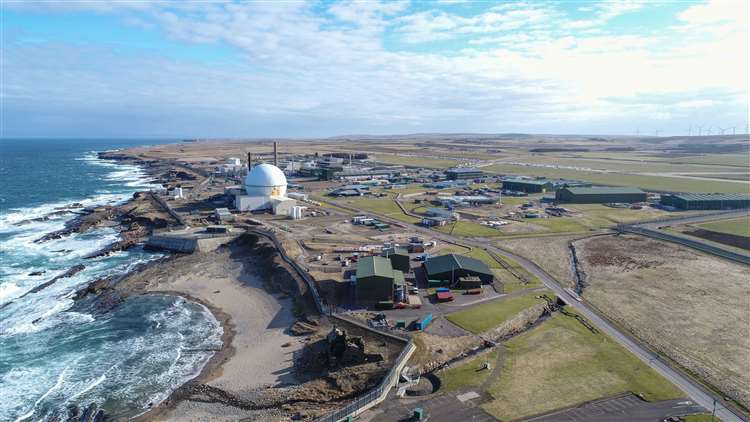
Residents closest to Dounreay and Vulcan are for the first time to be excluded from the emergency planning zone around the redundant nuclear sites.
It is being shrunk to reflect the perceived reduction in risk to the public presented by the adjoining plants.
The zone would be the focus of the response to what is considered a worst-case scenario involving a radiation release.
Up until the plug was pulled on Dounreay’s fast reactor programme in the mid-1990s, its zone extended to five kilometres. The equivalent at Vulcan was two kilometres.
Dounreay’s limit was subsequently cut to 1.5km and reduced further in 2020 when a new linked zone taking in both sites was set at 700 metres.
France seeks European subsidies for its nuclear industry – fears “discrimination against nuclear”
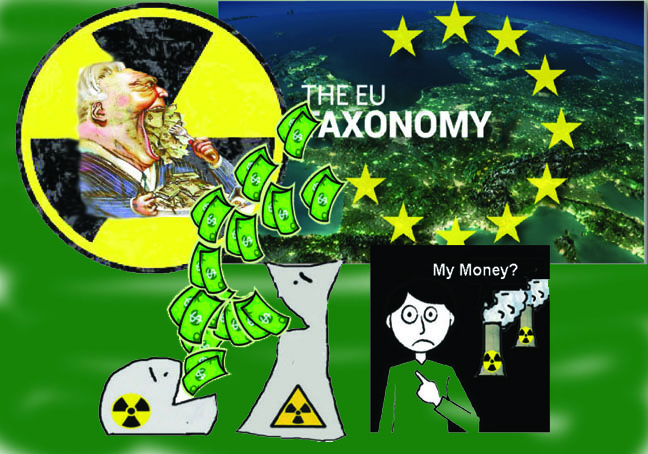
France urges swift deal on EU power reform to counter US subsidies Energy minister says bloc will lose out to Biden’s IRA if Paris and Berlin fail to resolve differences over nuclear power.
The US will be the main winner if a Franco-German divide over nuclear power prevents a long-awaited reform of Europe’s electricity market being finalised, France’s energy minister has warned. Agnès Pannier-Runacher said in an interview with the Financial Times that the sweeping overhaul of EU rules was needed as soon as possible to give businesses visibility on power prices, at a time when the US was luring industry with President Joe Biden’s clean energy subsidy programme under the Inflation Reduction Act……………….
The call comes ahead of a bilateral conference in Hamburg, starting on Monday, between French president Emmanuel Macron and German chancellor Olaf Scholz, accompanied by their cabinet ministers. Energy issues will be high on the agenda because Paris and Berlin have been arguing for months over the EU electricity market reform, specifically over how nuclear energy will be priced and the extent to which it can be subsidised……………
Behind the scenes in recent days, Paris and Berlin have been exchanging duelling policy papers and rewritten clauses for the draft law, while marshalling support from other EU member states.
On this reform and others, France has mounted a pro-nuclear campaign now joined by other countries that use the technology, including Poland and Hungary, in an effort to ensure the sector will be treated favourably.
But its drive has hit roadblocks, particularly in Germany, over concerns France will end up riding roughshod over state aid rules and benefit from lower prices for consumers and industry that other countries cannot match………………………………………………………..
Whether France and Germany will be able to square their differences in time for the next meeting of EU energy ministers on October 17 is unclear. The risk is that the reform will not be done by the end of the year and only become harder as EU parliament elections approach……………………..
The main thing still to be ironed out in the reform is the use of a mechanism known as “contracts for difference” (CFDs) which guarantee a minimum price for energy produced, and whether they should be applied to existing nuclear plants or just new ones. The CFDs have typically been used to incentivise renewable energy projects by guaranteeing revenues for producers, and Berlin has argued they should only apply to new investments.
France’s Energy Minister Pannier-Runacher said French reactors built decades ago required billions of euros in new investments for maintenance and to extend their lifespan and therefore should not be penalised with heavy restrictions around the application of CFDs.
As well as a minimum price, the CFD mechanism allows governments to recover excess revenues if prices jump past a set threshold, raising more questions about how governments then use those funds, especially if they were to be directed at providing further energy subsidies.
France had been happy with an original proposal on market reform put forward by the European Commission in March. But subsequent amendments with more restrictions on the uses of CFDs in a version presented by the European parliament have sparked the pushback. “At a certain stage it amounts to a discrimination against nuclear. We would not be allowed to do in the French system what other countries can [with their energy assets],” Pannier-Runacher said.
Class action launched against British Government over nuclear bomb tests in Australia

By A Current Affair Staff 7 Oct 23 https://9now.nine.com.au/a-current-affair/nuclear-bomb-testing-australia-class-action-british-government/199eafe9-c774-432e-99b2-f71a96ffb696—
It’s a scandal that has spanned decades as Australian and British servicemen sent to nuclear testing sites fight to be officially recognised for their service and suffering.
Between 1952 and 1963, Great Britain carried out nuclear bomb tests in Australia and the Pacific.
Doug Brooks was at the first one.
“The only thing we were told to do was turn our backs to the blast ground zero, cover our eyes with our hands and the blast x-rayed our hands we could see the bones,” he told A Current Affair.
Tony Spruzen was at the Maralinga test range in the remote outback of South Australia.
“The brightness was so much, it’s something like I never experienced before, I could see through my eyelids, I could see the bones of my fingers,” he said.
Doug and Tony are two of the rapidly diminishing number of veterans sent to the nuclear test sites.
In total 45 tests were conducted by Britain’s Ministry of Defence – 12 of those were in Australia at the blessing of the Menzies government.
There were 22,000 servicemen in the Pacific tests. 1500 are still alive.
Now there is a new class action against the British Government.
“Well, what’s prompted it is that we’ve discovered medical records do in fact exist for these servicemen,” lawyer Matthew Jury said.
“We have a copy of these records and what that tells us is the other medical records exist which the government has been concealing for 70 years so those surviving servicemen who want answers now know that those records exist so where and the government has been concealing them.”
Jury’s firm has launched the action class and he claims records reveal the radiation levels in the blood and urine of the servicemen.
“As they have grown older they have developed extreme and aggressive forms of cancer,” Jury said.
“There have been miscarriages and other birth defects which can’t be treated by their doctors because their doctors don’t have their full medical records.”
The British Ministry of Defence hasn’t responded to requests for an interview or statement.
Watch the full story in the video player above. [on original]
Depleted Ukrainium: What Comes After Failure?

public support for the war—and here and here official support—ever more visibly wobbles and wanes……… And those running the war in Ukraine are slowly but surely losing on this side of the conflict.
October 5, 2023, By Patrick Lawrence / Original to ScheerPost #Ukraine
ou cannot name the last time you read anything about a parliamentary election in Slovakia, so I won’t bother asking. But you are reading about one this week, assuming you still follow mainstream media—if only to understand what you are supposed to think about one or another event, as against what has actually occurred.
In results announced in Bratislava Sunday, a leftist party whose primary platform plank is opposition to the war in Ukraine won 23 percent of the vote. On Monday the Slovakian president, Zuzana Čaputová, formally asked Robert Fico, who leads the SMER party, to form a government. It looks like he will do so in a coalition with either Voice, a social-democratic party that took 15 percent of the vote, or with Progressive Slovakia, a liberal-centrist party that finished with 18 percent of the vote.
Fico is an interesting figure. He has served as prime minister twice over the course of a decade, during which time he proved sufficiently European to bring Slovakia into the euro. To one or another extent, his likely coalition partners favor keeping Slovakia as a card-carrying member of the Western coalition supporting Ukraine. But they did not win the election: Fico did.
And Fico is all business in his opposition to Slovakia’s support for the U.S. proxy war tearing Ukraine and its people to pieces.
SMER’s platform assigns the West and Ukraine equal responsibility for the war—a purposeful rip into the “unprovoked” charade—and promises an immediate end to all Slovakian arms shipments to the war effort. Speaking after the election results were announced, Fico pointedly pledged to press Kiev and its backers to begin peace talks with Moscow. “More killing is not going to help anyone,” he declared.
There are two things to say about Robert Fico’s return to the top of Slovakian politics. One, we find once again that the U.S. is a victim of its old, Manichean habit of dividing the whole of humanity into good guys and bad guys. The headline on CNN’s report on the elections reads, “Pro–Russian politician wins Slovakia’s parliamentary election.” The New York Times head is, “Unease in the West as Slovakia Appears Set to Join the Putin Sympathizers.”
Tell me, which of these is more pathetic? “Pro–Russian?” “Putin sympathizers?” This is infantile—apart from being false, I mean. Fico simply articulates an independent, perfectly sound position on the war. CNN and The Times are infantilizing their viewers and readers as they reduce this position to the simplistic binary of a Saturday-morning cartoon. The insidious thing here, and let us be ever vigilant on this point, is that these media are inserting into our brains the thought that any deviation from the Russophobic orthodoxy amounts to support for the Kremlin’s demonized occupant.
Two, “unease” is too mild a word for the reigning sentiment among the war-mongering elites in Washington and the European capitals. An incipient panic is closer to the reality as public support for the war—and here and here official support—ever more visibly wobbles and wanes. The first front in any war is the home front, where it is imperative the battle is won. And those running the war in Ukraine are slowly but surely losing on this side of the conflict.
They are losing it on the ground in Ukraine, too, it is now more or less obvious. Our question becomes: Where will the powers that instigated this war and invested heavily in it turn next? As I argued soon after the Russian intervention began in February 2022, this conflict was probably conceived as the Washington neoconservatives’ shoot-the-moon moment, its all-out play to take down the Russian Federation. What happens now, as the neocons lose this round of Hearts and the game as they have played it is over?
To my great relief, the blue-and-yellow flags that disfigured the American landscape in the early months of the war are now mostly gone. More than half of Americans polled agree with Robert Fico: No more military aid and weapons to Ukraine. This percentage is headed in only one direction from here on out.
Volodymyr Zelensky’s swing through North America beginning with his attendance at this year’s General Assembly last month, went pretty badly. At the GA, he did not make any headway persuading the global majority opposed to the war to come over to his side. His reception in Washington was… what is the best word?… muted? House Republicans, many of whom oppose more military aid, refused to meet him. When, over the weekend, Speaker Kevin McCarthy finally pushed through a bill to keep the government funded, he had to strip out a provision authorizing another tranche of weapons funding.
The mood elsewhere appears to be no brighter. That astonishing debacle in the Canadian Parliament—presenting an old SS man as a hero because he fought the Soviets?—cannot have done Zelensky’s constituency in Canada any good. Across the pond there are signs of impatience as roughly eight million Ukrainian refugees settle in Europe, displaying little interest—and who can blame them?—in going home when the war is over. War or no, solidarity or no, the Poles have blocked imports of cheap Ukrainian wheat. There are signs of buyer’s remorse among the Finns a matter of months after their impulsive decision to join NATO. And now the Slovakians and their new leader’s alarming display of political and intellectual independence.
However these matters may stand as you read this commentary, the trends here outlined are destined to accelerate in coming months. The Ukrainians’ long-touted counteroffensive, a major prop in the campaign to maintain public support for the war, is touted no more. It is well on the way to taking its place next to the 2007 “surge” in Iraq. Remember that? Of course you don’t. And you won’t remember the counteroffensive any more distinctly in, I would say, a year’s time.
Not even The New York Times pretends any longer that the front line in eastern Ukraine has budged more than a matter of meters the whole of this year. And this is before the harsh winter weather begins. At that point, stasis will be the best the Ukrainians can hope for. All this autumn and all winter, the Russians are likely to continue their rolling volleys of rockets, missiles, and artillery shells to the point most of Ukraine east of Kiev resembles Ypres or the Somme in 1918.
Let us look ahead to next spring, then. The Ukrainian front will have sustained another winter’s deterioration, and popular discontent among Europeans is likely to have sharpened. It will be considerably harder to pretend that the Kiev regime can win the war or, indeed, that it makes any sense to continue it. And Joe Biden will be looking at an election in seven or so months.
At that point, what? ………………………………………………………………………………………………………………………………. more https://scheerpost.com/2023/10/05/patrick-lawrence-depleted-ukrainium/
#Ukraine ‘very cheap way’ to fight Russia, NATO state claims
“It is very much in our interest to support Ukraine, because they are fighting this war, we are not fighting it,”
https://www.rt.com/news/584053-dutch-nato-ukraine-cheap/ 6 Oct 23
The Dutch defense minister made a case for funding Kiev at a conference in Poland
Arming Kiev is a cost-effective way of preventing Moscow from threatening NATO, Dutch Defense Minister Kajsa Ollongren said on Wednesday at the Warsaw Security Forum.
Ollongren was asked whether the US and its allies can continue supporting Ukraine “for as long as it takes,” given the political in-fighting in Washington.
“We cannot pretend that we’ll just wait and see how the American elections are going,” she said. “Because they have the same interest, in a way. Of course, supporting Ukraine is a very cheap way to make sure that Russia with this regime is not a threat to the NATO alliance. And it’s vital to continue that support.”
“It is very much in our interest to support Ukraine, because they are fighting this war, we are not fighting it,” Ollongren noted, while admitting that NATO has “skin in the game.”
Ollongren explained that she had recently visited the US and that political developments there are cause for concern, but that Western Europeans need to talk with their American colleagues and persuade them to stay the course.
“I think that we are capable of a lot, and we have proven that in the past year and a half, and the only thing we have to do is keep it up,” the minister said, adding that the scale of military assistance to Kiev has surprised Ukraine, Russia, and even NATO itself.
The US and its allies have channeled a large amount of money, weapons, ammunition, and supplies to Ukraine since the conflict with Russia escalated in February 2022.
EU foreign policy chief Josep Borrell revealed earlier this week that the bloc has sent Ukraine €85 billion ($89.8 billion) so far, of which more than €25 billion was military aid.
The most recent estimates of US spending were from the end of July, and amounted to $46.6 billion in military aid, $3.9 billion in humanitarian aid, and $26.4 billion in loans and cash payments to keep the government in Kiev going.
Moscow has repeatedly warned that the deliveries of heavy weapons and other aid are tantamount to direct involvement in the hostilities. Washington and Brussels, however, insist they are not actually a party to the conflict. Russia has said that foreign weapons will not change the course of the fighting and will not deter Moscow from achieving its goals in Ukraine.
Russian officials have cited NATO’s expansion eastward as one of the root causes of its conflict with Ukraine and the standoff with the West.
Lincolnshire: a green and nuclear promised land

buried in the small print in the accompanying Job Description are the words ‘the post is fully funded by Nuclear Waste Services’ and the post is described as ‘Permanent’.
https://www.nuclearpolicy.info/news/lincolnshire-a-green-and-nuclear-promised-land/ 6 Oct 23 #nuclear #antinuclear #nuclear-free #NoNukes
Lincolnshire County Council intends to ‘pursue nuclear schemes which respond to the growth of the sector’ by creating a specialist officer role to advise it, and Nuclear Waste Services seem keen to back it because they are paying their salary.
The authority has just placed an advertisement for a Policy and Engagement Officer who will ‘build our understanding of the sector, [to] prepare information about the growth of the sector, and [to] pursue schemes which respond to the growth of the sector’.
To the UK/Ireland Nuclear Free Local Authorities it is clear their understanding of the harsh realities faced by the sector is lacking as they reference the ‘proposed Geological Disposal Facility’, ‘the introduction of a fusion reactor’ and the ‘production of small modular reactors’ as though all are imminent.
If the motivation behind the appointment is primarily economic, then Lincolnshire County Council is labouring under a delusion, for pursuance of any of these propositions would be long-term and very uncertain.
The Theddlethorpe site is one of three that are known to be under active consideration by Nuclear Waste Services for the GDF; however, there is significant opposition from the local community and elected members, any siting will be subject to a promised ‘Test of Public Support’ in 2027, and even if taken forward it will be decades before it is built.
The earliest likely date that any practical fusion reactor, assuming that one can be made to work and is commercially viable, would be sometime in the 2050s. Despite the hype, every fusion experiment so far has required the expenditure of far more energy to start and sustain it than the amount of energy released at the end of it, and all these experiments have been of incredibly short duration.
And with reference to small modular reactors, it was only yesterday that Great British Nuclear recommended a set of designs to take forward. Now, in this nuclear version of a reality TV show, the contestants will face a three-year rigorous assessment by the Office of Nuclear Regulation, and those who survive will have to build a working prototype, build a factory to manufacture the parts, find a site or sites they deem suitable, secure site-specific permissions from regulators, planners, and government, avoid legal challenges from the local community, build the damned thing, and get it working. Sorry LCC – it’s going to be 2030’s at the earliest.
But if any motivation behind the appointment is the Council’s belief that nuclear is somehow the means to create ‘carbon free’ electricity to arrest climate change, their delusion is stronger still. For with over a decade at least to run before any possible earliest deployment of a working reactor in the county, the authority is clearly stepping away from its responsibility to do what it can now to mitigate its effects and for the people of Coningsby in Lincolnshire, who in July 2022, laboured under a temperature of 40.3 degrees centigrade, the hottest recorded in the UK, the wait will be especially bitter.
The NFLAs, wishing to be helpful, offer Lincolnshire County Council some alternate suggestions for duties for the appointed officer.
Councillor David Blackburn, Chair of the NFLA’s English Forum, explains:
“We would love to see the appointee help lower energy bills for the households of Lincolnshire, lower energy consumption, generate truly green, sustainable energy, and create jobs for the county, but new nuclear, which takes forever, costs a fortune, contaminates its surroundings, and leaves a deadly legacy of toxic nuclear waste, need not feature.
“Why? Because this officer should instead be seeking grants to install energy saving devices and insulation in the county’s most energy inefficient homes, many of which will be occupied by households in the greatest financial hardship, and, by working in partnership with communities, district and local councils, educational and medical establishments, social landlords and businesses, help install renewable energy technologies, such as a programme of roof top solar schemes, across the county.
“These activities would generate cleaner, cheaper electricity and create jobs in the short-term, not in the never ever”.
Will the job be repurposed to make this happen? The NFLAs think not as buried in the small print in the accompanying Job Description are the words ‘the post is fully funded by Nuclear Waste Services’ and the post is described as ‘Permanent’.
Councillor Blackburn concluded: “Whilst this may mean job security for the successful candidate, it must represent insecurity for the residents of Theddlethorpe, Mablethorpe, and Sutton.
“For the first duty listed for the postholder will be to act as ‘the main point of contact between the council and the geological disposal facility which is proposed by Nuclear Waste Services for Theddlethorpe in Lincolnshire’.
“If NWS is indeed providing ‘permanent’ funding then it must remain of the view that, despite the clear local opposition to the proposal, a GDF might be go forward for Theddlethorpe in the future. Otherwise, why would they invest?
“I pity the people of Lincolnshire whose County Council appears to want to redesignate the county as a green, but nuclear promised, land.”
Russia not looking for ‘more territory’ – Putin
“We were not the ones who organized a bloody coup in Kiev; it wasn’t us who intimidated the Crimeans and Sevastopol residents with Nazi-style ethnic purges. We weren’t the ones who tried to force the Donbass to obey using shellings and bombings. We were not the ones who threatened violence against those who wanted to speak their native language,”
Rt.com 6 Oct 23
The president stressed that the Ukraine conflict is not about expansion
The conflict with Ukraine is not driven by territorial ambitions, Russian President Vladimir Putin insisted in a speech at the Valdai International Discussion Club on Thursday.
Putin stressed that Russia is already the largest country in the world and therefore is not motivated by seeking new lands.
He noted that Russia still has a lot of work to do in developing the remote Siberian and the Far Eastern regions…….
The Russian leader insisted that a lasting peace can only be established when “everyone feels safe and knows that their opinion is respected.”
Elsewhere in his speech, Putin said that Russia was not the one that initiated the conflict in Ukraine, but is instead trying to put an end to it.
“We were not the ones who organized a bloody coup in Kiev; it wasn’t us who intimidated the Crimeans and Sevastopol residents with Nazi-style ethnic purges. We weren’t the ones who tried to force the Donbass to obey using shellings and bombings. We were not the ones who threatened violence against those who wanted to speak their native language,” Putin said, stressing that it was Kiev that used tanks and artillery to wage war against the Donbass.
Despite civilians and children being killed in Donbass long before Russia launched its military operation last year, no other countries, especially in the West, paid any attention to this or shed any tears for them, the president said.
“The war started by the Kiev regime with the active, direct support of the West is now in its tenth year,” Putin noted. “The special military operation is aimed at stopping it.”
The four-day 20th anniversary meeting of the Valdai Discussion Club has been taking place in Sochi since October 2. The end of the forum is marked by a plenary session. Its participants include politicians, scientists, and social activists, including foreign guests. https://www.rt.com/russia/584093-no-new-lands-russia/
Slovenian nuclear plant shut due to leak in containment building

SARAJEVO, Oct 6 (Reuters) #nuclear #antinuclear #nuclear-free #NoNukes – Slovenia’s only nuclear power plant Krsko (NEK), jointly owned by Slovenia and Croatia, was shut down early on Friday due to a leak in its containment building, the company said on its website.
“The nuclear power plant Krsko was shut down today, at 05:30 (0330 GMT), and has been placed under safe state of so-called hot-standby,” the company said.
Expert teams have begun work to locate the site of the leak, the company said, adding it would be able to estimate the time for repairs and a restart of the plant after the source of the leak had been found…………………. https://www.reuters.com/world/europe/slovenian-nuclear-plant-shut-due-leak-containment-building-2023-10-06/
US is pushing Russia ‘toward using’ nuclear weapons by arming Ukraine, Belarus leader says
CNN, By Mariya Knight, October 6, 2023 #nuclear #antinuclear #nuclear-free #NoNukes
Belarusian President Alexander Lukashenko said Friday that by arming Ukraine, the United States is pushing Russia toward using nuclear weapons.
“I am getting the impression – I say again that it is my opinion – that Americans are pushing Russians toward using the most terrifying weapon. They arm Volodymyr Oleksandrovych Zelensky and his army and provide long-range missiles. Even missiles able to fly for 300 km (186 miles),” Lukashenko said during his visit to a military facility in the Brest region.
Lukashenko added that if such a missile struck Russian territory, Moscow would have to respond.
“One such attack deep into the Russian territory and the response will be colossal. Otherwise, why do we need these (nuclear) weapons for?,” Lukashenko said.
According to him, the fanning of tensions between the countries could lead to a situation when Russia “will take out the red button and put it on the table.”
He added that Americans didn’t fear for their safety “because they are across the ocean.”
Lukashenko’s comments came after Russian President Vladimir Putin said Thursday it was possible to revoke the ratification of a treaty banning nuclear tests.
The day after Putin’s comments, Russian State Duma Speaker Vyacheslav Volodin said the State Duma Council “will definitely discuss the issue of revoking ratification of the Comprehensive Nuclear Test Ban Treaty” at their next meeting.
Lukashenko also commented on the uncertain fate of US Congress aid for Ukraine, calling it a signal for Ukraine “to hurry up, expand the scope of the counteroffensive and throw more young men there.”
“It is everywhere in the media now. They blame Zelensky for a slow pace in the counteroffensive. The counteroffensive was unsuccessful,” Lukashenko said, claiming that “only old men are taking part in the combat.”………………….. more https://edition.cnn.com/2023/10/06/europe/belarus-us-pushing-russia-to-nukes-intl-hnk/index.html
Ukrainians who helped elderly neighbours in Russian occupation are being convicted of collaboration.
In Occupation, They Cared for the Vulnerable. Now They’re in Jail for It
Ukrainians who ensured elderly neighbours survived when Russia took their town are being convicted of collaboration.
SCHEERPOST, By Oleksiy Arunyan / openDemocracy October 6, 2023 #Ukraine
When the eastern Ukrainian city of Lyman was occupied for five months last year, Valentyna Tkach and Tetiana Potapenko stayed behind. They volunteered to help their vulnerable neighbours. They cared for elderly residents, contacted the Russian occupation administration to ask for food and coal for them, and even buried dead bodies.
Now, both women are in detention, having been accused by Ukraine’s Secret Service of collaboration with Russia – a crime punishable by up to 10 years in prison.
Tkach and Potapenko were volunteers long before the occupation. Since Soviet times, Lyman’s population has self-organised to better coordinate with local authorities. Residents of each of the city’s ‘microdistricts’ nominate individuals, who are usually women and are known as street attendants (vulychni), to maintain order and liaise with the mayor’s office on their behalf.
This work is coordinated by a head of the neighbourhood, who is elected by residents. When Russia captured Lyman, the local leaders in Tkach and Potapenko’s microdistricts fled, and the women stepped up to take on their roles.
Today, they believe they are being punished for helping others. As part of a series of stories on collaboration trials in the Donetsk region, Ukrainian news outlet Graty met both women in April, while they were in pre-trial detention. Below, [on original] openDemocracy publishes an abridged translation of Graty’s feature…………………………………………………………………………………………………………….. more https://scheerpost.com/2023/10/06/in-occupation-they-cared-for-the-vulnerable-now-theyre-in-jail-for-it/
UK’s Nuclear Waste Service has said that a willing community could trump unsuitable geology.

NWS is on record as saying that a willing community could trump unsuitable
geology. Nuclear Waste Services have taken this decision to withdraw
Allerdale without carrying out seismic blasting in the Solway area to
‘investigate the geology.’
We believe that this is because of the
vigorous campaign we have led against the invasive and damaging seismic
testing by Nuclear Waste Services and the bad publicity this has generated
for the nuclear dump plans.
For more analysis and opportunities to resist
the ongoing nightmare of a massive, deep and very hot nuclear dump (or more
than one what with all the even hotter new nuclear waste this government is
planning) please visit our new campaign site Lakes Against Nuclear Dump
Radiation Free Lakeland 4th Oct 2023
Jeffrey Sachs: Beyond the Neocon Debacle in #Ukraine
October 4, 2023 https://consortiumnews.com/2023/10/04/jeffrey-sachs-beyond-the-neocon-debacle-in-ukraine/
Four events have shattered NATO’s drive for enlargement eastward. Now, decisions by the U.S. and Russia will matter enormously for the entire world’s peace, security and wellbeing.
By Jeffrey D. Sachs, Common Dreams
We are entering the end stage of the 30-year U.S. neoconservative debacle in Ukraine. The neocon plan to surround Russia in the Black Sea region by NATO has failed. Decisions now by the U.S. and Russia will matter enormously for peace, security, and wellbeing for the entire world.
Four events have shattered the neocon hopes for NATO enlargement eastward, to Ukraine, Georgia, and onward.
The first is straightforward. Ukraine has been devastated on the battlefield, with tragic and appalling losses. Russia is winning the war of attrition, an outcome that was predictable from the start but which the neocons and mainstream media continue to deny.
The second is the collapsing support in Europe for the U.S. neocon strategy. Poland no longer speaks with Ukraine. Hungary has long opposed the neocons. Slovakia has elected an anti-neocon government. E.U. leaders — including French President Emmanuel Macron, Italian Prime Minister Giorgia Meloni, Spain’s Acting Prime Minister Pedro Sanchez, German Chancellor Olaf Scholz, U.K. Prime Minister Rishi Sunak, and others — have disapproval ratings far higher than approvals.
The third is the cut in U.S. financial support for Ukraine. The grassroots of the Republican Party, several GOP presidential candidates and a growing number of Republican members of Congress oppose more spending on Ukraine. In the stop-gap bill to keep the government running, Republicans stripped away new financial support for Ukraine. The White House has called for new aid legislation, but this will be an uphill fight.
The fourth, and most urgent from Ukraine’s point of view, is the likelihood of a Russian offensive. Ukraine’s casualties are in the hundreds of thousands, and Ukraine has burned through its artillery, air defenses, tanks and other heavy weapons. Russia is likely to follow with a massive offensive.
The neocons have created utter disasters in Afghanistan, Iraq, Syria, Libya and now Ukraine. The U.S. political system has not yet held the neocons to account, since foreign policy is carried out with little public or congressional scrutiny to date. Mainstream media have sided with the slogans of the neocons.
Ukraine is at risk of economic, demographic and military collapse. What should the U.S. government do to face this potential disaster?
Urgently, it should change course. Britain advises the U.S. to escalate, as Britain is stuck with 19th-century imperial reveries. U.S. neocons are stuck with imperial bravado. Cooler heads urgently need to prevail.
President Joe Biden should immediately inform President Vladimir Putin that the U.S. will end NATO enlargement eastward if the U.S. and Russia reach a new agreement on security arrangements. By ending NATO expansion, the U.S. can still save Ukraine from the policy debacles of the past 30 years.
Biden should agree to negotiate a security arrangement of the kind, though not precise details, of Putin’s proposals of Dec. 17, 2021. Biden foolishly refused to negotiate with Putin in December 2021. It’s time to negotiate now.
There are four keys to an agreement. First, as part of an overall deal, Biden should agree that NATO will not enlarge eastward, but not reverse the past NATO enlargement. NATO would of course not tolerate Russian encroachments in existing NATO states. Both Russia and the U.S. would pledge to avoid provocations near Russia’s borders, including provocative missile placement, military exercises and the like.
Second, the new U.S.-Russia security agreement should cover nuclear weapons. The U.S. unilateral withdrawal from the Anti-Ballistic Missile Treaty in 2002, followed by the placement of Aegis missiles in Poland and Romania, gravely inflamed tensions, which were further exacerbated by the U.S. withdrawal from the Intermediate Nuclear Force Agreement in 2019 and Russia’s suspension of the New Start Treaty in 2023.
Russian leaders have repeatedly pointed to U.S. missiles near Russia, unconstrained by the abandoned ABM Treaty, as a dire threat to Russia’s national security.
Third, Russia and Ukraine would agree on new borders, in which the overwhelmingly ethnic Russian Crimea and heavily ethnic Russian districts of eastern Ukraine would remain part of Russia. The border changes would be accompanied by security guarantees for Ukraine backed unanimously by the U.N. Security Council and other states such as Germany, Turkey and India.
Fourth, as part of a settlement, the U.S., Russia, and the E.U. would re-establish trade, finance, cultural exchange and tourist relations. It’s certainly time once again to hear Rachmaninoff and Tchaikovsky in U.S. and European concert halls.
Border changes are a last resort and should be made under the auspices of the U.N. Security Council. They must never be an invitation to further territorial demands, such as by Russia regarding ethnic Russians in other countries. Yet borders change, and the U.S. has recently backed two border changes.
NATO bombed Serbia for 47 days until it relinquished the Albanian-majority region of Kosovo. In 2008, the U.S. recognized Kosovo as a sovereign nation. The U.S. government similarly backed South Sudan’s insurgency to break away from Sudan.
If Russia, Ukraine, or the U.S. subsequently violated the new agreement, they would be challenging the rest of the world. As President John F. Kennedy once observed, “even the most hostile nations can be relied upon to accept and keep those treaty obligations, and only those treaty obligations, which are in their own interest.”
The U.S. neocons carry much blame for undermining Ukraine’s 1991 borders. Russia did not claim Crimea until after the U.S.-backed overthrow of Ukraine’s President Viktor Yanukovych in 2014. Nor did Russia annex the Donbass after 2014, instead calling on Ukraine to honor the U.N.-backed Minsk II agreement, based on autonomy for the Donbass. The neocons preferred to arm Ukraine to retake the Donbass by force rather than grant the Donbass autonomy.
The long-term key to peace in Europe is collective security as called for by the Organization for Security and Co-operation in Europe (OSCE).
According to OSCE agreements, OSCE member states “will not strengthen their security at the expense of the security of other States.”
Neocon unilateralism undermined Europe’s collective security by pushing NATO enlargement without regard to third parties, notably Russia. Europe — including the E.U., Russia and Ukraine — needs more OSCE and less neocon unilateralism as key to lasting peace in Europe.
Jeffrey D. Sachs is a university professor and director of the Center for Sustainable Development at Columbia University, where he directed The Earth Institute from 2002 until 2016. He is also president of the U.N. Sustainable Development Solutions Network and a commissioner of the U.N. Broadband Commission for Development. He has been adviser to three United Nations secretaries-general, and currently serves as an SDG Advocate under Secretary-General Antonio Guterres. Sachs is the author, most recently, of A New Foreign Policy: Beyond American Exceptionalism (2020). Other books include: Building the New American Economy: Smart, Fair, and Sustainable (2017) and The Age of Sustainable Development, (2015) with Ban Ki-moon.
Britain Has Run Out of Military Equipment to Give #Ukraine

A British military source told The Telegraph: ‘We’ve given away just about as much as we can afford.’
By Dave DeCamp / Antiwar.com https://scheerpost.com/2023/10/04/britain-has-run-out-of-military-equipment-to-give-ukraine/
The UK has run out of military equipment that it can give to Ukraine, according to a senior British military source speaking to The Telegraph.
“We’ve given away just about as much as we can afford,” the unnamed source told the paper, adding that the UK had a role to play in encouraging other nations to continue arming Ukraine.
“We will continue to source equipment to provide for Ukraine, but what they need now is things like air defense assets and artillery ammunition, and we’ve run dry on all that,” the source said.
The UK has been a staunch supporter of the proxy war in Ukraine and has led many escalations in NATO support, including the provision of Storm Shadow cruise missiles, which have a range of 155 miles, and toxic depleted uranium ammunition for use with British-made Challenger 2 tanks.
The Telegraph report came after Ben Wallace, who resigned as defense secretary last month, said he urged Prime Minister Rishi Sunak to spend billions more so Britain could overtake Germany as Ukraine’s top supporter in Europe. The source speaking to The Telegraph said the onus should not be on London to provide the “billions” Wallace has called for. “Giving billions more doesn’t mean giving billions of British kit,” the source said.
The UK’s lack of arms for Ukraine is the latest sign that NATO support for the proxy war is fracturing. Poland recently declared it would no longer provide Ukraine with weapons over a grain spat, Slovakia elected a candidate who campaigned on ending military support for Ukraine, and Congress still has yet to authorize the additional $24 billion in spending on the war that President Biden is seeking.
NATO member calls for ‘security umbrella’ to cover #Ukraine
RT Wed, 04 Oct 2023 https://www.rt.com/russia/583994-lithuania-ukraine-nato-umbrella/
Lithuania’s foreign minister has said that Kiev must not fall into “the gray zone” of world politics
Ukraine must be covered by NATO’s security guarantees, Lithuanian Foreign Minister Gabrielius Landsbergis insisted on Tuesday. He further urged the West, which has ploughed hundreds of billions of dollars into Ukraine, to take a firmer stance on helping Kiev achieve victory over Russia.
“Ukraine must become a NATO member. NATO’s transatlantic security umbrella must also protect those countries that were left in the gray zone of geopolitics,” Landsbergis said at a security conference in Warsaw, according to the Lithuanian Foreign Ministry.
Kiev’s backers in its conflict with Russia “must do everything to keep Ukraine within its 1991 borders on this side,” He demanded, while lauding Germany for agreeing to permanently station 4,000 troops in Lithuania. “Efforts to strengthen the eastern flank depend on our will to defend ourselves,” he said.
“When we are saying that we will help Ukraine for as long as necessary, why can’t we clearly state that we are seeking the victory of Ukraine? The victory of Ukraine must be a strategic goal for us all,” Landsbergis argued.
According to Article 5 of the NATO Charter, an armed attack on one member is automatically considered an attack against all other members.
Although NATO countries repeatedly pledged to continue providing heavy weapons and other military aid to Kiev, they fell short of granting Ukraine a clear roadmap to full membership in the US-led bloc. Ukraine formally applied to join NATO more than a year ago, but still has not received a concrete timetable for accession.
In July, President Vladimir Zelensky slammed the decision not to provide a path to membership as “unprecedented and absurd.” US Secretary of State Antony Blinken, however, said at the time that Kiev cannot join the alliance “in the midst of a war” with Moscow.
Russia has insisted that NATO’s continuing expansion eastward and the bloc’s military cooperation with Kiev were among the root causes of the conflict. Moscow also warned that military aid to Ukraine makes NATO members de facto participants in the conflict.
Zelensky names battalion after 1930s fascist sympathizer
the Organization of Ukrainian Nationalists (OUN)…….. Konovalets served as its first leader….. The OUN allied itself with Nazi Germany during World War II in the hope of creating a Berlin-backed Ukrainian state.
https://www.rt.com/russia/583894-konovalets-battalion-ukraine-army/ 4 Oct 23
A Ukrainian unit was bestowed with the title ‘Evgeny Konovalets’ to mark a national military holiday.
Kiev has renamed a military unit in honor of Evgeny Konovalets, the fascist sympathizer who led the Ukrainian nationalist insurgency in Poland during the 1920s. The ‘honorary title’ was bestowed by President Vladimir Zelensky last week.
According to a presidential decree published by Zelensky’s office, the 131st reconnaissance battalion of the army was given its new name as part of events connected with the Day of Defenders of Ukraine, which was marked on Sunday.
Konovalets is one of numerous historical figures who have been lionized in modern Ukraine for their roles in fighting for an independent nation state. A Galician-born veteran on the Austro-Hungarian side in World War I, he was peripherally involved in the short-lived secessionist Ukrainian People’s Republic in the late 1910s.
In 1920, Konovalets moved to Czechoslovakia, where he and other Ukrainian nationalists with combat experience founded the Ukrainian Military Organization (UVO), a paramilitary organization that was involved in the armed fight in what is now Western Ukraine.
The insurgency conducted assassination attacks against Polish officials, as well as supposed Ukrainian collaborators who supported Warsaw’s sovereignty over Galicia. The UVO existed until 1929, when it merged with other radical nationalist and fascist groups into the Organization of Ukrainian Nationalists (OUN). Then based in Switzerland, Konovalets served as its first leader.
The UVO’s terrorist activities against Poland were partially financed by Germany’s Abwehr military intelligence. Konovalets maintained contact with various fascist organizations in Europe and personally met Adolf Hitler in the early 1930s. According to papers published later, Konovalets expressed skepticism about the German Nazi leader in private communications with fellow nationalists.
Konovalets was assassinated in Rotterdam in 1938 by a Soviet intelligence agent. The OUN allied itself with Nazi Germany during World War II in the hope of creating a Berlin-backed Ukrainian state.
Kiev’s elevation of controversial figures was further highlighted last month, when Zelensky joined the Canadian parliament in giving a standing ovation to Yaroslav Hunka, a 98-year-old veteran of a Nazi Waffen-SS unit. Parliament Speaker Anthony Rota, who had invited the Ukrainian-Canadian Hunka to the chamber, stepped down from his position last week after taking full responsibility for the incident.
1 This Month





PLEASE OPPOSE HR 8255 AND S.3639 – bills would accelerate satellite deployment, with no environmental review or safeguards – https://ncstd5li.quorum.us/campaign/169331/
To see nuclear-related stories in greater depth and intensity – go to https://nuclearinformation.wordpress.com
-
Archives
- October 2026 (19)
- September 2026 (339)
- August 2026 (330)
- July 2026 (355)
- June 2026 (287)
- May 2026 (306)
- April 2026 (356)
- March 2026 (251)
- February 2026 (267)
- January 2026 (308)
- December 2025 (358)
- November 2025 (359)
-
Categories
- 1
- 1 NUCLEAR ISSUES
- business and costs
- climate change
- culture and arts
- ENERGY
- environment
- health
- history
- indigenous issues
- Legal
- marketing of nuclear
- media
- opposition to nuclear
- PERSONAL STORIES
- politics
- politics international
- Religion and ethics
- safety
- secrets,lies and civil liberties
- spinbuster
- technology
- Uranium
- wastes
- weapons and war
- Women
- 2 WORLD
- ACTION
- AFRICA
- Atrocities
- AUSTRALIA
- Christina's notes
- Christina's themes
- culture and arts
- Events
- Fuk 2022
- Fuk 2023
- Fukushima 2017
- Fukushima 2018
- fukushima 2019
- Fukushima 2020
- Fukushima 2021
- general
- global warming
- Humour (God we need it)
- Nuclear
- RARE EARTHS
- Reference
- resources – print
- Resources -audiovicual
- Weekly Newsletter
- World
- World Nuclear
- YouTube
-
RSS
Entries RSS
Comments RSS

