Britain plans ‘robocop’ force to protect nuclear sites with paint bombs
AI-powered drones are being designed to cut labour costs and boost
security at Sellafield. Britain’s nuclear sites could soon be protected
by a “robocop” style police force made up of AI-powered drones equipped
with paint bombs and smoke guns.
The Nuclear Decommissioning Authority
(NDA), which runs high-security nuclear sites such as Sellafield and
Dounreay, wants to build a robotic police force to cut costs and boost
security across sites containing radioactive waste. It has offered £1.5m
to security and defence companies for initial designs of a robotic defence
system, with a view to commissioning a fully-fledged version in the future.
The NDA’s document for the project says that a key aim is to cut labour
costs by reducing the number of armed police. Currently, the Civil Nuclear
Constabulary employs nearly 1,600 people, with its cost bill rising to
£130m in 2022/23 – up from £110m in 2018.
The procurement document
said: “The NDA covers 17 nuclear sites, 1,000 hectares of land and over
800 buildings. We are interested in innovative ways to ensure our sites
remain safe and secure in a resource-constrained environment.” A
spokesman for the NDA confirmed the “roboforce” plans, claiming that
police officers will be able to control the technology without being
exposed to danger. “They will be able to override the system, or
investigate and deal with intruders from a control room,” the spokesman
said.
Telegraph 1st Feb 2024
Blackwater Against New Nuclear Group (BANNG) firmly contradicts Therese Coffey, MP on Bradwell as a nuclear site.

Therese Coffey MP suggests Bradwell is a large brownfield site. In fact,
the site is occupied by the long closed Bradwell A power station now in the
process of decommissioning before being returned to greenfield land use.
Perhaps her most preposterous assertion is that ‘Bradwell has hosted
nuclear power and hopes to do so again in the future’. In fact, the
communities and Councils around the Blackwater estuary in Essex are
overwhelmingly against new nuclear development at Bradwell.
Many years ago, BANNG gathered 10,000 signatures face-to-face for a petition against new
nuclear development at Bradwell which was taken to Whitehall. Since then,
the Chinese developer, CGN, has withdrawn its proposals for a massive new
nuclear power station in the face of implacable hostility from the local
community.
‘Therese Coffey would do well to check her facts and look to
her own backyard and devote her campaigning against the destruction of the
Suffolk coast by the giant Sizewell C nuclear power station project, with
its long-term stores of radioactive wastes, rather than seek to impose
unwanted infrastructure on the precious marshlands of Essex.’
BANNG 31st Jan 2023
International Court of Justice Rules Against Ukraine on Terrorism, MH17

In a blow to Ukraine, the World Court ruled Russia didn’t finance terrorism in Donbass and the court refused to blame Moscow for the downing of Flight MH17.2
Joe Lauria, in The Hague, Netherlands, Consortium News, https://consortiumnews.com/2024/02/01/icj-rules-against-ukraine-v-russia-on-terrorism-mh17/
The World Court ruled on Wednesday that Russia did not finance terrorism in its defense of separatists in Ukraine and the court refused to find Russia guilty of downing Malaysian Airlines Flight 17 as Ukraine had asked.
The case was brought to the ICJ by Ukraine in 2017, three years after the U.S.-backed coup in Kiev overthrew the democratically-elected President Viktor Yanukovych.
When Russian speakers in Donbass rebelled against the unconstitutional change in government that they had voted for, the coup leaders in 2014 launched what it called an “anti-terrorist” military operation to put down the rebellion.
Russia responded by helping ethnic Russians with arms and other military equipment. Ukraine claimed to the court that that was in breach of a treaty barring terrorism financing.
But the ICJ ruled on Wednesday that the treaty only covered cash transfers made to alleged terrorist groups. This “does not include the means used to commit acts of terrorism, including weapons or training camps,” the Court said in its judgement.
“Consequently, the alleged supply of weapons to various armed groups operating in Ukraine… fall outside the material scope” of the anti-terrorism financing convention, the Court ruled. The Court also said it had no evidence to show that any of the armed militias in Donbass fighting against the government could be characterized as terrorist groups.
The ICJ found only that Russia was, “failing to take measures to investigate facts… regarding persons who have allegedly committed an offense.” It added that the court “rejects all other submissions made by the Ukraine.”
The ruling is highly significant in undermining Kiev’s claim to be fighting a war against terrorists in Donbass, an essential part of the Ukraine’s and the West’s narrative in justifying its brutal operation that left more than 10,000 civilians dead.
Russia invaded Ukraine in February 2022 amid indications that Kiev was beginning a new offensive against Donbass. Ukraine and the West had failed to implement two peace agreements negotiated in Minsk and endorsed by the U.N. Security Council.
Western and Ukrainian officials later admitted they never had any intention of implementing the deal and pretended to to buy time to build up its forces against Russia.
Rejected MH17 Claim
In its complaint to the Court, Ukraine had also claimed that Russia was responsible for the downing of Malaysia Airlines flight MH17 in 2014, killing all 298 civilian passengers and crew on board. Kiev wanted Russia to pay compensation to the victims.
But the court refused to rule whether Russia was responsible and to order compensation. This ruling appears to contradict the results of the official investigation into the incident.
The Dutch Safety Board (DSB) and a Dutch-led joint investigation team (JIT) concluded in 2016 that the plane was shot down by ethnic Russian separatists using a missile supplied by Russia. Moscow has denied involvement in the incident.
The ruling on MH17 came two weeks after the European Court of Justice decided that the Dutch government was not required to release information it has about the incident. The Dutch news outlet RTL Nieuws had brought the case before the ICJ.
It wanted to know what reports the Dutch government had received about Ukrainian airspace before the plane was shot down. The government refused to release that data and the European court ruled it did not have to divulge information regarding aviation safety.
No Discrimination
Ukraine was also denied compensation for what it said was discrimination against ethnic Tatars and Ukrainians in Crimea after Russia annexed the peninsula in 2014.
The court only agreed that Russia failed to adequately protect Ukrainian language education in Crimea. This complaint came as Ukraine passed laws discriminating against the Russian language in the country.
US Judge Votes Against Russia
Joan Donoghue, the American judge who is president of the Court, voted to protect Ukraine against several of the measures of the judgement.
For instance, she voted (in a 10-5 vote) against rejecting “all other submissions made by Ukraine with respect to the International Convention for the Suppression of the Financing of Terrorism.” She only voted for the point criticizing Russia for not properly investigating the charge and against rejecting Ukraine’s demands for compensation.
Donoghue also voted (in another 10-5 vote) against rejecting Ukraine’s charge regarding discrimination against Ukrainians and Tartars in Crimea.
France’s ASN nuclear safety authority warns of fraud risk in nuclear industry
ELISE WU, Montel Paris, 31 Jan 2024
Montel) The head of France’s ASN nuclear safety authority has revealed that it found 43 cases of fraud and forgery in the French nuclear industry last year, warning that the threat of corruption is growing.
“There are a fairly constant 40 or so situations reported to us each year,” said ASN chief Bernard Doroszczuk.
The cases were related to materials used in nuclear reactors as well as false certificates from welders and inspectors, he added.
“Inspections of the supply chain of materials used in the nuclear sector reveal recurring weaknesses: mainly a lack of knowledge among suppliers of safety requirements, a lack of…….. (Subscribers only) ……………………………..more https://www.montelnews.com/news/1536520/french-asn-warns-of-fraud-risk-in-nuclear-industry—
France limits its investment in Britain’s Sizewell C, as the global nuclear industry requires massive government subsidies

Why are nuclear power projects so challenging? Increasing nuclear energy
capacity is not easy. Projects across the globe have been fraught with
delays and budget overruns, with the Financial Times revealing last week
that France is pressing the UK to help fill budget shortfalls at the
Hinkley Point C project in England, being built by EDF.
The International Energy Agency (IEA) says nuclear projects starting between 2010 and 2020
are on average three years late, even as it forecasts nuclear power
generation will hit a record high next year and will need to more than
double by 2050. Technical issues, shortages of qualified staff,
supply-chain disruptions, strict regulation and voter pushback are the key
factors developers and governments are grappling with. In the US, Georgia
Power is scheduled to complete work within weeks on the second of two
gigantic new nuclear reactors that are at the vanguard of US plans to
rebuild its nuclear energy industry.
But the expansion of Plant Vogtle is
seven years late and has cost more than double the original price tag of
$14bn due to a series of construction problems, highlighting the complexity
of nuclear megaprojects. These complexities, high costs and long build
times — as well as strict regulation due to risks of nuclear accidents
— make nuclear power a daunting prospect for many investors.
As a result, the sector is heavily subsidised by governments. Many reactor suppliers for
large-scale projects are state-owned, working alongside the private sector
to build the full plant. But countries also have a limit on how much they
are willing to spend. EDF, now fully owned by the French state, will limit
its stake in its next planned UK plant, Sizewell C, to 20 per cent.
FT 1st Feb 2024
https://www-ft-com.ezproxy.depaul.edu/content/6d371375-b7be-4228-a3d5-2ad74f91454a
Britain will test fire Trident nuclear missile for the first time since 2016 as fears of World War Three grow
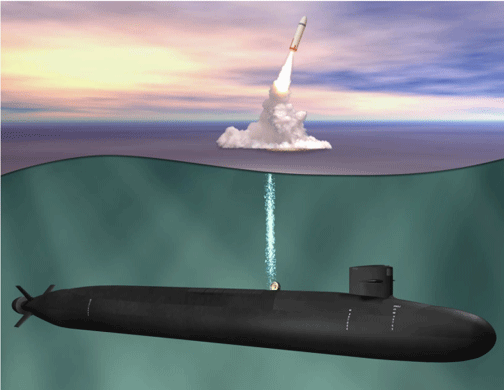
- HMS Vanguard is reported to have sailed into the Atlantic earlier this week
- It is expected to test-fire a Trident missile 3,500 miles from the US
Daily Mail, By CHRIS JEWERS, 2 February 2024
Britain is primed to test a Trident nuclear missile for the first time since 2016 amid growing fears of a global conflict, according to reports.
Officials are said to have issued a warning to shipping in the region of the test as nuclear submarine HMS Vanguard sailed into the Atlantic earlier this week.
The test will be the first time the UK has test fired a Trident missile since a botched launch in 2016 on sister sub HMS Vengeance which left the navy red-faced.
HMS Vanguard has undergone a seven-year refit in Plymouth since then, and is now set to fire an unnamed missile, The Sun reports.
The tests are understood to be the final hurdle the £4 billion submarine must clear in order to re-enter service as part of the UK’s nuclear deterrent force. ……..
HMS Vanguard has been hailed as a 491-foot ‘colossus’ that can patrol under the surface of the seas for months at a time.
On board, she can carry up to 16 Trident 2 D5 missiles, a submarine-launched ballistic missile (SLBM), built by American firm Lockheed Martin.
They also share the name with the UK’s nuclear programme (the Trident nuclear programme) the purpose of which is to ‘deter the most extreme threats to our national security and way of life, which cannot be done by other means,’ according to the mission statement by the Ministry of Defence.
Each missile is armed with British-made thermonuclear warheads that are 20 times more powerful than the Oppenheimer-developed weapons dropped during the Second World War on the Japanese cities of Hiroshima and Nagasaki.
The warheads are delivered by multiple independently targetable re-entry vehicles (MIRVs), or – in other words – exoatmospheric ballistic missiles.
Citing a Royal Navy source, The Sun said Britain’s nuclear submarines can carry more explosive power than was dropped in the entirety of the Second World War.
In the coming test, HMS Vanguard is expected to launch a single missile that will not be armed with nuclear warheads, about 55 miles off the US coast……………………
The missiles are designed to blast to the edge of space and track their position against the stars, before re-entering the atmosphere (hence exoatmospheric), plummeting to earth and raining warheads down on its target.
The maximum range of the missile is 12,000km (7,400 miles), which is roughly the distance from London to Indonesia one way, or Hawaii the other.
A warning was issued by the US National Geospatial Intelligence Agency to shipping that could cross the missile’s expected course, The Sun said.
The ‘hazardous operations’ warning also plots areas closer to the launch site where debris is expected to fall into the ocean…………………………….
Reports of the test come amid rising fears that Britain and her allies could be pulled into a conflict in the coming years.……………………………………………………………………
The test also comes after it was reported last year that a Royal Navy nuclear submarine and its crew were mere moments from being crushed after its depth gauge suddenly failed.
Reports said the Vanguard class sub, which had been carrying 140 crew and Trident 2 missiles, suffered the huge malfunction while on a mission in the Atlantic.
It caused a frantic scrabble with engineers managing to stop the submarine and its nuclear reactor from plunging further and being crushed by underwater pressure just minutes before disaster struck. …………………………………………………… more https://www.dailymail.co.uk/news/article-13034029/Britain-test-fire-Trident-missile.html
Campaigners Warn Return of US Nukes to UK Would ‘Make Britain a Guaranteed Target’

The U.S. is reportedly planning to deploy nukes “three times the strength of the Hiroshima bomb” to an air base in Suffolk.
JAKE JOHNSON, Feb 02, 2024, Common Dreams
Nuclear weapon abolitionists sounded alarm Friday in response to fresh evidence that the United States is planning to station nukes in the United Kingdom for the first time in more than 15 years, a move that opponents said would only heighten the risk of an atomic war.
The U.S. removed more than 100 nuclear bombs from Royal Air Force Lakenheath, a base in Suffolk, in 2008 following sustained protests from the U.K.-based Campaign for Nuclear Disarmament (CND) and other nonproliferation advocates.
CND warned in a statement Friday that the redeployment of nukes to Lakenheath would “make Britain a guaranteed target in the event of any war between NATO and Russia.”
Nuclear weapon abolitionists sounded alarm Friday in response to fresh evidence that the United States is planning to station nukes in the United Kingdom for the first time in more than 15 years, a move that opponents said would only heighten the risk of an atomic war.
The U.S. removed more than 100 nuclear bombs from Royal Air Force Lakenheath, a base in Suffolk, in 2008 following sustained protests from the U.K.-based Campaign for Nuclear Disarmament (CND) and other nonproliferation advocates.
CND warned in a statement Friday that the redeployment of nukes to Lakenheath would “make Britain a guaranteed target in the event of any war between NATO and Russia.”
“We encourage both the media and the public to increase pressure on the British government to be honest about this deployment,” said Kate Hudson, CND’s general secretary.
The Telegraphreported last week that “procurement contracts for a new facility at RAF Lakenheath in Suffolk confirm that the U.S. intends to place nuclear warheads three times the strength of the Hiroshima bomb at the air base.”………………………………………. more https://www.commondreams.org/news/us-nuclear-weapons-uk
It’s not a done deal and you are not alone’: anti-GDF campaigners pledge solidarity with South Holderness over nuclear waste dump plan,
Last week’s surprise news that South Holderness is being considered as another
potential site for a Geological Disposal Facility, or in layperson’s
language a nuclear waste dump, will have been a great shock to many local
people. But residents can take heart because this is the fifth such
announcement by Nuclear Waste Services and residents in West Cumbria and
East Lincolnshire faced with similar news in previous years have mobilised
successful campaigns to fight similar plans in their areas.
NFLA 30th Jan 2024
1
Cracks appear in Labour-Green alliance over claims that Heysham power stations letter was ‘reckless’
Cracks have appeared in an alliance between Labour and the Greens after a
letter calling for the lives of Heysham Power Stations to be extended was
branded “reckless”. Lancaster City Council leader Phillip Black was also
accused of “operating outside the terms of a collaboration agreement”
between Labour and the Greens, who between them form the majority of the
council’s coalition cabinet.
Councillor Jack Lenox of the Greens also said
it was “completely inappropriate for Councillor Black to suggest that
pressure on the council’s budget should be a factor in extending the lives
of these nuclear power stations”. Councillor Black, from Labour, has
responded by accusing the Greens of “Machievellian nonsense” and making
“baseless accusations”.
Beyond Radio 30th Jan 2024
Is this the World’s Most Expensive and Most Delayed Power Project?
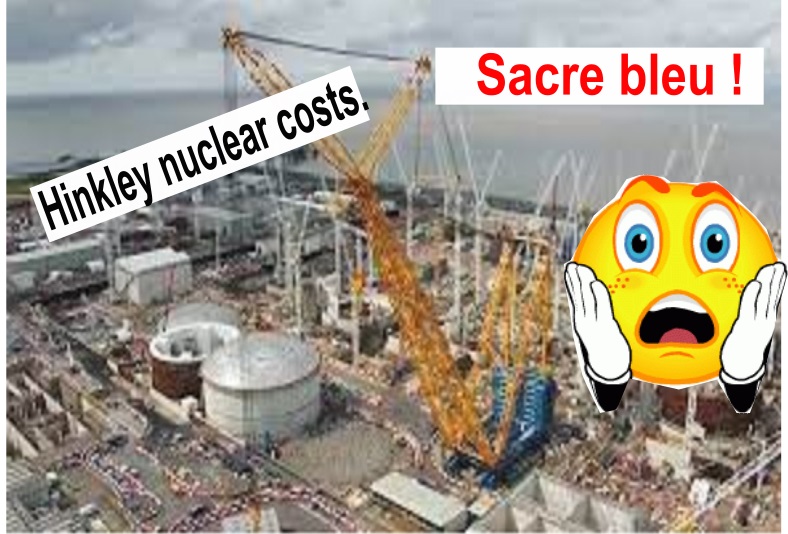
By Leonard Hyman & William Tilles – Jan 31, 2024,
Yes, they are still building the Hinckley Point C nuclear power station in the United Kingdom, and yes the latest estimated cost is more than the previously estimated cost and the completion date has receded another two years into the future.
This nuclear project received its license for construction in 2012, with an estimated cost of £18 billion and completion date in 2025. The last estimate calls for 2029-2031 completion at a cost of £46 billion. To the extent that these estimates can be trusted, the plant would end up costing double the original estimate in real terms. In the same time period, solar and wind costs will decline by at least one half. We are not sure yet whether Hinckley Point will set an all-time record as the most expensive and most delayed power-related project in history, but it certainly will be a contender.
As is the case for so many climate- or security-related projects, the UK government offered significant subsidies to the builder. But in a different way. Most governments, nowadays, offer start-up subsidies in order to bring production levels up to a point where economies of scale kick in, after which costs drop rapidly and consumers get real benefits. The cost curves for wind, solar, and energy storage show how well this strategy works. Give the industry a kickstart and watch the action take place.
Not so with nuclear, where costs seem to rise with encouragement rather than fall. Opting for nuclear, then, seems more like an ideological rather than a technological or economic choice, especially for British Conservative politicians. “Nuclear has to be part of the package”, they seem to say. Even if the nuclear cost per kW installed is five-eight times higher than non-fossil alternatives. But, fortunately, the UK government is not directly on the hook for the added costs, the Chinese co-investor in the project has declared that it will not contribute more, and it looks as if French utility EDF will bear the increased costs if it does not get a new power contract. But if the UK decides to stick EDF with the bill, what will that decision do to discourage further nuclear construction? Given the perilous nature of that construction (namely the danger of cost inflation), who could take the risk of initiating new projects other than a government agency?………………………………………….
Oil Price 31st Jan 2024
Safety concerns persist at Ukraine’s Zaporizhzhya Nuclear Power Plant (ZNPP)
Ukraine’s Zaporizhzhya Nuclear Power Plant (ZNPP) lost its immediate
back-up 750 kV power supply to the reactor units for several hours during
the week of 15 January.
This was the latest incident underlining persistent
nuclear safety and security risks at the site, director general Rafael
Mariano Grossi of the International Atomic Energy Agency said on 19 January
during its Update 207 report. Thursday’s failure of two of the ZNPP’s
back-up power electrical transformers showed the continuing vulnerability
in the availability of external power, which the plant needs to cool its
six reactors and for other essential nuclear safety and security functions.
Modern Power Systems 30th Jan 2024
https://www.modernpowersystems.com/news/newssafety-concerns-persist-at-znpp-iaea-update-11474827
NATO chief says more war is way to secure lasting peace in Ukraine
30 Jan 2024 https://www.sott.net/article/488375-NATO-chief-says-more-war-is-way-to-secure-lasting-peace-in-Ukraine
More weapons and ammunition to Kiev is the “path to peace,” according to the bloc’s Secretary General Jens Stoltenberg
Any negotiations between Moscow and Kiev about a peace agreement are “inextricably” linked to the situation on the battlefield, NATO Secretary General Jens Stoltenberg has stated, insisting that the bloc must send even more military aid to Kiev.
Speaking in Washington at a joint press conference with US Secretary of State Antony Blinken, Stoltenberg said that aid to Ukraine is“not charity”but is an“investment into our own security.”
He also shared his view that, in order to achieve a lasting peace in Ukraine, the West needs to ramp up its support for Kiev and send it more weapons and ammunition, proclaiming that “weapons to Ukraine is the path to peace
The comments come as the future of Western aid to Ukraine looks increasingly uncertain, with many of Kiev’s backers running out of resources to help the country. The Ukrainian leadership is also reportedly losing hope of success against Russia, without Western support.
Stoltenberg also argued that a Ukrainian surrender could not be considered a “just peace,” which, he prescribed, can only be reached by having Russian President Vladimir Putin “realize that he will not get what he wants on the battlefield.”
Comment: The phrase that aid to Ukraine is “not charity” but is an “investment into our own security is not original. Stoltenberg used at the recent WEF meeting and just a few days ago, US senator,Jeanne Shaheen, in the Boston Globe wrote:
America’s targeted assistance to Ukraine is not charity, nor is it a blank check. It is a strategic investment with oversight that bolsters US deterrence, protects democracies across Europe, and strengthens the US industrial base — including to contractors in New England.
The US senator is a member of the CFR and in the above, it is clear that what she writes above is from the same script as Stoltenberg and Blinken. It is equally clear that none of them are at all interested in what happens to Ukraine as a country or what happens to ordinary Ukrainians. To them it is a war against Russia because they see it to be a real threat to their hegemonic ‘rules based’ order. They argue by saying that allocating more money to Ukraine is also good for the US as the money in truth gets funnelled to the American military industrial complex, where many of them get serious ‘donations’.
Blinken nonetheless admitted during their press conference that the lack of foreign military aid to Kiev, especially now that Washington has run out of the military assistance it has been providing to it, has put Ukraine in a tough spot on the battlefield.
The Secretary of State reiterated the White House’s calls on Republican lawmakers in Congress to approve Joe Biden’s $60-billion additional military aid package for Kiev, which has been stuck in the House of Representatives for several months now. The GOP has refused to greenlight the bill unless Biden agrees to revise and tighten the US’ border-control laws.
Blinken stressed that it is “vital” that Congress pass the president’s supplemental budget request in order to “ensure that Ukraine knows success and Russia knows strategic failure,” noting that without US assistance, “everything that Ukrainians achieved … will be in jeopardy.“
Moscow, meanwhile, has repeatedly denounced Western military support to Ukraine, stressing that “pumping” the country with more weapons and ammunition has only served to prolong the fighting and cause more bloodshed without affecting the inevitable outcome of the conflict.
Comment: So everything that Ukrainians achieved …will be in jeopardy. He doesn’t mention what Ukraine achieved yet he likely isn’t referring to the total destruction of Ukraine, the loss of 1 – 1.5 million men, the flight abroad of 10-15 million Ukrainians and the loss of 20% of Ukrainian territory…so far, to mention a few things.
He is most likely referring to what US Senator Lindsey Graham said when he visited Kiev to reassure Zelensky that “the Ukraine war was the best money the US ever spent because we get to kill Russians!“.
MP calls for vote on Holderness nuclear site which local petition brands ‘hazardous waste dumping ground’
Graham Stuart has called for a public vote on whether a nuclear waste site
should be built in Holderness amid opposition from some living in the area.
‘Beverley and Holderness ‘ MP said Nuclear Waste Services, the Government
Agency which unveiled the waste site proposals last week, should be forced
to make their case directly to the public. Joanne Turner, whose Change.org
petition calls for the site to be rejected, said the beautiful south
Holderness area should not be turned into a dumping ground for hazardous
waste.
Hull Daily Mail 31st Jan 2024
2
UK’s Nuclear “money pit” tops $59 billion.

What a turkey! by beyondnuclearinternational, https://beyondnuclearinternational.org/2024/01/31/what-a-turkey/
Hinkley Point C costs hit a new high but nuclear plant still isn’t roasting Christmas turkeys
By Linda Pentz Gunter
The Great Mosque of Mecca is considered the most expensive building in the world at $115.2 billion. Right behind it comes….a nuclear power plant! The two-reactor 3,260MW Hinkley Point C nuclear site still under construction in the UK will now cost at least £46 billion ($59 billion) according to the latest figures released by its developer, the French energy giant, EDF.
As such, Hinkley Point C has now earned the dubious honor of becoming the second most expensive building in the world. And it’s not even finished. The price could soar still higher.
EDF originally bragged that Britons would be baking their Christmas turkeys powered by Hinkley Point C by 2017. The completion date has now been pushed to “after 2029”.
The nuclear power industry is very good at tripling things. Perhaps not global nuclear installations by 2050 as it bragged would happen during an announcement at the COP28 climate summit last December. But the price tag for a new reactor? Timelines for new reactor construction? Straight A grades all around!
That’s almost what’s happening at Hinkley Point C where the new price is more than double the original estimated cost of £18 billion ($23 billion). Getting to triple the cost still seems eminently achievable given the new completion date.
This not-so-shocking news, given nuclear power’s track record, comes after the recent, overblown announcement by Rishi Sunak’s Conservative government that Britain would launch its “biggest expansion of nuclear power for 70 years to create jobs, reduce bills and strengthen Britain’s energy security.” The plan will of course achieve none of these things.
Far from reducing electricity bills for British consumers, the Hinkley nuclear project will in fact increase them “far above the market electricity price,” predicted Dr Norbert Allnoch, CEO of the International Economic Forum for Renewable Energies (IWR), based in Münster, Germany.
According to estimates by IWR, the cost of the electricity generated by Hinkley Point C will be “significantly higher than the 15 cents/kWh mark” and will continue to rise. This is because the UK government agreed a “state-guaranteed price for nuclear power being paid to EDF, which is linked to the inflation rate,” says IWR.
All of this came after the recent announcement that UK authorities had granted a Development Consent Order (DCO) to EDF’s identical twin EPR reactor project on the Suffolk Coast at Sizewell, while committing £1.3 billion ($1.6 billion) in funding for the project. The French company has already been tearing up pristine countryside there, destroying habitat and disturbing wildlife at the adjacent Minsmere Nature Reserve.
Meanwhile, France is pushing the UK to pay for the cost-overruns at Hinkley and the expected ballooning bills at Sizewell once work begins. France reportedly blames Britain for prompting the Chinese firm CGN to withdraw its 33.5% share from the Hinkley plant after Britain booted China out of the Sizewell C nuclear project.
Chinese investment in UK nuclear projects has been a hot political potato for some time, and came to be viewed as “an unacceptable national security risk.” A proposed new reactor project at Bradwell in Essex, a joint project between China and France, looks unlikely to go forward, at least in part due to security concerns about Chinese involvement.
These challenges prompted the UK government to seek alternative sources of funding, inevitably settling on ratepayers using something called a Regulated Asset Base (RAB). RAB effectively funds future nuclear projects by charging ratepayers up front in their electricity bills for the anticipated costs of nuclear plant design, construction, commissioning, and operation.
“Hinkley Point C has been a shambolic money pit,” said a spokesperson from Together Against Sizewell C on X (formerly Twitter). “It’s been hit by delay after delay and the costs are escalating at an alarming rate. Nobody can say with any confidence when it will go live or how much money will have been wasted on it.”
The story of Hinkley C illustrates that the nuclear sector is “out of control economically,” said Paul Gunter, director of the Reactor Oversight Project at Beyond Nuclear. The cost of EDF’s EPR reactor being built in France at Flamanville and still incomplete, has more than quadrupled to close to $15 billion. Another EPR, at Olkiluoto in Finland, went from $3.2 billion to more than $12 billion and launched 12 years late.
On U.S. soil, two AP1000 reactors at the Vogtle nuclear power plant site in Georgia, will likely come in at a total price tag of at least $35 billion, $20 billion more than originally estimated, with the second of the two reactors still not on line.
UK govt awards Hitachi £33.6 m to design small nuclear reactors

GE Hitachi awarded nuclear design funding, 30 January 2024
GE Vernova’s nuclear business, GE Hitachi Nuclear Energy, was on 25
January awarded a £33.6 m Future Nuclear Enabling Fund grant from the
UK’s Department for Energy Security & Net Zero. The UK government has
ambitions for 24 GW of nuclear generation by 2050 to help in providing
energy security for the UK and for meeting net zero. The grant will help GE
Hitachi develop its small nuclear reactor design.
Modern Power Systems 30th Jan 2024
https://www.modernpowersystems.com/news/newsge-hitachi-awarded-nuclear-design-funding-11474778
1 This Month





PLEASE OPPOSE HR 8255 AND S.3639 – bills would accelerate satellite deployment, with no environmental review or safeguards – https://ncstd5li.quorum.us/campaign/169331/
To see nuclear-related stories in greater depth and intensity – go to https://nuclearinformation.wordpress.com
-
Archives
- October 2026 (10)
- September 2026 (339)
- August 2026 (330)
- July 2026 (355)
- June 2026 (287)
- May 2026 (306)
- April 2026 (356)
- March 2026 (251)
- February 2026 (267)
- January 2026 (308)
- December 2025 (358)
- November 2025 (359)
-
Categories
- 1
- 1 NUCLEAR ISSUES
- business and costs
- climate change
- culture and arts
- ENERGY
- environment
- health
- history
- indigenous issues
- Legal
- marketing of nuclear
- media
- opposition to nuclear
- PERSONAL STORIES
- politics
- politics international
- Religion and ethics
- safety
- secrets,lies and civil liberties
- spinbuster
- technology
- Uranium
- wastes
- weapons and war
- Women
- 2 WORLD
- ACTION
- AFRICA
- Atrocities
- AUSTRALIA
- Christina's notes
- Christina's themes
- culture and arts
- Events
- Fuk 2022
- Fuk 2023
- Fukushima 2017
- Fukushima 2018
- fukushima 2019
- Fukushima 2020
- Fukushima 2021
- general
- global warming
- Humour (God we need it)
- Nuclear
- RARE EARTHS
- Reference
- resources – print
- Resources -audiovicual
- Weekly Newsletter
- World
- World Nuclear
- YouTube
-
RSS
Entries RSS
Comments RSS

