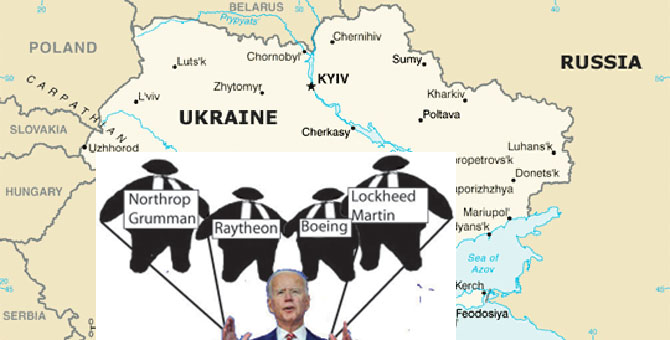
Why Biden’s $61 billion in weapons for Ukraine won’t prevent inevitable defeat
Walt Zlotow, West Suburban Peace Coalition, Glen Ellyn IL 11 Feb 24
For 4 months President Biden has been beseeching Congress to grant another $61 billion in aid to Ukraine to continue their 2 year war with Russia. This is on top of $113 billion that has made no dent in Ukraine’s efforts to prevail against overwhelming Russian forces.
Biden could give Ukraine a trillion dollars in aid but it’s essentially worthless because Ukraine is running out of soldiers to use US weapons.
A dozen Ukrainian soldiers and commanders told the Washington Post that personnel deficits are at their lowest point ever.
One mechanized brigade battalion commander advised he’s down to 40 soldiers from a normal 200 to hold off the Russian advance. Another mentioned the same shortage in his unit.
Replacements are scares since August when Zelensky fired all recruitment office heads due to corruption. That’s caused a dramatic decline in replacements still not solved.
But if Biden gets his $61 billion he’d be better off tossing it into a bonfire instead of squandering it on more weapons for Ukraine. That will only prolong a war that was lost on Day One, 717 days ago. Had Biden not torpedoed a peace deal nearly inked in the first month, over 400,000 Ukrainian soldiers would still be alive, the Ukraine economy would not be devastated, and Ukraine may not have lost a single square mile of territory.
Biden knows the $61 billion more will not turn the tide. But as Pete Seeger sang about LBJ continuing to fight a lost war in Vietnam 57 years ago, in today’s White House…’The Big Fool says to push on.’
France’s EDF shuts down two nuclear reactors after fire at Chinon plant

Reuters, February 11, 2024, https://www.reuters.com/business/energy/frances-edf-shuts-down-two-nuclear-reactors-after-fire-chinon-plant-2024-02-10/
—
Nuclear energy operator EDF has shut down two reactors at Chinon in western France after a fire in a non-nuclear sector of the plant in the early hours of Saturday, the company said.
The fire has been extinguished, it said.
“Production unit number 3 at the Chinon nuclear power plant has shut down automatically, in accordance with the reactor’s safety and protection systems,” EDF said in a statement, adding it also shut down reactor number 4, which is coupled to number 3.
France’s nuclear safety watchdog said in a separate statement the fire had led to an electricity cut at the plant that triggered the automatic shutdown.
Chinon is one of France’s oldest nuclear plants.
Reporting by Tassilo Hummel; editing by Barbara L
European Union now promoting the lie that nuclear power is “green”

Nuclear power officially labelled as ‘strategic’ for EU’s decarbonisation, By Paul Messad | EURACTIV.fr | translated by Anne-Sophie Gayet, 7 Feb 24
The Council of EU member states and the European Parliament agreed on Tuesday (6 February) to label nuclear power as a strategic technology for the EU’s decarbonisation, following months of intense negotiations in Brussels over the Net-Zero Industry Act (NZIA).
…………….. The agreement encompasses tried and tested nuclear technologies as well as future third and fourth generation ones, i.e. small modular reactors (SMRs) and advanced nuclear reactors (AMRs). Their fuel cycles are also included in the text.
“The message is clear: the EU recognises that we need nuclear power to achieve the objectives of the Green Deal,” the French MEP told Euractiv. https://www.euractiv.com/section/energy-environment/news/nuclear-power-officially-labelled-as-strategic-for-eus-decarbonisation/
EDF’s nuclear struggles dampen EU nuclear prospects – the industry “on a slow descent to hell”.

MURIEL BOSELLI, Paris, France, 08 Feb 2024 19:48
(Montel) The latest setbacks at the UK’s new Hinkley Point C nuclear power plant have cast a shadow over Europe’s nuclear revival, experts told Montel, with one former EDF executive saying France’s nuclear industry was “on a slow descent to hell”.
A feud between Paris and London over who should fork out an extra EUR 6-8bn for Hinkley Point C’s (HPC) cost overruns was tarnishing the nuclear industry’s image as pro-nuclear nations try to promote atomic power in the battle against climate change, experts said.
HPC faces a new four-year delay and may not be commissioned until 2031, with completion costs now forecast at between GBP 31-34bn,… (Subscribers only)
Montel 8th Feb 2024
https://www.montelnews.com/news/1537139/edfs-nuclear-struggles-dampen-eu-nuclear-prospects
Rolls-Royce snubbed for UK’s first private small nuclear reactor plant
Proactive, Philip Whiterow, 08 Feb 2024
Rolls-Royce Holdings PLC (LSE:RR.)‘s mini-nuclear plans have seemingly suffered a setback with the UK’s first privately funded station to use reactors built by Westinghouse.
The US group said it signed an agreement with Community Nuclear Power to install four AP300 small modular reactors (SMRs) at the North Teesside project to generate up to 1.5 gigawatts of power or enough for up to two million homes.
Westinghouse added it hopes to have the first AP300 operating unit available in “the early 2030s”…………………………………..
Mini-reactors or SMRs were a key plank of former prime minister Boris Johnson’s plans to rejuvenate Britain’s nuclear industry and hit his green energy targets.
…………………………………….
Lord Houchen, the mayor of Tees Valley, said one of the major issues it faced was the lack of policy clarity in the UK over SMRs.
Although reportedly ahead of the competition, Rolls-Royce’s SMR is still said to be only mid-way through the UK approval process.
The new power station is being entirely privately funded and will be sited at Seal Sands, a former chemical works. https://www.proactiveinvestors.co.uk/companies/news/1040531/rolls-royce-snubbed-for-uk-s-first-private-nuclear-plant-1040531.html
Another $61 billion to kill more Ukrainians in an unnecessary and losing war

The $61 billion will make no difference on the battlefield except to prolong the war, the tens of thousands of deaths, and the physical destruction of Ukraine.
The Biden-Schumer Plan to Kill More Ukrainians JEFFREY D. SACHS, Feb 08, 2024, Common Dreams, https://www.commondreams.org/opinion/the-biden-schumer-plan-to-kill-more-ukrainians
President Joe Biden is refusing to fold a losing hand as he bets with Ukrainian lives and U.S. taxpayer money. Biden and Democratic Senate Majority Leader Chuck Schumer propose to squander the lives of tens of thousands more Ukrainians and $61 billions of federal funds to keep Biden’s disastrous foreign policy failure hidden from view until after the November election.
The $61 billion will make no difference on the battlefield except to prolong the war, the tens of thousands of deaths, and the physical destruction of Ukraine. It will not “save” Ukraine. Ukraine’s security can only be achieved at the negotiating table, not by some fantasized military triumph over Russia.
$61 billion is not nothing. This worse-than-useless outlay would exceed the combined budgets of the U.S. Department of Labor, Environmental Protection Agency, National Science Foundation, and the Women, Infant, and Children nutrition program.
Almost exactly 10 years ago this month, Biden did much to put Ukraine on the path to disaster. This is well known to those who have looked carefully at the facts but is kept hidden from view by the White House, the Senate Democrats, and the mainstream media that back Biden. I have previously provided a detailed chronology, with hyperlinks, here.
Ukraine’s security can only be achieved at the negotiating table, not by some fantasized military triumph over Russia.
In 1990, President George H. W. Bush, Sr. and his German counterpart Chancellor Helmut Kohl promised Soviet President Mikhail Gorbachev that NATO would not expand eastward if the Soviet Union accepted German reunification. When the Soviet Union disbanded in December 1991, with Russia as the successor state, American leaders decided to renege.
President Bill Clinton began NATO expansion over the vociferous opposition of top diplomats like George Kennan and the opposition of his own Secretary of Defense, William Perry. In 1997 Zbigniew Brzezinski upped the ante, with a plan for NATO to expand all the way to Ukraine. He famously wrote that without Ukraine, Russia would cease to be a great power.
Russian leaders have repeatedly made clear that NATO expansion to Ukraine is understandably the reddest of Russian redlines.
In 2007, President Vladmir Putin stated that NATO enlargement to that date was a cheat on the 1990 promise, and that it must go no further. Despite these clear warnings, including by his own diplomats, George W. Bush Jr. committed in 2008 to expand NATO to Ukraine and Georgia in order to surround Russia in the Black Sea.
William Burns, now CIA director, and then the U.S. Ambassador to Russia, wrote a famous memo entitled “Nyet means Nyet,” explaining that Russia’s opposition to NATO enlargement was across Russia’s political spectrum. Most Ukrainians themselves were also firmly against the plan, favoring neutrality over NATO membership. The Ukrainian Rada declared Ukraine’s state sovereignty in 1990 on the basis of becoming “a permanently neutral state.” In 2009, the people of Ukraine elected Viktor Yanukovych, who ran on a platform of neutrality.
In early 2014, the U.S. decided to help bring down Yanukovych in a coup. This was standard U.S. deep-state operating procedure, one used on dozens of occasions around the world. he CIA, National Endowment for Democracy, USAID, and NGOs like the Open Society Foundation went to work in Ukraine. The point person was Victoria Nuland, who was first Richard Cheney’s principal deputy foreign policy advisor, then George Bush Jr.’s ambassador to NATO, then Hillary Clinton’s spokesperson, and by 2014 Assistant Secretary of State.
This time, the Russians caught the conspiracy on tape, in an intercepted call between Nuland and U.S. Ambassador to Ukraine Geoffrey Pyatt (now Assistant Secretary of State). Nuland explains to Pyatt that Vice President Joe Biden will help choose and cement the post-coup government. The 2014 Ukraine team, including Biden, Nuland, Jake Sullivan (then and now Biden’s national security advisor), Geoffrey Pyatt, and Antony Blinken (then the deputy national security advisor), remains the Ukraine team today.
It is a team of bunglers. They thought that Yanukovych’s overthrow would quickly usher in NATO expansion. Instead, ethnic Russians in Ukraine virulently rejected the Russophobic post-coup government that was installed by Nuland, and called for autonomy of the ethnically Russian regions. In a referendum, Crimea voted overwhelmingly to join Russia.
Obama, Biden, and their team armed the post-coup government to attack the ethnically Russian regions, thinking this would be the end of it. Yet the regions resisted. Ukraine and the breakaway regions signed the Minsk Agreements to bring an end to the fighting and give constitutional autonomy to the ethnically Russian Donbas. The Minsk II agreement was backed by the UN Security Council, but the U.S. privately agreed with the Ukrainian government that it was okay to ignore it.
In 2021, after 7 years of fighting and more than 14,000 deaths in the Donbas, Putin called on newly elected President Biden to stop NATO enlargement and engage in negotiations with Russia over mutual security arrangements. Biden rejected Putin’s call to end the gambit of NATO enlargement to Ukraine.
In February 2022, Putin launched the Special Military Operation (SMO) invasion to push Ukraine to the negotiating table. Ukraine’s President Volodymyr Zelensky immediately called for negotiations based on Ukraine’s neutrality. Within a month, a framework agreement to end the fighting was reached between Ukraine and Russia, based on Ukraine’s neutrality and an end to NATO’s enlargement to Ukraine. Biden stepped in to stop the deal, with the U.S. informing Zelensky that the U.S. would not support neutrality.
Biden and team had still more failed tricks up their sleeve. They firmly believed that U.S. financial sanctions—freezing Russia’s assets and cutting it out of the SWIFT banking system—would cripple the Russian economy and cause Putin to relent. In fact, they expected that the ensuing economic crisis would topple him. Of course, nothing of the sort happened.
Then they expected that NATO weaponry would trounce Russia on the battlefield. That too did not happen. Then they expected that Ukraine’s “counter-offensive” in the summer of 2023, backed by Pentagon and CIA planners, would defeat Russia. Instead, Ukraine lost hundreds of thousands of soldiers dead and wounded—its military hardware destroyed.
The entire war, including the loss of Ukrainian territory, the hundreds of thousands of Ukrainian casualties, and the utter waste of more than $100 billion of U.S. taxpayer money to date, could easily have been avoided.
Now, Biden and Schumer want to throw more Ukrainian lives and more tens of billions of dollars at this glaring failure. They want to do this in a rushed vote, without any Congressional let alone public oversight, without hearings, and without any strategy. The fact is they want to save Biden from the embarrassment of a decade of puerile and failed plotting, at least until the November election.
There remains one answer for Ukraine’s security: diplomacy and neutrality. That solution doesn’t cost lives or money. It was Ukraine’s choice before the 2014 coup and again in 2022 until stopped by Biden. It is the path that Biden and the Senate Democrats still refuse to take.
EU Policy. Commission invites industry to join support platform for mini nuclear
euronews, By Robert Hodgson, 09/02/2024
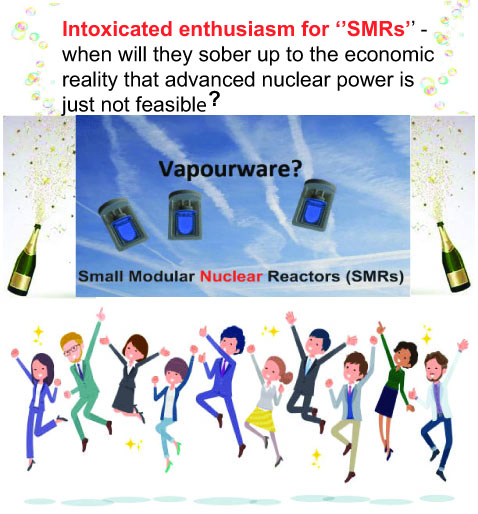
The European Commission has invited interested companies to help “to facilitate and speed up the development, demonstration, and deployment” of small modular nuclear reactors, a fledgling technology it hopes will help the EU achieve its goal of reaching net-zero greenhouse gas emissions by 2030.
……………………………………………………………………………………………………… The inclusion of nuclear power in Europe’s climate mitigation policy has been divisive, with France leading a group of EU members in favour promoting it as a low-carbon solution and Germany against …………………..
Internal market commissioner Thierry Breton said SMRs would play a “central role” in Europe’s climate action. “In a context of increasing business competition on SMRs at global level, Europe is promptly responding, capitalising on its strong nuclear competence, innovation, and manufacturing capability,” he said in a statement.
……………………………….. Environmental groups have criticised the Commission’s reliance on technologies, including SMRs and carbon capture and storage, that have yet to be proved at scale for meeting EU climate targets, rather than focusing resources on promoting existing solutions such as solar and wind power…………. https://www.euronews.com/green/2024/02/09/commission-invites-industry-to-join-support-platform-for-mini-nuclear
Small Modular Reactors do not solve the many problems of nuclear, NGOs say

As the European Commission prepares to launch its industry alliance for Small Modular Reactors (SMRs) on 6 February, civil society organisations stress the high costs and slow progress, making this technology a risky distraction for the climate.
The European Union (EU) should concentrate its efforts on climate solutions that are already working to reduce emissions quickly, rather than costly experiments.
Davide Sabbadin, Deputy Manager for Climate and Energy at the EEB, said:
In its desperate fight for survival, the European nuclear industry is pleading for public support for SMRs, but smaller-scale nuclear won’t change the poor economics of investments in atomic energy. We don’t even know how long it would take to build SMRs, as all previous attempts have been scrapped. Why should the EU invest in costly alternatives over existing climate solutions? Every euro wasted on nuclear projects could help replace fossil fuels faster and cheaper if invested in renewables, grids, and energy storage instead.”
Like other industry alliances fostered by the Commission, the purpose of the new SMR alliance is to bring together governments, industry players, and stakeholders who seek to accelerate the development of the SMR industry. However, the launch of this alliance signals a dangerous shift of direction for the EU institutions prompted by the nuclear industry’s increasing calls for public funding and administrative support.
Despite the hype, SMRs do not currently answer any of the industry’s fundamental problems:
- Too expensive: In relative terms, the construction costs for SMRs are higher than for large nuclear power plants due to their low electricity output.
- Unproven technology: Even the simplest designs used today in submarines will not be available at scale until late next decade, if at all. Taking into account the learning curve of the nuclear industry, an average of 3,000 SMRs would have to be constructed in order to be financially viable.
- Ineffective climate solution: According to the latest IPCC report published in March 2023, nuclear power is one of the two least effective mitigation options (alongside Carbon Capture and Storage).
- Waste problem: Current SMR designs would create 2-30 times more radioactive waste in need of management and disposal than
- conventional nuclear plants.
- Geostrategic interests: Several EU countries rely on technology and nuclear fuel supplied by Russia’s state-owned Rosatom. Switching from importing Russian fossil fuels to Russian nuclear energy tech does not serve the EU’s energy security interests in the slightest.
New nuclear ventures take time and resources that we simply don’t have to tackle the climate crisis. Diverting attention from energy efficiency and faster-to-deploy renewables to costly and experimental technologies risks pushing Europe further away from meeting its climate commitments under the Paris Agreement.
The science is clear and must guide EU climate policy. In the 20 pages of the European Scientific Advisory Board on Climate Change’s report dedicated to the various “levers” the EU can use to curb carbon emissions in the energy sector, there is not a single reference to nuclear or SMRs.
Over $1 Billion in Weapons Missing In Ukraine
Real Clear Wire, By Adam Andrzejewski, February 07, 2024
Topline: The Department of Defense has failed to properly track $1 billion worth of weapons provided to Ukraine, according to an internal audit released on Jan. 10 by the DOD Inspector General.
Key facts: The DOD is supposed to use special “enhanced end-use monitoring” techniques” to “safeguard” key weapons such as smaller, high-tech weaponry provided to Ukraine, which are likely targets for theft.
The audit says these monitoring procedures are not properly being followed in Ukraine, due to staffing shortages, poor internal logistics and more.
The audit found that $1 billion of the $1.7 billion — or 59% — in enhanced end-use monitoring designated weapons provided to Ukraine as of June 2023 are “delinquent,” meaning they can’t be accounted for in inventory reports.
Maybe the weapons are being used properly; maybe they have been stolen by Russian forces. No one can be completely sure…………………………….
The report also found that inventory databases were not regularly updated and that the Ukrainian Armed Forces failed to properly report missing weapons……………….
Background: The Biden administration has sent over $75 billion to Ukraine since February 2022, including $44 billion in military aid.
Some Republican leaders are already trying to block Biden’s request for additional funds for Ukraine. The missing weapons could strengthen their arguments.
This is not the first time weapons have gone missing during Biden’s administration……………………………………………………
Summary: While there is no direct evidence that weapons in Ukraine have actually been misused, the $1 billion inventory error calls into question the White House’s constant assurances that any aid would be carefully tracked.
Zelensky military purge to extend beyond top general – media
Rt.com 7 Feb 24
Together with General Valery Zaluzhny, the Ukrainian leader allegedly plans to let go of Chief of the General Staff Sergey Shaptala
Ukrainian President Vladimir Zelensky is reportedly considering letting go not only of Armed Forces Commander-in-Chief Valery Zaluzhny, but also of the Chief of the General Staff, according to the news outlet Ukrainskaya Pravda.
The report comes after Zelensky admitted last week that he intends to fire the top commander of the Ukrainian Armed Forces. The two have had a major falling out following Kiev’s failed summer counteroffensive. Zaluzhny has described the battlefield situation as a “stalemate,” while Zelensky has vehemently rejected this assessment, especially in light of waning support from Kiev’s Western backers.
In an interview with Italy’s RAI TG1 news channel on Sunday, Zelensky announced that he is planning a “serious” overhaul of the country’s leadership, noting that these changes will not be “about a single person.” He did not, however, list any specific names.
Citing sources within the Ukrainian government, Ukrainskaya Pravda reported on Monday that Zaluzhny may indeed not be the only one getting canned amid Zelensky’s purge and suggested that Sergey Shaptala, who currently serves as the Chief of the General Staff, will also be leaving his position as early as this week.
“[The fate of] everyone else has not yet been decided,” the source told the outlet.
Rumors of Shapatala’s resignation appear to be partially confirmed by a post from Zaluzhny, who posted a picture with his colleague on Monday, wishing him a happy birthday and writing: “It will still be difficult for us, but we will never be ashamed.”………………………………………………………………… more https://www.rt.com/russia/591911-ukraine-zelensky-shapatala-firing/
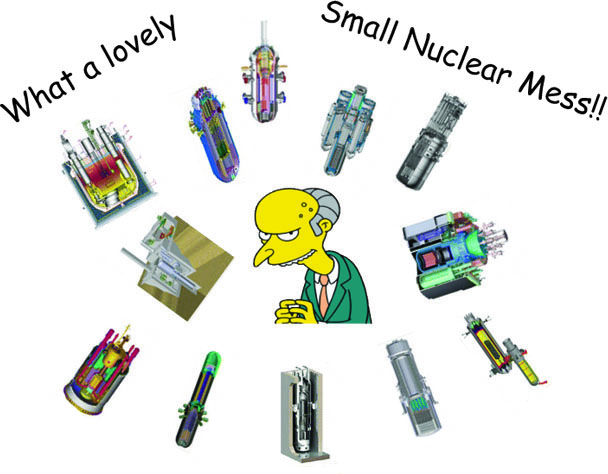
The dangerous craze for SMRs
This is going too far in trivializing risk. And this is not limited to “acceptability” which seems to be ASN’s major concern, but to the risks of such “mixed” installations.

a serious accident situation (AZF, Lubrizol) could damage the SMR unit and transform the accident into a disaster.
Bernard Laponche, Doctor of Science in Nuclear Reactor Physics, President of the Global Chance association, Le Club Mediapart, 5th Feb 2024 https://blogs.mediapart.fr/bernard-laponche/blog/050224/le-dangereux-engouement-pour-les-smr
The development of small modular nuclear reactors (SMR) is the subject of spectacular announcements.Based on the declarations of the Nuclear Safety Authority (ASN) on this
subject, we launch an appeal for reason on the realities and difficulties of such projects, on the technical, safety and security levels .
During his press conference on January 31, 2024, the president of the Nuclear Safety Authority (ASN) addressed the issue of small modular nuclear reactors, known as SMRs, and answered some questions on this subject.
In his presentation, the president highlights the technical and societal questions posed by these new reactors, as well as the safety, security and non-proliferation issues “to be integrated upstream of the projects”.
These are the usual concerns when we are interested in nuclear reactors, which produce heat and possibly electricity from fission and chain reactions of fissile elements (uranium, plutonium), but also products fission and transuranium elements found in irradiated fuels currently intended for reprocessing, leading to the accumulation of radioactive waste in addition to that from the dismantling of reactors. These are the problems that will have to be analyzed for candidate SMR reactors, as for any nuclear reactor and with the same rigor as for conventional reactors.
In the same way that a conventional industrial installation cannot claim to be free from all risk of accident, no nuclear installation can claim to be free of any risk of accident. The declaration “a nuclear accident is possible in France” by successive ASN officials is valid for SMRs, even if, as its current president says, certain innovative SMRs “present potentially promising intrinsic safety characteristics” .
The first “prototype” examples of candidate reactors under the title of SMR, that is to say intended to be mass-produced in a factory before installation on site, will therefore have to be built on nuclear sites, probably those housing research reactors.
As ASN points out, the use of SMR in France would not be of great interest for the production of electricity given the importance of the current fleet of EDF power plants and the announced projects. But, on the other hand, SMRs could be very useful for the production of heat or steam for the process industries (paper, food, chemical industries, etc.) of which there are very many.
It would then be necessary to install the SMR reactor very close to the industrial installation or even, according to ASN, inside this installation.
This is going too far in trivializing risk. And this is not limited to “acceptability” which seems to be ASN’s major concern, but to the risks of such “mixed” installations.
Indeed, we cannot admit the presence of a basic nuclear installation, containing highly radioactive materials within a classic industrial installation, of the ICPE type in which a serious accident situation (AZF, Lubrizol) could damage the SMR unit and transform the accident into a disaster.
Furthermore, it is clear that each promoter of an SMR candidate aims for a large order in the number of copies (of the order of a hundred say some) which will allow the “modular” manufacturing of reactors in a dedicated factory, this allowing the supposed reduction in unit cost.
In this case, by eliminating the solution of an SMR in the plant itself, we would have the creation of a large number of INB-ICPE couples. Even if we admit that the probability of an accident on the SMR is lower than for a conventional reactor (which remains to be demonstrated for each case), this probability is multiplied by the number of reactors, all identical.
In examining the safety files for EDF’s large power reactors and nuclear fuel plants, ASN and IRSN pay very close attention to “external attacks” of natural or malicious origin. What happens to these concerns for SMS located almost everywhere on the territory, on locations which are those of the industrial installation which they must supply with heat and whose location was chosen without any concern for nuclear safety and security? ? How would specific protection be organized which, to be effective, would certainly be expensive, especially since the SMRs concerned would be of low power?
The profusion of candidate projects for SMR, some of which are financially supported by the Government, leads to each being examined by the IRSN and the ASN, as announced by the latter. This examination can be postponed over time depending on the maturity of the projects, all of which currently only exist on file, more or less elaborate.
If this examination is done correctly, that is to say with as much care as for a power reactor, the examination of the technical and safety files of each SMR prototype is a considerable task. We can fear that the “craze” for SMRs that ASN speaks of will exert dangerous pressure on the quality of studies and safety and security injunctions.
Finally, but this is not the problem of the IRSN and the ASN, we would still need to have serious information on the costs. Not only that of the construction of a prototype (the example of NuScale in the United States is edifying) but also that of its exploitation and especially that of the fuel, from its manufacture to its treatment after use, dismantling and management garbage.
When we examine in the light of what we know of the climatic upheavals which are already affecting our territory and will intensify considerably, we can really ask ourselves the question of the fragility and the risk of installing a little small nuclear reactors everywhere which will obviously be subject, depending on the period and their site, to floods, droughts, storms, tornadoes, earthquakes, etc.
All those who today say they want to welcome an SMR on their territory should really think about it seriously.
Energy Security Minister Graham Stuart opposes Holderness nuclear waste site
By Stuart Harratt, BBC News
A MP said he is supporting efforts to oppose plans to bury nuclear waste in East Yorkshire.
Beverley and Holderness Conservative MP Graham Stuart called on East Riding Council to withdraw from discussions with Nuclear Waste Services (NWS).
The government agency has named South Holderness as a potential site for a Geological Disposal Facility (GDF).
Mr Graham, who is also the Minister for Energy Security, had previously called for a public vote on the proposals.
He now says he is supporting a motion by two local Conservative councillors, Lyn Healing and Sean McMaster, asking that the local authority stop talks with NWS.
‘Community says no’
“South Holderness is a special place, and the news that the area was being considered as the site for the UK’s GDF shocked many in our community,” Mr Stuart said.
“It is the people of Holderness who should determine what happens in their area and they have made clear their opposition to these plans.”
He added: “Our community says ‘No’ and Lyn and Sean have my backing to seek our withdrawal.”
Ms Healing and Mr McMaster said their motion to withdraw from discussions would be submitted to a full council meeting on 21 February.
“Yes, investment in Holderness is badly required but is this the right investment? We now believe it isn’t,” the councillors said……………………………………………………………………………… more https://www.bbc.com/news/uk-england-humber-68233882
Campaigners deeply concerned at Dr Thérèse Coffey’s support for Bradwell new nuclear power
A CAMPAIGNER group opposing new nuclear power in Bradwell-on-Sea said they
are “deeply concerned” following comments made by an MP. According to
the Blackwater Against New Nuclear Group (BANNG), former deputy prime
minister Dr Thérèse Coffey showed support for Bradwell as a “logical”
landfall site for a substation and converter linking East Anglian offshore
wind farms to the on-land national grid. BANNG have now refuted these
comments. A spokesman said: “National Grid has made it clear that
Bradwell is in the wrong place for the connection, would require upgraded
transmission infrastructure and faces environmental constraints from the
many designated areas on the Essex coastlands.
Maldon Standard 6th Feb 2024
Ukraine’s top general sparing neo-Nazis from frontline slaughter – ex-CIA analyst
https://www.rt.com/russia/591948-zaluzhny-zelensky-nationalist-allies/ 7 Feb 24
Valery Zaluzhny may find allies in radical nationalists in his standoff with President Vladimir Zelensky, Larry Johnson says
Ukrainian President Vladimir Zelensky, who has reportedly been attempting to fire his top general, Valery Zaluzhny, could find himself out of a job before the nation’s top military commander, considering that the latter is backed by armed neo-Nazis, former CIA analyst Larry Johnson has argued.
Amid widespread reports that Zelensky had unsuccessfully tried to sack Zaluzhny, Ukrainian and foreign media described a tense meeting between the pair, with the general reportedly rejecting a call to resign voluntarily and the president hesitating to remove him under pressure from military top brass. Zelensky has since told the press that a major overhaul of the military command was imminent.
In conversation with Nima Alkhorshid, the Brazil-based host of the YouTube channel, Dialogue Works on Sunday, Johnson claimed the soap opera would be hilarious “if hundreds of thousands of Ukrainians weren’t dead and maimed.”
”The guy with the gun usually wins and last time I checked Zaluzhny’s got more guns than Zelensky,” Johnson said.
Comparing the two men, he said the general should not be seen as a “great guy.”
“I don’t want to present Zaluzhny as some sort of military genius or really a good-hearted man,” the commentator remarked. He is “a bit of a scumbag” who “embraces the neo-Nazi ideology,” Johnson claimed.
”He’s been very careful to not insert the most ideologically driven troops – the Azov and the Kraken units – into the front lines where they get killed, because he wants to preserve them. Instead, he is sending the cannon-fodder guys.”
Whether or not Zaluzhny shares the radical nationalist ideology of the Ukrainian far-right is hard to tell from his public statements, but he is believed to have considerable support in those circles.
A social meia post on Friday by Andrey Stempitsky, a Ukrainian military leader and prominent member of the nationalist Right Sector group, featured a photo of him giving Zaluzhny an honorary ID, certifying the general as the first member of Stempitsky’s brigade. A portrait of Stepan Bandera, a Ukrainian nationalist leader and Nazi collaborator, was in the background of the image.
Zelensky was elected president in 2019 on a platform of reconciliation with rebels in the east and with Russia, but threats of violence by the extreme right made his office pull back from early attempts to deliver on that promise
IAEA watchdog to visit nuclear plant in occupied Ukraine to assess safety of ageing fuel and low staffing.
UN nuclear watchdog chief Rafael Grossi said
he would visit the Zaporizhzhia nuclear power plant in Russian-occupied
Ukraine today to see if it can be run with a reduced number of staff and
whether its years-old uranium fuel is safe. Russia gained control of
Europe’s largest nuclear power plant after launching a full-scale
invasion of Ukraine in early 2022, and its six nuclear reactors are now
idled.
Irish Independent 7th Feb 2024
1 This Month





PLEASE OPPOSE HR 8255 AND S.3639 – bills would accelerate satellite deployment, with no environmental review or safeguards – https://ncstd5li.quorum.us/campaign/169331/
To see nuclear-related stories in greater depth and intensity – go to https://nuclearinformation.wordpress.com
-
Archives
- October 2026 (10)
- September 2026 (339)
- August 2026 (330)
- July 2026 (355)
- June 2026 (287)
- May 2026 (306)
- April 2026 (356)
- March 2026 (251)
- February 2026 (267)
- January 2026 (308)
- December 2025 (358)
- November 2025 (359)
-
Categories
- 1
- 1 NUCLEAR ISSUES
- business and costs
- climate change
- culture and arts
- ENERGY
- environment
- health
- history
- indigenous issues
- Legal
- marketing of nuclear
- media
- opposition to nuclear
- PERSONAL STORIES
- politics
- politics international
- Religion and ethics
- safety
- secrets,lies and civil liberties
- spinbuster
- technology
- Uranium
- wastes
- weapons and war
- Women
- 2 WORLD
- ACTION
- AFRICA
- Atrocities
- AUSTRALIA
- Christina's notes
- Christina's themes
- culture and arts
- Events
- Fuk 2022
- Fuk 2023
- Fukushima 2017
- Fukushima 2018
- fukushima 2019
- Fukushima 2020
- Fukushima 2021
- general
- global warming
- Humour (God we need it)
- Nuclear
- RARE EARTHS
- Reference
- resources – print
- Resources -audiovicual
- Weekly Newsletter
- World
- World Nuclear
- YouTube
-
RSS
Entries RSS
Comments RSS

