Russia urges IAEA to publicly reveal Ukrainian attacks on nuclear plant
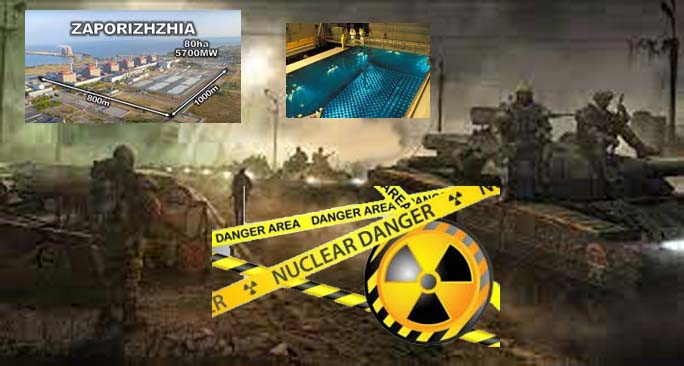
https://www.rt.com/russia/595516-russia-iaea-zaporozhye-attacks/ 6 Apr 24
The Zaporozhye NPP lost the connection to its last remaining backup power line after artillery fire was heard in the vicinity
Moscow has appealed to the International Atomic Energy Agency (IAEA), urging it to publicly record the recurring attacks by the Ukrainian army on the Zaporozhye Nuclear Power Plant.
The plant is Europe’s largest atomic power station, with six reactor cores capable of generating a gigawatt of electricity each. The plant came under Moscow’s control in 2022, early on in the Ukraine conflict, and was formally transferred to Rosatom management after Zaporozhye Region was incorporated into Russia following a referendum. Kiev claimed it was illegally occupied and insisted that Russia kept heavy weapons at the plant and was attacking Ukrainian forces from it.
Kiev has since targeted the facility with artillery, missile, and drone attacks, and has sent armed groups to try and seize it. Earlier this week, the NPP lost the connection to its only remaining back-up power line, a key source of the electricity it needs to cool its reactors, with the IAEA team on the ground reporting that it heard “numerous rounds of artillery fire” in the vicinity of the plant. On Friday, the NPP wrote on Telegram that it has been repeatedly attacked by Ukrainian drones recently.
Russian Foreign Ministry spokeswoman Maria Zakharova warned Kiev on Friday against further attacks on the plant, noting that they could harm critical infrastructure and destabilize the facility. She also appealed to the IAEA to make the recent attacks and their perpetrators known to the public.
“We strongly urge the IAEA and its leadership to actively use the experts present at the station to publicly record all cases of attacks from the Ukrainian side and clearly state where the threat to the safe operation of this facility really comes from,” she said in a statement.
In a statement to TASS late Friday, the IAEA said it was aware of the reported attacks and was studying them, but refused to give any further details.
The IAEA deployed a permanent on-site monitoring mission to the plant in September 2022, but has repeatedly declined to publicly assess the incidents involving the facility or name Ukraine as the perpetrator.
Experts from the agency said the plant is now entirely dependent on the only remaining 750-kilowatt line for off-site power. The NPP reported that the loss of connection to the backup power line is being investigated, and noted that the radiation background at the station and the surrounding area so far remains unchanged.
EDF confirms cracks on 1.3 GW Paluel 2 reactor
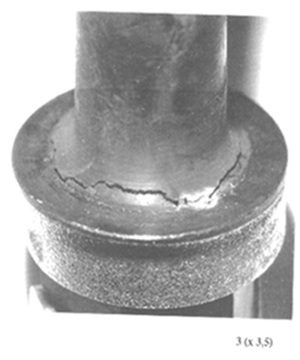
(Montel) EDF has found cracks on its Paluel 2 (1.3 GW) nuclear reactor in the north of France, a company spokeswoman told Montel on Friday, confirming prior comments by the firm’s executive director Cedric Lewandowski.
Reporting by: Caroline Pailliez, 05 Apr 2024, https://montelnews.com/news/df0e8352-e018-4d1d-af96-63266d385d3c/edf-confirms-corrosion-cracks-on-paluel-2-1-3-gw-reactor
Questioned by a parliamentary committee late on Thursday, Lewandowski said the French state-run firm had “recently” found traces of corrosion at its Blayais 4 (910 MW) and Paluel 2 reactors. He gave no further details.
Contacted by Montel, an EDF spokeswoman confirmed the firm had found cracks at the Paluel unit but refused to provide any other details such as when and where the corrosion was found or whether repairs were underway.
“The possibility of carrying out this type of repair on shutdowns scheduled for 2024 is included in our production forecasts,” she added.
Paluel 2 has been offline for maintenance and refueling since 2 February. The outage was initially scheduled to last 98 days but EDF warned last week the shutdown could be extended up to a “total of 135 days”.
The reactor is currently due to return to service on 10 May.
The news comes after EDF confirmed last month that a 30-day outage extension at its Blayais 4 (910 MW) reactor was due to corrosion.
“No surprise”
Lewandowski told the committee in the upper house that the “recent discovery” of corrosion at Blayais 4 and Paluel 2 “came as no surprise”.
Having checked France’s newest reactors, which it said were most susceptible to corrosion, the firm was now probing older units, such as at Blayais and Paluel, he said, adding EDF knew it would also find cracks of “lesser importance” on those units.
Corrosion was “still with us” and “would be until 2025” when the firm was due to complete its probe of France’s 56 reactors, he said.
“Fortunately, we are now in the process of mastering it… Our construction sites are getting faster and faster, our ability to understand the phenomenon is now almost total.”
EDF warned in December it might have to extend one in three planned outages for around 30 days on average at 13 reactors this year and 13 reactors in 2025, based on the probability of finding corrosion on units yet to be examined.
The issue has dogged the company, with reactor outages jumping 47% in 2022 due to problems at numerous units, with output plunging to a 33-year low of 279 TWh.
Edited by: Chris Eales, Robin Newbold
America’s crazed proxy war on Russia is destroying Ukraine’s economy

Walt Zlotow, West Suburban Peace Coalition, Glen Ellyn IL 7 Apr 24
I’m no economist. But you don’t need to be one to figure out the economic catastrophe the US has imposed on its Trojan Horse Ukraine in its lust to weaken Russia.
Most opponents of this endless US debacle focus on the hundreds of thousands dead Ukrainian soldiers without a single US death to weaken, isolate Russia.
But we should not ignore the economic basket case Uncle Sam has created, essentially degrading life for every Ukrainian not yet killed.
Since goading Russia into invading 26 months ago, Ukraine has ceased to exist as an economically independent nation. Its exports have largely vanished, its imports have exploded. Ukraine has gone from a surplus exporter to a massive importer. That dries up foreign currency making the paying for further imports, even the national debt, increasingly problematic.
Exports plummeted by 17% and 30% respectively in ’22 and ’23. Imports? More than doubled since America’s disastrous, losing proxy war crossed the Red Line to invasion.
Ukraine now spends half its GDP on defense that’s accomplishing nothing but more soldier cemeteries and spiraling economic collapse. Its borrowed over $40 billion in last 2 years, a 200% increase compared to the previous 10 years. Its external debt is now 90% of GDP and heading north to 140% by 2026 according to EU estimates.
All this could have been avoided had the US realized 33 years ago that the Soviet Union’s demise meant the true end to the Cold War. Now, having turned the Cold War into a Hot War destroying Ukraine, America’s crazed leaders, including most Democrats and Republicans, lust for another $61 billion in weapons that will prolong the flow of red blood and red ink.
And the Big Fool in the White House just says ‘Push on.’
West helping Ukraine attack deep inside Russia – CNN
https://www.rt.com/russia/595314-west-helps-ukraine-drone-attacks/ 5 Apr 24
Kiev’s foreign backers are coordinating the flight paths of kamikaze drones, a report says
Western countries are helping Ukraine to launch kamikaze drones deep into Russian territory, CNN reported on Tuesday, citing a source close to Kiev’s drone program.
An unnamed Ukrainian official who spoke to CNN described how Kiev uses UAVs with longer ranges and “more advanced capabilities” to strike targets located more than 1,000km (621 miles) from the border.
“The flights are determined in advance with our allies, and the aircraft follow the flight plan to enable us to strike targets with meters of precision,” the source said.
The admission of receiving guidance from abroad follows multiple reports that Western personnel are providing Ukrainian troops with intelligence and information about specific targets.
The Washington Post cited a senior Ukrainian official last year as saying that Kiev’s soldiers “almost never” use advanced weapons, including US-made HIMARS rocket launchers, without receiving coordinates from the Pentagon.
On Tuesday, Ukrainian drones targeted Russia’s Tatarstan, a region 650km east of Moscow (400 miles), which had not previously been attacked by UAVs. One drone was aiming to hit an oil refinery in Nizhnekamsk, a city located roughly 1,100km (680 miles) from the border. Mayor Ramil Mullin said that the aircraft was disabled by air defenses and caused no damage.
Another drone struck a student dormitory inside the industrial zone in Elabuga, injuring 13 people. The hub hosts several companies that make high-tech equipment, including drones, according to Russian media.
Moscow has repeatedly warned that the delivery of weapons and other military aid to Kiev makes Western countries de facto direct participants in the conflict. The Russian Defense Ministry and local authorities have said that Kiev uses Western-supplied arms to indiscriminately fire at civilians.
Ukrainian military leaders know they can’t win on battlefield – Guardian

https://www.rt.com/russia/595341-ukraine-gur-attacks-guardian/ 5 Apr 24
Their army’s weakness has prompted Kiev’s strikes on Russian infrastructure, senior officers have allegedly told the London newspaper.
Ukraine has no other option but to launch attacks inside Russia, including on its oil infrastructure, because its army faces continued setbacks on the battlefield, The Guardian has reported, citing the leadership of the country’s military intelligence service, the GUR.
Officers who allegedly spoke to the British newspaper were candid about Kiev’s desperate military situation. GUR Brigadier-General Dmitry Timkov said his country was like a patient on life support.
”We are attached to a drip. We have enough drugs to stay alive. But, if the West wants us to win, we need the full treatment,” he admitted, referring to the dwindling quantities of military aid coming from Kiev’s western backers.
Major General Vadim Skibitsky, the deputy head of the GUR, admitted that a Ukrainian victory, widely promised by Kiev, is impossible at the moment. Facing multiple setbacks, the agency had “no choice” but to launch strikes deep inside Russia. He described this as a “NATO-standard procedure, known as center of gravity, or COG.”
The concept was first developed by Carl von Clausewitz, the famous Prussian general and military theorist, and essentially refers to targets that have the most value for the enemy, physically or morally.
GUR officials that spoke to the Guardian claimed credit for a recent string of Ukrainian drone strikes on Russian oil infrastructure. This contradicts public statements by the head of SBU, the Ukrainian civilian security agency, Vasily Maliuk who said it was his agents who were responsible for the operations.
Both branches have been overhauled in the years since the 2014 armed coup in Kiev, with the CIA’s help, according to Western media reports. Both were allegedly involved in targeted assassinations of people deemed enemies of Ukraine, since before the conflict with Russia began in 2022.
The newspaper said GUR intends to launch a new major attack on the Crimean Bridge – and to disable it – “in the first half of 2024.” Ukraine has previously targeted the structure, twice in 2022 and 2023.
READ MORE: West helping Ukraine attack deep inside Russia – CNN
The first plot involved a powerful bomb hidden in a truck, which killed the vehicle’s driver and four other civilians in nearby cars. Moscow said GUR masterminded this attack. The second strike involved naval kamikaze drones that SBU said were deployed by its agents. That bombing killed two civilians.
Moscow has accused Kiev of engaging in terrorism as a method of war. The regime in Kiev has adopted the tactics, Russian officials are claiming, because it is unable to score victories on the battlefield.
British Rebellion Grows Against Arming Israel
London’s mayor, 50 Labour MPs and Winston Churchill’s grandson have joined widening calls to defy Israel’s impunity by demanding the U.K. stop sending it arms, reports Joe Lauria
Joe Lauria, in Bradford, England, Consortium News, April 4, 2024
Even Winston Churchill’s grandson is calling for Britain to stop shipping arms to Israel.
Asked whether it was time for Britain to stop sending weapons to Israel after it killed seven international aid workers this week, the Conservative peer Lord Nicholas Soames said, “It’s probably time that that happened now, yes, I think if we’re determined to show that we are not prepared to countenance these ongoing disasters.”
The rebellion within British ruling circles against knee-jerk support for is Israel is spreading after the killing of the aid workers and after leaked audio recordings on Saturday revealed the British government is ignoring the advice of its own lawyers not to continue supplying weapons to Israel for its Gaza operation without risking complicity in crimes against humanity.
[It took Westerners, including three Britons, being killed to spur this action after more than 32,000 Palestinians are dead. It also forced Israel on Friday to sack two military officers and reprimand two top commanders for “serious” errors in killing the aid workers, who were in marked cars. There’s nothing like the fear of an arms cutoff to make Israel try to do something.]
On Wednesday, more than 600 British lawyers, academics and retired senior judges — including three who sat on the country’s Supreme Court — wrote to Prime Minister Rishi Sunak imploring him to cut off military aid and even called for sanctions against the most senior Israeli leaders.
The rebellion is erupting in both major parties, as well as in the Liberal Democrats, which on Thursday wrote to No. 10’s ethics advisor to urge a probe into whether U.K. arms sales could be a breach of Britian’s ministerial code. The letter said “the UK must not be complicit in breaches of international humanitarian law,” The Guardian reported.
The Labour Party is in upheaval as the mayor of London and 50 Labour MPs on Thursday said Britain should no longer arm a state that is increasingly unable to hide its crimes. “In my view, the fact the government is not publishing the legal advice, one can only draw one conclusion,” Mayor Sadiq Khan told the Politics Joe website. “I think the government should be pausing all sales of weapons to Israel. I think we should be holding to account the Israeli government.” He added: It’s got to stop.”
As he tries to unify a fractious party over the issue, Labour leader Keir Starmer has not gone beyond calling for the legal advice mentioned in the leaked audio to be made public.
Britain exported £42 million of weapons to Israel in 2023. Figures since Oct. 7 last year have not yet been released. A British break with Israel on Gaza would be politically more significant than the size of the arms transfers.
Tories Imploding Too
Rebellion is breaking out in the ruling Conservative Party as well. Churchill’s grandson has been joined by Lord Hugo Swire and three Tory MPs – Paul Bristow, Flick Drummond and David Jones – in demands that arms shipments be halted.
Sir Alan Duncan, a figure reviled by Julian Assange supporters for gleefully organizing his arrest from the Ecuador Embassy in April 2019, is being investigated by the Conservative Party for potentially “anti-semitic” remarks after he criticized pro-Israel Tory “extremists.”
“The time has come to flush out those extremists in our own parliamentary politics, and around it, some of whom are at the very top of government, or have been,” he told a radio interviewer on Thursday. “They have never been called to account by journalists to say: Do you agree with your own party’s policy? Do you condemn illegal settlements?’”
Duncan, a former minister in Conservative Theresa May’s government, added: “Conservative Friends of Israel has been doing the bidding of [Benjamin] Netanyahu, bypassing all proper processes of government, to exercise undue influence at the top of government.”
David Cameron, the former prime minister, current foreign secretary and prospective Tory leader once again, is reportedly under pressure from these party “extremists” because he doesn’t share their fanatical devotion to Israel. This is a man who as prime minister once called Gaza an “open-air prison.” He is far more restrained in his criticism now. But he’s feeling the heat in party backrooms……………………………. more https://consortiumnews.com/2024/04/04/british-rebellion-grows-against-arming-israel/
Dounreay workers vote to strike
Workers at the Dounreay nuclear power complex in Caithness have voted to
strike after long-running pay talks stalled. The GMB union said members at
the plant had overwhelmingly backed industrial action including strikes,
working to rule and an overtime ban. It comes after a pay offer was
rejected. GMB said its vote delivered a “crushing majority” on a
turnout of 85%. Other unions, Unite and Prospect, are also balloting
members.
Press and Journal 4th April 2024
Ukraine aid will bankrupt future US generations – congressman
https://www.rt.com/news/595344-ukraine-aid-bankrupt-us/ 5 Apr 24
America risks getting bogged down in “yet another forever war,” Republican Eli Crane has warned.
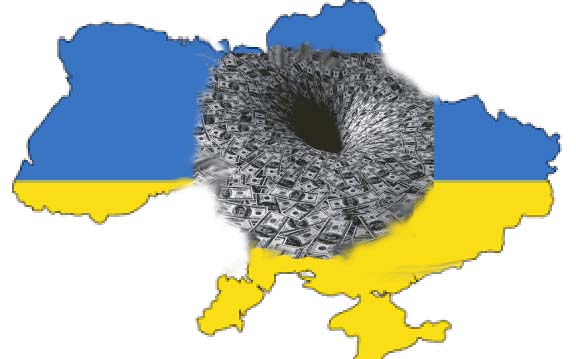
The US should end its financial support for Ukraine and instead focus on how Kiev can settle the conflict, Republican congressman Eli Crane has said. His comments come as House Speaker Mike Johnson said the chamber is likely to vote soon on providing Kiev with new funding.
Several months ago, US President Joe Biden proposed a supplemental security package that would earmark around $60 billion in assistance to Ukraine, but it has since remained stalled in Congress as Republicans demand more focus on security at the Mexican border.
On Sunday, however, Johnson signaled that the package could come up for a vote soon, with “some important innovations.” Among these, he said, is a possibility of extending a loan to Ukraine – an idea favored by GOP presidential frontrunner Donald Trump – as well as seizing Russian sovereign assets frozen in the US and transferring the proceeds to Kiev.
Since the start of the Ukraine conflict, the West has frozen around $300 billion in Russian assets, most of which are under European control. While numerous Western officials have proposed seizing the funds to finance Ukraine, many have pointed out that there is no legal basis for doing so. Moscow, for its part, has called the blocking “theft,” warning of retaliation if its funds were to be confiscated.
Some GOP members, however, have argued against aiding Kiev. In this vein, Eli Crane told Fox News on Tuesday that Washington is “funding what appears to be yet another forever war.” This effort, the Arizona congressman suggested, “will bankrupt future generations – all while disregarding our own security as our southern border remains open.”
“It’s absurd that overnighting more tax dollars to Ukraine is even a consideration. It should be totally off the table and replaced with a push for peace talks,” he added.
This sentiment was also shared by Republican congresswoman Marjorie Taylor Greene of Georgia, who suggested on Tuesday that any talk of loaning money to Ukraine sounds “absolutely ridiculous.”
“It’s… laughable to even try to tell the American people that Ukraine will ever pay us back!.. Why isn’t our government brokering peace in Ukraine?” she said.
The US has provided Ukraine with $113 billion in various forms of assistance since the start of hostilities. Meanwhile, Russia has repeatedly condemned Western arms shipments to Ukraine, saying these will only prolong the conflict, while making the West a direct participant in the hostilities.
US Secretary of State Blinken says Ukraine will be NATO member

Ukraine, if/when it enters NATO, will have “unresolved” territorial issues. Crime and the Donbass are in Russian hands and will remain in Russian hands. If Ukraine enters NATO with that being the case, border conflicts over that territory could spark war, which would then drag in NATO through Article V. Such a war would be extremely bloody and potentially escalate to nuclear armageddon.
Reuters, Thu, 04 Apr 2024 https://www.sott.net/article/490373-US-Secretary-of-State-Blinken-says-Ukraine-WILL-be-NATO-member
U.S. Secretary of State Antony Blinken said on Thursday that Ukraine will eventually join NATO as support for the country remains “rock solid” among member states.
“Ukraine will become a member of NATO. Our purpose at the summit is to help build a bridge to that membership,” Blinken told reporters in Brussels.
Comment: For now, this appears to primarily be belligerent rhetoric, because at least some analysts say that Ukraine can’t join whilst involved in a conflict and with ongoing border disputes.
However, Russia has discussed creating a demilitarised zone, and so it is possible that this will compel it to neutralise Ukrainian regions even further West than they would have otherwise. Furthermore, this speaks more to the desperation of the West, and to Russia’s upper hand, which it could maintain so long as it doesn’t, precipitously, escalate the situation. And, amidst all this, the West ruins itself, its position on the global stage, and its ability to provoke the rising multipolar world.
Footage, and relevant snippet from the X post, below:
Will Tanner:
Secretary of State Blinken says that Ukraine will be joining NATO This is insane. This is insane. This is intentionally starting WWIII to help Hunter Biden’s paymasters level of insane 1) Ukraine, if/when it enters NATO, will have “unresolved” territorial issues.
1) Ukraine, if/when it enters NATO, will have “unresolved” territorial issues. Crime and the Donbass are in Russian hands and will remain in Russian hands. If Ukraine enters NATO with that being the case, border conflicts over that territory could spark war, which would then drag in NATO through Article V. Such a war would be extremely bloody and potentially escalate to nuclear armageddon.
2) This is Putin’s red line. In the 90s, when the USSR fell, America promised the Russians that NATO wouldn’t expand to the East. Then, in Russia’s weakness (created in large part by Goldman Sachs helping the oligarchs loot the country through privatization), it expanded to the East, doing just what it promised it wouldn’t, much to Russia’s chagrin. But Putin, while upset, has made it clear that Ukrainian membership in NATO is his red line that would mean war, potentially nuclear. It is utterly unacceptable and would have been like Ireland or Canada joining the Warsaw Pact. That’s why he launched the war; by “demilitarizing” Ukraine by shelling its army into oblivion and by creating a constant conflict, he wants to keep Ukraine out of NATO without going to war with NATO. He thought we wouldn’t be so dumb as to bring it into the alliance if it is fighting a war with Russia.
More NATO involvement in Ukraine doesn’t bode well, as the following highlights:
NATO chief, Jens Stoltenberg, admitting that the war did start in 2014. And from that same year, 2014, NATO has been busy training and arming the Ukraine armed forces
Russia declares ‘state of emergency’ after radiation detected in eastern city of Khabarovsk
Authorities in Russia’s far eastern city of Khabarovsk have declared a state of emergency in an area where a “radiation source” was found, TASS news agency reported on Friday, adding that elevated radiation levels were detected near a power pylon about 2.5 km (1.5 miles) from residential buildings.
Officials have not provided an explanation for the leak but have confirmed its containment and transfer to a secure radioactive waste storage site. A state of emergency is to persist for a minimum of three additional days as law enforcement continues investigations into the incident.
Reports indicate a delay of approximately one week before authorities responded to the leak. Video footage has surfaced depicting an individual in a nuclear protective mask, carrying a radiation reader, which displayed escalating readings as he traversed a designated “waste dump” area.
No one had been injured or exposed to radiation and “there is no threat to the health of citizens”, TASS quoted the local branch of Russia’s consumer safety watchdog as saying.
It said radiation levels would be monitored for the next two days and the source of the radiation would be investigated.
The cost of Europe’s new nuclear power plants.
By Paul Messad | Euractiv France, 5 Apr 24
An alliance of 15 pro-nuclear EU member states said the EU needs an additional 50 GW of nuclear power by 2050 to meet energy transition targets, requiring the construction of more than 30 new reactors.
The additional 50 GW of nuclear capacity is estimated to cost between €5 and €11 billion per GW, a range that “shows a great deal of uncertainty and a big difference in the assumptions”, energy economist Professor Jaques Percebois told Euractiv.
Basic assumptions
When costs are expressed in terms of electricity production (measured in kWh, GWh), they take into account the total cost of generating unit of power: investment in construction, operation (day-to-day running, maintenance, etc.) and fuel (loading, life cycle, etc.). This is the Levelised Cost of Energy (LCOE).
However, estimates often focus on the investment costs required to construct the plant (measured in kW, GW)
“Because it represents around 70% of the cost of a new reactor while operating costs represent only around 15% and fuel costs around 15% of the total amount,” explained Percebois.
Different estimates may include or exclude costs associated with decommissioning plants and treating the waste. Cost figures can also be strongly impacted by assumptions about external factors like future inflation rates………………………………..
Any country wishing to subsidise nuclear plant construction needs to navigate EU State aid rules. A number of member states are also calling for the possibility of dipping into European funds to finance nuclear power, or even to set up new dedicated funds.
Support for financing from publicly-backed banks, such as the European Investment Bank (EIB), can also prove decisive………………………………………………………………………………………………..
More clarity needed
This mix of factors explains the wide variations in cost estimates for new nuclear. However, at some point it will be necessary “to have figures” warns Percebois, if only to estimate funding requirements…………. https://www.euractiv.com/section/energy-environment/news/nucleaire-comment-definir-le-cout-des-futurs-reacteurs-en-europe/
Inside Sellafield behind the razor wire gun- toting guards and blast barriers at the toxic nuclear site

The 700-acre Sellafield complex means different things to different
people. To UK authorities it is a decommissioning hub being used to
spearhead the clean-up of Britain’s early nuclear industry mistakes, made
before the issue of long-term waste disposal was a priority.
In Ireland,
about 180km away, Sellafield is mostly seen as a potential hazard, a byword
for danger. A former reprocessing site for lethal spent nuclear fuel rods,
it was also known for a now-defunct power plant that was tacked on, Calder
Hall, but this was only ever a minor part of it. Reprocessing was the main
activity.
These days, Sellafield is seen as more of a nuclear dump for the
most radioactive material from all over the UK, with work ongoing in a
100-year, £134 billion (€156 billion) decommissioning project.
Yet another view of Sellafield: in the eyes of one nuclear industry source, the
site is a “gravy train” for well-paid staff and big contractors. Sellafield Ltd, the site’s UK state-owned operator whose mission is to make it safe, spends more than £2.5 billion each year on the clean-up strategy. It is also a bustling 24-hour workplace for 11,000 people paid an
average of €91,000 each annually.
The site’s critics, including the UK academic and radioactivity adviser to the Irish State, Dr Paul Dorfman, warn that the nuclear industry tries to dazzle outsiders with glossy public
relations. Sellafield, meanwhile, says it is only trying to be honest and
open about what it does.
The company, which answers to the UK government
through the Nuclear Decommissioning Authority (NDA), confirms that The
Irish Times is the first media outlet from the Republic to be granted
recent access to the site and its inner sanctum, where the most dangerous
nuclear material is handled. Thirty years after U2′s Bono landed on a
nearby beach in a Greenpeace protest, and almost 20 years after the
Republic last tried to sue the UK over its safety risks, its existential
relevance to Ireland remains.
Sellafield hasn’t gone away, you know. The battle to keep it safe goes on.
Irish Times 30th March 2024
Kiev has lost more than 80,000 troops since January
Russian MoD more https://www.rt.com/russia/595275-ukraine-losses-troops-shoigu/ 3 Apr 24
In excess of 1,200 Ukrainian tanks and other armored vehicles have also been destroyed, Sergey Shoigu has estimated.
Ukrainian forces have lost more than 80,000 troops since the beginning of the year, Russian Defense Minister Sergey Shoigu said on Tuesday, adding that the Russian military is continuing to reduce “the enemy’s combat potential.”
More than 14,000 pieces of military hardware have also been destroyed by Russian forces since January, including 1,200 tanks and other armored combat vehicles. During the same period, Moscow has liberated some 403 square kilometers of Russia’s new territories, Shoigu told a conference call with the country’s military leadership.
Despite Kiev’s lack of success on the battlefield, the Ukrainian leadership “is still trying to convince its Western sponsors of its ability to resist the Russian Army,” he said. To do so, Kiev has resorted to terrorism and long-range strikes on Russian territories, targeting the civilian population, the minister added.
“Our armed forces react asymmetrically to such crimes by Ukrainian militants,” the defense minister said. In March alone, the Russian military carried out 190 group strikes and two massive assaults on Ukraine using precision weapons and unmanned aerial vehicles, which targeted the country’s military and energy infrastructure facilities, he added.
Last month, the Russian Defense Ministry reported that the Ukrainian military had lost a total of 444,000 personnel since the outbreak of the conflict in February 2022, including 166,000 during last year’s failed summer counteroffensive.
However, Ukrainian President Vladimir Zelensky claimed in February that only 31,000 of its soldiers had been killed since the start of the conflict. He did not reveal how many had been injured or gone missing in action.
Meanwhile, Ukrainian military commanders have repeatedly complained about a significant shortage of manpower, prompting Kiev to seek new ways of replenishing its fighting force. This includes asking Ukraine’s Western supporters to send back draft dodgers who are hiding abroad, and lower the threshold for citizens to be recruited into military service.
Moscow has repeatedly described the Ukraine conflict as a proxy war being waged against Russia by the US and its allies, and has accused the West of using Ukrainians as “cannon fodder” in pursuit of their own interests.
Dennis Kucinich: the US engineered a coup to drag Ukraine into a conflict
by Donald A. Smith, PhD, 3 Apr 24, https://progressivememes.org/ukraine/Dennis-Kucinich-on-Ukraine.html
In this April 2, 2024 interview with Judge Napolitano, Dennis Kucinich says: “What’s happened is that the U.S. State Department and U.S. Government basically engineered a coup in Ukraine and used that to drag Ukraine into a conflict in Donetsk and Luhansk in the Donbas and ignited this war which Russia has been horrible in the way they have come in and attacked. There’s been six hundred thousand people, the flower of Ukraine, who have been killed. This thing is heartbreaking. But we cannot ignore the role that the U.S. has played in helping to impel it, and we cannot ignore the fact that, as you point out, there was a chance to resolve this two years ago.” (He’s referring to how in March of 2022 the U.S. forced the Zelensky government to step back from a peace deal that was being negotiated with Russia.)
Kucinich says that it will be impossible for the U.S. and NATO to defeat the Russian military. “There needs to be an end to this war, an effort to repair Ukraine.” Stop this “vainglorious effort to build up NATO.” Napolitano said that the neocons Victoria Nuland, Anthony Blinken, Jake Sullivan and Joe Biden think they can use Ukraine as a battering ram to weaken Russia, but Putin is popular and the Russian economy is thriving. Napolitano says, “The war was started in 2014 by the United States with the coup, as you pointed out.” (For more details about how the U.S. engineered the war, see this. The CIA was deeply involved. Numerous senior U.S. diplomats warned that aggressive NATO expansion would lead to a war. RAND Corporation recommended arming Ukraine as the best way to weaken Russia. The U.S. government always lies about its wars.)
Napolitano asks Kucinich why all the Dems in Congress are behind the war in Ukraine. Kucinich replies that it’s partly due to the desire not to be shunned by their caucus and partly due to a desire to support the incumbent Democratic president.
Kucinich said that Senator Biden supported the disastrous war in Iraq, and the same sort of thinking that led to that war exists in the U.S. government today. Indeed, many of the same people are making policy. They’re leading us to war with Russia and in the Middle East (Gaza and possibly Iran) and are preparing for war with China. “It’s madness. It’s against the interest of the American people. It’s against the taxpayers of this country. It’s driving our national debt. It’s leading to the collapse of America, not the collapse of Russia, not the collapse of China.” Instead of trying to rule the world by military force, we should take care of our own needs.
Kucinich also condemns U.S. support for Israel’s war in Gaza and calls what Israel is doing “ethnic cleansing” and “genocide.” Israel bombed the Iranian embassy in Syria, also a crime according to international law. On the one hand, President Biden says Israel should not invade Rafah and should respect Palestinian lives. On the other hand, Biden gives billions of dollars of weapons. Netyanahu has got the “Biden government over a barrel because of the politics of this. And he knows that and will keep going on.” “You can’t give someone a gun who has a record of killing innocent people and say, ‘Don’t kill innocent people'” (without being complicit).
“We cannot afford to be the policeman of the world” with a $34 trillion debt.
Naopolitano (who has been interviewing a lot of lefty peace activists) ends by calling Kucinich a “fierce defender of civil liberties, constitutional government and peace.”
1 This Month





PLEASE OPPOSE HR 8255 AND S.3639 – bills would accelerate satellite deployment, with no environmental review or safeguards – https://ncstd5li.quorum.us/campaign/169331/
To see nuclear-related stories in greater depth and intensity – go to https://nuclearinformation.wordpress.com
-
Archives
- September 2026 (339)
- August 2026 (330)
- July 2026 (355)
- June 2026 (287)
- May 2026 (306)
- April 2026 (356)
- March 2026 (251)
- February 2026 (267)
- January 2026 (308)
- December 2025 (358)
- November 2025 (359)
- October 2025 (375)
-
Categories
- 1
- 1 NUCLEAR ISSUES
- business and costs
- climate change
- culture and arts
- ENERGY
- environment
- health
- history
- indigenous issues
- Legal
- marketing of nuclear
- media
- opposition to nuclear
- PERSONAL STORIES
- politics
- politics international
- Religion and ethics
- safety
- secrets,lies and civil liberties
- spinbuster
- technology
- Uranium
- wastes
- weapons and war
- Women
- 2 WORLD
- ACTION
- AFRICA
- Atrocities
- AUSTRALIA
- Christina's notes
- Christina's themes
- culture and arts
- Events
- Fuk 2022
- Fuk 2023
- Fukushima 2017
- Fukushima 2018
- fukushima 2019
- Fukushima 2020
- Fukushima 2021
- general
- global warming
- Humour (God we need it)
- Nuclear
- RARE EARTHS
- Reference
- resources – print
- Resources -audiovicual
- Weekly Newsletter
- World
- World Nuclear
- YouTube
-
RSS
Entries RSS
Comments RSS