Julian Assange: Sweden Broke Own Laws With Nobel Prize to Venezuela’s Machado

The same dynamic is at play in the Caribbean once again, according to Assange, as the Nobel Committee crowns a Venezuelan politician best known for her unhinged appeals for foreign military intervention and her dedication of her Nobel victory to US President Donald Trump.
Max Blumenthal and Wyatt Reed, The Grayzone, December 17, 2025
By awarding its peace prize to Trump’s favorite Venezuelan opposition figure, pro-war coup plotter Maria Corina Machado, the Nobel Committee contravened the principles enshrined in its founding documents, as well as Swedish law, Julian Assange alleged in an explosive brief reviewed by The Grayzone.
The Swedish government violated its own laws by awarding the Nobel Peace Prize to Venezuelan opposition figure Maria Corina Machado, according to an explosive legal brief filed by Julian Assange, the Wikileaks co-founder and former political prisoner who was hounded across the globe, confined in harsh conditions, and subjected to physical and psychological torment over the course of a decade by the US and its allies.
The Nobel committee’s decision to award Machado the Peace Prize — and the 11 million Swedish Kroner ($1.18 million USD) reward which accompanies it — means that “there is a real risk that funds derived from Nobel’s endowment have been or will be… diverted from their charitable purpose to facilitate aggression, crimes against humanity, and war crimes,” Assange stated.
The Wikileaks founder pointed to the “ample public statements… showing that the U.S. government and María Corina Machado have exploited the authority of the prize to provide them with a casus moralis for war,” adding that the explicitly stated purpose of the war sought by Machado and her wealthy Latin American backers would be “installing her by force in order to plunder $1.7 trillion in Venezuelan oil and other resources.”
The Nobel Foundation stands accused of a number of violations of Swedish criminal law, including breach of trust, misappropriation and gross misappropriation, conspiracy, crimes against international law, as well as financing of aggression, facilitation of war crimes and crimes against humanity, and breaching Sweden’s stated obligations under the Rome Statute, to which Stockholm says it is “deeply committed.”
Under Swedish law, “Alfred Nobel’s endowment for peace cannot be spent on the promotion of war,” Assange noted. “Nor can it be used as a tool in foreign military intervention. Venezuela, whatever the status of its political system, is no exception.”
By granting Nobel funds to Machado, Assange argues that the Committee is effectively financing “a conspiracy to murder civilians, to violate national sovereignty using military force…” By refusing to end payments, “they flagrantly violate Nobel’s will and clearly cross the threshold into criminality,” he alleged. The Wikileaks co-founder seeks the “immediate freezing of all remaining funds and a full criminal investigation” into Committee members who awarded the prize.
The Nobel Prizes were established in 1901 according to Swedish inventor Alfred Nobel’s last will and testament, which was later incorporated into the Swedish and Norwegian legal systems. The Peace Prize, which is meant to be bestowed on the figure who has contributed most to “fraternity between nations,” the “abolition or reduction of standing armies,” and “the holding and promotion of peace congresses,” has served as a cornerstone of Scandinavian soft power ever since.
Since its inception, however, the prize was marred by controversy due to the violent legacy of its recipients, and the political ambitions of its Norwegian sponsors. In the case of one of the Prize’s first winners, US President Theodore Roosevelt, the Norwegian Nobel Committee was criticized at the time for overlooking the American statesman’s naked warmongering in Latin America in order to curry favor with the nascent US empire. The New York Times sardonically observed that “a broad smile illuminated the face of the globe when the prize was awarded … to the most warlike citizen of these United States.”
The same dynamic is at play in the Caribbean once again, according to Assange, as the Nobel Committee crowns a Venezuelan politician best known for her unhinged appeals for foreign military intervention and her dedication of her Nobel victory to US President Donald Trump.
As Assange explained, Trump’s massive buildup of US military forces off the coast of Venezuela “has already committed undeniable war crimes, including the lethal targeting of civilian boats and survivors at sea, which has killed at least 95 people.”
“The Office of the United Nations High Commissioner for Human Rights labeled these U.S. coastal strikes against civilian boats “extrajudicial executions,” the Wikileaks co-founder wrote. And the “principal architect of this aggression” was none other than Trump’s Secretary of State Marco Rubio, who “nominated María Corina Machado for the peace prize.”
Norwegian Nobel judges tied to influential Venezuelan regime change lobbyist
The awarding of the Nobel Peace Prize to a figure as clearly unqualified as Machado – and in apparent violation of Swedish law – raised questions about whether the Committee had been influenced by powerful outside interests. Machado’s nomination for the prize by the US Secretary of State had an undeniable impact on the decision, as the Nobel ceremony serves as a central channel of Norwegian soft power. But inside Oslo, a political powerbroker determined to return to power in his family’s native Venezuela may have also played a role in swinging votes for Machado. ………………………………………………………………………………………………………………………………..
The odds of Machado winning surged from 3.75% to 72.8% just hours before the Nobel Committee officially informed Machado of her victory. One unusually prescient bettor won $65,000 gambling on the Venezuelan opposition figure. “It seems we have been prey to a criminal actor who wants to earn money on our information,” said Kristian Berg Harpviken, the head of the Nobel Institute.
Months later, The Nobel committee still has yet to conclude its investigation into the corruption scandal. As of publication, the committee did not respond to a request for comment by The Grayzone.
For what promotes itself as the world’s premiere peacemaking institution, it may be too late to undo the damage wrought by giving the Nobel Prize to an avowed champion of violent regime change.
“Using her elevated position as the recipient of the Nobel Peace Prize, Machado may well have” already “tipped the balance in favor of war,” Assange concluded. https://thegrayzone.com/2025/12/17/julian-assange-sweden-nobel-venezuelas-machado/
Nuclear power plant is threat to our future.

Western Morning News, Jo Smoldon Bridgwater, Somerset18 Dec 2025,
https://www.pressreader.com/uk/western-morning-news/20251218/281835765040539
YES, of course the Stop Hinkley event you publicised (Letters, December 13) was Christmas humour, but it does concern us that significant facts are being ignored about the outdated Hinkley Point C new (old) nuclear power plant being built on our precious Severn estuary when climate change predictions suggest that the Hinkley coastline will be inundated and flooding will occur across Somerset.
How will this be safe when HPC radioactive waste will be too hot to move and will have to reside on the fragile coastline for over 200 years?
It seems that there are not enough skilled workers to complete the HPC job which has had design problems, despite supposedly learning from the mistakes at Olkiluoto, in Finland, Flammanville, in France, and Taishan, in China.
The original workforce of 8,000 has now had to increase to 15,000, and still the start-up date is up in the clouds. The costs have escalated from £18 billion to current predicted costs of £46 billion and rising.
How is the country going to pay for this and all the other pie in the sky so-called new nuclear builds that roll off the tongues of the fast turnover of politicians that have been involved?
So far it has taken 10 Prime Ministers, starting with Thatcher, to partially build HPC. Their legacy is a big mistake that nobody has the courage to say we shouldn’t have started this, it’s a runaway train on which nobody has figured out how to apply the brakes.
HPC is finished. HPC will never be needed, I believe, other than for a building site training programme.
Not one of those Prime Ministers will be accountable for the toxic high level radioactive waste that will be lurking on the Severn estuary coastline far into the future for our children’s children to pay for and deal with.
The level of radioactivity of the waste will be in total around 80% of the radioactivity level currently of Sellafield. This fact alone will mean that Hinkley will be the Sellafield of the South.
Hinkley’s design is currently in the news due to its intention of destroying more of our precious Severn estuary fish and marine life in its massive cooling water intakes, which will suck in an Olympic-sized swimming pool of water every 20 seconds.
EDF is faltering over its requirement to protect the fish with an acoustic fish deterrent. Even so, this technology may save some of the fish, but the eggs and fry will pass into the cooling system and be destroyed by the heat and chemicals, which will then be pumped back out into the estuary.
The technology of nuclear power belongs to the last century and is wasteful of energy. The steam process results in two thirds of the heat energy being pumped out into the estuary warming the sea.
Stop Hinkley continues to hold EDF to account, and we will be watching, and we will be back for the next predicted finish date of 2027 with our HPC Christmas turkey to cook.
Subject: Rushing to Deregulation – the report of the Nuclear Regulatory Taskforce

NFLA 18th Dec 2025
Introduction:
‘Nuclear plants should be built closer to urban areas and should be allowed to harm the local environment’ so concluded The Times, 24 November 2025 on reporting on the findings of the Nuclear Regulatory Taskforce in its final report to the UK Government. This recommendation made to Ministers
flew in the face of accepted policy, the Semi-Urban Population Density Criteria. that building new nuclear plants near towns and cities should be banned because of the risk posed to large numbers of people in the event of an accident involving radioactive materials.
Many of the other 46 recommendations made by the NRTs were equally disquieting, representing a
manifesto of deregulation – a ‘radical reset’ – in the vain hope that this will spark a renaissance in the nuclear industry, with new nuclear plants thrown up more quickly and more cheaply.
The outcome of the inquiry was effectively predetermined in line with a press release from the Office of the Prime Minister issued 6 February 2025. This appeared to mirror the front pages of vituperative pro-nuclear newspapers, with Prime Minister Starmer speaking of his determination to ‘slash red tape to get Britain building [new nuclear power stations] – as part of his Plan for Change ‘with the government ‘ripping up archaic rules and saying no to the NIMBYS to prioritise growth’.
The press release announced that the Prime Minister was establishing a Nuclear Regulatory Taskforce charged
with making this vision a reality which will ‘report directly to the PM’.
i
Although supposedly independent, three of the five taskforce members had clear links to the nuclear industry (Andrew Sherry is former chief scientist at the National Nuclear Laboratory, Dame Sue Ion has held various posts in UK nuclear industry bodies, and Mark Bassett is a member of the InternationalNuclear Safety Advisory Group), handy for a body charged with identifying the means to sideline Britain’s ‘overly bureaucratic’ nuclear regulations.
Cynics – like this author – might postulate that the findings were largely pre-written at the outset and that the real purpose of the taskforce was to seek to justify them.
In working upon this justification, the taskforce, reinforced by intermittent but consistent statements from Government Ministers, nuclear trades unions, and industry lobbyists, has sought to trash regulators as overzealous, and their regulations as disproportionate, and campaigners and members of the public who oppose nuclear development as NIMBYS and BLOCKERS, with their recourse to legal remedies seen as irksome……………………………………………………………………………………………………………………………………………………https://www.nuclearpolicy.info/wp/wp-content/uploads/2025/12/A445-NB331-Rushing-to-Deregulation-Dec-2025.pdf
Transition will halve our energy costs by 2050

NESO report says net zero will make energy cheaper within 25 years
Energy Live News 11th Dec 2025
Britain could halve its energy spending by 2050 as decarbonisation cuts costs and shields the economy from fossil fuel shocks.
That is the headline finding from NESO’s new analysis of the Future Energy Scenarios 2025 which lays out three illustrative routes to net zero and the price tags attached.
NESO says energy-related costs fall in every pathway dropping from roughly 10% of GDP today to around 5-6% by mid-century even as demand rises due to population growth, economic expansion and power-hungry data centres.
The reason is simple. Spending shifts from imported fossil fuels to homegrown renewables, stronger networks and efficient electric heating which cut operating costs and create local jobs.
The report also shows just how much a net zero system protects the country………….. https://www.energylivenews.com/2025/12/11/transition-will-halve-our-energy-costs-by-2050/
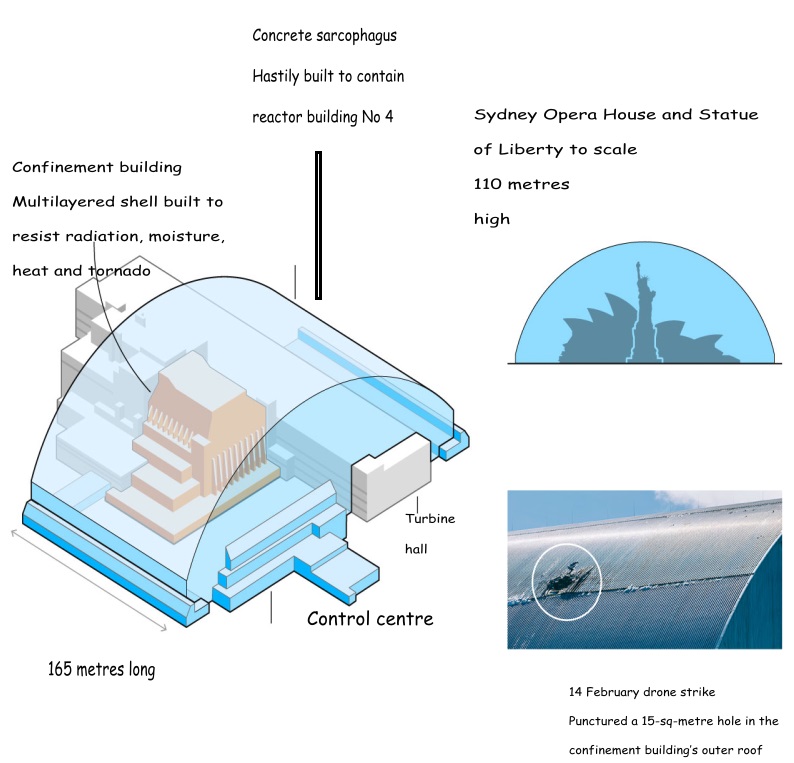
Panic as Chernobyl’s $2 billion protective shield cracks open sparking fears of a deadly radiation leak
Daily Mail, By STACY LIBERATORE, US SCIENCE & TECHNOLOGY EDITOR, 18 December 2025
The dome built over the remains of the Chernobyl disaster has been damaged, raising fears it may no longer be able to contain radioactive material.
Officially known as the New Safe Confinement (NSC), the at least $2 billion protective shield was constructed over Reactor 4, which caused the world’s worst nuclear disaster in 1986.
The United Nations‘ International Atomic Energy Agency (IAEA), a nuclear watchdog, revealed this month that the NSC was severely damaged in a Russian drone strike in February.
The IAEA team conducted a safety assessment earlier this month, finding the dome had lost its primary safety functions, including confinement capability.
IAEA director general Rafael Mariano Grossi said: ‘Limited temporary repairs have been carried out on the roof, but timely and comprehensive restoration remains essential to prevent further degradation and ensure long-term nuclear safety.’
The inspection brought some relief, confirming that the dome’s main structure and monitoring systems remain intact.
But beneath the damaged shelter lies massive quantities of radioactive material from the 1986 disaster, making the site a ticking time bomb.
The IAEA has urged urgent repairs and upgrades to Chernobyl’s protective shelter, calling for better humidity control, advanced corrosion monitoring, and a high-tech automatic system to keep the radioactive reactor remains under control.
The damaged dome is the latest of several such expert missions since September last year, when the substations became increasingly affected by the military conflict.
‘These substations are essential for nuclear safety and security. They are absolutely indispensable for providing the electricity all nuclear power plants need for reactor cooling and other safety systems,’ Grossi said
‘They are also needed to distribute the electricity that they produce to households and industry.’
In 2026, with support from the European Bank for Reconstruction and Development (EBRD), the Chornobyl site will undertake additional temporary repairs to support the re-establishment of the NSC’s confinement function, paving the way for full restoration once the conflict ends.
‘The IAEA – which has a team permanently at the site – will continue to do everything it can to support efforts to fully restore nuclear safety and security at the Chornobyl site,’ Grossi said in a statement……………………………………………………………………………………………… https://www.dailymail.co.uk/sciencetech/article-15393121/Chernobyl-protective-shield-radiation-leak.html
New UK-France Nuclear Steering Group Meets to Advance Cooperation Under Northwood Declaration
Statement by the United Kingdom and the French Republic on Nuclear Policy and Cooperation.
From: Cabinet Office, 18 December 2025, https://www.gov.uk/government/news/new-uk-france-nuclear-steering-group-meets-to-advance-cooperation-under-northwood-declaration
At the UK-France Summit in July 2025, Prime Minister Keir Starmer and President Emmanuel Macron affirmed their commitment to strengthening the UK-France nuclear relationship. They signed the Northwood Declaration, which established the UK-France Nuclear Steering Group in order to provide political direction and coordinate bilateral work across nuclear policy, capability and operations.
On 10 December, the Nuclear Steering Group met for the first time in Paris, jointly chaired by senior officials from the UK Cabinet Office and the Presidency of the French Republic.
They were accompanied by senior military personnel and officials from defence and foreign ministries to discuss Euro-Atlantic security issues and coordination of their respective independent deterrents. They discussed their approach to strengthening deterrence in Europe and confirmed their ambition for bilateral co-operation on nuclear deterrence.
They also observed Operation POKER which was the first time foreign officials were given access to this demonstration of France’s strategic nuclear airborne component.
Zaporizhzhia nuclear plant running on single power line, Russia says.

By Reuters, December 17, 2025, https://www.reuters.com/business/energy/zaporizhzhia-nuclear-plant-running-single-power-line-russia-says-2025-12-16/
MOSCOW, Dec 16 (Reuters) – The Russian-controlled Zaporizhzhia nuclear power plant in Ukraine is currently receiving electricity through only one of two external power lines, its Russian management said on Tuesday.
The other line was disconnected due to military activity, the management said, adding that radiation levels remain normal. Repair work will begin as soon as possible.
The nuclear plant, Europe’s largest, has been under Russian control since March 2022, when Russian forces overran much of southeastern Ukraine. It is not currently producing electricity but relies on external power to keep the nuclear material cool and avoid a meltdown.
Each side has regularly accused the other of shelling the facility. It experienced a couple of complete power outages earlier this month but was subsequently reconnected.
In September and October the plant was without external power for 30 days, relying on backup diesel generators, until a damaged line was reconnected during a local ceasefire arranged with the help of the U.N. nuclear agency.
Reporting by Reuters Writing by Maxim Rodionov Editing by Mark Trevelyan
Scottish National Party says UK nuclear deterrent is ‘America-first’.

By Tom Dunlop, UK Defence Journal, December 17, 2025
A disagreement over defence innovation and reliance on US technology surfaced in the House of Commons during Defence questions.
SNP MP Dave Doogan argued that what he described as an “America-first posture” is harming UK defence innovation, particularly in relation to the nuclear deterrent. He said the system relies heavily on US technology, citing components including “fusing, firing, arming, neutron initiators, the gas transfer system and the Mark 4 aeroshell.” Doogan also criticised plans to buy additional F-35 aircraft for what he characterised as “US-manufactured gravity-delivered nuclear weapons.”
He questioned why the government appeared aligned with US priorities while, in his view, overlooking European initiatives. “President Trump will put America first, but it is difficult to understand why this Labour Government seem keen to do the same, while spurning the innovation opportunity of the £130 billion SAFE programme in the EU,” Doogan told the House……………https://ukdefencejournal.org.uk/snp-says-uk-nuclear-deterrent-is-america-first/
–
Council battling illegal work near nuclear site.
Niki Hinman, Local Democracy Reporting Service, 17 Dec 25, https://www.bbc.com/news/articles/c4g583jlpl3o
A council continues to gather evidence to prosecute those responsible for an illegal development near a nuclear weapons site.
Work has been carried out on land opposite the Atomic Weapons Establishment’s (AWE) Aldermaston campus despite a temporary stop notice, West Berkshire Council said.
Hundreds of people have signed an online petition that states the work has left others feeling “unsafe, anxious and unprotected”, according to the Local Democracy Reporting Service.
The authority said the applicant has not submitted additional information to make it a valid application and so it is not being considered.
Neither the council nor the police have legal powers to remove individuals or items from the land and the council says the relevant civil legal processes must be followed to enable this.
“The temporary stop notice remains in force,” a council spokesperson said.
“Any activity that breaches it is a criminal offence, and officers are continuing to gather evidence to support potential prosecution.”
CLEAN? -WHAT A LIE! NIA welcomes first-ever nuclear appointment to Government’s Clean? Power Advisory Commission.
Sizewell C’s Julia Pyke brings expertise in delivering major infrastructure projects and effective community engagement
The Nuclear Industry Association has welcomed the appointment of Julia Pyke, Co-Managing Director of Sizewell C, as one of the UK Government’s eight new Clean Power 2030 Advisory Commissioners – marking the first time somebody with significant nuclear experience has been appointed to the Commission.
The appointment recognises the vital role nuclear power plays in delivering secure, reliable and low-carbon electricity, and ensures nuclear expertise is at the heart of advice shaping the UK’s clean power future.
Tom Greatrex, Chief Executive of the Nuclear Industry Association, said:
“Julia Pyke’s appointment is a hugely positive step and a clear recognition that nuclear must be central to delivering the UK’s clean power mission. The fact that this is the first time a nuclear leader has been appointed to the Commission ensures that decisions on the UK’s energy future are informed by the realities of building and operating clean, reliable power at scale.”
The Ukrainian negotiations are dragging on

on December 10, the unelected president, Volodymyr Zelensky, convened a videoconference with Scott Bessent, Jared Kushner (not as a negotiator in Moscow, but as a director of the Affinity Partners fund), and Larry Fink (a director of the BlackRock fund and already the owner of a large portion of the farmland) [ 6 ] . The purpose was clearly to assess what could be purchased in exchange for the rare earths. What was unthinkable ten months ago suddenly became possible.
Thierry Meyssan, voltairenet.org, Tue, 16 Dec 2025, https://www.sott.net/article/503525-The-Ukrainian-negotiations-are-dragging-on
Peace negotiations in Ukraine are hampered by the Zelensky administration’s resistance. The administration is attempting to buy time,first through legal means, then military action, and finally, political maneuvering. However, the contacts made suggest what this peace will look like.
Peace negotiations between Ukraine and Russia are dragging on. Clearly, the Russian side, confident of victory, intends to liberate what remains of the Donbas as soon as possible, while the Ukrainian side refuses to concede anything.
Europeans from the EU and the UK are holding numerous meetings, almost one a day, with the sole obsession of continuing the war, with or without the United States.
Two new events have changed the game:Washington is considering leaving NATO and the Ukrainians are accepting the idea of selling their country.
Washington and NATO
On December 1st, a secret videoconference was held with the participation of the French (Emmanuel Macron) and Finnish (Alexander Stubb) presidents, the German Chancellor (Friedrich Merz), the Polish (Donald Tusk), Italian (Giorgia Meloni), Danish (Mette Frederiksen) and Norwegian (Jonas Gahr Støre) prime ministers, the NATO Secretary General (Mark Rutte), the President of the European Commission (Ursula von der Leyen) and the President of the European Council (António Costa).
According to Der Spiegel, which obtained access to the meeting’s minutes, the NATO Secretary General stated that he agreed with the Finnish President and that Europeans should be wary of the peace agreement in Ukraine that President Donald Trump’s special envoys, Steve Witkoff and Jared Kushner, were negotiating [ 1 ] .
This is the first time a sitting NATO Secretary General has dared to openly criticize a sitting US President.
The National Security Strategy, published on December 4th by the White House, mentions NATO five times.However, it is no longer a crucial alliance for the United States, given that President Trump has signaled the end of the “American Empire.” Washington is too preoccupied with its $33 trillion debt to dedicate itself to the defense of Western Europe. The document therefore merely notes that the member states of the Atlantic Alliance will have to ensure their own security by allocating 5% of their gross domestic product (GDP) to it — a far cry from their current level of spending. It also notes that the alliance is not expected to expand further [ 2 ] .
On December 9, five days later, a Republican representative, Thomas Massie (Kentucky), introduced a bill (HR 6508) aimed at withdrawing the United States from NATO. This bill was sent to the Foreign Affairs Committee on December 12 [ 3 ] . This was the first time this issue would be addressed in Congress.
It is too early to conclude anything, but we must already note that there is a current opposed to the Atlantic alliance within the Trump supporters and that European states are awarethat they will not be able to ensure both their own national defense and attack the Russian Federation.
Privately, President Trump’s aides say he will withdraw from the alliance by mid-2027;a deadline that could be brought forward.
The leaders of the European Union are well aware of this.
Continue readingEurope is about to commit financial self-immolation: Its leaders know it
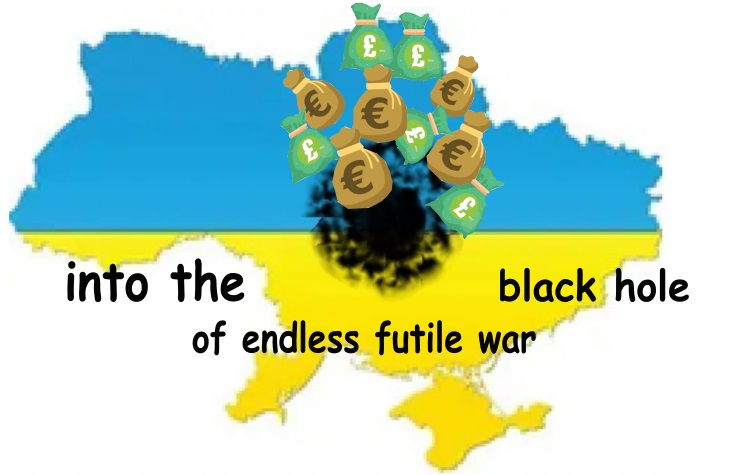
The people who will pay for this are not sitting in Commission buildings, they are the ones whose pensions, currencies, and living standards are being quietly offered up to preserve a collapsing illusion of power
Gerry Nolan, Ron Paul Institute for Political Economy, 15 Dec 2025, https://www.sott.net/article/503527-Europe-is-about-to-commit-financial-self-immolation-Its-leaders-know-it
Italy’s decision to stand with Belgium against the confiscation of Russian sovereign assets is not a diplomatic footnote. It is a moment of clarity breaking through the fog of performative morality that has engulfed Brussels.
Strip away the slogans and the truth is unavoidable: the seizure of Russian sovereign reserves will not change the course of the war in Ukraine by a single inch.
This is not about funding Ukraine, it is about whether sovereign property still exists in a Western financial system that has quietly replaced law with cult-like obedience.
That is why panic has entered the room.
The European Commission wants to pretend this is a clever workaround, a one-off, an emergency measure wrapped in legal contortions and moral posturing masquerading as hysteria. But finance does not function on intentions, rage, or narratives. It functions on precedent, trust, and enforceability. And once that trust is broken, it does not return.
The modern global financial system rests on a single, unglamorous principle, that State assets held in foreign jurisdictions are legally immune from political confiscation.
That principle underwrites reserve currencies, correspondent banking, sovereign debt markets, and cross-border investment. It is why central banks like Russia’s (once) accepted euros instead of bullion shipped under armed guard. It is why settlement systems like Euroclear exist at all.
Once that rule is broken, capital does not debate. It reprices risk instantly and it leaves.
Confiscation sends a message to every country outside the Western political orbit: your savings are safe only as long as you remain politically compliant.
That is not a rules-based order. It is a selectively enforced order whose rules change the moment compliance ends. What we have is a compliance cartel, enforcing law upward and punishment downward, depending on who obeys and who resists.
Belgium’s fear is not legalistic. It is actuarial. Hosting Euroclear means hosting systemic risk. If Russia or any future target successfully challenges the seizure, Belgium could be exposed to claims that dwarf the sums being discussed. Belgium is therefore right to be skeptical of Europe’s promise to underwrite such colossal risk, given the bloc’s now shattered credibility. No serious financial actor would treat such guarantees as reliable.
Italy’s hesitation is not ideological. It is mathematical. With one of Europe’s heaviest debt burdens, Rome understands what happens when markets begin questioning the neutrality of reserve currencies and custodians.
Neither country suddenly developed sympathy for Moscow. They simply did the arithmetic before the slogans.
Paris and London, meanwhile, thunder publicly while quietly insulating their own commercial banks’ exposure to Russian sovereign assets, exposure measured not in rhetoric, but in tens of billions. French financial institutions alone hold an estimated €15-20 billion, while UK-linked banks and custodial structures account for roughly £20-25 billion, much of it routed through London’s clearing and custody ecosystem rather than sitting on government balance sheets.
This hypocrisy and cowardice are not accidental. Paris and London sit at the heart of global custodial banking, derivatives clearing, and FX settlement, nodes embedded deep within the plumbing of global finance. Retaliatory seizures or accelerated capital flight would not be symbolic for them; they would be catastrophic.
So the burden is shifted outward. Smaller states are expected to absorb systemic risk while core financial centers preserve deniability, play a double game, and posture as virtuous.
This is anything but European solidarity. It is class defense at the international level.
The increasingly shrill insistence from the Eurocrats that the assets must be seized betrays something far more revealing than hysteria or resolve: the unmasking of a project sustained by delusion and Russophobic dogma, in which moral certainty did not arise from conviction, but functioned as a mechanism for managing cognitive dissonance, a means of avoiding realities that any serious strategy would already have been forced to confront.
Continue readingLet the investor beware: why buying UK government Green Savings Bonds now means backing nuclear.

15th December 2025, https://www.nuclearpolicy.info/news/let-the-investor-beware-why-buying-government-green-savings-
In commercial transactions, prospective purchasers are often urged to exercise caution before signing on the dotted line with a Latin phrase, ‘caveat emptor’ or ‘let the buyer beware’. The UK/Ireland Nuclear Free Local Authorities would like to warn future purchasers of government savings products to be wary that they might be investing in nuclear projects.
The UK’s Green Financing Programme raises financing from investors through the issuance of green gilts via the Debt Management Office and the sale of retail Green Savings Bonds to the public via National Savings and Investments. This money has been invested in projects which help the government move toward their ambition to achieve net zero carbon emissions by 2050.
Many savers desiring to help tackle climate change will have invested their hard-earned money into the three-year, interest-bearing bonds which were first launched in October 2021.
To date, the Green Financing Programme has raised over £51 billion.
The Green Financing Framework issued in 2021 included guidelines on the projects that could be backed; these fell into six categories: clean transportation, renewable energy, energy efficiency, pollution prevention and control, living and natural resources, and climate change adaptation.
Every year the government publishes a report identifying which projects have been backed into the last twelve months and their impact on climate emissions[i]. Typically this has including building offshore wind farms, investing in electric buses, offering discounts on electric vehicles, installing electric vehicle charging points, planting masses of trees, and insulating homes.
Now in a retrograde step, the government, obsessed with funnelling as much public money as possible into nuclear power, has issued a revised Green Financing Framework, with future investment in nuclear energy projects now included in the list of Eligible Green Expenditures.[ii]
The Framework makes clear that ‘the proceeds from sales of green gilts or Green Savings Bonds issued prior to 27 November 2025 will not be allocated to nuclear energy related expenditures’, but there will be no restriction on such investment after this date.
In the new supposedly ‘Green’ Category: Nuclear Energy, investment can be made in: ‘Electricity and/or heat (including cogeneration); support for the design, development, construction, commissioning, safe operation, lifetime extension, or supporting infrastructure of new or existing nuclear power generation assets (including enabling fuelcycle activities; radioactive waste and spent fuel storage, management and final disposal), and research and development for future fission and fusion energy technologies
Nuclear is NOT a green energy technology, but permitting the use of money raised from green investors in the management and disposal of high-level radioactive waste, which poisons people and our planet for millenia, must surely be the ultimate travesty. Our advice: avoid.
EU member says it won’t finance Ukraine.
13 Dec, 2025 https://www.rt.com/news/629416-czech-pm-ukraine-aid/
The European Commission must find other ways to continue aiding the Kiev regime, Czech Prime Minister Andrej Babis has said.
The Czech Republic will not take part in any financial support of Ukraine, Prime Minister Andrej Babis has said, adding that the bloc must find other ways to continue funding Kiev.
The right-wing Euroskeptic politician, who was appointed prime minister earlier this week, campaigned on prioritizing domestic issues. He has long criticized the extensive aid to Kiev under his predecessor Petr Fiala, whose cabinet launched a major international munitions procurement scheme for Ukraine.
In a video posted to his official Facebook page on Saturday, Babis said he had spoken with Belgian Prime Minister Bart De Wever, a vocal opponent of the European Commission’s plan to fund Kiev through a so-called “reparations loan” tied to about $200 billion in Russian assets frozen in the bloc.
The Commission aims to reach a deal on the scheme next week, but De Wever – whose country hosts the financial clearinghouse Euroclear, where the bulk of the assets are held – has called it tantamount to “stealing” Russian money.
“I agree with him. The European Commission must find other ways to finance Ukraine,” Babis said.
Belgium, fearing legal retaliation from Russia, has demanded guarantees from other EU members to share the burden if the funds must eventually be returned. According to Czech media, this could cost Prague about $4.3 billion. Babis said the country simply cannot afford it.
“We, as the Czech Republic, need money for Czech citizens, and we don’t have money for other countries… we’re not going to guarantee anything for [the Commission], and we’re not going to give money either, because the coffers are simply empty,” he stated.
In what is seen as the first step toward advancing the “reparations loan” scheme, the bloc on Friday approved controversial legislation replacing the six-month consensus renewal of the Russian assets freeze with a longer-term arrangement that could shield it from vetoes by opposing states. The move has raised concerns about undermining the EU’s core principle that major foreign policy and financial decisions require unanimous consent, with Hungarian Prime Minister Viktor Orban condemning it as “unlawful.”
Multiple EU states have raised concerns over the loan scheme, citing legal and financial risks. Slovak Prime Minister Robert Fico on Friday warned that further funding for Kiev would only prolong the conflict.
Moscow has condemned the “reparations loan” plan as illegal, with Kremlin spokesman Dmitry Peskov calling it “a grand scam.”
US sets out condition for Ukraine security guarantees – Axios
13 Dec 25 https://www.rt.com/news/629413-us-condition-ukraine-security-guarantees/
Kiev could receive assurances as part of a peace deal if it agrees to territorial concessions, the report says
The administration of US President Donald Trump is willing to offer Kiev NATO-style and Congress-approved security guarantees if it agrees on territorial concessions to Russia, Axios reported on Saturday, citing sources. Ukraine has rejected any concessions and has called instead for a ceasefire – a proposal Moscow has dismissed as a ploy to win time and prolong the conflict.
The outlet cited unnamed US officials as saying that negotiations on security guarantees from the US and EU nations to Ukraine had made “significant progress.” An Axios source claimed that Washington wanted a guarantee “that will not be a blank check … but will be strong enough,” adding: “We are willing to send it to Congress to vote on it.”
The package proposal, the official continued, would entail territorial concessions, with Ukraine “retaining sovereignty over about 80% of its territory” and receiving “the biggest and strongest security guarantee it has ever got,” alongside a “very significant prosperity package.”
Russian Foreign Minister Sergey Lavrov has said that Moscow is open to discussing a security guarantees framework on condition that it will not be aimed at Russia. He added that Moscow believes Washington to be “genuinely interested in a fair settlement that… safeguards the legitimate interests of all parties.”
The Axios report also said the US viewed as “progress” recent remarks by Ukrainian leader Vladimir Zelensky suggesting Ukraine could hold a referendum on territorial concessions, particularly those concerning Donbass.
Moscow, however, has stressed that Donbass – which overwhelmingly voted to join Russia in 2022 – is sovereign Russian territory, and Ukrainian troops will be pushed out of the region one way or the other. It also suggested that Zelensky’s referendum play was a ploy to prolong the conflict and gain time for patching up the Ukrainian army.
Moscow insists that a sustainable peace could only be reached if Ukraine commits to staying out of NATO, demilitarization and denazification, limits the size of its army, and recognizes the new territorial reality on the ground.
1 This Month

of the week – Shut Down Drone Warfare!


Tell the Ukrainian Government to Drop Prosecution of Peace Activist Yurii Sheliazhenko

Petition to revoke the licensing of the Near Surface Nuclear Disposal Facility (NSDF) at Chalk River. https://www.ourcommons.ca/petitions/en/Petition/Details?Petition=e-7247
To see nuclear-related stories in greater depth and intensity – go to https://nuclearinformation.wordpress.com
-
Archives
- April 2026 (68)
- March 2026 (251)
- February 2026 (268)
- January 2026 (308)
- December 2025 (358)
- November 2025 (359)
- October 2025 (376)
- September 2025 (257)
- August 2025 (319)
- July 2025 (230)
- June 2025 (348)
- May 2025 (261)
-
Categories
- 1
- 1 NUCLEAR ISSUES
- business and costs
- climate change
- culture and arts
- ENERGY
- environment
- health
- history
- indigenous issues
- Legal
- marketing of nuclear
- media
- opposition to nuclear
- PERSONAL STORIES
- politics
- politics international
- Religion and ethics
- safety
- secrets,lies and civil liberties
- spinbuster
- technology
- Uranium
- wastes
- weapons and war
- Women
- 2 WORLD
- ACTION
- AFRICA
- Atrocities
- AUSTRALIA
- Christina's notes
- Christina's themes
- culture and arts
- Events
- Fuk 2022
- Fuk 2023
- Fukushima 2017
- Fukushima 2018
- fukushima 2019
- Fukushima 2020
- Fukushima 2021
- general
- global warming
- Humour (God we need it)
- Nuclear
- RARE EARTHS
- Reference
- resources – print
- Resources -audiovicual
- Weekly Newsletter
- World
- World Nuclear
- YouTube
-
RSS
Entries RSS
Comments RSS
 nuclear-news