NATO chief insists that use of F-16 fighter jets over Russian territory is ‘not escalation’ –
Use of F-16s over Russian territory ‘not escalation’ – NATO chief
Ukraine has the right to defend itself, and this includes “striking legitimate military targets” on the territory of Russia, Stoltenberg declared. “Self-defense is not escalation,” he added.
Andrey Kartapolov, the chairman of the Russian State Duma Defense Committee, said last week that Moscow would consider any bases used by Kiev to fly donated F-16s as legitimate military targets regardless of what country they are located in.
Any airfields hosting Ukraine’s F-16 fighter jets, whether they are in or outside the country, will be legitimate targets for the Russian military if they participate in combat missions against Moscow’s forces, the chairman of the Russian State Duma Defense Committee, Andrey Kartapolov, has warned.
Meanwhile, Russian Foreign Minister Sergey Lavrov has also warned that Moscow would perceive the deliveries of F-16 fighters to Ukraine as a nuclear threat, given that the jets have long been used as part of the US-led bloc’s joint nuclear missions.
Use of F-16s over Russian territory ‘not escalation’ – NATO chief. 13 Jun, 2024 HomeWorld News
Donating fighter jets to Kiev will not involve members of the alliance in the conflict, Jens Stoltenberg has insisted
Ukrainian strikes anywhere inside Russia using Western-donated F-16 aircraft would not be an escalation of the conflict and would not make NATO member states parties to it, the military bloc’s Secretary General Jens Stoltenberg has claimed.
Several European nations intend to provide dozens of the warplanes once Ukraine has pilots and ground infrastructure to fly them.
Speaking ahead of a NATO defense ministers’ gathering in Brussels, Stoltenberg said “different allies have different types of restrictions on the use of their weapons,” and welcomed the recent relaxation of these rules by some member states.
Washington reportedly gave Kiev the green light to fire American weapons at targets outside of what the two nations insist is Ukrainian territory, allowing strikes inside Russia’s Belgorod Region as part of the fight for the neighboring Kharkov Region. Other Western nations have also said their weapons can be used in similar ways.
Ukraine has the right to defend itself, and this includes “striking legitimate military targets” on the territory of Russia, Stoltenberg declared. “Self-defense is not escalation,” he added.
“And we have the right to help Ukraine,” he continued. “By doing that, NATO allies don’t become party to the conflict.”
Moscow perceives the entire conflict as part of a US-initiated proxy war against Russia. It considers NATO’s increasing military presence in Ukraine and its intention to eventually bring the nation into the fold as major national security risks.
NATO member states arming Ukraine, providing “mercenaries” to bolster its troops, and helping Kiev to plan and deliver attacks against Russia are de facto participants in the hostilities, senior Russian officials have claimed.
Russian President Vladimir Putinhas warned that any attacks using Western weapons deep inside Russia will be retaliated against.Moscow could supply long-range weapons from its own arsenal to third parties, who would then use them against Western military assets, he suggested. Such tit-for-tat escalation could lead to a major disaster for all parties involved, Putin has warned.
Andrey Kartapolov, the chairman of the Russian State Duma Defense Committee, said last week that Moscow would consider any bases used by Kiev to fly donated F-16s as legitimate military targets regardless of what country they are located in.
——
https://swentr.site/russia/599085-russia-strike-nato-airfields-f16/
U.S. – NATO threats ignore ‘red lines’ in Ukraine.

NATO’s long-range missiles target Russia
Stoltenberg was explicit: “We are giving weapons to Kyiv and consider them Ukrainian from this moment, so Ukraine can do whatever it wants with these arms, in part, strike at Russian territory where it deems necessary.” (bne IntelliNews, May 31)
Previously, the United States, Germany and other NATO members had forbidden the Ukrainian military from using the weapons delivered to them to strike targets inside Russia.
Workers World, By Sara Flounders June 7, 2024
Front lines are collapsing for the Ukrainian army, whole units surrendering. Top commanders are fired. Faced with complete disarray of the U.S.-NATO instigated war in Ukraine, U.S. militarists are doubling down.
According to the Ukrainian constitution, President Volodymir Zelensky’s term in office is over. But he remains in power by martial law. This has led Ukrainian workers to hold strikes and work stoppages. But this news is ignored in the Western media.
A national truckers’ work slowdown inside Ukraine moved traffic to a 5-mile-an hour crawl and halted grain exports based on national anger at the expanded draft mobilization made by Zelensky, now an unelected president. (yahoonews.com, May 18)
Ukraine’s combat units are so severely understaffed that the government would have to triple its mobilization in order to continue the current level of fighting, according to Eric Ciaramella, former U.S. National Intelligence Council official. The draft can’t fill the current gap,…………………………………………………………………………………………………………..
U.S.-NATO plans are in total disarray. Rather than reconsider their strategy, which has brought setbacks and defeats in Ukraine and for Israel in Gaza, this has led to an ominous escalation in U.S. military threats.
The threat to dangerously escalate the war in Ukraine arises from the plans to give Ukraine high-speed missiles and allow the Kyiv regime to use the weapons to strike inside Russia. This threat is not just from a single statement or one delivery of weapons.
The statements promoting strikes with the U.S.-supplied weapons to targets inside Russia are being made directly by President Biden and Secretary of State Antony Blinken, U.S. Speaker of the House Mike Johnson and NATO Secretary General Jens Stoltenberg, who is a former prime minister of Norway, but acts as if he were a U.S. official.
Ukraine at center of 75th Anniversary NATO Summit
NATO officials are frantic that Ukrainian defense lines of Kharkov, the second-largest city in Ukraine, located in the northeast of the country, are about to fall.
Kharkov is a majority Russian-speaking city. It is the industrial, energy, science, rail and transport hub. It lies east of the Dnieper River on the Donetsk-Donbass Canal. Kharkov is the key industrial center still under Ukrainian control east of the Dnieper River.
According to a May 16 New York Times article, fear of Kharkov’s imminent collapse is what is driving U.S. threats. This loss is decisive in any control of Ukraine’s east, including the entire Donbass industrial region.
Adding to the urgency is that at the 75th Anniversary NATO Summit, July 9-11 in Washington, D.C., NATO plans to unveil a “Security Package” for Ukraine involving 32 countries’ bilateral agreements with Ukraine. These bilateral agreements would serve as a bridge for Ukraine’s entry into NATO.
Ukrainian entry into NATO would allow Kyiv to invoke the alliance’s collective defense clause, potentially triggering a broader regional conflict with Russia. During an April visit to Kyiv, NATO Secretary General Jens Stoltenberg vowed that “Ukraine will become a member of NATO.” (defensenews.com, June 3)
All these elaborate plans would be dashed if Ukrainian defense lines crumbled before the NATO Summit in Washington, D.C. This 75th anniversary NATO Summit is a grand plan to showcase U.S. and Western imperialist dominance.
NATO’s long-range missiles target Russia
NATO’s dangerous escalation is galloping forward on several fronts.
Stoltenberg was explicit: “We are giving weapons to Kyiv and consider them Ukrainian from this moment, so Ukraine can do whatever it wants with these arms, in part, strike at Russian territory where it deems necessary.” (bne IntelliNews, May 31)
Previously, the United States, Germany and other NATO members had forbidden the Ukrainian military from using the weapons delivered to them to strike targets inside Russia.
In the past, the Ukrainian military command had violated NATO’s official statements and used U.S. Stinger air defense missiles, M142 HIMARS, MLRS and other multiple launch rockets to strike the Belgorod region of Russia. The Russian Army’s air defense forces destroyed more than 10 missiles in the sky over Belgorod and displayed the U.S. stamped shells.
Weeks ago, the British government allowed Ukraine to use its long-range Storm Shadow missile systems for attacks anywhere in Russia. Now France and Germany have taken the same position as Britain. The Storm Shadow cruise missile has a range of over 180 miles, triple the range of the missiles Ukraine has used until now.
French President Emmanuel Macron further escalated the threat by stating the West must not exclude sending NATO ground troops to Ukraine…………………………………………………………………………………..
Internationally, many voices are sounding the alarm. Such attacks are of the most extreme danger, because the slightest targeting slip up, a misinterpretation of instructions, a rogue operator on the ground, could lead to a global conflagration.
These attacks require a satellite-based military network that Ukraine does not have. Only U.S. and NATO forces under U.S. command are capable of conducting such attacks against Russia.
Divisions appear inside NATO
Divisions within the U.S. commanded and dominated NATO military alliance are appearing. Frustration and failure are intensifying the infighting even among members of the G7 and major NATO participants.
Many NATO countries’ leaders, reacting to mass pressure from below, have already sharply expressed opposition to U.S. total support of Israel’s genocidal campaign against Palestine.
Italy’s Deputy Prime Minister Matteo Salvini objected to Stoltenberg’s call for allies to lift restrictions on using Western-supplied weapons against targets in Russia. “It is out of the question to lift the ban on Kyiv to strike military targets in Russia. … We want peace, not the antechamber of World War III” (Ukrainian Pravda, May 27)
Italian Foreign Minister Antonia Tajani reinforced this position: “We will send no Italian soldier to Ukraine, and the military tools that Italy sends are used inside Ukraine. We are working for peace.” (Italian news agency Ansa, as reported by European Pravda, May 25)
On May 28, Belgian Prime Minister Alexander De Croo told Biden during talks in Washington, D.C., that he rules out the use of Belgium’s weapons, including F-16 fighter jets, outside Ukraine. To reinforce his point, De Croo reminded the reporters that the bilateral security agreement Belgium signed with Ukraine means, “We are sending 30 F-16s, and we will thus become the biggest supplier of fighter aircraft for the Ukrainian air force. But the agreement is very clear. It is about fighter aircraft that can be used by the Ukrainians on Ukrainian territory.” (belganewsagency.eu, May 31)
Phony ‘Peace Summit’
Zelensky’s effort to call a “Peace Summit” on June 15 and 16 in Lucerne, Switzerland, exposes Ukraine’s dwindling support. The “Peace Summit” bars Russian participation. The effort is so flimsy that not even Biden is bothering to attend.
In desperation, Zelensky has blamed China’s decision not to participate as the reason other countries are ignoring the phony event.
Russian Foreign minister Sergey Lavrov dismissed the Lucerne summit, saying, “This conference in Switzerland has no meaning. The only meaning it can have is to try to preserve this anti-Russian bloc which is in the process of crumbling.”
Silence continues to prevail in Western corporate media regarding the four negotiation offers made by President Putin in the past two weeks.
RAND Corporation: ‘Pour it on’
The Rand Corporation, a powerful think tank for the major military industries, confirms the cynical calculations that justify war profits, regardless of the danger.
U.S. escalation will push the Europeans to ante up, the Rand article said. Even more ominous: “From a narrow U.S. perspective, greater U.S. involvement is an opportunity to test new capabilities and gain experience helping a partner facing a numerically superior foe. Such experience could be very relevant for helping Taiwan resist Chinese aggression.” (Rand, May 22, defenseone.com, “How to win in Ukraine: pour it on, and don’t worry about escalation”)
Russia warns NATO
President Putin delivered Russia’s strongest warning to date against the NATO escalation. He chose a meeting in Tashkent, Uzbekistan, with top Uzbek officials. With 37 million people, Uzbekistan is the second most populous country of the former Soviet Union. ……………………….. At a large press conference following the meetings, Putin said, “Long-range precision weapons cannot be used without space-based reconnaissance. … Final target selection and what is known as launch mission can only be made by highly skilled specialists who rely on this technical reconnaissance data. It can happen without the participation of the Ukrainian military.
“Launching other systems, such as ATACMS, for example,” Putin continued, “also relies on space reconnaissance data. Targets are identified and automatically communicated to the relevant crews. … The mission is put together by representatives of NATO countries, not the Ukrainian military. This unending escalation can lead to serious consequences. If Europe were to face those serious consequences, what will the United States do, considering our strategic arms parity? It is hard to tell…………………………………………..
Rather than reassess their deteriorating global position, U.S. strategists seem determined to put the fate of the world at risk. https://www.workers.org/2024/06/79079/
Russia broadens tactical nuclear weapons drills
Reuters, By Guy Faulconbridge and Lidia Kelly, June 12, 20247
MOSCOW, June 12 (Reuters) – Russia said on Wednesday that soldiers and sailors from its northern Leningrad military district bordering NATO members Norway, Finland, Poland, Estonia, Latvia and Lithuania took part in drills to deploy tactical nuclear weapons.
The move appears to broaden the disclosed geography of the nuclear drills to include soldiers from military districts which cover almost all of Russia’s European border, which stretches from the Arctic Ocean down to the Black Sea.
President Vladimir Putin ordered the drills, which were announced last month to take place in the Southern Military district bordering Ukraine, after what Russia said were signals from Western officials that they would allow Ukraine to strike deep into Russia with Western weapons.
“The personnel of the Leningrad Military District missile unit are practicing combat training tasks,” Russia’s defence ministry said in a statement about the drills…………………………………….. more https://www.reuters.com/world/europe/russia-says-its-non-strategic-nuclear-drills-involve-iskander-missiles-2024-06-12/—
Great British Nuclear Small Reactors competition timeline delayed for General Election, amid doubts on their viability
There have been some doubts cast, with the Environmental Audit Committee claiming that SMRs will not be able to help the UK decarbonise by 2035. Additionally, US think tank Institute for Energy Economics and Financial Analysis (IEEFA) has said that SMRs are “too expensive, too slow, and too risky”.
10 JUN, 2024 BY TOM PASHBY
The six small modular reactor (SMR) developers shortlisted in Great British Nuclear’s (GBN’s) competition now have an extra two weeks to submit documentation due to the General Election.
The competition winner will receive government backing to deploy a fleet of SMRs in the UK. At the time of the competition announcement, GBN chief executive Gwyn Parry-Jones
said parties would be “aiming for a final contract agreement in the
summer”. Even if not successful in GBN’s competition, many of the
shortlisted firms have signalled intent to deliver SMRs in the UK.
Rolls-Royce SMR recently announced a prototype module testing facility at
the University of Sheffield and Holtec has shortlisted four UK sites for
its SMR module factory. Westinghouse has plans to deploy the first
privately funded SMRs in North Teesside by the 2030s.
There have been some doubts cast, with the Environmental Audit Committee claiming that SMRs will not be able to help the UK decarbonise by 2035. Additionally, US think tank
Institute for Energy Economics and Financial Analysis (IEEFA) has said that
SMRs are “too expensive, too slow, and too risky”.
New Civil Engineer 10th June 2024
Top civil servant joins EDF after running department that struck nuclear deal
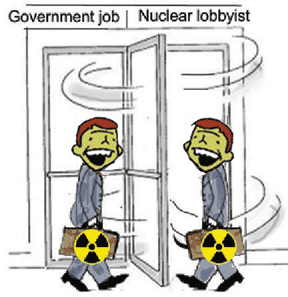
Alex Chisholm, who led business office during Hinkley Point C negotiations, appointed UK chair of energy firm
Rowena Mason Guardian, Whitehall editor, Wed 12 Jun 2024
One of the UK’s most senior civil servants, Alex Chisholm, has been revealed as the new UK chair of the energy company EDF, after having previously run the department that struck a deal for it to build a new nuclear power station.
Chisholm was permanent secretary at the Cabinet Office, and before that led the business department, which worked on the government deal for EDF to go ahead with the Hinkley Point C nuclear plant in Somerset. The agreement was struck in 2016 with UK bill payers bearing the cost of the construction over a 35-year period.
The long-delayed project’s costs have soared from an estimated £18bn to at least £31bn and it is due to be completed in 2031 – about 14 years after EDF thought it would be up and running.
The French state-owned company is a specialist in nuclear power, and one of the “big six” energy providers that have been criticised for huge profits during the energy crisis sparked by the war in Ukraine.
Chisholm’s departure is one of a number of high-profile exits from the civil service before a likely change of governing party. Alex Aiken, a former longstanding head of government communications, recently left Whitehall for a job as an adviser on communications to the government of the United Arab Emirates.
There is also speculation about the future of Simon Case, the cabinet secretary and former royal aide installed by Boris Johnson, given incoming prime ministers often want their own preferred candidate in the job.
Chisholm’s EDF role was approved by the watchdog on post-government jobs, known as the Advisory Committee on Business Appointments. But the watchdog said he must wait three months after departing government to take up the job and observe a ban on lobbying the government or involvement in negotiating government contracts for two years after leaving office.
The watchdog said: “In 2016, his department was responsible for the decision on finalising the first contract for difference [a pricing mechanism], with respect to EDF and the construction of Hinkley Point C. However, this was ultimately a decision for the secretary of state and followed the 2014 approval from the European Commission and was based on terms agreed then, 10 years ago.
“Significantly, due to the period of time that has elapsed, the committee did not consider Sir Alex could reasonably be seen to have influenced this decision in anticipation of an offer of work a decade later.”
Chisholm said his appointment came “at a time of great change and opportunity in the energy sector”……….https://www.theguardian.com/politics/article/2024/jun/11/top-civil-servant-edf-department-nuclear-deal-alex-chisholm
Alarm over 174 security breaches at Clyde nuclear bases

Rob Edwards, June 10, 2024, https://theferret.scot/security-breaches-clyde-nuclear-bases/—
Two nuclear bomb bases on the Clyde recorded 174 security breaches over five years, according to information released by the Ministry of Defence (MoD).
Between 2018 and 2022 there were 130 breaches reported at the Trident submarine base at Faslane, near Helensburgh, and a further 44 breaches at the nearby nuclear weapons store at Coulport.
The MoD has not given any details of the incidents, but suggested that some were “minor”. They could include lost identity cards, misplaced documents and data protection breaches, it said.
The MoD stressed that it investigated every incident “no matter how small” with the aim of continuously improving security.
Campaigners, however, warned there were “risks of major catastrophe” at Faslane and Coulport. They called on whoever wins the general election to “get to grips” with security problems.
The Conservatives, Labour and the Liberal Democrats all support the UK’s nuclear weapons programme. The Scottish National Party and the Greens oppose it.
A freedom of information response released by the MoD in May revealed that the Royal Naval Armaments Depot at Coulport recorded the highest number of security breaches – 13 – in 2019. Since then, there were 11 in 2020, nine in 2021 and nine in 2022.
Coulport is where around 200 of the UK’s arsenal of nuclear warheads are kept in underground bunkers. Spread across the slopes above Loch Long, the site is dotted with watchtowers and protected by a series of barbed wire fences.
The latest MoD release also confirmed a previous report that there were 60 security breaches at Faslane in 2022. Another report in 2022 said that there were 16 breaches at Faslane in 2021, and 18 in each of the previous three years.
Faslane, on the Gareloch, is the home port for the UK’s four Vanguard-class submarines that carry nuclear-armed Trident missiles. One submarine is meant to be continuously on patrol at sea, but in recent years the service has been stretched.
The numbers of security breaches in 2023 and so far in 2024 have not been published by the MoD. But it has previously released figures for nuclear safety incidents that have also plagued the Clyde bases.
The Ferret reported in April that Faslane and Coulport logged 843 “nuclear site events” from 2019 to April 2024. Twelve of them were classified by the MoD as having “actual or potential for radioactive release to the environment”.
We also revealed in August 2023 that the MoD’s Defence Nuclear Organisation, which oversees the UK nuclear weapons programme, had recorded 113 “security concerns” since 2017-18. Again, no details were given.
The Scottish Campaign for Nuclear Disarmament warned that security breaches should not be “shrugged off” as minor. “Faslane and Coulport combine nuclear bombs, nuclear reactors and missiles – radioactivity, explosives and highly flammable rocket fuel – always presenting potential targets and risks of major catastrophe,” said the campaign’s chair, Lynn Jamieson.
“At these most dangerous places, regular breaches signal either a grossly-inappropriate casual culture or the impossibility of 100 per cent security. Incidents rising to 60, averaging more than one a week, is a warning and calls for public investigation.”
Jamieson also attacked the MoD failure to provide details of the breaches. “Secrecy cloaks the reality of the everyday risks in our own backyard,” she told The Ferret.
“Secrecy is convenient for politicians who spout the myth that threatening to destroy half the planet with nuclear weapons keeps us safe.”
Some nuclear security breaches ‘serious’
The Nuclear Information Service, which researches and criticises nuclear weapons, argued that any security breaches were concerning. “If, as the MoD imply, some of these incidents were relatively minor, why have no further details been disclosed?” asked the service’s director, David Cullen.
“The obvious inference is that some of the incidents were much more serious. Whoever wins the election, I hope the incoming government will get to grips with this.”
The large increase in security breaches at Faslane between 2021 and 2022 was “especially worrying”, he said. A report by the London news broadcaster, LBC, in September 2023 suggested that this could be linked to Russian activity in the wake of the invasion of Ukraine in February 2022.
According to the MoD, incidents “can include minor breaches”. They can also include “the mis-accounting of documentation, loss of identity cards, inadvertent use of personal electronic devices and breaches in general data protection,” it said.
A spokesperson for the Royal Navy added: “Security is of paramount importance and we investigate every incident, no matter how small, to ensure we learn from experience and continuously improve our security.”
Will NATO member states individually or collectively go to war against Russia?

VOLTAIRE NETWORK | 31 MAY 2024, https://www.voltairenet.org/article220954.html
Spokesman for the German government Steffen Hebestreit said his country opposed the deployment of NATO’s anti-missile system on Ukrainian territory.
The German point of view matches that of Secretary General of the Alliance Jens Stoltenberg who said in an interview with The Economist: “The time has come for allies to reflect on whether they should lift some of the restrictions on the use of weapons given to Ukraine (…) Especially now, when a lot of fighting is taking place in Kharkov, near the border, denying Ukraine the ability to use these weapons against legitimate military targets on Russian territory makes it very difficult to defend it.”
He also said: “We have no intention of sending NATO ground troops to Ukraine because our objective… is twofold: to support Ukraine as we do, but also to ensure that it does not escalate into a full-scale conflict”
According to the New York Times, US Secretary of State Antony Blinken would be in favor of this second proposal. Steffen Hebestreit, for his part, evaded journalists’ questions on this subject.
☞ Extending the protection of the Atlantic anti-missile shield to Ukrainian territory would mean going to war collectively against Russia. But allowing Ukraine to attack Russia with weapons supplied by NATO member states would mean their individual entry into war against Russia.
For his part, Italy’s deputy prime minister Matteo Salvini commented: “This gentleman [Jens Stoltenberg] is dangerous because talking about World War III, Western weapons capable of striking and killing inside Russia, seems to me very, very dangerous and reckless (…) NATO cannot force us to kill in Russia, nor can anyone force us to send Italian soldiers to fight or die in Ukraine.”
Russian president Vladimir Putin told reporters: “This constant escalation can lead to serious consequences. If these serious consequences occur in Europe, how will the United States behave, given our parity in the field of strategic weapons? It’s hard to say. Do they want a world conflict?”. “Let them [European NATO member states] remember that their territory is small and their population is dense,” he continued.
Russian senator Dmitry Rogozin, former director of Roscosmos, directly warned Washington: “We are not only on the threshold, but already on the edge, beyond which, if the enemy is not stopped in such actions, an irreversible collapse of the strategic security of the nuclear powers will begin.”
In all likelihood, Poland is expected to be the first NATO member state to allow Ukraine to strike Russia with the weapons it has supplied. Moscow would then have to retaliate by striking at least the NATO logistics center on Polish territory in Rzeszów. It will be up to the other NATO member states to consider whether or not to activate Article 5 of the North Atlantic Treaty and start World War III.
From a strategic point of view, the deployment of US medium-range missiles on the borders of Russia and China now exposes them to this eventuality. That is why Russian Foreign Minister Sergei Lavrov announced that the two countries reached a joint defense agreement during President Vladimir Putin’s last visit to Beijing. In addition, Russia is currently conducting simulations with Belarus of the use of tactical (not strategic) nuclear weapons.
Biden hits ‘new low’ in arming ‘pro-Nazi’ Azov: US Congressman

ByAl Mayadeen English, Source: Agencies, 12 Jun 2024 https://english.almayadeen.net/news/politics/biden-hits–new-low–in-arming–pro-nazi–azov–us-congressm
Paul Gosar says the Biden administration’s decision to lift a ban on arms supplies to Ukraine’s Azov battalion prolongs the war.
US President Joe Biden has reached a new low after his administration decided to remove restrictions on arms supplies to Ukraine’s Azov battalion, US Congressman Paul Gosar pointed out on Wednesday.
On Tuesday, The Washington Post, citing the US State Department, reported that the Biden administration has lifted the ban on arms supplies to and training of the Azov battalion.
Established in 2014 by Ukrainian ultra-nationalists in the wake of the Western-backed Maidan riots, the Azov Battalion was included in the National Guard of Ukraine in November of that year.
The battalion has come under severe criticism for its support of Nazi ideology and symbols, as well as its human rights violations against the Russian-speaking population of Eastern Ukraine.
Russia’s Supreme Court designated Ukraine’s Azov Battalion as a terrorist organization in August 2022.
Russian Ambassador to the United States Anatoly Antonov called the reported decision by the United States outrageous, adding that it raises serious concerns about US readiness to fight terrorism.
The Russian Prosecutor General’s Office last year accused Azov militants of employing prohibited means and methods of warfare, including the torture of civilians and the killing of children.
The battalion’s symbol is the neo-Nazi Wolfsangel, a black swastika against a yellow background. Founded by Andriy Biletsky, who vowed to “lead the white races of the world in a final crusade…against Semite-led Untermenschen,” the group is a pack of neo-Nazis working with the US-backed Ukrainian military.
MP’s claim of support for nuclear power in Highlands challenged
By John Davidson john.davidson@hnmedia.co.uk, Northern Times 11th June 2024
An anti-nuclear campaigner has hit out at a claim made by Highland MSP Edward Mountain that people in the region want nuclear power.
The Conservative MSP hosted an energy summit in Strathpeffer last Friday, bringing together industry experts and members of the public.
The aim was to discuss the future of energy production and provision in the Highlands, with panellists including representatives from SSEN, Storegga, Highland Fuels, Highland Renewables, and the Anaerobic Digestion and Bioresources Association.
Scottish Greens brand Labour’s commitment to nuclear weapons ‘obscene and immoral’

Chris Jarvis 9 June 2024 https://bright-green.org/2024/06/09/scottish-greens-brand-labours-commitment-to-nuclear-weapons-a-obscene-and-immoral/
Labour’s commitment to the UK’s nuclear arsenal has been branded an ‘obscene and immoral waste of money’ by the Scottish Green Party. The party’s external affairs spokesperson Ross Greer went on to say that nuclear weapons are a ‘moral evil’ and urged voters who support a nuclear-free world to vote Green.
Greer said: “Nuclear weapons are a moral evil and an obscene and immoral waste of hundreds of billions of pounds. It is a vast money pit that could be far better spent eradicating poverty, tackling the climate crisis and transforming public services like the NHS.
“Trident does nothing to make us safer, and has no place in Scotland. The so-called ‘triple-lock’ that Labour is proposing is a multi-billion bung to a weapons industry already enjoying eye watering profits from the UK’s aggressive foreign policy.
The message from Sir Keir Starmer is very simple. If you care about peace and global security, don’t vote Labour.”
Greer added: “With Labour and Tories in lockstep on nuclear weapons, the only way we will disarm Scotland’s waters is as an independent nation.
“I look forward to the day when an independent Scotland can finally take its place on the world stage and join the dozens of other nations who have signed the Treaty on the Prohibition on Nuclear Weapons.”
Macron Says France Working To ‘Finalize’ Plan To Send Troops to Ukraine
The French leader says other NATO countries have agreed to send troops to train Ukrainian forces
by Dave DeCamp June 9, 2024, https://news.antiwar.com/2024/06/09/macron-says-france-working-to-finalize-plan-to-send-troops-to-ukraine/
On Friday, French President Emmanuel Macron said France was working to “finalize a coalition” of NATO countries that are willing to send troops to Ukraine to train Ukrainian forces, a step that would mark a huge escalation in the proxy war.
During a press conference with Ukrainian President Volodymyr Zelensky in Paris, Macron said Ukraine’s request for NATO trainers was “legitimate” and downplayed the risk of escalation.
“It’s much more efficient and practical for certain capacities in certain conditions to train on Ukrainian soil, it’s a legitimate request,” Macron said. “We’re going to use the coming days to finalize the broadest possible coalition.” He added that several NATO countries have already agreed to the plan.
Moscow has said that any French trainers deployed to Ukraine would be legitimate targets of the Russian military, but Macron dismissed the warning. “This is not deploying … European soldiers on the front line. It is recognizing the sovereignty of Ukraine over its territory,” he said. “Who would we be to give in to the invocations or threats of Russia?”
Reuters reported on May 30 that France planned to initially send a few dozen troops to asses the training mission before sending hundreds of soldiers. The talk of sending French troops to Ukraine has highlighted the fact that there are already a small number of NATO special operations soldiers inside Ukraine (97 as of March 2023), but a larger public deployment will take NATO involvement in the war to another level.
The advancement of France’s plans to send troops to Ukraine comes after the US gave Ukraine the greenlight to strike Russian territory with US-provided missiles, which also risks a major response from Russia. So far, the Biden administration has said it has no plans to send trainers to Ukraine, but it has taken escalatory steps that it’s previously ruled out throughout the conflict
Keir Starmer’s policy on nuclear weapons
Prof Nick Megoran
School of geography, politics and sociology, Newcastle University
It is ironic that news of Keir Starmer’s plan to restate Labour’s commitment to “a ‘triple lock’ for the UK’s nuclear deterrent” (Keir Starmer to declare Labour as ‘party of national security’, 2 June) emerged on the same day that Toshiko Tanaka, a survivor of the Hiroshima atomic bomb, addressed a spellbound meeting in London – organised by the Campaign for Nuclear Disarmament and the Quakers – about her childhood experiences in 1945.
She spoke of seeing the initial explosion that killed every one of her classmates. She recounted regaining consciousness with a mouth full of dirt, running home to a mother who could not recognise her own badly burnt daughter, and smelling the lingering stench of burning flesh as bodies were cremated. To this day, she struggles to sleep as new sores break out on her skin, and cannot see a grilled tomato without remembering the ghastly sight of skin peeling off the dying who staggered through her neighbourhood like zombies.
Through the nuclear non-proliferation treaty, the UK is committed to the goal of a nuclear-weapons-free world. Starmer should formulate policy based on our legal and moral obligations, not a calculating attempt to win votes by looking tougher than the Tories.
Norman Rimmell
Darley Dale, Derbyshire
Jeremy Corbyn is right – our political leaders are sticking their heads deeply in the sand. He could have added that if it’s possible for something to go wrong then you can be certain that one day it will. We may escape nuclear war, but accidental nuclear attack will, one day, happen. We’ve been extremely lucky to have escaped this so far, but eventually our luck will run out, unless we put a stop to this madness.
Nuclearisation of universities
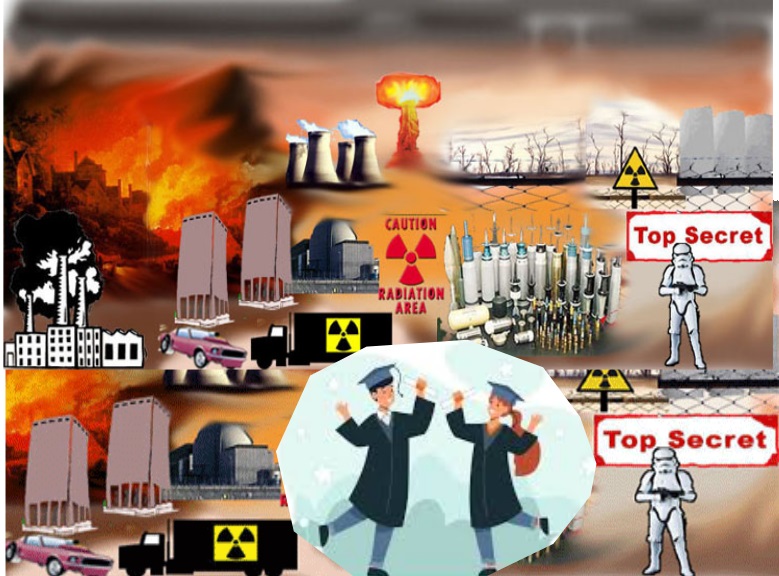
Helping youngsters start a nuclear career
by Business Crack, June 9, 2024
“………..The Nuclear Sponsorship Scheme offers 50 students a series of summer placements after each year of their degree as well as funding worth £42,000 – £27,000 in university fees and a £15,000 subsistence bursary – £5,000 per year for three years.
The scheme is means-tested and aimed at increasing social mobility among young people from lower socio-economic backgrounds………………… https://businesscrack.co.uk/2024/06/09/helping-youngsters-start-a-nuclear-career/
MSP’s claim of support for nuclear power in Highlands challenged
By John Davidson , john.davidson@hnmedia.co.u, 09 June 2024 https://www.johnogroat-journal.co.uk/news/msp-s-claim-of-support-for-nuclear-power-in-highlands-challe-352590/
An anti-nuclear campaigner has hit out at a claim made by Highland MSP Edward Mountain that people in the region want nuclear power.
The Conservative MSP hosted an energy summit in Strathpeffer last Friday, bringing together industry experts and members of the public.
The aim was to discuss the future of energy production and provision in the Highlands, with panellists including representatives from SSEN, Storegga, Highland Fuels, Highland Renewables, and the Anaerobic Digestion and Bioresources Association.
More than 70 people attended the Let’s Talk Energy Summit at Strathpeffer Pavilion.
Mr Mountain, who convenes the Scottish parliament’s Net Zero, Energy and Transport Committee, said that these contributors would be useful to inform his work at Holyrood.
He said that people at the summit wanted to see a mixture of different energy systems, including nuclear, rather than just renewables.
“I was excited to host this well-attended event in Strathpeffer alongside an experienced panel of five industry professionals where we discussed the many complexities of renewable energy,” Mr Mountain said.
“I was interested to note the near-unanimous support for nuclear energy throughout the audience as part of our energy mix in the Highlands, and I feel that we ought to look at developing our power closer to where it is going to be used.
“People in the Highlands understand better than anyone the need for different energy sources, as well as energy security.
“However, these communities won’t be walked over when it comes to infrastructure, and big companies need to understand that they must be honest about what they are planning in the medium and long-term.”
Tor Justad, chairperson of Highlands Against Nuclear Power (HANP), challenged the assertion that the support for nuclear at the summit reflected public opinion.
He said: “In a recent survey, 62 per cent of the Scottish population supported renewable energy over nuclear.
“There may have been ‘near unanimous’ support from a handful of organisations and public at the ‘Energy Summit’ held in Strathpeffer recently, but presumably they weren’t provided with any downsides to nuclear.
“If HANP had been invited we could have provided a long list of reasons why nuclear has no place either in energy production or reaching a net zero target.
“A few of these include cost – as producing electricity through nuclear is three times as expensive as renewables; and the risks at all stages, including decommissioning, as we know from radioactive particles on shores near Dounreay, sodium tank leaks and previous accidents involving the shaft and silo.
“Nuclear is not clean as uranium has to be mined and there are massive carbon emissions during the average 13-year construction period of a nuclear plant.
“So the claim that Highlanders want nuclear power has no basis in fact and any support is likely to come from nuclear employees at Dounreay and their supporters, where it is claimed that the clean-up will take another 40 years at a cost to taxpayers of a staggering £8.7 billion – so not much chance of cheaper electricity any time soon.
“HANP will continue to actively oppose any new nuclear proposals for the Highlands, any part of Scotland and in other parts of the UK together with fellow NGO’s opposed to new nuclear.”
Ukrainian officials stole $490 million meant for military – MP
https://www.rt.com/russia/599073-ukraine-fortification-construction-embezzlement/ 10 June 24
Criminal proceedings are underway in relation to dozens of cases of alleged embezzlement, according to politician Mikhail Bondar.
Nearly $500 million given to Kiev for the construction of defensive fortifications to repel Russia’s advance has been embezzled or stolen, media reported on Sunday, citing Mikhail Bondar, a member of the Ukrainian parliament.
Ukrainian law enforcement authorities have launched around 30 criminal proceedings linked to the embezzlement of 20 billion hryvnias ($491 million), Bondar told lawmakers at a closed-door session of the parliamentary investigative commission on fortifications, according to multiple media reports. In the absence of defensive fortifications, Russian forces have made rapid advances in the country.
“Members of the commission from Servants of the People [Ukraine’s ruling party], when they heard such figures, immediately tried to defend the managers of the funds,” Bondar said. However, he claimed that the “lion’s share” of the funds had been disbursed through Ukraine’s military and civil authorities, which the MP described as the “vertical of the president.”
Ukrainian lawmakers have urged the defense ministry, as well as local military authorities, to provide information on the use of budget funds for the construction of defenses.
Last month, Ukrainian media reported that military and civilian authorities in Kharkov Region had paid millions of dollars to fake companies for the supply of non-existent construction materials to build fortifications.
According to Ukrainian anti-corruption activists, Kharkov Region authorities alone embezzled or stole 7 billion hryvnias ($176.5 million) that they had been given to build fortifications along the border. The lack of defenses has resulted in Russian troops overrunning a dozen settlements in quick succession.
For the supply of wood, the Kharkov Department of Housing and Communal Services and OVA Regional Military Administration signed contracts worth 270 million hryvnias ($6.8 million) with five companies that had been set up immediately after the contracts were announced. No bidding process took place, and at least two of these companies were owned by the same person, an anti-corruption report claimed.
In May, Russia launched a large-scale offensive on Kharkov Region, capturing multiple towns and villages. Some Ukrainian troops, including Denis Yaroslavsky, a commander active in the area, blamed their superiors for putting up inadequate defenses, claiming they may have embezzled money intended for their construction.
For months, Kharkov Region has been a source of Ukrainian cross-border attacks on Russia’s Belgorod Region. Its proximity has allowed Ukrainian troops to regularly shell the Russian city with multiple rocket launch systems.
In March, Russian President Vladimir Putin suggested that Moscow could be forced to “create a cordon sanitaire” in Kiev-controlled territories to prevent attacks on Russian border regions.
1 This Month




PLEASE OPPOSE HR 8255 AND S.3639 – bills would accelerate satellite deployment, with no environmental review or safeguards – https://ncstd5li.quorum.us/campaign/169331/
To see nuclear-related stories in greater depth and intensity – go to https://nuclearinformation.wordpress.com
-
Archives
- September 2026 (339)
- August 2026 (330)
- July 2026 (355)
- June 2026 (287)
- May 2026 (306)
- April 2026 (356)
- March 2026 (251)
- February 2026 (267)
- January 2026 (308)
- December 2025 (358)
- November 2025 (359)
- October 2025 (375)
-
Categories
- 1
- 1 NUCLEAR ISSUES
- business and costs
- climate change
- culture and arts
- ENERGY
- environment
- health
- history
- indigenous issues
- Legal
- marketing of nuclear
- media
- opposition to nuclear
- PERSONAL STORIES
- politics
- politics international
- Religion and ethics
- safety
- secrets,lies and civil liberties
- spinbuster
- technology
- Uranium
- wastes
- weapons and war
- Women
- 2 WORLD
- ACTION
- AFRICA
- Atrocities
- AUSTRALIA
- Christina's notes
- Christina's themes
- culture and arts
- Events
- Fuk 2022
- Fuk 2023
- Fukushima 2017
- Fukushima 2018
- fukushima 2019
- Fukushima 2020
- Fukushima 2021
- general
- global warming
- Humour (God we need it)
- Nuclear
- RARE EARTHS
- Reference
- resources – print
- Resources -audiovicual
- Weekly Newsletter
- World
- World Nuclear
- YouTube
-
RSS
Entries RSS
Comments RSS

