Doncaster prisoners could sue government over exposure to radon gas

Inmates complain of rashes and fever, echoing the events that led Dartmoor jail to close last year
Richard Palmer, Observer 20th April 2025, https://www.theguardian.com/society/2025/apr/20/doncaster-prisoners-could-sue-government-over-exposure-to-radon-gas
The government faces further potential legal action over concerns about levels of radon gas at a second prison, after Dartmoor jail was forced to close.
Ministry of Justice officials have ordered radon detection equipment to be installed at Lindholme prison near Doncaster in South Yorkshire, where prisoners have reported feeling unwell with symptoms such as headaches, rashes and fever.
There are concerns about the risks of inhaling radioactive particles that can cause lung cancer.
Radon, a naturally occurring gas, is the second leading cause of lung cancer after smoking in the UK. There are concerns that the levels in Lindholme could be several times over the domestic safety limit.
A spokesperson for the Ministry of Justice said: “Radon monitoring is in place at HMP Lindholme as a precautionary measure.” No prisoners have been moved out of the jail.
Last week, the Observer revealed that about 500 former inmates and staff at Dartmoor are taking legal action after being exposed to what they claim were dangerously high levels of radon for years until the prison was closed for safety reasons last summer.
Kesar and Co, the law firm representing them, is also representing prisoners who have been in Lindholme. Violeta Hansen, a Danish radon expert advising the Dartmoor prisoners, said it had been known since at least 1987 that the area had high levels of radon, which is formed by decaying uranium found in rocks and soils, and jail staff had been monitoring levels inside the prison since 2010.
“They knew a long time ago they had a radon issue,” she said. “Why didn’t they do anything until 2024 when they did a risk assessment?”
Britain’s prison system is struggling with overcrowding and it is a logistical challenge to rehouse prisoners, such as the 941 at Lindholme.
Ben Leapman, editor of Inside Time, a free prisoners’ newspaper owned by the charity the New Bridge Foundation, which first reported the health scare at Lindholme, said there were only 553 places free across the men’s prison estate in England and Wales last week.
He said the radon levels in the prison were a cause for concern, not least because prisoners spent so long in their cells. “Even today, a lot of prisoners are locked in their cells for 22 hours a day because there isn’t enough work or courses to keep them busy,” he said.
Framatome and Sizewell C sign contract for EPR reactor instrumentation.

Framatome and Sizewell C have signed a contract for the supply,
qualification, and pre-assembly of conventional instrumentation for the EPR
reactors under construction at Sizewell, strengthening their collaboration
on this large-scale project.
Energy News 18th April 2025,
https://energynews.pro/en/framatome-and-sizewell-c-sign-contract-for-epr-reactor-instrumentation/
Third tender submitted in UK SMR selection process

Holtec has announced that it has submitted its final tender response to
Great British Nuclear as part of the UK’s ongoing small modular reactor
technology selection competition.
GE Hitachi and Rolls-Royce SMR earlier
confirmed they had submitted final tenders. There were initially six
companies shortlisted by Great British Nuclear (GBN), the arms-length body
set up to oversee the UK’s plans for new nuclear, with the four shortlisted
companies – Westinghouse being the other – entering negotiations last
September.
In February, the four SMR vendors were issued with an Invitation
to Submit Final Tenders. The aim is for GBN to select up to three of the
technologies, with the intention of supporting the deployment of multiple
units of a company’s SMRs at a site. GBN currently owns land for potential
new nuclear at Wylfa in Anglesey in North Wales, and at Oldbury in
Gloucestershire in southwest England, but other sites could also be chosen.
In an interview early last year for the World Nuclear News podcast, GBN
Chairman Simon Bowen said the intention was to place contracts with one,
two or three technology providers – this would be for co-funding the
technology all the way through to completion of the design, regulatory,
environmental and site-specific permissions process, and the potential to
place a contract for the supply of equipment. Each selected technology
would have an allocated site with the potential to host multiple SMRs.
World Nuclear News 16th April 2025
https://www.world-nuclear-news.org/articles/third-tender-submitted-in-uk-smr-selection-process
Aerial photos show state of Sizewell C preparatory works

Aerial photos of the proposed Sizewell C nuclear power station in Suffolk
have revealed the state of preparatory works ahead of its final investment
decision (FID). Despite the nuclear power plant having received development
consent in 2022, its FID is still yet to be achieved and the mood of
potential investors has been the subject of intense speculation.
Centrica chief executive Chris O’Shea said his company’s stake in Sizewell C
could be “between 1% or 2% and 50%”, meanwhile, the French spending
regulator Cour des comptes said EDF should scale back its involvement in
the project.
Nevertheless, preparatory work is underway such on road
upgrades and ground freezing, with over £2.5bn worth of contracts having
been awarded already. Four photos taken from an aerial platform, which
could be a drone, aircraft or hot air balloon, were published by Stop
Sizewell C on 8 April. The images were republished by Nuclear Free Local
Authorities (NFLA), which said the photos had been taken by an “anonymous
source” who “kindly made them free of license for open use”.
New Civil Engineer 16th April 2025, https://www.newcivilengineer.com/latest/aerial-photos-show-state-of-sizewell-c-preparatory-works-16-04-2025/
Bill Gates enters race to build mini-nuclear reactors in Britain
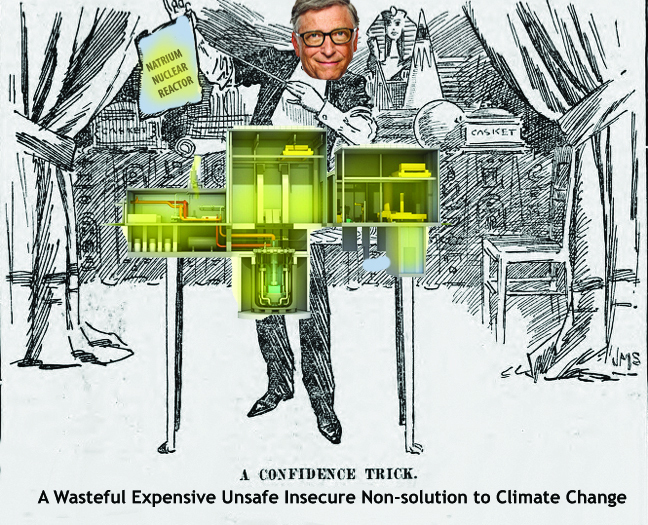
Competition from billionaire’s company TerraPower threatens blow for Rolls-Royce
A company founded by Bill Gates has submitted a bid to build
mini-nuclear reactors in Britain, dealing a potential blow to
Rolls-Royce’s hopes of dominating the domestic market.
Seattle-based TerraPower has written to the Government outlining its intention to submit
its reactor design for regulatory approval. The move kickstarts efforts by
the US company to enter an increasingly competitive market to build small
modular reactors (SMR), which are expected to play a key role in the UK’s
shift to cleaner energy.
The Microsoft billionaire’s company has
developed a reactor, called Natrium, that uses a molten sodium heat storage
system that allows it to rapidly ramp up its power output at peak times.
Natrium is the Latin word for sodium which has the chemical symbol Na.
Chris Levesque, TerraPower chief executive, said: “I am incredibly
excited to begin the process of licensing the Natrium technology in the UK.
Rolls-Royce had hoped to corner UK market with its small modular reactors.
While TerraPower is not involved in the competition for the UK’s SMR
contract, the potential entrant of a new deep-pocketed rival into the
market will pose a fresh challenge to Rolls-Royce’s plans.
Telegraph 16th April 2025, https://www.telegraph.co.uk/business/2025/04/16/bill-gates-bids-to-build-mini-nuclear-reactors-in-britain/
Ukrainian-born US lawmaker says Ukraine should cede land to Russia, demand Zelensky’s resignation
by The Kyiv Independent news desk April 7, 2025
Ukrainian-born U.S. lawmaker Victoria Spartz has said Ukraine should cede land to Russia, and its people should demand the resignation of President Volodymyr Zelensky.
In an interview with the Telegraph published on April 7, Spartz said Ukraine is not in a position to demand the return of all occupied territories. “If they were winning the war, that would be very different,” she added.
Spartz was born in Chernihiv Oblast and moved to the U.S. in 2000. She was elected to Congress three times, in 2020, 2022, and 2024, and represents Indiana’s 5th District.
Spartz initially supported U.S. aid for Ukraine and has often spoken about the war in personal terms.
However, she has also criticized the Ukrainian government, particularly Zelensky and his chief of staff, Andriy Yermak.
Spartz, who has been a critic of both the Biden administration and the Ukrainian government, supported U.S. President Donald Trump’s call to negotiate with Russian President Vladimir Putin.
“There are no easy solutions,” she said, placing blame on former President Joe Biden for what she sees as failed support.
“President Trump inherited it, so now he has to deal with it.”………………..
On April 4, 2024, The Wall Street Journal reported that Spartz would not support a new $60 billion Ukraine aid bill. She articulated “a lack of clear strategy” and the need for better oversight.
Spartz also said she has “largely moved on from focusing heavily on Ukraine.” In October 2023, Spartz also backed fellow Republican Jim Jordan’s calls for more accountability in Ukraine funding………………..
“To win wars, you need to have leaders who know how to win, not to try not to lose and become oligarchs themselves,” she said. Spartz also claimed Zelensky “took control of all Ukrainian media, prosecuted churches, businesses and volunteers.”https://kyivindependent.com/uss-only-ukrainian-born-lawmaker-says-ukraine-should-cede-land-to-russia-demand-zelenskys-resignation/
Protester for life
Activist Angie Zelter has been arrested more than a hundred times. She’s not stopping now, writes LINDA PENTZ GUNTER
ANGIE ZELTER doesn’t know if there are already US nuclear weapons at the RAF Lakenheath base in Suffolk. In fact we may never know, says the 73-year-old grandmother and veteran of countless protests, who began her activism at the Greenham Common women’s occupation in 1981 that saw US cruise missiles removed from the base there 10 years later.
RAF Lakenheath is a misnomer. It is actually a US Air Force base where, it is suspected,
preparations are underway for a return of US nuclear weapons to the base,
if they are not there already. This week and next, hundreds of peace and
disarmament activists will be travelling there to attend a peace camp that
includes rallies, a conference and culminates in a blockade on April 26.
The camp is hosted by the Lakenheath Alliance for Peace, a network of
groups and individuals from Britain and around the world. Protesters are
expected to include activists from other countries where US military bases
are located.
Morning Star 16th April 2025
https://morningstaronline.co.uk/article/protester-life
Germany: One exit and back? The role of nuclear power in the Merz coalition.
April 14, 2025, by Joachim Wille Note, abbreviation, background, and translation – Dieter Kaufmann, Working Group Against Nuclear Facilities, Frankfurt am Main, Germany
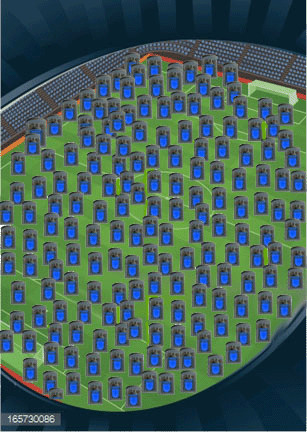
“SMRs will hardly be able to produce electricity more cheaply than conventional new nuclear power plants, unless thousands of them are mass-produced, which is not at all foreseeable.”
Although desired by some members of the Merz coalition, there will be no comeback for nuclear power plants. Joachim Wille philosophizes about the reasons.
Berlin – For a while, it looked as if the future Merz coalition would reverse the shutdown of the most recently shut-down nuclear power plants. The CDU/CSU, by far the largest partner, pushed for reversing the phase-out. The paper from the grand coalition’s “Energy and Climate” exploratory group stated – colored in the CDU/CSU blue – the CDU/CSU’s wish: “Nuclear energy can play a significant role, particularly with regard to climate goals and security of supply.”
Union backtracks on nuclear power: Coalition agreement seals Germany’s nuclear phase-out
But the coalition agreement recently presented by Merz and his colleagues no longer mentions any of this. This is an unmistakable signal: Germany is sticking to its nuclear phase-out, which was initiated in 2011 by CDU Chancellor Angela Merkel after the Fukushima disaster.
And this despite the fact that the public image of nuclear power has turned positive. The last three nuclear power plants in Germany were shut down two years ago. Today, however, according to a survey, a narrow majority of Germans (55 percent) support a return to nuclear energy, while 36 percent oppose it.
In politics, the CDU/CSU could have seen its pro-nuclear stance vindicated. It wanted to investigate whether the recently shut-down reactors could still be reactivated, and possibly even build new mini-reactors, as well as invest more money in the promising future of nuclear fusion. In the current representative Verivox survey, almost a third of respondents (32 percent) favor building new nuclear power plants, while another 22 percent would like to see only the most recently decommissioned plants brought back online.
After the Fukushima disaster: The Bundestag in Berlin voted in 2011 to shut down nuclear power plants
The phase-out of nuclear power, which at its peak provided around a third of the electricity consumed in Germany, was finally sealed by the Fukushima nuclear power plant disaster. In 2011, the Bundestag passed a cross-party resolution to gradually shut down the 17 nuclear power plants still in operation at the time.
After the reactor meltdowns in Japan, which rendered an entire region uninhabitable, there was a consensus: the “residual risk” of even Western nuclear technology is too great, and a phase-out is necessary. Ultimately, safety calculations showed that even with nuclear power plants made in Germany, serious accidents with radioactive contamination of large areas in the surrounding area, including entire cities, could not be ruled out.
Polls at the time showed high levels of support for the decision pushed forward by Merkel. The physicist’s legendary utterance when she saw the explosions at the Fukushima nuclear power plants on TV was legendary: “That’s it.”
Note: In 2011 polls, over 80 percent of the German population wanted to shut down all nuclear power plants after Fukushima
After the end of the Merkel era: The Union included plans for a return to nuclear power in coalition negotiations
After the end of the Merkel era, the remaining nuclear fans in the Union felt they had the upper hand again. It also looked as if they had a good chance of prevailing in the negotiations with the SPD. In particular, their demand for an “assessment of whether … a resumption of operation of the most recently shut-down nuclear power plants is still possible at a reasonable technical and financial cost,” as stated in the energy policymakers’ paper, seemed to have a good chance of success.
But there is no mention of this in the coalition agreement. Only fusion research plays a role here. “Our goal is: The world’s first fusion reactor should be located in Germany,” it states. However, the time perspective here is two or more decades. So, have Klingbeil’s Social Democrats, who have been pushing for a phase-out since the Chernobyl disaster in 1986, prevailed with their course against the CDU/CSU’s nuclear fans?
The energy industry doubts the CDU/CSU’s plan to reactivate nuclear power plants.
The most recent election platform clearly stated: “Nuclear power has been shut down in Germany, and that’s a good thing.” The anti-nuclear NGO “ausgestrahlt” sees it this way, accusing the SPD of having “burst the Union’s nuclear soap bubbles.” In fact, it’s at least as likely that the Union leaders realistically assessed the problems of the nuclear power renaissance. The dismantling of the nuclear power plants is already well advanced, and restarting them would be extremely expensive and very time-consuming due to the need for new permits.
A return to nuclear power is hardly possible: Nuclear power plant operators have closed their chapter.
In addition, the three current nuclear power plant operators, EnBW, PreussenElektra, and RWE, have practically closed the chapter on nuclear power. None of them would voluntarily take the entrepreneurial risk of reversing the decommissioning process. Before the start of the grand coalition negotiations, the line was clear. EnBW’s nuclear power chief Jörg Michels said: “The decommissioning status of our five nuclear power plants is, in practical terms, irreversible.”
PreussenElektra stated that it was not “engaged in such thought experiments.” RWE CEO Markus Krebber stated: “We are past the point in this country where we should bring decommissioned nuclear power plants back online.”
Estimates by the nuclear power plant service provider Nukem show how expensive the restart would have been. He estimates the cost of repairing the six reactors shut down between 2021 and 2023 at one to three billion euros per nuclear power plant, depending on how far the decommissioning has progressed. This would therefore involve a sum of ten billion euros or more, which would likely have had to come from the federal budget in Berlin.
Nukem CEO Thomas Seipolt told bild.de that he sees “a realistic possibility of a comeback for nuclear power” by 2030 and is therefore making a corresponding offer to the future German government. For his company, which specializes in the decommissioning of nuclear power plants and the management of nuclear waste, such a renaissance of nuclear power would have been extremely lucrative. But the fact remains: Despite the federal government’s €500 billion special fund for infrastructure and climate protection, such a massive cash injection for the nuclear power plant operators would have been virtually impossible to implement.
Further arguments against nuclear power: Green electricity now dominates the electricity market
But other arguments may have slowed the nuclear renaissance. “A return to nuclear power doesn’t fit in a market increasingly dominated by green electricity,” said Christoph Pistner, nuclear power expert at the Öko-Institut, to the Frankfurter Rundschau newspaper. The share of renewables in the grid is growing rapidly; currently, it’s already 60 percent, and according to current plans, it’s expected to reach around 80 percent by 2030 and even 100 percent by 2035.
The same applies, by the way, to the mini-nuclear power plants (Small Nuclear Reactors) proposed by the CDU/CSU, which, according to Pistner’s estimates, could not be ready for series production and built until the mid-2030s at the earliest. And: “As things stand today, SMRs will hardly be able to produce electricity more cheaply than conventional new nuclear power plants, unless thousands of them are mass-produced, which is not at all foreseeable.”
And then Pistner recalled a politically critical aspect: “A return to nuclear energy has the potential to jeopardize the search for a final storage site in Germany.” The search for a final storage site was restarted after the Fukushima nuclear phase-out, which eliminated the previously hotly contested Gorleben site, which proved to be geologically unsuitable. A Gorleben 2.0 would probably be the last thing the Merz grand coalition needs – https://www.fr.de/politik/warum-sich-die-neue-koalition-gegen-eine-atom-rueckkehr-entschied-93684231.html Groko (Grand Coalition) is an abbreviation for grand coalition.
Background: Nuclear phase-out in Germany
The first phase-out of nuclear energy in Germany took place in 2000. As early as 2006, it was clear that the conservative parties (CDU/CSU), also known as the Union, wanted to return to nuclear energy with a new government change in 2009. This happened in 2010. But then Fukushima happened in 2011, and Chancellor Merkel withdrew from nuclear energy after just a few months. The resolution was supported by all parties in the federal parliament in Berlin that the last nuclear power plants would be shut down on December 31, 2022. We would have preferred to phase out nuclear power sooner.
All social groups have prepared for the nuclear phase-out. Then Russia, Putin’s country, invaded Ukraine in February 2022 for the second time since 2014. Natural gas and oil became very expensive. Electricity prices also rose. In addition, half of all nuclear power plants in France were shut down in the winter of 2022/2023 for various reasons. The Union then wanted to re-enter nuclear energy. But it was too late. Nuclear power plant operators in Germany were annoyed. Planning security looks different. Nuclear power plants are not kettles that can be switched on and off.
An agreement was reached with the nuclear power plant operators, and the remaining three nuclear power plants were extended until April 15, 2023, as long as the nuclear fuel still allowed. Certain fuel elements were converted once again in the core area of the three nuclear power plants. Then it was over.
Peace camp protestors hand in letter to US airbase commanders at Lakenheath

14th April 2025, https://www.nuclearpolicy.info/news/peace-camp-protestors-hand-in-letter-to-us-airbase-commanders-at-lakenheath/
On this the first day of a two-week Peace Camp hosted by the Lakenheath Alliance for Peace, a delegation from LAP will hand in a letter to commanders of the US airbase at Lakenheath.
The Peace Camp will comprise various themed days, including Democracy Day on 22 April, for which the NFLA Secretary has produced a bespoke briefing paper for peace activists wishing to engage with Councillors on the issue of nuclear disarmament. As a partner in LAP, the UK/Ireland NFLAs have endorsed the letter.
The letter reads:
14th April 2025
Peace camp protestors hand in letter to US airbase commanders at Lakenheath
On this the first day of a two-week Peace Camp hosted by the Lakenheath Alliance for Peace, a delegation from LAP will hand in a letter to commanders of the US airbase at Lakenheath.
The Peace Camp will comprise various themed days, including Democracy Day on 22 April, for which the NFLA Secretary has produced a bespoke briefing paper for peace activists wishing to engage with Councillors on the issue of nuclear disarmament. As a partner in LAP, the UK/Ireland NFLAs have endorsed the letter.
The letter reads:
Dear Base Commanders and all personnel of ‘RAF’/USAF Lakenheath,
Lakenheath Alliance for Peace (now consisting of around 60 Alliance Organisations) are writing to you once more. This is our 5th letter[1] to you and we politely ask that you please reply to us.
As you will know from our previous communications and protests over the last year, we are concerned at the blatant disregard of international humanitarian law by the preparation to use US guided nuclear bombs. Just one could kill hundreds of thousands of people and cause lasting devastation to our environment. We are also horrified and ashamed that you have been training Israeli pilots who are engaged in a genocide in Gaza and have also, along with USAF Mildenhall, been aiding and abetting that genocide.
We are engaged in a 2-week nonviolent presence at your base in order to show that your war mongering is not being done in our name.
Many people living close to US military bases in Europe, Japan and South Korea (to mention just a few) are extremely concerned that you operate outside the rule of law and in the interests of controlling scarce resources for yourselves, not for purely self-defensive reasons and certainly not in the interests of the general public in our countries.
The informed public understand that the existential threats facing us are escalating climate change, biodiversity loss and nuclear annihilation. Your activities at Lakenheath are exacerbating all these threats and putting us all in danger. They are a breach of our peace and are in breach of national and international laws.
Yours in peace,
Lakenheath Alliance for Peace, info@lakenheathallianceforpeace.org.uk
CND Cymru has highlighted the continued lack of investment in communities and people, while billions is to be spent subsidising the nuclear industry.
Following reports that the Westminster government is doubling down on
Nuclear Power, including a potential further investment in Sizewell C and a
raft of new Small Modular Reactors (SMRs), CND Cymru has highlighted the
continued lack of investment in communities and people, while billions is
to be spent subsidising the nuclear industry.
Keir Starmer seems poised to announce renewed public subsidy in Hinkley Point C, not set to open till 2031, and support for a further reactor at Sizewell C, costing billions in
taxpayer money. Coupled with a renewed focus on pushing through SMR
proposals, also likely subsidised by the taxpayer, Starmer may be set to
hand over £10 billion to the nuclear industry at a time when austerity is
looming over everyone.
Citing the potential for growth, Starmer is banking
on moderate gains by corporations in order to save a stagnating economy
that would benefit more from investment in community and green projects.
A CND Cymru spokesperson said “The willingness of the government to fund
the nuclear industry to the tune of billions while preaching austerity to
everyone else is absolutely farcical. We have seen the winter fuel payment
means tested, an attack on disability and other welfare systems, and a
refocus away from people towards profit. This government is functionally
taking money from the pockets of working class people and handing it to
corporations in the nuclear and warfare industry in order to chase a
mythical idea of growth – all while suppressing the true wealth creators in
this country.
A different, greener, fairer, future is possible which
doesn’t leave future generations with nuclear waste – and the government
has time to refocus and adjust their plans in order to build that future.
We must not accept the subsidy of the nuclear industry – all meant to prop
up a failing industry in order to preserve our nuclear attack capabilities
– while working people are facing impossible choices or sometimes not even
having the luxury of choice – starving and freezing – while the CEOs and
shareholders rake in the cash. Something has to change – and it is in the
government’s power to change it if they wish; because austerity, the death
of thousands, and the attack on millions, is a political choice, not
economic necessity.”
CND Cymru 14th April 2025
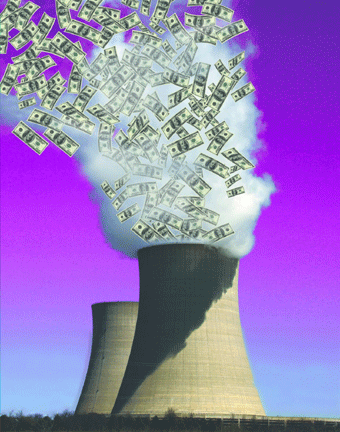
CND Cymru condemns billions for nuclear industry
Morning Star 15th April 2025
https://morningstaronline.co.uk/article/cnd-cymru-condemns-billions-nuclear-industry
CAMPAIGNERS have condemned the billions being poured into nuclear energy while the Westminster government “preaches austerity” for everybody else.
CND Cymru attacked Sir Keir Starmer today, claiming he was poised to announce more public subsidy for the Hinkley Point C nuclear power plant in Somerset, not due to open until 2031.
A CND Cymru spokesperson said: “The willingness of the government to fund the nuclear industry to the tune of billions while preaching austerity to everyone else is absolutely farcical.
The anti-nuclear campaigners said Hinkley Point is likely to cost over £40 billion, £14bn over the initial estimate, with CND pointing out the project was managed by French company EDF.
“We must not accept the subsidy of a failing industry in order to preserve our nuclear attack capabilities while working people are facing impossible choices,” the CND spokesperson said.
“A different, greener, fairer, future is possible which doesn’t leave future generations with nuclear waste.”
Zelensky started the war then begged for missiles – Trump

Ed COMMENT. Unsurprisingly, Donald Trump again plays fast and loose with the truth. In fact Zelensky did not start Russia’s wholescale invasion of Ukraine. Putin did.
However, there’s more than a grain of truth in Trump’s claim. Zelensky deceived the Ukrainian public by pledging to support the autonomy of the Donbass regions, and end the Ukraine government’s 8 year war against them. Once elected, he reneged on this .
14 Apr, 2025 , https://www.rt.com/news/615756-zelensky-started-war-trump/
The Ukrainian leader has recently renewed his call for Washington to supply air defense systems
Ukraine’s Vladimir Zelensky should never have started a war with Russia, US President Donald Trump has said.
In a press conference alongside El Salvador’s President Nayib Bukele in the Oval Office on Monday, Trump commented on Zelensky’s recent offer to finance $15 billion worth of Patriot air defense batteries with the aid of Kiev’s European backers.
“He’s always looking to purchase missiles,” the US presided noted.
“When you start a war, you got to know that you can win the war,” he said of Zelensky. “You don’t start a war against somebody that’s 20 times your size and then hope that people give you some missiles.”
Trump added that he gave Kiev American-made Javelin man-portable anti-tank missiles during his first presidency.
In an interview with CBS News on Sunday, Zelensky called on the US to supply Ukraine with more air defenses. Kiev is ready to buy or lease up to ten Patriot air defense systems, and some European backers have offered to help with the money, he claimed.
During the interview, the network suggested that Trump tried to cut Kiev out of peace talks with Russia, and that he lied in his statements about the conflict. Trump allegedly “rewrote history, saying, falsely, that Ukraine had started the war and calling… Zelensky ‘a dictator without elections’,” according to CBS.
The US president lashed out at the news network on Truth Social on Monday, calling the interview inaccurate and fraudulent.
Trump has repeatedly claimed that the Ukraine conflict would never have escalated had he been in the White House, rather than his predecessor Joe Biden.
According to the US president, the previous administration invested more than $300 billion into supporting Kiev. Trump has promised to “get back” the money, entering talks with Ukraine about jointly exploiting its mineral resources. He also suggested taking over Ukrainian nuclear power plants.
The Kremlin has hailed the Trump administration’s peace efforts, but cautioned that resolving long-standing issues will take time and “painstaking work.”
Flood warnings as Europe named as the fastest-warming continent in the world

Europe has been named the fastest-warming continent in the world in a
UN-led annual report. The UN-led European State of the Climate 2024, which
included contributions from about 100 scientists and experts, found that
last year was the warmest on record for the continent as countries were hit
by clear climate change impacts, extreme weather and record temperatures.
Released on Tuesday by the UN World Meteorological Organisation (WMO) and
the Copernicus Climate Change Service (C3S), the report details a year of
extremes.
Independent 15th April 2025, https://www.independent.co.uk/climate-change/flooding-spain-global-warming-un-report-b2733121.html
Campaign for Nuclear Disarmament (CND), to blockade RAF Lakenheath after US exemption to British nuclear safety rules revealed
Berny Torre, Sunday, April 13, 2025, https://morningstaronline.co.uk/article/cnd-blockade-raf-lakenheath-after-us-exemption-british-nuclear-safety-rules-revealed
PROTESTERS will set up a two-week peace camp outside RAF Lakenheath tomorrow after it emerged that all United States forces in Britain are exempt from meeting nuclear safety regulations.
And CND said that activists will block the Suffolk base on April 26, the last day of their vigil.
Declassified documents uncovered by CND show that former defence secretary Ben Wallace signed the “sensitive” waiver exempting US troops from telling local authorities they are storing nuclear weapons and exempt from sticking to regulations applied to radiation risks, leaving local authorities unable to draft disaster emergency plans.
It is known that RAF Lakenheath is being prepared to host new US nuclear weapons, but the March 2021 waiver exempts all US bases in Britain.
CND general secretary Sophie Bolt said: “Far from keeping people safe, all these nuclear weapons make Britain a target. Yet the government is more concerned about its special relationship with the US than people’s safety.
“The peace camp comes just as we learn that Britain’s cover-up of a US nuclear weapons deployment has been in the works for at least four years, alongside proof that people living close to any US base in this country, not just in East Anglia, are at great risk.”
Lakenheath Alliance for Peace co-founder Angie Zelter said: “It is horrifying and shameful that USAF Lakenheath, on British soil and with the connivance of the UK government, is involved in war crimes and genocide.
“Pilots from Israel and Saudi Arabia are trained at Lakenheath and US planes and bombs go out to take part in the bombings in Gaza and Yemen.
“We are here to say this is not in our name and to warn service personnel in the base that they should never obey illegal orders and should refuse to take part in the never-ending wars that are destroying people and planet.”
Greenham Common campaigner Ginnie Herbert said: “The cruise missiles left Greenham Common, international law changed and the common was handed back to the people.
“Forty years later and here we are protesting again as secret decisions are made and US nuclear weapons return to Lakenheath.”
The new camp will include a programme of events and actions taking place at the base and in nearby towns and villages.
A Ministry of Defence spokesman said: “It remains a long-standing UK and Nato policy to neither confirm nor deny the presence of nuclear weapons at a given location.”
Nuclear waste returns to Germany amid protests.
Matt Ford with dpa, NDR, 04/01/2025April 1, 2025, Edited by: Sean Sinico
https://www.dw.com/en/nuclear-waste-returns-to-germany-amid-protests/a-72108958
Seven containers filled with nuclear waste were transferred from ship to train in northern Germany for transport to Bavaria. But Germany still has no permanent storage solution for its radioactive material.
A ship carrying castor seven containers filled with highly radioactive nuclear waste docked in the northern German port of Nordenham, Lower Saxony, on Tuesday morning, amid protests and a heightened police presence.
The nuclear waste is being transported from Sellafield in northwest England to a temporary storage unit in Niederaichbach in the southern German state of Bavaria. The waste left the northwestern English port of Barrow-in-Furness last Wednesday and is being transferred from ship to train in Nordenham before continuing southwards. The nuclear waste was what remained after the reprocessing of fuel elements from decommissioned German nuclear power plants.
The first of the containers, which are four meters (13 feet) long and weigh over 100 tons, was lifted off the special “Pacific Grebe” transport ship by a large crane on Tuesday morning and underwent inspection to measure radiation levels and ensure they matched those taken in Sellafield.
The port in Nordenham remains sealed off and guarded by heavily armed police, who have thus far reported no incidents, despite a number of protests by anti-atomic energy groups.
Nuclear waste: Why are people protesting?
“Every castor container carries enormous risk,” said Helge Bauer from the protest group Ausgestrahlt, which means “radiated.” “Nuclear waste should, therefore, only be transported once — to a permanent storage site.”
Further protests are planned along the presumed route of the train carrying the waste over the coming days, including in the cities of Bremen and Göttingen.
“Every castor transport is one too many because it only postpones the problem and does not solve it,” Kerstin Rudek, a spokesperson for the group Castor-Stoppen, said in a statement, adding that nuclear waste should not be moved until a safe, final storage location is determined.
Where is the waste from if Germany phased out nuclear energy?
Germany began phasing out the use of nuclear power in 2003, a process which was accelerated following the Fukushima disaster in Japan in 2011. Germany’s final remaining nuclear power plants were shut down in 2023.
But Germany is still obligated to take back nuclear waste produced by used elements from its plants which, up until 2005, were regularly transported to reprocessing plants in Sellafield and La Hague, France. The transport of processed German nuclear waste back to the country has often been subject to protests.
According to the Society for Nuclear Service (GNS), over 100 castor containers were transported from La Hague to Gorleben, Lower Saxony, between 1995 and 2011. The final four were transported to Philippsburg, Baden-Württemberg, in 2024. Six containers were reportedly transported from Sellafield to Biblis, Hesse, in 2020, with seven more still to come.
Where does Germany store nuclear waste?
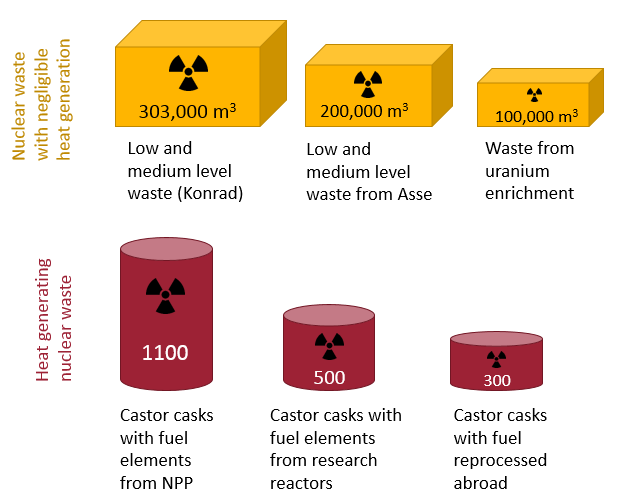
Germany’s Federal Company for Radioactive Waste Disposal (BGE) is still in the process of identifying a suitable location for the permanent underground storage of 27,000 cubic meters of nuclear waste produced over the course of 60 years of German nuclear energy production.
Nuclear waste, which can remain radioactive and, therefore, highly dangerous for hundreds of thousands of years, is currently stored in 16 temporary locations above ground, but it can’t stay there forever.
“We are using an empiric process to identify a location which offers the best possible security,” the BGE’s Lisa Seidel told public broadcaster NDR in November 2024.
1 This Month
26 September – International Day for the Total Elimination of Nuclear Weapons





PLEASE OPPOSE HR 8255 AND S.3639 – bills would accelerate satellite deployment, with no environmental review or safeguards – https://ncstd5li.quorum.us/campaign/169331/
To see nuclear-related stories in greater depth and intensity – go to https://nuclearinformation.wordpress.com
-
Archives
- September 2026 (305)
- August 2026 (330)
- July 2026 (355)
- June 2026 (287)
- May 2026 (306)
- April 2026 (356)
- March 2026 (251)
- February 2026 (267)
- January 2026 (308)
- December 2025 (358)
- November 2025 (359)
- October 2025 (375)
-
Categories
- 1
- 1 NUCLEAR ISSUES
- business and costs
- climate change
- culture and arts
- ENERGY
- environment
- health
- history
- indigenous issues
- Legal
- marketing of nuclear
- media
- opposition to nuclear
- PERSONAL STORIES
- politics
- politics international
- Religion and ethics
- safety
- secrets,lies and civil liberties
- spinbuster
- technology
- Uranium
- wastes
- weapons and war
- Women
- 2 WORLD
- ACTION
- AFRICA
- Atrocities
- AUSTRALIA
- Christina's notes
- Christina's themes
- culture and arts
- Events
- Fuk 2022
- Fuk 2023
- Fukushima 2017
- Fukushima 2018
- fukushima 2019
- Fukushima 2020
- Fukushima 2021
- general
- global warming
- Humour (God we need it)
- Nuclear
- RARE EARTHS
- Reference
- resources – print
- Resources -audiovicual
- Weekly Newsletter
- World
- World Nuclear
- YouTube
-
RSS
Entries RSS
Comments RSS

