Germany and nuclear weapons: A difficult history

Volker Witting | Rina Goldenberg, 02/17/2024February 17, 2024
Donald Trump’s suggestion the US will no longer apply NATO’s principle of collective defense should he become president again has sent shockwaves through Europe.
German Defense Minister Boris Pistorius is annoyed by the current debate about European nuclear weapons.“There is no reason to discuss the nuclear umbrella now,” he told public broadcaster ARD.
Ever since Donald Trump suggested that, as US president, he would not provide military assistance to NATO countries if they invested less than 2% of their GDP in their defense, German politicians have been discussing whether French and British nuclear weapons would suffice as a protective shield or whether Europe needs new nuclear weapons.
“The debate about European nuclear weapons is a very German debate that we don’t see in any other country,” political scientist Karl-Heinz Kamp from the German Council on Foreign Relations (DGAP) told DW — especially not in Eastern Europe, where there is a constant perceived threat from Russian President Vladimir Putin’s Russia.
Germany has a special history: Germany was “seen as an intrinsically aggressive country, that had started two world wars and could not be trusted with nuclear weapons,” said Kamp.
Germany-based nukes during the Cold War
In 1954, not long after the end of World War II, the first chancellor of the Federal Republic of Germany, Konrad Adenauer, signed an agreement renouncing the production of its own nuclear, biological or chemical weapons on its territory. In return, the US included West Germany in its nuclear deterrence policy against the Soviet-led Warsaw Pact.
In 1958, the German parliament, the Bundestag, approved the deployment of US nuclear weapons, despite some pacifist protests among the population. In 1960, 1,500 US nuclear warheads were stored in West Germany and a further 1,500 in the rest of Western Europe.
The nuclear weapons were also available to the Bundeswehr for training and use in the “case of defense.” “There was never any discussion about Germany acquiring its own nuclear weapons,” said Kamp.
The West German and European peace movements grew. The protest against the “NATO Dual-Track Decision” in 1982 saw over a million people in West Germany take to the streets in protest against the planned stationing of new US medium-range missiles in the country.
Nevertheless, on November 22, 1983, a center-right majority in the Bundestag approved the stationing of the missiles in US bases shortly thereafter. At the time, the Greens were newly represented in the Bundestag and appealed to the Federal Constitutional Court against the storing and deployment of nuclear missiles on West German territory. This bid was rejected as unfounded in December 1984.
During the Cold War, East Germany, the communist German Democratic Republic (GDR), was part of the Warsaw Pact military alliance, and from 1958, nuclear missiles and warheads were stationed in Soviet military bases on GDR territory. Some were withdrawn in 1988 as part of the Intermediate-Range Nuclear Forces Treaty between the US and the Soviet Union.
After German reunification and the withdrawal of the Soviet military, the territory of the former GDR officially became free of nuclear weapons in 1991.
Post-Cold War Germany
After the fall of the Berlin Wall in 1989, the collapse of the Soviet Union and the end of the division between East and West Germany, the German position was once again cemented in the so-called “Two-Plus-Four Treaty”: No nuclear weapons! On September 12, 1990, the four victorious powers of World War II (the US, the Soviet Union, France and UK) stipulated that Germany East and West should be reunified and renounce nuclear weapons.
Kamp says this was hardly surprising, because “a German nuclear power would be something that would cause horror. For historical reasons alone.”
The US government withdrew many of these nuclear warheads after the collapse of the Soviet Union, though an estimated 180 US nuclear weapons are still stored in Europe, in Italy, Turkey, Belgium, the Netherlands and Germany.
Experts believe that 20 US nuclear warheads are currently stored in the town of Büchel in Rhineland-Palatinate, western Germany. “But the decision-making authority over these weapons lies solely with the American president,” explained Kamp.
Any debate about Germany acquiring its own nuclear weapons is completely unrealistic, says political scientist Peter Rudolf from the German Institute for International and Security Affairs. Nuclear bombs need to be stored so that they are not easy targets, he told the Frankfurter Allgemeine daily.
“Survivable nuclear weapons would have to be on nuclear-powered submarines that can remain underwater for a very long time, he said, pointing to equipment the Bundeswehr does not have. “So there are so many problems standing in the way of a German nuclear bomb that it has no relevance to current crises,” Rudolf concluded.
“Those who are now talking about a European defense dimension are not talking about German nuclear weapons, because Germany is a member of the Nuclear Non-Proliferation Treaty and has made several binding commitments under international law to renounce the possession of weapons of mass destruction — including nuclear weapons,” agreed Kamp.
Defense Minister Pistorius, meanwhile, who made headlines not so long ago saying Germany should get “war-ready”, is now keen to brush the whole debate aside: He told ARD that “the majority of those in charge in the United States of America know exactly what they have in their transatlantic partners in Europe, what they have in NATO.”
And Kamp agrees: “Trump may be able to damage NATO considerably, but he cannot destroy it. You can’t destroy decades of transatlantic relations in one term of office.”
Edited by Ben Knight and Peter Hille
Germany and Ukraine sign ‘long term’ security deal
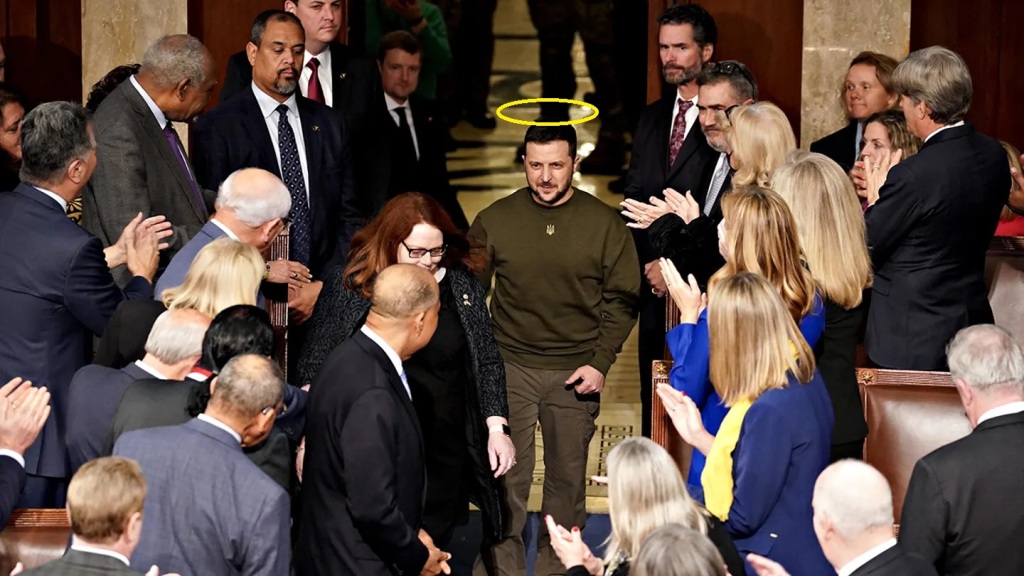
Zelensky said that the details of the agreement “are very specific and involve long-term support,” and that the pact proves that one day “Ukraine will be in NATO.”
https://www.rt.com/news/592570-germany-ukraine-security-deal/ 17 Feb 24
Ukrainian President Vladimir Zelensky has said the agreement proves his country will join NATO
German Chancellor Olaf Scholz and Ukrainian President Vladimir Zelensky have signed a security pact under which Berlin will supply Kiev with military and economic aid for another ten years.
Inked on Friday, the agreement commits Germany to providing “unwavering support for Ukraine for as long as it takes in order to help Ukraine defend itself” and restore its 1991 borders. In addition to retaking the regions of Donetsk, Lugansk, Kherson, and Zaporozhye, this feat would also involve the seizure of Crimea from Russia, which some American officials and Kiev’s former military chief view as next to impossible.
On top of military aid, the plan binds Germany to training Ukrainian police officers, transferring weapons manufacturing technology, paying for green energy projects, and a range of other efforts to help the Ukrainian government “continue providing services to its people”
Speaking at a ceremony in Berlin, Zelensky said that the details of the agreement “are very specific and involve long-term support,” and that the pact proves that one day “Ukraine will be in NATO.”
Germany is Ukraine’s second-largest Western backer, behind only the US. To date, Berlin has given Kiev €22 billion ($23.7 billion) in assistance, including €17.7 billion in military aid, according to figures compiled by the Kiel Institute for the World Economy. When aid transferred via the EU is included, Germany has handed over a total of €28 billion to Ukraine, Scholz said on Friday.
In addition to signing the decade-long pledge to Ukraine, Scholz announced a new package of military aid worth €1.1 billion. It will include 36 self-propelled howitzers, 120,000 artillery shells, and additional ammunition for Ukraine’s German-provided Iris-T air defense systems.
Germany’s outlay has hurt its own military readiness, with the New York Times reporting in November that training exercises are routinely canceled due to ammunition shortages, while German soldiers have yet to fire their latest howitzers, all of which have been sent to Ukraine.
Scholz’s decision to sanction Russian energy imports has also hammered the German economy, with industrial output falling by 2% last year, while the entire economy shrank by 0.3% in the same time period, according to the country’s Federal Statistical Office. One in three German manufacturers is currently considering moving abroad, Federation of German Industries (BDI) chief Siegfried Russwurm told Bild on Saturday, citing persistent inflation and high energy costs.
German energy companies reject nuclear energy proposals – citing high risks and toxic waste problem
Will nuclear energy make a comeback in Germany? Germany phased out nuclear
energy nearly a year ago. But even with the multi-billion euro problem of
how to store radioactive waste, some policians are calling for new nuclear
plants to be built.
The CDU and CSU have changed their position on nuclear
power again. Now many in the party are calling for new reactors to be
built. CDU leader Friedrich Merz has said that shutting down the last
reactors was a “black day for Germany.” The parties also say that old
reactors should be reconnected to the grid. Merz says that the country
should restart the last three power plants that were shut down — citing
climate protection, as well as rising oil and gas prices.
Those proposals have not found much enthusiasm among German energy companies. EnvironmentMinister Steffi Lemke is not surprised. “The energy companies made
adjustments a long time ago, and they still reject nuclear power in Germany
today. Nuclear power is a high-risk technology whose radioactive waste will
continue to be toxic for thousands of years, and will be an issue for many
generations.”
Deutsche Welle 28th Jan 2024
https://www.dw.com/en/will-nuclear-energy-make-a-comeback-in-germany/a-68098059
German defense chief against going ‘all in’ on Ukraine
23 Jan 24, https://www.rt.com/news/590954-germany-defense-minister-pistorius-no-ukraine-all-in/
Boris Pistorius says donating too many weapons to Kiev would weaken Berlin’s own forces
Germany should exercise some caution in its support for Ukraine, Defense Minister Boris Pistorius has told the newspaper Der Tagesspiegel. He also revealed that Berlin is considering reverting to a compulsory military service system.
The defense chief warned last month that European nations have less than a decade to ramp up their military capabilities in anticipation of a potential armed confrontation with Russia, and predicted that the US would shift its focus to the Asia-Pacific region.
In an interview published on Friday, Pistorius dismissed criticisms that Germany is not sending enough weaponry to Ukraine, pointing out that Berlin is the second largest contributor to Kiev after the US. However, he stressed that shipping German-made long-range Taurus cruise missiles, which Kiev has been requesting for months, is currently out of the question.
“We have so far delivered everything that is possible,” he said, adding that Germany carefully weighs up the potential impact of each new shipment to Ukraine.
Pistorius cautioned that Berlin must also “keep an eye on its own defense capabilities” meaning that it can’t go “all in” for Ukraine as some are demanding.
“Otherwise we would be defenseless ourselves,” he warned, while calling on other European nations to ramp up their defense production, to become more independent of the US.
The German minister suggested that Russian President Vladimir Putin could eventually “attack a NATO country,” while acknowledging that such a scenario was unlikely at present. Germany must thoroughly upgrade its armed forces and civil defense, he concluded.
As part of these efforts, the Bundeswehr will simplify its recruitment policies and loosen its enlistment criteria, he noted, while mentioning the current debate on reintroducing compulsory military service.
A survey last month revealed that only 17% of German adults would be prepared to defend their country without question in case of a military conflict.
Earlier this week, Chancellor Olaf Scholz confirmed that Berlin would shell out more than €7 billion ($7.6 billion) on military aid for Ukraine this year.
Berlin provided Kiev with nearly $23 billion in aid between February 2022 and November 2023, according to the Kiel Institute for World Economy (IfW).
Since Kiev’s summer counteroffensive fizzled out with no major gains and heavy losses, top Ukrainian officials have increasingly been pressuring their Western backers for more weaponry.
Germany’s coal power production drops to lowest level in 60 years in2023 after nuclear exit
Germany’s coal power production drops to lowest level in 60 years in
2023 after nuclear exit. Germany’s lignite power production fell to the
lowest level since 1963 last year, while hard coal power production even
dropped to the lowest level since 1955, an analysis by research institute
Fraunhofer ISE has found.
The country’s entire coal-fired power
production fell by almost one third (48 TWh), cutting coal’s share of
total net power generation to 26 per cent. Meanwhile, the country sourced
nearly 60 percent (59.7%) of its net power production from renewables,
which generated a total of 260 terawatt hours (TWh), an increase of 7.2
percent compared to 2022. With an increase of more than 17 TWh, output from
wind turbines grew particularly strong, according to the institute’s
annual energy review.
Renew Economy 4th Jan 2024
German nuclear plant to be replaced by Europe’s biggest battery.
PreussenElektra, operator of the decommissioned Brokdorf nuclear power
plant in northern German state Schleswig-Holstein, which was taken offline
at the end of 2021, wants to transform the site into a power storage
facility, reports NDR.
Initial plans could see a 100-megawatts (MW) battery
plant operating on a site close to the nuclear power station in 2026. A
second phase would add 700-megawatts of capacity, hosted on the 12-hectare
site of the nuclear power plant itself. (No storage duration was cited).
The company hopes to have the entire project online in 2036, but is waiting
for authorisation to begin dismantling the decommissioned reactor.
Renew Economy 15th Dec 2023
The German Environment Agency shows that a global tripling of nuclear capacity by 2050 is neither realistic nor needed to achieve climate goals
This factsheet analyzes the role of nuclear energy in global climate
scenarios. It shows that a global tripling of nuclear capacity until 2050
is neither realistic nor is it needed to achieve climate targets according
to the Paris agreement.
The factsheet presents an analysis of nine global
climate scenarios that achieve climate targets according to the Paris
agreement as well as two non-target scenarios with an emphasis on the role
of nuclear energy.
In order to assess how realistic these top-down
scenarios are, it compares these figures with the plans and programs of
governments for the expansion (or phase out) of nuclear power.
A tripling of today’s nuclear capacity of 370 GW would require 1.110 GW net
electrical capacity to be operational in 2050. If we assume a very high
sixty year lifetime for all nuclear reactors in operation and under
construction today, roughly 210 GW of the current nuclear fleet would still
be online in 2050.
Thus, a total of nearly 900 GW would have to be
constructed additionally between 2024 and 2050. Assuming a linear increase
in the rate of new construction up to 2050, starting with the amount of new
nuclear connected to the grid in 2023, in 2050 more than 60 GW would need
to be connected to the grid to meet the tripling nuclear target, compare
Figure 10.
This would be approximately twice the maximum historic capacity
connected to the grid in a single year. On average, more new capacity would
have to be added every year over 25 years as was the case at the historical
maximum in 1985. From these numbers, it is evident, that a tripling of
nuclear capacity until 2050 is neither realistic nor is it needed to
achieve climate targets according to the Paris agreement.
German Environment 30th Nov 2023
Disproportionately High Contributions of 60 Year Old Weapons-137Cs Explain the Persistence of Radioactive Contamination in Bavarian Wild Boars

Environmental Science and Technology, Felix Stäger, Dorian Zok, Anna-Katharina Schiller, American Chemical Society, ACS Publications 30th Aug 2023
Abstract
Radionuclides released from nuclear accidents or explosions pose long-term threats to ecosystem health. A prominent example is wild boar contamination in central Europe, which is notorious for its persistently high 137Cs levels. However, without reliable source identification, the origin of this decades old problem has been uncertain. Here, we target radiocesium contamination in wild boars from Bavaria. Our samples (2019–2021) range from 370 to 15,000 Bq·kg–1 137Cs, thus exceeding the regulatory limits (600 Bq·kg–1) by a factor of up to 25. Using an emerging nuclear forensic fingerprint, 135Cs/137Cs, we distinguished various radiocesium source legacies in their source composition. All samples exhibit signatures of mixing of Chornobyl and nuclear weapons fallout, with 135Cs/137Cs ratios ranging from 0.67 to 1.97. Although Chornobyl has been widely believed to be the prime source of 137Cs in wild boars, we find that “old” 137Cs from weapons fallout significantly contributes to the total level (10–68%) in those specimens that exceeded the regulatory limit. In some cases, weapons-137Cs alone can lead to exceedances of the regulatory limit, especially in samples with a relatively low total 137Cs level. Our findings demonstrate that the superposition of older and newer legacies of 137Cs can vastly surpass the impact of any singular yet dominant source and thus highlight the critical role of historical releases of 137Cs in current environmental pollution challenges.
Synopsis
Sixty years old 137Cs from nuclear weapons fallout contributes significantly to the notorious contamination levels in wild boars in Central Europe that were previously believed to be dominated by Chornobyl.
Introduction
In the face of climate change, nuclear energy is experiencing a renaissance as a low-carbon option to feed humanity’s hunger for energy. (1) However, the release of radionuclides into the environment from nuclear accidents or nuclear weapons fallout poses potential threats to public health and societies and economic activities as some radionuclides are capable of persistently contaminating the food chain, resulting in widespread and long-term risk of radiation exposure. (2,3) The fission product cesium-137 (137Cs, half-life T1/2 = 30.08 y) is a prominent example of such contaminants as it is ubiquitously present in the environment. It originates from the fallout of atmospheric nuclear explosions from the mid-20th century (weapons-137Cs) and nuclear accidents, most prominently the Chornobyl (4) and Fukushima (5,6) nuclear accidents (reactor-137Cs).
For safety regulations, many countries have employed strict regulatory limits for 137Cs levels in general food products (e.g., EU < 600 Bq·kg–1 and Japan: <100 Bq·kg–1). (7) However, although routine radiation surveillance provides essential quantitative information on 137Cs contamination levels, the attribution of a contamination to its origins remains poorly understood as the ubiquitous weapons-137Cs cannot be distinguished from any reactor-137Cs. This analytical challenge impedes the comprehensive understanding of the origin of environmental 137Cs contamination, which is a critical prerequisite for a quantitative assessment of the responsibilities for certain 137Cs legacies and the establishment of more targeted strategies for environmental remediation and protection. More than ever, with threats of nuclear strikes or accidental releases in the course of the Russo-Ukrainian war, it is now imperative to be able to identify the source of any release of 137Cs and evaluate their environmental consequences.
Synopsis
Sixty years old 137Cs from nuclear weapons fallout contributes significantly to the notorious contamination levels in wild boars in Central Europe that were previously believed to be dominated by Chornobyl.
Introduction
ARTICLE SECTIONS
In the face of climate change, nuclear energy is experiencing a renaissance as a low-carbon option to feed humanity’s hunger for energy. (1) However, the release of radionuclides into the environment from nuclear accidents or nuclear weapons fallout poses potential threats to public health and societies and economic activities as some radionuclides are capable of persistently contaminating the food chain, resulting in widespread and long-term risk of radiation exposure. (2,3) The fission product cesium-137 (137Cs, half-life T1/2 = 30.08 y) is a prominent example of such contaminants as it is ubiquitously present in the environment. It originates from the fallout of atmospheric nuclear explosions from the mid-20th century (weapons-137Cs) and nuclear accidents, most prominently the Chornobyl (4) and Fukushima (5,6) nuclear accidents (reactor-137Cs). For safety regulations, many countries have employed strict regulatory limits for 137Cs levels in general food products (e.g., EU < 600 Bq·kg–1 and Japan: <100 Bq·kg–1). (7) However, although routine radiation surveillance provides essential quantitative information on 137Cs contamination levels, the attribution of a contamination to its origins remains poorly understood as the ubiquitous weapons-137Cs cannot be distinguished from any reactor-137Cs. This analytical challenge impedes the comprehensive understanding of the origin of environmental 137Cs contamination, which is a critical prerequisite for a quantitative assessment of the responsibilities for certain 137Cs legacies and the establishment of more targeted strategies for environmental remediation and protection. More than ever, with threats of nuclear strikes or accidental releases in the course of the Russo-Ukrainian war, it is now imperative to be able to identify the source of any release of 137Cs and evaluate their environmental consequences.
While isotopic signatures of actinides (e.g., uranium and plutonium) have been used successfully to distinguish the contributions between various sources, (8,9) radiocesium isotopic fingerprints have not yet been applied routinely for source identification. Cesium-135 is an ideal and long-lived candidate (T1/2 = 2.3 My) after a release, better suited than fast-fading 134Cs (T1/2 = 2.07 y). Also, the production mechanism of 135Cs provides more detailed information on the nuclear origin of a contamination, which hence allows attribution of a radiocesium contamination to its source via its distinct 135Cs/137Cs ratio. Its mother nuclide (135Xe) has a large cross-section for thermal neutron capture, resulting in suppressed onset of 135Cs under the high neutron flux density of a reactor core. (10) By contrast, despite the intense but short neutron flux at the moment of a nuclear explosion, 135Xe mostly “survives” the explosion because most primary fission products of the 135 isobar are 135Te and 135I, which have yet to decay to 135Xe. (11)
A nuclear explosion hence yields a relatively high 135Cs/137Cs ratio, whereas a reactor yields a low ratio. Nowadays, analytical protocols for commercial triple quadrupole inductively coupled plasma mass spectrometry (ICP-QQQ-MS) as well as thermal ionization mass spectrometry (TIMS) are available for the precise determination of 135Cs/137Cs, thus allowing the application of the 135Cs/137Cs ratio as an isotopic fingerprint in nuclear forensics and environmental tracing studies. (12−19) In any case, the application of 135Cs/137Cs as a forensic fingerprint is still far from routine as it requires meticulous chemical separation and sophisticated analytical procedures.
Synopsis
Sixty years old 137Cs from nuclear weapons fallout contributes significantly to the notorious contamination levels in wild boars in Central Europe that were previously believed to be dominated by Chornobyl.
Introduction
ARTICLE SECTIONS
In the face of climate change, nuclear energy is experiencing a renaissance as a low-carbon option to feed humanity’s hunger for energy. (1) However, the release of radionuclides into the environment from nuclear accidents or nuclear weapons fallout poses potential threats to public health and societies and economic activities as some radionuclides are capable of persistently contaminating the food chain, resulting in widespread and long-term risk of radiation exposure. (2,3) The fission product cesium-137 (137Cs, half-life T1/2 = 30.08 y) is a prominent example of such contaminants as it is ubiquitously present in the environment. It originates from the fallout of atmospheric nuclear explosions from the mid-20th century (weapons-137Cs) and nuclear accidents, most prominently the Chornobyl (4) and Fukushima (5,6) nuclear accidents (reactor-137Cs). For safety regulations, many countries have employed strict regulatory limits for 137Cs levels in general food products (e.g., EU < 600 Bq·kg–1 and Japan: <100 Bq·kg–1). (7) However, although routine radiation surveillance provides essential quantitative information on 137Cs contamination levels, the attribution of a contamination to its origins remains poorly understood as the ubiquitous weapons-137Cs cannot be distinguished from any reactor-137Cs. This analytical challenge impedes the comprehensive understanding of the origin of environmental 137Cs contamination, which is a critical prerequisite for a quantitative assessment of the responsibilities for certain 137Cs legacies and the establishment of more targeted strategies for environmental remediation and protection. More than ever, with threats of nuclear strikes or accidental releases in the course of the Russo-Ukrainian war, it is now imperative to be able to identify the source of any release of 137Cs and evaluate their environmental consequences.
While isotopic signatures of actinides (e.g., uranium and plutonium) have been used successfully to distinguish the contributions between various sources, (8,9) radiocesium isotopic fingerprints have not yet been applied routinely for source identification. Cesium-135 is an ideal and long-lived candidate (T1/2 = 2.3 My) after a release, better suited than fast-fading 134Cs (T1/2 = 2.07 y). Also, the production mechanism of 135Cs provides more detailed information on the nuclear origin of a contamination, which hence allows attribution of a radiocesium contamination to its source via its distinct 135Cs/137Cs ratio. Its mother nuclide (135Xe) has a large cross-section for thermal neutron capture, resulting in suppressed onset of 135Cs under the high neutron flux density of a reactor core. (10) By contrast, despite the intense but short neutron flux at the moment of a nuclear explosion, 135Xe mostly “survives” the explosion because most primary fission products of the 135 isobar are 135Te and 135I, which have yet to decay to 135Xe. (11) A nuclear explosion hence yields a relatively high 135Cs/137Cs ratio, whereas a reactor yields a low ratio. Nowadays, analytical protocols for commercial triple quadrupole inductively coupled plasma mass spectrometry (ICP-QQQ-MS) as well as thermal ionization mass spectrometry (TIMS) are available for the precise determination of 135Cs/137Cs, thus allowing the application of the 135Cs/137Cs ratio as an isotopic fingerprint in nuclear forensics and environmental tracing studies. (12−19) In any case, the application of 135Cs/137Cs as a forensic fingerprint is still far from routine as it requires meticulous chemical separation and sophisticated analytical procedures.
Bavaria, southeastern Germany, is notorious for its heavy 137Cs contamination following the Chornobyl nuclear accident. (20) It was reported that 137Cs inventory in surface soil ranged from 102 to 105 Bq·m–2 in April 1986 [data from the Federal Office for Radiation Protection (BfS), Germany]. As a potent accumulator of 137Cs, (21,22) regional wild boars (Sus scrofa) were subsequently contaminated, and the 137Cs activity concentrations in their meat exceeded the regulatory limit by approximately 1–2 orders of magnitude. However, unlike most forest species, which initially also exhibited high 137Cs contamination in their bodies followed by a decline with time (i.e., a short ecological half-life), (23,24) 137Cs levels in wild boars have not shown a significant decline trend since 1986. (20,25)
In certain locations and instances, the decline in contamination levels is even slower than the physical half-life of 137Cs. (26) This phenomenon has been termed “wild boar paradox” and is generally attributed to the ingestion of 137Cs accumulating hypogeous fungi (e.g., deer truffle, Elaphomyces) by wild boars. (27,28) Depending on the soil composition, especially clay mineral content, (29) these underground mushrooms are a critical repository of the downward migrating 137Cs. They are one major food item for wild boars, particularly during winter when food on the surface is scarce. (30) However, due to the lack of convincing evidence for identifying the sources of 137Cs, the origins of the persistent contamination in wild boars remains unclear.
Here, we analyzed the 137Cs activities together with 135Cs/137Cs ratios in wild boar meat samples, collected from 11 Bavarian districts during 2019–2021. Reporting the largest environmental sample set of 135Cs/137Cs to date (n = 48), we undertook a critical comparison with the published values and validated the feasibility of utilizing 135Cs/137Cs for source identification. Using a mixing model, we estimated the contribution of weapons-137Cs and reactor-137Cs, which not only deepens our understanding of the “wild boar paradox” but may also allow a future location-specific prediction of the evolution of the 137Cs contamination in wild boars with time. Lastly, our method can be applied for the traceability of 137Cs in any environmental samples in the future.
Materials and Methods……………………………………………………..
Results and Discussion………………………………………………………..
……..more https://pubs.acs.org/doi/full/10.1021/acs.est.3c03565
Germany facing up to its nuclear waste problem

German nuclear phaseout leaves radioactive waste problem
Klaus Deuse, August 30, 2023 https://www.dw.com/en/german-nuclear-phaseout-leaves-radioactive-waste-problem/a-66661614?maca=en-Facebook-sharing&mibextid=2JQ9oc&fbclid=IwAR1xPxzvz3kfLoNV1JbUx70rWCRa5tiML4tl2jffIm0ILDquq2-av2j7bxw
While Germany searches for a permanent storage facility for its nuclear waste, it risks sitting on piles of dangerous waste for decades. The problem drains public finances by hundreds of millions of euros every year.
Germany ended the era of nuclear energy in Europe’s biggest economy when it decommissioned the last three remaining nuclear power plants on April 15 this year. Decades of nuclear power generation, however, have left a legacy that is unlikely to go away as smoothly as the phaseout: nuclear waste.
Since a permanent German storage facility is out of sight in the near future, the spent fuel rods, packed into specialized containers called Casks for Storage and Transport of Nuclear Material (CASTOR), will likely remain in interim storage for decades.
About 1,200 CASTOR containers are currently stored at 17 interim sites in Germany. A state-owned company, the Bundeseigene Gesellschaft für Zwischenlagerung mbH (BGZ), is tasked with operating the sites.
BGZ spokesperson Janine Tokarski told DW that the company finally expects “about 1,800 containers from across Germany to be designated for final disposal.”
Another state company, the Federal Company for Radioactive Waste Disposal (BGE), is exploring sites in Germany for the final disposal of the dangerous waste. According to Tokarski of BGZ, experts plan to find a site and, more importantly, reach a political consensus on it “in the 2040s at the earliest.”
From then on, another 20 to 30 years are likely to be spent on planning and construction, said Tokarski. She anticipates the beginning of final storage “in the 2060s at the earliest.” The shipping of all the waste from the various interim sites will probably take another 30 years, she added.
The century-long operation is expected to cost hundreds of billions of euros. Last year alone, BGZ spent €271 million ($292 million) just to ensure Germany’s nuclear waste is safely stored — €191 million of the sum on operating the interim sites and €80 million on investments in them.
A nuclear fortress
In 1992, the first CASTOR containers with highly radioactive fuel rods were stored in the interim storage site of Ahaus in northwestern Germany.
The 200-meter-long (218-yard-long) central storage building towers 20 meters high above the flat landscape of the Münsterland region and is protected by a wire fence surrounding the sprawling 5,700-square-meter (61,354-square-feet) site.
Bisected by a reception and maintenance area, the building currently holds more than 300 yellow casks containing burned fuel rods. Additionally, six CASTOR containers, each 6 meters long and weighing 120 tons, are stored in one of the two halls, keeping the waste leak-tight for a calculated 40 years.
Leak tightness is achieved through a pressure switch installed in the double-wall sealing system of these containers, said David Knollmann from BGZ in Ahaus.
“A gas is inserted between the two walls, specifically helium gas, at a certain pressure. This switch ensures the pressure doesn’t fall below a certain level,” he told DW.
David Knollmann proudly added that in 30 years, there hasn’t been a single case of a container requiring repairs.
The nuclear safety at the Ahaus interim storage site is not only overseen by German nuclear authorities but also by Euratom, an independent nuclear energy organization run by European Union member states, and the International Atomic Energy Agency (IAEA). Their auditors inspect the site regularly but without advance notice.
Pressure of time
In addition to the two central interim storage facilities in Ahaus and Gorleben, Germany operates other decentralized temporary storage facilities at the sites of all former German nuclear power plants.
Moreover, additional waste, shipped for reprocessing to France and the UK, will eventually return to Germany. Knollmann said this will only happen “when all the necessary regulatory conditions are met.”
Much of the waste, he explained, comes from “dismantled nuclear power plants” and includes contaminated pumps and filters. Those would eventually be stored at the Schacht Konrad site near the town of Salzgitter, a former iron ore mine proposed as a deep geological repository for medium- and low-level radioactive waste.
The Schacht Konrad mine, said Tokarski, is expected to become operational as a nuclear waste storage “around the early 2030s.”
All German interim storage sites are subject to limited operating permits of 40 years. For example, the permit for the Ahaus site will be up for renewal by 2028 at the latest. As all experts agree that a final central repository for Germany’s nuclear waste won’t be fully operational before 2090 at the earliest, the country faces the problem of what to do with the radioactive material until then.
Without political consensus on the issue, Ahaus residents fear that their neighborhood’s storage facility might secretly become “a final repository solution.”
Chancellor Scholz dismisses talk of keeping nuclear energy option open in Germany
German Chancellor Olaf Scholz dismissed a suggestion by a junior coalition
partner that the country should keep open the option of using its closed
nuclear power plants, declaring that atomic energy is a “dead horse” in
Germany.
Germany switched off its last three nuclear reactors in April,
completing a process that received wide political support after Japan’s
Fukushima nuclear reactor disaster in 2011. But some argued for a rethink
after energy prices spiked because of the war in Ukraine. Among those who
advocated a reprieve were members of the Free Democrats, a pro-business
party that is part of Scholz’s governing coalition.
Daily Mail 2nd Sept 2023
German Chancellor Scholz speaks out against new nuclear power, Deutschlandfunk reports
September 2, 2023 https://www.reuters.com/business/energy/german-chancellor-scholz-speaks-out-against-new-nuclear-power-deutschlandfunk-2023-09-01/
FRANKFURT, – German Chancellor Olaf Scholz said he is against a new nuclear power debate in the country, in an interview released late on Friday with German radio station Deutschlandfunk.
“The issue of nuclear power is a dead horse in Germany,” said Scholz, leader of Germany’s social democrats (SPD).
Scholz’s coalition partner, the free democrats (FDP), recently demanded Germany should keep an nuclear option.
For new nuclear power plants to be built, significant time and investment would be required, Scholz said, estimating at least 15 billion euros ($16.16 billion) would have to be spent per power plant over the next 15 years.
On the widely debated topic of an industrial electricity price cap in Germany, the chancellor expressed doubt how this could be funded, naming options including taxpayer money and debt.
($1 = 0.9282 euros)
Reporting by Emma-Victoria Farr; Editing by Leslie Adler and Josie Kao
Luck Is Not a Strategy for the Ukraine, The Germans Take the “Evidence-based” Path.
We Chat with Nuclear Expert Dr. Paul Dorfman
Hot Globe, STEVE CHAPPLE, JUL 20, 2023
“………………………………………………………………………………. HOT GLOBE: It’s always bothered me that Saudi Arabia because of the Trump administration has now got access to the beginnings of nuclear power, and to a future nuclear bomb. The idea of selling small nuclear reactors around the world raises a pretty problematic point.
DORFMAN: That’s absolutely true. Saudi has made no bones about its nuclear ambitions and I mean its military nuclear ambitions. Saudi diplomats have said quite clearly that they’re looking towards Iran and that they’re seriously thinking about both civil and military nuclear. So there’s a potential for an arms race, a military nuclear arms race in the Middle East region. It’s actually even more bad news for the Middle East because in a proxy war if say, for example, Russian and America wanted to have a bit of a go and they didn’t want to absolutely destroy each other’s country where would they be fighting their proxy nuclear war? The first region that comes to mind is the Middle East and Saudi and Iran.
The economies of small nuclear reactors depend absolutely on production to scale. It’s been proven time and time again that in order to make any money at all, to break even on small nuclear production, you need to sell them abroad. Now, selling them abroad to whom, for what reasons? You’d be selling them to developing nations who may or may not have the capacity to regulate, to protect, to defend in depth, and so therefore you would be significantly expanding the potential for military nuclear risk whether that means a dirty bomb or further nuclear development.
HOT GLOBE: A slightly different question here, but Germany had ongoing nuclear plants and even though they were still producing electricity, they’ve shut those down. That may be a little puzzling to some Americans. Can you explain that?
DORFMAN: First of all, what Germany does is evidence-based policy. Germany puts out its scientific, technological questions, its energy questions, to well-funded high level research units. They go away and do their research. They come back with their research. They give it to the government departments and then the government makes a decision. So it’s evidence-based policy making. Over the years Germany has said well, we want to get to net-zero and we’re kind of worried about nuclear. Now around 2011 when Fukushima happened–remember Chancellor Merkel is a PhD chemist. She realized like many of us that even in an advanced society things could go badly wrong since accidents are by definition accidental.
HOT GLOBE: Good line
DORFMAN: Yeah, who knew? [laughs] So when Fukushima happened, Merkel and many others in Germany said well, look, we can’t stand the pain of this. I was having supper with Naoto Kan, the premier of Japan at the time of Fukushima after we both spoke in Westminster. Even then I was shocked when he turned to me and said that if the wind had been in the wrong direction, they would have lost Tokyo. The majority of the pollution went out into the Pacific Ocean. Now to the point about Germany. It’s landlocked so the Germans looked at the possibility of an accident and they came up with the numbers. It would cost trillions and trillions and trillions of Euros if they had a nuclear accident and they said look, we really can’t be doing this. This is just crazy, basically, and so we’re going to do “the German energy transition.” We’re going to try to lead the world on this and we’re going to move stepwise into renewables-plus, that’s renewables solar wind energy storage, interconnection, demand site management, energy management, distributed grids and a significant centralized upgrade of grids, too.
Now clearly Germany has a core problem, a fossil fuel problem, but they didn’t want to go down the fissile fuel route so Germany has said well OK for the time being we’re going to rely on gas but then we’re going to move to a full renewable economy. Well, the war has speeded that up. Since the war Germany has burnt less coal and Germany has shuttered all its nuclear power plants. It’s done this because what Germany says it will do, it does, unlike many other states. It set upon a route to go renewables. Now there is no such thing as a free lunch. Everything costs and there’s no perfect solution to the energy crisis, but what Germany is trying to do is to lead the world in this so-called energy transition, and I won’t spout numbers but basically what has happened is you’ve just seen significant renewable deployment, significant storage and a water storage as it were deployment which is sort of integrated into the power system and also integrated into the democratic system whereby by local communities also own the local renewable aspects of the local renewable power generation. It’s basically saying well look yes we can do this rather like Americans, you know, we have a dream, we will try to do this, it will be difficult but we will do our best to get there since the costs and the risks of nuclear are far too great. Let’s find a realistic, sustainable, positive, constructive way through……..
more https://hotglobe.substack.com/p/nuclear-power-is-already-a-climate
Germany Rejects Cluster Bombs For Ukraine As Clip Surfaces Of Biden Admin Previously Calling Them A ‘War Crime’
Zero Hedge, BY TYLER DURDEN, SATURDAY, JUL 08, 2023
In light of the Biden White House approving cluster bombs for Ukraine, under the justification that ‘but Russia used them first’, below is a quick trip down memory lane…
First, here is then White House press secretary Jen Psaki unequivocally condemning the use of cluster munitions as a potential “war crime” in 2022. The implication behind the exchange is that only the “bad guys” use them…
[Video here on original]
Next, below is a lengthy letter from top-ranking Congressional Democrats in a 2013 written to then President Barack Obama highlighting the evils of cluster bombs, explaining they are “indiscriminate, unreliable and pose an unacceptable danger to US forces and civilians alike.”
The letter emphasized they “cause unintended harm to civilians and civilian infrastructure, in many cases long after the cessation of hostilities,” and also recalled that “During Operation Desert Storm, US-dropped cluster submutnions caused more US troops casualties than any single Iraqi weapon system.”
Back when Democrats were outraged over cluster bombs and the potential for war crimes and indiscriminate killing…
[documentery evidence here on original]
It’s no wonder that key US allies in Europe are now objecting to the decision to supply Kiev with the internationally banned weapons.
“Germany opposes sending cluster munitions to Ukraine, its foreign minister said on Friday, a day after U.S. officials said Washington was planning to provide Kyiv with the weapons, widely denounced for killing and maiming civilians,” Reuters reports. Foreign Minister Annalena Baerbock told reporters in Vienna: “I have followed the media reports. For us, as a state party, the Oslo agreement applies.”
As for NATO leadership, Secretary General Jens Stoltenberg shrugged off reports that the US is set to announce cluster bombs for Ukraine. “This will be for governments to decide, not for Nato to decide,” he said Friday. He essentially said that because Russia is already deploying them, this makes it okay for Ukraine to do the same…… https://www.zerohedge.com/geopolitical/germany-rejects-cluster-bombs-ukraine-clip-surfaces-biden-admin-previously-cal1
Nuclear. The Flamanville EPR impacted by the shutdown of the first reactor in China?
In China, the first EPR reactor is again shut down after the discovery of “excessive oxidation” on the reactor claddings. What effect on Flamanville (Manche)?
It looks like a new pebble in the shoe for the EPR , which already had plenty of it. Officially, however, everything is fine. Shutdown of the Taishan 1 reactor in the first quarter of this year was scheduled. This began on January 31, 2023 .
To this reloading operation, the Chinese operator, of which EDF is a 30% shareholder, added inspections. The objective announced by Taishan Nuclear, three weeks ago, is to “gather data for long-term stable operation “, without giving more details. This shutdown was normally only supposed to last a month…
What effect on Flamanville?
But, according to Le Canard enchaîné , this shutdown is linked to the discovery of “excessive oxidation” on the reactor sheaths.
Designed by EDF, the Chinese EPR of Taishan 1 has broken down due to poor workmanship on the made in France sheaths which protect the nuclear fuel. The most beautiful effect, less than a year from the start of the Flamanville EPR!
These sheaths, manufactured by Framatome , are used in particular to transmit the heat given off by the uranium to the water in the primary circuit. Taishan Nuclear would have discovered that in use, friction would tend to slightly damage these fuel sheaths. To date, no restart date has been mentioned.
The first EPR model built in the world, the Taishan 1 reactor has suffered numerous breakdowns since its commissioning in 2018. This technical shutdown could cost France dearly, while a similar problem had been observed a few years ago. on one of the reactors of the Chooz power plant, in the Ardennes (stopped for five months at the time).
If EDF and Framatone have not communicated in recent days, this umpteenth episode is problematic , while a relaunch of the expansion of the EPR is expected in France, and hoped for internationally.
These five months of shutdown of Taishan 1 are added to the counter of the long months of inactivity of the reactor since its commissioning. While EDF announces that it wants to start up the Flamanville EPR next year, this breakdown shows that the start-up of an EPR reactor is not the guarantee of reliable and abundant production.Greenpeace France
Germany’s power mix boasts more renewables, lower spot market prices – despite nuclear exit
Germany’s shutdown of nuclear power plants in April did not result in a
ramp-up of lignite-fired power plants, despite concerns. Instead, there has
been a significant increase in the share of renewables in the electricity
mix, and the proportion of coal-generated electricity has fallen by more
than 20%.
Electricity in Germany has become cheaper and cleaner since its
last three nuclear power plants were shut down, according to new data from
the Fraunhofer Institute for Solar Energy Systems ISE. Net electricity
production from lignite and hard coal has decreased by more than 20%, while
natural gas has experienced a minor decline.
In contrast, renewables have
reached a record share of 57.7% of net electricity generation. According to
Fraunhofer ISE, the German energy system successfully managed the nuclear
phase-out. The decommissioned reactors’ reduced output was offset by lower
consumption, decreased exports, and increased imports.
PV Magazine 4th July 2023 https://www.pv-magazine.com/2023/07/04/germanys-nuclear-exit-leads-to-more-renewables-lower-spot-market-prices/
1 This Month

of the week – Shut Down Drone Warfare!


Tell the Ukrainian Government to Drop Prosecution of Peace Activist Yurii Sheliazhenko

Petition to revoke the licensing of the Near Surface Nuclear Disposal Facility (NSDF) at Chalk River. https://www.ourcommons.ca/petitions/en/Petition/Details?Petition=e-7247
To see nuclear-related stories in greater depth and intensity – go to https://nuclearinformation.wordpress.com
-
Archives
- March 2026 (237)
- February 2026 (268)
- January 2026 (308)
- December 2025 (358)
- November 2025 (359)
- October 2025 (376)
- September 2025 (257)
- August 2025 (319)
- July 2025 (230)
- June 2025 (348)
- May 2025 (261)
- April 2025 (305)
-
Categories
- 1
- 1 NUCLEAR ISSUES
- business and costs
- climate change
- culture and arts
- ENERGY
- environment
- health
- history
- indigenous issues
- Legal
- marketing of nuclear
- media
- opposition to nuclear
- PERSONAL STORIES
- politics
- politics international
- Religion and ethics
- safety
- secrets,lies and civil liberties
- spinbuster
- technology
- Uranium
- wastes
- weapons and war
- Women
- 2 WORLD
- ACTION
- AFRICA
- Atrocities
- AUSTRALIA
- Christina's notes
- Christina's themes
- culture and arts
- Events
- Fuk 2022
- Fuk 2023
- Fukushima 2017
- Fukushima 2018
- fukushima 2019
- Fukushima 2020
- Fukushima 2021
- general
- global warming
- Humour (God we need it)
- Nuclear
- RARE EARTHS
- Reference
- resources – print
- Resources -audiovicual
- Weekly Newsletter
- World
- World Nuclear
- YouTube
-
RSS
Entries RSS
Comments RSS
 nuclear-news