Utility losing interest in investing in nuclear power
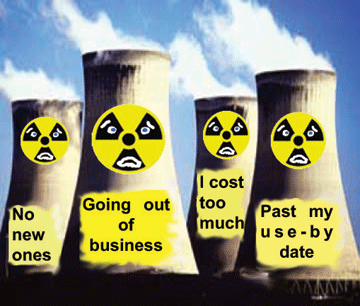
E.ON says its commitment to nuclear is fading LONDON, March 14 (Reuters) – German utility E.ON , which together with rival RWE plans to build new nuclear plants in Britain, said on Wednesday its appetite for investing in nuclear power had slowed down.
“Our appetite to boost nuclear with great energy has become smaller,” said board member Klaus-Dieter Maubach during the company’s 2011 results conference…. time and cost overruns at new nuclear plants in Finland and France….. E.ON posted a net loss of 2.22 billion euros in 2011 as it was hit by Germany’s decision to shut down its oldest nuclear plants in the wake of Japan’s Fukushima accident and losses in its gas business.
Germany’s prosperity with wind and solar feed-in tariffs
Energy production using fossil and nuclear fuels is penalised in Germany by virtue of the Renewable Energy Act, which guarantees higher prices for generators of electricity sourced from wind and solar through feed-in-tariffs.
Today Germany has over 150 million solar panels installed or 25,000MW,

 Germany has the wind at its back, MATTHEW WRIGHT, ABC 9 FEB 2012, Germany is currently the world-leader in installing renewable energy THE recent clinching of a $1.9 billion Australian defence contract by the Germans illustrates to carbon price knockers that they need look no further for proof that an economy which relies on renewable energy can outsmart one dependent on fossil fuels.
Germany’s electricity sector delivers 21 per cent of its power from renewable sources, such as the wind and the sun. …..
what of Germany, which finds itself at the epicenter of the EU debt maelstrom?
How is it possible that a nation shouldering the lion’s share of bailing out Europe’s basket-case economies has its finances in the best shape ever in two decades?
The yearly German unemployment rate keeps falling and at 6.7 per cent in January was the lowest since reunification. The Berlin based BGA Exporters and Wholesalers group estimated total German exports hit a record $US1.3 trillion last year.
This is hardly a picture of an economy that has been struggling under the impost of a carbon cost and renewable energy subsidies.
Energy production using fossil and nuclear fuels is penalised in Germany by virtue of the Renewable Energy Act, which guarantees higher prices for generators of electricity sourced from wind and solar through feed-in-tariffs.
The legislation has encouraged a phenomenal uptake of solar roof panels for a nation that hardly boasts sunny weather. ….
Critics who claim that pricing carbon using feed-in-tariffs, taxes or emissions trading is somehow linked to an underperforming economy and high jobless rates ought to be silenced by Germany’s success in bursting that myth.
And if the proof in the pudding is not enough for the naysayers, they could look to volumes of published material demonstrating that the early costs of encouraging renewable energy benefit an economy in a matter of years.
Respected energy experts Dr Wolfram Krewitt and Dr Joachim Nitsch’s published research while at the German Aerospace Centre that is regularly cited to drive home this point.
In a peer reviewed paper they wrote: “While the success of the German Renewable Energy Sources Act in supporting the use of renewable energy sources for electricity generation is widely acknowledged, it is partly criticised for imposing unjustified extra costs on society.
“[This] paper makes an attempt to estimate the external costs avoided in the German energy system due to the use of renewable energies for electricity generation, and to compare them against the compensation to be paid by grid operators for electricity from renewable energies according to the Renewable Energy Sources Act.
“… [R]esults clearly indicate that the reduced environmental impacts and related economic benefits do outweigh the additional costs for the compensation of electricity from renewable energies,” Krewitt and Nitsch concluded.
Another misleading argument renewable energy doubters like to peddle is that the rise in renewable energy use and the reduction in coal use is only possible in economies that also have a nuclear sector, to supply supposedly ‘reliable’ electricity when ‘the sun don’t shine and the wind don’t blow’.
Germany also recently burst this myth…..http://www.abc.net.au/environment/articles/2012/02/09/3426757.htm
Court rules that Germany’s nuclear fuel tax is legal
 EON, RWE Retreat After German Court Backs Nuclear Fuel Tax Bloomberg, By Stefan Nicola and Karin Matussek – Jan 12, 2012 EON AG (EOAN) and RWE AG (RWE), Germany’s biggest utilities, fell in Frankfurt trading after a court said the country’s nuclear fuel tax
didn’t break the law.
EON dropped 1.3 percent to 16.45 euros after a tax court in the state of Baden-Wuerttemberg upheld the levy in two interim rulings against plaintiff EnBW Energie Baden- Wuerttemberg AG, the country’s third-largest utility. RWE slipped 0.7 percent while EnBW slid 2.6 percent….
… Germany’s utilities are cutting costs and selling assets to curb losses related to the government’s decision to exit nuclear power by 2022. The shutdown of the country’s eight oldest reactors, as well as the nuclear fuel tax, drafted in 2010, cut EON’s earnings by 2.3 billion euros ($3 billion) in 2011, Chief Financial Officer Marcus Schenck said in November.
The judges didn’t share the legal analysis by courts in Munich and Hamburg, which had ruled in favor of EON and RWE over the tax. The divergence in rulings will be resolved once Germany’s top tax court mades its judgement.
http://www.bloomberg.com/news/2012-01-12/eon-rwe-retreat-after-german-court-backs-nuclear-fuel-tax.html
Solar energy boom in Germany helps lower prices
German Solar Boom Continues, As Subsidies Disappear, German Solar Stays On Top, Green Chip Stocks, By Abhishek Shah, January 8th, 2012 The German Solar Energy Market is biggest in the world and has installed the largest number of solar panels for the last few years. 2012 promises to be no different with Germany again set to the biggest solar market for solar panel manufacturers though Italy would give good competition.
The German Solar Subsidy program has been the best in the world unlike the start and stop feed in tariff programs of Spain,Czech,UK,Australia and other places. A stable step in cut of feed in tariffs has helped solar energy prices coming down by more than 50% in the last few years though demand has only increased.
The influx of cheap solar panels from China has let the December 2012 explode to almost 2-3 GW according to the German solar association BSW. The high rates of return of over 10% due to super cheap Chinese solar panels at 80-90c/watt has been the major reason for the explosion in demand which could be the biggest month in Germany ever. While German Solar Market has remained robust as ever,the German solar panel producers like Solon, Sunways have been vanquished with a number of major solar companies failing and getting acquired. The Asian solar companies have been the major beneficiaries of this demand growth in Germany and Europe.
The massive rise in demand will imply that according to the EEG ,there will be a 15% cut in July 2012 after a 15% cut in January 2011. This would bring the solar FIT prices quite low and provide a restraint to the galloping German solar energy installations which is reaching more than 25 GW . http://www.greenchipstocks.com/articles/german-solar-boom-continues/1475
Renewable energy: Germany shows the way in new industrial revolution
Feldheim has zero unemployment ..
the technology already exists to allow people to be energy self-sufficient.

 All eyes on German renewable energy efforts SF Gate, By MELISSA EDDY, Associated Press, December 29, 2011 “……Feldheim, a village of just 145 people, is already putting into practiceGermany’s vision of a future powered entirely by renewable energy……
In June, the nation passed the 20 percent mark for drawing electric power from a mix of wind, solar and other renewables. That compares with about 9 percent in the United States or Japan — both of which rely heavily on hydroelectric power, an energy source that has long
been used.
Expanding renewables depends on the right mix of resources, as well as government subsidies and investment incentive — and a willingness by taxpayers to shoulder their share of the burden. Germans currently pay a 3.5 euro cent per kilowatt-hour tax, roughly euro157 ($205) per year for a typical family of four, to support research and investment in and subsidize the production and consumption of energy from renewable sources.
That allows for homeowners who install solar panels on their rooftops, or communities like Feldheim that build their own biogas plants, to be paid above-market prices for selling back to the grid, to ensure that their investment at least breaks even……
Key to success of the transformation will be getting the nation’s powerful industries on board, to drive innovation in technology and create jobs. According to the Environment Ministry, overall investment in renewable energy production equipment more than doubled to euro29.4
billion ($38.44 billion) in 2011. Solid growth in the sector is projected through the next decade.
Some 370,000 people in Germany now have jobs in the renewable sector, more than double the number in 2004, a point used as proof that tax payers’ investment is paying off…… Continue reading
Fukushima residents learn at first hand the success of renewable energy projects
“It is important for the Japanese to realize that renewable energy can work on a large scale, and that people can make money from it,” said Yamamoto,
 Fukushima residents tour German renewable village; learn about non-nuclear energy sources Washington Post, By Associated Press, November 30 FELDHEIM, Germany — A group of residents from the radiation-stricken area around Japan’s tsunami-hit nuclear reactors and a Tokyo actor are visiting Germany to learn how renewable energy could work in their
homeland…..
The group, organized and led by representatives of Greenpeace Japan, arrived Wednesday in the northeastern German village of Feldheim to learn how its 145 residents have taken advantage of the energy generated by a nearby windfarm and a biofuel plant that burns the
waste from a local pig farm to become an entirely self-sustaining, energy-positive village….. Continue reading
Police violence does not deter huge anti nuclear protests in France and Germany
 After 126 hours en route the 13th CASTOR delivery arrived for storage in Gorleben. The longest and most expensive delivery trip ever was caused by blockades of anti-nuclear activists, starting in France, continuing throughout Germany and culminating in the Gorleben area itself.
After a trip of nearly five and a half days from Normandy in France the 13th delivery of processed German nuclear waste reached the “temporary” storage hall in Gorleben, a village in northwest Germany at about 10 pm on Monday +++ Police perpetrated massive violence and breaches of the law against demonstrators, injuring at least 355 with truncheons, gas, dogs, horses and water cannons +++ The 25,000 activists in the county were the second largest number ever +++ Resistance against the shipment began in France where activists reported police violence against them but also an upsurge of anti-nuclear sentiment in the country +++ In the Gorleben area resistance took the form of rail and road squats, chain-ons (one caused a 14-hour delay in the train journey) and massive road traffic disruptions, notably by farmers with tractors and agricultural machinery +++(See German Source here)
The activists’ first aid team of doctors and other health professionals report treating at least 355 injured by police, including serious head wounds and a suspected vertebral fracture from truncheoning. About a third of the injuries were caused by gas, the others mainly by truncheons. One person was run down by a horse, another had a tooth bashed out. Some police who’d been affected by their own mace or who were totally exhausted (10 cases) were also treated. In some cases the first aiders were denied access, especially during the trucking phase. Nine were ordered away from places. A doctor was not allowed to examine an arrested injured person. In another case first aiders were kettled while washing out people’s eyes. There were several cases of police violence against first aiders, e.g. one was injured by gas, another by several blows with a truncheon. A first aid camp in Laase was overrun linkby police, who threatened and insulted first aiders. The group is shocked by the high number of injured which will probably rise because not all the numbers are in yet. http://linksunten.indymedia.org/en/node/50895
Nuclear waste train delayed by huge anti nuclear protest
 Thousands block nuke train in Germany ABC 702 Sydney, 28 Nov 11, German police battled thousands of anti-nuclear protesters trying to block a train carrying nuclear waste in the north of the country. The convoy taking the German waste is now nearing the end of its 1,200-kilometre journey from a reprocessing centre in north-western France to a storage facility in the northern German city of Dannenberg.
After stopping for 18 hours, including overnight, amid mass demonstrations, the train only covered about 30 kilometres in four hours. Thousands of activists swarmed the tracks along the route near Dannenberg and boasted that the train’s journey had now topped the 92-hour record set during a shipment one year ago. Continue reading
Police use water cannons against German anti nuclear protestors
Germany nuclear protesters clash with police, BBC News 24 November 2011 Police in northern Germany have used water cannons against demonstrators waiting for the arrival of a shipment of nuclear waste from France.
Scuffles broke out between police and protesters after fireworks and paint were thrown at officers. Protesters had tried to block a crossroads at Metzingen, near the shipment’s destination. French authorities have stopped the train in Remilly, short of the border.
Some reports quoted authorities as saying it would wait for 24 hours to avoid more mass protests, ….. The train had left Areva’s nuclear fuel reprocessing facility in Normandy on Wednesday after a scuffle between police in riot gear and several hundred protesters who tried to occupy the train tracks near the town of Valognes…..
It is the first waste shipment to Germany since Berlin decided to shut all its nuclear plants by 2022, following Japan’s nuclear disaster caused by the earthquake and tsunami in March.
The train was the last of 12 shipments of treated German nuclear waste sent in recent years from France. The contract between Areva and German nuclear power producers has expired and is not expected to be renewed, as Germany has voted against the transportation of radioactive nuclear fuel.
The train is carrying 11 tubular containers of highly radioactive nuclear waste, that are due to be stored in Gorleben in northeast Germany. But officials have not resolved where waste should be stored permanently and opponents argue that the Gorleben site is unsafe.http://www.bbc.co.uk/news/world-europe-15883782
Small is economic, as well as beautiful – renewable energy developments
And will the rest of Europe follow? The poll-leading Socialists in France, after all, are talking of halving the country’s nuclear capacity. “Most of the world will follow this way, but it will be slow,” Dudenhauser says. “Everyone expected blackouts after the nuclear shutdown, but it didn’t happen. But it would not be manageable if everyone goes Germany’s way in the next two years.”
 Size not a factor in German power play , Climate Spectator, GilesParkinson, 24 Nov 11 It seems strange that the world’s most cautious and best performing economy should be acting as some sort of crash test dummy for the world’s clean energy future. But this is exactly the position that Germany finds itself in following its commitment earlier this year to abandon nuclear energy and to push towards its vision of a fully renewable power supply by 2050.
And if this is the future, then companies that have based their models around the principal of centralised power stations may find little cause for comfort. But it is presenting enormous opportunities for those focused on the concept of distributed generation, particularly fuel cells – at least that’s the take of Roman Dudenhausen, the CEO and co-founder of German energy consultants ConEnergy, and a recently appointed director to the board of Australia’s Ceramic Fuels Cells.
Dudenhausen says the accelerated phase-out of Germany’s nuclear capacity is presenting companies such as Ceramic with a unique opportunity…… Continue reading
Germany putting serious money into renewable energy
Germany sets aside $130 billion for renewable energy, Online Opinion, By John Daly -, 24 October 2011 German Chancellor Angela Merkel announced on 30 May that Germany, the world’s fourth-largest economy and Europe’s biggest, would shutter all of its 17 nuclear power plants between 2015 and 2022, an extraordinary commitment, given that they currently produce about 28 percent of the country’s electricity.
Underlining the government’s seriousness in changing the country’s energy matrix, Germany’s Kreditanstalt fur Wiederaufbau (German Development Bank) is to underwrite renewable energy and energy efficiency investments in Germany with $137.3 billion over the next five years, Germany Trade and Invest reported. Overall, the German government’s 6th Energy Research Program has made an extraordinary $274.6 billion available for joint funding initiatives in energy storage research over the next three years. Continue reading
Solar feed in tariffs working for Germany, Japan, China
 Feed in Tariffs: Investing in a Renewable Energy Future, Policy Shop, 16 Oct 11 Mijin Cha Clean energy skeptics have seized on the failure of Solyndra to argue that scaling up renewable sources is a pipe dream.
They should visit Germany.
In the first quarter of 2011, Germany’s renewable energy output accounted for 19.2 percent of its total electricity consumption. Germany installed more solar PV in 2010 than the whole rest of the world and is well on its way to meeting the target of 35 percent of its electricity coming from renewables by 2020. And, in 2010, almost 370,000 people were employed in the renewable energy sector.
So how does Germany gets lots of clean energy and green jobs?
The key to this success is an incentive called a feed-in-tariff. Continue reading
Support of government and the people points to success for Germany’s nuclear phaseout
Germany will be able to make the nuclear phase-out without any serious risks, as 80% of the people back up the government and even themselves massively invest in renewable energies. At the same time the economy profits from 100,000 new jobs and enterprising tasks.
“Germany’s Nuclear Phase-out Will Be Successful and Without Serious Risks” The Energy Collective, 6 Oct 11, Germany has made one of the most radical policy changes in the wake of Fukushima. Like Japan, it decided to phase out nuclear power by 2022. Furthermore, by the middle of the century, fossil fuels shall only play a minor role in the energy supply of the country….
How can Germany succeed in phasing out nuclear energy while also decarbonising its energy supply? Continue reading
Giant industrial company Siemens abandons nuclear energy, favors renewables
 Siemens to quit nuclear industry BBC News, 19 Sept,11, German industrial and engineering conglomerate Siemens is to withdraw entirely from the nuclear industry… chief executive Peter Loescher said, announcing that the firm will no longer build nuclear power stations. ”The chapter for us is closed,”
Germany’s competitive advantage with 21st Century energy technology
closure of Germany’s NNP installations, previously scheduled to be shuttered as late as 2036, would give Germany a competitive advantage in the development of renewable energy,
Germany’s renewable energy sources surge after Fukushima crisis, ARAB NEWS, By JOHN C. K. DALY, Sep 9, 2011 The worldwide implications for nuclear power advocates in light of the 11 March disaster at Japan’s Daichi Fukushima nuclear complex, battered first by an earthquake and a subsequent tsunami, are slowly unfolding.
Nations committed to nuclear power are being subjected to a relentless PR barrage by nuclear construction firms, who stand to lose billions if current contracts are suspended or, even worse, canceled. Continue reading
1 This Month

of the week – Shut Down Drone Warfare!


Tell the Ukrainian Government to Drop Prosecution of Peace Activist Yurii Sheliazhenko

Petition to revoke the licensing of the Near Surface Nuclear Disposal Facility (NSDF) at Chalk River. https://www.ourcommons.ca/petitions/en/Petition/Details?Petition=e-7247
To see nuclear-related stories in greater depth and intensity – go to https://nuclearinformation.wordpress.com
-
Archives
- April 2026 (68)
- March 2026 (251)
- February 2026 (268)
- January 2026 (308)
- December 2025 (358)
- November 2025 (359)
- October 2025 (376)
- September 2025 (257)
- August 2025 (319)
- July 2025 (230)
- June 2025 (348)
- May 2025 (261)
-
Categories
- 1
- 1 NUCLEAR ISSUES
- business and costs
- climate change
- culture and arts
- ENERGY
- environment
- health
- history
- indigenous issues
- Legal
- marketing of nuclear
- media
- opposition to nuclear
- PERSONAL STORIES
- politics
- politics international
- Religion and ethics
- safety
- secrets,lies and civil liberties
- spinbuster
- technology
- Uranium
- wastes
- weapons and war
- Women
- 2 WORLD
- ACTION
- AFRICA
- Atrocities
- AUSTRALIA
- Christina's notes
- Christina's themes
- culture and arts
- Events
- Fuk 2022
- Fuk 2023
- Fukushima 2017
- Fukushima 2018
- fukushima 2019
- Fukushima 2020
- Fukushima 2021
- general
- global warming
- Humour (God we need it)
- Nuclear
- RARE EARTHS
- Reference
- resources – print
- Resources -audiovicual
- Weekly Newsletter
- World
- World Nuclear
- YouTube
-
RSS
Entries RSS
Comments RSS
 nuclear-news