New EU law permits export of nuclear waste, but Germany won’t do that
Merkel confirms Germany won’t export nuclear waste, DW, 6 Jan 13, The
German chancellor has said the country is to dispose of its nuclear
waste within its own borders. The announcement came after her
environment minister denied a report that the government planned to
export it.
Chancellor Angela Merkel delivered her message on her government’s
nuclear waste disposal policy on Saturday at her Christian Democrat
Party’s (CDU) convention in the north western state of Lower Saxony.
It’s clear “that we’ll dispose our own [radioactive] waste here,” she
said, adding that this position had been “well-established.”
Merkel’s confirmation of her party’s position served to back her
environment minister, Peter Altmaier, who had spoken out on the issue
on Friday….. The current scheduled date for a complete German
shutdown is 2022. http://www.dw.de/merkel-confirms-germany-wont-export-nuclear-waste/a-16500965
Possible export of nuclear waste draws criticism, DW 5 Jan 13,
“…..A new law would allow Germany and other EU countries to export
radioactive material….., a new draft law has emerged in the midst of
the waste site debate. Changes to the existing law would allow the
possible export of spent nuclear fuel to storage facilities abroad.
The law is required because of EU guidelines from 2011 that must be
enshrined in national law by all member states by August 2013.
EU guideline
The draft, which Deutsche Welle has seen, allows the “permanent
storage” of nuclear waste abroad when “at the time of delivery there
is a valid accord between the Federal Republic of Germany and the
third-party country.” In other words, German nuclear waste may be
stored outside of Germany, provided certain conditions are met: for
example, that the storage facility in which the German waste is to be
stored was already operational prior to the export of the waste.
In response to criticism from environmental groups, the German
government has denied that plans are afoot to send German nuclear
waste abroad. However, Berlin emphasized that Germany is obliged under
European law to insert the criticized paragraph into existing German
law…… http://www.dw.de/possible-export-of-nuclear-waste-draws-criticism/a-16500605
Berlin goes for 100% renewable energy, in buying back the grid
The new municipal utility would work towards a 100 percent renewable supply of energy starting with distributed cogeneration units whose efficiencies are at least 80 percent. And as Germans always understand, the path to a greater share of renewable energy always requires energy conservation and efficiency, so the new utility would also focus on these goals
 Berlin to buy back grid and go 100 percent renewable, Renewables International 18 Dec12, The German capital has resolved to buy back its power supply. On Wednesday, the grand coalition that governs the city-state passed a resolution to buy back its grid and switch to renewables. Continue reading
The background to Germany’s leadership for a nuclear power free Europe
 As we know, in fact, nothing happened. Germany quickly adapted to the loss of the more-than-25% (but no much above that) of national power which nuclear electricity had provided
 Germany’s Energiewende And The End Of Nuclear Power, The Market Oracle Nov 25, 2012 By:Andrew_McKillop NUCLEAR SHOCK TREATMENT For Ukraine and Japan, learning to do without nuclear power needed shock treatment: the 1986 Chernobyl catastrophe, and the 2011 Fukushima disaster. The combined economic cost and losses due to these “unforeseen nuclear accidents” will probably exceed $500 billion over the years and the decades. Nuclear accidents are in a class apart, for long term damage capability.Above all, certainly since Fukushima they cannot be kept away from and out of public debate.
Like all revolutions, Germany’s Energiewende or energy transition – which took an intense new lease of life and renewed public interest following the Fukushima disaster – was set in motion by many factors. Continue reading
Chancellor Merkel’s nuclear free gamble has paid off
The British right wing economic magazine The Economist, which in 1998 had gleefully predicted oil prices of “$5 a barrel by 2010”, branded Merkel’s May 2011 action “a lunatic gamble.”
Germany’ trade surplus remains massive while the UK goes on running huge deficits, to add to its national debt and small scale economy status, relative to economic giant Germany
Germany’s Energiewende And The End Of Nuclear Power, The Market Oracle Nov 25, 2012 By: Andrew_McKillop”…..The real blackout was political. Merkel’s support for the Energiewende, like her support for many other policies and programs had always been tepid. However, she had suddenly pinned Germany’s future entirely on renewable energy and energy saving. Continue reading
Germany well on track to nuclear free success
The nuclear industry and its supporters pounced on Merkel’s decision. They predicted blackouts on a scale Germany hadn’t experienced since World War II and skyrocketing electricity prices that would wreck the nation’s heavy manufacturing sector, the bedrock of the German economy. They warned that Germany would cease to be an energy exporter and be forced to import electricity from, of all places, French nuclear power plants. Utilities would have to burn more coal to make up for the lost nuclear power, they said, pumping huge amounts of greenhouse gases into the atmosphere. The British weekly The Economist branded Merkel’s action “a lunatic gamble.”
More than a year and a half later, however, those dire predictions haven’t materialized.
”You have to choose between the old system and the new one. And we have chosen renewables.”
 Germany Abandons Nuclear Power and Lives to Talk About It, Bloomberg Business Week By Osha Gray Davidson November 16, 2012“……..Like all revolutions, the German Energiewende was set in motion by many factors and its course altered by a multitude of events and actors along the way. A few key moments stand out, however, and the Chernobyl catastrophe is one of them. To fully understand the Energiewende, and to anticipate its future twists and turns, it’s essential to understand the role Chernobyl played in shaping the German public’s view of nuclear power. Continue reading
Germany’s lengthy process of dismantling nuclear power plants
Fears of low nuclear radiation run high, DW, 08.11.2012 Wolfgang Dick Decommissioned German nuclear power plants will be dismantled over the long term. Though no incidents have occurred in Germany, some citizen initiatives say legal safety measures are too lax.
Vattenfall, the company that runs the Brunsbüttel nuclear plant, recently applied to the Environment Ministry in the state of Schleswig Holstein for a permit to tear down the facility. The whole unit is supposed to be completely dismantled, rather than sealed over with a
concrete sarcophagus in the style of the Chernobyl reactor.
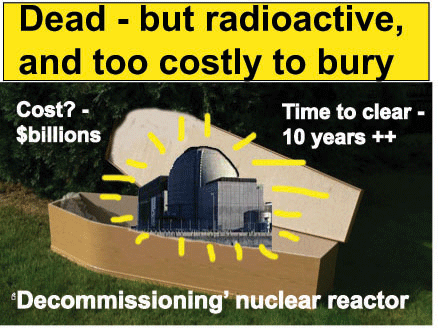
Since the German government decided to phase out nuclear power last year, the country has been gathering some experience dismantling nuclear power plants: Continue reading
Germany’s nuclear shutdown has brought economic and environmental benefits
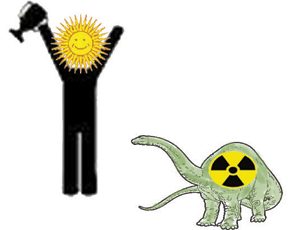 “Probable Game-Changer”: Special issue of Bulletin of Atomic Scientists shows exiting nuclear power brings economic and environmental benefits — ‘Startling’ findings http://enenews.com/game-changer-special-issue-of-bulletin-of-atomic-scientists-shows-exiting-nuclear-power-brings-economic-and-environmental-benefits-startling-findings
November 1st, 2012
Title: Bulletin: German nuclear exit delivers economic, environmental benefits
Source: Phys.org
Date: November 1, 2012
[…] Forbes.com went as far as to ask, in a headline, whether [Germany’s exit from nuclear power after the Fukushima disaster] was “Insane—or Just Plain Stupid.”
But a special issue of the Bulletin of the Atomic Scientists, published by SAGE, “The German Nuclear Exit,” shows that the nuclear shutdown and an accompanying move toward renewable energy are already yielding measurable economic and environmental benefits, with one top expert calling the German phase-out a probable game-changer for the nuclear industry worldwide. […]
Freie Universität Berlin politics professor Miranda Schreurs says the nuclear phase-out and accompanying shift to renewable energy have brought financial benefits to farmers, investors, and small business;
Felix Matthes of the Institute for Applied Ecology in Berlin concludes the phase-out will have only small and temporary effects on electricity prices and the German economy;
University of Kassel legal experts Alexander Rossnagel and Anja Hentschel explain why electric utilities are unlikely to succeed in suing the government […]
Lutz Mez, co-founder of Freie Universitӓt Berlin’s Environmental Policy Research Center, presents what may be the most startling finding of all. […] “It has actually decoupled energy from economic growth, with the country’s energy supply and carbon-dioxide emissions dropping from 1990 to 2011, even as its gross domestic product rose by 36 percent.”
Germany produces 50% of energy from solar during mid-day hours — ‘Equivalent to 20 nuclear power stations at full capacity without any radioactive waste left over’
Germany’s nuclear phaseout – financial benefits to farmers, investors, and small business
 the nuclear shutdown and an accompanying move toward renewable energy are already
yielding measurable economic and environmental benefits, with one top expert calling the German phase-out a probable game-changer for the nuclear industry worldwide.
the nuclear phase-out and accompanying shift to renewable energy have brought financial benefits to farmers, investors, and small business;
Bulletin: German nuclear exit delivers economic, environmental
benefits http://www.ecnmag.com/news/2012/11/bulletin-german-nuclear-exit-delivers-economic-environmental-benefits, 11/01/2012 Following the accident at the Fukushima Daiichi Nuclear Power Station in 2011, the German government took the nation’s eight oldest reactors offline immediately and passed legislation that will close the last nuclear power plant by 2022.
This nuclear phase-out had overwhelming political support in Germany. Continue reading
Costly to set up, but Germans think that clean energy is worth the price
Poll finds large majority of Germans favor phasing out nuclear power despite rising costs News Ser 22 Oct 12 Poll: Germans accept nuke exit despite rising bill ASSOCIATED PRESS |22 Oct 12 A new poll finds that a large majority of Germans back the government’s decision to phase out nuclear power and switch to renewable energies within a decade, despite rising electricity bills.
The poll for German news magazine Focus published Sunday found that 72 percent continue to support the country’s energy switchover. Only 24 percent were opposed to the policy.
Germany’s grid operators announced earlier this month that a surcharge on households’ electricity prices financing the expansion of renewable energies will increase by 47 percent starting in January. A typical family of four will then have to pay about (EURO)250 ($325) per year on top of their bill… http://www.newser.com/article/da21vv5g1/poll-finds-large-majority-of-germans-favor-phasing-out-nuclear-power-despite-rising-costs.html
Renewable energy resulting in cheaper baseload power
German baseload power cheaper than French 12 months running, Renewables International, 7 Oct 12 Yesterday, the European Energy Exchange (AEX) released figures for September, revealing that the price of baseload power in Germany has fallen by nearly 0.8 cents per kilowatt-hour over the past year – and has been cheaper than baseload power in France for 12 consecutive months.
The EEX published the trading results for September yesterday, but unfortunately the press release is currently only available in German.
What it shows is that day-ahead prices in Germany & Austria are lower than in France or Switzerland both in terms of base load and peak load. Indeed, though the press release explains that prices on the German and French markets “converge 75% of the time” (during periods of low consumption, such as during the night and on weekends), the difference in prices has become considerable, with the difference in base load prices being 4% on the average for September…..
day-ahead prices have been lower in Germany than in France for 12 consecutive months. The average German baseload price in September was slightly below the price in August, so the downward pressure on prices continues. The drop over the past 12 months in Germany has indeed been quite dramatic at around 18% – from 5.264 cents per kilowatt-hour in
September 2011 to the current 4.467 cents last month.
The news is especially important because nuclear power, which provides slightly more than 75% of France’s power supply, is often held to be an especially inexpensive source of baseload power. Furthermore, opponents of renewables repeatedly voice their concern about the cost impact of green power scaring away industry. …..
http://www.renewablesinternational.net/german-baseload-power-cheaper-than-french-12-months-running/150/537/57302/
Renewable energy revolution is paying off in Germany
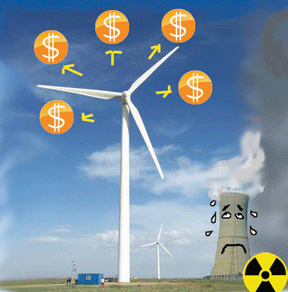 German Green on Wind Energy Benefits & Nuclear Phaseout SEPTEMBER 21, 2012 BY ZACHARY SHAHAN Here’s a nice bit of a Guardian interview with Cem Özdemir, Chair of the German Green party , that was just published yesterday:
 Clean Technica (http://s.tt/1nZNl) “…….We are looking at a third industrial revolution, and just as there were once those who opposed the invention of the steam engine, there are now those who hark back to nuclear energy. In Germany we now have just over 20% of our energy coming from renewable sources. All predictions from the past have turned out not to be true: when I went to school, my teachers used to say that maybe, just maybe we might have 3% of renewable energy one day. Angela Merkel says we’ll have 35% by 2020; we at the Green party say it’ll be 45%. My guess is: we’ll both be wrong, because it’ll be even more than that….
don’t listen to what the Greens have to say, listen to what Siemens is doing. Siemens are not switching from nuclear to clean energy because they want to lose money: they want to make profit. And I’d warn anyone who questions whether they’ll manage: industrial policy, that’s one thing the Germans know how to get right. If the Brits would rather hand the first mover advantage down to us, then so be it – as a German, I thank them for it. We already cater for many of the markets for renewable energy around the globe, and our future competitors are more likely to come from China than from the other side of the Channel.
In Germany, industry is now starting to thank us for pestering in the past, because it forced them to go through the kind of innovations that the rest of the world is now catching up with. The Brits are still discussing whether they should insulate their houses better in the future, and we insulate them. http://cleantechnica.com/2012/09/21/german-green-on-wind-energy-benefits-nuclear-phaseout/
A village shows how to make a good profit out of renewable energy
Bavarian village rakes in $5.7m a year by selling green energy http://reneweconomy.com.au/2012/bavarian-village-rakes-in-5-7m-a-year-by-selling-green-energy-33024 Cleantechnica 30 August 2012 By Chelsea Small towns have no more excuses. Bavarian village Wildpoldsreid, with a population of about 2,600, has created a local economy that produces 321 per cent more energy than it needs, selling the excess back to the national grid at a rate of $US5.7 million annually. This little German powerhouse has utilised solar, biogas digesters, windmills, hydro power plants, and a natural wastewater system to reduce its own use and increase its energy positive output. Every hamlet, township, city, metropolis, and megalopolis can learn something from Wildpoldsreid. Continue reading
Developing storage systems for renewable energy
 Storage systems for renewable energy, Energy Harvesting Journal , 13 Aug 12, Energy storage systems are one of the key technologies for the energy turnaround. With their help, the fluctuating supply of electricity based on photovoltaics and wind power can be stored until the time of consumption.
At Karlsruhe Institute of Technology (KIT), several pilot plants of solar cells, small wind power plants, lithium-ion batteries, and power electronics are under construction to demonstrate how load peaks in the grid can be balanced and what regenerative power supply
by an isolated network may look like in the future.
“High-performance batteries on the basis of lithium ions can already be applied reasonably in the grid today,” says Dr. Andreas Gutsch, coordinator of the Competence E project. As stationary storage systems, they can store solar or wind power until it is retrieved by the grid. “When applied correctly, batteries can also balance higher load and production peaks and, hence, make sense from an economic point of view.”
The Competence E project is presently developing several pilot systems consisting of photovoltaics and wind power plants coupled to a lithium-ion battery. Over a development phase of two years, a worldwide battery screening was made. “Now, we know which lithium-ion cells are suited best for stationary storage systems,” says Gutsch.
The first stage of the modular systems will be constructed on KIT Campus North by the end of 2012. It will have a capacity of 50 kW…..
http://www.energyharvestingjournal.com/articles/storage-systems-for-renewable-energy-00004648.asp?sessionid=1
German utility company thriving following exit from nuclear power
E.ON triples net profit as nuclear past fades Aug 13, 2012
* H1 net 3.13 billion euros vs 948 million year ago
* Trading and Optimisation unit seen posting full-year profit
* Could close some power plants
* Shares up 1.2 pct (Recasts, adds trading unit, analyst)
By Christoph Steitz and Vera Eckert FRANKFURT, Aug 13 (Reuters) – E.ON AG, Germany’s largest utility, said net profit more than tripled in the first half of the year, benefiting from a gas price deal with Russia’s Gazprom and absence of charges related to Germany’s exit from nuclear power.
German utilities have posted strong first-half results so far, thanks to renegotiated gas purchase contracts and higher selling prices, in a recovery from the downturn caused by the government’s decision last year to shut nuclear power stations.
Last month, EnBW, Germany’s third-largest utility, said first-half sales at its gas unit rose a third because of an expansion in gas trading activity….
http://in.reuters.com/article/2012/08/13/eon-results-idINL6E8JD1220120813
Burying dead nuclear reactors – expensive, but lucrative for some!
consultancy Arthur D. Little has put the total costs at no less than €18 billion…..
Dismantling a nuclear plant until it has completely vanished can take several decades, depending on which technique is used.
the process of fully decommissioning a plant can take more than 40 years,
Germany’s pricey nuclear burial, Climate Spectator , 18 Jul 2012, Christoph Steitz and Tom Käckenhoff “…..by 2014, almost nothing will be left of what once was Germany’s first commercial boiling water reactor. Germany’s decision to shut down all nuclear plants by 2022,
sparked by last year’s Fukushima nuclear disaster in Japan, is a done deal……
… a giant hole in the ground where the reactor vessel used to be. Work to decommission plants mainly includes removing and disposing of contaminated material as well as decommissioning the plants themselves while making sure that no radiation spreads.
Spent fuel from reactors needs to be encased and then transported to safe fuel dumps while cooling towers, often regarded a blight on landscapes, then need demolishing…..
Today, the four operators of nuclear plants in Germany – E.ON, RWE, EnBW and Vattenfall – have made a total of more than €30 billion ($36.7 billion) in provisions for the dismantling of the plants and the disposal of nuclear waste. Continue reading
1 This Month

29 Jan. Thursday 7-8 p.m. Webinar – World’s Largest Nuclear Station in Port Hope, ON?


31st January – Challenging the War Machine – a DECLASSIFIED UK SUMMIT



Website of the Week
Now until to February 10, 2026 Radioactive waste storage in France: the debate is finally open! How to participate?
-
Archives
- January 2026 (246)
- December 2025 (358)
- November 2025 (359)
- October 2025 (376)
- September 2025 (258)
- August 2025 (319)
- July 2025 (230)
- June 2025 (348)
- May 2025 (261)
- April 2025 (305)
- March 2025 (319)
- February 2025 (234)
-
Categories
- 1
- 1 NUCLEAR ISSUES
- business and costs
- climate change
- culture and arts
- ENERGY
- environment
- health
- history
- indigenous issues
- Legal
- marketing of nuclear
- media
- opposition to nuclear
- PERSONAL STORIES
- politics
- politics international
- Religion and ethics
- safety
- secrets,lies and civil liberties
- spinbuster
- technology
- Uranium
- wastes
- weapons and war
- Women
- 2 WORLD
- ACTION
- AFRICA
- Atrocities
- AUSTRALIA
- Christina's notes
- Christina's themes
- culture and arts
- Events
- Fuk 2022
- Fuk 2023
- Fukushima 2017
- Fukushima 2018
- fukushima 2019
- Fukushima 2020
- Fukushima 2021
- general
- global warming
- Humour (God we need it)
- Nuclear
- RARE EARTHS
- Reference
- resources – print
- Resources -audiovicual
- Weekly Newsletter
- World
- World Nuclear
- YouTube
-
RSS
Entries RSS
Comments RSS
 nuclear-news