Record production of renewable energy in Denmark and Germany
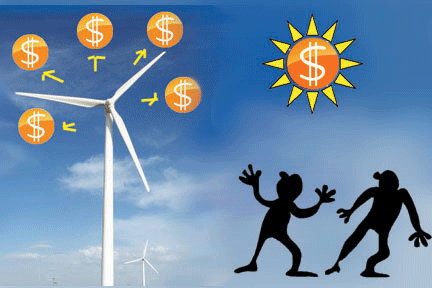 Renewable Energy Generation Hits All Time Highs in Denmark and Germany Permaculture Magazine | Friday, 15th November 2013 Denmark’s and Germany’s wind and solar electricity generation is peaking, covering much of their countries’ need, setting the trend for renewable energy systems that do not cost the Earth. In the last month, solar and wind energy has been reaching record breaking figures in some countries in Europe.
 On November 4th this year, Denmark’s wind turbines covered 122% of the countries demand for electricity.
“This is the highest registered figure so far,” says Preben Maegaard, director of the Nordic Folkcenter for Renewable Energy.
 A month before on October 3rd, Germany’s renewable energy peaked at 59.1% with a combination of solar and wind. Across the entire day, 36% of total electricity generation was achieved, with solar contributing 11% at 20.5 gigawatts at its peak.
“It was around midday on October 3, which just happened to be Germany’s annual Reunification Day holiday, when the sun was at its fullest and the significant peak was reached. Over the entire day, 36.4% of total electricity generation was achieved with solar and wind power; solar panels contributed 11.2% on their own. At its peak, solar accounted for 20.5 gigawatts.
“Although the electrical grid withstood the large amount of renewable energy flowing to it, you’ll be pleased to know that electricity prices also dived. A drop in demand from big, conventional power plants led the electricity price index at 2:00pm to 2.75 cents per kilowatt hour. The index covers Germany, Austria, France, and Switzerland.
“So there you have it. A country as large and industrialized as Germany can and did operate successfully, albeit on a national holiday, using a large percentage of renewable energy. And this is only the beginning,” comments Jim Winstead.
These surges not only showed that renewable energy can supply energy needs, but neither power grids broke down under the surge…..http://www.permaculture.co.uk/news/1511134008/renewable-energy-generation-hits-all-time-highs-denmark-and-germany
Call for German utilities to pay more of nuclear decommissioning costs
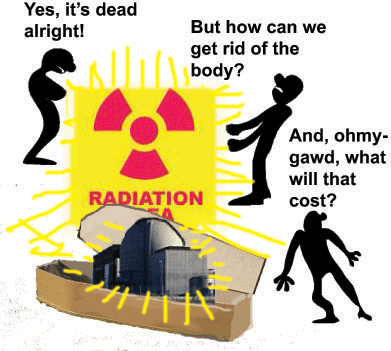 German parties want utilities to shoulder nuclear shutdown costs BY MARKUS WACKET BERLIN Thu Nov 14, 2013 (Reuters) – German parties negotiating the formation of a coalition government want to make utilities pay more to dismantle their nuclear power plants and protect taxpayers from billions of euros in related costs, documents obtained by Reuters show.
Such a move, if adopted by a coalition of Chancellor Angela Merkel’s conservatives and the Social Democrats (SPD), would be a blow to E.ON, RWE, Vattenfall and EnBW who have already put aside 30 billion euros in provisions.
“A … fund could be considered to safeguard the financing of the disposal of nuclear assets,” the paper from the working group on environmental policies said.
Under the new proposal, the utility companies could be forced to pay into the fund which would be under political control.
Over a dozen working groups are hammering out policy compromises on a range of issues with the aim of forming a government in December. The nuclear proposal would have to be approved by a larger coalition panel led by Merkel and other party leaders before it was set in stone.
“We expect cooperation from the nuclear power operators in the switch to renewable energy and an acknowledgement of their responsibility for the orderly ending of the use of atomic energy,” the paper said.
The idea of a fund reflects concerns that Germany’s four nuclear power companies have taken insufficient precautions to pay for the dismantling of the plants and storage of atomic waste…….
The SPD is also keen to raise nuclear fuel tax and to extend the levy beyond 2016, when it is currently due to expire. However conservatives oppose this notion.
(Writing by Madeline Chambers; Editing by Susan Fenton) http://www.reuters.com/article/2013/11/14/us-germany-coalition-nuclear-idUSBRE9AD0HN20131114
Germany’s grid copes with Renewable energy load – 59% of all energy produced
Germany Reaches 59% Renewable Energy Peak, Power Grid Doesn’t Blow Up http://www.the9billion.com/2013/10/30/germany-59-percent-renewable-energy-peak/ by JOHN JOHNSTON on 10/30/2013 Earlier this month on a very sunny and windy day, Germany managed to hit a peak of 59.1% renewable power generation, and what’s more, the heavily industrialized county’s power grid did not explode, Greentechmedia has pointed out. t was around midday on October 3, which just happened to be Germany’s annual Reunification Day holiday, when the sun was at its fullest and the significant peak was reached. Over the entire day, 36.4% of total electricity generation was achieved with solar and wind power; solar panels contributed 11.2% on their own. At its peak, solar accounted for 20.5 gigawatts.
Although the electrical grid withstood the large amount of renewable energy flowing to it, you’ll be pleased to know that electricity prices also dived. A drop in demand from big, conventional power plants led the electricity price index at 2:00pm to 2.75 cents per kilowatt hour. The index covers Germany, Austria, France, and Switzerland.

So there you have it. A country and large and industrialized as Germany can and did operate successfully, albeit on a national holiday, using a large percentage of renewable energy. And this is only the beginning.
Focus shifts to investing in renewable energy – German power provider RWE
RWE’s “business of renewable energy will provide stable value contributions and remain the only area for growth investments”
 Germany’s RWE looks for renewable energy push Eco News, 30 Oct 13 Germany’s major power producer RWE recently surprised by revealing it was departing from its traditional business model and would “create value by leading the transition to the future energy world”.
Now, RWE is looking for new ways to boost its renewable power business, including partnerships with investors, according to an internal document seen by Reuters Newsagency.
In the past Germany’s largest power producer, has traditionally based its business model based on large-scale thermal power production.
European media reports say the new strategy was decided on at a meeting of RWE’s Supervisory Board in the Polish capital, Warsaw, in September and will be revealed publicly soon.
RWE plans to “develop new partnership models with financial investors” to fund renewable projects, according to the document.
Its technological focus has been on wind power, which is better suited to larger utilities due to its plant-sized parks and requires large investments. A steep drop in wholesale power prices and a boom in renewable energy, which has driven conventional power plants into loss-making territory, have hit hard at RWE, along with other German utilities E.ON and EnBW.
RWE, which is scheduled to report nine-month results on November 14, could not immediately be reached for comment.
RWE’s “business of renewable energy will provide stable value contributions and remain the only area for growth investments”, Reuters reports the document saying….. http://econews.com.au/news-to-sustain-our-world/germanys-rwe-looks-for-renewable-energy-push/
Germany’s people powered renewable energy success
Three reasons Germans are killing it on renewable energy http://reneweconomy.com.au/2013/three-reasons-germans-are-killing-it-on-renewable-energy-56628 By John Farrell on 24 October 2013 CleanTechnica Germany is racing past 20% renewable energy on its electricity grid, but news stories stridently warn that this new wind and solar power is costing “billions.” But often left out (or buried far from the lede) is the overwhelming popularity of the country’s relentless focus on energy change (energiewende).
How can a supposedly expensive effort to clean up the energy supply be so popular?
1. It’s about the cost, not the price
Most news stories focus on the cost of electricity in Germany, which has some of the highest rates per kilowatt-hour in the world. But they don’t note that the average German electricity bill – about $100 a month – is the same as for most Americans. Germans are much more efficient users of energy than most, so they can afford higher rates without having higher bills. (Note to self: check out options for energy efficiency).
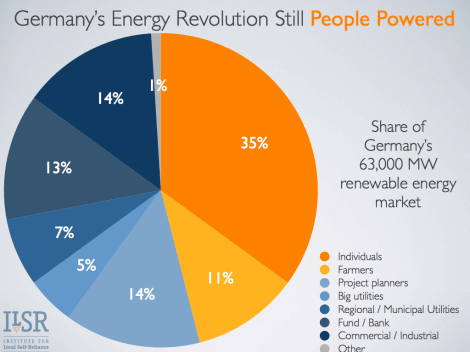 Ger,amy’s people-powered renewabl eenergy success
2. It’s about vision Continue reading
Refuting the lies of anti renewable energy propaganda
 Myth-busting Germany’s energy transition Smart Planet By Chris Nelder | October 12, 2013 Major English-language media have been propagating a false narrative about the stunning success of Germany’s transition to renewable energy: theEnergiewende. To hear them tell it, the transition has been a massive failure, driving up power prices, putting Germany’s grid at risk of blackouts, and inspiring a mass revolt against renewables.
Nothing could be further from the truth……..
I debunked a few of the hoary tropes about the Energiewende one year ago, such as the notion that the grid can’t handle a large share of variable renewable power. But apparently many in the major Western media still haven’t gotten the memo.
So let’s clear out the fog and debunk a few of the favorite myths about theEnergiewende.
Myth: “After the Fukushima nuclear accident in Japan two-and-a-half years ago, Merkel quickly decided to begin phasing out nuclear power and lead the country into the age of wind and solar.” (This one is from the above-mentioned Der Spiegel article.)
Fact: Germany’s switch to renewables started in 1991, and the nuclear phaseout started in 2002. Continue reading
Germany shows political success of its renewable energy transition
it is a clear signal that citizens are favouring a publicly owned, decentralised energy system with a leading role of renewables.”
The German result is likely to present good news. HSBC believes the IPCC report – despite its criticism in some quarters, and particularly by the fossil fuel lobby – could mark “a new phase in climate action”.
Germany votes for energy transition, and to buy back the grid http://reneweconomy.com.au/2013/germany-votes-for-energy-transition-and-to-buy-back-the-grid-50110 By Giles Parkinson on 25 September 2013
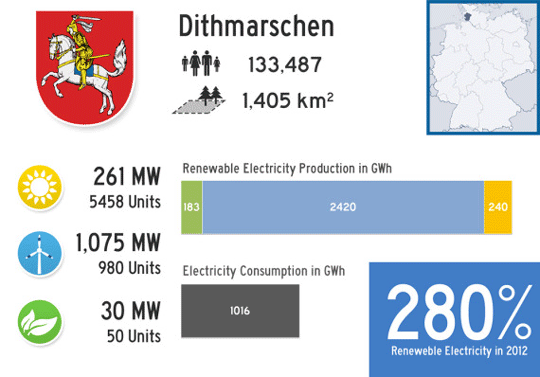
As the dust settles on the election results, and Chancellor Angela Merkel begins the process of selecting a new coalition partner, most observers are suggesting that the poll results are positive for Germany’s Energiewende, the ambitious energy transition program that aims to have Europe’s strongest industrial economy powered 50 per cent by renewables by 2030, and 80 per cent by 2050. (Below renewable energy in just one province of Germany 2012)
German utilities losing money on coal, gas, and nuclear plants
 German energy giants pull plug on coal, nuclear The Local, 18 Aug 2013 Ever since Chancellor Angela Merkel announced a phase-out of nuclear energy over the next decade and pledged to generate as much as 80 percent of the country’s electricity from renewables by 2050, big question marks have been hanging over the future of coal and gas-fired plants in Germany.
Merkel, seeking a third term in general elections on September 22nd, is a staunch supporter of this hugely popular policy move.
But the turnaround is depriving utilities, including market leaders RWE and E.ON, of massive profits from their atomic plants and turning their gas and coal-fired stations into loss-makers as they are sidelined by rival renewable sources of energy.
Last week, the two biggest players in the German sector unveiled steep drops in profits, and “many of our plants are operating at a loss,” complained RWE’s finance chief Bernhard Günther.
Indeed, RWE announced that it would shut down a number of plants –representing combined capacity of 4,300 megawatts — in both Germany and the Netherlands. And more could follow, Continue reading
Germany opposes EU plan to subsidise nuclear industry
 Germany rebuffs European nuclear power subsidy proposal By Charlie Dunmore and Henning Gloystein BRUSSELS/LONDON, July 19 (Reuters) – Germany on Friday rebuffed draft plans by the European Commission to allow European Union member states to directly subsidise nuclear power.
Several European governments, such as Britain and France, plan to build new nuclear power stations, but many companies are shying away from investing in the expensive technology without the safeguard of government support. The Commission’s draft, seen by Reuters and titled “Paper of the Commission Services containing draft guidelines on environmental and energy aid for 2O14-2O20”, proposes to allow governments to provide direct state aid for nuclear power……..
“This document was not endorsed by the Commission, but is a preparation document for a public consultation,” European Commission spokesman for competition policy Antoine Colombani said in Brussels.
“The European Commission does not wish in any way to encourage subsidies to nuclear power… However, it appears that some member states do wish to subsidise nuclear power, and the Commission is in charge of state aid control, so whenever a member state notifies a measure we are obliged to examine it,” he added.http://www.reuters.com/article/2013/07/19/europe-nuclear-energy-idUSL6N0FP2P820130719
Impressive graphs tell the success story of Germany’s renewable energy
 I highly recommend this article. It shows with several excellent graphs, just how successful German counties are being in developing renewable energy and energy efficiency. The example below is of just one county
One of the most important details being missed by most of those common limited observations is the fact that the renewable energy success of the last decade was mainly driven by some pioneering regions, counties, and municipalities. Those local communities moved forward with conviction, while many others have remained dormant willingly or hindered by state governments that blocked investments by passing arbitrary anti-renewable regulations in favor of conventional power companies.
To showcase what we know about what is at least possible, here are the top 3 out of 295 Landkreise (Counties / administrative districts) in terms of the renewable share in their regional power mix. Most of their success is based on investments during the last 10–15 years based on technology that is now outdated
Germany: 100% renewable energy and beyond http://reneweconomy.com.au/2013/germany-100-renewable-energy-and-beyond-78310 By CleanTechnica on 8 July 2013 While many countries still discuss whether or not a 100% renewable energy system – or “just” a 100% renewable electricity supply – is even theoretically possible, Germans seem no longer bothered by such unscientific doubts. To make matters “worse,” some of them (including myself) are even convinced that a transition to a 100% renewable energy system can and should be accomplished within only a few decades’ time.
Some people might find this different perception of the problems we face to overcome the energy crisis of the 21st century so puzzling that they would rather choose to believe that the Germans have simply gone mad. Luckily, nothing could be further from the truth, and I’ve got a few nice examples that might explain the German mindset……
Another popular myth among so called “professional journalists” is that what is happening in Germany is due to on some kind of “big government” program. Obviously, this domestic narrative-driven reporting is not very interested in looking at important details that could explain the big picture. Continue reading
Germany’s Chancellor Merkel got it right, on switch from nuclear to renewables
Nuclear Cuts Vindicate Merkel as RWE Profit Dips, Bloomberg By Julia Mengewein – Jul 5, 2013 Germany’s $710 billion green-energy drive is cutting production at nuclear reactors, the nation’s most profitable large-scale plants, as power prices slump to a six-year low. The proportion of hours during which electricity traded at less than 30 euros ($39) a megawatt-hour, the level at which UBS AG says reactors start losing money, rose to 50 percent last month, the most since 2007 and 92 percent more than a year ago, data from the Epex Spot SE exchange show. RWE AG (RWE) cut output at its Gundremmingen plant near Munich 31 times in the first half as solar and wind output jumped, compared with 18 times in 2012, according to data compiled by Bloomberg.
The reductions, which typically last for hours at a time, underscore how Chancellor Angela Merkel’s plan to replace atomic power with renewable energy within a decade is gaining ground at the expense of profit at utilities from RWE to EON SE. The boom in green power, coupled with the lowest demand in 10 years, sent the average operating margin at 15 European utilities to the lowest since 2002, company data compiled by Bloomberg show.
“We will see more of those situations where renewable output is so high, that spot prices collapse below the level of the cash costs for nuclear plants,” Patrick Hummel, an analyst at UBS in Zurich, said July 2 by e-mail. “This really is a double-whammy for power producers. Fewer running hours means less power is sold and that happens at a lower price.”….. Continue reading
Germany’s nuclear waste “depository site law”
 What to do with nuclear waste? DW 28 June 13 Fifty years after Germany began using nuclear power, the country is once again looking for a suitable nuclear waste storage facility. Search priorities include transparency, safety and scientific criteria.
The German government, together with the opposition, hopes to approve a so-called depository site law for nuclear waste ahead of federal elections in September. The Bundestag, Germany’s lower house of parliament, on Friday (June 28) will vote on the planned legislation.
After a nearly 35-year controversy over the suitability of a salt mine in Gorleben in northern Germany as a potential site for storing high-level nuclear waste, the search for a storage site will begin again. The bipartisan compromise is considered historic. Continue reading
A critical question – who pays for long term nuclear waste storage?
 What to do with nuclear waste? DW 28 June 3 “……..Who pays? The forum Ecological-Social Market Economy has evaluated the Swiss study and, based on its findings, estimated the future costs for storing nuclear waste from Germany’s eight deactivated and nine active nuclear power plants. According to conservative calculations by the researchers, Germany can reckon with storage costs of about 18 billion euros in the future.
The German Atom Forum, comprised of all German nuclear power plant operators, intends to pay as little as possible for storage and rejected shouldering costs for the new site search. In their opinion´”there is no legal basis” for them to pay and all costs should be “financed by taxpayers.”
Environment Minister Peter Altmaier has a different view. He intends to have the nuclear plant operators take responsibility for the waste they generate. http://www.dw.de/what-to-do-with-nuclear-waste/a-16755844
World looks to Germany in the energy revolution
the people of Berlin seem to gravitate towards an environmentally conscious energy discussion. Bike commuters abound, energy efficiency and environmental concerns are a tenant of the informed public. In the relatively hot summer – 37 degree highs on average – the most noticeable omission from most building’s energy profile is air conditioning……..
Germany spearheads global renewable energy awareness Mohammed Alshoai Saudi Gazette, 24 June 13 BERLIN – The streets of Berlin face a different kind of traffic than those of Riyadh: bicycle traffic, which speaks multitudes in a city cultured with environmental awareness, so much so that Energiewende – literally: energy transformation – has become a word recognized in every household and office building in the German capital.
Following the Fukushima incident in 2011, the Germans took an almost unanimous vote on moving away from nuclear energy and promoting renewables. This vote has lead to a consensus on nuclear phaseout, which has become a tenant of Energiewende, emphasized by the high public tension surrounding nuclear energy.
Rainer Baake, currently the director of Agora Energiewende and formerly State Secretary at the Federal Ministry for the Environment, Nature Conservation and Nuclear Safety said at a roundtable: “Nobody wants to get back into nuclear. It is very clear that everybody wants to expand on renewables.” Renewable energy is an economic, environmental and political concern in Germany, currently emphasized by their upcoming elections in September. The main sources of renewable energy in Germany are wind power, solar and photovoltaic cells, collectively making up between 23 and 25 percent of the European nation’s energy structure, according to Agora Energiewende, along with several government organizations in Berlin.
One current issue being discussed on a political level, Baake said, is the expansion of Germany’s grid system versus a capacity market bent on storing energy for low peak production times and high consumption seasons, particularly in Germany’s cold winters.
“Grids are much more important than storage,” Baake said, adding that it is a much more affordable option, where heating in winter attributes a peak demand of 80 gigawatts. Baake added that the price per megawatt has gone significantly down from €90 to €100 in 1998 to approximately €30 to €50 today. Continue reading
Closing of Germany’s nuclear reactors
Nuclear Decommissioning Surge Is Investor Guessing Game, Bloomberg by Stefan Nicola in Berlin at snicola2@bloomberg.net; Julie Johnsson in Chicago at jjohnsson@bloomberg.net editor responsible for this story: Reed Landberg at landberg@bloomberg.net 16 June 13 “………German Closings Germany closed eight units after Fukushima and will shutter another nine by 2022. Its four utilities have set aside about 33 billion euros for decommissioning their 21 reactors and handling the deadly waste from them. The utilities set up GNS, a company that supplies 125-ton Castor dry casks to store and transport spent nuclear fuel, and also employ in-house decommissioning staff.
EON is 10 years into the job on its oldest commercial-scale unit, the 672-megawatt Stade plant in Lower Saxony, slated for completion by 2014. It started tearing down its 670-megawatt Wuergassen reactor in 1995, and plans to also complete that next year.
RWE said tearing down its 1970s-era Muelheim-Kaerlich reactor will cost about 750 million euros; it didn’t give cost estimates for the two pressurized water reactors at the 2,525-megawatt Biblis plant, which was closed after Fukushima, citing a lack of permits for their deconstruction plans.
EON declined to reveal the individual bill for the Wuergassen and Stade projects. It said costs are at about 1 billion euros depending on the reactor type, citing a “benchmark report for Germany,” in an e-mailed reply to questions.
Green Opposition
The opposition Green Party, which was in government from 1998 until 2005 and helped draft Germany’s first nuclear phase-out agreement, has called for the money to be put in a government-administered fund.
“Projects are often more expensive and longer than anticipated,” Sylvia Kotting-Uhl, a lawmaker with the Greens, said in an interview. “The question is: Will the money be available when it’s needed? A public fund would ensure that.”….”
EON and RWE said the current system shouldn’t be changed in favor of a state-run fund. The German system of setting aside money via utilities’ balance sheets “has proven itself,” Lothar Lambertz, a spokesman for RWE, said in an e-mailed reply to questions.http://www.bloomberg.com/news/2013-06-16/nuclear-decommissioning-surge-is-investor-guessing-game.html
1 This Month

29 Jan. Thursday 7-8 p.m. Webinar – World’s Largest Nuclear Station in Port Hope, ON?


31st January – Challenging the War Machine – a DECLASSIFIED UK SUMMIT



Website of the Week
Now until to February 10, 2026 Radioactive waste storage in France: the debate is finally open! How to participate?
-
Archives
- January 2026 (246)
- December 2025 (358)
- November 2025 (359)
- October 2025 (376)
- September 2025 (258)
- August 2025 (319)
- July 2025 (230)
- June 2025 (348)
- May 2025 (261)
- April 2025 (305)
- March 2025 (319)
- February 2025 (234)
-
Categories
- 1
- 1 NUCLEAR ISSUES
- business and costs
- climate change
- culture and arts
- ENERGY
- environment
- health
- history
- indigenous issues
- Legal
- marketing of nuclear
- media
- opposition to nuclear
- PERSONAL STORIES
- politics
- politics international
- Religion and ethics
- safety
- secrets,lies and civil liberties
- spinbuster
- technology
- Uranium
- wastes
- weapons and war
- Women
- 2 WORLD
- ACTION
- AFRICA
- Atrocities
- AUSTRALIA
- Christina's notes
- Christina's themes
- culture and arts
- Events
- Fuk 2022
- Fuk 2023
- Fukushima 2017
- Fukushima 2018
- fukushima 2019
- Fukushima 2020
- Fukushima 2021
- general
- global warming
- Humour (God we need it)
- Nuclear
- RARE EARTHS
- Reference
- resources – print
- Resources -audiovicual
- Weekly Newsletter
- World
- World Nuclear
- YouTube
-
RSS
Entries RSS
Comments RSS
 nuclear-news