Nuclear waste sparks fury in Germany

Staff Writer April 4, 2025,
https://www.neimagazine.com/news/nuclear-waste-returned-to-germany-amid-protests/
The Pacific Grebe, a specialist nuclear transport vessel carrying radioactive nuclear waste from the UK, was met by anti-nuclear activists when it arrived at Nordenham port in north-western Germany. The nuclear waste was the result of reprocessing fuel elements from decommissioned German NPPs at the UK’s Sellafield site.
This was the second of three planned shipments. Seven flasks containing high level waste (HLW) were transported by rail from the Sellafield site in West Cumbria to the port of Barrow-in-Furness, where they were then loaded onto the Pacific Grebe, operated by Nuclear Transport Solutions (NTS).
Vitrified Residue Returns (VRR) are a key component of the UK’s strategy to repatriate HLW from the Sellafield site, fulfilling overseas contracts. The first shipment of six flasks each with 28 containers of HLW to Biblis took place in 2020.
he Pacific Grebe, a specialist nuclear transport vessel carrying radioactive nuclear waste from the UK, was met by anti-nuclear activists when it arrived at Nordenham port in north-western Germany. The nuclear waste was the result of reprocessing fuel elements from decommissioned German NPPs at the UK’s Sellafield site.
This was the second of three planned shipments. Seven flasks containing high level waste (HLW) were transported by rail from the Sellafield site in West Cumbria to the port of Barrow-in-Furness, where they were then loaded onto the Pacific Grebe, operated by Nuclear Transport Solutions (NTS).
Vitrified Residue Returns (VRR) are a key component of the UK’s strategy to repatriate HLW from the Sellafield site, fulfilling overseas contracts. The first shipment of six flasks each with 28 containers of HLW to Biblis took place in 2020.
According to Germany’s Federal Office for the Safety of Nuclear Waste Management (BASE – Bundesamt für die Sicherheit der nuklearen Entsorgung)) the transport licence for the latest shipment was approved in December. Until 2005 German utilities shipped used fuel from NPPs to La Hague in France and Sellafield in the UK for reprocessing: “The resulting liquid waste was then melted down into glass and has since been gradually returned to Germany,” BASE noted. “The last shipment of this waste from France was returned in November 2024.” There is one more shipment planned, after the current one, from the UK to complete the repatriation.”
BASE issued a licence in April 2023 for the storage of the vitrified waste at the Isar interim storage facility, which is licensed to hold a maximum of 152 casks of high-level radioactive waste and “according to current plans, there will be 28 fewer high-level waste casks there than originally intended, including the casks containing the vitrified waste”.
According to Germany’s Society for Nuclear Service (GNS – Gesellschaft für Nuklear‑Service), “The waste is massively shielded from external radiation. In the reprocessing plant, the waste is mixed with liquid silicate glass and poured into cylindrical stainless-steel containers, which are then sealed tightly after hardening. These containers, filled with the hardened glass mixture, are called “glass moulds”. For transport and storage, the moulds are placed in … massive, more than 100-tonne cast iron and stainless-steel containers, which have been proven in extensive tests to provide both strong shielding and to be safe under extreme conditions.”
Until 2011 reprocessed waste was sent to the Gorleben interim storage facility in Lower Saxony, where 108 casks of vitrified radioactive waste have been stored, which was “already a large proportion of the total waste to be returned from reprocessing”. BASE said, as part of the Site Selection Act of 2013 to seek a repository for high-level radioactive waste, the remaining vitrified waste abroad was to be stored in interim storage facilities at nuclear power plant sites.
“The aim was to avoid giving the impression that Gorleben had already been chosen as the site for a final storage facility during the open-ended search for a repository site. In 2015, the federal government, the federal states and the utility companies agreed to store the remaining radioactive waste in Biblis, Brokdorf, Niederaichbach (Isar NPP) and Philippsburg,” BASE noted.
France’s Orano completed the 13th and final rail shipment from France of vitrified high-level nuclear waste, to Philippsburg, in Germany in November 2024. In total 5,310 tonnes of German used fuel was processed at Orano’s La Hague plant up to 2008.
The latest shipment of waste from Sellafield is due to be transported to the interim storage facility at the site of the former Niederaichbach NPP in southern Bavaria. The Niederaichbach heavy water gas cooled reactor operated for only 18 months from 1972-1973. From 1975 to 1995 the plant was demolished and the site returned to greenfield condition. A monument marks its former location near the closed Isar NPP.
Germany’s Federal Company for Radioactive Waste Disposal (BGE – Bundesgesellschaft für Endlagerung) is in the process of identifying a suitable location for the permanent underground storage for 27,000 cubic metres of nuclear waste produced over the course of 60 years of German nuclear energy production.
On arrival at Nordenham port, the seven castor containers were transferred by crane from the Pacific Grebe to a train in the harbour, where tests were carried out to ensure legal radiation limits were not exceeded. The containers each measure four metres in length and weigh over 100 tonnes.
The train’s route to the Isar storage facility is not being publicised for security reasons.
Further protests are planned along the presumed route of the train over the coming days, including in the cities of Bremen and Göttingen. “Every castor transport is one too many because it only postpones the problem and does not solve it,” Kerstin Rudek, a spokesperson for the group Castor-Stoppen, said in a statement, adding that nuclear waste should not be moved until a safe, final storage location is determined.
Germany’s Conservative Christian Democratic Union (CDU) mulls reactivation of nuclear power plants
Germany’s Conservative Christian Democratic Union (CDU) party is
considering restarting six of the country’s recently deactivated nuclear
power plants. According to newspaper Handelsblatt on April 1, a new working
paper of the CDU’s parliamentary group demanded an investigation on
whether a reactivation of the power stations was technically possible and
economically feasible. If the current owners of the plants in question –
energy companies E.On, RWE and EnBW – were not willing to restart the
reactors themselves, a State-owned enterprise reportedly could take over
ownership of the infrastructure.
Brussels Signal 2nd April 2025 https://brusselssignal.eu/2025/04/germanys-cdu-mulls-reactivation-of-nuclear-power-plants/
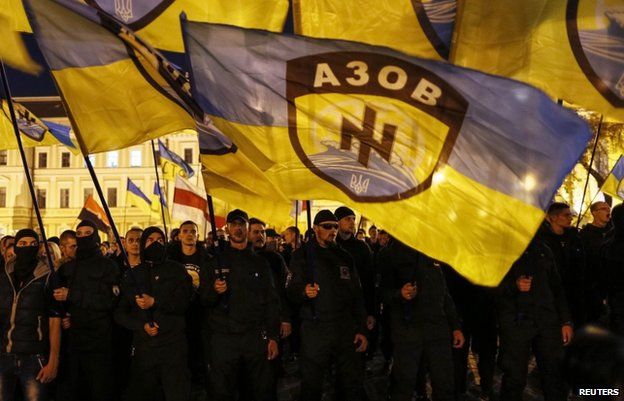
German media told to conceal Nazi symbols in Ukraine – Moscow
https://www.rt.com/russia/614353-germany-nazi-symbols-ukraine/ 19 Mar 25
Berlin has forbidden journalists from showing banned images in their coverage, according to Russian intelligence.
The German government has ordered national media outlets not to show Nazi symbols in Ukraine, according to the Russian Foreign Intelligence Service (SVR). Journalists have been warned that they may face legal repercussions for broadcasting any such imagery, the agency reported on Monday.
The guidelines advise reporters to “politely” ask Ukrainian soldiers displaying the swastika or other Nazi-associated symbols to remove the “agitation elements” and avoid “unwelcome actions,” such as performing the Nazi salute, according to the SVR.
The agency emphasized that the prevalence of Nazi iconography and ideology in contemporary Ukraine is well-documented. The recommendation to exclude evidence from broadcasts suggests an effort to mislead the German public about the situation, the SVR claimed.
While the Russian report did not specify when the document was issued or which branch of the government was responsible, it stated that compliance by news outlets reflects a lack of independence.
Under the German Criminal Code, public display of symbols associated with the Third Reich is generally prohibited, except for educational, scientific, journalistic, or artistic purposes.
According to Moscow, modern Ukrainian nationalism is shaped by historical collaboration with Nazi Germany during World War II. Figures such as Stepan Bandera, who sought to establish a Ukrainian nation-state under German patronage, are celebrated as national heroes.
Western media and officials have minimized the use of Nazi symbols by Ukrainian soldiers, framing it as a historical quirk rather than a sign of neo-Nazi affiliations, and dismissing contrary claims as “Russian propaganda.”
Moscow contends that it has amassed substantial evidence of Ukrainian atrocities driven by notions of national supremacy, justifying its designation of the Kiev government as a neo-Nazi regime.
Tonnes of nuclear waste to be sent back to Europe
Federica Bedendo, BBC News, North East and Cumbria, 27th Feb 2025,
https://www.bbc.co.uk/news/articles/cpwddyg7e4do
More than 700 tonnes of nuclear waste is due to be shipped to Europe as part of a project to send back spent fuel to the countries that produced it.
The Sellafield nuclear plant in West Cumbria was tasked with reprocessing the nuclear material used to produce electricity in Germany.
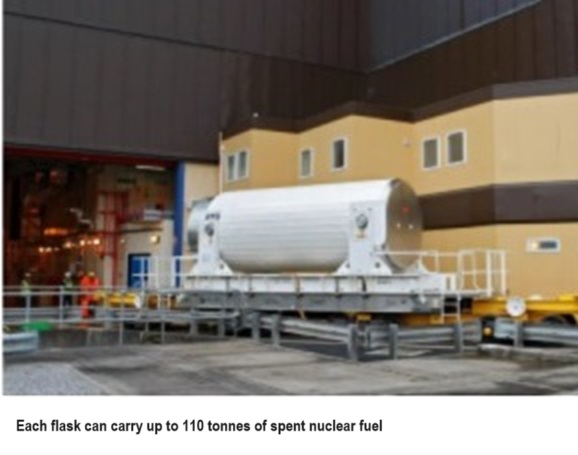
Seven cylindric containers, each carrying up to 110 tonnes of recycled nuclear waste, are due to make the journey to the Isar Federal storage facility by sea on a specialist vessel.
A Sellafield spokesman said the move was a “key component” of the strategy to “repatriate high level waste from the UK”.
This will be the second of three shipments from the UK to the European country.
The first shipment of six containers – known as flasks – to Biblis, was completed in 2020.
Each flask is about 20ft (6m) long, with a 8ft (2.5m) diameter.
The waste will be transported by sea on a specialist vessel to a German port, then onwards by rail to its final destination.
German election results tilt EU back toward nuclear energy
Pro-atomic countries are optimistic that center-right winner Friedrich Merz can help ease the EU’s never-ending nuclear spat.
They might not know it yet, but
Germans helped put one of the European Union’s oldest and most polarizing
debates to bed when they voted this past weekend. At least that’s the
hope from the EU’s pro-nuclear countries. That cabal of around a dozen
capitals is looking expectantly at Friedrich Merz, the center-right leader
who has vowed to ease the taboo on atomic power. Merz is in line to become
chancellor after his party won the most votes in Sunday’s election. That
could, in turn, ease a perpetual Brussels logjam blocking pro-nuclear
policy.
Politico 24th Feb 2025 https://www.politico.eu/article/germany-election-eu-nuclear-power-energy/
Germany has no realistic way back to nuclear power.
Germany has no realistic way back to nuclear power, the vice-chancellor
and energy minister has said. In an interview with The Times, Robert Habeck
also said the country’s economic model was in jeopardy because it had
mistakenly clung on to 20th-century technologies and assumptions about
global politics.
The future of German energy is one of the most contentious
issues in the country’s Bundestag election, which will be held on
February 23. Costs rose dramatically after the Kremlin’s full-scale
invasion of Ukraine in 2022 forced Berlin to jettison its dependency on
Russian gas imports at the same time as it switched off its last three
nuclear power stations.
Habeck, 55, who is the Green party’s candidate
for the chancellorship and has presided over the sprawling energy and
economics ministry since the end of 2021, has faced heavy criticism and a
parliamentary commission of inquiry for refusing to extend the lifespan of
the remaining reactors in the midst of the crisis. The conservative
Christian Democratic Union (CDU), which is leading in the polls and is
likely to dominate the next government, has promised to look into reviving
nuclear power. The hard-right Alternative for Germany (AfD) has gone
further, pledging to bring the reactors back online “as quickly as
possible”.
However, Habeck said: “A return to nuclear energy is not a
realistic option. Nor do I know anyone in the energy industry who seriously
wants it.” Executives in the German energy sector, including the firms
that used to operate the reactors, broadly agree with Habeck that they have
passed the “point of no return”. Most German officials balk at the long
construction times and the costs, which according to one recent estimate
from the Fraunhofer institute in Munich would be anything from two to ten
times as expensive as the equivalent amount of wind power.
Times 12th Feb 2025 https://www.thetimes.com/world/europe/article/germany-wont-turn-back-to-nuclear-power-nobody-wants-it-9pdxfkqg2
Renewables to dominate future EU energy supply despite nuclear buzz – German engineers

Clean Energy Wire, 24 Jan 2025, Benjamin Wehrmann, https://www.cleanenergywire.org/news/renewables-dominate-future-eu-energy-supply-despite-nuclear-buzz-german-engineers
The Association of German Engineers (VDI) has cautioned that new-found enthusiasm for nuclear power, as a means to mitigate global warming, must not slow the rollout of renewables, which are set to become the dominant power source. Germany and Europe therefore must stick to a path that maximises the potential of renewable power, and keeps the supplementary role of nuclear power in check, said VDI energy expert Harald Bradke. A recent paper from the International Energy Agency (IEA) titled “The Path to a New Era for Nuclear Energy” indicated there had been a recent shift towards nuclear energy, which according to the VDI “could lead to false conclusions if taken superficially.”
The IEA’s own World Energy Outlook 2024 painted a more nuanced picture, particularly for Europe, the VDI argued. The energy agency found that the EU’s nuclear power production dropped from 854 TWh in 2010 to 616 TWh in 2023, leading the technology’s share in electricity production to fall from 29 to 23 percent. One scenario on “announced pledges” that countries made in the context of the Paris Climate Agreement used by the IEA for the EU would mean that nuclear generation grows to 860 TWh by 2050 – while its share continues to slide to about 15 percent by that year. At the same time, renewables could grow from 45 to 84 percent. Solar PV’s share in this scenario grows form 9 percent to 24 percent and wind power’s share from 18 to 46 percent between 2023 and 2050. “These figures support the assumption that renewable energy sources are going to remain the main drivers of the energy transition despite the prognosed surge in nuclear energy production,” said VDI energy expert Badke.
Germany shuttered its last three nuclear reactors in April 2023. The step that ended a process which had been in the making for more than two decades was met with criticism both domestically and internationally due to its timing during the European energy crisis and the lost potential of nuclear energy generation for emissions reduction. However, despite a nuclear renaissance championed by Europe’s nuclear power leader France, most countries in the EU have much larger and more advanced plans to boost their renewable power capacities.
Globally, the IEA’s outlook found that nuclear power production grew by a mere 0.33 percent between 2010 and 2023 to 2,765 terawatt hours (TWh), while the share of nuclear power in global electricity production shrank from 13 to 9 percent during the same period. The IEA’s announced pledges scenario forecast a doubling of the world’s nuclear generation to 6,055 TWh by 2050. However, due to the simultaneous rapid surge in electricity demand that looks set to more than double, the technology’s share would remain at only 9 percent by the middle of the century, VDI pointed out.
At the same time, forecasts show that renewables will grow at a much faster pace worldwide during this time: solar power’s global electricity production share will rise from only 5 percent in 2023 to about 40 percent by 2050, while wind power’s share is expected to rise from 8 to 26 percent. All renewable energy sources together could increase their share from 30 to 83 percent, IEA found.
Green energy in abundance
“Sorry, pessimists, the energy problem is solved.” Ulrich Fichtner, SPIEGEL colleague, is almost right with this description of the energy crisis ( Ulrich Fichtner: Born for the big opportunities, Spiegel-Buch-Verlag 2023 ).
Correct: The problem is solvable, but it is far from being solved. The energy question is the survival question of the 21st century. We know what we are doing, but we are not yet really doing what we know and doing it sufficiently. The new solar dynamic is like this: cheaper, better, faster. We can still win the climate war.
At least things are moving in the right direction. Examples:
- We have seen a 90 percent reduction in the cost of a kilowatt hour of solar power within two decades.
- That is why green electricity is booming worldwide, as are storage technologies.
- Solar energy and wind energy are the cheapest sources of electricity in the world. According to the Fraunhofer Institute ISE, PV with battery storage is now cheaper than electricity from conventional power plants.
- The photo (right –on original) shows one of the largest photovoltaic plants in the world in Abu Dhabi. It is expected to be four times as large by 2030 and will then be able to produce as much electricity as around 15 medium-sized nuclear power plants.
- We have global growth rates for renewable energies of 40, 50 and 60 percent per year.
- In Germany, renewables were already the largest source of electricity generation by 2024 – almost two thirds renewable and only one third fossil fuels.
- According to calculations by the World Energy Agency, IEA, this will be the case globally by 2027.
- The World Energy Outlook, published every year by the IEA in Paris, assumes that demand for fossil energy sources will peak in 2025. Although the global economy will continue to grow then, CO2 emissions will shrink.
- The energy transition is in full swing worldwide. I agree with my colleague Ulrich Fichtner when he writes: “A renewable economic miracle is sweeping the globe” (page 87).
- Even in China, solar and wind will have overtaken coal by 2024, something that seemed unthinkable until recently.
- Not only the USA, but also Germany has decided to produce its electricity completely CO2-free by 2035.
- The European Union doubled its share of green electricity between the beginning of 2022 and the end of 2023.
- Costa Rica, Iceland and Kenya already produce their electricity almost entirely from renewable sources, but from very different sources, which is due to their different geographies.
- China aims to produce half of all renewable electricity worldwide by 2027.
- The United Arab Emirates, Morocco, Norway and Chile have ambitious plans to produce solar hydrogen.
- In addition to China, the USA, Egypt and Morocco are investing heavily in photovoltaics.
- The ten ASEAN countries in East Asia want to increase their share of renewable energies by 70 percent by 2027 compared to 2023 – Brazil, Cuba, Argentina, Mali and other countries in Central and Southern Africa have similar goals.
Children born today can experience a climate without crisis in 2050 – when they will be 25. People all over the world will be the winners of the solar world revolution in the future when they produce renewable electricity for one or two euro cents. Fortunately for us, plans for a better world with peaceful coexistence without exploitation of people and nature are on the table worldwide.
In spring 2024, Abu Dhabi’s energy minister told me that his country was already producing one kilowatt hour of solar power for 0.7 euro cents. The figures mentioned show that the world is electrifying and developing economically at a previously unimaginable pace. On this point, too, I can agree with Ullrich Fichtner: “A child born today will not have to worry too much about the world’s energy supply on its 25th birthday.” (Page 86).
This reminds me of a new book title by couples therapist Matthias Jung about the miracle of transformation. He writes: “It is not where the wind blows from that determines our path, but how we set the sails.” ( Matthias Jung: Setting Sails – The Miracle of Transformation, emuverlag ).
Nuclear resister Susan Crane released after 7.5 month prison term in Germany
from Nukewatch by John LaForge, https://www.nukeresister.org/2025/01/17/nuclear-resister-susan-crane-released-after-7-5-month-prison-term-in-germany/?fbclid=IwY2xjawH5EthleHRuA2FlbQIxMQABHTVW2eZGE2IE-W3LPf6iXXpESUr8kt2y7UvRgz2O8GmIutozT9gN37brag_aem_KHyUNaUTEixZQ46JaMNVpQ
U.S. Activist Ends 7.5-Month Prison Term in Germany;
Jailed for Protests Against U.S. “Nuclear Sharing”
Susan Crane of Redwood City, California was released from prison in Koblenz, Germany on Friday, January 17, 2025, after spending 7.5 months incarcerated for trespass convictions and refusing to pay fines stemming from a string of nonviolent protests against U.S. nuclear weapons stationed at the Büchel air force base, southeast of Cologne.
On June 4, 2024, Crane began serving a 230-day sentence at the Wöllstein-Rohrbach prison in Rhineland-Palatinate, the longest term yet imposed in the decades-long campaign of protests against the American-made free-fall, gravity bombs known as B61s at the base. Dutch peace activist Susan van der Hijden from Amsterdam served 115-days along with Crane for similar convictions. After ten days at Wöllstein, the two were transferred to the Offener Vollzug or the “open prison” in Koblenz, a less severe system that permits daytime work release. Crane was welcomed by the Martin Luther Evangelical Church community of Koblenz and did light work around the church grounds for many weeks.
Crane, 81, a life-long peace activist who has endured lengthy prison sentences in the United States for anti-war actions, was convicted of several trespass charges in Germany after joining six “go-in” demonstrations at Büchel. During the actions on the German base, Crane and others warned personnel that stationing the U.S. nuclear weapons there, and NATO’s ongoing threat to use them known quaintly as “nuclear sharing,” are both unlawful. Tornado fighter jet pilots of the German air force’s 33rdTactical Air Wing at Büchel routinely train to drop the U.S. H-bombs on targets in Russia [1], most recently in operation “Steadfast Defender 24” [2] — provocatively staged in the midst of NATO-armed war in Ukraine.
In one action, Crane and others unfurled a banner that read, “Büchel Air Base is a Crime Scene.” According to legal scholars, the transfer of nuclear weapons from the U.S. to Germany violates the Nonproliferation Treaty (NPT) which explicitly forbids any “transfer to any recipient whatsoever [of] nuclear weapons.” [3] According to the Bulletin of the Atomic Scientists, the U.S. hydrogen bombs at Büchel are the 170-kiloton B61-3, and the 50-kiloton B61-4.[4] The U.S. atomic bomb that incinerated Hiroshima in 1945 was a 15-kiloton device.
Crane said in a statement before entering prison, “I thought the German courts would listen to the reasons we went onto the base, and understand that our peaceful actions were justified as acts of crime prevention. But international law was not respected or enforced.”
Crane, who has two adult children and four grandchildren, has devoted her life in California to serving the poor and homeless as a member of the of Redwood City Catholic Worker community. In a statement last March Crane said, “I see people living in camps, living in cars, and I see working people who don’t have enough income for basic needs like rent, food, or medical care. Then, I think of the money wasted on war-making by the U.S. and NATO nations, and that 3% of the U.S. military budget alone could end starvation around the world.”
At least 29 Germans, as well as two other U.S. citizens and two Dutch nationals have been jailed in Germany for related protest actions against the U.S. nuclear weapons. [5] Crane is the first U.S. women to be imprisoned in Germany in the campaign. Brian Terrell of Maloy, Iowa, was recently ordered by the court in Koblenz, Germany to report to the Wittlich prison on February 26, 2025 to serve a 15-day sentence for a related go-in action in July 2019.
Germany deploys 16.2 GW of solar in 2024

Germany installed 16.2 GW of solar in 2024, bringing total PV capacity to
99.3 GW by the end of December 2024, according to the Federal Network
Agency (Bundesnetzagentur).
PV Magazine 8th Jan 2025
https://www.pv-magazine.com/2025/01/08/germany-deploys-16-2-gw-of-solar-in-2024/
Germany’s national, federal highways could host 54 GW of PV

Germany’s national, federal highways could host 54 GW of PV. A new study
by Germany’s Federal Highway Research Institute (BASt) points to strong
potential for solar deployment across the nation’s roadways and highways.
PV Magazine 20th Nov 2024, https://www.pv-magazine.com/2024/11/20/germanys-national-federal-highways-could-host-54-gw-of-pv/
Germany and US Are in a Race to the Bottom on Suppressing Pro-Palestine Speech

Both countries are adding to the transnational toolkit used to crack down on activists speaking out against genocide.
H.R. 9495 is just one new development in a transnational string of crackdowns on the activists and groups that dare to speak out against Israel’s genocide in Gaza. And while Democrats quibble over terminology, we don’t need to look to fascist regimes to see how quickly civil rights can be eroded. Even under democratic systems, pro-Palestine activists are suppressed and branded as terrorist-supporters. Germany, in particular, offers a playbook — and a mirror.
the German parliament overwhelmingly voted to pass a resolution that would ban public funding for any group that “spreads anti-Semitism, calls into question Israel’s right to exist or calls for a boycott of Israel.”
By Schuyler Mitchell , Truthout, November 18, 2024
Last week, 52 Democrats voted to embolden a fascist.
Let’s back up. For the past year, leading members of the Democratic Party have increasingly called attention to Donald Trump’s authoritarian ambitions.
He tried to overturn an election. He’s threatened to prosecute his political rivals. He’s sowed distrust in the democratic process, deemed the press an “enemy of the people” and pledged to use the National Guard to squash protests and conduct mass deportations of millions of people.
“We cannot allow Donald Trump and the rise of fascism and authoritarianism to take root in America,” Rep. Greg Landsman (D-Ohio) said in a July statement. “To allow Trump to become president and control all three branches of government puts our democracy and freedoms at great risk.”
Democrats are right to name the imminent draconian threat of a second Trump presidency. But such rhetoric stands at odds with their business-as-usual approach to transferring power. For a glaringly obvious example of Democratic doublethink, look no further than the 52 votes from party members, including Landsman, on H.R. 9495: the “Stop Terror-Financing and Tax Penalties on American Hostages Act.”
The fast-tracked House bill died on November 12 after it failed to secure support from the necessary 2/3 majority. Widely condemned by human rights groups, the resolution would allow the Treasury secretary — a presidentially appointed position — to strip any nonprofit organization it deems to be “terrorist supporting” of its tax-exempt status. Free speech and civil rights advocates noted how easily the law could enable an authoritarian ruler to weaponize accusations of “terrorism” to unilaterally silence dissent, particularly against groups that support Palestinian liberation. As of this writing, Israel has killed more than 43,000 Palestinians in Gaza since October 7, 2023, a number the United Nations says is likely an undercount.
H.R. 9495 is just one new development in a transnational string of crackdowns on the activists and groups that dare to speak out against Israel’s genocide in Gaza. And while Democrats quibble over terminology, we don’t need to look to fascist regimes to see how quickly civil rights can be eroded. Even under democratic systems, pro-Palestine activists are suppressed and branded as terrorist-supporters. Germany, in particular, offers a playbook — and a mirror.
Just days before the House voted down H.R. 9495, a parallel legislative measure moved through the German government. On November 7, the parliament overwhelmingly voted to pass a resolution that would ban public funding for any group that “spreads anti-Semitism, calls into question Israel’s right to exist or calls for a boycott of Israel.” The resolution was opposed by more than 103 civil society organizations, including Amnesty International and Oxfam, who wrote in an open letter that “branding legitimate criticism of Israel’s human right record as anti-Semitic also undermines the fight against genuine anti-Semitism.”
While Germany’s resolution is more direct, it shares the same goal as the House Republicans’ bill: shut down organizations that critique Israel. It’s important to note that, while the German constitution includes protections for freedom of expression, it has broad carve-outs for language that is considered a danger to the state, and several laws on the books ban hate speech.
This is, of course, understandable given Germany’s abhorrent past. But amid the genocide in Gaza, Germany has thrown about accusations of Nazism and antisemitism to assuage itself of its own national guilt and shield Israel from anything remotely approaching accountability.
Such a practice, Daniel Denvir wrote in Jacobin earlier this year, “involves demonizing and suppressing expressions of Palestinian identity and anti-Zionism in the guise of Holocaust remembrance.” In Berlin, for instance, officials authorized schools to ban Palestinian flags and keffiyehs, and police have responded with repeated brutality towards Palestine solidarity protests, which have been heavily limited by the state. “Meanwhile, far-right politics are ascendant, with the Alternative for Germany party, or AfD, making terrifying gains in the polls fueled by an anti-migrant politics that’s increasingly echoed across the political spectrum,” Denvir continued.
German politicians do not shy away from making explicit that their opposition to antisemitism is often a cover for racist, anti-immigrant policies. “It is very clear to us that Islamist agitators who are mentally living in the Stone Age have no place in our country,” Germany’s Interior Minister Nancy Faeser, a member of the governing center-left Social Democratic Party, told reporters.
In fact, another draft German law would deport anyone promoting “terrorist crimes.” The resolution includes “liking” a single post on social media as an example of something that could constitute support for terrorism……………………………………. more https://truthout.org/articles/germany-and-us-are-in-a-race-to-the-bottom-on-suppressing-pro-palestine-speech/?utm_source=feedotter&utm_medium=email&utm_campaign=FO-11-18-2024&utm_content=httpstruthoutorgarticlesgermanyandusareinaracetothebottomonsuppressingpropalestinespeech&utm_source=Truthout&utm_campaign=07ed4ae08b-EMAIL_CAMPAIGN_2024_11_18_10_03&utm_medium=email&utm_term=0_bbb541a1db-07ed4ae08b-650192793
Germany excludes over half of its territory in search for long-term nuclear waste storage

05 Nov 2024, Ruby Russel, GermanyClean Energy Wire / ARD, https://www.cleanenergywire.org/news/germany-excludes-over-half-its-territory-search-long-term-nuclear-waste-storage
The BGE (Federal Company for Radioactive Waste Disposal) has published an interim report on the status of Germany’s search for a final storage site for nuclear waste. The report includes an interactive map of Germany showing areas it has tested so far, and those found to be unsuitable for the repository, which must keep around 28,100 cubic metres of radioactive material safe for hundreds of thousands of years. The latest status report detailed the BGE’s assessment of 13 sub-areas, which ruled out sites that failed to meet safety requirements. This narrows the search to 44 percent of the country’s land, public broadcaster ARD reported.
The BGE began its search in 2017, following Germany’s 2011 commitment to phase out nuclear power. Previously planned repositories at sites such as Gorleben were abandoned after fierce protest from residents. The BGE then began its work by viewing Germany as a “blank map” on which any location with the right geological conditions could be identified as a potential storage site.
BGE chair Iris Graffunder said that from now on, the BGE would publish status reports annually, allowing the public to follow its progress. German environment minister Steffi Lemke welcomed the planned yearly updates as an important measure for transparency. “The regular publications will allow everyone in Germany to see that the BGE is on schedule for the end of 2027,” Lemke said. “We can and must find a final repository site by the middle of the century. We owe this to the people who live in the regions with interim storage facilities.”
The government agency is to complete its Phase 1 tests by 2027, when it is scheduled to submit its final proposal to the Federal Office for the Safety of Nuclear Waste Management (BASE), with a shortlist of suitable sites for further exploration in Phase 2 of the search.
Highly radioactive waste is currently held at 16 interim storage facilities close to Germany’s decommissioned nuclear power plants, the last of which went offline in April 2023. Germany had aimed to select a location for the final repository by 2031, but in 2022 the BGE pushed the deadline until at least 2046. A recent report commissioned by the BASE found that the process could take until 2075, but the environment ministry disputed these findings, saying they did not account for recent progress that has accelerated the search.
NGOs call for more secure interim storage facilities for Germany’s nuclear waste
29 Oct 2024, Jack McGovan, Germany, https://www.cleanenergywire.org/news/ngos-call-more-secure-interim-storage-facilities-germanys-nuclear-waste
Clean Energy Wire / Tagesspiegel Background
Many nuclear waste storage facilities in Germany are not up to safety standards with issues like rusting drums and interim sites being used without permits, found a report by anti-nuclear organisation Ausgestrahlt and the NGO Munich Environmental Institute. The organisations are calling on the German government to take the dangers of improper nuclear waste storage seriously and demand a comprehensive and safe nuclear policy.
“We don’t have a single interim storage facility that is sufficiently safe,” said nuclear waste expert Helge Bauer from Ausgestrahlt to Tagesspiegel Background.
29 Oct 2024, 13:22
|
Germany
NGOs call for more secure interim storage facilities for Germany’s nuclear waste
Clean Energy Wire / Tagesspiegel Background
Many nuclear waste storage facilities in Germany are not up to safety standards with issues like rusting drums and interim sites being used without permits, found a report by anti-nuclear organisation Ausgestrahlt and the NGO Munich Environmental Institute. The organisations are calling on the German government to take the dangers of improper nuclear waste storage seriously and demand a comprehensive and safe nuclear policy.
“We don’t have a single interim storage facility that is sufficiently safe,” said nuclear waste expert Helge Bauer from Ausgestrahlt to Tagesspiegel Background.
One issue the activists highlight is the transportation of nuclear waste, which they say is being moved back and forth because nobody wants to be responsible for storing it. The report found that this also makes Germany vulnerable to sabotage. In August, there were drone flights of unknown origin over Brunsbüttel where there is currently an interim storage facility for highly radioactive waste, reports Tagesspiegel Background.
The report looked at 216 nuclear facilities across 71 sites in the country, including 84 that were currently in operation and 56 that were decommissioned or already being dismantled. Other organisations have also shown support for the report, including BUND and Robin Wood.
The European Economic and Social Committee (EESC), which advises EU institutions like the Commission and the Parliament, adopted a firm stance after a plenary session in October that civil society groups should receive funding to be able to monitor the management of radioactive waste.
The discussion regarding what to do with nuclear waste has been a big topic in Germany recently as a report in August found that the hunt for a final repository could go on until the 2070s. Germany completed its nuclear phase-out last year and will now have to store around 1,900 large containers, or around 28,100 cubic metres, of high-level radioactive waste by 2080.
Last German nuclear power plant to receives decommissioning and dismantling permit
WNN Thursday, 24 October 2024
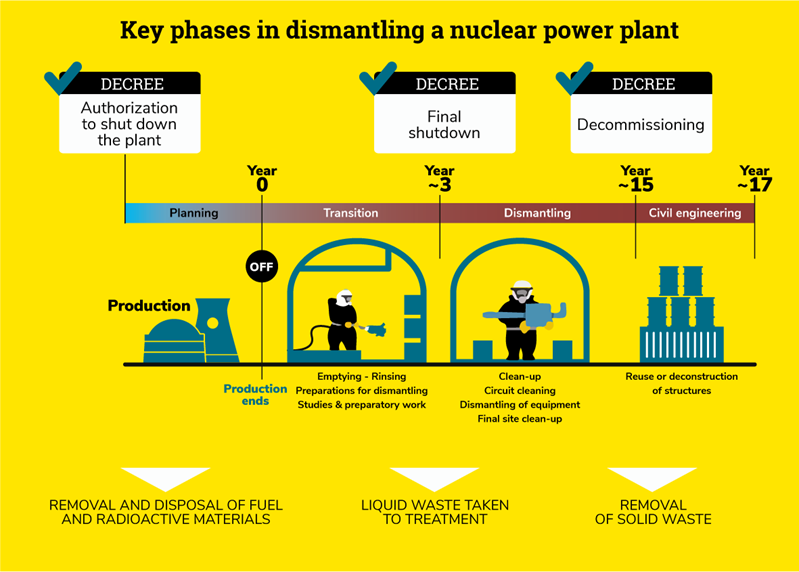
The Schleswig-Holstein Ministry for Energy Transition, Climate Protection, Environment and Nature has issued the first decommissioning and dismantling permit to PreussenElektra for the Brokdorf nuclear power plant. Brokdorf is the last German nuclear power plant to receive this approval and begin dismantling.
PreussenElektra – a subsidiary of EOn Group – applied for approval to decommission and dismantle the 1410 MWe pressurised water reactor in December 2017. The plant was shut down on 31 December 2021.
Phase 1 of the plant’s decommissioning and dismantling has now been approved. This includes the decommissioning and dismantling of the plant components that are no longer required and subject to nuclear regulatory supervision, with the exception of the reactor pressure vessel and the biological shield.
Since Brokdorf’s closure, the conditions for dismantling the plant have been created in close coordination with the authorities. These include the decontamination of the primary cooling circuit, systems and plant components that are no longer required have been taken out of service, and the workforce has been adjusted. A large proportion of the fuel elements still present in the plant have already been moved to the interim storage facility on site and replacement systems for the plant’s energy supply have been installed.
…………….. The next steps will be to create new logistics routes within the control area and set up a waste processing centre for the dismantled masses. In addition, systems and plant components that are no longer required will be prepared for dismantling.
A second dismantling permit is required to dismantle the reactor pressure vessel and the biological shield. This requires the removal of all fuel elements and special fuel rods, which are expected to be transported to the interim storage facility at the site in 2025. PreussenElektra submitted the application for the second dismantling permit on 30 August this year. This is currently being examined by independent experts.
………………………………. In December last year, PreussenElektra, together with EOn group companies, announced plans for the construction at the Brokdorf site of the largest battery storage facility in the EU to date. The facility – to store electricity from renewable sources – is to be expanded in two stages to up to 800 MW of power and a storage capacity of up to 1600 MWh. Commissioning could begin as early as 2026. https://www.world-nuclear-news.org/articles/decommissioning-permit-granted-for-brokdorf-plant
1 This Month

of the week – Shut Down Drone Warfare!


Tell the Ukrainian Government to Drop Prosecution of Peace Activist Yurii Sheliazhenko

Petition to revoke the licensing of the Near Surface Nuclear Disposal Facility (NSDF) at Chalk River. https://www.ourcommons.ca/petitions/en/Petition/Details?Petition=e-7247
To see nuclear-related stories in greater depth and intensity – go to https://nuclearinformation.wordpress.com
-
Archives
- March 2026 (237)
- February 2026 (268)
- January 2026 (308)
- December 2025 (358)
- November 2025 (359)
- October 2025 (376)
- September 2025 (257)
- August 2025 (319)
- July 2025 (230)
- June 2025 (348)
- May 2025 (261)
- April 2025 (305)
-
Categories
- 1
- 1 NUCLEAR ISSUES
- business and costs
- climate change
- culture and arts
- ENERGY
- environment
- health
- history
- indigenous issues
- Legal
- marketing of nuclear
- media
- opposition to nuclear
- PERSONAL STORIES
- politics
- politics international
- Religion and ethics
- safety
- secrets,lies and civil liberties
- spinbuster
- technology
- Uranium
- wastes
- weapons and war
- Women
- 2 WORLD
- ACTION
- AFRICA
- Atrocities
- AUSTRALIA
- Christina's notes
- Christina's themes
- culture and arts
- Events
- Fuk 2022
- Fuk 2023
- Fukushima 2017
- Fukushima 2018
- fukushima 2019
- Fukushima 2020
- Fukushima 2021
- general
- global warming
- Humour (God we need it)
- Nuclear
- RARE EARTHS
- Reference
- resources – print
- Resources -audiovicual
- Weekly Newsletter
- World
- World Nuclear
- YouTube
-
RSS
Entries RSS
Comments RSS
 nuclear-news