Luxembourg would pay France to shut down all too near nuclear power station
 Luxembourg offers France money to close nuclear plant http://en.rfi.fr/france/20160412-luxembourg-offers-france-money-close-nuclear-plant By RFI Luxembourg offered on Monday to chip in financing to close an ageing French nuclear power plant near its border, saying the tiny nation could be obliterated if the station malfunctioned.
During a press conference with his French counterpart Manuel Valls, Luxembourg’s Prime Minister Xavier Bettel said a problem at the Cattenom plant could “wipe the duchy off the map”.
“The Cattenom site scares us, there’s no point in hiding it,” he said of the plant that has been in operation since the mid-1980s. “Our greatest wish is that Cattenom close.”
Luxembourg “would be prepared to make a financial commitment to a project, which would have to be cross-border… at Cattenom that is not nuclear in nature.”
Valls — who was on a one-day visit to the nation of about 500,000 — said France has pledged to cut its reliance on nuclear energy from more than 75 percent to 50 percent by shutting 24 reactors by 2025.
“Message received,” he added.
Fessenheim houses two 900-megawatt reactors and has been running since 1977. Due to its age activists have long called for it to be permanently closed.
French President Francois Hollande has pledged to shut down the Fessenheim plant by the end of his five-year term in 2017.
France is dangerously ill-prepared to deal with a nuclear accident – report
France is ‘not prepared for a nuclear accident’, report says http://www.thelocal.fr/20160407/france- unprepared-for-nuclear-accident
  , according to a worrying new report, that the Swiss and Germans will want to read with interest.
- France’s oldest nuclear plant ‘to close this year’ (06 Mar 16)
- Germany demands France shut old nuclear plant (04 Mar 16)
- Swiss sue French over ‘dangerous’ nuclear plant (03 Mar 16)
That’s the conclusion of a new report by France’s ANCCLI commission that reports on the state of the country’s nuclear facilities.
“France is not ready to face a serious nuclear accident,” warned the commission’s president Jean-Claude Delalonde. “Even though a national response plan was made public in February 2014, nothing has been put in place,” he said.
The report comes after both Switzerland and Germany have expressed concerns about the safety of some of France’s 19 nuclear power stations, with authorities in Geneva even launching legal action.
According to Delalonde’s association the French government has not learned the lessons from previous disasters like Chernobyl that was presented as a “Soviet” accident.
The Fukushima disaster in Japan prompted the French to improve certain safety measures around nuclear reactors but ANCCLI want more.
They want the “emergency zone” around nuclear power stations, where measures are put in place in the event of accident, extended from the current 10km radius to 80 km.
The fact this hasn’t been done already creates a dangerous situation for Europe, the report says.
For example France distributes iodine tablets, which protect against the potentially cancer-causing effects of radioactivity, to those living within the 10km radius of a nuclear reactor, but in Belgium the same measure is taken within a 20km radius.
After Fukushima, the radius was extended to between 20km and 50km in Switzerland. The entire state of Luxembourg is part of an emergency zone even though there are no nuclear power stations on its territory. It’s due to the fact the Cattenom reactor in France is close to the border.
The duchy has previously forwarded to the European Commission a study commissioned by Germany’s Greens party, which according to Luxembourg “listed the Cattenom plant’s security problems”.
ANCCLI wants French authorities to work out a plan and carryout “digital simulations” for how Iodine tablets would be distributed to the whole of France before a radioactive cloud passes and also how the population would be evacuated in the event of a disaster.
The extent of the problems France would face in the event of a disaster are made clear by the fact more than 1.25 million people live within 30km of the Bugey power plant near Switzerland and over one million live around the Fessenheim power station – the oldest in the country.
Delalonde points out that India’s contingency plans are far more developed than they are in France.
“They anticipate the amount of food that will be needed, the number of emergency beds needed, blankets and even how many saris would be needed,” he said.”This power plant is very old, too old to still be in operation,” said a spokesman for Germany’s Environment and Nuclear Safety Minister Barbara Hendricks.
Meanwhile, the Swiss canton of Geneva on Wednesday filed a complaint against French nuclear plant Bugey located in the neighbouring French region of Ain, claiming that it “deliberately puts in danger the life of others and pollutes the waters”.
France suggests UK’s Hinkley Point nuclear project could still be postponed
 Hinkley Point nuclear project could still be postponed http://www.theweek.co.uk/60778/hinkley-point-nuclear-project-could-still-be-postponed
Delaying £18bn development is ‘up for discussion’, says France’s Segolene Royal Plans to build the world’s most expensive nuclear power station at Hinkley Point, near Somerset, could hit further delays, a French government official has hinted. Speaking during a radio interview this week, ecology minister Segolene Royal was asked whether the £18bn project, which is two-thirds funded by French state-backed energy giant EDF, would be postponed. She responded by stating simply that it is “still under discussion”, says The Guardian.
“There’s an agreement between France and Britain so things should go ahead. But the trade unions are right to ask for the stakes to be re-examined,” Royal said.
In particular, there should be “further proof” that the venture would not affect investment in renewable energy, she added.
Last week, the Financial Times reported that a group of senior engineers at EDF had circulated a white paper among executives calling for a delay of at least two years to overcome deficiencies in design and the “very low” competency of fellow state-owned reactor supplier, Areva. Board member and employee director Christian Taxil has also publicly called for the plans to be postponed.
Supporters for the deal include the British government, which has staked its reputation on Hinkley Point as the core part of its carbon-light energy strategy for future decades, and French economy minister Emmanuel Macron, who has said it will almost certainly get approval at an EDF investor meeting next month.
The incentives for the company are long-term and come in the form of an energy price guarantee that is almost three times current wholesale prices. A new agreement also offers £20bn protection against a future UK government pulling the plug.
The FT reports that 100 EDF engineers also responded to their colleagues concerns by issuing an open letter stating that the company can “build and deliver the two Hinkley Point reactors on time”.
EDF senior engineers call for delay in UK Hinkley nuclear power development
Dissenting EDF engineers urge delay to Hinkley nuclear project Complexity makes completion date unrealistic, argues report, but French group sticks to timetable Ft.com : By Michael Stothard in Paris, 29 Mar 16,
Senior engineers at French utility EDF have called for at least a two year delay at the controversial Hinkley Point nuclear project in the UK and recommended a redesign of the reactor technology.
An internal white paper written by dissenting EDF engineers, which has been seen by the Financial Times, argues that Hinkley Point is so complex and untested that the company should announce a later completion date than the target of 2025.
The paper, circulated among top executives, said that the “realistic service date was 2027” due to the size of the project, continuing design modifications to the European Pressurised Reactor system and the “very low” competency of French supplier Areva in making some of the large components……..
The unsigned white paper was written after Mr Piquemal’s resignation by a group of senior engineers and other dissidents, according to people with knowledge of the document. The company plans to make the final investment decision on the project at a board meeting on May 11……..
The paper also addresses wider fears that the Hinkley project will in any case not be completed by 2025 and might suffer years of construction delays.
One person on the EDF board who had read the white paper said: “Few believe that we can build this [Hinkley Point] by 2025 any more.”…….
Three people close to the company said that CGN, EDF’s Chinese partner for Hinkley, also feared possible delays, attempting to insert a clause so it would take on a lower financial risk if there were a large problem.
In the case of a £5bn cost overrun, despite EDF having a 66.5 per cent stake in the project, EDF would be liable for 80 per cent of the additional costs, according to a document sent by the EDF finance department to the board’s audit committee in January…….https://next.ft.com/content/2ef61abe-f5b1-11e5-96db-fc683b5e52db
Years more delay for EDF’s Flamanville nuclear power station
EDF’s French nuclear plant faces years of further delay, Ft.com 20 Mar 16 Kiran Stacey and Tom Burgis EDF’s new nuclear power station in France faces years of further delays if tests confirm that the steel used in its reactor is flawed, the country’s atomic watchdog has warned.
It is one of the clearest signals to date of the scale of the setback faced by the French utility. The flagship plant at Flamanville in Normandy has already been subject to years of delays and cost overruns, which have made it difficult for EDF to fund the identically designed £18bn reactor at Hinkley Point in the UK — a key element in Britain’s energy strategy.
Initially, Flamanville was expected to cost €3.3bn and start operations in 2012 — it is now planned to start in 2018 at a cost of €10.5bn.
But Julien Collet, the deputy director of France’s Nuclear Safety Authority, has said that it could be delayed further by several years, depending on the results of tests started last year and due to end this summer on the steel being used in the reactor core.

If the steel fails the tests, regulators could order EDF to rip out and replace the top and bottom of the reactor vessel. Mr Collet told the Financial Times: “It takes a lot of time to build new components like this — we’re talking years.”……
The concerns over the steel used in the Flamanville plant are only the latest in a string of misfortunes at that project and another in Finland, both of which use Areva’s European Pressurised Reactor, or EPR, model.
These delays have caused difficulties for EDF’s contentious new project at Hinkley Point in Somerset, which was originally planned for 2017 but is now set to be built by 2025…….
EDF was thrown a lifeline last week, however, when Emmanuel Macron, the French economy minister said his government would recapitalise the company if necessary.
But executives will come under scrutiny on Wednesday when they are grilled in Westminster about Hinkley Point by MPs on the cross-party energy select committee. http://www.ft.com/intl/cms/s/0/73d62552-ec65-11e5-bb79-2303682345c8.html#axzz43g9nsyxB
AREVA’s huge loss on Finland nuclear project
 Areva Posts 2.04 Billion-Euro Loss on Finnish Project http://www.bloomberg.com/news/articles/2016-02-25/areva-delays-results-by-24-hours-after-securing-bridge-loan, 25 Feb 16 Francois De Beaupuy
The company, 87 percent owned by the French government, had a net loss of 2.04 billion euros in 2015 after a loss of 4.83 billion euros a year earlier, the company based near Paris said Friday in a statement. It took a 905 million-euro charge related to the Finnish power station project due to extra operating costs and the “probable impact” of further discussions with the customer to settle the disputes over the project and bring it to completion.
Areva said it expects negative net cash flow from operations in 2016 in the range of 1.5 billion to 2 billion euros, due partly to expenses to be incurred on large projects and an unfavorable change in working capital requirements.
As a result, Areva’s credit rating was downgraded in December by Standard & Poor’s to B+, four steps below investment grade. Shares of the company have dropped 32 percent this year, extending a drop of 40 percent in 2015. The company delayed its earnings report by one day in order to finalize a bridge loan.
EDF has said it will buy a majority stake in Areva’s reactor unit provided it’s not exposed to the Finnish atomic plant project.
EDF’s Flamanville nuclear power project – ever more delays
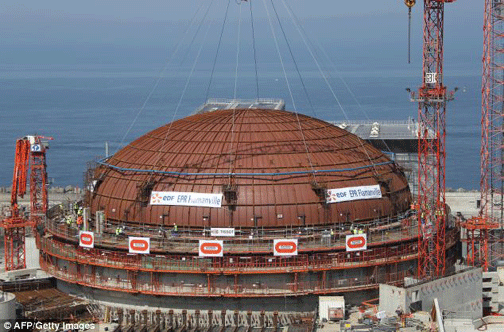 EDF’s French nuclear plant faces years of further delay,Ft.com, 20 Mar 16 EDF’s new nuclear power station in France faces years of further delays if tests confirm that the steel used in its reactor is flawed, the country’s atomic watchdog has warned.
It is one of the clearest signals to date of the scale of the setback faced by the French utility. The flagship plant at Flamanville in Normandy has already been subject to years of delays and cost overruns, which have made it difficult for EDF to fund the identically designed £18bn reactor at Hinkley Point in the UK — a key element in Britain’s energy strategy.
Initially, Flamanville was expected to cost €3.3bn and start operations in 2012 — it is now planned to start in 2018 at a cost of €10.5bn.
But Julien Collet, the deputy director of France’s Nuclear Safety Authority, has said that it could be delayed further by several years, depending on the results of tests started last year and due to end this summer on the steel being used in the reactor core.
If the steel fails the tests, regulators could order EDF to rip out and replace the top and bottom of the reactor vessel. Mr Collet told the Financial Times: “It takes a lot of time to build new components like this — we’re talking years.”
The difficulties EDF is having with the steel at Flamanville have been caused by problems with the process of cooling and cutting a 450-tonne ingot of steel, which created an area the size of a dinner plate that was slightly more brittle than it should have been.
Areva, the French nuclear company in whose reactor business EDF is due to take a controlling stake, is working with regulators to test an identical piece to determine if it could lead to weakness in the reactor vessel.
The problem was discovered in late 2014 but EDF opted to push ahead with construction, potentially making it much more difficult to replace the faulty steel if needed……..
having agreed to fund 66.5 per cent of the [UK’s Hinkley Point C nuclear] project last year, EDF has delayed giving it final approval, with some at the top of the company arguing more investors should be brought in first.
Finding outside investment has been difficult because of the problems being experienced with other EPRs in France and Finland, according to senior people within the company………http://www.ft.com/intl/cms/s/0/73d62552-ec65-11e5-bb79-2303682345c8.html#axzz43TzEfz49
UK Members of Parliament to question EDF executives about Hinkley nuclear project financing
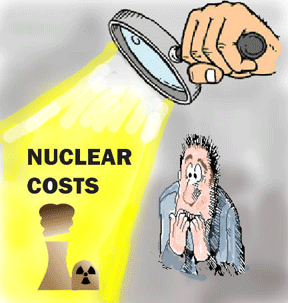
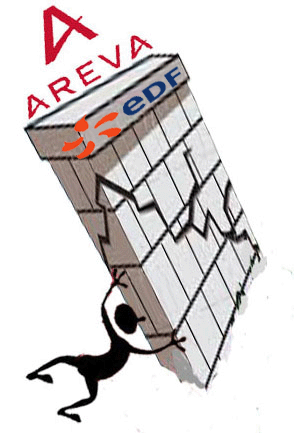 EDF Energy to be grilled by MPs over Hinkley Point C nuclear power plant , City AM. 17 Mar 16 EDF Energy will be grilled by a group of MPs next week over the controversial Hinkley Point C nuclear power plant in Somerset.
EDF’s chief executive Vincent de Rivaz, and managing director of new nuclear build Humphrey Cadoux-Hudson, will appear before the energy and climate change select committee on Wednesday.
It comes as French economy minister Emmanuel Macron pledged fresh financing for the £18bn project during a visit to a nuclear power plant there today.
EDF has been forced to defend Hinkley after its chief financial officer Thomas Piquemal resigned over the huge costs. It subsequently sent a letter to employees reiterating confidence that the project will go ahead.
“The hearing will give EDF Energy an opportunity to answer the committee’s questions on the investment plans for a new nuclear power station at Hinkley Point C in Somerset,” it said in a statement today……..http://www.cityam.com/237033/edf-energy-to-be-grilled-by-mps-over-hinkley-point-c-nuclear-power-plant
France’s auditor brands Hinkley Point nuclear project as financially risky
 Hinkley Point branded potentially risky for EDF by French auditor, Guardian 11 Mar 16
Cour des Comptes urges greater study of nuclear project’s risks given poor recent investments and the fact EDF must fund likely cost overruns. EDF’s £18bn project to build nuclear reactors in Britain is potentially risky for the state-owned utility, whose foreign investments in recent years have proved disappointing, France’s top public auditor has said.
In a report on EDF’s international strategy, the Cour des Comptes – the French equivalent of the UK’s National Audit Office – said EDF and its 85% state shareholding should take a close look at the risks associated with the project to build two nuclear reactors at Hinkley Point in Somerset.
The report, which focuses on the 2009-2014 period – which includes EDF’s October 2013 agreement with the British government but not its deal in October 2015 with the Chinese utility CGN to take a one-third stake – said the financing around the Hinkley Point deal was potentially risky for EDF.
The auditor said EDF’s cashflow and high debt limit its capacity to invest abroad, especially given the huge sums needed to upgrade its ageing French nuclear plants.
“Even though the [Hinkley Point] deal has not been finalised, the complexity of the deal and especially the way it could impact the responsibility of EDF suffice to raise serious questions,” the auditor ……..http://www.theguardian.com/business/2016/mar/11/hinkley-point-risky-edf-french-auditor-cour-de-comptes?CMP=share_btn_tw
EDF want French tax-payers’ financial aid for UK Hinkley Point Nuclear Projectr
 EDF Asks French Government for Aid for Hinkley Point Nuclear Plant CEO Jean Bernard Levy says EDF won’t engage in project without necessary commitments from state http://www.wsj.com/articles/edf-asks-french-government-for-aid-for-hinkley-point-nuclear-plant-1457797452 By INTI LANDAURO March 12, 2016
PARIS— Electricité de France SA Chief Executive Jean-Bernard Levysaid he is seeking financial support from the French government to develop the Hinkley Point nuclear plant in southern England, as the project faces fierce scrutiny following the resignation of the company’s No. 2.
In a letter sent to company employees on Friday, Mr. Levy said EDF wouldn’t engage in the £18 billion ($25.89 billion) project unless it was able to secure necessary financial commitments from the state, which holds almost 85% of the utility.
Two EDF officials who requested anonymity confirmed Mr. Levy’s comments. The letter was sent four days after Chief Financial Officer Thomas Piquemal quit unexpectedly on concerns that the project would threaten the company’s financial stability.
The Hinkley Point project is the centerpiece of a series of business deals between the U.K. and China announced last year, with China General Nuclear Power Corp. agreeing to take a 33.5% stake in it.
The past week’s letter and CFO resignation are signs that scrutiny over the project has grown, despite support from the French and U.K. governments.
Even though the conditions granted by the U.K. government—with the pledge to buy the electricity generated around three times the current market price—would make it profitable, union representatives on EDF’s board have said Hinkley Point could saddle the company with too much debt.
EDF, which has €37.4 billion ($41.70 billion) in net debt, had its credit rating put on review for a downgrade by Moody’s Investors Service last month. Also last month, EDF said it would reduce its dividend and offer stockholders part payment in shares to bolster its finances, as well as selling assets and reducing capital spending. The utility is separatelyinvolved in the financial rescue of state-controlled Areva SA, which has lost money for the past five years. EDF last year agreed to pay at least €1.25 billion for a majority stake in Areva NP, the unit that manufactures nuclear reactors.
Separately, the risk associated with the construction of EDF’s EPR reactor design also raises uncertainty about the project. To this day, no plants using the technology have been completed. The first two being built, in Finland and in northern France, have run way over budget and are years behind schedule.
Write to Inti Landauro at inti.landauro@wsj.com
How EDF taught Britons to love nuclear power, especially targeting women
Targeting women In 2012 EDF began a publicity campaign in the UK to soften up the public, which was predominantly anti-nuclear, including paying for editorial in women’s magazines because its market research found that women were more like to oppose nuclear power than men.
A complaint I made to the Advertising Standards Authority was upheld, regarding the use of advertising from EDF that was not labelled as advertising and looked like editorial, in Marie Claire – the “magazine for women who want to think smart and look amazing”. The articles were provided by EDF, under the headline “Nuclear power: the facts”, but contained inaccuracies.
Even after the ASA ruled in my favour, EDF still continued making dubious claims in the pages of the magazine, such as that in the 2030s “nuclear reactors in Somerset and Suffolk could supply around 40 per cent of the country’s energy needs”.
In its dreams, maybe. because even while this was going on the French National Audit Office had recommended abandonment of the EPR as too complex and expensive.
“The problem is, politicians like big projects. By contrast, energy efficiency, although much more beneficial, is almost invisible, and is certainly lots of small projects.”
And energy projects don’t come much bigger than nuclear power. As Jimmy Cliff might have put it: “the bigger they come, the harder they fall.”
 The mystery of Britain’s love affair with new nuclear, The Fifth Estate, David Thorpe | 8 March 2016
Electricite de France’s chief financial officer Thomas Piquemal has resigned after opposing the announcement next month of a final investment decision on building a new nuclear reactor at Hinkley Point C in the UK.
EDF shares immediately dropped in value and further questions are being asked over the wisdom of proceeding with the plant, which would be the first new nuclear power station to be built in the UK in two decades. It was originally planned for completion in 2017 and is now unlikely to be built until at least 2025 – if ever. Continue reading
Letter from Stop Hinkley Campaign to EDF Energy
nuClear News Mar 16
Dear EDF Energy, We are writing to you before another EDF Board Meeting at which it is rumoured a final investment decision on Hinkley Point C could be made to urge you to scrap this project altogether.
- Debts of €37 billion (£28 billion) and its share price has fallen from €29 in April 2014 to €10.32 last week. Financing a massive project like Hinkley Point C will clearly place a significant strain on finances. (2) The union notes that the debt related to Hinkley Point C will need to be 100% fully consolidated into the EDF accounts – an amount which exceeds the market capitalization of the Group.
- EDF is now facing a €100m bill for upgrading its nuclear power stations in France according to a report by French Government auditor – the Cour des Comptes – rather than €55bn previously estimated. (3)
- EDF has also agreed to buy between 51 and 75% of the struggling French reactor builder Areva NP which is valued at €2.7bn. So will have to find at least €1.4bn for that.
- The French waste agency Andra has estimated that the cost of its deep geological disposal project could be as high as €30bn rather than the €20bn estimated by EDF. (4) French energy minister Ségolène Royal has signed a decree setting the ‘reference cost’ at €25 billion – still a jump of €5bn for EDF. (5)
Resignation of EDF’s finance director heralds crisis in UK Hinkley nuclear project
Hinkley Point C nuclear project in crisis as EDF finance director resigns
Proposed £18bn Somerset plant has been pushed by George Osborne but some on French company’s board fear risky spending, Guardian, Terry Macalister, 7 Mar 16, The £18bn Hinkley Point C nuclear project was in crisis on Sunday night after reports that the finance director of EDF, the company behind the scheme, had resigned.EDF tells contractors to restart work on Hinkley Point, report says
Thomas Piquemal has stood down from his post after expressing trenchant opposition to those on the EDF board who want to give the green light to the project within weeks, sources said.
The resignation of such an important figure on the EDF board will make it much harder for the remaining executives to proceed with Hinkley in the short term……..
Piquemal is said to have been arguing that pursuing what would be the world’s most expensive power project at this moment could jeopardise the French group, which already has rising debts.
Union members on the EDF board are also implacably opposed to Hinkley Point, saying it is too expensive and a risk to the energy company’s future…….http://www.theguardian.com/environment/2016/mar/07/hinkley-point-c-nuclear-project-in-crisis-as-edf-finance-director-resigns?CMP=twt_a-environment_b-gdneco
Burdened by the failure of AREVA, Electricite De France struggles for survival
French Mastery of Nuclear Power at Stake in U.K. Reactor Project, Bloomberg Francois De Beaupuy March 4, 2016
-
EDF faces dilemma of whether to proceed with $26 billion plant
-
Unions argue for a delay because company’s future is `at risk’
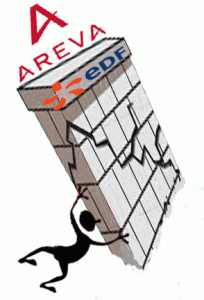 Electricite de France SA, the world’s largest operator of nuclear power plants, is stuck in a multibillion-dollar quandary that will shape its future.
Going ahead with new EPR atomic plants in the U.K. would strain the limits of its balance sheet as slumping electricity prices across Europe reduce cash flow. Dropping the Hinkley Point venture in southwest England would further damage the image of a new French-designed reactor, already tarnished by delays and cost overruns at projects elsewhere…….
The EPR reactor design from French nuclear group Areva SA was once a symbol of the nation’s engineering prowess. EDF’s former Chief Executive Officer Pierre Gadonneix predicted it would sell “like hotcakes” around the world. Project setbacks and the safety fears following the Fukushima disaster in Japan in 2011 stymied those plans, while a flood of competing energy supplies from solar and wind has left one of the nation’s most important industries in distress. - The two 1,600-megawatt plants at Hinkley Point would cost about 18 billion pounds ($26 billion), with China General Nuclear Power Corp. paying for a third. Standard & Poor’s is threatening to downgrade EDF’s credit rating if the U.K. project, which has been planned for more than eight years, goes ahead……
- EDF shares, 85 percent of which are owned by the French state, have lost as much as 89 percent of their value since peaking in 2007 and hit a record low on Feb. 25. French year-ahead wholesale electricity prices dropped 60 percent over the same period…….
-
Areva Burden
Areva has complicated matters for EDF, accumulating 5.5 billion euros of losses on the construction of an EPR in Finland that’s already seven years late. Areva was due to take 10 percent of Hinkley Point, with EDF taking 45 percent to 50 percent and two Chinese partners holding the remaining 40 percent. As Areva’s finances worsened, it withdrew, forcing EDF to raise its stake to 66.5 percent. To make matters worse, EDF was called to rescue Areva by the French government by taking a majority stake in its troubled reactor unit.
EDF has its own problems with the EPR it’s building in Flamanville. Costs have more than tripled to 10.5 billion euros and construction is now six years behind schedule. The French nuclear watchdog has expressed concerns about the strength of the reactor vessel, forcing EDF and Areva to conduct tests to prove its safety.
“EDF is vulnerable to events over which it has no control: falling power prices following deregulation, and the balance sheet knock-on impact from Areva’s financial troubles,” said Adam Dickens, an analyst at HSBC Holdings Plc, in a March 1 report.
The company is borrowing money to pay its dividend and plans to sell assets to finance new developments. It cut annual operational expenditures by 300 million euros, or 1.4 percent, last year and plans to reduce them by a further 700 million euros by 2018. On Feb. 16, it reduced its estimate for how much it will spend to extend the life of its French reactors by 5 billion euros to 50 billion euros.
“Risks are way too high, ” Francis Raillot, a representative of the CFE-CGC union at EDF, said on Feb. 29. “We want the final investment decision to be delayed. The future of the company is at stake.” http://www.bloomberg.com/news/articles/2016-03-03/french-mastery-of-nuclear-power-at-stake-in-u-k-reactor-project
This year, France will close Fassenheim, its oldest nuclear power station
France’s oldest nuke plant ‘to close this year’ , The Local 7 Mar 16, France is to close down its oldest nuclear power plant, at the centre of a row with neighbouring Germany and Switzerland, by the end of this year, a green minister said Sunday.
- Germany demands France shut old nuclear plant (04 Mar 16)
- Swiss sue French over ‘dangerous’ nuclear plant (03 Mar 16)
”The timeline is one the president has repeated to me several times, it’s2016,” said Emmanuelle Cosse, who was named to President Francois Hollande’s cabinet last month, referring to the Fassenheim plant.
Cosse was speaking to French media after a row sparked Friday when Germanydemanded that France close down Fassenheim following reports that a 2014 incident there was worse than earlier portrayed……..
On Sunday, Cosse said that to reach its target, the government would have”to close other nuclear plants, other reactors, obviously, over several years.”
Hollande named Cosse, a member of the French Greens Party (EELV), housingminister as part of a reshuffle seen as a bid to broaden his appeal ahead of a re-election bid next year. http://www.thelocal.fr/20160306/frances-oldest-nuke-plant-to-close-this-year
1 This Month

of the week – Shut Down Drone Warfare!


Tell the Ukrainian Government to Drop Prosecution of Peace Activist Yurii Sheliazhenko

Petition to revoke the licensing of the Near Surface Nuclear Disposal Facility (NSDF) at Chalk River. https://www.ourcommons.ca/petitions/en/Petition/Details?Petition=e-7247
To see nuclear-related stories in greater depth and intensity – go to https://nuclearinformation.wordpress.com
-
Archives
- April 2026 (114)
- March 2026 (251)
- February 2026 (268)
- January 2026 (308)
- December 2025 (358)
- November 2025 (359)
- October 2025 (376)
- September 2025 (257)
- August 2025 (319)
- July 2025 (230)
- June 2025 (348)
- May 2025 (261)
-
Categories
- 1
- 1 NUCLEAR ISSUES
- business and costs
- climate change
- culture and arts
- ENERGY
- environment
- health
- history
- indigenous issues
- Legal
- marketing of nuclear
- media
- opposition to nuclear
- PERSONAL STORIES
- politics
- politics international
- Religion and ethics
- safety
- secrets,lies and civil liberties
- spinbuster
- technology
- Uranium
- wastes
- weapons and war
- Women
- 2 WORLD
- ACTION
- AFRICA
- Atrocities
- AUSTRALIA
- Christina's notes
- Christina's themes
- culture and arts
- Events
- Fuk 2022
- Fuk 2023
- Fukushima 2017
- Fukushima 2018
- fukushima 2019
- Fukushima 2020
- Fukushima 2021
- general
- global warming
- Humour (God we need it)
- Nuclear
- RARE EARTHS
- Reference
- resources – print
- Resources -audiovicual
- Weekly Newsletter
- World
- World Nuclear
- YouTube
-
RSS
Entries RSS
Comments RSS
 nuclear-news