Hinkley nuclear project for UK and France political reasons: let’s stop pretending otherwise
The real point of this story is that nuclear power is not commercially viable but has become a state-sponsored technology. There is nothing wrong with state supported technology. But we could save a lot of time and money by not pretending that it is something else.

 Lets Stop Pretending Nuclear Power Is Commercially Viable http://oilprice.com/Alternative-Energy/Nuclear-Power/Lets-Stop-Pretending-Nuclear-Power-Is-Commercially-Viable.html By Leonard Hyman & William Tilles
Sat, 30 April 2016, First its new president, Jean-Bernard Levy, said French state utility EDF would delay a decision on its joint French-Chinese nuclear project in the UK, Hinkley Point. That was over a year ago. Then the CFO of EDF, Thomas Piquemal, quit reportedly because he opposed the project on fi-nancial grounds. That was a short time ago. Then after a leaked memos, the French gov-ernment just announced that EDF would be raising more money and the Hinkley decision would now come in September.
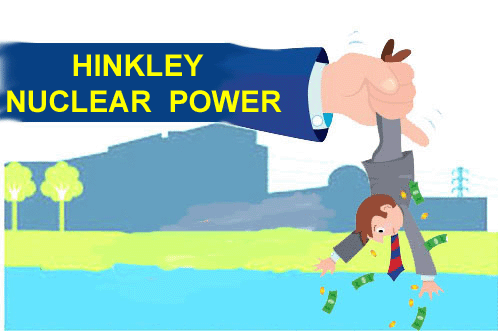
Now for the finances. These British nuclear units will cost roughly £18 billion ($27 billion). EDF has already sold a 35 percent share to the Chinese state nuclear company. However EDF still has to find more outside investors and get its ownership of the plant below 50 percent or it will have to consolidate Hinkley Point on its books and show all of the project’s debt on its own balance sheet.
If we were gamblers we would not wager that EDF will take the obvious first step towards restor-ing its financial health and cancels the Hinkley project. Of course, if David Cameron loses the Brexit vote (a referendum to take the UK out of the European Union) and is ejected from Number Ten Downing Street, a new Prime Minister might take a more skeptical view of Hinkley Point.
The real point of this story is that nuclear power is not commercially viable but has become a state-sponsored technology. There is nothing wrong with state supported technology. But we could save a lot of time and money by not pretending that it is something else.
French and Russian nuclear utilities to work together, on decommissiong, and more
 French and Russian nuclear utilities extend collaboration, World Nuclear News, 26 April 2016
French utility EDF has signed an agreement to extend its cooperation with Rosenergoatom, the operator of Russia’s civil nuclear power plants. The companies will cooperate in reactor operations, decommissioning and waste management…..
Through the agreement, EDF and Rosenergoatom intend to develop cooperation in areas such as the maintenance, modernization and operating period extension of nuclear power plants, as well as decommissioning and radioactive waste management http://www.world-nuclear-news.org/C-French-and-Russian-nuclear-utilities-extend-collaboration-2604164.html
Further delay for UK Hinkley nuclear project, as EDF decides to consult unions
 Fresh setback for Hinkley Point as EDF consults French unions, Telegraph UK Alan Tovey 22 APRIL 2016 Plans by EDF to build the new Hinkley Point nuclear power station have been further delayed after the French energy company said it would consult with unions before announcing its final investment decision.
After a board meeting on Friday, the company said it had agreed a “significant” recapitalisation that would make it “possible for EDF to proceed with its strategic investment programme – including Hinkley Point C”.
However, the directors added they would go through a formal consultation process with unions over the decision. Although it will not be binding on the board, this statutory process would take 60 days, pushing it close to the June 23 referendum on whether or not Britain will remain in the UK.
Sources close to the French government – which is EDF’s majority shareholder with an 85pc stake – said administrative delays could easily push this consultation past the date of the Brexit vote.
Consulting the unions over the decision presents fresh hurdles to the muchdelayed plan to build the Hinkley Point power station, the first in a fleet of new nuclear power stations for the UK.
Ten years ago, EDF was predicting Hinkley would be supplying power by 2017.
Unions are sceptical about whether EDF can afford the investment – which the French firm is financing two thirds of, with the rest coming from Chinese investors – and have made public their opposition to the scheme.
Some senior staff at EDF are also against the power company’s involvement in such a huge project…….http://www.telegraph.co.uk/business/2016/04/24/fresh-setback-for-hinkley-point-as-edf-consults-french-unions/
European law mean sit is illegal for France’s govt to fund EDF’s Hinkley nuclear project

 France funding Hinkley C ‘would be illegal’ under EU competition rules say Greenpeace and Ecotricity http://www.cheddarvalleygazette.co.uk/France-funding-Hinkley-C-illegal-EU-competition/story-29158662-detail/story.html By Cheddar Valley Gazette April 24, 2016 The European Commission is ‘almost certain’ to block the French Government spending billions of pounds of taxpayers’ money to make sure the Hinkley C nuclear power station project is completed.
That was the view of a coalition of West environmentalists today, who said if the French president Francois Hollande was to plunge £3 billion into Hinkley C, it would breach European state aid rules.
The European Union forbids states using taxpayers’ money to invest in projects which favour one company over another – and a new report revealed this morning by a leading London law firm says that would clearly be illegal under EU competition rules.
EDF, the firm planning to build a third nuclear power station in west Somerset, is majority-owned by the French Government anyway, but Greenpeace, Stroud-based renewable energy firm Ecotricity and the Green Party’s South West MEP, Molly Scott Cato, have all said they would challenge that decision, and ask the European Commission to block any state investment by France.
EDF is putting in half the £18 billion Hinkley C project cost, two Chinese nuclear energy firms are investing a third, but attempts by EDF to find that shortfall – one-sixth, or around £3 billion – have failed amid fears the project would be uneconomic.
The firm has gone to French Government ministers to ask for state backing, and that is ‘expected’ to be ratified and the project get the go-ahead in the next couple of weeks.
But the environmentalists who have long campaigned against Hinkley C said this morning that would breach EU competition rules, arguing the French Government should not be allowed to use taxpayers’ money to compete against energy providers in this country who receive no such help.
Dale Vince, Ecotricity founder, said his firm would consider legal action to stop Hinkley C. “It’s time for everyone to realise that we’ve reached the end of the road for Hinkley Point – it’s not going to happen,” he said.
“Illegal state aid is one thing, and we’ll work with Greenpeace to challenge that if it happens, but it’s not just financial issues, there are technical problems with Hinkley Point too – EDF are yet to build one of these reactors and their first two attempts are, between them, 16 years late and billions over budget.
“Our government needs to change its stance on green energy, which powered a quarter of the country last year and could do so much more if the sector received even a fraction of the economic and political support given the nuclear industry,” he added.
Greenpeace have yesterday wrote to energy minister Amber Rudd and chancellor George Osborne warning the ministers not to proceed with the project unless and until the French state support has been notified to and approved by the EU Commission.
“The only way Hinkley can be kept alive is on the life support machine of state aid,” said Greenpeace boss John Sauven. “EDF, if it is to stay in business, needs a new vision which is not looking backwards. And the UK Government needs to stop penalising the UK renewable energy industry in favour of propping up an ailing state owned nuclear industry in France.
“Globally, the nuclear market is shrinking year by year overtaken by the huge surge in renewable energy. The UK should be a haven for renewable energy investment given the massive potential for wind, solar and tidal to cost effectively meet our energy needs,” he added.
The legal opinion is given by Jon Turner QC, Ben Rayment and Julian Gregory, three eminent competition and EU law barristers from Monckton Chambers.
It sets out how the French government’s reported refinancing plans for EDF are likely to be illegal under EU law unless and until they are approved by the European Commission.
The European Commission’s investigation of state aid takes around a year, and it is doubtful that approval would be given.
“The numbers for the Hinkley deal have never stacked up and it is clear that the commercial case for this white elephant is dead,” said Green MEP for the south west, Molly Scott Cato.
“We have now a political battle where the stakes for both the UK and France are just too high to admit failure. But we cannot let this override EU rules on state aid or fair competition.”
“With EDF close to bankruptcy and serious questions over the legality of state aid for the project the French government and the French President are showing themselves to be totally irresponsible. The Board of EDF must put the interests of its shareholders and employees first and avoid committing economic suicide by rejecting a final investment decision,” she added.
EDF has consistently denied claims it was benefiting from illegal state aid, and robustly defended the legal action from Austria that the British Government’s agreement to pay EDF double the current electricity price for the energy Hinkley C will produce.
France’s tax-payers €3bn to save debt-ridden nuclear corporation EDF
 State pays €3bn to bail out EDF http://www.connexionfrance.com/france-edf-electricity-areva-nuclear-investment-bail-out-view-article.html April 24, 2016
THE GOVERNMENT has agreed to bail out struggling electricity company EDF to the tune of €3billion, months after it agreed a similar capital injection for nuclear energy giant Areva.
On Friday, EDF announced a €4billion capital investment programme, and the state – which owns an 85% stake in the company – has agreed to pay 75% of the cost.
The electricity giant has been fighting to bring its massive debts under control in the face of weak European electricity prices. It has also invested in several major projects, including a new British nuclear power plant at Hinkley Point.
The government said it would accept EDF shares as its dividend in 2016 and 2017, rather than cash. “The State reaffirms its confidence in the management of the company and all its employees for the success of EDF as part of a quality social dialogue,” argued the Ministries of Economy and Finance in a joint statement.
In return, EDF said it would aim to reduce its costs by €1billion in 2019 compared to 2015, and shave €2billion off its investment plans over the next three years. It had originally planned to make €700million in savings over three years. The group also plans to raise €10 billion by selling off gas, coal and oil interests.
Employee’s legal threat hangs over EDF’s U.K. Nuclear Project
EDF Unions Threaten to Go to Court Over U.K. Nuclear Project, Bloomberg, Francois De Beaupuy April 22, 2016
-
Employee representatives ask to be consulted before decision
-
Trade unions say they’ll sue if not consulted in advance
-
Electricite de France SA’s unions are threatening to take the company to court if employees are not consulted in advance on a decision concerning a proposed 18 billion-pound ($25.8 billion) U.K. atomic plant project.
EDF’s workers committee, which includes representatives from the biggest unions, met near Paris and voted to take legal action should the company fail to consult employees on Hinkley Point, according to a statement Thursday. The project is key to EDF earnings and has prompted disagreements between management and unions, it said.
“We ask that the workers’ committee is consulted before any decision by management or the board,” the committee said. If that didn’t happen then “the committee would be forced to take legal action to have any decision linked to the Hinkley Point project suspended or annulled.”
The threat marks the latest attempt by workers to delay a decision, given concerns about EDF’s finances amid falling power prices across Europe. Union FO has already threatened to call for a strike. EAS, an association of EDF employees holding the company’s shares, is asking the stock market regulator to require that the French government, which owns 85 percent of EDF, repurchases shares at the initial public offering price…..http://www.bloomberg.com/news/articles/2016-04-21/edf-unions-threaten-to-go-to-court-over-u-k-nuclear-project
French corporation EDF and its zombie nuclear reactors
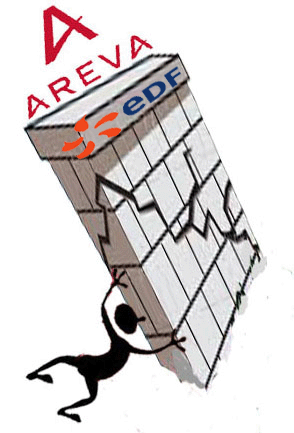 EdF: Living with its ZOMBIE REACTORS!, Jonathon Porritt, 24 Apr 16,
You seriously wouldn’t want to be a Director of EdF at the moment. The agenda for an average Board Meeting must be seriously gloomy on each and every occasion. Here’s how I imagine the key agenda items for their last meeting on 16th February – helpfullysummarised by EdF’s Company Secretary.
Item 1: Existing EPR construction projects
1.1 Olkiluoto (Finland)
Continuing, horrendous cost overruns, leading to ongoing legal stand-off with Finnish partners. Already delayed by seven years, but (hopefully!) could be finished by 2018.
1.2 Flamanville (France)
Continuing, horrendous cost overruns. Already delayed by nine years, but (hopefully!) could be finished by 2018.
1.3 Taishan (China)
Serious problems with both reactors under construction, but, this being China, everything’s shrouded in secrecy. WARNING: This could be much worse than we currently understand.
1.4 Pressure vessels
Still waiting for final safety assessment from French regulators. WARNING: There could be really serious problems here, despite our best efforts to ‘work with’ the regulator.
1.5 Deadlines/UK Treasury
These deadlines are now CRITICAL – as in EXISTENTIAL.
UK Treasury’s loan guarantees are linked to Flamanville operating successfully. And if it is not working properly by 2020, loan guarantee will be completely withdrawn.
Item 2: New reactors at Hinkley Point, Somerset………
Item 3: Extending the life of our UK reactors……
Item 4: Extending the life of our French reactors…….
Item 5: Energy Transition Law (France)…….
Item 6: Financial position…….
…..The implications of all this for the UK couldn’t possibly be more severe. Initially, HinkleyPoint was meant to be on stream by 2025, generating a whacking great 7% of total electricity supply. Earlier delays meant that this had already slipped to 2030. Now that the start date has slipped again, to 2019, AT THE EARLIEST, that 2030 date looks insanely optimistic…….http://www.jonathonporritt.com/blog/edf-living-its-zombie-reactors
France gives €3bn bailout to EDF’s Hinkley nuclear plant
 France gives €3bn lifeline to Hinkley nuclear plant, Sunday Times, Robin Pagnamenta, Energy Editor, 24 Apr 16, A decision on the proposed nuclear power station will not be taken until after an EDF shareholders’ meeeting Erance has thrown its support behind EDF, the French electricity company, and its plan to build the £18 billion nuclear power station at Hinkley Point, Somerset, by supplying a €3 billion lifeline.
President Hollande’s administration has agreed to put in the money towards a proposed €4 billion (£3 billion) cash-raising the company is proposing by issuing new shares. EDF said last night that the confirmation of the fundraising made it possible for the company to proceed with investments including Hinkley Point C by putting it on a “solid financial footing”……http://www.thetimes.co.uk/article/union-threats-force-edf-to-delay-hinkley-decision-0zf56xjms
EDF wants to extend depreciation period for nuclear plants this year, but nuclear watchdog may not be willing
 EDF to extend depreciation period for nuclear plants this year – CEO https://au.news.yahoo.com/world/a/31423313/edf-to-extend-depreciation-period-for-nuclear-plants-this-year-ceo/ Reuters on April 23, 2016 PARIS – French utility EDF will extend the depreciation period for its nuclear plants this year, its CEO said in a newspaper interview, an accounting move that will free up cash for costly investment projects in France and Britain.
“By the closing of our first-half results, we will draw the accounting consequences of our intention to extend the lifespan of our existing nuclear plants beyond 40 years,” EDF CEO Jean-Bernard Levy said in Saturday’s Le Figaro newspaper.
EDF had said before it intended to extend the lifespan of its French nuclear plants to 50 or 60 years, beyond the 40 years they were initially built for. Energy Minister Segolene Royal said in February that the government was willing to give the go-ahead for such a move.
But French nuclear watchdog ASN is the only authority allowed to grant such an extension, and it has said a decision on the matter would not come before 2018-2019. To make the accounting change, which would automatically boost EDF’s profits, the company must convince its auditors that there is a good chance of the extension being granted.
In 2003, EDF extended the depreciation schedule for nuclear reactors in its accounts to 40 years from 30 years – six years before the ASN agreed to the move.
The utility, 85 percent-owned by the French government, said on Friday it would seek to raise 4 billion euros ($4.5 billion), amid concerns that a 23 billion euro nuclear plant project at Hinkley Point in Britain would put a strain on its finances.
(Reporting by Michel Rose; Editing by Toby Chopra and Hugh Lawson)
EDF plan to help finance Hinkley nuclear project could be illegal
Legal challenge fuels doubt over Westcountry nuclear power station By WMNK Rossiter http://www.plymouthherald.co.uk/Legal-challenge-fuels-doubt-Westcountry-nuclear/story-29157974-detail/story.html April 22, 2016 By Keith Rossiter A French government plan to help energy company EDF to build a nuclear power station in Somerset could be illegal, barristers have warned.
Greenpeace and green energy company Ecotricity released a legal opinion on a proposed package of financial support.
French economy minister Emmanuel Macron insisted this week that the £18 billion Hinkley Point C power station will go ahead, in spite of doubts over the viability of the project.
EDF won the contract to build Hinkley Point, but has delayed giving the final go-ahead for months. The company has still not signed off a contract with its Chinese partner China General Nuclear Power Corporation.
Mr Macron said he was “actively working” with EDF and the UK Government to draw up the “final points” of a deal for Hinkley and that it was “very important for France” that the project went ahead.
EDF declined to comment on the Greenpeace claims.
The latest speculation, fuelled by Mr Macron, is that the French government would accept dividends from EDF in the form of shares rather than cash.
The legal experts say that the capital injection this would give to EDF would constitute state aid.
“This would destroy a level playing field for European energy companies,” Greenpeace said.
John Sauven, Greenpeace UK executive director, said: “The only way Hinkley can be kept alive is on the life support machine of state aid.
“The UK Government needs to stop penalising the UK renewable energy industry in favour of propping up an ailing state-owned nuclear industry in France.
“The UK should be a haven for renewable energy investment given the massive potential for wind, solar and tidal to cost effectively meet our energy needs.”
The legal opinion from competition and EU law barristers Jon Turner QC, Ben Rayment and Julian Gregory says that the reported refinancing plans for EDF are likely to be illegal under EU law unless and until they are approved by the European Commission.
Greenpeace has written to Amber Rudd, the Energy Secretary, and George Osborne, the Chancellor, warning them not to proceed with the project unless the French state support has been notified to and approved by the Commission.
Ecotricity says State aid for Hinkley would be harmful to EDF’s competitors.
Dale Vince, Ecotricity founder, said: “It’s time for everyone to realise that we’ve reached the end of the road for Hinkley Point – it’s not going to happen.
“Illegal state aid is one thing, but there are technical problems too. EDF is yet to build one of these reactors and their first two attempts are, between them, 16 years late and billions over budget.
“Our government needs to change its stance on green energy, which powered a quarter of the country last year and could do so much more if the sector received even a fraction of the economic and political support given the nuclear industry.”
Molly Scott Cato, Green MEP for the South West, has already asked the European Commission to investigate whether a proposed rescue plan for Hinkley C was in breach of European state aid rules.
She said: “The numbers for the Hinkley deal have never stacked up and it is clear that the commercial case for this white elephant is dead.
“We now have a political battle where the stakes for both the UK and France are just too high to admit failure.”
This week Amber Rudd said that further delays or even a cancellation of Hinkley would not compromise national energy supply.
Dr Scott Cato said: “We know the lights won’t go out if there is a concerted effort to implement Plan B based on renewable energy, energy efficiency and innovative smart grid and energy storage solutions.
“This could be delivered in time to prevent blackouts and create 122,000 quality jobs – many more than nuclear could ever hope to deliver.”
France’s nuclear corporation EDF warned on legal action over the Hinkley nuclear project debacle
Pressure rises on EDF board over Hinkley Point nuclear plant, FT.com, 19 Apr 16, Michael Stothard in Paris A group of managers at French utility EDF have sent a letter to its board of directors warning they could all face legal action if the company pushes ahead with its contentious Hinkley Point C nuclear project in the UK.
The letter, dated April 19 and seen by the Financial Times, said that if a board decision in favour of Hinkley Point led to the “destruction of the value” at EDF its directors could be held personally responsible……….
French president François Hollande is also meeting ministers at the Élysée Palace on Wednesday to discuss financing options for Hinkley Point. The French state has an 85 per cent stake in EDF.
The letter by the group of EDF managers highlights the internal battle that has raged within the company over Hinkley Point, with chief financial officer Thomas Piquemal resigning last month because of concerns that the UK project could threaten the company’s future…….
Two other nuclear projects in France and Finland using the same reactor technology proposed for Hinkley Point are both severely delayed and billions over budget…….. http://www.ft.com/intl/cms/s/0/d6d16bd0-0628-11e6-9b51-0fb5e65703ce.html#axzz46IzsG72i
EDF’s minority shareholders want French govt to be forced to buy them out.
EDF staff investors demands France buys out minorities in nuclear dispute
Staff shareholder group says state abuses majority
* Minorities say EDF used as government policy tool
* EAS fears Hinkley Point will crimp future dividends (Adds detail on dividend, EDF no comment)
Reuters By Geert De Clercq PARIS, April 19 An EDF employee shareholders group has asked the AMF market regulator to force the French state to buy out the utility’s minority shareholders, in a dispute over its plans to build nuclear plants in Britain.
In a letter to the AMF, seen by Reuters on Tuesday, EDF Actionnariat Salarie (EAS) asks the market regulator to consider requiring the state to launch a so-called public withdrawal bid.
EAS alleges that the government is abusing its position as a majority shareholder by forcing EDF to go ahead with building nuclear plants in Britain, which EAS says is too risky for EDF and will prevent it from paying dividends in coming years……..
HINKLEY POINT CONSEQUENCES
EAS argues that in pushing EDF’s 18 billion pound (22.8 billion euros) project to build two reactors at Hinkley Point, in Britain, the government defends the interests of the country’s nuclear industry rather than those of EDF, at the expense of its minority shareholders…….
Hinkley Point is crucial for the survival of reactor builder Areva and France’s many smaller nuclear companies, in an industry that employs about 200,000 people. With three quarters of its power generated by nuclear, France needs no more reactors, and export prospects are limited after the 2011 Fukushima disaster.
“While the state only owns 85 percent of EDF’s capital, it behaves as if it is the sole proprietor and uses the company as a lever for its industrial policy,” EAS said.
It also said the UK project will prevent EDF from paying a dividend for at least seven years……..
On Wednesday, the government will discuss EDF’s finances ahead of an EDF board meeting on Friday. Sources close to the company said the board will review financing options but will not decide on Hinkley Point. (1 euro = 0.7906 pounds) (Editing by Alexander Smith) http://www.reuters.com/article/edf-nuclear-shareholders-idUSL5N17M5CN
France’s nuclear corporation faces massive costs for decommissioning nuclear reactors
Nuclear reactor clean-up weighs on EDF, FT.com, 19 Apr 16, Michael Stothard in Paris French utility faces questions about whether it has set aside enough to decommission power plants
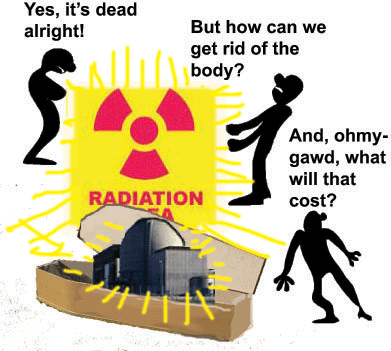 In 1997 French utility EDF started to dismantle its first nuclear power plant, a 30-year-old heavy water reactor in Brennilis, north-western France. It was expected to cost €250m.
The bill is now set to be at least half as much again, and the decommissioning is still not done. In fact, there has never been a full dismantling of a reactor in France, the only European country to get three-quarters of its electricity from nuclear power.
EDF, the operator of all 58 of France’s reactors, is preparing to build a new £18bn plant at Hinkley Point in the UK that some at the Paris-based company have warned is too dangerous given its stretched balance sheet. EDF’s other big reactor project, at Flamanville in France, is already six years behind schedule and €7.2bn over budget.
Hinkley and Flamanville have focused attention on another looming challenge for EDF: has the company set aside enough money to cover the huge cost of dismantling and cleaning up its existing nuclear power stations in France?
Unlike the UK, where the state has assumed much of the financial risk of taking apart nuclear reactors, in France it all falls on EDF, which has established a €23bn special fund for this purpose.
The €23bn — much of it invested in equities and bonds — has been set aside to cover what EDF estimates will be the €54bn cost of decommissioning the 58 reactors and safely storing their radioactive waste. This includes €23bn for dismantling the power stations, and €26bn for managing spent fuel………..
EDF faces several major investments. As well as the £18bn Hinkley Point project, EDF is involved in bailing out reactor designer Areva by buying a controlling stake in its reactor business for €2.5bn. It is also extending the life of France’s existing nuclear power stations until 2025, at a cost of €55bn.
And it is not just the decommissioning of the 58 reactors that is of concern. The estimated cost of storing radioactive waste — potentially for thousands of years — has been steadily rising………..http://www.ft.com/cms/s/0/c82ae2c4-0582-11e6-9b51-0fb5e65703ce.html#axzz46IzsG72i
France committed to investing in Hinkley nuclear plant, even if it bankrupts EDF
 French ‘committed’ to investing in Hinkley C nuclear plant Plymouth Herald April 17, 2016 By Kate Langston The French government is “completely committed” to building the Westcountry’s new nuclear power plant at Hinkley, the country’s ministers have confirmed.
In an interview with the BBC, the French economy minister Emmanuel Macron stressed the £18 billion project is “very important” to the French state, which owns 85% of energy firm EDF.He added that backers still need to finalise some “technical and industrial” aspects of the Hinkley C deal, but should be in a position to sign in a “week or more”.
The assurances from Mr Macron come less than a week after he sparked fresh fears for the Somerset-based development by announcing he had “not yet made a decision” about the investment.
They also follow the publication of a letter from the main union representing EDF workers stating the firm is “on the edge of bankruptcy”, and should not be risking billions of pounds in the UK……..
The original date for the generator to come online has been pushed back from 20203 to 2025, and the estimated cost has soared from £16 billion to between £18 and £24.5 billion…….
Mr Macron told journalists that Hinkley is “important for [France’s] commitment to nuclear energy”. “We back Hinkley Point project, it’s very important for France, it’s very important for the nuclear sector and EDF,” he said.
“Now we have to finalise the work, and especially the technical and industrial work, very closely with EDF, with the British government, to be in a situation to sign in the coming week or more.”
The EDF board was due to meet to make a final decision on its investment in Hinkley in January, but this was postponed and is now expected to take place in May.
But John Sauven, director of environmental pressure group Greenpeace which is opposed to the new plant, has accused Mr Macron of saying one thing to a UK audience “and another to the French”.
“He has made it abundantly clear in French that no decision has been made,” he told the BBC. “The reasons are clear: the costs are rising, the problems are mounting, and the opposition in France is growing.
“The alternatives are looking increasingly attractive no matter which language you speak.”……….http://www.plymouthherald.co.uk/French-committed-investing-Hinkley-C-nuclear/story-29126276-detail/story.html
EDF in America going for wind power, abandoning nuclear
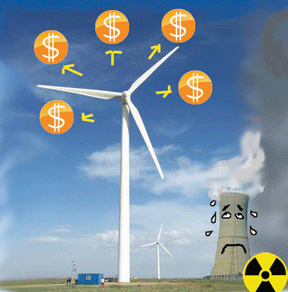 EDF shows that wind makes better sense than nuclear,Ecologist Chris Goodall April 2016 EDF in the UK may be propelled by its disastrous nuclear ambitions, writes Chris Goodall. But across the Atlantic it’s another story: the company is the US’s biggest wind developer, and selling its power, profitably, for under 40% of the price it has been promised for Hinkley C, including federal tax credits…….
Within the same company, they do things very differently on the other side of the Atlantic; there EDF focuses wholeheartedly on wind and has no nuclear under development.
It has just proudly announced that it has become the largest wind developer in North America with a portfolio in 2015 of over 1 gigawatt of newly constructed wind farms.
If it continues at the current rate, it will be generating more electricity from wind by 2025 than would be provided by Hinkley Point C. The numbers are as follows. Hinkley will generate about 25 terawatt hours a year. EDF’s 2015 annual portfolio of new wind projects will provide about 3 terawatt hours a year at average US utilisation factors.
If it continues to develop new wind projects at the rate of 1 gigawatt a year, it will be generating well over 30 terawatt hours a year from wind by the end of 2025. 2025 is when EDF says Hinkley will be finished.
What about the capital cost of wind versus nuclear? The latest US estimates suggest a figure of about $1,700 per kilowatt of capacity. That means EDF’s projects completed in 2015 cost about $1.8bn. Over ten years, that rate of installation will mean a total cost of around $18bn or about £13bn. Wind is therefore at least 30% cheaper to construct.
And it is much cheaper to operate. The most important project it completed in 2015, the 250 MW farm at Roosevelt in New Mexico, has sold its electricity for the next 20 years to a utility for $23.39 a megawatt hour, less than 20% of the price agreed for Hinkley of £92.50/MWh.
Note that the Roosevelt price is somewhat subsidised by Federal tax credits but even without this benefit the cost of wind would be less than 40% of the price of UK nuclear. Wind saves consumers money when compared to the nuclear alternative.
It’s simple really: renewables are a better and more secure investment
EDF finances many of its US wind projects on the back of power purchase agreements with major companies such as Microsoft, Procter and Gamble and Google. They commit to buy the electricity produced at a fixed price, not the inflation adjusted figure that the UK will pay for Hinkley. The EDF press release said:
“Corporate America is increasingly turning to renewable energy to power its business operations, based both on consumer preferences and because renewable energy simply makes economic sense.”
We never hear this line from EDF in the UK.
EDF cannot guarantee the wind will blow or the sun shine. Unlike in Britain, its US business is also investing heavily in energy storage. The US company has announced 100MW of battery systems in the US because “Energy storage is an attractive, cost-effective addition to intermittent energy generation projects.” However there’s no mention of batteries on EDF’s UK web site.
For sensible reasons large international companies often pursue varied market strategies in different countries. EDF in the US has decided to back wind while the UK has gone for nuclear.
But even a quick look shows that the energy and financial returns to the US strategy seem far clearer and better for the company, and its customers, than the tactics of the UK business. http://www.theecologist.org/blogs_and_comments/commentators/2987489/edf_shows_that_wind_makes_better_sense_than_nuclear.html
1 This Month

of the week – Shut Down Drone Warfare!


Tell the Ukrainian Government to Drop Prosecution of Peace Activist Yurii Sheliazhenko

Petition to revoke the licensing of the Near Surface Nuclear Disposal Facility (NSDF) at Chalk River. https://www.ourcommons.ca/petitions/en/Petition/Details?Petition=e-7247
To see nuclear-related stories in greater depth and intensity – go to https://nuclearinformation.wordpress.com
-
Archives
- April 2026 (114)
- March 2026 (251)
- February 2026 (268)
- January 2026 (308)
- December 2025 (358)
- November 2025 (359)
- October 2025 (376)
- September 2025 (257)
- August 2025 (319)
- July 2025 (230)
- June 2025 (348)
- May 2025 (261)
-
Categories
- 1
- 1 NUCLEAR ISSUES
- business and costs
- climate change
- culture and arts
- ENERGY
- environment
- health
- history
- indigenous issues
- Legal
- marketing of nuclear
- media
- opposition to nuclear
- PERSONAL STORIES
- politics
- politics international
- Religion and ethics
- safety
- secrets,lies and civil liberties
- spinbuster
- technology
- Uranium
- wastes
- weapons and war
- Women
- 2 WORLD
- ACTION
- AFRICA
- Atrocities
- AUSTRALIA
- Christina's notes
- Christina's themes
- culture and arts
- Events
- Fuk 2022
- Fuk 2023
- Fukushima 2017
- Fukushima 2018
- fukushima 2019
- Fukushima 2020
- Fukushima 2021
- general
- global warming
- Humour (God we need it)
- Nuclear
- RARE EARTHS
- Reference
- resources – print
- Resources -audiovicual
- Weekly Newsletter
- World
- World Nuclear
- YouTube
-
RSS
Entries RSS
Comments RSS
 nuclear-news