 ill-equipped to make nuclear parts – French watchdog, Reuters,
Creusot Forge machinery inadequate for making huge parts
* Areva stopped commercial production at factory last year
* Areva wants to restart plant this summer
* Nuclear watchdog must give permission for restart
* Critics say oversight of French nuclear industry needs review
By Geert De Clercq PARIS, March 16 Creusot Forge, a supplier of nuclear plants around the world owned by France’s Areva , is under investigation for making substandard parts and falsifying documents.
Now, France’s nuclear regulator says machinery at the plant, which was shut for commercial production last year, is not up to the job. n an interview, Remy Catteau, the head of nuclear equipment at the ASN (Nuclear Safety Authority), said that an inspection of the plant late last year showed that it did not have the right equipment to produce the parts for the nuclear reactors. “Creusot Forge is at the limit of its technical capacity. The tools at its disposal are not adequate to manufacture such huge components. In such a situation, errors are made,” Catteau told Reuters by telephone.
“The inspection brought to light the fact that the safety culture in the plant is not sufficient to produce nuclear components.”
The disclosure adds to the problems of Areva, once the world’s biggest nuclear company, which owns Creusot Forge.
Areva shut the factory after it found that manufacturing documents at the plant may have been falsified over some 40 years and parts made by the foundry did not meet specifications.
Authorities around the world have checked the nuclear reactors using the parts. Two reactors in France – Fessenheim 2 and Gravelines 5 – were shut after the checks due to safety concerns.
The investigation by the regulator is ongoing but Areva hopes to restart production at the factory this summer, if ASN allows it……
INSPECTIONS
Precision is critical when making parts such as containment vessels, which are huge steel cylinders that house the reactor core and control rods.
Creusot Forge made the vessel lid and bottom for the Flamanville 3 EPR reactor under construction in western France. But at the end of 2014, Areva discovered excessive carbon concentrations in those components, which weaken the steel.
“For Flamanville 3, the equipment was at its limit, there was no margin for error,” Catteau said.
Flamanville’s future is now uncertain. The ASN will rule by the summer whether the new reactor can go into operation by 2018, despite those weak spots. A red light would lead to years of further delays for Areva and its customer EDF.
Regulators from the U.S., Britain, China and other countries are also looking into quality and manufacturing issues at the Creusot Forge foundry in eastern France after Areva unearthed the false manufacturing documentation from the 1965-2013 period.
“One of the ways to resolve problems was to hide things, and that was the wrong way,” Catteau said……..
Areva is being restructured and recapitalized with help from the French state after years of losses wiped out its equity. It lost 665 million euros ($702 million) last year, 2.04 billion euros in 2015 and 4.83 billion euros in 2014.
Critics of France’s nuclear energy establishment say the problems at Creusot Forge prove that oversight of the whole industry, including the ASN, needs an overhaul.
World Nuclear Industry Status Report author Mycle Schneider said France’s parliament should task independent experts with an inquiry, but he does not see the political will for that.
“The entire chain of responsibility has failed, from Areva to its client EDF and the ASN. I don’t see an initiative yet that addresses the entire scope of the problem,” Schneider said. ($1 = 0.9426 euros) (Editing by Anna Willard) http://www.reuters.com/article/areva-safety-creusot-idUSL5N1GM2XM
March 17, 2017
Posted by Christina Macpherson |
France, safety |
1 Comment
 No2NuclearPower, No.93 March 2017
The French government is selling assets so it can prop up its heavily indebted nuclear utilities. EDF announced in 2015 that it would divest €10bn of assets by 2020 to ease its debt load ‒ which now stands at €37.4bn. EDF, which is supposed to be building a new nuclear plant at Hinkley Point, issued three profit warnings last year following a string of unplanned nuclear plant shutdowns.
EDF is contending with a government-directed restructuring of the French nuclear industry, and is being pushed by the French state, its controlling shareholder, to rescue reactor builder Areva by taking over the part of its struggling business that is behind EPR technology. The EPR reactor that EDF is building at Flamanville in France is already six years late and €7.2bn over budget. A large drop in French nuclear output over the winter due to safety inspections on 18 of its French reactors, at the request of the country’s nuclear regulator ASN, was partly to blame for a sharp drop in profits. Furthermore, the company is saddled with debt and needs to spend €55bn upgrading its existing reactors in France. (4) A recent report for Greenpeace France suggests that if EDF has to close 17 of its 58 reactors to meet the government’s requirement that nuclear power should provide 50% of the nation’s electricity in 2025, then EDF will have to increase its provisions by more than €20 billion. The cost of handling nuclear waste will add at least €33.5 billion to that figure. (5)
A French parliamentary committee said that EDF would need a public bailout to meet the cost of closing ageing power stations. The warning was issued after unions expressed fury about an announcement that EDF plans to cut 3,900 jobs in France over the next three years. Jean-Marc Sylvestre, an economics commentator, said that the group was on the “edge of a precipice” and faced a choice between privatisation and bankruptcy. He described EDF’s situation as a “catastrophe foretold”. EDF’ s critics say that the company, which has debts of more than €37 billion lacks the financial resources to meet its commitments in France, let alone embark upon the Hinkley Point scheme. Their concerns were fuelled with the publication of a report by the committee for sustainable development, which accused EDF of failing to plan for the dismantling of its plants. (6) EDF has only set aside has €36 billion to pay to clean up reactors at the end of their working lives, whereas it needs €75 billion. EDF disputes the figures. (7) http://www.no2nuclearpower.org.uk/nuclearnews/NuClearNewsNo93.pdf
March 4, 2017
Posted by Christina Macpherson |
business and costs, France |
1 Comment
 EDF faces £1m a day bill to keep French nuclear reactor offline https://www.theguardian.com/business/2017/feb/21/edf-faces-1m-a-day-bill-to-keep-french-nuclear-reactor-offline Prolonged closure at Flamanville plant after fire damage piles further financial pressure on state-owned energy firm, Guardian, Adam Vaughan, 21 Feb 17, The prolonged closure of a major French atomic reactor after an explosion this month probably costs EDF at least £1m a day, according to experts.
The nuclear plant operator, which will spend £18bn building the UK’s first new nuclear power station in a generation, shut unit 1 at its Flamanville plant after a fire broke out in the turbine hall.
The company initially estimated it would switch on the reactor within a week, but later pushed the date to the end of March. Work begins this week on replacing damaged equipment.
The unexpectedly long closure adds to the financial pressure on EDF, which last week reported a 6.7% decline in core earnings to €16.4bn (£14bn) in 2016. Closures of its French nuclear plants last year, partly for safety checks, have already cost the 85% state-owned company an estimated €1.3bn.
Prof Neil C Hyatt, head of nuclear materials chemistry at the University of Sheffield, said the lost revenue from the reactor closure in Normandy could be £1m per day.
“Bringing a nuclear power plant back online after an unscheduled outage is a complex task and EDF will want to ensure that all parts of the system are working safely and effectively. A short delay to complete the necessary checks is to be expected, given that the outage was unplanned,” he said.
Another expert said the cost of closure could be up to £1.8m per day, depending on energy market prices, and questioned why there was a delay.
“It took operator EDF almost a week to progressively correct the original outage estimate from one day to 50 days. EDF has provided no information as to why the outage time went from a few days to seven weeks,” said Mycle Schneider, a nuclear energy consultant based in Paris.
The 1.3GW reactor at Flamanville is one of a dozen of EDF’s French nuclear fleet currently offline, which the company said was usual for this time of the year.
It did not say why the restart date for the reactor had been revised four times, or why it had jumped from a few days to more than six weeks. John Large, a nuclear consultant who has advised the UK government, said initial reports that the fire was in a ventilator suggested the offline reactor would be back online within a week or two. Replacing such parts should be relatively straightforward, he said.
He added that the plant’s continued closure would also add to headaches at the French grid operator RTE, which warned of power cuts at the start of winter due to nuclear outages. “The continuing impact on the grid is likely to be significant, especially if a cold snap develops,” Large said.
A second reactor at the plant is still supplying electricity to the French grid. EDF said: “Work on recommissioning the affected equipment has started this week and should last several weeks, with reconnection to the grid planned for the end of March.”
February 22, 2017
Posted by Christina Macpherson |
business and costs, France |
Leave a comment
 Algerians take steps to prosecute France for nuclear tests https://www.middleeastmonitor.com/20170215-algerians-take-steps-to-prosecute-france-for-nuclear-tests/#.WKqZtaGEIJo.facebook
The top human rights organisation in Algeria announced yesterday that it has contacted the UN Human Rights Council regarding France’s refusal to admit to the crimes of its nuclear test programme. The French government carried out 17 nuclear tests in the Algerian desert, causing the death of 42,000 individuals; thousands more were left chronically ill due to being exposed to nuclear radiation.
The details were revealed in a statement by the National Secretary of the Algerian League for the Defence of Human Rights, Houari Kaddour, who is tasked with this issue, during an interview with Anadolu news agency. Kaddour stressed that his organisation “is trying to use all legal means to put the French authorities on trial and prosecute them in all international legal bodies, as well as in the EU, for their crimes.”
Algeria marked the 57th anniversary of the French nuclear tests two days ago. They were carried out between 1960 and 1966; Algeria gained independence from France in 1962. The French authorities still refuse to admit to these crimes and instead have announced that they will pay financial compensation to the victims.
According to Kaddour, his organisation contacted the UN Human Rights council and requested it to look into the crimes. “We also urged the Algerians in Europe to help us find lawyers specialising in international law to file a lawsuit against France in the next three months, before the Office of the High Commissioner on Human Rights in the EU. We also plan to prosecute France in the local courts in Switzerland which specialise in international crimes.”
Kaddour said that his organisation is coordinating with a number of human rights and international bodies in this regard, including all international human rights organisations, international organisations against nuclear testing, and French human rights groups. He noted that the Algerians had submitted over 730,000 compensation cases that were rejected by the compensation committee due to the impossible conditions imposed on the victims. Civilian victims, he added, are not recognised.
The Algerian League for the Defence of Human Rights accused the Algerian authorities of “not putting enough pressure on France to admit to these crimes.”
February 22, 2017
Posted by Christina Macpherson |
France, Legal |
Leave a comment
 It is extraordinary that some French wine producers are accompanying the Australian and French nuclear promoters spruiking the benefits of nuclear waste dumping to the community in the Barndioota region of South Australia. Not only are many vital questions unanswered as ENuFF SA (Everyone for a Nuclear Free Future SA) has shown, but this propaganda campaign completely ignores both the opposition to nuclear waste dumping, in France and the radioactive danger to France’s Champagne vineyards
“The Champagne producers are facing two nuclear timebombs – one already leaking at Soulaine, and one planned at Bure. The wine producers in the Rhone region stood up to the nuclear state in France and won. The Champagne region needs to act fast before it’s too late,” said Fred Marillier of Greenpeace France. “The French Government must stop this madness. The new facility must not accept any more waste, and an immediate investigation launched into how to stop further contamination of ground water.”
Radioactive waste leaking into Champagne Water Supply, Levels set to rise warns Greenpeace, Greenpeace 30 May, 2006 Greenpeace today revealed that France’s iconic sparkling wine, Champagne, is threatened by radioactive contamination leaking from a nuclear waste dumpsite in the region. Low levels of radioactivity have already been found in underground water less than 10 km from the famous Champagne vineyards.
Problems at the dumpsite, including water migration leading to fissures in the storage cells have been reported to French nuclear safety agency in recent weeks (1). Greenpeace has written to the Comita des Producteur de Champagne to warn them that their production risks contamination, as experienced by dairy farmers in la Hague, Normandy.

The waste dump, Centre Stockage l’Aube (CSA) in Soulaine eastern France, contains mostly waste from Electricite de France (EdF) and AREVA, but also includes foreign nuclear waste disposed of illegally under French law (2). Every week nuclear waste is trucked across France to the Champagne site. Once full, the dumpsite will be one of the world’s largest with over 1 million cubic meters of waste, including plutonium and other radionuclides.
ANDRA, the national nuclear waste agency operating the site, stated that it would not release any radioactivity into the environment when given permission for the dumpsite in the late 1980’s. Greenpeace research released last week showed levels of radioactivity leaking from another dumpsite run by ANDRA in Normandy were up to 90 times above European safety limits in underground water used by farmers, and that the contamination was spreading into the countryside (3). The Champagne site will receive a total of 4 thousand terabequerels of tritium; more than three times the amount of tritium waste as the dumpsite in Normandy.
“We have been told for decades that nuclear dumpsites will not leak and that the best standards are being applied. In reality the dumpsite in Normandy is a disaster, and radioactivity is already leaking from the dumpsite in Champagne,” said Shaun Burnie nuclear campaigner at Greenpeace International. “The authorities know they have a problem in Champagne already, with mistakes in the design. This is only the beginning of the problem, the bigger picture is that France has a nuclear waste crisis out of control that is threatening not only the environment and public health but also the economy of the Champagne region.”
In addition to the problems with the waste stores at the site, Greenpeace has learnt recently that French nuclear safety agency DGSNR has written to AREVA seeking clarification of the type of waste being disposed of at the Champagne site (4).
In addition to the low and intermediate waste site, a new high-level waste dumpsite is being planned in Bure also in the Champagne region, in which the most radioactive material in France would be deposited. Plans to build a high level waste facility in the Rhone Valley were scrapped a few years ago after strong opposition by the wine producers due to the threat to their vines and wine production.
“The Champagne producers are facing two nuclear timebombs – one already leaking at Soulaine, and one planned at Bure. The wine producers in the Rhone region stood up to the nuclear state in France and won. The Champagne region needs to act fast before it’s too late,” said Fred Marillier of Greenpeace France. “The French Government must stop this madness. The new facility must not accept any more waste, and an immediate investigation launched into how to stop further contamination of ground water.”……http://www.greenpeace.org/international/en/press/releases/radioactive-waste-leaking-into/
February 10, 2017
Posted by Christina Macpherson |
AUSTRALIA, environment, France, spinbuster |
Leave a comment

 Flamanville plant in northern France has been hit by a massive explosion Staff writers, news.com.au News Corp Australia Network 9 Feb 17 AN EXPLOSION at a nuclear power plant on France’s northwest coast on Thursday caused minor injuries, but the authorities said there was no risk of radiation.
The blast occurred in the engine room at the Flamanville plant, which lies 25 kilometres west of the port of Cherbourg and just across from the Channel Islands. “It is a technical incident. It is not a nuclear accident,” senior local official Jacques Witkowski said. He said a ventilator had exploded outside the nuclear zone at the plant, which has been in operation since the 1980s and is operated by state-controlled energy giant EDF.
“It’s all over. The emergency teams are leaving,” Mr Witkowski said.Five people suffered smoke inhalation but there were no serious injuries, Mr Witkowski said.
One of the two pressurised water reactors at the plant was shut down after the explosion and the incident was declared over at 1100 GMT (10pm AEDT), the authorities said.
The two 1300 megawatt reactors have been in service since 1985 and 1986, and the site currently employs 810 people, along with an additional 350 subcontractors.
A new third-generation reactor known as EPR is being built at Flamanville, which will be the world’s largest when it goes into operation in late 2018.
“Explosions in turbines, usually related to oil in bearings overheating, are not uncommon and occur from time to time in conventional coal, oil or gas plants,” said Barry Marsden, a professor of nuclear graphite technology at the University of Manchester.
But Neil Hyatt, a professor of radioactive waste management at Sheffiled University said the incident should not be taken lightly.
“Any incident of this kind at a nuclear power plant is very serious, and the national and international regulators will want to undertake a thorough investigation to understand the cause and lessons to be learned,” he said.
Construction of the new reactor at Flamanville began in 2007 and was initially due for completion in 2012 but has been delayed several times, and its initial budget has more than tripled, to 10.5 billion euros ($11.2 billion)…….http://www.news.com.au/world/europe/flamanville-plant-in-northern-france-has-been-hit-by-a-massive-explosion/news-story/28f0f083f4850f3289939ed489f56c95
February 10, 2017
Posted by Christina Macpherson |
France, incidents |
Leave a comment
France joins suitors for Kenya’s nuclear plant venture, Business Daily Africa, NEVILLE OTUKI, notuki@ke.nationmedia.com February 7 2017 IN SUMMARY French Economy and Finance minister Michel Sapin said the nuclear-rich European country was looking to offer Kenya technical, engineering and financial support to develop reactors.
Kenya plans to start building its first nuclear plant from 2022 in a five-year period at a cost of about Sh500 billion
China, Russia, South Korea and Slovakia have since inked various pacts with Kenya in manpower development and skills exchange as they eye a possible deal.
France has joined the list of countries courting Kenya for a multi-billion-dollar deal to build East Africa’s first nuclear power plant.

French Economy and Finance minister Michel Sapin said the nuclear-rich European country was looking to offer Kenya technical, engineering and financial support to develop reactors.
Kenya plans to start building its first nuclear plant from 2022 in a five-year period at a cost of about Sh500 billion.
China, Russia, South Korea and Slovakia have since inked various pacts with Kenya in manpower development and skills exchange as they eye a possible deal.
“We have expressed our readiness to support the construction of the plants. Our support involves everything from expertise to funding,” Mr Sapin said on Sunday after concluding his two-day visit to Kenya during which he presided over the return of Peugeot assembly to Kenya…….
Mr Sapin said that France was seeking pacts with Nairobi like the ones it entered with South Africa on nuclear power development.
France has over the years signed several pacts with South Africa whose two power plants were built by French firm Areva.
South Africa plans to add more nuclear power plants.
Energy experts from Italy and Germany last October, however, advised Kenya to drop plans to build nuclear reactors and instead harness its vast renewable energy resources for power generation. The experts, attending a renewable energy conference in Nairobi, reckoned that Kenya is better off developing more geothermal wells, solar parks and wind farms.
They cited massive costs for a nuke plant, long construction periods of about 10 years and expensive decommissioning of plants at the end of their lifespan, especially disposing of hazardous radioactive waste.
February 8, 2017
Posted by Christina Macpherson |
France, Kenya, marketing |
Leave a comment
 SA’s nuclear build contract still wide open, says France minister, SUNDAY TIMES BUSINESS BY ASHA SPECKMAN, 2017-02-05 France’s finance minister Michel Sapin believes the race between suppliers to win South Africa’s nuclear build is still wide open and that France has a trick up its sleeve.
Sapin addressed the media in Pretoria on Friday after a meeting with Finance Minister Pravin Gordhan on the same day that he discussed issues related to the nuclear build.
Communicating through a translator, he said he had reminded Gordhan of the “quality and the know-how of French companies” which operate in the nuclear sector and has asked for “full transparency” on the process. The talks had also broached the questions of price, financing and affordability of the project. But Sapin declined to go into further detail.
Russia’s Rosatom was rumoured to be a frontrunner in the bidding for the multibillion-rand nuclear contract. But last month it denied it had made an official bid. French nuclear companies EDF Group and Areva intend to put in a joint bid but had not yet done so, Sapin said. “I still have a feeling the competition is open and we’ll see how it unfolds. France is not afraid of competition … We have trump cards up our sleeves,” he said.
Sapin’s was a working visit to deepen relationships and did not involve signing agreements. It forms part of a concerted drive by the French government to expand its partnerships in the wake of Brexit,which would have major trade implications……..http://www.timeslive.co.za/sundaytimes/businesstimes/2017/02/05/SAs-nuclear-build-contract-still-wide-open-says-France-minister
February 6, 2017
Posted by Christina Macpherson |
France, marketing |
Leave a comment
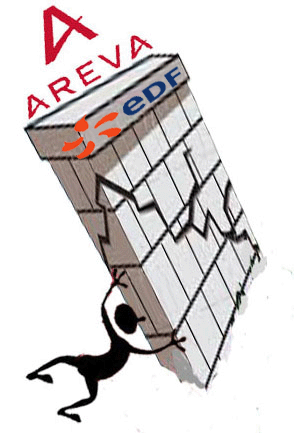 France’s Next President May Face $3 Billion Nuclear Hangover,
  Bloomberg by Francois De BeaupuyFebruary 4, 2017,
Whoever succeeds Francois Hollande as France’s president may find one of their first tasks in office will be selling off some of the nation’s prized assets to prop up the state’s nuclear industry.
That’s because the government is as much as 3 billion euros ($3.2 billion) short of the 7.5 billion euros it has said it needs this year to fix the financial problems of Areva SA and Electricite de France SA, said two government officials with direct knowledge of the matter. Hollande will try to find an answer before he leaves office in June, one of the people said. If he can’t, his successor must decide how to plug the gap, said the other person.
France is preparing to rescue its nuclear industry after EDF was weakened by falling European power prices and Areva lost billions on a long-delayed project in Finland. The president must either increase the national debt or weigh politically sensitive privatizations of holdings in anything from automakers such as Renault SA to the former phone monopoly — a tall order with the first round of presidential elections just three months away…….
While the government has enough in its privatization account for the 3 billion-euro stimulus it plans for EDF this quarter, it remains almost 3 billion euros short of the 4.5 billion euros it wants to help its near-bankrupt reactor maker, Areva, complete its restructuring and meet debt repayments this year, said the officials. Areva shareholders on Friday voted in favor of a 5 billion-euro state-backed bailout, which includes 500 million euros from Japanese investors………https://www.bloomberg.com/news/articles/2017-02-03/france-s-next-president-said-to-face-3-billion-nuclear-hangover
February 4, 2017
Posted by Christina Macpherson |
business and costs, France, politics |
Leave a comment
 EDF board approves closure of oldest nuclear power station in France
Decision on Fessenheim plant comes after pressure from Berlin and need to comply with legal cap on atomic energy generation, Guardian, Adam Vaughan, 25 Jan 17, EDF has voted to begin the process of closing France’s oldest nuclear power station after pressure from Germany and a law capping the country’s reliance on atomic power.
The French energy firm’s board approved plans on Tuesday to close the 39-year old Fessenheim plant in north-east France, near the German border, allaying fears that the company, which is 85%-state owned, would drag its heels until President François Hollande left office later this year.
Hollande had promised in his manifesto to shut the site in an effort to build an alliance with the Green party. Fessenheim has also been the subject of complaints about safety from the German and Swiss governments.
Under Hollande, France has pledged to reduce its reliance on nuclear from 78% of electricity generation to 50% by 2025 and increase its use of renewables, such as wind and solar. The country’s nuclear plants are ageing, with many expected to come to the end of their life in the 2030s.
France’s energy transition law caps the amount of nuclear power at 63.2 gigawatts, meaning the Fessenheim plant needs to close in 2018 to pave the way for a new one at Flamanville.
Under the deal agreed by EDF, the company will be paid €490m (£420m) in compensation for dismantling the plant and retraining its 850 workers.
“With this decision on the part of its board of directors, EDF is guaranteeing compliance with legislation imposing a ceiling for France’s installed nuclear electricity generation capacity, while at the same time safeguarding to the utmost the interests of the company and its customers,” said Jean-Bernard Lévy, its chief executive……..https://www.theguardian.com/world/2017/jan/24/edf-board-approves-closure-of-oldest-nuclear-power-station-france-fessenheim-plant
January 25, 2017
Posted by Christina Macpherson |
business and costs, France |
Leave a comment

 Safety fears over EDF bid to permit doubling of nuclear reactor cracks The Herald, 22 Jan 17 THE nuclear industry is secretly bidding to relax safety standards to allow the doubling of the number of cracks in the radioactive cores of Scotland’s ageing reactors
EDF Energy is asking for the safety rules to be rewritten so that it can keep running its nuclear power stations at Hunterston in North Ayrshire and Torness in East Lothian until they are at least 47 and 42 years old. They were originally designed to last 30 years.
Prolonged radiation bombardment causes the thousands of graphite bricks that make up reactor cores to crack, threatening a safe shutdown. But EDF is asking the UK government’s watchdog, the Office for Nuclear Regulation (ONR), to permit an increase in the proportion of cracked bricks from 10 to 20 per cent.
The revelation has sparked alarm from politicians and campaigners, who say that the industry is “gambling with public safety” and the public must be consulted. One leading expert argues that Hunterston should be immediately shut down
Hunterston started generating electricity in 1976. EDF currently plans to keep it operating until 2023, and the ONR is due to conclude a safety review of its future operation at the end of January
On January 13 EDF closed down one of Hunterston’s two reactors for planned maintenance, including inspections of cracking in the graphite core. The reactor is due to be restarted on February 10.
Torness was started up in 1988 and is currently planned to operate until 2030. The company, however, has said that it is hoping that the lives of both nuclear stations can be extended by a few more years.
EDF’s bid to relax safety standards at Hunterston and Torness is highlighted in a new report today for the Scottish Greens. It concludes that the risks from graphite cracking are serious and argues that an international convention demands that environmental risks must be assessed, alternative energy sources considered and the public consulted.
According to the report’s author, Edinburgh-based anti-nuclear campaigner and consultant, Peter Roche, Scotland doesn’t need nuclear electricity. “Despite the fact cracks are beginning in the graphite core of these reactors, increasing the risk for us all, the public has still not been asked for its opinion once,” he said……..
John Large, a consulting nuclear engineer, pointed out that the integrity of the graphite bricks was vital to nuclear safety. If they failed, they could block channels that enable control rods to be inserted to close down reactors and prevent them from overheating.
“Ageing problems like this serious cracking of the graphite bricks at the heart of each reactor are deeply worrying, so much so that these nuclear plants should now be permanently shut down,” he said.
Large accused EDF and the ONR of “false confidence” in believing they fully understood graphite cracking, which was difficult to predict. “The Hunterston B nuclear reactors now in their forty-first year of operation, should be immediately shut down,” he stated….
The company also argued that environmental impact assessments – and, by implication – public consultations were not required for life extensions at Hunterston and Torness..
ONR’s deputy chief inspector Mark Foy confirmed that EDF had asked for the proportion of graphite bricks allowed to be cracked to rise from 10 to 20 per cent. “That is provided to us in the form of a comprehensive justification, which we will assess to see whether we’re satisfied it’s safe to operate,” he said…….. http://www.heraldscotland.com/news/15039668.Safety_fears_over_EDF_bid_to_permit_doubling_of_nuclear_reactor_cracks/
January 23, 2017
Posted by Christina Macpherson |
France, safety |
Leave a comment
EDF board prepares to defy Hollande on nuclear closure Power company’s bid to keep plant open shows president’s waning authority, Ft.com 19 Jan 17 by: Michael Stothard in Paris François Hollande risks falling short on another pledge as the board of state-controlled energy company EDF next week prepares to vote down his plans to close France’s oldest nuclear plant.
The French president promised in 2012 to shut down the Fessenheim power plant near the German and Swiss borders — long a target for anti-nuclear activists — in a bid to win over the Green party. But with just months left of his mandate ahead of the presidential election on April 23, some within EDF are attempting to drag their feet long enough for a change of government, according to three people with knowledge of the situation……..
Mr Hollande’s difficulties are partly down to a legal quirk with the vote. Six government-appointed representatives on the boardare not allowed to vote on the motion because of a conflict of interest, according to people close to the company. Six union representatives are set to vote against closure. The CGT and moderate CFDT unions have both said publicly that they will do so to protect the 850 workers at the site. This means it will take only one of the six remaining independent board members to vote against closure for the motion to be rejected. According to several people with knowledge of the situation, at least one is willing to vote no.
The Hollande government has put immense pressure on EDF to formalise the closure……..
The government does hold some cards. The state, as well as owning 85 per cent of the company’s equity, is participating in a €3bn capital raising. It must also sign off on an extension of the licence for a stopped second reactor at Paluel in northern France. A person close to the situation said the government could conceivably find a way around the board opposition or convince some board members to change their mind. …….
If EDF hangs on long enough, it might be able to resist the closure of Fessenheim completely. François Fillon, the centre-right presidential candidate who is the frontrunner to win the presidential election, has said he is against the closure of the plant.
https://www.ft.com/content/62551c48-de77-11e6-9d7c-be108f1c1dce
January 21, 2017
Posted by Christina Macpherson |
France, politics |
Leave a comment
France, which owns 87% of Areva, said it would offer €4.5 per Areva SA share to minority investors which include Kuwait’s investment fund and French energy group Total Paris: France will buy out minority shareholders in Areva and delist the troubled nuclear group, the government said on Wednesday as talks with potential investors in a new nuclear fuel company being spun out of Areva neared a conclusion.
The state, which owns 87% of Areva, said it would offer €4.5 per Areva SA share to minority investors which include Kuwait’s investment fund, French utility EDF and French energy group Total.
Areva’s shares have fallen by as much as 90% from their 2007 highs as the group chalked up repeated losses. The stock was suspended on Tuesday at €5.2.
European Union (EU) antitrust regulators approved the French government’s plan to inject €4.5 billion ($4.8 billion) into Areva on Tuesday, saying the rescue would not unduly distort competition.
The ruling will allow Areva, whose capital has been wiped out by years of losses, to restart as a smaller firm focused on uranium mining and nuclear fuel production and recycling.
Legacy Areva SA—the firm left over after this split and the sale of Areva’s reactor unit to state-controlled EDF—will get a €2 billion capital increase and will hold the liabilities related to the troubled Olkiluoto 3 project in Finland, which has been hit by delays.
Areva said negotiations with unspecified investors in the new company were being finalised. It said last month that two investors have made a €500 million ($526.40 million) offer for a combined 10% stake in the new entity.
Paris: France will buy out minority shareholders in Areva and delist the troubled nuclear group, the government said on Wednesday as talks with potential investors in a new nuclear fuel company being spun out of Areva neared a conclusion.
The state, which owns 87% of Areva, said it would offer €4.5 per Areva SA share to minority investors which include Kuwait’s investment fund, French utility EDF and French energy group Total.
Areva’s shares have fallen by as much as 90% from their 2007 highs as the group chalked up repeated losses. The stock was suspended on Tuesday at €5.2.
European Union (EU) antitrust regulators approved the French government’s plan to inject €4.5 billion ($4.8 billion) into Areva on Tuesday, saying the rescue would not unduly distort competition.
The ruling will allow Areva, whose capital has been wiped out by years of losses, to restart as a smaller firm focused on uranium mining and nuclear fuel production and recycling.
Legacy Areva SA—the firm left over after this split and the sale of Areva’s reactor unit to state-controlled EDF—will get a €2 billion capital increase and will hold the liabilities related to the troubled Olkiluoto 3 project in Finland, which has been hit by delays.
Areva said negotiations with unspecified investors in the new company were being finalised. It said last month that two investors have made a €500 million ($526.40 million) offer for a combined 10% stake in the new entity.
A person familiar with the situation said the two investors are Japan’s Mitsubishi Heavy Industries and JNFL. Talks are continuing with China’s National Nuclear Corporation about also taking a minority stake.
“These talks are continuing and focus on governance issues, and on the issue of the balance between the different third-party investor parties,” French industry minister Christophe Sirugue told Reuters in an interview.
Sirugue, who said he had discussed the governance issue with Chinese vice-premier Ma Kai during his visit to France in November, added that the make-up of the board of the new company is another important issue in the talks. Reuters
January 13, 2017
Posted by Christina Macpherson |
business and costs, France, politics |
Leave a comment
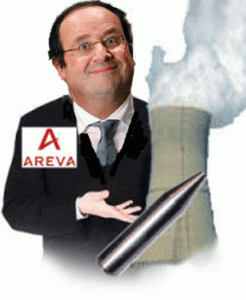 France ready to save nuclear group Areva, regardless of election outcome, Globe and Mail, GEERT DE CLERCQ, PARIS — Reuters, Jan. 04, 2017 A government-led rescue of French nuclear group Areva and the wider atomic-energy industry may cost the state as much as €10-billion ($13.94-billion Canadian), but political support is almost certain whoever wins the presidential election in May.
While taxpayers will ultimately pick up the huge bill, the main election contenders – from the Socialists and conservatives to the far-right National Front – broadly back the bailout, which involves splitting up Areva.
On top of its dire financial state, Areva is beset by technical, regulatory and legal problems. But given its importance to a nuclear industry that generates three quarters of France’s electricity and employs 220,000 people, the next government probably has little choice but to stand by the scheme hatched under outgoing Socialist President Francois Hollande.
France has a small but fierce anti-nuclear movement and some critics oppose investing billions in extending the life of aging reactors. Nevertheless, nuclear energy is broadly accepted, even though neighbouring Germany has decided to ditch it altogether following the 2011 disaster at Japan’s Fukushima plant…….
The nuclear industry rescue also involves a cash injection for power utility EDF, which operates France’s 58 nuclear reactors and will buy part of Areva’s business. But for all the domestic support, Brussels must also rule on whether the bailout complies with European Union rules on state aid………
Once the champion of France’s nuclear industry, 87-per-cent state-owned Areva has seen its equity wiped out by years of losses. Among its biggest problems is a nuclear plant it is building in Olkiluoto, Finland. Work is almost a decade behind schedule and huge cost overruns have led to Finnish utility TVO and Areva claiming billions from each other.
A similar project in Flamanville, France is also running years late, with costs spiralling. Areva has also had to take heavy writedowns on its African uranium mines while foreign orders have generally slumped since the Fukushima accident.
On top of this, U.S. and other regulators are investigating possible safety problems related to the suspected falsification of documents at Areva’s Le Creusot plant, which makes components for reactors worldwide.
In a restructuring that means an end to Areva as an integrated nuclear group, the firm will sell its reactor unit Areva NP to EDF. The French state will effectively nationalize the Olkiluoto liabilities and Areva will receive a mainly state-funded cash injection of €5-billion to refloat it as a uranium mining and nuclear fuel group.
The government is also seeking Japanese and Chinese investors to buy minority stakes in the fuel group, provisionally called NewCo, for £1-billion euros. http://www.theglobeandmail.com/report-on-business/international-business/european-business/france-ready-to-save-nuclear-group-areva-regardless-of-election-outcome/article33498170/
January 6, 2017
Posted by Christina Macpherson |
France, politics |
Leave a comment
 French watchdog deepens probes into Areva nuclear parts Concerns about quality and documentation could have knock-on effect on Hinkley Point Rt.com JANUARY 4, 2017 by: Michael Stothard in Paris
Investigators are widening probes into potentially faulty nuclear reactor components made at a factory operated by Areva, the struggling French manufacturer, after the problems contributed to multiple shutdowns of power plants last year.
Julien Collet, deputy director of the ASN, France’s nuclear regulator, said he wanted to “go much further” with investigations into Areva’s components, including one probe into the falsification of documents that certified the quality of certain parts.
Separately, the ASN is expected to issue a report this year about issues with components made by Areva for a new nuclear power plant at Flamanville in France. The report’s findings could have an impact on the proposed Hinkley Point C nuclear plant in the UK, which is due to use the same technology as Flamanville.
The ASN is leading investigations into two scandals relating to Areva’s supply of components for France’s existing nuclear power stations.
First, French investigators said in June that some steel components made at Areva’s Le Creusot factory — notably parts used in steam generators — had excessive carbon levels, which could make them vulnerable to cracking.
Second, Areva announced in May that it had found evidence suggesting employees had doctored quality-assurance documents relating to many different nuclear reactor components made at Le Creusot for up to 40 years.
Both affairs have contributed to French nuclear power plants run by EDF, the utility, being shut down last year………
Overseas regulators are monitoring events in France. David McIntyre of the US Nuclear Regulatory Commission said it was concerned by the revelations about doctored documents at Le Creusot, which has supplied some components to US nuclear power plants……..
Beyond Areva’s potentially faulty components in France’s existing nuclear power stations, there is another — potentially even larger — issue looming.
In 2014, the reactor vessel at the planned new nuclear power plant at Flamanville — which was made at Areva’s factory in Chalon/Saint-Marcel — was found to have potentially critical structural weaknesses as a result of excessive carbon levels……….
Any significant problems with the vessel could be catastrophic for EDF, as redoing this important piece of the plant would mean restarting much of the construction work, which is already billions of euros over budget and years late.
“If the reactor vessel is deemed faulty, it would be a disaster,” said Denis Florin, founder of Lavoisier Conseil, a consultancy.
Flamanville is a flagship project for EDF, using European Pressurised Reactor technology that is also earmarked for the Hinkley Point C power plant in the UK.
Any further delays at Flamanville could pose problems for Hinkley. This is partly because the financial support package the UK government has offered for Hinkley is premised on Flamanville being operational by 2020.
If Flamanville’s reactor vessel is found to be flawed, it could push back the completion date — currently scheduled for the end of 2018 — beyond 2020.
EDF has said it does not plan to use the UK financial support package, as it is financing the project from its own balance sheet, but this could still rob the company of room for manoeuvre should Hinkley face problems.
Additional reporting by Kana Inagaki in Tokyo https://www.ft.com/content/2baf6270-c36a-11e6-81c2-f57d90f6741a
January 6, 2017
Posted by Christina Macpherson |
France, secrets,lies and civil liberties |
Leave a comment











 nuclear-news