EDF’s two nuclear plants in Britain should be negotiated as one, French minister says.

Guy Taylor, Transport Reporter, 25 April 2025
EDF’s two nuclear construction schemes at Hinkley Point and Sizewell C should be treated as one financial venture in negotiations, according to France’s energy minister.
Marc Ferracci told the FT he had held discussions with the UK’s energy minister Ed Miliband at the sidelines of a conference in London on Thursday.
“France and EDF are very committed to deliver the projects but we have to find a way to accelerate them and we have to find a way to consolidate the financial schemes of both projects,” he said.
The French government has been pushing ministers in the UK to lend a hand with Hinkley Point’s floundering finances over the last year.
Costs on the nuclear project have risen to as high as £46bn and it argues EDF, the French state-owned energy firm, should not be forced to cover the overruns.
EDF’s equity stake in Sizewell C, a 3.2 gigawatt nuclear station on the Suffolk Coast, is smaller than Hinkley Point.
Ferracci denied that the French government was looking to use Sizewell as “leverage” against the financial troubles at Hinkley………………….. https://www.cityam.com/edfs-two-nuclear-plants-should-be-negotiated-as-one-french-minister-says/
Framatome and Sizewell C sign contract for EPR reactor instrumentation.
Framatome and Sizewell C have signed a contract for the supply,
qualification, and pre-assembly of conventional instrumentation for the EPR
reactors under construction at Sizewell, strengthening their collaboration
on this large-scale project.
Energy News 18th April 2025,
https://energynews.pro/en/framatome-and-sizewell-c-sign-contract-for-epr-reactor-instrumentation/
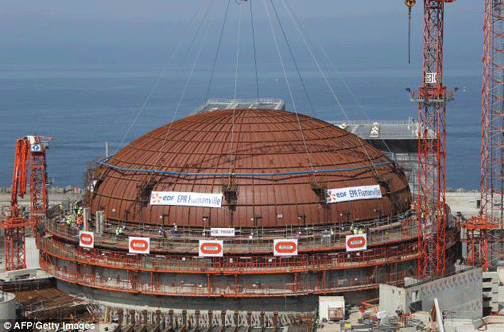
Newest French reactor faces further delays due to new issues.
By Reuters, April 11, 2025
EDF’s Flamanville 3 reactor outage was extended for an additional week to
carry out maintenance on three more components in the nuclear part of the
reactor, an EDF spokesperson told Reuters on Friday. The extension comes
after a two-month delay for maintenance on the cooling circuit and rotors
of the turbo alternator group.
The reactor is currently in the ramp-up
phase and has only produced a minimal amount of power since starting last
December. EDF said it could not provide specific details on the components
that require maintenance or the cost, but said that the summer date to
reach full power has not changed.
The maintenance to the turbo alternator
will only be measurable when the reactor is next connected to the grid, the
EDF spokesperson said, meaning that there could be an additional shutdown
if additional problems are found during the ramp up. EDF said that the
shutdown is a normal part of the ramp-up process where the equipment is
stress-tested before operating at full power and will be repeated several
times in the coming weeks and months. https://www.reuters.com/business/energy/newest-french-reactor-faces-further-delays-due-new-issues-2025-04-11/
The Flamanville EPR nuclear reactor will not be able to deliver its full power without major works.

According to our information, EDF has still not been able to identify the cause of the malfunction of the turbine in the Normandy reactor.
La Tribune Juliette Raynal, 04/07/25
After a doomed construction site, the Normandy reactor of the Flamanville EPR started up on December 21, twelve years behind schedule. Its entry into service does not signal the end of the problems, far from it. According to our information, the difficulties encountered with the turbo-alternator unit, the centerpiece of a nuclear power plant, will prevent the first French EPR from delivering its full electrical power without major intervention requiring the assembly of scaffolding inside a room that is difficult to access.
Contacted by La Tribune , EDF did not wish to comment on this information and indicated that it was maintaining its provisional schedule with the transition to 100% of its nominal power in the summer of 2025. “While technically the reactor could well reach its full thermal power in the coming months, the electrical power will be reduced by 10 to 20% due to the partial vacuum,” qualifies a well-informed source.
As we reported on March 13, EDF teams had to deal with abnormal heating in the turbo-generator unit. Located in the heart of the engine room, the 70-meter-long Arabelle turbine, manufactured by General Electric, but now owned by Arabelle Solutions, a subsidiary of EDF,
transforms the thermal energy contained in the steam into mechanical energy to drive the alternator that produces electricity.
The Arabelle turbine, the centerpiece of the power plant
In a technical document published following a general meeting, organized on February 25th within the framework of the Local Information Commission (CLI), the electrician revealed a malfunction: “The temperature increases beyond the authorized limit on stages 7 and 8 of the turbo alternator group when trying to reach the expected condenser vacuum . “
…………………………………….. the 57th reactor in the French fleet is still shut down due to a maintenance operation on equipment located in the nuclear part of the plant.
After several postponements, its start-up is expected on April 11. “While these adjustments allow the reactor to be restarted without exceeding the authorized heating levels, they will not allow it to operate at full power,” a well-informed source cautions. “The reactor will only be able to continue its tests at a partial vacuum,” the same source specifies.
……………………………..With the vacuum reduced, the turbine’s efficiency will be mechanically reduced and could therefore be between 10 and 20% below its nominal operating temperature.
The cause of the malfunction has not yet been identified.
“The work that has been carried out on the bearings is corrective work. It helps to reduce the fault that is causing excessive heating, but the teams involved do not expect this to completely resolve the problem. In short, it helps to treat the symptoms, but not the cause, which remains unidentified ,” reports this source.
According to our information, to attempt a diagnosis, EDF teams will have to install scaffolding inside the condenser itself. A room that is difficult to access since it is located just below the turbine. “It is an intrusive operation that requires a complete shutdown of the reactor for at least several weeks ,” according to this well-informed source.
“A nightmare to cope with”
Unlike a conventional shutdown for refueling, which lasts on average 30 to 40 days, this first break should last “at least 250 days ,” said Régis Clément, deputy director of EDF’s nuclear fleet division, during a press briefing on December 20. In other words, more than eight months. EDF also intends to take advantage of this interruption to replace the defective tank cover, required by the nuclear regulator.
While waiting for this operation, the various components of the turbine, due to its abnormal operation, could well be damaged. And for good reason, even if by lowering the vacuum level the defect becomes acceptable, it does not disappear. As a result, the bearings wear unevenly and mistreat the turbine. “This machine risks being a nightmare to operate ,” fears a person close to the case.
New EDF boss at mercy of ‘to-do list’ that ousted his predecessor
The new boss of French state-owned energy group EDF faces the same nearly
impossible tasks that led to the ousting of his predecessor: satisfying the
government’s often contradictory demands for cheap power to help industry
and the construction of costly new nuclear reactors.
Bernard Fontana, nominated as chief executive on March 21, is a seasoned industrialist who
has run EDF’s engineering arm Framatome for nearly nine years. He will
seek to avoid the fate of the previous chief executive Luc Rémont, removed
last month after just over two years because of repeated clashes with the
state.
On Fontana’s to-do list will be repairing relations with the
government, the company’s only shareholder, striking energy supply deals
with some of EDF’s biggest industrial clients, while also advancing plans
to build six nuclear reactors in just over a decade — a key initiative of
French President Emmanuel Macron, which was announced three years ago.
Fontana’s main challenge is to balance competing pressures of delivering
low rates for power, demanded by government and industry, while generating
profits that will help support vast investments required to launch new
nuclear reactors.
The company ran over budget and behind time on the
completion of Flamanville, a new nuclear reactor in northern France, and
faces budget and timing issues with the UK’s Hinkley Point. It has also
faced criticism that it is yet to outline timelines and costings for the
project to build the six new nuclear reactors, which were originally due by
the end of 2024.
Last month, the government pushed back the launch date
from 2035 to 2038, although observers have long considered the 2035 target
unachievable. In short, Fontana’s success will depend on whether he can
walk the tightrope of running EDF profitably while delivering the vast
capital outlay needed to reboot France’s nuclear sector. This will
require a major shift from Rémont’s uncompromising approach. “If
Fontana has taken the job, he’s understood the lesson [from Rémont’s
sacking]. If he hasn’t, he’s an idiot,” said another adviser.
FT 6th April 2025 https://www.ft.com/content/b9f39568-6029-4016-9c5f-0242dd8b9174
France’s UK energy apathy poses nuclear problem for Labour
France’s public spending watchdog is advising the country to cut back on its involvement in UK nuclear projects
Brad Gray, Tortoise 27th March 2025, https://www.tortoisemedia.com/2025/03/26/frances-uk-energy-apathy-poses-nuclear-problem-for-labour
EDF has reduced its stake in the Sizewell C nuclear power plant by a further 7.7 per cent, leaving the UK government with an 83.8 per cent share.
In 2022, a government buy-out to allow the Chinese state to exit the project made the UK the leading investor.
Last week Emmanuel Macron fired the EDF chief following a row over energy prices, and France’s public spending watchdog is advising the country to cut back on its involvement in UK nuclear projects and focus on small modular reactors instead.
As France reduces its investment, taxpayers are likely to foot more of the bill than anticipated – a tough pill to swallow as the chancellor slashes public funding.
When complete, Sizewell C is forecast to provide up to 7 per cent of the country’s electricity needs, with reactors lasting 60 years. Right now it’s a political headache.
EDF reduces stake in Sizewell C as boss sacked
the sacking raises “further fundamental questions about the wisdom of proceeding with the Sizewell C ‘Replica’ project of Hinkley Point C in which EDF is set to be deeply involved”
“Clearly Sizewell C could not reach a Final Investment Decision without taxpayers shouldering the bulk of the project’s massive cost – a hugely controversial choice given that the Chancellor is currently scrabbling around to save as much money as possible.“
25 Mar, 2025 By To s-sacked-25-03-2025/ https://www.newcivilengineer.com/latest/edf-reduces-stake-in-sizewell-c-as-boss-sacked-25-03-2025/
EDF’s ownership of Sizewell C has decreased to 16.2% and the UK government’s stake increased to 83.8%. Meanwhile, the French company’s chief executive has been axed and its financial stability has been called into question.
The UK’s flagship gigawatt-scale new nuclear projects under construction – Hinkley Point C in Somerset and Sizewell C in Suffolk – are both subject to intense scrutiny as costs rise and timelines slip.
Hinkley Point C is late and over budget, and Sizewell C is awaiting its delayed final investment decision (FID) which is scheduled to be made at the Spending Review on 11 June. The FID will reveal the final determination of who will fund the project and how. The government has already invested several billion pounds in developing it.
Hinkley Point C’s costs rose from around £25bn in 2015 to up to £34bn in 2024, and Sizewell C is projected to cost £40bn – double what it was estimated by EDF and the UK Government to cost in 2020. However, the Treasury disputes this latter figure.
EDF Sizewell C ownership stake reduced
On 24 February 2024, NCE reported that EDF was appearing to scale back its proposed ownership ambitions of Sizewell C.
EDF’s 2024 Annual results document laid out its contribution to the power plant, which is “subject to some conditions, including […] a share in ownership of the project of 10 to 19.99%, including a cap on financial exposure in value.” It also requires “a return on capital expected by EDF as an investor in line with market return for this type of assets, risk allocation profile and its investment policy.”
It is understood that the reason for selecting 19.99% rather than 20% is because a company buying 20% would have to set up a subsidiary entity to take the ownership.
Credit ratings agency Fitch Ratings announced in a ‘Rating Action Commentary’ on 21 March 2025 that the Sizewell C’s owners – the UK Government and EDF – had changed their ownership stakes.
EDF previously confirmed in its 2024 half year results that Sizewell C is owned 76.1% by the UK Government and 23.9% by EDF.
Fitch’s announcement said: “As of end-2024, the project was owned 83.8% by the UK government and 16.2% by EDF, down from 49.4% at end-2023.”
This marks a fresh drop in EDF’s ownership by 7.7 percentage points.
The decrease comes after French public spending watchdog Cour des comptes said EDF should scale back involvement in UK nuclear projects.
Macron sacks EDF chief and funds EDF reactors
In France, where the government has political control of the entirely state-owned EDF (Électricité de France), Macron fired the company’s chief executive Luc Rémont.
The UK’s Daily Telegraph linked Rémont’s ousting to EDF’s planned electricity price hikes for French industrial customers, of which Macron had promised to “take back control”.
Adding further pressure to EDF’s leadership, French building materials company Saint-Gobain chairman and chief executive officer Benoit Bazin, speaking to French business news channel BFM Business, accused EDF of “giving the middle finger to French industry”.
It has also been reported that the French state has agreed to issue a single subsidised loan “covering at least half the construction costs of six nuclear reactors”, according to the president’s office. It is understood that the six reactors are at the pairs at Penly, Gravelines and Bugey in France.
Former energy secretary reacts to ‘extremely concerning’ developments‘.
Backbench Conservative peer Lord Howell of Guildford reacted to the news. Howell was energy secretary in Margaret Thatcher’s government which supported the construction of nuclear power plants.
He described the reduced stake in Sizewell C as “one more development in growing concern about EDF’s capacity or ability to continue with Hinkley Point C project or take a large (20%+) position in the Sizewell C proposed project.”
Reflecting on the sacking of the EDF boss, he said this is “An extremely worrying development.”
He went on to say the sacking raises “further fundamental questions about the wisdom of proceeding with the Sizewell C ‘Replica’ project of Hinkley Point C in which EDF is set to be deeply involved”
Anti-Sizewell C groups say ‘alarm bells should be ringing’
Stop Sizewell C executive director Alison Downes said: “EDF has not contributed a single penny financially to Sizewell C for well over a year now, and is under growing pressure in France, not only having lost its boss but to scale back its international commitments across the board.
“Clearly Sizewell C could not reach a Final Investment Decision without taxpayers shouldering the bulk of the project’s massive cost – a hugely controversial choice given that the Chancellor is currently scrabbling around to save as much money as possible.
“Rachel Reeves should cancel Sizewell C now and redirect those funds to the Warm Homes Plan, which would lower energy bills and create jobs in every constituency.”
Chancellor Rachel Reeves has proposed austerity measures for the welfare state, which she says are needed to fund infrastructure developments, ahead of the Spring Statement and Spending Review.
Cuts to welfare, particularly covering disability and unemployment support, are proving to be unpopular with dozens of MPs on the left of the Labour party.
A Together Against Sizewell C (TASC) spokesperson said: “Alarm bells should be ringing as the UK government stake in Sizewell C increases to 84% with only the UK taxpayer currently funding Sizewell C’s development costs.
“This begs the question, ‘Why are EDF refusing to put any further money into Sizewell C?’ EDF have decided to build no more of this reactor design in France, indicating they have no confidence in the EPR design destined for Sizewell.”
The spokesperson went on to say: “EDF are broke, as evidenced by their desperate search for cash to finish Hinkley Point C’s construction.
“This is hardly a secure basis for the UK government to continue in partnership with EDF and certainly not a good advert to encourage potential investors.”
Referencing EDF’s plans for a final stake to be as low as 10%, TASC said: “This evidences that even the developer considers the Sizewell C development to be inherently
EDF and the Department for Energy Security and Net Zero did not respond to requests for comment.
France delays EPR2 reactors to 2038
The 4th meeting of France’s Nuclear Policy Council (CPN – Conseil de
politique nucléaire), chaired by President Emmanuel Macron, decided to
delay the commissioning of EPR2 reactors to 2038 – a postponement of
three years. The CPN, which has been held regularly since 2022, defines the
main orientations of national nuclear policy.
The EPR2 programme, announced
in February 2022, envisages the construction of six upgraded EPR reactors
with an option for eight more. The first three pairs of EPR2 reactors are
planned for the Penly, Gravelines and Bugey NPP sites. Construction is
expected to start in 2027. The cost was originally estimated at €51.7bn
($56.4bn), but this was revised upwards to €67.4bn in 2023, according to
the Court of Auditors. Taking inflation into account, a total budget of
nearly €80bn is now being considered.
Nuclear Engineering International 21st March 2025, https://www.neimagazine.com/news/france-delays-epr2-reactors-to-2038/
Macron ousts EDF boss accused of giving French industry ‘the middle finger’
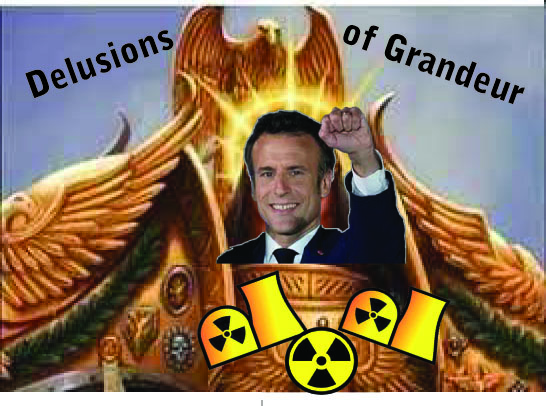
Luc Rémont will be replaced in a reshuffle with factory energy prices set to soar
Alex Singleton, Business Reporter, https://www.telegraph.co.uk/business/2025/03/21/macron-ousts-boss-state-run-edf-french-energy-prices-surge/
Emmanuel Macron has ousted the boss of the state-run EDF after French industrialists revolted over its high electricity prices.
Luc Rémont is to be replaced in a surprise reshuffling of the company’s top ranks, Mr Macron’s office said on Friday. Mr Rémont has run the the state-owned energy giant since November 2022.
The shake-up follows an outcry over the high energy prices EDF is poised to charge factories. Benoît Bazin, the boss of building materials giant Saint-Gobain, had accused EDF of “giving the middle finger to French industry” by increasing prices.
Rules that force EDF to sell energy to major industrialists at below-market prices are set to expire at the end of the year and the generator had announced plans to raise its prices.
Industry group Uniden, which represents dozens of France’s biggest manufacturers including Renault and steelmaker ArcelorMittal, claimed EDF was “deliberately turning its back” on French businesses at a time when manufacturers were “exposed to unprecedented non-European competition that threatens the very survival of many sites”.
The row is embarrassing for Mr Macron, who had pledged to “take back control of electricity prices” and who sees cheap electricity as a way of securing the French economy. Two years ago, he fully nationalised EDF by buying the 16pc of the company the government did not already own.
The shake-up comes days after the Macron administration said it had agreed state financing for six new nuclear reactors to be built by EDF over the coming decades.
Anger over high industrial energy prices is rising in the UK too. UK factories pay 50pc more for electricity than rivals in France and Germany, and four times as much as American plants. High prices have been blamed on net zero and slow-moving plans to expand nuclear power.
Warnings from industrialists that net zero energy policies are damaging the economy have fallen on deaf ears. Ed Miliband, the Energy Secretary, said this week the UK Government was “absolutely up for the fight” over net zero.
EDF is one of the largest players in the UK nuclear power market, after buying three formerly nationalised regional electricity boards and the nuclear operator British Energy.
It is currently building the UK’s first new nuclear power station for over 20 years, Hinkley Point C, and plans to embark on the construction of another, Sizewell C. But in January, the future of this new project was thrown into doubt after the French state auditor warned it against embarking on risky new foreign projects.
EDF declined to comment. The French government has been approached for comment.
French government ousts head of nuclear power group EDF.
Luc Rémont’s exit comes after months of tension over plans for new reactors and clash over pricing strategies.
France has ousted the chief executive of the
state-owned nuclear power group EDF after months of tensions over strategy
and the risk of cost overruns in the construction of six new reactors.
Luc Rémont, who had been at EDF since November 2022, would be replaced by
Bernard Fontana, the current head of Framatome, a subsidiary of EDF that
builds reactors and components, the Élysée Palace said on Friday.
EDF runs the country’s fleet of 57 nuclear plants that generate roughly 70
per cent of France’s electricity, and commercialises nuclear projects
abroad. Rémont succeeded in the initial challenge of restoring the output
of the fleet of reactors after a period plagued by technical problems, and
was in the early stages of a plan to build new more powerful, yet costly
ones, known as the EPR2.
But his term was marred by continued spats with
the state, which nationalised EDF through buying out the minority
shareholders in 2023. The Elysée decided not to renew Rémont’s
three-year term that was set to expire in June.
A major point of contention
was over Rémont’s plans to revamp how EDF sells electricity to big
industrial companies with energy-intensive activities. In the past, the
company was legally required to sell fixed amounts of electricity to them
at a price approved both by the French government and the European
Commission.
With those rules expiring next year, Rémont had been set to
combine market pricing with the signing of long-term contracts with
customers in energy-intensive industries. But the offers attracted few
companies since the terms and prices were less attractive. In parallel to
long-term contracts, EDF said this month that it would launch a new
auction-like process for other industries, including foreign buyers, in a
move that angered energy-intensive groups in France.
FT 21st March 2025, https://www.ft.com/content/c822f4e4-c15a-4038-aad4-a7151629277d
Macron Ousts EDF CEO as Tension Rises on French Power Costs
The French government said Electricite de France SA Chief Executive Officer Luc Remont is stepping down as the state-owned utility faces increasing complaints from large industrial clients over the cost of electricity.
Author of the article:, Bloomberg News, Francois de Beaupuy, https://financialpost.com/pmn/business-pmn/macron-ousts-edf-ceo-as-tension-rises-on-french-power-costs 21 Mar 25
(Bloomberg) — The French government said Electricite de France SA Chief Executive Officer Luc Remont is stepping down as the state-owned utility faces increasing complaints from large industrial clients over the cost of electricity.
President Emmanuel Macron is considering appointing Bernard Fontana, the 64-year-old senior executive vice president in charge of the company’s Industry and Services unit, as the new chairman and CEO, the president’s office said in a statement Friday. Remont, 55, has held the positions since November 2022.Article content
“The choice that the government has long supported is electricity that is abundant, clean and not too expensive, and it’s based on this choice that Bernard Fontana’s nomination has been made,” French Prime Minister Francois Bayrou said on a trip to Bourges, central France. “He’s an industrialist, which means he’s used to running teams and speeding up projects.”
Tensions between the government, EDF and major customers have been mounting over the utility’s electricity offerings. Representatives of power-hungry users, such as chemical makers, have said EDF’s new offers aren’t attractive enough, threatening their competitiveness, while rivals in the US and Asia enjoy cheaper energy. Their concerns have been exacerbated recently by sluggish economic growth, uncertainties over gas prices due to the Ukraine war, and mounting trade tensions between Europe, the US and China.
A French regulation that forces the nuclear behemoth to sell more than a quarter of its atomic output at a steep discount to current wholesale prices expires at year’s end. Meantime, the debt-laden utility said it needs to increase expenditure on nuclear projects and the power grid to help the country’s energy transition.
On Thursday, Benoit Bazin, the CEO of French glass and building materials producer Cie. de Saint-Gobain, said on BFM Business television that his company has delayed investment in France because it cannot predict energy costs from next year. Meantime, it has invested in Norway and Canada to electrify plants, and will soon do the same in Spain.
Bazin said he was “extremely shocked” by Remont’s recent decision to auction long-term power supply contracts to rival producers and suppliers, broadening offers that initially were reserved for its large electricity clients.
“EDF is a national company that has a public service mission on the competitiveness of the French industry,” the Saint-Gobain CEO said. “France won’t keep its industry, nor re-industrialization and decarbonization if we keep walking on our head.”
Shutting Sites
Earlier this week, Marc Schuller, chief operating officer of French chemical maker Arkema SA, said during a parliamentary hearing that talks with EDF over new power contracts were “advancing very slowly.
“If nothing is done, we’ll have to consider shutting down sites and stopping some activities because we wouldn’t be competitive anymore,” Schuller said.
Fontana has held a variety of management positions during his career at steelmakers ArcelorMittal SA and Aperam SA, including CEO of Swiss cement maker Holcim Ltd. Within EDF, he’s been in charge in recent years of Framatome, the unit that makes large equipment for nuclear plants.
Beyond easing tensions with large customers, the future boss of EDF will have to complete complex talks with the French and UK governments over the financing and construction of new reactors, which are key planks of these countries’ net-zero ambitions.
—With assistance from Shelby Knowles.
EDF may get state loan for six new reactors

France’s Nuclear Policy Council – headed by President Emmanuel Macron –
has agreed that a subsidised government loan should be issued to
state-owned power utility EDF to cover at least half the construction costs
of six EPR2 reactors.
World Nuclear News 18th March 2025,
https://www.world-nuclear-news.org/articles/edf-may-get-state-loan-for-six-new-reactors
Turbine, cooling: these unforeseen events that keep the Flamanville EPR at a standstill.
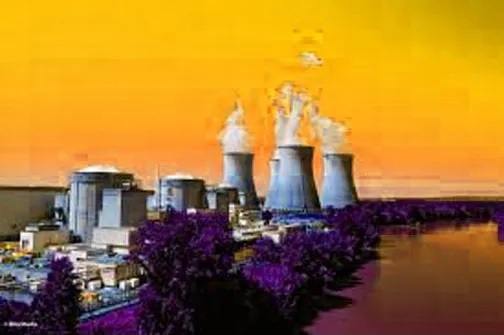
EDF is extending an unscheduled shutdown of the Flamanville EPR until the end of March in order to make adjustments to the turbine. During its first 100 days of operation, the nuclear reactor will have undergone 76 days of maintenance.
By Amélie Laurin, March 6, 2025
EDF had warned: the ramp-up of the Flamanville EPR, the first nuclear reactor to be commissioned in France in twenty-five years, would be very gradual. The public group has once again shut down, for a month and a half, its Normandy pressurized water reactor, which had been connected to the electricity grid on December 21, the first day of winter.
These maintenance operations were not planned and are the result of technical difficulties. They began on February 15 and are due to continue until March 30, after being extended three times.
Turbine heating
This work follows two initial suspensions of electricity production at Flamanville, between Christmas and mid-January, and at the turn of February. Two shutdowns that were, themselves, scheduled. In total, the reactor will have been immobilized for 76 days, during its first 100 days of operation.
The cause: various technical adjustments. In mid-February, the EPR stopped producing electrons due to an insufficient water flow in the seawater cooling circuit, which is only used “in exceptional situations”. This was followed by an intervention “on a temperature probe of the main circuit”, specifies a regulatory press release.
EDF appears to consider reduced final stake in Sizewell C nuclear to as low as 10%
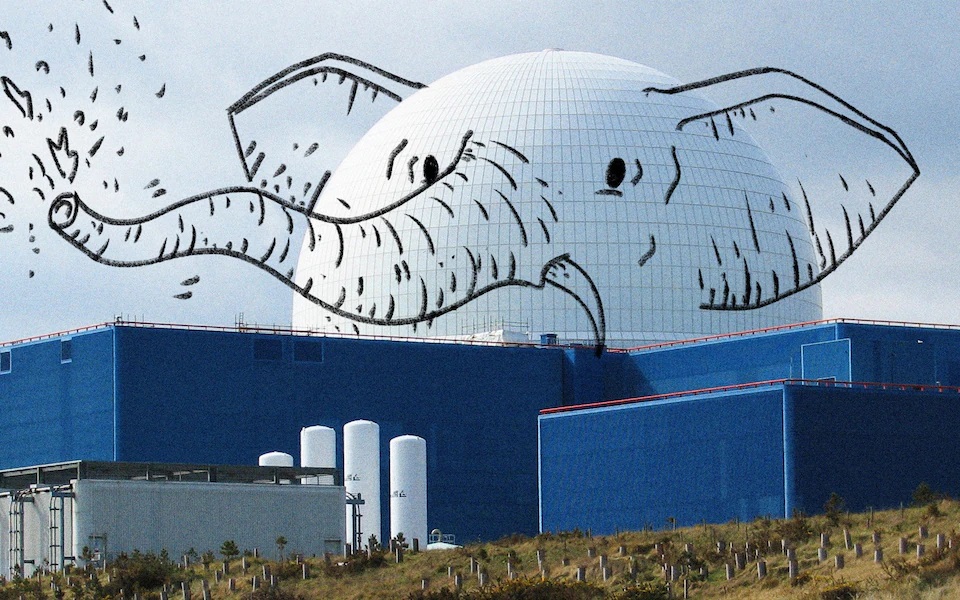
New Civil Engineer, 24 Feb, 2025 By Tom Pashby
French state-owned energy giant EDF which is the sole operator of nuclear power plants in the UK has said it will consider becoming a 10-19.99% owner of Sizewell C, having previously committed up to 20%.
EDF previously confirmed in its 2024 half year results that Sizewell C is owned 76.1% by the UK Government and 23.9% by EDF.
Despite the final investment decision (FID) still not having been made, approximately £5.5bn of taxpayer money has been committed to the scheme, and contractors have been awarded £2.5bn of works which are underway ahead of main construction.
Speculation about the ownership of Sizewell C abounds because of the secrecy around the process, the potential for much of the £40bn investment to be stumped up by the taxpayer, and Centrica’s recent comments which weakened confidence in the scheme.
Centrica CEO Chris O’Shea said the energy company’s stake in Sizewell C could be “between 1% or 2% and 50%”.
“I’m not going to commit Centrica money for something that won’t give us the returns we need.”
EDF previously said it would own maximum 20% stake
In a press release from EDF on 20 December 2022, the company said: “EDF will only retain a minority stake of a maximum of 20% at final investment decision”.
Since the 20% figure was announced, French public spending watchdog Cour des comptes said EDF should scale back involvement in UK nuclear projects.
The auditor said “a final investment decision on [Sizewell C] should not be approved until a significant reduction in EDF’s financial exposure to the Hinkley Point project has been achieved.
………………….Ownership stake scaled back to 10-19.99%
EDF’s 2024 Annual results document laid out its contribution to the power plant which is “subject to some conditions, including … a share in ownership of the project of 10 to 19.99%, including a cap on financial exposure in value.”
It also requires “A return on capital expected by EDF as an investor in line with market return for this type of assets, risk allocation profile and its investment policy.”
It is understood that the reason for selecting 19.99% rather than 20% is because a company buying 20% would have to set up a subsidiary entity to take the ownership.
Another aspect of any ownership stake is a requirement to take on debt.
A UBS spokesperson told NCE: “The project would have something like £4bn of debt for every £2bn equity.”
Anti-Sizewell C groups say EDF appears to be attempting to ‘wriggle out’ of ownership
Stop Sizewell C executive director Alison Downes said: “The mention of this lower percentage stake (10%) in EDF’s results is significant.
“EDF’s leadership is clearly strapped for cash and doesn’t seem to buy its own rhetoric that replication could result in Sizewell C being built on time, significantly cheaper than Hinkley C – and neither do we.
“A reduction in EDF’s stake would leave the UK government with an even bigger costly void to fill.”
Downes also pointed out that regardless of EDF’s ownership status, the company would still likely get a construction contract since no other company has the relevant expertise.
Together Against Sizewell C spokesperson Chris Wilson said it was no surprise that “EDF hope to wriggle out of their financial commitment to the Sizewell project by suggesting a cap on their exposure and a reduction in their investment down to 10%”.
Wilson said this was not surprising given that EDF is “struggling to find investors to plug the £8bn- £13bn gap in the funding they need to finish the Hinkley Point C (HPC) build and the French state auditor’s advice to not take a final investment decision in Sizewell C until their exposure at HPC is reduced.”
“As the UK govt scrabble around for the likely £40 billion for the Sizewell C development, it’s hardly a good advert to potential investors that we now have EDF, the original promoter, hoping to reduce their exposure to as low as 10%”, Wilson said…………………………………………….. https://www.newcivilengineer.com/latest/edf-appears-to-consider-reduced-final-stake-in-sizewell-c-to-as-low-as-10-24-02-2025/
French State Spars With EDF Over Multibillion-Euro Reactor Plan
French government officials took issue with Electricite de France SA’s plan to build six nuclear plants, saying cost estimates are too broad and reactor designs not firmed up, according to people with knowledge of recent talks.
Bloomberg News, Francois de Beaupuy, Feb 14, 2025 – https://financialpost.com/pmn/business-pmn/french-state-spars-with-edf-over-multibillion-euro-reactor-plan
EDF’s board met with state representatives last week amid growing concern that the company and its suppliers are far from ready to launch a project deemed key to France’s long-term energy security. The world’s biggest nuclear-plant operator needs to prove it has a credible plan after long delays and cost overruns at other reactor developments caused debts to balloon.
Officials at the Feb. 5 meeting characterized state-owned EDF’s presentation as unconvincing on both budget and reactor design, the people said, asking not to be identified discussing private talks.
A French state auditor said last month that a final investment decision on the six reactors should be made only once their design is well advanced and funding finalized. It said the estimated bill for construction, excluding financing costs, had swelled to almost €80 billion ($84 billion) when accounting for inflation.
The criticism at last week’s presentation went both ways. EDF Chief Executive Officer Luc Remont railed against the government for enacting a finance bill that doesn’t specify tax rates on future windfall revenues, the people said. Several board members also expressed concerns about the uncertainty surrounding the level of state aid for reactor projects, the people said.
Spokespeople for EDF and the government’s shareholding agency declined to comment.
Slow progress is not only fueling tensions between EDF and the government. It also threatens to undermine preparations along the supply chain for reactor construction. In the past two years, EDF has seen US and Korean competitors make inroads in European markets as its own proposals were overlooked.
Nuclear Revival
The difficulties faced by a nuclear behemoth such as EDF may also raise questions over the speed and breadth of an atomic-power renaissance across Europe, with many countries planning new reactors to cut emissions from power generation and bolster energy security.
Back in July, EDF’s Remont expressed hope that a state support package for the six new reactors would be agreed upon by the end of 2024, paving the way for a final investment decision by the end of 2025 or early next year.
Already on the back foot, EDF must now move quickly to pin down costs and designs so that the government can work out the necessary support and seek approval from European competition authorities, the people said. The state aid needs to be fine-tuned to limit any remedies requested by Brussels, they said.
1 This Month

of the week – Shut Down Drone Warfare!


Tell the Ukrainian Government to Drop Prosecution of Peace Activist Yurii Sheliazhenko

Petition to revoke the licensing of the Near Surface Nuclear Disposal Facility (NSDF) at Chalk River. https://www.ourcommons.ca/petitions/en/Petition/Details?Petition=e-7247
To see nuclear-related stories in greater depth and intensity – go to https://nuclearinformation.wordpress.com
-
Archives
- March 2026 (237)
- February 2026 (268)
- January 2026 (308)
- December 2025 (358)
- November 2025 (359)
- October 2025 (376)
- September 2025 (257)
- August 2025 (319)
- July 2025 (230)
- June 2025 (348)
- May 2025 (261)
- April 2025 (305)
-
Categories
- 1
- 1 NUCLEAR ISSUES
- business and costs
- climate change
- culture and arts
- ENERGY
- environment
- health
- history
- indigenous issues
- Legal
- marketing of nuclear
- media
- opposition to nuclear
- PERSONAL STORIES
- politics
- politics international
- Religion and ethics
- safety
- secrets,lies and civil liberties
- spinbuster
- technology
- Uranium
- wastes
- weapons and war
- Women
- 2 WORLD
- ACTION
- AFRICA
- Atrocities
- AUSTRALIA
- Christina's notes
- Christina's themes
- culture and arts
- Events
- Fuk 2022
- Fuk 2023
- Fukushima 2017
- Fukushima 2018
- fukushima 2019
- Fukushima 2020
- Fukushima 2021
- general
- global warming
- Humour (God we need it)
- Nuclear
- RARE EARTHS
- Reference
- resources – print
- Resources -audiovicual
- Weekly Newsletter
- World
- World Nuclear
- YouTube
-
RSS
Entries RSS
Comments RSS
 nuclear-news