European Pressurised Reactor at Flamanville: nuclear is expensive and it doesn’t work.

 France Culture 14th Feb 2020, EPR: nuclear is expensive and it doesn’t work. A kind of modern replica of the Danaïdes barrel, the EPR at Flamanville, in the Manche department, is once again being talked about: between construction delays (delivery scheduled for 2010, “potentially promised” now in 2022) and additional costs ( estimated three billion, we would exceed 12 billion today), is there ultimately a future for what was sold in the late 90s (1998-2000) as
the new wonder of the genre?
French govt considers a “0% nuclear” energy plan: and problems in existing nukes
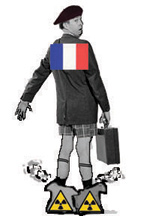 Europe1 16th Feb 2020, The government is considering a “0% nuclear” energy plan and the Flamanville EPR, still under construction, should open, at best, ten years behind schedule: in the coming years, there will be no shortage of challenges for the first producer electricity in France. If the group
Electricity of France (EDF), will supply “all the sites of Paris 2024 in
renewable energies” , all is not however rosy on the side of the first
electricity supplier in Europe. Several points are to be reviewed on its
copy in the coming years, especially around the construction of new nuclear
power plants in France, including that of Flamanville.
https://www.europe1.fr/economie/epr-de-flamanville-et-part-du-nucleaire-les-defis-dedf-3949806
Algeria’s radioactive legacy from France’s nuclear bomb tests
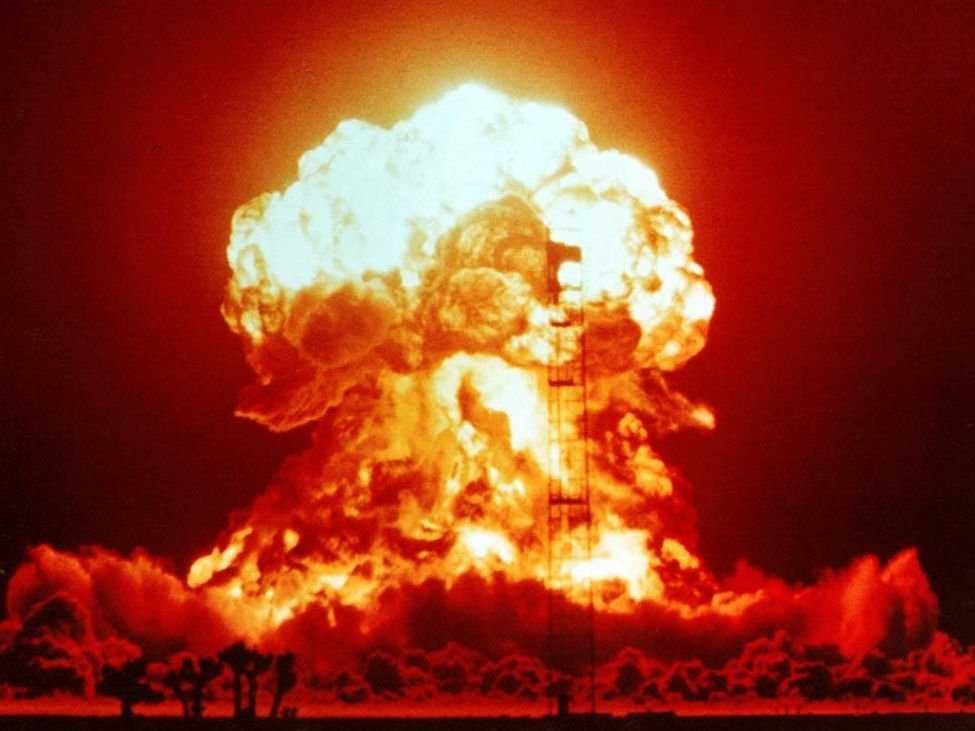 Algeria: 60 years on, French nuclear tests leave bitter fallout https://www.dw.com/en/algeria-60-years-on-french-nuclear-tests-leave-bitter-fallout/a-5235435113.02.2020, Author Elizabeth Bryant (Paris)
Decades after the first French nuclear test in Algeria, thousands of victims are still waiting for compensation from the government. Why is France dragging its feet over the issue?
Jean-Claude Hervieux still remembers joining a crowd of soldiers and high-level officials in Algeria’s Sahara desert to witness one of France’s first nuclear tests. Things didn’t go exactly as planned.
Instead of being contained underground, radioactive dust and rock escaped into the atmosphere. Everyone ran, including two French ministers. At military barracks, the group showered and had their radiation levels checked as a crude means of decontamination. “You don’t see nude ministers very often,” Hervieux chuckled.
But as France marks the 60th anniversary of its first nuclear test — near Algeria’s border with Mauritania, on February 13, 1960 — there is not much to laugh about. Critics have long claimed more than three decades of nuclear testing may have left many victims, first in Algeria and later in French Polynesia, where the bulk of testing took place.
But so far, only hundreds have been compensated, including just one Algerian. And as key nuclear testing anniversaries tick by, the unresolved fallout of the nuclear explosions has also fed into longstanding tensions between Paris and its former colony.
It is part of the whole issue of decolonization, and of Algerians asking for French recognition of crimes committed” as a colonial power, said Brahim Oumansour, North African analyst for the Paris-based French Institute of International Relations. For France, he added, doing so might mean “financial compensations in the millions of euros.”
Such issues are off the French government’s current public radar. A major nuclear policy speech last week by President Emmanuel Macron made no mention of them. France’s compensation commission says it has responded to claims that meet criteria set out by law.
The French Defense Ministry and Algerian authorities did not respond to questions about the tests.
A former electrician, Hervieux spent a decade working on the French nuclear tests, first in Algeria and later in French Polynesia. The botched Beryl explosion he witnessed in May 1962 took place two months after Algeria’s independence from France. The desert testing would continue for another four years, thanks to an agreement Paris secured with Algiers. “The showers cleaned our bodies and clothes,” Hervieux said of the Beryl incident, “but not what we breathed in or swallowed.”
Hervieux asked French authorities for the results of his radiation tests. They were bizarre, he said. One claimed to have screened him when he was on vacation; another named his father. He was told yet another had been destroyed on grounds it was contaminated.
Buried everything
Altogether, Paris exploded more than 200 nuclear devices. Most were in remote atolls of French Polynesia, but the first 17 took place in Algeria’s desert. In 1996, French President President Jacques Chirac called a halt to the testing.
When we left Algeria, we dug large holes and we buried everything,” said Hervieux, now 80, of France’s departure from the desert sites, in 1966.
He later joined AVEN, a pressure group for victims of French nuclear tests, although he says he remains healthy.
While he did not witness ill effects in Algeria, Hervieux describes visiting a village in French Polynesia where high radiation levels had been detected. “A local teacher said children were sick and vomiting,” he recalled. “Mothers were asking why their children’s hair was falling out.”
In Algeria, testing sites are still contaminated, activists say, many fenced off by only barbed wire, at best. “I saw radiation levels emitted from minerals, rocks vitrified by the bombs’ heat, which are colossal,” said retired French physicist Roland Desbordes, who has visited the sites. “These aren’t sites buried in the corner of the desert — they’re frequently visited by Algerian nomads,” who recuperate copper and other metals from the detritus.
Indelible scar?
The former president and now spokesman for CRIIRAD, an independent French research group on atomic safety, Desbordes claims the French army has key classified information about the testing it will not open to public scrutiny, including about the health and environmental effects of the explosions. But he believes Algerian authorities also bear some blame.
Each anniversary they talk about how these nuclear tests were not good,” he said, “but it’s also up to them to close off the sites to ensure nobody can access them.”
Reports, including a pair of decade-old documentaries by Algerian reporter Larbi Benchiha, suggest the testing left an indelible scar on local communities. Unaware of the danger, they collected once-buried scrap metal uncovered by desert winds, and turned them into jewelry and kitchen utensils.
Altogether, between 27,000 to 60,000 people from communities surrounding the test sites were affected, according to one Al Jazeera report, citing differing French and Algerian estimates.
But out of more than 1,600 claims filed under a decade-old French compensation law that finally acknowledged health problems from the tests, only 51 have come from Algeria, according to France’s nuclear compensation commission, CIVEN. A separate Supreme Court ruling recently reinstated two extra compensation claims from French Polynesia.
Among other criteria, the 2010 law requires proof of a minimum level of exposure to weapons tests, and offers a list of 23 types of cancers that qualify for compensation.
“There are very few demands and we can only judge those we receive,” said CIVEN Director Ludovic Gerin, who added the Algerian claims didn’t meet compensation criteria.
“We can’t actively search for victims,” he added, “so we’re a bit blocked.”
French President Emmanuel Macron seeks leading role in post-Brexit EU nuclear strategy
|
Macron seeks leading role in post-Brexit EU nuclear strategy, Defense News, By: Thomas Adamson, The Associated Press PARIS (AP) 8 Feb 20,— French President Emmanuel Macron on Friday advocated a more coordinated European Union defense strategy in which France, the bloc’s only post-Brexit nuclear power, and its arsenal would hold a central role.
Addressing military officers graduating in Paris, Macron set out his country’s nuclear strategy in a bid to show leadership one week after nuclear-armed Britain officially exited the EU. PARIS (AP) — French President Emmanuel Macron on Friday advocated a more coordinated European Union defense strategy in which France, the bloc’s only post-Brexit nuclear power, and its arsenal would hold a central role. Addressing military officers graduating in Paris, Macron set out his country’s nuclear strategy in a bid to show leadership one week after nuclear-armed Britain officially exited the EU……. https://www.defensenews.com/smr/nuclear-arsenal/2020/02/07/macron-seeks-leading-role-in-post-brexit-eu-nuclear-strategy/ |
|
|
Sloppy safety and waste management at Electricite de France’s nuclear sites
 Improve Nuclear Plant Maintenance Works, Watchdog Says, Francois de Beaupuy, Bloomberg News (Bloomberg) 24 Jan 2020 — Electricite de France SA and its suppliers must improve maintenance operations at nuclear reactors and waste management because they have lost skills and become sloppy in recent years, the French nuclear safety authority said.
The warning reflects a string of incidents related to substandard manufacturing or installation of equipment at EDF and its suppliers. It underscores the difficulties the French nuclear giant faces in extending the lifetime of aging reactors and building new ones, prompting it to announce an action plan to revamp the industry’s skills.
“There’s a need to reinforce skills and some carelessness among some players in the industry,” Bernard Doroszczuk, chairman of Autorite de Surete Nucleaire, said at a press conference near Paris on Thursday. “There’s a lack of rigor in the oversight of safety by operators,” from manufacturing to welding to equipment tests “which must be corrected.”
Discussions are still going on with EDF regarding safety improvements, including ways to prevent or mitigate the impact outside its plants in case of a severe accident such as the meltdown of the radioactive fuel and its vessel, said Sylvie Cadet-Mercier, a commissioner of the regulator. A spokesman for the utility declined to comment…… https://www.bnnbloomberg.ca/edf-must-improve-nuclear-plant-maintenance-works-watchdog-says-1.1378571
Legal action against Orano’s lying advertising about nuclear power solving climate change
 Reporterre 16th Jan 2020 The Sortir du nuclear network is filing a complaint against an Orano advertising campaign, which presents nuclear energy as a solution against climate change. A false statement intended to boost investments in a declining sector, denounces the association.
https://reporterre.net/Le-nucleaire-bon-pour-le-climat-Orano-poursuivi-pour-publicite-mensongere
Significant drop in France’s nuclear energy production
Reuters 10th Jan 2020, EDF’s French nuclear power generation fell by a more than expected 3.5 percent last year, the state-owned utility said on Friday. The French company’s domestic nuclear output power dropped to 379.5 terawatt hours (TWh), missing a revised production target of between 384 TWh and 388 TWh.power output tumbling in the final month of 2019 by 15.2% to 33 TWh. The
operator of France’s 58 nuclear reactors, covering about 75% of the
country’s electricity needs, had revised its 2019 nuclear production
target from 390 TWh to between 384 TWh and 388 TWh in November because of reactor maintenance and safety checks after an earthquake.
The European Pressurised Water Reactor (EPR) is dragging nuclear company EDF into $billions of debt

Climate News Network 31st Dec 2019, The edifice already heading for the status of the largest and most expensive construction project in the world, the Hinkley C nuclear power station (above) in the UK, is dragging its builder, the French giant EDF, into ever-deeper debt: the company’s flagship reactor is facing still more delay.
Although EDF is a vast company, owning 58 reactors in France alone,
and is 85% owned by the French state, it owes around €60 billion ($67bn),
a debt expected to increase by €3 billion ($3.35bn) a year.
This has led some city analysts, notably S&P Global, to downgrade the company’s prospects to “negative” − which is essentially a recommendation to
shareholders to sell.
Apart from the problem that EDF’s fleet of reactors in France is operating well beyond their original design life and are in constant need of safety and maintenance upgrades, the company’s main problem is its flagship, the European Pressurised Water Reactor (EPR), which is getting into ever-greater difficulties.

In Europe there are four EPRs under construction: the two barely begun at Hinkley Point in Somerset in the west of England; one in northern France at Flamanville (below) in Normandy; and the original prototype in Finland, known as Olkiluoto 3 (OL3) (above) . The extraordinary fact is that, although OL3 was due to start up in 2009, it is still incomplete, and its start date has just been put back again – until 2021.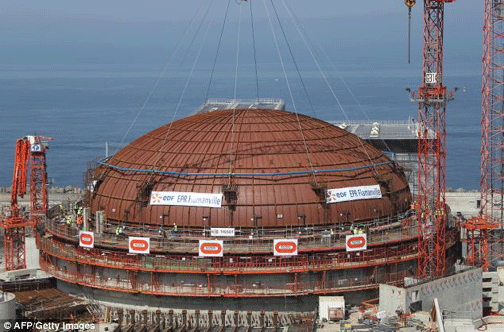
https://climatenewsnetwork.net/flagship-reactor-launch-postponed-again/
“Potentially faulty electrical components” in France’s nuclear backup systems
|
Montel 27th Dec 2019, EDF has replaced 28 “potentially faulty electrical components” making backup systems for the Penly 2 nuclear reactor (1330 MW) unavailable and is checking whether other units could present the same “safety” problem, said France’s ‘Nuclear Safety Authority (ASN) and EDF Friday.
https://www.montelnews.com/fr/story/edf-change-des-pices-dfectueuses-%C3%A0-penly-2/1074523 |
|
In France, over the next decade renewable energy is ‘on track to overtake nuclear’
 Renewables ‘on track to overtake nuclear’ in France https://www.powerengineeringint.com/2019/12/16/renewables-on-track-to-overtake-nuclear-in-france/ Kelvin Ross A new study claims that renewables are on track to overtake nuclear power as the dominant energy source in France in the next decade.The share of renewables in France will hit 42.9 per cent of the country’s power mix by 2023, up from 19.9 per cent in 2018, according to analytics company GlobalData. Renewables ‘on track to overtake nuclear’ in France https://www.powerengineeringint.com/2019/12/16/renewables-on-track-to-overtake-nuclear-in-france/ Kelvin Ross A new study claims that renewables are on track to overtake nuclear power as the dominant energy source in France in the next decade.The share of renewables in France will hit 42.9 per cent of the country’s power mix by 2023, up from 19.9 per cent in 2018, according to analytics company GlobalData.
And the research suggests that renewables will continue to rise as nuclear reactors come offline. The report examining France’s power outlook to 2030 reveals that in 2018 nuclear power dominated the capacity mix by 47.2 per cent, followed by renewables, hydropower and thermal power. In the non-hydro renewable energy mix, wind contributed 56.7 per cent followed by solar PV with 35.6. GlobalData analyst Piyali Das said that France “is aiming to boost the renewable energy sources through tender mechanism. Renewable power sources are expected to increase at a compound annual growth rate of 8.9 per cent between 2019 and 2030 with a net capacity addition of around 50 GW. “Installed capacity for onshore wind will double from its current levels of 15.1 GW by 2026, and to support the expansion the government has announced doubling of the renewable energy budget. Solar PV is not behind by much in terms of growth and will witness an addition of more than 24 GW during the same period.” Das said that in the long-term, the French government has decided to cut down its fossil fuel dependency and is replacing coal and oil power stations with gas-fired plants. The government also has wants to reduce nuclear generation to 50 per cent of net generation by 2035, with a plan to decommission around 14 reactors by 2035 and fill the gap with renewable sources. “To date the development of renewable energy is largely supported by public support mechanisms,” explained Das. “These mechanisms finance the difference between the remuneration of their production on the wholesale market and the purchasing price guaranteed by the state to the renewable producer. |
|
Legal action regarding defective welds in EPR nuclear reactor
Crilan 16th Dec 2019, On July 20, 2018 and following the “Sortir du nuclear” network and Greenpeace France, CRILAN filed a complaint with the Cherbourg Public Prosecutor concerning defective welds, particularly those relating to
crossings of the containment. This December 16, 2019, following ASN
inspections and in connection with the complaint by Réseau “Sortir du
nuclear” and Greenpeace France, CRILAN files a complaint with the Public
Prosecutor of Paris for serious breaches relating to the qualification of
some equipment installed on the EPR.
These are materials participating in
the safety demonstration: mechanical (pumps, valves) or electrical (relays,
circuit breakers, etc.). This qualification is based in particular on
studies and tests. It must be the subject of documentation and traceability
of reservations and “open” points, which has not always been the case.
As EDF is subject to regulations on basic nuclear installations, violations
committed may be penalized.
France’s EDF company is trying to ‘restore trust’ in the nuclear industry
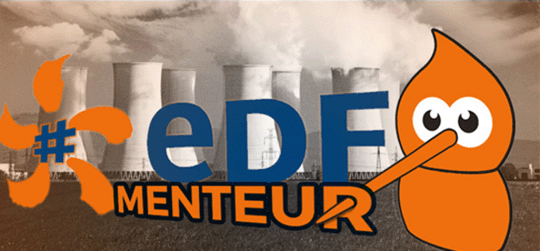
France’s nuclear industry in dire straits
The French nuclear revolution is rusting away, December 6, 2019, THE AUSTRALIAN, Henry Ergas “……..France’s nuclear power industry faces a future that is more uncertain than ever. The problems gripping the industry were highlighted late last month in an official report prepared by the former president and chief executive of PSA Peugeot Citroen, Jean Martin Folz.
While the report’s focus is on the difficulties that have plagued the construction of a new reactor at Flamanville in northwestern France, its implications reach much further.
With nuclear power plants accounting for more than 70 per cent of its overall electricity generation, no country is as dependent on nuclear energy as is France.
The decision to rely so massively on nuclear energy was taken in 1974, after the oil shock of the previous year had underlined France’s vulnerability to Middle Eastern oil. Prime minister Pierre Messmer launched a crash program that led to the construction of 56 reactors in just 15 years.
…….. however, most of France’s generators are approaching the final decade of their useful life. Planning for their replacement has been a stop-start affair, with the Greens’ increasingly strident opposition to nuclear power deterring successive governments from taking action.
As a result, only the Flamanville plant received the go-ahead, with construction beginning in 2007 for an expected entry into service in 2012. Virtually from the outset, the project was beset by woes. At this stage, the total costs of construction are four times greater than initially estimated, while the plant will not enter service before the end of 2022.
The problems stem partly from the sheer complexity of the new reactor, which is the first of its kind to be built in France.
Additionally, the catastrophe at Fukushima in 2011 led to regulatory changes that necessitated costly redesigns. And the project has suffered more than its fair share of mismanagement, aggravated by a byzantine allocation of responsibilities between EDF, the main French electricity utility, which oversaw the project, and many layers of subcontractors.
However, as the Folz report shows, the primary cause of the difficulties lies in the erosion of the industry’s skill base during the long hiatus from the end of the crash program in 1990 to the initiation of Flamanville………
There is, at this point, no prospect of France scaling up its nuclear program  ………The cost blowout at Olkiluoto drove Areva, the “national champion” of France’s nuclear industry, into bankruptcy.
Even with an injection of $7.3bn in public funds EDF, which acquired Areva, lacks the balance sheet strength to underwrite new projects, while the French government’s borrowing ability is hampered by its already too high levels of debt.
To make matters worse, the regulated prices at which EDF has to sell the power it generates mean that it cannot charge its European clients the full value of the baseload it supplies.
 As for global investors, who might provide the debt financing EDF would require, they are wary of projects that are risky in themselves ….
Given those constraints, the government has announced a modest plan to eventually build six additional reactors. So far, however, there are no actionable decisions beyond the completion of Flamanville. And work on the next generation of reactors….. has been quietly downgraded, making it likely that there will no fourth generation reactor of French design.
The consequences for France itself are far-reaching. Beginning in the late 1950s, French firms succeeded in one high-technology market after the other by developing or acquiring a rather basic design (including the Westinghouse Pressurised Water Reactor, the Mirage jet fighter and the TGV high-speed train) that they upgraded while producing it on a large scale.
That era is over, and there is every sign France is struggling with almost all the major projects it has in train.
The Folz report should therefore come as an ominous warning for Australia’s submarine project, as it identifies French industry’s serious managerial and technological weaknesses in a range of areas, such as precision welding, that are crucial to that project’s success……. https://www.theaustralian.com.au/commentary/the-french-nuclear-revolution-is-rusting-away/news-story/afe4546ed799939cf117d71f05035c5e
Another shutdown at French nuclear power station Golfech
France Bleu 2nd Dec 2019. A nuclear reactor again shut down at the Golfech power station after a leak. The production unit number 2 of the Tarn-et-Garonne power plant was stopped this Monday, December 2 in the morning, after the discovery of a steam leak in a non-nuclear part. This reactor had just been restarted just four days ago.
France wants to label nuclear as “green”. Germany will have none of it
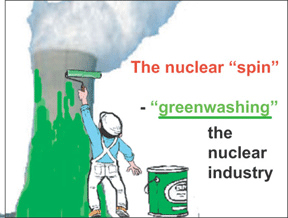 Paris, Berlin divided over nuclear’s recognition as green energy https://www.euractiv.com/section/energy-environment/news/france-and-germany-divided-over-nuclears-inclusion-in-eus-green-investment-label/ By Cécile Barbière | EURACTIV.fr | translated by Daniel Eck 27 Nov 19, Disagreement on the inclusion of nuclear power in the EU’s upcoming green finance taxonomy has revived long-standing divisions between France and Germany over the energy transition. EURACTIV France reports.
Franco-German relations have already been strained by French President Emmanuel Macron’s radical comments on NATO’s “brain death,” which attracted strong rebukes in Berlin.
Now, the European Commission’s proposed taxonomy for sustainable finance has emerged as a new bone of contention.
Tabled in 2018, the EU taxonomy aims to determine which economic activities can benefit from a sustainable finance label at European level. The objective is to give clear indications to investors so they can redirect their financing towards environmentally-friendly sectors.
Six pre-defined environmental objectives must be met in order to obtain the label. If any technology seriously undermines one of those goals, it is automatically disqualified.
It is because of this double level of control that nuclear energy failed to win the green label in the European Parliament, until the Council representing EU member states voted to reinstate it in September.
Although nuclear energy largely meets the low-carbon emissions objective, “it was not possible to include nuclear power because there is no scientific evidence for waste treatment. This means that the sector does not meet both requirements,” explained Jochen Krimphoff, WWF’s deputy director for green finance.
Since the beginning of the negotiations on the EU’s taxonomy, France has been pushing to reintroduce nuclear power, much to Germany’s dismay.
“France will advocate that nuclear energy should be part of this eco-label,” said French Finance Minister Bruno Le Maire at the conference to replenish the Green Fund at the end of October.
“We cannot succeed in the ecological transition, and we cannot achieve our goal in terms of combating global warming without nuclear energy,” the French minister said.
Although nuclear energy largely meets the low-carbon emissions objective, “it was not possible to include nuclear power because there is no scientific evidence for waste treatment. This means that the sector does not meet both requirements,” explained Jochen Krimphoff, WWF’s deputy director for green finance.
Since the beginning of the negotiations on the EU’s taxonomy, France has been pushing to reintroduce nuclear power, much to Germany’s dismay.
“France will advocate that nuclear energy should be part of this eco-label,” said French Finance Minister Bruno Le Maire at the conference to replenish the Green Fund at the end of October.
“We cannot succeed in the ecological transition, and we cannot achieve our goal in terms of combating global warming without nuclear energy,” the French minister said.
The move is all the more surprising given France’s rather progressive positions on the taxonomy. For example, Paris has, like the Commission and Parliament, been calling for the taxonomy to enter into force as early as 2020, while the Council has advocated for implementation in 2023.
For its part, Germany would not be opposed to labeling gas as green. This could be at the risk of a deal that would see both gas and nuclear power re-entering the scheme.
1 This Month

of the week – Shut Down Drone Warfare!


Tell the Ukrainian Government to Drop Prosecution of Peace Activist Yurii Sheliazhenko

Petition to revoke the licensing of the Near Surface Nuclear Disposal Facility (NSDF) at Chalk River. https://www.ourcommons.ca/petitions/en/Petition/Details?Petition=e-7247
To see nuclear-related stories in greater depth and intensity – go to https://nuclearinformation.wordpress.com
-
Archives
- April 2026 (19)
- March 2026 (251)
- February 2026 (268)
- January 2026 (308)
- December 2025 (358)
- November 2025 (359)
- October 2025 (376)
- September 2025 (257)
- August 2025 (319)
- July 2025 (230)
- June 2025 (348)
- May 2025 (261)
-
Categories
- 1
- 1 NUCLEAR ISSUES
- business and costs
- climate change
- culture and arts
- ENERGY
- environment
- health
- history
- indigenous issues
- Legal
- marketing of nuclear
- media
- opposition to nuclear
- PERSONAL STORIES
- politics
- politics international
- Religion and ethics
- safety
- secrets,lies and civil liberties
- spinbuster
- technology
- Uranium
- wastes
- weapons and war
- Women
- 2 WORLD
- ACTION
- AFRICA
- Atrocities
- AUSTRALIA
- Christina's notes
- Christina's themes
- culture and arts
- Events
- Fuk 2022
- Fuk 2023
- Fukushima 2017
- Fukushima 2018
- fukushima 2019
- Fukushima 2020
- Fukushima 2021
- general
- global warming
- Humour (God we need it)
- Nuclear
- RARE EARTHS
- Reference
- resources – print
- Resources -audiovicual
- Weekly Newsletter
- World
- World Nuclear
- YouTube
-
RSS
Entries RSS
Comments RSS
 nuclear-news