France’s unfairly heavy monitoring of anti-nuclear activists, treating them as violent criminals

 Justice has massively monitored Bure’s anti-nuclear activists Reporterre, April 27, 2020 / Marie Barbier (Reporterre) and Jade Lindgaard. Dozens of people tapped, a thousand retranscribed discussions, more than 85,000 conversations and intercepted messages, more than 16 years of cumulative telephone surveillance time: the judicial information opened in July 2017 is a disproportionate machine of intelligence on the movement antinuclear from this village of the Meuse, according to the documents consulted by Reporterre and Mediapart.
Faces caught in a web of arrows and diagrams. Under each photo: date and place of birth, nickname, organization. The individuals are grouped into “clans”, linked to places and ratings of the investigation file. Some faces are magnified, others reduced to the size of a pinhead. Some people are entitled to a photo, others appear in the form of a pictogram – blue for men, fuchsia pink for women.
This diagram [on original] was produced by the Anacrim criminal analysis cell of the national gendarmerie. Its software, Analyst’s notebook, makes it possible to visualize the links between people via their telephone numbers, places, events. This technique is usually used to solve particularly serious crimes: it recently emerged from the Gregory of legal darkness case, and is currently used in the investigation of the multi-repeat killer Nordahl Lelandais.
Examining magistrate Kévin le Fur used it to dissect the organization of the opposition movement at Cigeo, the radioactive waste landfill center planned next to the village of Bure, in the Meuse. Scheduled to come into operation in 2035, it is one of the largest industrial facilities in project today in France, and a very sensitive site for the nuclear industry.
The Anacrim diagram appears in the file of the judicial information for association of criminals, where ten antinuclear militants are under investigation for various reasons in connection with degradations committed in a hotel and the organization of an undeclared demonstration in August 2017. Subject to strict judicial control, those under investigation are prohibited from seeing each other, talking to each other and even being in the same room.
In the Bure case, Anacrim produced a total of fourteen diagrams on “the role and involvement” of the accused and the interactions between collectives and associations. This method leaves its mark on education. Seven people, among the ten indicted, are for criminal association, but 118 individuals are listed in the organization chart of the gendarmes placed in the investigation file.
Dozens of people tapped, more than a thousand transcribed discussions, tens of thousands of conversations and intercepted messages, more than fifteen years of cumulative telephone interception time: the judicial information opened in July 2017 looks like a real intelligence machine on the anti-nuclear movement of Bure, according to the investigation file consulted by Reporterre and Mediapart, and of which Liberation had unveiled part of the content in November 2018. An extraordinary investigation, extremely intrusive and focused on the surveillance of political activists whom the justice system seems to consider as enemies of democracy.
Molotov cocktails and stones fly. Gendarmes were injured and a protester mutilated by a grenade on the foot. Those charged are for different reasons from each other: participation in a gathering after summons, participation in a criminal association for the preparation of an offense punishable by five or ten years’ imprisonment, detention (or complicity) in an organized gang of incendiary product, damage to the property of others by dangerous means, concealment of property from an aggravated theft, voluntary violence in meetings.
From the first days of the investigation, the gendarmes were worried about “criminal designs” unrelated to the “legitimate challenge in a democratic state” of the militants implicated. “These actions can no longer be considered as a legitimate social and societal protest” or “as a form of democratic opposition”, they write in a report, July 27, 2017. According to them, “some of the opponents deliberately choose a violent path. They attack the property associated with the contested projects, but sometimes also the people working for the development of these industrial installations and at the same time against the police. ” In the eyes of the investigators, “opponents criminalize themselves”.
Part of the seals is sent to the Anti-Terrorism Office, a unit of the gendarmerie responsible for the prevention and suppression of acts of terrorism. To take the measure of the surveillance of the militants of Bure and their entourage, Reporterre and Mediapart evaluated the means deployed by the gendarmerie and the justice in their mission. Almost 765 telephone numbers have been the subject of identity verification requests from telephone operators. At least 200 other requests were made to find out the call histories, their places of emission, the bank details of the holders subscription, PUK codes to unlock a phone when you don’t know your PIN.
According to Me Raphaël Kempf, one of the lawyers for the indictments: Listening for so long is proof that we are not in a classic criminal judicial procedure intended to collect evidence of the commission of crimes, but that we are using the means of law and criminal procedure for the purpose of intelligence, which is political in nature. ”
If we add up all these sequences, we get a cumulative time spent listening to activists equivalent to more than sixteen years! According to the minutes, most of these people were listened to permanently by a team of gendarmes taking turns behind their screens. In total, more than 85,000 conversations and messages were intercepted, according to our estimates. And no less than 337 conversations were transcribed on trial- verbal, to which are added some 800 messages reproduced by the Technical Assistance Center (CTA). Are these means proportionate to the crimes being prosecuted? Joined by Reporterre and Mediapart, Olivier Glady, public prosecutor of Bar-le-Duc answers: “I cannot answer that. This is a dossier that makes fifteen volumes. You have files of other kinds (traffic in vehicles or narcotics) which are roughly equivalent, I am not sure that the proportionality of the investigations is simply to relate to a number as you give it to me. ”
During these innumerable hours spent listening to the militants, the gendarmes tracked the indications, sometimes tiny, of each other’s responsibilities in organizing the protest. These are two cultures which, behind closed doors of a judicial investigation, seem to confront each other from a distance. On the one hand, the gendarmes. On the other, anti-nuclear, libertarian culture, who refuse hierarchy and formal assignments to roles. Inevitably, the vision of gendarmes stumbles on the spontaneous and horizontal practices of regulars at the Maison de la Résistance. This old farm in Bure was bought in 2004 by anti-nuclear activists to create a place of struggle. It has become a place of collective life where people come to sleep during a gathering, get together, work, cook, party……. https://reporterre.net/1-3-La-justice-a-massivement-surveille-les-militants-antinucleaires-de-Bure
France: The Forgotten Nuclear Power That Could Kill Billions of People
|
France: The Forgotten Nuclear Power That Could Kill Billions of People
Paris might not have a massive stockpile of nukes, but they could do some serious damage if need be. National Interest, by Caleb Larson, 26 Apr 20, The French nuclear arsenal is pretty substantial, with air- and sea-based components. Here is a breakdown of French nuclear capabilities. Nuclear Dyad Unlike the United States or Russia, who maintain a nuclear triad of land-based, submarine-launched, and air-launched missiles, France has a dyad of submarines that can launch nuclear ballistic missiles and a stockpile of air-launched nuclear cruise missiles. M51 Ballistic Missile The M51 is the heart of French nuclear deterrence at sea. Each missile has six to ten Multiple Independent Reentry Vehicles (MIRVs), and each of those MIRVs is guessed to be in the 75 to 110 kiloton range. Its range is estimated at 8,000 kilometers, or just under 5,000 miles and the missiles are launched from the nuclear-powered Triumphant-class submarines. Air-Sol Moyenne Portée The Air-Sol Moyenne Portée is the air-launched component of French strategic deterrence. The missiles play a unique role in French deterrence, where their use would be considered a warning shot of sorts before the more widespread use of nuclear weapons would be used in a conflict. …….. Hadès The Hadès missile system was at one point a land-based component of French strategic deterrence — though only at the tactical, not strategic level, due to the system’s relatively short 480 kilometer, or about 300 mile range……. https://nationalinterest.org/blog/buzz/france-forgotten-nuclear-power-could-kill-billions-people-148396 |
|
France’s nuclear company EDF in spiralling debt crisis
|
New York Times 22nd April 2020, Plummeting electricity demand and falling power prices during the coronavirus outbreak could leave EDF in need of a capital injection by the
end of 2020 to avoid a spiralling debt crisis, a source close to the French firm and analysts said. The state-controlled utility, which operates the
world’s largest nuclear fleet, has long been weighed down by a 41.1 billion-euro debt pile. Shrinking income due to the health crisis and likely delays in reforming France’s electricity market, which could have boosted the firm’s earnings power, are now adding to its challenges and pressuring its financial ratios. A source close to EDF’s management said
the company may need a capital injection towards the end of the year to cushion the shock, with one analyst putting the size of any rights issue at several billion euros. |
|
EDF nuclear power company looks to a profitable future in small-scale, distributed RENEWABLE energy
 Can EDF Make Big Money in Small-Scale Renewables?, Greentech Media
The world’s leading nuclear power generator is betting big on a future of small-scale, distributed energy.
Électricité de France operates 58 nuclear reactors in its home country and owns stakes in several U.S. nuclear plants that it’s now moving to sell. But EDF’s biggest stamp on the American power market has come in large-scale renewables: Its San Diego-based EDF Renewables North America subsidiary has developed and now operates gigawatts of wind and solar farms across the country.
Now, EDF Renewables is trying to replicate that success on a much smaller scale. How it fares in the distributed space will be of great interest to other 20th-century energy giants feeling their way toward a transformed, low-carbon future.
Over the past few years, and largely through acquisitions, EDF Renewables has amassed one of the most comprehensive U.S. distributed energy businesses, covering solar, energy storage, microgrids and electric vehicle chargers.
The coronavirus crisis may open the door to more dealmaking, said Raphael Declercq, who runs the Distributed Solutions unit at EDF Renewables North America. “There will be some casualties in our sector: Assets seemed overpriced up to a month ago; that may change and we may be able to grow through acquisitions,” Declercq told GTM.
Several European energy giants have been on a recent shopping spree for distributed energy companies in the startup-rich U.S. — notably Shell, EDF and Enel. Without their own U.S.-based utilities to worry about taking business from, they can roll up fleets of behind-the-meter energy assets and deliver power to customers in new ways, while learning lessons that can be applied in other markets.
“It’s a grab game right now, getting as much of that value chain as possible,” said Elta Kolo, content lead for grid edge research at Wood Mackenzie. “In a way, you’re almost seeing a new type of utility emerging in the market,” she said.
It’s a hazardous moment for the energy industry, oil companies and utilities alike. State-controlled EDF last week pulled its financial guidance for 2020 and 2021, saying it expects a sharp drop in its French nuclear output this year as the coronavirus outbreak depresses power demand…….
The rising importance of corporate renewables…….
Fitch downgrades EDF’s Outlook to Negative
The Outlook revision mainly reflects a large production cut in nuclear generation in France related to the coronavirus pandemic, and ongoing problems with new nuclear, adding to an expected increase in leverage to slightly above our rating sensitivity on average for 2020-2022. It also reflects growing uncertainties about the nuclear-market reform in France – which we still expect to be finally implemented – in terms of timing and final impact.
KEY RATING DRIVERS
Production Cuts due to Pandemic: The pandemic and the lockdown have caused daily electricity demand to fall up to 20% yoy and depressed both spot and forward electricity prices. EDF has announced a cut of French nuclear production to 300TWh in 2020 and to 330TWh-360TWh for 2021-2022 (from our earlier assumption of 385TWh annually for the whole period), due mainly to the operational impact of the pandemic on the outages scheduled for these years and, to a lesser extent, to the drop in demand. While the announcement led to a rebound of forward prices 2021-2022 to around 45EUR/MWh, we do not expect EDF to fully benefit from it due to the ARENH reference price of 42EUR/MWh. For 2020, EDF is largely protected from the low price environment through hedging.
Large Working Capital Outflows: Another immediate consequence of the pandemic has been an increase in the number of end-customers struggling to pay their bills. In this respect, EDF will continue to supply power to households and small companies with overdue bills without penalties. ,……..
Company’s Reaction Uncertain: EDF has not yet communicated revised financial targets to the market, and we do not know what actions it will focus on to mitigate the impact of the pandemic. …….
Problems with New Nuclear: At Flamanville, fuel loading would occur at best at end-2022 (compared with the previously estimated late-2019), implying an increase of construction costs by EUR1.5 billion (in 2015 real terms and excluding interests during construction) compared with previous estimates. HPC – the other key nuclear project of EDF – following another cost review in September 2019, sees an increase in construction costs of GBP1.9 billion-GBP2.9 billion (2015 real terms) compared with previous estimates. It remains to be seen if the pandemic will further increase the delay and cost overrun for these projects…….. https://www.fitchratings.com/research/corporate-finance/fitch-revises-edf-outlook-to-negative-affirms-idr-at-a-22-04-2020
EDF cutting back on its nuclear energy goals
EDF pulls financial targets in response to pandemic, WNN, 15 April 2020 EDF said on 23 March it would lower its 2020 nuclear power production target of 375-390 TWh, but did not say by how much. On 8 April French transmission system operator RTE said that electricity demand in the country had fallen between15% and 20% since the lockdown.
“The economic turmoil that follows from the current health crisis is causing a drop in power demand and is significantly impacting many of the group’s businesses, namely nuclear generation (which EDF indicates is currently under review and will be adjusted significantly below the initial assumption), new-build projects and services,” EDF said. “Consequently, the EDF Group withdraws all its financial targets for 2020, including the lower end of the EBITDA range of EUR17.5 billion, as well as for 2021.”…….
A new decree – published in the Official Journal on 27 March – postponed the deadline for loading of first fuel at EDF’s EPR unit at its Flamanville site in Normandy by four years, to April 2024. Under the currect schedule, the loading of fuel is planned by the end of 2022. …… https://www.world-nuclear-news.org/Articles/EDF-pulls-financial-targets-in-response-to-pandemi
EDF, French company building Hinkley Point power station, shifts workers’ costs to UK govt
Coronavirus: EDF to furlough Hinkley Point workers after reducing site numbers, Edward Thicknesse CITY A.M. 29 Mar 20, Hundreds of workers at EDF’s Hinkley Point C nuclear plant are being furloughed after the firm decided to cut the number of workers on site by more than half.
In an attempt to cut costs, the Telegraph reported that many of the site’s workers are being moved onto the government’s employee retention scheme, which guarantees them 80 per cent of their wages.
In an attempt to cut costs, the Telegraph reported that many of the site’s workers are being moved onto the government’s employee retention scheme, which guarantees them 80 per cent of their wages.
Although some of the 2,000 or so workers moved off the nuclear site in Somerset will continue to work in back office roles, the requirement to pay the majority will now shift to the government.
Those initially set to be moved onto the Treasury scheme are contractors working on the site, not EDF employees.
The French firm said: “Hinkley Point C has reduced the number of workers on its site to enable safe working. The project has not asked for any additional Government support and the majority of workers will remain in employment”.
It is understood that contractors are furloughing 500 or so employees, with the intention to bring them back onto payroll as soon as possible.
EDF has not issued a statement on whether it expects the coronavirus pandemic to impact the project’s timeline. …..
EDF’s decision to reduce its workforce came after the government came under pressure to suspend all non-essential construction work over safety concerns.
Politicians of all stripes, from London mayor Sadiq Khan to Tory ex-minister Iain Duncan Smith hit out against the government’s decision not to pause all such work for the duration of the crisis. https://www.cityam.com/coronavirus-edf-to-furlough-hinkley-point-workers-after-reducing-site-numbers/
French nuclear workers in fear of coronavirus infection
 French nuclear plants tighten hygiene procedures over coronavirus worries Benjamin Mallet, PARIS (Reuters) 21 Mar 20, – French utility EDF is introducing stricter hygiene procedures at its nuclear plants after walk-outs by a small number of workers who feared getting infected with coronavirus during radiation screening, union and industrial sources said on Friday.
Under French labor laws, staff have the right to walk off the job if they consider there is a clear and imminent threat to their health or safety.
After working in the radioactive areas of nuclear plants, staff have to step through narrow shower-style portals in their underwear to be checked for possible radiation exposure. Workers feared the surface areas of these portals could become a source of spreading the virus.
EDF (EDF.PA) has now agreed to clean the portals twice per eight-hour shift, to increase security distances between workers and provide gloves and hand sanitizer, according to new internal rules announced on Tuesday.
“The problem has been solved or will be soon, provided that guidelines are respected,” CGT union member Thierry Raymond told Reuters.
CGT nuclear specialist Thomas Plancot said more than a dozen workers – mostly contractors – had walked out over the issue in the nuclear plants of Fessenheim, Civaux and Chooz, including a sixty-year-old who considered himself especially at risk because of his age. …….https://www.reuters.com/article/us-health-coronavirus-france-nuclear/french-nuclear-plants-tighten-hygiene-procedures-over-coronavirus-worries-idUSKBN2172J1
Coronavirus cluster in the area – construction stalled at France’s Flamanville nuclear reactor
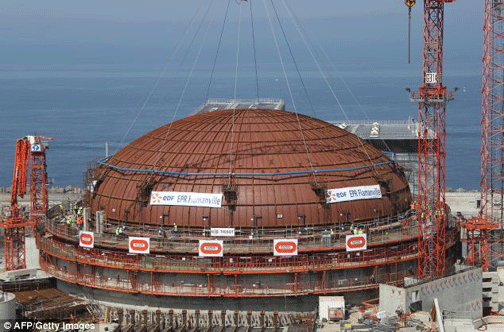
France’s EDF to reduce Flamanville nuclear plant staffing over virus, PARIS, March 16 (Reuters) – EDF will reduce staff to around 100 from 800 at its Flamanville nuclear power plant in northern France due to coronavirus infections in the Cotentin region, a spokesman for the French utility said on Monday.
Only people in charge of safety and security will remain on-site.
The decision was made because of a cluster of COVID-19 infections in region, the spokesman said adding that some staff displayed signs of the virus.
“But today, it is no longer possible to carry out tests. There are too many cases,” he said. “As a preventive measure and because it is no longer possible to carry out tests to confirm cases, we have decided to only keep those in charge of safety and security,” the spokesman said.
While the two reactors have been offline for maintenance since January and September, respectively, major maintenance work was under way.
EDF also said construction work on a long-delayed third reactor on the site would be reduced.
The French government is preparing an order that would put its inhabitants under partial lockdown to combat the coronavirus epidemic, sources aware of the planning said on Sunday, a move that would tighten further restrictions on public life. (Reporting by Bate Felix; writing by Geert De Clercq; editing by Jason Neely and Louise Heavens) AT TOP https://uk.reuters.com/article/health-coronavirus-france-nuclear/update-1-frances-edf-to-reduce-flamanville-nuclear-plant-staffing-over-virus-idUKL8N2B962I
France starts a series of nuclear power shutdowns
|
France begins winding down its reliance on nuclear powerFrance began shutting down its oldest nuclear plant last month after 43 years of operation, the first in a series of closures the government has proposed though the the country won’t altogether abandon its reliance on nuclear power. Bellona March 4, 2020 by Charles Digges
France began shutting down its oldest nuclear plant last month after 43 years of operation, the first in a series of closures the government has proposed though the the country won’t altogether abandon its reliance on nuclear power. Yet the closure of the two reactors at the Fessenheim plant along the Rhine River on France’s border with Switzerland and Germany, is part of a broad energy strategy to rely more on renewable energy sources. That strategy would see French dependence on nuclear energy from supplying three-quarters of its electricity to about half by 2035. The shutdown has also been a key goal of anti-nuclear campaigners since the Fukushima disaster in 2011. Experts have noted that the reactors at Fessenheim, brought online in 1977, fall far short of even those reactors at Fukushima, with some warning that seismic and flooding risks in the Alsace region have been underestimated. Prime Minister Edouard Philippe says the plant’s second reactor will be shut down in June 30 – though it will be several months before both reactors go cold and their used fuel can start to be removed. Another dozen reactors that will soon exceed their 40-year age limit must close by 2035 to meet the phase-down target. The plan also sees France closing its remaining coal plants, and moving to renewables like solar and wind to close the energy gap and help fight climate change. But at the same time, state-owned energy giant EDF is racing to get its first next-generation reactor running at the Flamanville plant in 2022– already 10 years behind schedule – and more may be in the pipeline. France’s history with nuclear power runs deep. The country runs 58 nuclear power plants, which sprang up largely as a response to the oil crisis in the 1970s. Those were built on the foundation of the CEA atomic energy commission, which was established in the wake of World War II in an effort to reestablish the nation’s sovereignty. Activists like Charlotte Mijeon, who is the spokesperson for the anti-nuclear group Sortir du nucléaire, told Voice of America news the Fessenheim closure is welcome news, but contended it doesn’t go far enough. “The government is closing one nuclear power plant, but it should not make us forget that the rest of the nuclear fleet is aging,” she told the agency. She also pointed to the huge subsidies nuclear power receives from the government, which they say makes it difficult for renewable power to compete……… France’s long insistence on using nuclear power has irritated Germany and Switzerland, which, as minority shareholders in Fessenheim, have long urged its shutdown. Germany also has plans of its own to phase out its nuclear power plants completely, a task it says it will finish by 2022. Polls among the French show growing resistance to nuclear power, with one survey taken in 2018 showing 53 percent of the population against the technology. https://bellona.org/news/nuclear-issues/2020-03-france-begins-winding-down-its-reliance-on-nuclear-power |
|
Veterans groups not happy -France wants to abolish the National Commission for Monitoring the Consequences of Nuclear Tests.
 Dismay over plans to scrap French nuclear monitoring commission, https://www.rnz.co.nz/international/pacific-news/410780/dismay-over-plans-to-scrap-french-nuclear-monitoring-commission 2 March 2020 Nuclear test veterans groups in French Polynesia have reacted with dismay at reports that Paris wants to abolish the National Commission for Monitoring the Consequences of Nuclear Tests.
Last week, the French publication Canard Enchaine reported that as part of administrative changes and cost-cutting measures, dozens of commissions would be disestablished.
The commission is the body bringing together state authorities, representatives of the French Polynesian government and veterans associations to work on the list of radiation-induced illnesses deemed to be relevant for compensation.
The head of the group Moruroa e tatou Hiro Tefaarere has told the broadcaster La Premiere the move was inadmissible yet not surprising for the Macron government.
He said the French president on one hand described colonialism as a crime against humanity and on the other everything was suppressed which would recognise the consequences of the tests.
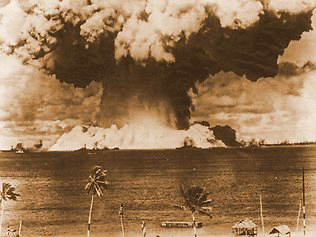
France carried out more than 190 nuclear weapons tests in the Pacific and until 2010 maintained that they were clean and posed no threat to human health.
Anti nuclear activists break into France’s Tricastin nuclear station
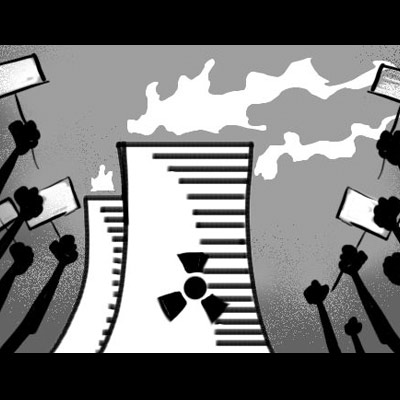 Reuters 21st Feb 2020. Activists from Greenpeace broke into the Tricastin nuclear power plant in southern France in order to demand its closure, the environmental pressure group said on Friday. “Some 50 Greenpeace activists gained access to several points at the Tricastin nuclear power plant this morning,” said Greenpeace spokeswoman Cecile Genot. “We are protesting and drawing attention to an aging nuclear power plant that is dangerous and should be shut down.” Officials for French state-controlled power group EDF, which runs Tricastin, had no immediate comment on the situation.
 |
ReplyForward
|
France starts out on the path to withdraw from nuclear energy
|
France Takes First Steps to Reduce Nuclear Energy Dependence https://www.voanews.com/europe/france-takes-first-steps-reduce-nuclear-energy-dependence, By Lisa Bryant, 21 Feb 20
February 21, 2020 France, the world’s most nuclear energy-dependent nation, is taking its first steps to shift to more renewables to power up.
On Saturday, the country begins a gradual shutdown of its aging Fessenheim plant. The move fits into the government’s broader energy strategy to reduce French dependence on nuclear energy from supplying three-quarters of its electricity to about half by 2035. Prime Minister Edouard Philippe says the plant’s first reactor will be closed Saturday, and the second in June. Another dozen reactors must close by 2035 to meet the phase-down target. The plan also sees France closing its remaining coal plants, and moving to renewables like solar and wind to close the energy gap and help fight climate change. For Charlotte Mijeon, spokesperson for anti-nuclear group Sortir du nucléaire, the Fessenheim shutdown is welcome news — but not enough. “It’s great that it’s eventually closed; however, we fear that Fessenheim is something like the tree hiding the forest,” she said. “The government is closing one nuclear power plant, but it should not make us forget that the rest of the nuclear fleet is aging.” France has 58 nuclear power plants, thanks to an energy strategy dating back to the 1970s oil crisis. Supporters say nuclear energy is a clean way to fight climate change while also meeting national energy needs. But critics say the plants have received billions in subsidies and nuclear lobbies are powerful, making it harder for renewables to compete. And they say the remaining plants pose mounting safety concerns as they age. “Regarding the climate emergency, we have no time left,” Mijeon said. “So we have to invest in green climate solutions, not in nuclear power, which is not only dirty, but also very expensive and slow.” While the reactor shutdown is a first for France, other countries, including Switzerland, Sweden and the United States, have also shut plants for a mix of budgetary, safety and environmental reasons. Neighboring Germany aims to phase out of nuclear power completely by 2022. It has been pushing for years for the shutdown of Fessenheim, which is located near its border |
|
France shuts down Fessenheim reactor in first phase of retreat from nuclear power
Reactor No. 1 will be halted on Saturday and the entire complex will come to a halt on June 30, the statement said.
Germany has long called for the plant, France’s oldest, to be shut down. It is the first nuclear complex to be closed under Macron’s plan.
France depends more on nuclear energy than any other country, getting about three-quarters of its electricity from the plants. Macron said in 2018, outlining France’s energy strategy for the next 30 years, that 14 nuclear reactors out of the 58 now running at 19 plants would be shut down by 2035. France would cap the amount of electricity it derives from nuclear plants at 50% by then.
Algeria and French Polynesia suffer from France’s 30 years of nuclear bomb testing
But Jean-Claude Hervieux has other memories. He joined the French testing efforts in Algeria as an electrician. He remembers a nuclear test in 1962 that did not go according to plan.
Radioactive dust and rock escaped from underground. Hervieux and others observing the testing ran for shelter. Two French ministers were among them. The group washed themselves in a military housing area to decontaminate.
France held more than 200 nuclear tests until a later president, Jacques Chirac, ended testing in 1996. Most tests took place in French Polynesia. But 17 took place in Algeria between 1960 and 1966, ending four years after Algeria’s independence from France.
Brahim Oumansour is a North Africa expert at the French Institute of International Relations in Paris. He said, “It’s part of the whole issue of decolonization and Algerians in general asking for recognition of colonization crimes.” He added that official recognition and financial compensation for the Algerian tests could cost millions of dollars.
Hervieux spent 10 years working on nuclear test areas in Algeria and later French Polynesia. Now 80 and living in France’s Lyon area, he says he is physically fine. But he used to receive some questionable radioactive testing results from the French government……
France’s nuclear compensation commission, CIVEN, said more than 1,600 claims have been filed under a 2010 French law that finally recognized health problems related to the testing.
Only about one-third have met the requirements needed to receive financial benefits. The requirements include about 24 possible radiation-related cancers. Almost all the claims came from France and French Polynesia. Of the 51 claims from Algeria, only one has been compensated…. https://learningenglish.voanews.com/a/questions-remain-as-france-marks-60-years-since-nuclear-tests-/5287541.html
1 This Month

of the week – Shut Down Drone Warfare!


Tell the Ukrainian Government to Drop Prosecution of Peace Activist Yurii Sheliazhenko

Petition to revoke the licensing of the Near Surface Nuclear Disposal Facility (NSDF) at Chalk River. https://www.ourcommons.ca/petitions/en/Petition/Details?Petition=e-7247
To see nuclear-related stories in greater depth and intensity – go to https://nuclearinformation.wordpress.com
-
Archives
- April 2026 (19)
- March 2026 (251)
- February 2026 (268)
- January 2026 (308)
- December 2025 (358)
- November 2025 (359)
- October 2025 (376)
- September 2025 (257)
- August 2025 (319)
- July 2025 (230)
- June 2025 (348)
- May 2025 (261)
-
Categories
- 1
- 1 NUCLEAR ISSUES
- business and costs
- climate change
- culture and arts
- ENERGY
- environment
- health
- history
- indigenous issues
- Legal
- marketing of nuclear
- media
- opposition to nuclear
- PERSONAL STORIES
- politics
- politics international
- Religion and ethics
- safety
- secrets,lies and civil liberties
- spinbuster
- technology
- Uranium
- wastes
- weapons and war
- Women
- 2 WORLD
- ACTION
- AFRICA
- Atrocities
- AUSTRALIA
- Christina's notes
- Christina's themes
- culture and arts
- Events
- Fuk 2022
- Fuk 2023
- Fukushima 2017
- Fukushima 2018
- fukushima 2019
- Fukushima 2020
- Fukushima 2021
- general
- global warming
- Humour (God we need it)
- Nuclear
- RARE EARTHS
- Reference
- resources – print
- Resources -audiovicual
- Weekly Newsletter
- World
- World Nuclear
- YouTube
-
RSS
Entries RSS
Comments RSS
 nuclear-news