Electricite de France fined for lying about Hinkley nuclear project, faces costs and delays due to pandemic
 France’s markets regulator for providing false information on the Hinkley
Point C nuclear project. EDF and former Chief Executive Officer Henri
Proglio, who was fined 50,000 euros, failed to properly disclose new
circumstances concerning the U.K. project’s financing, the Autorité des
Marchés Financiers said in a statement on Thursday.
announced it would build the U.K.’s first nuclear reactors since 1995
after reaching a deal with the government on guaranteed prices for the
power they’d generate. The energy firm also said the project would
benefit from a British credit guarantee on conditions that were yet-to-be
agreed. EDF and Proglio should have specified in a statement a year later
that there had been significant changes on the guarantees, the AMF said.
accusation brought forward by AMF investigators. The AMF’s enforcement
committee assesses civil market-abuse cases ranging from insider trading to
publishing misleading information.
facing delays at the Hinkley Point C nuclear plant as the coronavirus
pandemic hampered work on-site and hit supply chains. The largest and most
advanced infrastructure project in the U.K. will miss three key milestones
this year, one of them critical — risking the 2025 completion deadline.
wave of coronavirus and lockdowns could cause more long-term set-backs.
“We’ve absorbed a lot of factory delays but we had some margin in our
program to do so,” Hinkley Point C’s managing director Stuart Crooks
said in an interview on-site in the southwest of England. EDF still expects
Hinkley to be finished on time.
assumption that the virus peters out by the end of the year so supply
chains and work at Hinkley can return to normal. There are about 4,500
staff currently on the site that covers an area equal to 245 soccer fields.
Initial plans were to ramp-up the number of workers to around 6,000 but
that depends how long social distancing rules stay in place.
Huge, costly, enormous effort, ITER nuclear fusion far from ready
|
France’s global nuclear fusion device a puzzle of huge parts, AP, By ELAINE GANLEY. 29 Jul 20,
“…….. Billed as the world’s largest science project, ITER is gigantic. The circular device, called a tokamak, has a 30-meter circumference, stands 30 meters (100 feet) high, and is made up of more than a million parts constructed in numerous countries. ………Some pieces transported to France weigh several hundred tons. Tools to put the reactor together match that size, with giant lifts that must transfer components over the walls and down into “the pit.” A key component being built by the U.S., the Central Solenoid, is the most powerful of ITER’s numerous magnets. Together, they will be strong enough to lift an aircraft carrier. The project begun in 2006 is far from over. The experimental reactor is to head for another landmark moment in five years, described as a “trial run” when scientists launch what is called “First Plasma” showing that the machine functions, including magnetic fields and other operations……
The project’s estimated cost just for the EU was about 20 billion euros ($23.5 billion), Bigot told reporters. He said a full price tag was difficult to estimate because participating countries make their own contributions. https://apnews.com/c9e1780864431c3edcd1cc2c17568c54
|
|
|
Takeover of UraMin – a scam linked to incompetence of leaders in the nuclear industry
Le Media 25th July 2020, Son of resistance fighters, Marc Eichinger was a trader for several banks before leading his investigation and security company, APIC, which protects companies in hostile terrain. With the Areva affair he becomes a spy, specializing in financial crime.
Since I opened the Areva file in February 2010, at the request of Admiral d’Arbonneau, I have the feeling that the
takeover of UraMin is not only a scam linked to incompetence or lightness of the leaders of the nuclear group in the treatment of this acquisition. A certain number of clues suggest that it goes beyond …I tend to think that the UraMin file will eventually come to light and become a historical benchmark in the area of international corruption. Yet at no time did we receive the slightest support from an elected politician. In this area, it is obvious that everyone sticks together. There is nothing to expect from politicians: the soup is too good, as they say.
EDF denies that China has increasingly big role in UK’s Hinkley Point nuclear project
EDF Denies Rising Chinese Influence at U.K. Nuclear Site, Bloomberg, By Corinne Gretler, July 26, 2020,
- Chinese partner’s role bigger than disclosed, Telegraph said
- EDF said allegations are ‘untrue,’ CGN’s role not increasing
Electricite de France SA denied a media report that China General Nuclear Power Corp.’s role at a U.K. nuclear site is increasing, underlining the growing tensions about China’s involvement in critical infrastructure.
The company understated the number of Chinese personnel on site and leaned heavily on CGN’s expertise in planning and construction, the Sunday Telegraph reported, citing company documents and unidentified sources. The newspaper also said Chinese engineers proposed a way to lift a concrete dome onto the reactor at Hinkley Point C that would’ve involved dangling the heavy structure above workers, before it was deemed too dangerous…………
EDF owns about two-thirds of the Hinkley Point program while CGN holds the rest. The project was approved in 2016. The Tories have demanded a review of the plant, the Telegraph said, citing former Conservative leader Sir Iain Duncan Smith saying ministers were misled when they approved China’s role as just a financial partner in the project. https://www.bloomberg.com/news/articles/2020-07-26/dalio-warns-of-u-s-china-capital-war-that-would-hit-dollar
France’s Flamanville new generation nuclear reactor “is a mess” – Energy Minister Barbara Pompili
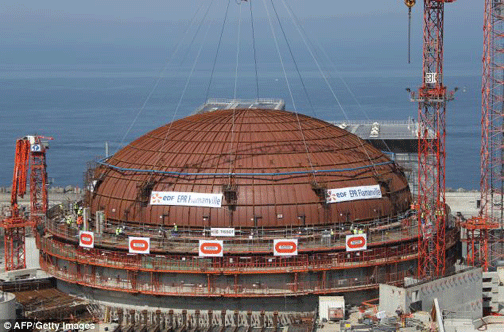 Montel News 23rd July 2020, The new generation EPR reactor EDF is building at Flamanville in France
“is a mess,” France’s new energy minister Barbara Pompili said on Thursday. “I think it’s clear. The Flamanville EPR is a mess. This has been said in a number of reports which cannot be suspected of being anti-nuclear, notably the Court of Auditors report,” she told France Inter radio. “The initial costs (of the EPR) have multiplied by four,” she said, pointing to “problems of competence” that “had to be resolved.”
https://www.montelnews.com/en/story/french-epr-is-a-mess–energy-minister/1133707?s=09
Electricite de France (EDF) ‘s new nuclear reactors not financially viable

French auditor calls for financing guarantee for future EPR projects, WNN, 15 July 2020, EDF must ensure the financing and profitability of its proposed EPR2 reactor before starting construction of any plants based on the design in France, the country’s state audit office has said. The EPR2 is a simplified version of the EPR design, construction of which has been hit by delays and cost increases in France and Finland……..
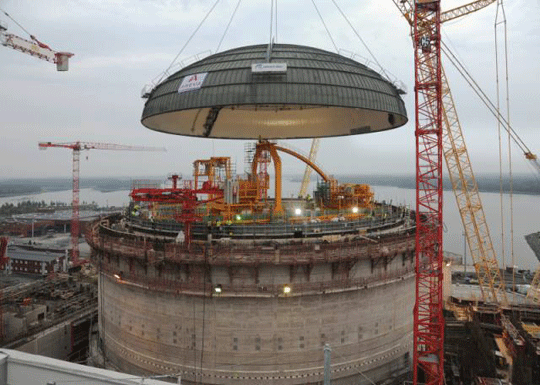 Construction of the Olkiluoto 3 EPR began in 2005, with completion of the reactor originally scheduled for 2009. However, with various delays and setbacks, fuel loading is now planned for later this year. The loading of fuel into the Flamanville EPR in France, construction of which began in December 2007, is now scheduled for the end of 2022. Two EPR units are also under construction at the Hinkley Point C project in Somerset, UK.launch of the construction sites of the first two EPRs, in Finland and in Flamanville. This insufficient preparation led to underestimating the difficulties and the construction costs, and to overestimating the capacity of the French nuclear sector to face it, at the cost of financial risks for the companies of the sector.”
The audit office added, “The construction of new EPRs in France cannot in any event be envisaged without clear prior answers on the methods of financing and the role of nuclear power production in the electricity mix of tomorrow.”
The report says EDF is no longer in a position to finance the construction of new reactors on its own. The utility, it says, is studying means of financing that either makes the consumer – as in the case of the UK’s contract-for-difference for construction of Hinkley Point C – or the taxpayer bear the costs of construction.
“The financial challenges are major, with the cost of construction of three pairs of EPR2 reactors being estimated at EUR46 billion (2018 value),” the Cour des Comptes notes. “Taking into account their duration of construction, production and dismantling, the decision to build or not to build future EPRs will have consequences until the 22nd Century. …. https://world-nuclear-news.org/Articles/French-auditor-calls-for-financing-guarantee-for-f
France’s state auditor questions the wisdom of EDF’s Hinkley Point nuclear project in UK

Telegraph 11th July 2020, Doubts cast on EDF’s ability to build power stations on time and budget.
French auditor questions wisdom of state-owned utility’s involvement in building the new Hinkley Point C power station in Somerset.
France’s state auditor has questioned the ability of the company building Britain’s next nuclear power plant to construct new reactors within “acceptable” costs and timeframes. State-owned EDF has already said that its Flamanville nuclear plant in Normandy will now cost €12.4bn due to the expense of fixing 66 faulty welds. On top of that, the project will cost another €6.7bn, according to France’s Court of Accounts in a new report.
EDF has also said the plant’s start date will be delayed until the end of 2022. Flamanville was originally due to cost €3.3bn and start operations in 2012.
Presenting the damning 148-page report this week, Court of Accounts chief Pierre Moscovici said: “There is still uncertainty on the ability of the French nuclear industry, despite its current strong efforts, to build new nuclear reactors within a time frame and costs that remain acceptable.”
The criticism follows a £3bn surge in costs at the Hinkley Point C reactor EDF is building in Somerset. The bill for the project will now be £22.5bn – £2.9bn more than previously forecast – with overruns paid for by EDF. The energy giant has faced lags at its other projects, including Finland’s Olkiluoto 3 nuclear reactor, which is running more than
a decade behind schedule.
In its report, the state auditor questioned the wisdom of involvement in Hinkley Point C, saying its construction was
“weighing heavily” on the financial situation of EDF, whose net debt hit €41bn at the end of last year.
Court reveals that EDF deceived UK about the true financial risks of Hinkley Point nuclear project
EDF boss suppressed report calling Hinkley Point ‘risky’Adam Sage, The Times, 10 July 20, thetimes.co.uk/article/edf-boss-suppressed-report-calling-hinkley-point-risky-gd5vcdhrx
The Times reports that the chief executive of the French company building the UK’s new nuclear reactors won boardroom approval for the project after suppressing an internal review labelling it as risk-laden. In a “highly critical report on the European Pressurised Reactors”, France’s Court of Audit said that the Hinkley Point project in Somerset, led by EDF, represented a “high financial risk” for the French state electricity group, the Times adds.
The court uncovered that the risks had been pointed out in a 2015 review that warned there “were not efficient enough to guarantee that risks would be controlled”. The Times continues: “The court said that Jean-Bernard Lévy, EDF’s executive chairman, had ‘refused to transmit the full report’ to directors or the government, even though the state has an 83.7% stake. They received only a synopsis.” The project received approval from the EDF board in 2016. The court also said that EDF must establish the financing and profitability of nuclear reactors before launching projects, reports Reuters, “dealing a blow to the state-owned utility’s ambitions to build new units”. And Reuters also reports that nuclear power generation at its reactors in France plunged 25.1% in June (compared to 2019) due to the effects of the coronavirus pandemic.
Meanwhile, writing in the Daily Telegraph, Sir Iain Duncan-Smith – MP and former leader of the Conservative Party – argues that the UK should “unwind its dependence on China” for “cheap goods and nuclear power”. He says: “The UK has enormous home grown tidal power potential, yet both tidal and hydrogen seem to have been brushed aside in favour of our growing dependence on large Chinese-run nuclear projects.” He concludes: “From Huawei to hydrogen and Hong Kong, we need to recognise the strategic threat China poses and, together with our allies, decide what we will do to reduce it, otherwise we risk repeating the failed lessons of the past.” And also in the Daily Telegraph, chief city commentator Ben Marlow says that the government should be stimulating manufacturing demand to contain the damage caused by Covid-19 to Rolls Royce – “Britain’s most illustrious engineering company”. He says: “It should start with nuclear where enlisting the expertise of Rolls-Royce in building so-called mini-nukes would help to solve its current geo-political nightmare with China. It would make it easier to ditch China General Nuclear Power Group from the plans to build giant new plants at Sizewell on the Suffolk coast and Bradwell in Essex, or scrap the proposals altogether.” These decisions would “also offer a greener and cheaper alternative to a technology that looks decidedly out of date already, and it would create jobs at a company in desperate need of a leg up – three birds with one stone”.
France’s oldest nuclear power plant at Fessenheim finally shut down
The two reactors at Fessenheim began operation in 1977 and 1978 and were already three years beyond their projected 40-year life span.
Although there is no legal limit on the operating life of French nuclear power plants, EDF had envisaged a 40-year lifetime for all second-generation PWRs.
Fessenheim had become a focus for anti-nuclear campaigners after the 2011 Fukushima accident in Japan, prompting then President Francois Hollande to promise its closure. However, it was not until 2018 that his successor Emmanuel Macron finalised the decision.,,,….. https://www.neimagazine.com/news/newsfessenheim-closes-down-8004216
France’s EDF in a financial pickle over huge costs of UK’s Hinkley C nuclear project
Dave Toke’s Blog 27th June 2020, The chickens are coming home to roost for EDF for their 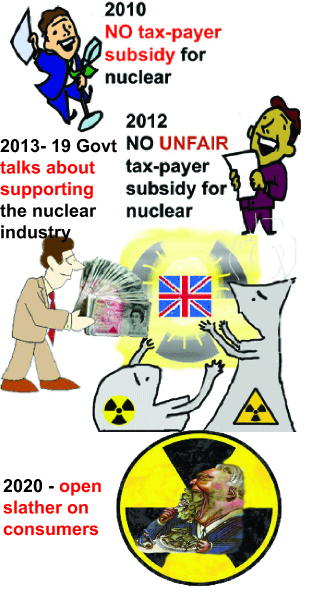 questionable decision to go ahead with building Hinkley C -a decision they took despite the lack of certainty over whether they would get enough backing from the British Government.
Originally EDF was publicised as being offered UK Treasury loan guarantees that had been widely touted as a vital basis for building Hinkley C. But now the French Financial Markets Regulator has
sanctioned EDF for not flagging up how conditional such loan guarantees were. These loan guarantees have never materialised.
Essentially, EDF is now continuing to build Hinkley C using money borrowed on its own balance
sheets – borrowings which are much more costly than UK Government backed guarantees and which reduce its own (EDF) profitability.
The Finance Officer of EDF actually resigned at the time EDF decided to go ahead with building Hinkley C. Of course all this is happening at the same time when we are being asked to believe that the next EPR (at Sizewell C) is going to be delivered at low cost to the consumer if the risk of building the plant is transferred from EDF to the British taxpayer and consumer!
This is the so-called RAB mechanism, something that could well just turn out to be an
almost unlimited cash facility for EDF to park their financial black hole in the centre of British finances (as well as those of the French).
https://realfeed-intariffs.blogspot.com/2020/06/edf-sanctioned-by-french-regulators-for.html
France’s old Fessenheim nuclear reactor to finally shut down- the first of many
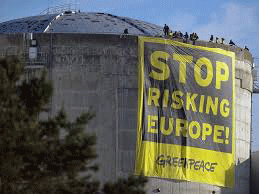 France’s oldest nuclear reactor to finally shut down,Guardian,
Environmentalists have welcomed news that the 43-year-old Fessenheim reactor will close, nine years after it was first planned, Agence France-Presse, 28 June 20,
France’s oldest nuclear power plant will shut down on Tuesday after four decades in operation, to the delight of environmental activists who have long warned of contamination risks, but stoking worry for the local economy.
The Fessenheim plant, opened in 1977 and already three years over its projected 40-year life span, became a target for anti-nuclear campaigners after the catastrophic meltdown at Fukushima in Japan in 2011.
Despite a pledge by then-president Francois Hollande just months after the Fukushima disaster to close Fessenheim – on the Rhine river near France’s eastern border with Germany and Switzerland – it was not until 2018 that his successor Emmanuel Macron gave the final green light.
Run by state-owned energy company EDF, one of Fessenheim’s two reactors was disconnected in February.
The second is to be taken off line early on Tuesday, but it will be several months before the reactors have cooled enough for the used fuel to be removed.
That process should be completed by 2023, and the plant is not expected to be fully dismantled before 2040 at the earliest. …..
More will follow, with only 294 people needed on site for the fuel removal process until 2023, and about 60 after that for the final disassembly. ……
There is no legal limit on the life span of French nuclear power stations, but the EDF had envisaged a 40-year ceiling for all second-generation reactors, which use pressurised water technology.
France’s ASN nuclear safety authority has said reactors can be operated beyond 40 years only if ambitious safety improvements are undertaken.
In the 1990s and 2000s, several safety failures were reported at Fessenheim, including an electrical fault, cracks in a reactor cover, a chemistry error, water pollution, a fuel leak, and non-lethal radioactive contamination of workers.
In 2007, the same year a Swiss study found that seismic risks in the Alsace region had been underestimated during construction, the ASN denounced a “lack of rigour” in EDF’s operation of the plant.
Without Fessenheim, France will still have 56 pressurised water reactors at 18 nuclear plants generating some 70% of its electricity. Only the US, with 98, has more reactors, but France is by far the world’s biggest consumer of nuclear energy.
In January, the French government said it would shut 12 more reactors nearing or exceeding the 40-year limit by 2035, when nuclear power should represent just 50% of the country’s energy mix in favour of renewable sources.
At the same time, the EDF is racing to get its first next-generation reactor running by 2022 – 10 years behind schedule – and more may be in the pipeline…….https://www.theguardian.com/environment/2020/jun/28/frances-oldest-nuclear-reactor-to-finally-shut-down
Nuclear power sales heavily affected byCOVID-19 in France: legal battles to follow
 The Impact of COVID-19 on Nuclear Electricity Sales Contracts in France, JDSUPRA, The Impact of COVID-19 on Nuclear Electricity Sales Contracts in France, JDSUPRA,
Nora Djeraba, Ruxandra Lazar, King & Spalding 19 June 20, The electricity sector, like numerous others in France, has been heavily affected by the economic shutdown due to the COVID-19 pandemic.
The first two weeks of confinement led to a reduction in electricity consumption in France of around 15 to 20% compared to the consumption usually observed at the same year period under equivalent weather conditions[1]. Such a variation in electricity consumption over such a short period of time is unprecedented, the most recent significant drop in demand having been observed during the economic crisis of 2008-2009, when, in contrast, the contraction in demand spread over the long term, reaching a maximum of -5% from one year to the next. Concomitantly, electricity prices on the wholesale markets dropped from EUR50-55/Mwh at the beginning of 2020 to around EUR20/Mwh at the end of March. This distressed economic situation highly impacted the so-called “alternative” electricity suppliers in France, i.e., suppliers other than the incumbent operator, EDF, which entered the retail electricity market in France as a result of its opening up to competition. Several of these suppliers declared force majeure under the contracts entered into with EDF for buying nuclear electricity at a price which became too high compared to the wholesale market price. Several decisions have already been rendered on this issue by the French energy market regulator – Commission de regulation de l’énergie or “CRE”, the Conseil d’Etat (the highest administrative court on administrative matters) and the Commercial Court of Paris, but the legal battle is only just beginning and, given the amounts at stake, we can expect it will be long and bitter……… https://www.jdsupra.com/legalnews/the-impact-of-covid-19-on-nuclear-52378/ |
|
Risk of fire on a nuclear submarine. France’s lucky escape, due to reactor being removed for overhaul
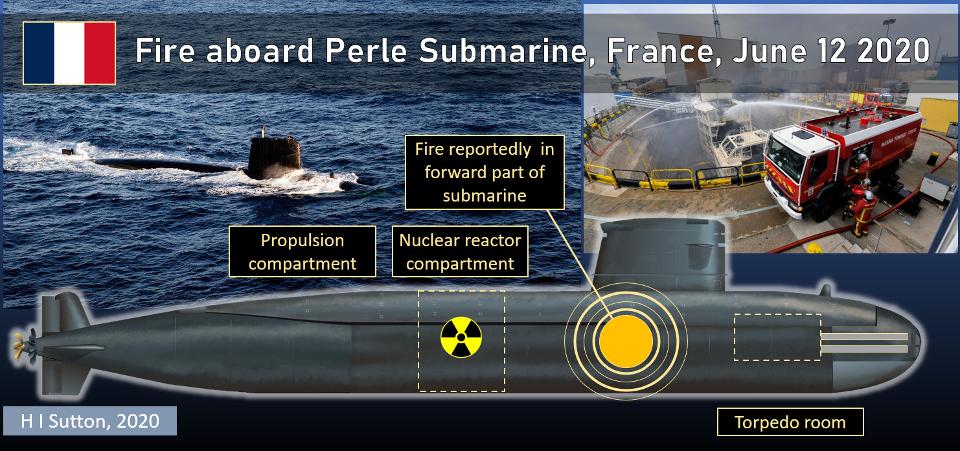
Why The Catastrophic Fire On A Nuclear Submarine Is Nothing To Gloat About https://www.forbes.com/sites/hisutton/2020/06/14/why-the-catastrophic-fire-on-a-nuclear-submarine-is-nothing-to-gloat-about/#ef9667d2ffd0
As details emerge of the fire aboard the French submarine Perle on Friday, it seems unlikely to me that the boat will be returned to service. Whichever way you look at it, the fire is a terrible blow for the French Navy (Marine Nationale). Their submarine fleet is already stretched. But France’s misfortune brings home a basic reality that it could happen to any navy.
The cause of the fire, which took most of Friday to extinguish, has yet to be determined. Florence Parly, Minister of the Armed Forces, was reported by Naval News as saying on June 13 that the “cause for such a strong (and rapid) fire is still unknown.” She also said that if the boat turns out to be fixable, everything will be done to repair it. Any hint of optimism in this statement may point to the terrible predicament that it will leave the French Navy in if it cannot be repaired.
No Reason To Gloat
You will not find many in the defense community laughing at France’s expense. When a Russian or Chinese warship suffers a similar accident, many casual observers are quick to make jokes. Less so the defense community.
For example on April 13 a Chinese Type-075 assault carrier caught fire in Shanghai. That ship, the first of its type, was being fitted out before delivery. The types of work done during refit are similar to the deep overhaul that Perle was being subject to. Or in December last year a Russian aircraft carrier caught fire.
But the Western defense community is very aware that these accidents could equally apply to their home navies. Overhauling ships and submarines is ‘hot work’ and fires can easily occur.
The fire took 14 hours to put out, from 10.35am until 00.50 am the next morning. This may sound like a long time, but the U.S. Navy had a similar experience dealing with a fire aboard the Los Angeles class submarine USS Miami in 2012. That fire, which was also during an overhaul, lasted 12 hours and caused so much damage that the boat had to be written off. In the American case it turned out that the fire had been started deliberately by a dockyard worker hoping that the alarm would get him off work early.
In general, fires aboard submarines can be harder to put out. This is because of the cramped spaces aboard, and also because there are very few openings into the submarine. And they can be more devastating than a similar fire aboard a surface vessel because the heat can deform the steel hull. On a surface vessel this can be repaired more easily, but with a submarine it can make the hull weaker so that it is no longer safe to dive. This is why I am not optimistic that she will be repairable.
The fire was not as bad as it could have been. Fortunately the nuclear reactor had apparently already been removed. So the fire has not been categorized as a nuclear accident. And the torpedoes and missiles had also been unloaded so there was no risk of them exploding.
Many core systems, such as the combat system and sonar, had also been removed. So if the hull can be saved, then returning her to service is at least feasible. But everything seems to depend on whether the hull itself has been weakened.
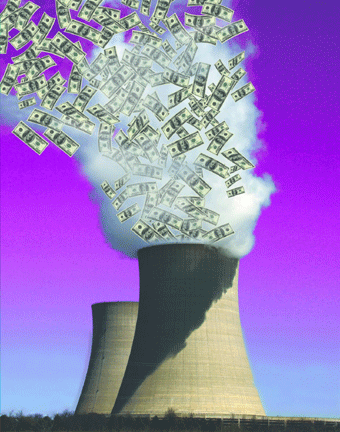
Why doesn’t debt-ridden EDF cut its losses and close its uneconomic UK nuclear reactors
|
Unanswered questions dog UK’s new nuclear plans Climate News Network June 11th, 2020, by Paul Brown A French company has designs on the United Kingdom: new nuclear plans for more reactors, with British consumers footing the bill.
– The French company EDF, a company in a hurry, wants permission to start building two more reactors in the United Kingdom, and it hopes to save money – by arranging for British taxpayers to pay the capital costs of its new nuclear plans. EDF is already building two reactors at Hinkley Point in the West of England, and it is hoping to transfer workers from that site to Suffolk, on the east coast, believing that will help it to save up to 20% of the construction cost of the two planned reactors, because everyone employed there will know already what to do. The catch is that EDF has no money itself to finance the construction and wants the UK government to impose a new tax on British electricity consumers so that they will pay the cost through their electricity bills. The UK has yet to decide whether to go ahead with this tax, euphemistically called a Regulated Asset Base. If adopted, what the scheme means is that the UK consumer will pay EDF’s bills rather than the company having to borrow the money from banks, which are increasingly unlikely to lend money to such expensive schemes because they take so long to build and promise little return. Anxieties abound Meanwhile EDF, which has a Chinese nuclear company as its junior partner, promises to create 25,000 jobs, including 1,000 apprenticeships during construction, and says 900 full-time jobs will be available when Sizewell C, as the station will be called, is complete. If all goes to plan the company hopes to start work in 18 months and says the two reactors will take 10 years to build. It expects them to provide 7% of the UK’s electricity, enough for six million homes. There are many objectors. Some say much of the coastline will be badly affected, including internationally important nature reserves. Others fear the site is highly vulnerable to sea level rise and therefore a danger to the public. Local people also fear that the construction site, with its attendant lorry and commuter traffic, will disrupt their lives for a decade, destroying the important tourist trade. Cheaper options Other more strategic objections, which might weigh heavier with the government, are that nuclear power is very expensive and much cheaper and less controversial alternatives exist, particularly on-shore and off-shore wind and solar power, and biogas. More importantly, a drive for energy efficiency, badly neglected in the UK at present, would render the whole project unnecessary. The problem EDF has is its track record on construction and repairs. The type of reactor it plans to build, the European Pressurised Water Reactor, said by the company to be the most powerful in the world, is proving extremely difficult to build, and till now none has yet been completed outside China. Construction is running more than 10 years late in both Finland and France, and costs continue to escalate.
EDF’s debts are now huge, so big that the French state is working out how to restructure the company by splitting it into a renewables arm (which is profitable) and a nuclear branch. There are serious doubts about the reliability of EDF’s claims and timetables for fixing existing power stations and opening new ones. The company currently owns all of the UK’s operating nuclear reactors, most of which are near the end of their lives, and there are serious doubts about whether they are economic and in some cases even safe. Two reactors at Hunterston in Scotland have serious cracking in the graphite blocks that are part of the control mechanism. The company has spent two years trying to justify continuing to operate the reactors to the Office for Nuclear Regulation (ONR). Similarly, at the other end of the UK, at Dungeness in south-east England, the station is also closed for extensive repairs, an outage that was going to take weeks has now stretched to two years – and the start-up date has just been put back again. Looking on the bright side One of the features of all of EDF’s activities is the extraordinary optimism the company seems to have, particularly about when reactors will be finished or ready to restart after repairs. With the Hunterston reactors restart dates have been announced nine times, only to be postponed each time. This track record led the Climate News Network to ask EDF some searching questions, including why they continued to offer optimistic start-up dates that were repeatedly postponed. We also asked why the company kept the Hunterston and Dungeness stations open at all, since repairing them was costly and they were already near the end of their operating lives. We asked EDF: “At what point do you cut your losses and close the stations permanently?” After five days of pleading for more time to answer, it sent us already published press releases extolling the virtues of the plan to build Sizewell, and several comments. …….HTTPS://CLIMATENEWSNETWORK.NET/UNANSWERED-QUESTIONS-DOG-UKS-NEW-NUCLEAR-PLAN/, l |
|
Fire on French submarine – luckily its nuclear reactor, nuclear fuel, had been removed for overhaul
 A French Submarine Caught Fire In Drydock. It Could Lead Paris To Rethink Its Nuclear Deterrence Strategy. Forbes, Sebastien Roblin 11 June 20 A fire broke out in the rear section of the French nuclear-powered attack submarine Perle on Friday morning as she lay in drydock in the port of Toulon. White clouds of smoke poured into the sky as firefighters from Toulon and Marseilles rushed to the scene. A French Submarine Caught Fire In Drydock. It Could Lead Paris To Rethink Its Nuclear Deterrence Strategy. Forbes, Sebastien Roblin 11 June 20 A fire broke out in the rear section of the French nuclear-powered attack submarine Perle on Friday morning as she lay in drydock in the port of Toulon. White clouds of smoke poured into the sky as firefighters from Toulon and Marseilles rushed to the scene.
Finally at 9:36 p.m local time the Mediterranean Maritime Prefecture reported that the fire had been brought under control by completely flooding the rear compartments of the boat with foam, further noting that the “reactor rooms remains untouched.”…….. Just as importantly, the ship’s 48 megawatt pressurized water nuclear reactor, nuclear fuel, and (conventional-only) weapons had been removed when the submarine entered the drydock in January 2020 for an overhaul by Naval Group due for completion by February 2021. For that reason, the local maritime prefecture claims there is no possibility of radioactive contamination from the incident.
The firefighting effort reportedly involved 30 specialist naval firefighters with support from a firefighting boat, as well as additional specialists scrambled from Marseilles, 11 specialized ground-based firefighting vehicles, and at least 10 ESNA submariners to advise the firefighters. However, there are growing fear that the Perle may have sustained too much damage to be saved. A veteran submariner told the local paper Var Matin “If the thick hull [made of 80HY high-tensile steel]…is deformed, the boat is screwed.” The cause of the blaze is speculated to possibly be faulty welding or a high-pressure cutting gone awry. France’s Nuclear Submarine Force French periodical LeMonde warned that should the Perle suffer “irremediable damage,” there was the possibility “the entire organization of French nuclear deterrence may have to be rethought. And the Navy may have to give up on certain strategic missions.” The Perle does not actually carry any nuclear weapons. However, one of the primary roles of French attack submarines is protecting the four larger Triomphant-class nuclear-powered ballistic missile submarines (SSBNs) from hostile submarines. Indeed, the SSBN Le Téméraire conducted a test launch of an unarmed M51 nuclear ballistic missile just the day prior. France perceives these submarines as performing a vital role in strategic nuclear deterrence, or “dissuasion” as it’s called in France………. Establishing the cause of the accident that may put out of action a valuable strategic asset will also be a priority for Defense Minister Florence Parley, particularly given how much more serious the incident might have been had weapons, the reactor and/or additional personnel had been onboard. For now the citizens of Toulon can only be thankful that loss of life was averted and that there is no apparent risk of contamination. The French Navy will have to take stock of the damage, adjust its plans for its SSN fleet accordingly—and consider how it can minimize the odds of another such accident occurring. https://www.forbes.com/sites/sebastienroblin/2020/06/12/a-french-submarine-caught-fire-in-drydock-it-could-lead-paris-to-rethink-its-nuclear-deterrence-strategy/#4addae213d05 |
|
|
1 This Month

of the week – Shut Down Drone Warfare!


Tell the Ukrainian Government to Drop Prosecution of Peace Activist Yurii Sheliazhenko

Petition to revoke the licensing of the Near Surface Nuclear Disposal Facility (NSDF) at Chalk River. https://www.ourcommons.ca/petitions/en/Petition/Details?Petition=e-7247
To see nuclear-related stories in greater depth and intensity – go to https://nuclearinformation.wordpress.com
-
Archives
- April 2026 (19)
- March 2026 (251)
- February 2026 (268)
- January 2026 (308)
- December 2025 (358)
- November 2025 (359)
- October 2025 (376)
- September 2025 (257)
- August 2025 (319)
- July 2025 (230)
- June 2025 (348)
- May 2025 (261)
-
Categories
- 1
- 1 NUCLEAR ISSUES
- business and costs
- climate change
- culture and arts
- ENERGY
- environment
- health
- history
- indigenous issues
- Legal
- marketing of nuclear
- media
- opposition to nuclear
- PERSONAL STORIES
- politics
- politics international
- Religion and ethics
- safety
- secrets,lies and civil liberties
- spinbuster
- technology
- Uranium
- wastes
- weapons and war
- Women
- 2 WORLD
- ACTION
- AFRICA
- Atrocities
- AUSTRALIA
- Christina's notes
- Christina's themes
- culture and arts
- Events
- Fuk 2022
- Fuk 2023
- Fukushima 2017
- Fukushima 2018
- fukushima 2019
- Fukushima 2020
- Fukushima 2021
- general
- global warming
- Humour (God we need it)
- Nuclear
- RARE EARTHS
- Reference
- resources – print
- Resources -audiovicual
- Weekly Newsletter
- World
- World Nuclear
- YouTube
-
RSS
Entries RSS
Comments RSS
 nuclear-news