In September, French nuclear production reached its second lowest level on record
record – also its second lowest this year – at 21.6 TWh, down 21.5%
compared to 2019, while outages several reactors have been extended, RTE
data said Thursday. Nuclear output last month was thus slightly higher, by
0.3 TWh, the lowest recorded in June, at 21.3 TWh, according to Montel’s
calculations. And it has decreased by 1.2 TWh compared to August. On
average, nuclear represented 68.4% of electricity production in France,
against 69% in August. https://www.montelnews.com/fr/story/production-nuclaire-%C3%A0-un-2me-plus-bas-record-en-septembre/1153335
Two new appeals against the Flamanville EPR
have decided to seize the Council of State in order to cancel the decree
extending the construction of the Flamanville EPR until 2024. On March 25,
in the confinement, the government issued a decree extending to 2024 the
validity of the creation authorization decree of the EPR in Flamanville,
which set earlier in April 2020 its deadline for commissioning.
France, France Nature Environnement Normandy, Crilan, Stop EPR neither in
Penly nor elsewhere) “strongly denounce this government obstinacy in
tolerating the continuation of this catastrophic project.”
French taxpayers don’t want to pay for Sizewell nuclear station, neither do British.
 France’s EDF demands clarity on British nuclear power plans Times John Collingridge 27 Sept 20, French energy giant EDF is set for a showdown with the Treasury over state funding for nuclear power stations as Britain’s atomic future faces a make-or-break moment.Jean-Bernard Lévy, chairman and chief executive of Électricité de France, will speak to chancellor Rishi Sunak via video link on Wednesday to demand clarity over Britain’s plans for funding nuclear power.
The industry was left reeling this month when Japan’s Hitachi quit its Horizon project to build a £20bn plant on Anglesey.
That shock retreat, after years of prevarication by Westminster over state support for nuclear power and turmoil in the Japanese nuclear industry, left only EDF and China General Nuclear with plans for atomic power stations in the UK.
EDF and China are building the delayed and over-budget £22.5bn Hinkley Point C power station in Somerset, but Paris has balked at
the prospect of French taxpayers funding the next nuclear project in Britain.
Instead, EDF, which is 84% owned by the French state, wants British taxpayers to underwrite a new plant at Sizewell in Suffolk. A
proposed new financial structure, the regulated asset base, would levy a tax on UK household energy bills to help pay for the project.
Other options include the British government taking a stake — although that has worried the Treasury, which is anxious about adding to its debt mountain.
EDF declined to comment. With most of Britain’s ageing reactors due to close by the end of the decade, Sunak and Boris Johnson face the dilemma of whether to fund more big nuclear plants, or rely on wind, solar, gas, small reactors and imported power to keep the lights on.
The American government has warned Hitachi against selling the Anglesey site to China, and is understood to be considering bankrolling US companies to take it over. Westinghouse, which makes the AP1000 nuclear plant, and NuScale Power,
which is developing small, modular reactors, are both believed to be
exploring options for the site. South Korea’s Kepco is also understood to
be interested, as is EDF.
France’s secrecy over its deplorable history of nuclear bomb testing in Algeria

|
Algeria: France urged to reveal truth about past nuclear tests, https://www.theafricareport.com/41067/algeria-france-urged-to-reveal-truth-about-past-nuclear-tests/, By Farid Alilat, Thursday, 10 September 2020, A study released shows the presence of waste tied to French nuclear tests in Algeria done during the 1960s. Jeune Afrique/The Africa Report had a chance to consult the report.
On 13 February 1960 at 7:04 a.m., France tested its first nuclear bomb, named Gerboise bleue, over Reggane. At the time, the French authorities explained that the tests were being conducted in uninhabited and deserted areas. However, at least 20,000 people were living at the sites, which still to this day have yet to be fully decontaminated. What waste remains of the 17 nuclear tests France carried out in Algeria between 1960 and 1967? What kind of condition is it in, and what repercussions does it have on the health of residents and the environment? Is France ready to assist Algerians in locating this waste and decontaminating sites, at a time when both countries show a willingness to work together on a memorial initiative regarding the colonial past? More than 60 years after Gerboise bleue, was conducted, a report from the International Campaign to Abolish Nuclear Weapons (ICAN) recommends that France answer these questions and provide Algeria with assistance in cleaning up the relevant sites. ‘Radioactivity Under the Sand’, a study led by Patrice Bouveret, director of the French Centre for Documentation and Research on Peace and Conflicts (Observatoire des armements), and Jean-Marie Collin, co-spokesperson for ICAN France, provides a comprehensive review of the presence of French nuclear waste in Algeria. Between February 1960 and February 1967, France carried out 17 atmospheric and underground nuclear tests in the Reggane and Hoggar regions, not far from a natural museum housing cave paintings which date back to the Neolithic period. Nine of these tests were conducted after Algeria gained independence in July 1962.
In accordance with a clause contained in the Evian Agreements of March 1962, France was permitted to continue its testing programme until 1967. On paper, the testing came to an end that year. However, the Algerian government under Chadli Bendjedid’s presidency secretly granted the French permission to continue carrying out tests at the B2-Namous site in Reggane until 1986. Radioactive materials left out in the openAlthough some of the facilities used for the tests were dismantled prior to and after the programme’s shutdown, waste is still present both above and below ground. At the end of the Algerian War, the two parties failed to negotiate a clause which would have forced France to decontaminate the sites or provide Algerians with archives and documentation related to the nuclear tests. “After seven years [from 1960 to 1967] of conducting a range of tests, the two sites at Reggane and In Ekker were handed over to Algeria without providing for any procedures to control and monitor radioactivity,” reads a December 1997 report from the French Senate. The institution acknowledged that the French authorities displayed “a certain lack of concern”, noting that local residents “could have been treated with at least a little consideration”. According to the authors of the ICAN report: “From the beginning of nuclear tests, France set up a policy of burying all waste in the sand. Everything that may have been contaminated by radioactivity had to be buried.” This included planes, tanks and other equipment. Worse still, radioactive materials (vitrified sand and contaminated rocks and lava) were left out in the open, thereby exposing the population and the environment to assured danger.
The report also mentions that since France is not subject to any obligation under agreements it has established with Algeria, it has never revealed the location or quantity of the buried waste. The authors add: “The nuclear past should no longer remain buried deep in the sand.” Lack of transparencyIn a 1996 ‘classified defence’-level report held in the archives of the French Ministry of Defence and which remains classified, the French authorities indicate that the tests had been halted without taking any initiative to provide documentation to their Algerian counterparts. “No memorandum and no report have been found that provide information about the radiological condition of the launch bases when they were returned to the Algerian authorities [in 1967],” the report reads. Not only does waste remain under the sand, but “the sites are not subject to checks for radioactivity and are even less the subject of campaigns to raise awareness among local residents about the health risks”. Although the Morin Law of 2010 (of which France recognised victims through its nuclear testing ) opened the doors to granting compensation to nuclear test victims in French Polynesia and Algeria, it failed to take environmental consequences into account. The Treaty on the Prohibition of Nuclear Weapons (TPNW), adopted in July 2017 and signed by Algeria, requires State Parties to take measures to assist the residents and areas contaminated by the tests. In addition, the treaty stipulates that “a State Party that has used or tested nuclear weapons or any other nuclear explosive devices shall have a responsibility to provide adequate assistance to affected States Parties, for the purpose of victim assistance and environmental remediation”. The issue is that, thus far, France has declined to sign the TPNW. What’s more, a lack of transparency still dominates. For example, ICAN’s report cites a secret agreement between France and Algeria regarding nuclear decontamination which was reportedly signed during former French President François Hollande’s visit with his Algerian counterpart, Abdelaziz Bouteflika, in Algiers in December 2012. The agreement concerned the notorious B2-Namous site in Reggane. A set of recommendationsWill the memorial initiatives recently undertaken by both countries – with the appointment of two experts, Benjamin Stora for France and Abdelmadjid Chikhi for Algeria – be a game changer for this chapter of history which continues to put a strain on relations between France and Algeria? According to Algeria’s veterans affairs minister, the memorial initiatives integrate the nuclear waste question. In keeping with these efforts, ICAN’s report recommends that the two parties hold discussions and that France improve Algerian citizens’ access to French medical archives, as well as that French legislation from 2010 “delineating the affected areas in the Sahara” be amended “so that they can be expanded, as was done for French Polynesia”. Other recommendations concern nuclear waste, with the report suggesting that “France should provide the Algerian authorities with a full list of sites where contaminated waste was buried, in addition to the precise location of each of these sites (latitude and longitude), a description of this material, as well as the type and thickness of the materials used to cover them”. The report also proposes that France “provide Algeria with the plans of the French Alternative Energies and Atomic Energy Commission’s [CEA] underground installations under the Reggane plateau military base, as well as the plans of the various galleries excavated in the Tan Afella mountain”. On 13 February 1960 at 7:04 a.m., France tested its first nuclear bomb, named Gerboise bleue, over Reggane. At the time, the French authorities explained that the tests were being conducted in uninhabited and deserted areas. However, at least 20,000 people were living at the sites, which still to this day have yet to be fully decontaminated. |
|
|
France’s weekly nuclear power generation drops
|
French nuclear weekly generation falls below 30 GW to 9-week-low, AuthorAndreas Franke , EditorJonathan Dart
HIGHLIGHTS 28.4 GW average some 10 GW below Sept. 2019 Low river levels at Chooz, unplanned outages, delays France turned net importer for week ending Sept. 6 London — French nuclear generation averaged 28.4 GW in the seven days to Sept. 6, the lowest weekly average in nine weeks, according to data from system operator RTE. Nuclear output rose to 29.2 GW on Sept. 7, but that was 12 GW lower than a year earlier as the 3-GW Chooz plant remained offline due to low river levels, with a number of reactor returns delayed……… |
|
EDF’s Economic Statement on impact of Sizewell nuclear project – gives unproven, misleading evidence
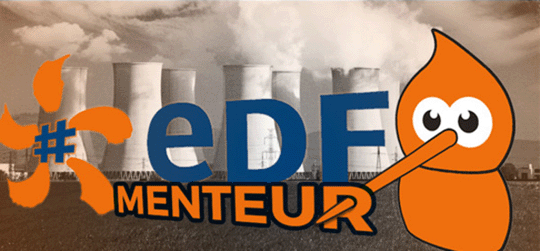 Stop Sizewell C 3rd Sept 2020, An independent review of EDF’s Economic Statement, assessing the impacts of Sizewell C to Suffolk’s local economy, has concluded that the project threatens “profitability and, in some cases, viability” of some local businesses, while others will be “at an immediate disadvantage when bidding for contracts”.
The report, Sizewell Economic Statement – Response, by highly-regarded independent research and analysis consultancy Development Economics, reveals multiple areas where EDF’s claimed benefits are over-optimistic, unproven or misleading, frequently omitting
evidence to support its figures or relying on “erroneous analysis”.
It concludes, critically, that EDF’s Economic Statement “fails to meet the minimum requirements of the legislation”, with no serious attempt to measure the deterrent effect on tourists and their expenditure, traffic congestion or competition for skills and labour.
The National Policy Statement EN-6 requires that applicants for major nuclear energy projects take into account ‘potential pressures on local and regional resources, demographic change and economic benefit’.
Global heating – low water rate affecting France’s Saint-Alban nuclear plant
  Low water flow may halve output at France’s Saint-Alban nuclear plant https://www.reuters.com/article/france-nuclear/low-water-flow-may-halve-output-at-frances-saint-alban-nuclear-plant-idUSL8N2G04V7 PARIS, Sept 3 (Reuters) – A low flow rate on the Rhone River will likely restrict output from Saturday to Monday at EDF’s Saint-Alban nuclear plant in southeastern France, French grid operator RTE said on Thursday.The two Saint-Alban reactors produce 1.3 gigawatts (GW) of power each and RTE said the reduction in output could be equivalent to the production of one unit. Low water flow may halve output at France’s Saint-Alban nuclear plant https://www.reuters.com/article/france-nuclear/low-water-flow-may-halve-output-at-frances-saint-alban-nuclear-plant-idUSL8N2G04V7 PARIS, Sept 3 (Reuters) – A low flow rate on the Rhone River will likely restrict output from Saturday to Monday at EDF’s Saint-Alban nuclear plant in southeastern France, French grid operator RTE said on Thursday.The two Saint-Alban reactors produce 1.3 gigawatts (GW) of power each and RTE said the reduction in output could be equivalent to the production of one unit.
The Saint-Alban 2 reactor is currently scheduled to go offline for routine maintenance on Sept. 19. EDF’s use of water is regulated by law to protect plant and animal life. The company is obliged to reduce output during hot weather when water temperatures rise, or when river levels and the flow rate are low. August was the third hottest in France on records going back to 1900, with the summer months between June and August entering the top 10 hottest summers on record, Meteo France data showed. Low flow rates were already an issue at the Saint-Alban plant last month, as RTE warned on Aug. 20 that the equivalent of one reactor could be taken offline for that reason. French nuclear availability is currently at 52.4% of total capacity, with 29.7 GW offline. (Reporting by Forrest Crellin; Editing by Susan Fenton) |
|
France’s President Macron joins the global nuclear lobby’s push to export nuclear reactors
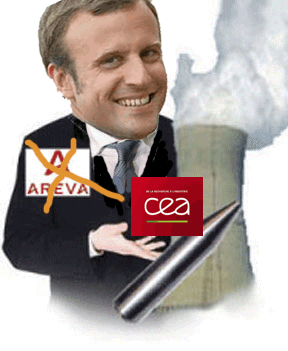 Macron talks nuclear energy and ways to control militias during Iraq visit, The National , Khaled Yacoub Oweis, Sep 2, 2020French PM is the most significant leader to visit Iraq since Prime Minister Mustafa Al Kadhimi came to power in May
During a visit to Baghdad on Wednesday, French President Emmanuel Macron discussed solving Iraq’s massive power shortages with nuclear energy ……. Mr Kadhimi told reporters in Baghdad that he discussed with Mr Macron “a future project” to use nuclear energy to produce electricity and solve decades-long power shortages……..
If realised, the project would place Iraq along with the UAE and Iran as the only Middle East countries with electricity produced by a nuclear reactor. ………. https://www.thenational.ae/world/mena/macron-talks-nuclear-energy-and-ways-to-control-militias-during-iraq-visit-1.1071729
Nuclear colonialism. ICAN says that France must clean up its nucleat test wastelands in Algeria

France must clean up Algerian nuclear test sites: group, https://www.france24.com/en/20200826-france-must- clean-up-algerian-nuclear-test-sites-group 28 Aug 20, France must clean up nuclear test sites in Algeria where radioactive waste remains from testing in the former colony during the 1960s, a Nobel Peace Prize-winning group said Wednesday.
France carried out 17 nuclear explosions in the Algerian part of the Sahara Desert between 1960 and 1966.
Eleven of the tests came after the 1962 Evian Accords ended the six-year war of independence and 132 years of colonial rule.
“France must give the Algerian authorities the full list of where the contaminated toxic waste was buried,” the International Campaign to Abolish Nuclear Weapons (ICAN) said in a new 60-page report.
“The ‘nuclear past’ must no longer remain deeply buried under the sand,” ICAN said, citing the concerned areas as the western Reggane region and a zone close to the In Ekker village.
The campaign group identified contaminated, radioactive elements that have either been buried, or are easily accessible.
“The majority of the waste is in the open air, without any security, and accessible by the population, creating a high level of sanitary and environmental insecurity,” ICAN said.The 2017 Nobel Peace Prize laureate group added that almost nothing has been done to clean the sites, inform the populations and evaluate the risks.
Exposure to radioactive material can cause cancer.
“This case study shows once more an asymmetry of power and an injustice that we find all through nuclear history,” Giorgio Franceschini, director of the Heinrich Boll Foundation which published the report, said in his forward.
“It is not a coincidence that France tested its first nuclear weapon in Algeria, that was still a French colony in 1960,” he added.
France refused to sign up the UN’s 2017 Treaty on the Prohibition of Nuclear Weapons, whereas Algeria signed and is in the process of ratifying the legally binding agreement.
Since Algeria’s independence, Franco-Algerian relations have been tumultuous.
Algerian President Abdelmadjid Tebboune in July called on France to fully apologise for its colonial past.
An apology could “make it possible to cool tensions and create a calmer atmosphere for economic and cultural relations”, especially for the more than six million Algerians who live in France, he said.
Water shortage, drought, necessitate shutdown of France’s Chooz Nuclear Plant
 Nuclear reactor in France shut down over drought, Chooz Nuclear Plant on Belgian border turned off after dry summer evaporates water needed to cool reactors, AA, Cindi Cook |25.08.2020 A nuclear power plant in northern France has been temporarily shuttered due to a drought in the area, said the company that runs the plant Tuesday.
The second reactor of the Chooz Nuclear Power Plant, in Ardennes, on the Belgian border, was shut down late Monday night, after the first reactor ceased operations Friday evening.
The actions were taken due to low water levels in the Meuse River, the main artery that runs through the area used to cool the two reactors.
The plant is named after Chooz, the commune where it is located in the Ardennes. The region is on level three of four drought alert levels…….
Water is a crucial ingredient for nuclear plant safety to cool the reactor core. ……
Water restrictions have been imposed this summer in 79 out of the 96 mainland departments in France due to drought conditions. https://www.aa.com.tr/en/europe/nuclear-reactor-in-france-shut-down-over-drought/1952943
France’s nuclear energy continues to be hit by global heating, drought, water shortage
Low flow rate may halve output at France’s Saint-Alban nuclear plant, https://in.reuters.com/article/france-nuclear/low-flow-rate-may-halve-output-at-frances-saint-alban-nuclear-plant-idINL8N2FM54B PARIS, Aug 20 (Reuters) – A low flow rate on the Rhone River will likely restrict output on Saturday and Sunday at EDF’s Saint-Alban nuclear plant in southeastern France, French grid operator RTE said on Thursday.The two Saint-Alban reactors produce 1.3 gigawatts (GW) of power each, and the output reduction could be equivalent to the production of one unit, RTE said.
EDF’s use of water is regulated by law to protect plant and animal life. It is obliged to reduce output during hot weather when water temperatures rise, or when river levels and the flow rate are low.
Last month was the driest July in at least 60 years and the first half of August was the second hottest on record, making it the fifteenth consecutive month with higher than average temperatures, Meteo France data showed.
RTE published a similar warning for the Chooz reactors in northern France on Tuesday, as low water levels on the Meuse river risk extending current maintenance periods.
French nuclear availability is currently at 63.6% of total capacity, with 22.7 GW offline. (Reporting by Forrest Crellin; Editing by Jan Harvey)
Climate change bad for nuclear: Hot weather, water shortage, likely to curb output at France’s Chooz nuclear reactors
|
Low water levels may curb output at France’s Chooz nuclear reactors -RTE, https://in.reuters.com/article/france-nuclear/low-water-levels-may-curb-output-at-frances-chooz-nuclear-reactors-rte-idINL8N2FC5XG PARIS, Aug 10 (Reuters) – Production may be reduced at EDF’s Chooz nuclear reactors in northern France on Saturday due to high temperatures lowering the water level on the Meuse River, French grid operator RTE said on Monday.The two reactors produce 1.45 gigawatts (GW) of power each. The shortfall could be equal to the production of one unit, RTE said.
The heat wave is forecast to peak at 37 degrees Celsius in the region on Wednesday, with temperatures falling as the week progresses, according to Meteo France’s weather forecast. Consumption in France is projected to reach 44.7 GW on Saturday, RTE data showed. French nuclear availability is currently at 60.6% of total capacity, with 24.6 GW offline. (Reporting by Forrest Crellin and Bate Felix; Editing by Cynthia Osterman) |
|
Flamanville -the costly bloated shoddy leaky white elephant in France’s nuclear room
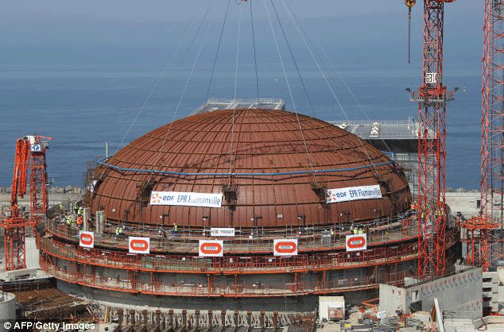
France’s Revolutionary Nuclear Reactor Is a Leaky, Expensive Mess
With a bloated budget, endless delays, and shoddy construction, EPR looks like a big mistake. BY CAROLINE DELBERT, AUG 3, 2020
- A revolutionary French reactor design is 10 years overdue and nearly four times over budget.
- Taking big technology swings requires risk, but this huge miscalculation looks bad.
- The reactor uses less uranium and aims to replace a decommissioned reactor at an existing plant.
France’s new energy minister has called a major French nuclear project “a mess” in public interviews. The European pressurized reactor (EPR) that was commissioned for the Flamanville nuclear power plant, where it joins two existing pressurized water reactors, has been delayed and plagued by problems. The latest extension takes the project timeline from 13 years to 17 at least.
The goal with the EPR design was to continue to kit out the world’s highest-output nuclear plants, with individual reactors that were more powerful and safer. The EPR uses less uranium because its chemical design is more efficient. And it’s not any kind of major technological leap; instead, it’s an iteration on a previous design that’s just a little bit better.
The engineers are so eager to keep iterating that they already have an EPR 2 design in the works. This sounds pretty straightforward … right?
That puts Flamanville 10 years past its original due date. One of the more alarming causes for delay is a break in the “main secondary system penetration welds,” which has contributed to a budget that’s bloated from a planned $3.9 billion to $14.6 billion.
Barbara Pompili was just appointed France’s minister of ecological transition, which is the department that includes energy as well as environmental issues like biodiversity. Pompili is publicly and avowedly anti-nuclear, even for civilian energy. With a new spotlight on her office, she told a French radio station, “We have made a commitment to reduce the share of nuclear power to 50 [percent] by 2035.”
Pompili said the critiques of Flamanville’s overdue EPR reflect broad industry consensus from different reports, not her own anti-nuclear views.
Fire at the Belleville nuclear power plant reveals the disorganization of EDF
  Le Journal de l’Energie 30th July 2020 A fire at the Belleville nuclear power plant reveals the disorganization of Le Journal de l’Energie 30th July 2020 A fire at the Belleville nuclear power plant reveals the disorganization ofEDF. A fire broke out at the Belleville-sur-Loire (Cher) nuclear power plant in April 2020 during a routine maintenance operation carried out by subcontractors, which should not have been left unattended. An incident that was largely avoidable if EDF had followed basic safety rules. An
inspection by the Nuclear Safety Authority (ASN), after the incident, identified “many deviations”. Although the incident did not have an impact on the operation of the plant, it calls into question the safety culture of EDF, the world’s leading nuclear operator. https://journaldelenergie.com/nucleaire/incendie-centrale-nucleaire-belleville-desorganisation-edf/ |
|
Global heating now causing nuclear reactor shutdowns in France
EDF warns heatwave may force brief outage for 2.6 GW Golfech reactors, S and P Global, London — Rising temperatures may lead to output restrictions at France’s 2.6 GW Golfech nuclear power plant from July 31, operator EDF warned. “Due to the temperature forecasts on the Garonne, production restrictions are likely to affect EDF’s nuclear power plant at Golfech,” it said July 27. 28 Jul 2020 Author Andreas Franke , Editor Felix Fernandez
HIGHLIGHTS
Restrictions focus on July 31 to August 3 period.
Mini-heatwave only forecast to last until weekend
July’s nuclear average above expectations at 30 GW
London — Rising temperatures may lead to output restrictions at France’s 2.6 GW Golfech nuclear power plant from July 31, operator EDF warned.
“Due to the temperature forecasts on the Garonne, production restrictions are likely to affect EDF’s nuclear power plant at Golfech,” it said July 27.
This could lead to “unavailability of both units” until August 2.
France’s most southerly reactors, located between Toulouse and Bordeaux on the Garonne river, were some of the most impacted units during an extended heatwave last summer when air temperatures rose above 40 C in late June.
The current spell of hot weather is not forecast to stretch beyond the weekend with Meteo France not yet characterizing it as heatwave despite measuring the highest temperature so far this year at nearby Albi at 39.9 C on July 27.
In 2019, temperatures briefly peaked in late June above 40 C amid extended spells of extreme hot weather, increasing river temperatures above critical levels.
Grid operator RTE forecasts power demand to peak above 55 GW on July 31 with average weighted temperatures 7 C above norms.
In June 2019, French demand spiked close to record summer highs of 59.5 GW as temperatures reached 45 C in some regions of southern France.
Around two-thirds of France’s 56 reactor units are river-cooled, with some restrictions due to high temperatures stretching into autumn during past summers…. https://www.spglobal.com/platts/en/market-insights/latest-news/electric-power/072820-edf-warns-heatwave-may-force-brief-outage-for-26-gw-golfech-reactors.
1 This Month

of the week – Shut Down Drone Warfare!


Tell the Ukrainian Government to Drop Prosecution of Peace Activist Yurii Sheliazhenko

Petition to revoke the licensing of the Near Surface Nuclear Disposal Facility (NSDF) at Chalk River. https://www.ourcommons.ca/petitions/en/Petition/Details?Petition=e-7247
To see nuclear-related stories in greater depth and intensity – go to https://nuclearinformation.wordpress.com
-
Archives
- April 2026 (19)
- March 2026 (251)
- February 2026 (268)
- January 2026 (308)
- December 2025 (358)
- November 2025 (359)
- October 2025 (376)
- September 2025 (257)
- August 2025 (319)
- July 2025 (230)
- June 2025 (348)
- May 2025 (261)
-
Categories
- 1
- 1 NUCLEAR ISSUES
- business and costs
- climate change
- culture and arts
- ENERGY
- environment
- health
- history
- indigenous issues
- Legal
- marketing of nuclear
- media
- opposition to nuclear
- PERSONAL STORIES
- politics
- politics international
- Religion and ethics
- safety
- secrets,lies and civil liberties
- spinbuster
- technology
- Uranium
- wastes
- weapons and war
- Women
- 2 WORLD
- ACTION
- AFRICA
- Atrocities
- AUSTRALIA
- Christina's notes
- Christina's themes
- culture and arts
- Events
- Fuk 2022
- Fuk 2023
- Fukushima 2017
- Fukushima 2018
- fukushima 2019
- Fukushima 2020
- Fukushima 2021
- general
- global warming
- Humour (God we need it)
- Nuclear
- RARE EARTHS
- Reference
- resources – print
- Resources -audiovicual
- Weekly Newsletter
- World
- World Nuclear
- YouTube
-
RSS
Entries RSS
Comments RSS
 nuclear-news