French Winter Power Twice as Pricey as Germany’s on Nuclear Woes

By Todd Gillespie, April 19, 2023 https://www.bloomberg.com/news/articles/2023-04-19/french-winter-power-twice-as-pricey-as-germany-s-on-nuclear-woes?leadSource=uverify%20wall#xj4y7vzkg
France’s weakened nuclear power output means the cost of its electricity for next winter is more than twice as expensive as Germany’s, as concerns over the health of the country’s reactors persist.
The “massive” gap of nearly €250 ($273) per megawatt-hour between French and German prices is because traders are pricing in more risk as they await updates on Electricite de France SA’s struggles with its aging atomic fleet, according to analysts at Engie SA’s EnergyScan. “No participants want to risk being short next winter,” they wrote.
French power for the first quarter of 2024 is trading at €416 per megawatt-hour, more than double Germany’s rate of €169. Normally a power exporter, France’s atomic generation has been gradually returning to service but still remains below historical averages.
France, which relies on nuclear energy for most of its electricity, is expected to remain heavily dependent on power imports during the winter months to meet its demand. Meanwhile, Germany closed its last nuclear plants Saturday after years of political tension over phasing out the technology, but is still very reliant on polluting coal-fired power.
French nuclear availability was at 62% on Wednesday, according to data compiled by Bloomberg. Nuclear output on Wednesday was above its level for this time last year after weeks of historic lows.
— With assistance by Josefine Fokuhl and Francois De Beaupuy
French nuclear watchdog ASN issues first lifespan extension to 40-year-old reactor
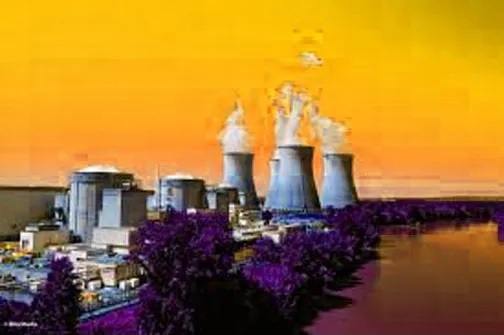
French nuclear watchdog ASN issued a decision allowing for the continued
operation of state-owned utility EDF’s Tricastin 1 nuclear reactor in
southern France, the first lifetime extension granted to a French reactor
after 40 years of operation.
In a decision published on Aug. 10 and seen by
Reuters on Tuesday, ASN granted the reactor an extension until its next
review, so for another ten years. Some 32 of France’s fleet of 56 reactors
are up for their fourth ten-yearly inspection this decade, leaving French
energy production reliant on securing a swathe of reactor extensions for
another ten years.
Reuters 22nd Aug 2023
EDF Warns of French Nuclear Output Cuts in Weekend Heat Wave
Bloomberg, By Francois De Beaupuy, August 22, 2023
Electricite de France SA will probably have to reduce nuclear output over the coming weekend as a heat wave affecting a large part of the country warms rivers used for cooling some of its reactors.
Due to the high temperatures forecast on Rhone river, production restrictions are likely to affect production at its Tricastin power plant — where two of its four 900-megawatt reactors are already………….(Subscribers only) more https://www.bloomberg.com/news/articles/2023-08-21/edf-warns-of-french-nuclear-output-cuts-in-weekend-heat-wave#xj4y7vzkg
French cruise ship makes rendezvous with Russian nuclear icebreaker near North Pole
Barents Observer, By Atle Staalesen August 20, 2023
The meeting between the two vessels took place in remote Arctic waters not far from the North Pole.
Video made by passengers onboard the 50 Let Pobedy and shared on social media shows the two vessels trading greetings and sailing side by side through thick sea-ice.
The Russian nuclear-powered icebreaker is on the way to the North Pole as part of an expedition for students. Shortly after its meeting with the tourist ship, it encountered also two other ships currently sailing in the area. According to ship operator Rosatom, the 50 Let Pobedy met with Arctic research station Severny Polyus, as well as research ship Akademik Tryoshnikov.
The latter ship had sailed all the way from St.Petersburg with new crew and equipment for the drifting station that is on a two-year expedition across the ice.
The Le Commandant Charcot is the new vessel built for cruise ship operator Ponant. It is classified as icebreaker and can make independent voyages to the North Pole. In 2021, it was first hybrid-electric luxury cruise ship to make it to the North Pole.
The ship set out on a 16-days expedition from Reykjavik in early August. It sails to the geographic North Pole and ends up in Longyearbyen, Svalbard.
It is not a voyage for the regular man and woman. The starting price per person is €31,485…………………………………………… https://thebarentsobserver.com/en/arctic/2023/08/french-cruise-ship-makes-rendezvous-russian-nuclear-icebreaker-near-north-pole
France and Russia co-operate on developing a plant in Russia for processing depleted uranium
The installation of equipment has begun at TVEL’s JSC Electrochemical Plant
(ECP) in Zelenogorsk in Russia’s Krasnoyarsk Region for W2-ECP, the
country’s second plant for the processing of depleted uranium hexafluoride.
The plant is part of a long-term project to manage and make use of depleted
uranium stocks in Russia. The plant, with a processing capacity of 10,000
tonnes per year, is being supplied by Orano Projets – the engineering arm
of France’s nuclear fuel cycle specialist Orano – under a EUR40 million
(USD44 million) contract signed in December 2019.
Under the terms of the contract, Orano will supply the equipment for the construction of the
deconversion facility, as well as providing technical assistance in its
installation and commissioning. The first equipment for the plant arrived
at the construction site in eastern Siberia from France in December 2021.
The project was originally expected to be completed in 2022. The W2-ECP
plant will accept deliveries of depleted uranium hexafluoride gas (DUF6 –
sometimes called DUHF) and deconvert these to uranium tetrafluoride, with
anhydrous hydrofluoric acid being produced as a by-product. Deconversion
transforms the toxic and somewhat corrosive gaseous DUF6 enrichment
tailings into a stable powdered oxide form fit for long-term storage,
transport or final disposal.
World Nuclear News 16th Aug 2023
https://www.world-nuclear-news.org/Articles/Construction-of-second-Russian-deconversion-plant
Public participation for the Flamanville EPR reactor commissioning project (INB 167)
ASN ………………………………………… TERMS OF THE CONSULTATION
Consultation reference [2023.06.39]
Public consultation on the Flamanville EPR reactor commissioning application, with the full application file made available, will take place from 5 June to 15 September 2023 on the ASN website.
Any additional relevant information, in particular with regard to the administrative procedure implemented, may be requested from the Nuclear Safety Authority, the competent authority to make the decision, by electronic means at the address info@asn.fr , or at its premises, 15 rue Louis-Lejeune – CS 70013 – 92541 Montrouge Cedex – by appointment on 01 46 16 42 74.
The paper file can be consulted on request and by prior appointment with the Prefecture of La Manche (on 02 33 75 47 39), which coordinates the availability on its premises, in the sub-prefectures, in the France Services area of the town of Les Pieux and in the town hall of Flamanville.
Observations and proposals from the public can be made on the ASN website for the duration of the consultation. As the project is subject to environmental assessment, the opinion of the Environmental Authority, EDF’s brief in response to this opinion and the opinions of the local authorities concerned by the project can also be consulted on the ASN website.
ASN will take into account the observations and proposals of the public within the framework of the current examination of the commissioning application for the installation. In the event that it considers giving a favorable response to this request, it plans to consult the public on its draft decision authorizing the commissioning…………………………………………….. https://www.asn.fr/l-asn-reglemente/consultations-du-public/mise-a-participation-du-public-pour-le-projet-de-mise-en-service-du-reacteur-epr-de-flamanville#documents-a-consulter
EDF Sees Increased Risk of Delay to New UK Atomic Reactors, financial doubts

Francois de Beaupuy, Bloomberg News, 27 Jul 23, https://www.bnnbloomberg.ca/edf-sees-increased-risk-of-delay-to-new-uk-atomic-reactors-1.1951285
– Electricite de France SA said the risk of further delay to two nuclear reactors in southwest England has risen because of construction setbacks.
EDF flagged last year that the plants may start 15 months late. The reactors at Hinkley Point have been touted by the UK government as sparking a nuclear renaissance, boosting energy independence and reducing reliance on fossil fuels. But the work has been plagued by multiple holdups and cost overruns.
The increased risk of a 15-month delay is due to “performances on civil works and challenges on mechanical, electrical, heating, ventilation and air conditioning,” EDF said Thursday in an earnings presentation. “Progress is below the planned trajectory and action plans have been set.”
The reactors, costing as much as £32 billion ($41.5 billion), are due to start operating in 2027 and 2028. The ballooning budget has fueled controversy over the vast sums needed for new nuclear developments, even as other low-carbon technologies such as offshore wind have also faced inflationary pressures.
Hinkley Point’s setbacks come as EDF seeks to arrange financing for a second pair of atomic plants — at Sizewell in eastern England — that would use the same design. Delays and cost overruns may deter investors who also face increasing demands for capital from renewables, which provide swifter returns.
The debt-laden French utility has a 66.5% stake in Hinkley Point, while China General Nuclear Power Corp. owns the rest. As funding requirements now exceed contractual commitments, shareholders will be asked to provide additional equity voluntarily starting in the fourth quarter.
“The probability that CGN will not fund the project beyond its committed equity cap is high,” EDF said Thursday. “Financing solutions are being investigated, in the event that CGN does not allocate its voluntary equity.”
France needs to invest 25 billion euros ($28 billion) each year to maintain its nuclear energy programme
EDF will need to invest around 25 billion euros ($28 billion) each year to
keep its nuclear fleet and network in shape and build new reactors required
for France’s energy transition, the company’s CEO said on Wednesday.
Grilled by lawmakers during a hearing before the French National Assembly’s
economic affairs committee, EDF’s Luc Remont said France also needed to
rethink parts of the company’s business model and its electricity tariff
policy to allow the utility to boost investments.
Reuters 19th July 2023
Nuclear Notebook: French nuclear weapons, 2023
Bulletin, By Hans M. Kristensen, Matt Korda, Eliana Johns, July 17, 2023
France’s nuclear arsenal has remained stable over the past decade and contains approximately 290 warheads……….. Nearly all of France’s warheads are deployed or operationally available for deployment on short notice.
…………………………………………………………………………………………
France’s nuclear doctrine
Successive heads of state, including Presidents Sarkozy, Hollande, and now Macron, have periodically described the role of French nuclear weapons. The Defense Ministry’s 2017 Defense and National Security Strategic Review reiterated that the nuclear doctrine is “strictly defensive,” and that using nuclear weapons “would only be conceivable in extreme circumstances of legitimate self-defense,” involving France’s vital interests. What exactly these “vital interests” are, however, remain unclear.
In February 2020, President Emmanuel Macron announced that France’s “vital interests now have a European dimension,” and sought to engage the European Union on the “role played by France’s nuclear deterrence in [its] collective security” (Élysée 2020). Macron clarified in October 2022 that these vital interests “would not be at stake if there was a nuclear ballistic attack in Ukraine or in the region,” apparently attempting to avoid being seen as expanding French nuclear doctrine (France TV 2022). Explicitly ruling out a nuclear role in case of Russian nuclear escalation in Ukraine appeared to contradict France’s statement at the August 2022 Review Conference for the Treaty on the Non-Proliferation of Nuclear Weapons, which explained that “for deterrence to work, the circumstances under which nuclear weapons would [or would not] be used are not, and should not be, precisely defined, so as not to enable a potential aggressor to calculate the risk inherent in a potential attack” (2020 Review Conference of the Parties to the Treaty on the Non-Proliferation of Nuclear Weapons 2022).
France does not have a no-first-use policy and reserves the right to conduct a “final warning” limitednuclear strike to signal to an adversary that they have crossed a line—or to signal the French resolve to conduct further nuclear strikes if necessary—in an attempt to “reestablish deterrence” (Élysée 2020; Tertrais 2020). Although France is a member of NATO, its nuclear forces are not part of the Alliance’s integrated military command structure.
If an aggressor is not deterred, President Macron explained in 2020, France’s “nuclear forces are capable of inflicting absolutely unacceptable damages upon that State’s centers of power: its political, economic and military nerve centers” (Élysée 2020).
…………………..The possibility of using the nuclear weapon first is assumed: our doctrine is neither that of no first use nor that of the sole purpose, according to which nuclear weapons are only addressed to the nuclear threat … Nuclear deterrence does not seek to win a war or prevent losing one” (Burkhard 2023; our translation).
…………………………………………………………………………… Under President Macron, France has engaged in a long-term modernization and strengthening of its nuclear forces.
……………………………………..Submarine-launched ballistic missiles
The French force of submarine-launched ballistic missiles (SLBMs) constitutes the backbone of the French nuclear deterrent.
………………………………………………….Air-launched cruise missiles
The second leg of France’s nuclear arsenal consists of nuclear ASMPA (air-sol moyenne portée-amélioré) air-launched cruise missiles for delivery by fighter-bombers operated by the Strategic Air Forces and the Naval Nuclear Aviation Force.
……………………………………………………………The French Ministry of the Armed Forces is also developing a successor to the ASMPA-R: a fourth-generation air-to-surface nuclear missile (air—sol nucléaire de 4e génération, ASN4G) with enhanced stealth and maneuverability that is scheduled to reach initial operational capability in 2035 and remain in service beyond the 2050s (Assemblée Nationale 2023)…………………………………..
The nuclear weapons complex
France’s nuclear weapons complex is managed by the Direction des Applications Militaires (DAM), a department within the Nuclear Energy Commission (Commissariat à l’énergie atomique et aux énergies renouvelables, or CEA). DAM is responsible for research, design, manufacture, operational maintenance, and dismantlement of nuclear warheads.
…………………………………………….more https://thebulletin.org/premium/2023-07/nuclear-notebook-french-nuclear-weapons-2023/
How much water do French nuclear plants use?

Figures showing that the cooling of reactors could capture 30% of water resources have been removed from the site of the Ministry of Environment.
Le Monde ,By Perrine Mouterde, March 26, 2023,
How much do nuclear power plants contribute to total water consumption in France? This simple question no longer seems to have a clear answer. At the root of the confusion lies the Ministry of Environmental Transition’s removal of a background paper on the resourcing and use of water in France on around March 10. According to this fact sheet from the statistical service, power plant cooling represented the second most water-consuming activity in the country (31%), behind agriculture (45%) and ahead of drinking water (21%) and industrial use (4%). The annual volume of water consumed in mainland France, over the period 2008-2018, was estimated at 5.3 billion cubic meters.
In the midst of the review of the parliamentary bill to accelerate the construction of new reactors, the figure of 31% was being used by opponents of atomic energy to demonstrate that this energy source was not adapted to climate change. “Once and for all, let’s say it, simply and firmly: at this rate, there will soon not be enough water in our rivers to cool the nuclear power plants!,” stated Marine Tondelier – the national secretary of Europe Ecologie-Les Verts (EELV, Greens) – on March 7, based on this data.
Three days later, the Ministry of Environmental Transition………….(subscribers only)
France to decide on nuclear financing by end of 2024
The French government will decide at the end of 2024 on the regulatory and
financing model for its nuclear revival programme, economy minister Bruno
Le Maire said late on Wednesday.
Montel 13th July 2023
https://www.montelnews.com/news/1510337/france-to-decide-on-nuclear-financing-by-end-of-2024
High river temperatures to limit French nuclear power production

By Forrest Crellin, July 13, 2023, PARIS, (Reuters) – Output restrictions are expected at two nuclear plants along the Rhone river in eastern France due to high temperature forecasts, nuclear operator EDF (EDF.PA) said, several days ahead of the similar warning last year, but affecting fewer plants.
The hot weather is likely to halve the available power supply from the 3.6 gigawatt (GW) Bugey plant and the 2.6 GW Saint Alban plant from July 13 and July 16 respectively, the operator said.
However, production will be at least 1.8 GW at Bugey and 1.3 GW at Saint Alban to meet grid requirements, and may change according to grid needs, the operator said.
Kpler analyst Emeric de Vigan said the restrictions were likely to have little effect on output in practice, with cuts likely only at the weekend or midday when solar output was at its peak, so that the impact on power prices would be slim.
He said the situation would need monitoring in coming weeks, however, noting it was unusually early in the summer for such restrictions to be imposed.
Water temperatures at the Bugey plant already eclipsed the initial threshold on July 9 where restrictions are possible, and are currently forecast to peak next week and then drop again, Refinitiv data showed……….
The Garonne river in southern France has the highest potential for warming to critical levels, but the Golfech plant is currently offline for maintenance until mid-August, the data showed.
“(The restrictions were) to be expected and it will probably occur more often,” Greenpeace campaigner Roger Spautz said.
“The authorities must stick to existing regulations for water discharges. Otherwise the ecosystems will be even more affected,” he added………………………….. more https://www.reuters.com/business/energy/high-river-temperatures-limit-french-nuclear-power-production-2023-07-12/
France to supply Ukraine with long-range cruise missiles with the ‘capacity to strike deeply’
By John Irish, July 11, 2023, VILNIUS, July 11 (Reuters) – France will join Britain in supplying Ukraine with long-range cruise missiles, which can travel 250 km (155 miles), a move that allows Ukrainian forces to hit Russian troops and supplies deep behind front lines, French officials said on Tuesday.
Emmanuel Macron said he had decided to boost military aid to Ukraine to help its counteroffensive as the French President arrived at a summit of the 31-member NATO alliance in Lithuania.
“I have decided to increase deliveries of weapons and equipment to enable the Ukrainians to have the capacity to strike deeply,” Macron said, while declining to say how many missiles would be sent.
A French diplomatic source said they were talking about 50 SCALP missiles produced by European manufacturer MBDA.
The missiles would come from existing French military stocks, a French military source told reporters, adding that it would be a “significant number”.
The French version, known as SCALP, has a range of about 250 km, three times as far as Ukraine’s existing missile capacities.
The missiles were being integrated into Ukrainian Russian-made warplanes, the French military source said……………………………….. more https://www.reuters.com/world/europe/france-send-long-range-missiles-ukraine-macron-2023-07-11/
France Cuts Nuclear Output as Heat Triggers Water Restrictions.
Francois de Beaupuy and Todd Gillespie, Bloomberg News,
Electricite de France SA will curtail production at one nuclear reactor
this weekend as a heat wave restricts the amount of water that can be
discharged into the Rhone River. The utility had warned of possible curbs
on output earlier this week as warm weather swept southern France, pushing
up temperatures on the Rhone. EDF uses water to cool its reactors before
releasing it into the river, and overheating the waterway can threaten fish
and other wildlife. One of four 900-megawatt reactors at the Bugey power
station will reduce generation to zero from Saturday morning to Sunday
evening due to “environmental issues”, EDF said in a notice Thursday.
It added that that the duration may change if the weather forecast changes.
Bloomberg 13th July 2023
https://www.bnnbloomberg.ca/france-cuts-nuclear-output-as-heat-triggers-water-restrictions-1.1945393
Nuclear Fusion: A Clean Energy Revolution Or A Radioactive Nightmare?

By Kurt Cobb – Jun 20, 2023, Oil Price
Fusion reactors, while producing energy, also produce neutron streams that can cause radiation damage, produce radioactive waste, necessitate biological shielding, and even create the potential for weapons-grade plutonium production.
Apart from the aforementioned problems, fusion reactors face issues such as tritium release, intensive coolant demands, and high operating costs, which would require the power plant to have at least a one-gigawatt capacity to balance costs.
Given the time and resources required for fusion power plant construction, the technology might not be feasible for timely carbon emission reduction, and the prospect of fusion energy might be distracting society from immediate solutions to energy scarcity and climate change.
……………………
The reality of fusion power, however, is one of huge scale and vast obstacles according to Daniel Jassby, a former research physicist at the Princeton Plasma Physics Lab. (All of what follows assumes that the remaining obstacles to producing net energy from fusion will be overcome. Addressing that issue would require a seperate and lengthy essay.)
Perhaps the most unexpected revelation Jassby offers runs entirely contrary to the clean image that fusion energy has in the public mind. It turns out that the most feasible designs for fusion reactors will generate large amounts of radioactivity and radioactive waste.
[here much detail on the operation of nuclear fusion]………………………………………………………………………..
To power the enormously energy-intensive process of fusion, a fusion plant will use a lot of energy just to run itself. That means scale will matter. In order to accommodate this so-called parasitic power drain AND produce enough excess electricity to sell to pay for the costs of constructing the plant and for its ongoing operation, fusion plants will have to have a capacity of at least one gigawatt (one billion watts). One gigawatt can supply electricity to 300,000 to 750,000 homes depending on how the calculation is done. And, even much larger capacity per plant will be desirable because it will decrease the percentage of power production devoted to sustaining the fusion reaction and servicing the plant infrastructure. In short, making fusion plants big will be the only way to make them economical. So much for my friend’s fantasy of handheld fusion power units!
In a second article, Jassby addresses the International Thermonuclear Experimental Reactor (ITER) located in France. The project is a cooperative research venture designed to study and perfect fusion. It will not produce any electricity itself, but rather set the stage for so-called demonstration plants which could be built in the second half of this century.
……………………..
just to operate its experiments, ITER will require 600 megawatts of power, a window into the parasitic power requirements of fusion reactors.
The fantasy of cheap, unlimited fusion power arriving soon with no serious side-effects prevents us as a society from grappling with near-term energy depletion and our ongoing dependence on fossil fuels in the accelerated manner required to prevent a major energy crisis. Hope that fusion energy will somehow solve our energy and climate problems is not a real plan. It is just another illusory and far-in-the-future technical fix offered to convince us that we don’t need to alter our way of life in any substantial way to address the serious problems we face. https://oilprice.com/Alternative-Energy/Nuclear-Power/Nuclear-Fusion-A-Clean-Energy-Revolution-Or-A-Radioactive-Nightmare.html
1 This Month

of the week – Shut Down Drone Warfare!


Tell the Ukrainian Government to Drop Prosecution of Peace Activist Yurii Sheliazhenko

Petition to revoke the licensing of the Near Surface Nuclear Disposal Facility (NSDF) at Chalk River. https://www.ourcommons.ca/petitions/en/Petition/Details?Petition=e-7247
To see nuclear-related stories in greater depth and intensity – go to https://nuclearinformation.wordpress.com
-
Archives
- March 2026 (244)
- February 2026 (268)
- January 2026 (308)
- December 2025 (358)
- November 2025 (359)
- October 2025 (376)
- September 2025 (257)
- August 2025 (319)
- July 2025 (230)
- June 2025 (348)
- May 2025 (261)
- April 2025 (305)
-
Categories
- 1
- 1 NUCLEAR ISSUES
- business and costs
- climate change
- culture and arts
- ENERGY
- environment
- health
- history
- indigenous issues
- Legal
- marketing of nuclear
- media
- opposition to nuclear
- PERSONAL STORIES
- politics
- politics international
- Religion and ethics
- safety
- secrets,lies and civil liberties
- spinbuster
- technology
- Uranium
- wastes
- weapons and war
- Women
- 2 WORLD
- ACTION
- AFRICA
- Atrocities
- AUSTRALIA
- Christina's notes
- Christina's themes
- culture and arts
- Events
- Fuk 2022
- Fuk 2023
- Fukushima 2017
- Fukushima 2018
- fukushima 2019
- Fukushima 2020
- Fukushima 2021
- general
- global warming
- Humour (God we need it)
- Nuclear
- RARE EARTHS
- Reference
- resources – print
- Resources -audiovicual
- Weekly Newsletter
- World
- World Nuclear
- YouTube
-
RSS
Entries RSS
Comments RSS
 nuclear-news