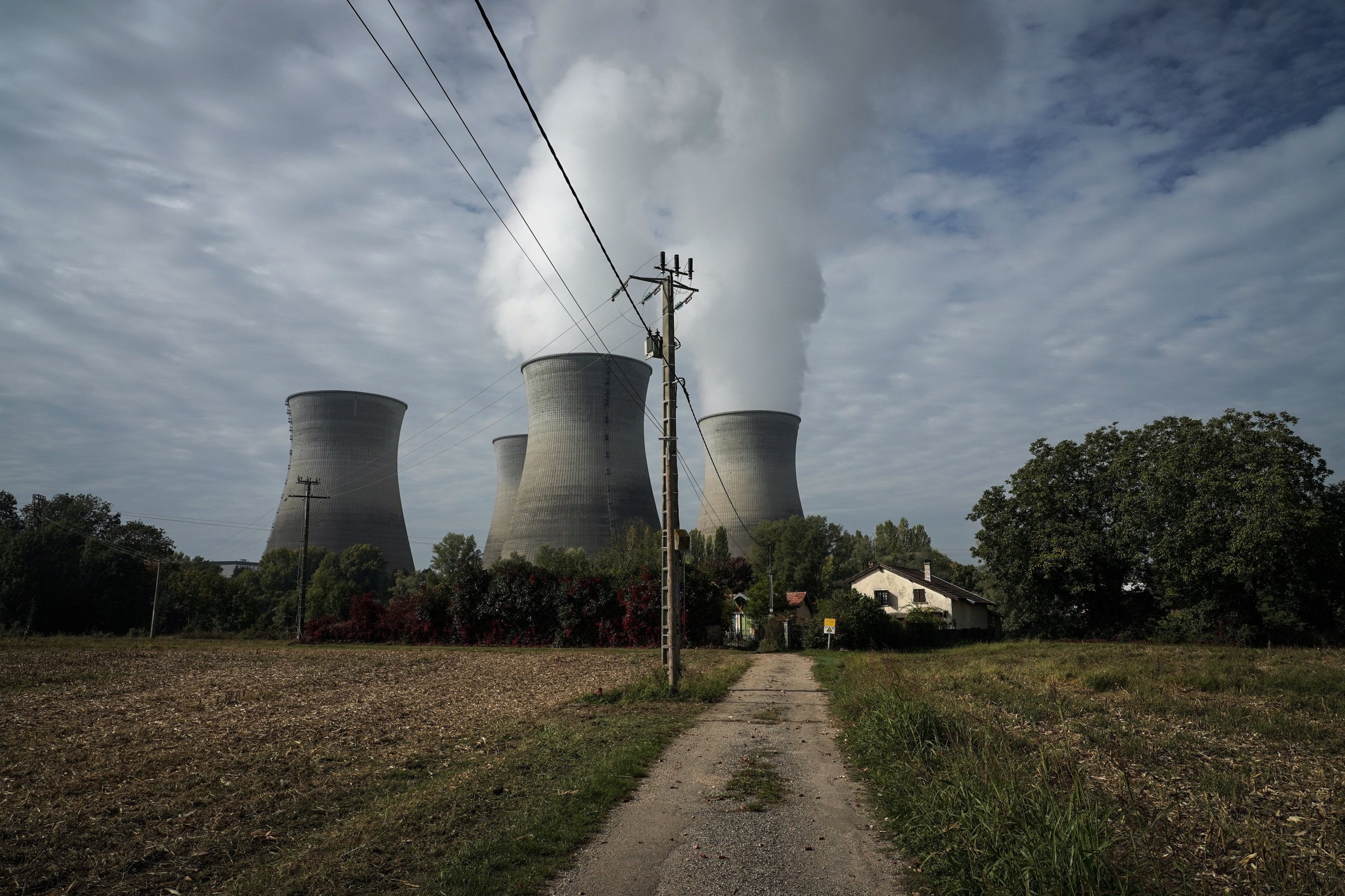
France presses UK to help fill multibillion-pound hole in nuclear projects

Call comes day after EDF flagged more delays of construction of power plant at Hinkley Point
Sarah White in Paris and Jim Pickard and Rachel Millard in London, 25 Jan 24, https://www.ft.com/content/3320c06e-7ce3-4a6b-ab22-4b8201a4cfca
The French government is pressing the UK to help plug a multibillion-pound hole in the budget of nuclear power projects being built in Britain by France’s electricity operator EDF. The call for a contribution from the UK is likely to cause tensions between Paris and London, a day after state-owned EDF admitted its construction of a new nuclear power station at Hinkley Point in Somerset would suffer further costly delays, taking the bill to as much as £46bn. The UK has said it will not put cash into the project, which counts EDF as a majority shareholder, and is already backed by a government guarantee on its revenues once it is up and running.
But Paris is pushing for a “global solution” that would also encompass funding issues at another planned UK plant, Sizewell C, said a French economy ministry official and another person close to the talks. “It’s a Franco-British matter,” the French economy ministry official said. “The British government cannot at the same time say EDF has to figure it out alone on Hinkley Point and at the same time ask EDF to put money into Sizewell. We’re determined to find a global solution to see these projects through.”
Sizewell in Suffolk has a different financial set-up to Hinkley. The UK this week said it would inject another £800mn of state funds, bringing its total contribution to £2.5bn at the £20bn plant, where it is the top shareholder. Its partner EDF has no obligation to put more money in. French officials said discussions on various options had begun several months ago with British counterparts, although they acknowledged London had flagged budgetary constraints that would have to be taken into account. In the UK, a government official played down the talks, adding that on Hinkley Point: “Costs will be the responsibility of EDF.”
An EDF executive told the BBC on Wednesday that the French company picks up “the tab for the cost overruns”. EDF on Tuesday warned Hinkley Point would not now be completed until 2029 at the earliest, four years later than its original start date, while the two reactors could cost up to £46bn to build at today’s prices, compared with a £18bn budget in 2016.
Other factors might play into the discussions, however. Under Prime Minister Rishi Sunak, Britain took the political initiative to eject Chinese group CGN as an investor in Sizewell — leaving that project in need of fresh private capital, but also prompting CGN to pull back from Hinkley, where it is a 33.5 per cent shareholder. The Chinese group has fulfilled its contracted payments on Hinkley but has no obligation to fund over-costs and stopped doing so a few months ago.
“The French don’t have many levers here but the CGN issue is a very real one,” a third person close to the talks said. Finding private investors to make up the Hinkley shortfall may be tough, several people close to the group said, although formulas such as state guarantees could be discussed. EDF is only just coming out of a period of financial turmoil, and has big investments to make at home, too, in the coming decades. It was fully renationalised last year
“Our goal here . . . is for what’s happening at Hinkley Point, with the delays and the issue with the Chinese partner’s decision, not to impact EDF’s financial trajectory excessively,” the French economy ministry official said. However, one UK nuclear industry figure said that EDF’s plight at Hinkley was the consequence of signing up to a deal with the UK government a decade ago, which at the time was criticised for being too generous to the French group. Under a so-called contract for difference signed with the state, construction costs are not covered but future electricity production is backed up by subsidies in case power prices fall below a certain threshold.
EDF’s UK Hinkley Nuclear Costs Balloon as Plant Delayed Again

Francois de Beaupuy, Bloomberg News, Jan 23, 2024
(Bloomberg) — Electricite de France SA’s nuclear project at Hinkley Point in the UK will cost as much as £10 billion ($13 billion) extra to build and take several years longer than planned, the latest in a series of setbacks for the budget and timetable of the country’s largest energy project.
EDF now expects the two reactors it’s building in southwest England to cost between £31 billion and £35 billion in 2015 terms, the French energy company said in a statement on Tuesday. That’s up from an estimate of £25 billion to £26 billion in 2022, and is the fifth budget increase in eight years. At today’s prices, the project would cost as much as £46 billion, according to the Bank of England’s inflation calculator. …………………
The UK is struggling to get its huge nuclear program off the ground. The government is aiming for as much as 24 gigawatts of capacity by 2050 and will have to accelerate rapidly to achieve that. Hinkley Point will be the first new atomic station to start generating in Britain since 1995. Construction of complex nuclear plants is notoriously slow, and the cost overruns and delays at Hinkley may damp investor enthusiasm for the sector…………………………………..
The setback comes just one day after the UK government pledged to invest an additional £1.3 billion in EDF’s second UK project at Sizewell C. Ministers are hoping the commitment will attract enough private capital to make a final investment decision this year and make progress toward its ambitious 2050 target.
EDF was already struggling with the budget for Hinkley after China General Nuclear Power Corp, its partner in the project, stopped funding, potentially leaving the French company to foot the bill until it is completed. The government-owned French company will also have to spend tens of billions of euros on new atomic plants at home in the coming decades.
Hinkley Point C is not a French government project and so any additional costs or schedule overruns are the responsibility of EDF and its partners and will in no way fall on taxpayers, said a spokesperson for the UK Department for Energy Security and Net Zero.
…….. EDF’s current fleet of five nuclear plants is scheduled to shrink to just three by the end of 2026. Last year, output slumped to the lowest in more than four decades.
While rising costs of metals, cement and labor are affecting industries including large offshore wind projects, the revised plan may revive a controversy over how expensive the technology is and whether further delays are inevitable. Still, the UK government said this month that the country will build another large-scale nuclear power plant, beyond current projects led by EDF.
t’s not the first time Hinkley has ballooned beyond its budget. EDF increased its estimates in 2017, 2019, 2021, and 2022 from an initial estimate of £18 billion when the contract was signed with the UK in 2016.
At the start of the project, the French utility expected the first unit to start by the end of 2025. However, Brexit, the Covid pandemic and the war in Ukraine have disrupted supply chains and boosted the cost of labor and essential materials like steel and cement.
“Going first to restart the nuclear construction industry in Britain after a 20-year pause has been hard,” said Stuart Crooks, Managing Director for Hinkley Point C. https://www.bnnbloomberg.ca/edf-s-uk-hinkley-nuclear-costs-balloon-as-plant-delayed-again-1.2025542
Nuclear start-up Newcleo drops plans for British factory in favour of France
COMMENT. This is a very interesting article. For one thing, it shows that these “advanced” nuclear reactors require plutonium to get the fission process happening. It also claims that these advanced nuclear reactors can solve the problem of plutonium wastes. That is not true. The wastes resulting from this process are smaller in volume, but more highly toxic. That means that they require the same area/voume of space for disposal as the original plutonium. On another angle, it does indicate the confusion that the British government is in about the way ahead in their highly suspect “Civil Nuclear Roadmap”. And on another angle again, it shows how Macron’s France is putting all its eggs into the one nuclear basket. When we look at the extreme costs, and the extreme climate effects, Macron’s French nuclear obsession is likely to result in political suicide.
Matt Oliver, Sun, 21 January 2024, https://finance.yahoo.com/news/nuclear-start-drops-plans-british-131702123.html#:~:text=A%20British%20nuclear%20startup%20has,lobbied%20personally%20by%20Emmanuel%20Macron.
A British nuclear startup has dropped plans to build a pioneering power plant in Cumbria and will invest £4bn in France instead, after it was lobbied personally by Emmanuel Macron.
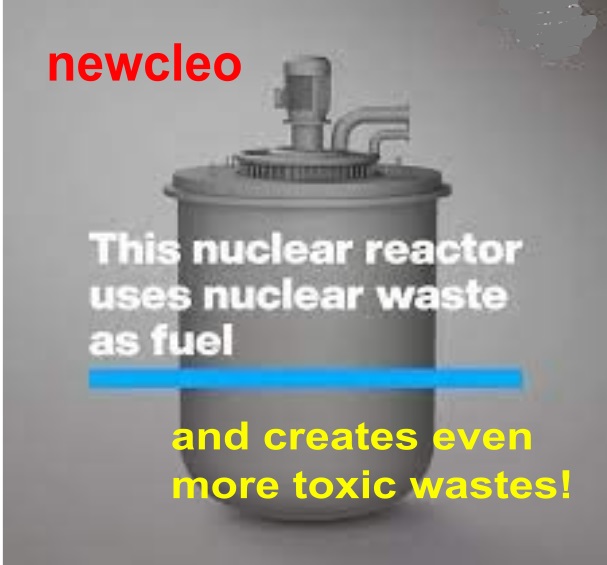
Newcleo, which is headquartered in London, is developing a type of mini nuclear power plant, known as an advanced modular reactor (AMR), that will use nuclear waste for fuel.
The company had hoped to tap into the UK’s vast stockpile of waste at Sellafield, where it wanted to invest £2bn in a waste reprocessing factory and AMR that would have created around 500 jobs.
It was also planning a similarly-sized facility in France.
But Stefano Buono, Newcleo’s chief executive and founder, said the company has now dropped the UK plans after the Government ruled out giving private companies access to the Sellafield stockpile in a nuclear industry “roadmap” published this month.
Instead, Newcleo is planning an enlarged development at an undisclosed location in the south of France, where it now plans to spend £4bn and create around 1,000 jobs, he said.
As part of that scheme, it will buy nuclear waste from French state energy giant EDF.
The company is also currently in the middle of a €1bn (£860m) fundraising.
The decision comes after the company was blocked from participating in the UK’s design competition for mini nuclear reactors.
By comparison, France has eagerly supported Newcleo and Mr Buono was lobbied repeatedly for investment by President Macron in face-to-face meetings.
Newcleo, which was also invited to last year’s “Choose France” business summit at the Palace of Versailles, has never been offered an in-person meeting with a British prime minister.
Mr Buono told The Telegraph: “Our plan initially was to use one factory in France and one in the UK.
“Now, we will double the capacity of France and we are not investing in the UK.”
He added that the company had hoped to pioneer its technology in Britain but added: “In two years, we were not able to even locate the site, so we have decided to accept the offer from France.
“We can proceed with our business model there.”
Newcleo’s decision to build its first plant abroad comes amid growing frustration within the British nuclear industry over the slow progress the Government has made towards identifying sites for new power plants.
The loss of significant investment to France will also be seen as the latest sign that Downing Street’s efforts to attract business investment are being outshone by President Macron, who has launched a charm offensive to lure companies across the Channel since Brexit.
He was the only G7 leader to attend the World Economic Forum in Davos, Switzerland, this week, while he has rolled out the red carpet for business leaders including Tesla boss Elon Musk and JP Morgan banker Jamie Dimon at his annual Choose France event.
Last year’s summit resulted in major deals, with Taiwanese car battery maker ProLogium unveiling plans for a €5.2bn plant at the port of Dunkirk and Verkor, a French company, pledging a €1.6bn battery factory there too.
In the UK, six SMR developers including Rolls-Royce have been shortlisted for support under a competition run by Great British Nuclear.
Newcleo was not considered because of the AMR’s lead cooling system and unusual fuel, Mr Buono has claimed.
The company’s novel design would run on processed plutonium, helping countries such as the UK dispose of the dangerous waste, which is expensive to manage. [Ed. This ignores the fact that this process results in a smaller volume of more highly toxic waste]
At Sellafield, the UK has amassed 140 tonnes of plutonium – the world’s biggest stockpile – as a result of historic nuclear weapons programmes and abandoned efforts to develop so-called fast breeding reactors that would have used it as fuel.
A massive effort is currently under way at the Cumbrian site to safely store the waste, but Mr Buono and his colleagues have argued it could be put to better use as reactor fuel.
The entrepreneur made his fortune selling cancer treatment developer AAA to Novartis for $3.9bn (£3.2bn) in 2017, reportedly earning him $420m.
His company has the backing of the Agnelli industrialist family, which made its money from Fiat and Ferrari.
The French government is expected to confirm a deal with Newcleo later this year.
The UK Government did not respond to requests for comment.
France Moves Away from Renewable Targets in Favor of Nuclear Power

By ZeroHedge – Jan 09, 2024, https://oilprice.com/Alternative-Energy/Nuclear-Power/France-Moves-Away-from-Renewable-Targets-in-Favor-of-Nuclear-Power.html
- The bill proposes a change from reducing to just tending towards a reduction in greenhouse gas emissions.
- It includes the removal of various objectives related to renewable energy production and consumption.
- The bill strongly affirms the use of nuclear energy as a sustainable choice and includes it as a key objective in the multi-annual energy program.
Authored by Mike Shedlock via MishTalk.com,
Four Key Things
- The wording of this preliminary bill relating to energy sovereignty is of course not final. It can still evolve between now and its presentation to the Council of Ministers and, then, during its discussion in Parliament. However, it already demonstrates a significant change in the executive’s conception of national energy policy.
- This draft bill weakens France’s climate objectives, starting with the objective of reducing our greenhouse gas emissions. The objective would no longer be to “reduce” but to tend towards a reduction in “our greenhouse gas emissions.
- This preliminary draft proposes to translate into law the executive’s choice to maintain a preponderant share of nuclear energy in electricity production. A choice which breaks with that of reducing this share of nuclear power and which was included in law no. 2015-992 of August 17, 2015 relating to the energy transition for green growth.
- This preliminary bill also reflects concern, on the eve of the European elections in June 2024; to abandon the legal category of renewable energies” in favor of a new category, that of “carbon-free energies”.
Removals
- The removal of quantified objectives for production and consumption of renewable energies in mainland France.
- The removal of the objective of encouraging the production of hydraulic energy.
- The removal of the quantified objective for the development of offshore wind power.
- The removal of the objective of encouraging the production of agrivoltaic electricity.
- The removal of the contribution objective to achieving air pollution reduction objectives.
- The removal of the building’s energy performance objective.
- The removal of the multiplication objective ofthe quantity of renewable and recovery heat and cold.
- Removal of the condition for shutting down the operation of a nuclear reactor
New Objectives
- The affirmation of the “sustainable choice of using nuclear energy”
- The new objective of using nuclear energy in the multi-annual energy program
Wow!
How often does France lead the way in common sense?
This has not passed yet, but it represents a clear change in direction if any of it passes, and that seems highly likely.
I wonder if President Emmanuel Macron is starting to look at French polls. Then again, the next French presidential election is not until 2027.
In the US, Biden doubles down on the only tactic he knows, running on Bidenomics while claiming Trump will be a dictator if he wins.
Both are losing tactics.
Via Zerohedge.com
Mr President, saying that nuclear power will save the climate is a lie.
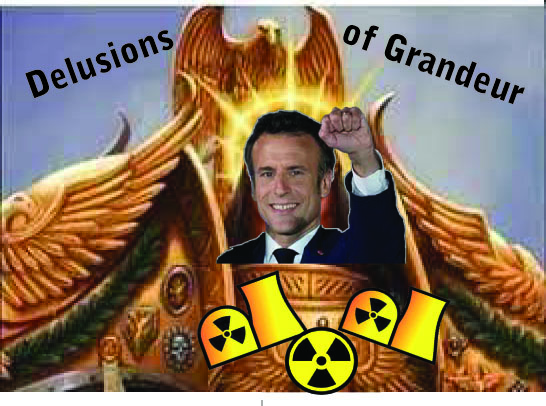
While Emmanuel Macron continues to affirm his attachment to the atom,
Yannick Jadot, Marine Tondelier, Eric Piolle and Sandra Regol are calling
on France not to get stuck again in costly and dangerous dependence on this
energy.
At the end of 2023, first in a forum, then in his wishes to the
French, President Macron reaffirmed his attachment to the relaunch of
nuclear power. He who questioned in 2017 the relevance of depending
three-quarters on a single source of electricity production has today
transformed into a nuclear industry salesman.
In Dubai, busy tripling
global production by 2050, he actively campaigned for the mention of
nuclear power in the final COP 28 agreement.
Liberation 9th Jan 2024
Behind the (somewhat dirty) scenes of nuclear waste processing

Behind the (somewhat dirty) scenes of nuclear waste processing. Nuclear
energy, even if many call it “clean”, produces a lot of waste (and costs
“crazy money”). A researcher was able to carry out a survey lasting
approximately one year on two French waste landfill sites. How are these
things managed? Exclusive interview. “There is no such thing as
decontamination. This is an abuse of language. You don’t kill the
radioactivity, you move it.”
Mediapart 9th Jan 2024
Energy Transition Minister Agnes Pannier-Runacher enthuses over “the rebirth of France’s nuclear industry”

EDF will construct the new plants with tens of billions in public financing

“EDF will construct the new plants with tens of billions in public financing ” – what could possibly go wrong?
France sees potential for 14 new nuclear reactors. 8 Jan 24, https://www.power-technology.com/news/france-may-build-14-new-nuclear-reactors/
France may need to build more than 14 new nuclear power plants, more than the six currently planned, if the nation is to meet its energy transition goal of reducing fossil fuel dependence from 60% to 40% by 2035.
Energy Transition Minister Agnes Pannier-Runacher stressed that nuclear will play an increasingly vital role in France’s energy mix. Speaking to La Tribune Dimanche just a few weeks before parliament reveals a bill relating to energy sovereignty, Pannier-Runacher said: “We need nuclear power beyond the first six EPRs [European Pressurised Reactors] since the existing (nuclear) park will not be eternal.”
This new energy strategy will be debated in parliament from late January and must be codified into law.
In 2022, French nuclear power output fell to a 30-year low after operational issues forced many reactors offline. This placed additional upward pressure on European energy prices, which were already being driven up reduced gas flows from Russia. However, French President Emmanuel Macron emphasised the importance of nuclear, stating: “What our country needs, and the conditions are there, is the rebirth of France’s nuclear industry.”
Over the course of 2023, availability improved, falling in line with state-controlled energy provider EDF’s target of 300–330 terawatt-hours. EDF will construct the new plants with tens of billions in public financing and chief executive Luc Rémont said his company aims to build roughly one 1.6GW reactor a year.
President Macron also reinforced his country’s commitment to nuclear at the recent COP28 climate summit in Dubai, where he led a group of 20 world leaders signing a pledge to “triple nuclear energy capacity from 2020 by 2050”. Shortly after signing, Macron pronounced that “nuclear energy is back”.
France currently has 56 operable reactors that produce around 70% of the nation’s electricity. Comparatively, Germany, another European superpower, does not produce any of its electricity from nuclear power, while in the UK the figure is 15%.
France has more grandiose plans for building nuclear reactors, but has no renewable energy targets.
France outstrips plans, to build additional nuclear plants beyond six
DAILY SABAH, BY AGENCE FRANCE-PRESSE – PARIS JAN 07, 2024
France is set to build eight new nuclear plants on top of six already announced, the energy minister has said, arguing more reactors are needed to hit carbon reduction targets.
A draft law set to be presented soon recognizes that “we will need nuclear power beyond the six first European Pressurized Reactors” (EPRs) announced by President Emmanuel Macron in early 2022, Agnes Pannier-Runacher told Sunday’s edition of the weekly newspaper Tribune Dimanche.
The bill will include a further eight plants that had until now been discussed as an “option” by the government, Pannier-Runacher said.
By contrast, the text would not include any targets for renewable energy generation by 2030, remaining “technologically neutral,” she added………………………………………………..
Pannier-Runacher suggested that the construction of even more than 14 nuclear reactors could be raised in talks with lawmakers once the energy bill reaches Parliament.
State energy firm EDF’s next-generation EPR has had a rocky start.
Three are online, one in Finland and two in China, after suffering massive construction delays and cost overruns that have also beset projects in Britain and France.
The first EPR in France, at Flamanville in Normandy, is set to come online for testing in mid-2024, EDF said last month – 17 years after construction started and at a cost of 12.7 billion euros ($13.9 billion), around four times the initial budget of 3.3 billion. more https://www.dailysabah.com/business/energy/france-outstrips-plans-to-build-additional-nuclear-plants-beyond-six
France’s Council of State opinion on a Bill relating to governance of nuclear safety in relaunching the nuclear sector

Only France could produce such a load of linguistical gymastics as this lengthy gobbledygook.
I’ve read the whole of the original, and still don’t understand it. I think it means that the Council of State thinks that what the government plans – is OK
It could mean a bit of privatising of some nuclear bits is OK. And the military connection is OK?
“the Council of State considers it unnecessary to provide, as the bill does, that the powers of the future authority do not extend to nuclear installations and activities of interest to defense”,”
“the bill modifies the rules currently applicable to ASN staff, in particular so that the ASNR can employ employees under private law,……… including 140 who will be automatically made available. of the Ministry of Defense for missions concerning it”
The Government has decided to make public
the opinion of the Council of State relating to the organization of the
governance of nuclear safety and radiation protection to meet the challenge
of relaunching the nuclear sector.
This bill, which includes twenty-two
articles, is organized into two titles respectively entitled “Nuclear
Safety and Radiation Protection Authority” and “Adaptation of the rules
of public procurement to nuclear projects” corresponding to its two
objects, which are distinct.
Title I includes provisions relating to the
missions and operation of the new independent administrative authority
(AAI) created by the bill, called the Nuclear Safety and Radiation
Protection Authority (ASNR) and resulting from the merger of the current
Nuclear Safety Authority. Nuclear Safety (ASN), which is an AAI, and the
Institute for Radiation Protection and Nuclear Safety (IRSN), which is a
public industrial and commercial establishment of the State (EPIC). This
title also includes provisions relating to the statutes and representation
of staff of the new authority and transitional provisions, particularly
concerning employees currently employed by the IRSN.
Council of State 22nd Dec 2023
EDF to extend nuclear outages in 2024, 2025 on corrosion issue
CAROLINE PAILLIEZ, Paris, France, 21 Dec 2023
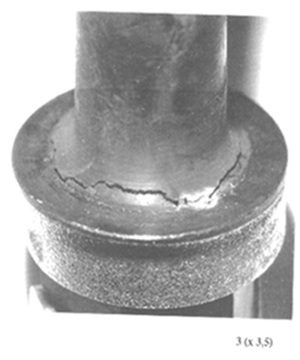
Montel) French utility EDF will extend planned outages at up to five of its reactors by an average of 30 days next year and again in 2025 related to repairs undertaken in 2023 for corrosion, it said late on Wednesday.
The shutdowns could affect one planned outage out of three at 13 reactors*, it said in a statement, adding it was “taking into account key learnings from controls and repairs undertaken in 2023 on reactors linked to stress corrosion cracking”.
The corrosion issue has dogged the firm, with reactor outages jumping 47% in 2022 due to corrosion issues at numerous units, with output plunging to a 33-year………. (Subscribers only) more https://www.montelnews.com/news/1533868/edf-to-extend-nuclear-outages-in-2024-2025-on-corrosion-issue
European nuclear Power Purchase Agreements (PPAs) may be unworkable – analysts
CAROLINE PAILLIEZ, Paris, France, SOPHIE TETREL, Paris, 18 Dec 2023
(Montel) Plans by France’s EDF to sell rights to its nuclear capacity to industrials across Europe via long-term power purchase agreements (PPA) while attractive may be unworkable, French analysts warned.
“If nuclear power is offered tomorrow in France at EUR 70/MWh, the whole of Europe will be interested,” said Peter Claes, head of Belgium’s Febeliec industry lobby, in light of a year of record high energy prices.
Yet the analysts, and even EDF itself, have warned that, in practice, the contracts were complex and potentially costly.
The PPAs were open to any big European power consumers wanting to…………………………..(Subscribers only) more https://www.montelnews.com/news/1533543/european-nuclear-ppas-may-be-unworkable–analysts
France scores diplomatic wins on banks and nuclear in new EU rules

Paris successfully pushed for weaker due diligence reporting by lenders and state-backed funding for nuclear power plants
Alice Hancock in Brussels, 15 Dec 2, Ft.com
France has secured a partial carve-out for banks from new EU rules to make companies responsible for environmental impacts in their supply chains. Paris also won, in separate negotiations, assurance that state-backed funding for its nuclear power plants will be possible under a reform of the EU electricity market, the culmination of a concerted effort to champion the low-carbon fuel in the face of opposition from Luxembourg, Austria and Germany.
Agnès Pannier-Runacher, French energy minister, hailed the decision as “excellent news”. “It gives us the means to ensure long-term financing for the transformation of our electricity system,” she said……………………………
France, backed by countries including Italy and the Czech Republic, has succeeded in making sure that banks, asset managers and investment groups will only have to report on upstream activities such as purchasing office equipment. They will not have to undertake due diligence on the activities of clients to whom they are offering loans — something that the European parliament had pushed for in the talks.
In a note circulated among negotiators earlier this month, the European Central Bank also warned that “excluding the financial sector would be counterproductive to the intention of the [law], as it would allow the EU financial sector to continue to fund activities detrimental to the EU [environmental and social governance] agenda”.
Arianne Griffith, corporate accountability lead at the NGO Global Witness, said that it was “shocking” that EU countries had “sunk plans to ensure that banks stop investing in environmental and human rights abuses”. Eelco Van der Enden, chief executive of the Global Reporting Initiative, said that it was “disheartening” to see that the French effort had watered down the application of the rules to the financial sector but that a review clause in the agreement could offer the opportunity to include them at a later stage………………………………………..
Both the energy market reform and the due diligence rules must be formally approved by the European parliament and member states in votes due to take place early next year. Once the due diligence directive is approved, EU governments will have two years to introduce the rules in national legislation. https://www.ft.com/content/a4f7c547-1a58-482f-889e-f6400c44bbf7
A blank cheque for France’s Industrial Centre for Geological Disposal (Cigéo) does not prove that it is safe.
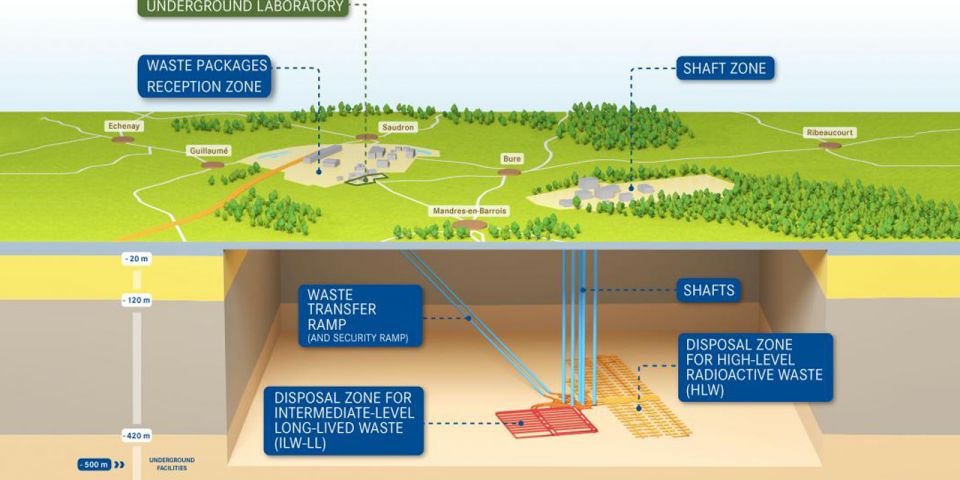
In September 2022, 32 organizations and 30 residents jointly filed an
appeal contesting the declaration of public utility (DUP) which was granted
to the Cigéo project (deep geological burial project for the most
radioactive waste) by decree on July 7, 2022.
This decision allowed the
National Agency for Radioactive Waste Management (ANDRA) to acquire the
missing land control for surface installations and the plumbness of
underground works, i.e. approximately 3,500 hectares (the equivalent of the
surface area of Lille) and to expropriate if necessary.
More than a year
later, on December 1, 2023, the Council of State rendered its decision.
Despite all the uncertainties and inaccuracies of the impact study of the
Cigéo project, ANDRA has succeeded in painting with scientific virtues the
fact that it is unable to provide precise evaluations, even with a
Declaration of ‘Public Utility (DUP) of 6,000 pages and almost 30 years of
studies.
It was enough for the Agency to affirm that it will do its best to
precisely identify the impacts of its project and to analyze and counter,
as the construction of Cigéo progresses, all their consequences. We do not
understand how such a project was able to obtain a DUP when it lacks so
much precise “basic” information. Let us remember: the declaration of
public utility facilitates land control, or even the start of work on other
so-called “preparatory” developments for Cigéo and allows the
industrial site to be physically anchored in the territory.
But for those
who read this decision a little too quickly, no, Cigéo is still not
“validated”. The project still needs to pass the stages of creation
authorization which, without giving up, we will attack by all means when
the time comes. We will at least have warned current decision-makers and
present generations and left messages for future generations, engraved in
stone in the archives of the Republic and its Councils.
Sortir du Nucleaire 1st Dec 2023
https://www.sortirdunucleaire.org/CIGEO-un-blanc-seing-qui-ne-signifie-pas-son
French nuclear tax is leap into the dark – analysts
SOPHIE TETREL, Paris, MURIEL BOSELLI, Paris, France, 28 Nov 2023
(Montel) France’s plan to replace the Arenh regulation with a nuclear tax is a “leap into the unknown” and does not guarantee that EDF will sell atomic output at EUR 70/MWh, analysts told Montel.
“We are switching to a full market system. It is a bit of a leap into the unknown and no longer a regulated system in which you know beforehand how much you are paying,” said Nicolas Goldberg, energy consultant at Colombus.
EDF and the government reached an agreement a fortnight ago that they would allow EDF to sell its atomic power at an average of EUR………………..…(subscribers only) more https://www.montelnews.com/news/1531984/french-nuclear-tax-is-leap-into-the-dark–analysts
France goes for its own costly small nuclear reactor, following the USA NuScale flop, and UK’s lagging Rolls Royce one.

https://www.bnnbloomberg.ca/french-nuclear-startup-seeks-150-million-for-reactor-prototype-1.2003704 27 Nov 23
Naarea, a three-year-old French nuclear startup, is looking to raise €150 million ($164 million) as it seeks to develop a small reactor that would meet growing industrial decarbonization needs from the start of the next decade.
The company, which already raised €50 million from a handful of French family offices such as Eren Groupe SA and €10 million from the government, is reaching out to venture capital, industrial and institutional investors, and sovereign wealth funds for a Series A funding round with the help of Rothschild & Co., co-founder Jean-Luc Alexandre said in an interview in Paris Friday. He hopes to close the fundraising in the first quarter next year.
Naarea, which stands for Nuclear Abundant Affordable Resourceful Energy for All, is part of a growing wave of companies from Europe to North America promoting smaller, cheaper (?) and safer(?) designs for reactors. The burgeoning(?) sector of small modular and advanced nuclear reactors — which have a wide array of sizes and technologies — suffered a setback this month when NuScale Power Corp. canceled a plan to build a plant in the US amid mounting costs.
“NuScale isn’t dead, and still has projects,” the Naarea CEO said, while pointing out that the French startup, which employs 175 people, has a different business model and is developing another technology. Naarea aims “to produce power and heat, as close as possible to industrial companies, to relieve the grid.”
The startup, which is working with the French nuclear industry and foreign laboratories, is seeking to build a reactor that would produce 40 megawatts of electricity — enough to power a car factory or some of the biggest desalination plants — as well as heat, according to Alexandre.
Naarea is working on so-called molten salt fast neutron reactors that would be the size of a bus. It would burn plutonium and highly toxic radioactive waste that’s currently stored in France. It has found a ceramic that would prevent corrosion from the liquid fuel, something that has hampered the development of such reactors in the past, the company’s boss said.
The nuclear startup and Automotive Cells Co. — the electric-car battery venture of Stellantis NV, Mercedes-Benz Group AG and TotalEnergies SE — signed a memorandum of understanding to study whether Naarea’s mini-reactors might meet the future needs of ACC’s factories, Naarea said in a statement Monday.
If all goes according to plan, there would be a full-scale prototype in 2028. By 2030, a total of €2 billion would be required to complete the reactor development, build a fuel plant at or near Orano SA’s nuclear-waste recycling facility in La Hague, and a separate reactor factory elsewhere in France. The startup also needs to convince nuclear safety and regulatory authorities about the project.
These reactors “are competitive because they are small,” and safe by design, Alexandre said.
1 This Month

of the week – Shut Down Drone Warfare!


Tell the Ukrainian Government to Drop Prosecution of Peace Activist Yurii Sheliazhenko

Petition to revoke the licensing of the Near Surface Nuclear Disposal Facility (NSDF) at Chalk River. https://www.ourcommons.ca/petitions/en/Petition/Details?Petition=e-7247
To see nuclear-related stories in greater depth and intensity – go to https://nuclearinformation.wordpress.com
-
Archives
- March 2026 (244)
- February 2026 (268)
- January 2026 (308)
- December 2025 (358)
- November 2025 (359)
- October 2025 (376)
- September 2025 (257)
- August 2025 (319)
- July 2025 (230)
- June 2025 (348)
- May 2025 (261)
- April 2025 (305)
-
Categories
- 1
- 1 NUCLEAR ISSUES
- business and costs
- climate change
- culture and arts
- ENERGY
- environment
- health
- history
- indigenous issues
- Legal
- marketing of nuclear
- media
- opposition to nuclear
- PERSONAL STORIES
- politics
- politics international
- Religion and ethics
- safety
- secrets,lies and civil liberties
- spinbuster
- technology
- Uranium
- wastes
- weapons and war
- Women
- 2 WORLD
- ACTION
- AFRICA
- Atrocities
- AUSTRALIA
- Christina's notes
- Christina's themes
- culture and arts
- Events
- Fuk 2022
- Fuk 2023
- Fukushima 2017
- Fukushima 2018
- fukushima 2019
- Fukushima 2020
- Fukushima 2021
- general
- global warming
- Humour (God we need it)
- Nuclear
- RARE EARTHS
- Reference
- resources – print
- Resources -audiovicual
- Weekly Newsletter
- World
- World Nuclear
- YouTube
-
RSS
Entries RSS
Comments RSS
 nuclear-news