France’s Flamanville EPR has numerous technical problems which mean that its safety issues are not “now closed”
Response from GLOBAL CHANCE to the ASN consultation on the request for
authorization to commission the Flamanville EPR reactor.
Contrary to what the President of the ASN stated on January 30, 2024 in his conference press
and the presentation of one’s wishes, numerous technical subjects which are
as much potential problems for the proper functioning of the EPR and which
call into question the reactor safety, cannot be considered “now closed”.
The problems that hamper the operation and safety of the EPR are numerous.
Most serious are presented in the following chapters in two parts: severe
and persistent then severe and whose solutions are risky. They lead to
asking questions including the answers do not appear in any of the
documents which constitute the file released made available to the public
by the ASN
Global Chance 9th Feb 2024
France’s EDF shuts down two nuclear reactors after fire at Chinon plant

Reuters, February 11, 2024, https://www.reuters.com/business/energy/frances-edf-shuts-down-two-nuclear-reactors-after-fire-chinon-plant-2024-02-10/
—
Nuclear energy operator EDF has shut down two reactors at Chinon in western France after a fire in a non-nuclear sector of the plant in the early hours of Saturday, the company said.
The fire has been extinguished, it said.
“Production unit number 3 at the Chinon nuclear power plant has shut down automatically, in accordance with the reactor’s safety and protection systems,” EDF said in a statement, adding it also shut down reactor number 4, which is coupled to number 3.
France’s nuclear safety watchdog said in a separate statement the fire had led to an electricity cut at the plant that triggered the automatic shutdown.
Chinon is one of France’s oldest nuclear plants.
Reporting by Tassilo Hummel; editing by Barbara L
EDF’s nuclear struggles dampen EU nuclear prospects – the industry “on a slow descent to hell”.

MURIEL BOSELLI, Paris, France, 08 Feb 2024 19:48
(Montel) The latest setbacks at the UK’s new Hinkley Point C nuclear power plant have cast a shadow over Europe’s nuclear revival, experts told Montel, with one former EDF executive saying France’s nuclear industry was “on a slow descent to hell”.
A feud between Paris and London over who should fork out an extra EUR 6-8bn for Hinkley Point C’s (HPC) cost overruns was tarnishing the nuclear industry’s image as pro-nuclear nations try to promote atomic power in the battle against climate change, experts said.
HPC faces a new four-year delay and may not be commissioned until 2031, with completion costs now forecast at between GBP 31-34bn,… (Subscribers only)
Montel 8th Feb 2024
https://www.montelnews.com/news/1537139/edfs-nuclear-struggles-dampen-eu-nuclear-prospects
The dangerous craze for SMRs
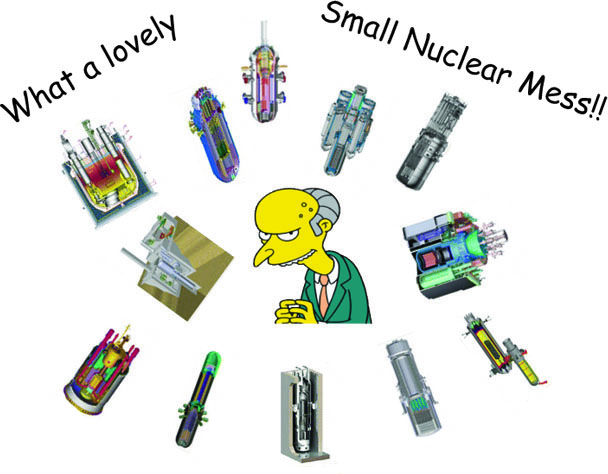
This is going too far in trivializing risk. And this is not limited to “acceptability” which seems to be ASN’s major concern, but to the risks of such “mixed” installations.

a serious accident situation (AZF, Lubrizol) could damage the SMR unit and transform the accident into a disaster.
Bernard Laponche, Doctor of Science in Nuclear Reactor Physics, President of the Global Chance association, Le Club Mediapart, 5th Feb 2024 https://blogs.mediapart.fr/bernard-laponche/blog/050224/le-dangereux-engouement-pour-les-smr
The development of small modular nuclear reactors (SMR) is the subject of spectacular announcements.Based on the declarations of the Nuclear Safety Authority (ASN) on this
subject, we launch an appeal for reason on the realities and difficulties of such projects, on the technical, safety and security levels .
During his press conference on January 31, 2024, the president of the Nuclear Safety Authority (ASN) addressed the issue of small modular nuclear reactors, known as SMRs, and answered some questions on this subject.
In his presentation, the president highlights the technical and societal questions posed by these new reactors, as well as the safety, security and non-proliferation issues “to be integrated upstream of the projects”.
These are the usual concerns when we are interested in nuclear reactors, which produce heat and possibly electricity from fission and chain reactions of fissile elements (uranium, plutonium), but also products fission and transuranium elements found in irradiated fuels currently intended for reprocessing, leading to the accumulation of radioactive waste in addition to that from the dismantling of reactors. These are the problems that will have to be analyzed for candidate SMR reactors, as for any nuclear reactor and with the same rigor as for conventional reactors.
In the same way that a conventional industrial installation cannot claim to be free from all risk of accident, no nuclear installation can claim to be free of any risk of accident. The declaration “a nuclear accident is possible in France” by successive ASN officials is valid for SMRs, even if, as its current president says, certain innovative SMRs “present potentially promising intrinsic safety characteristics” .
The first “prototype” examples of candidate reactors under the title of SMR, that is to say intended to be mass-produced in a factory before installation on site, will therefore have to be built on nuclear sites, probably those housing research reactors.
As ASN points out, the use of SMR in France would not be of great interest for the production of electricity given the importance of the current fleet of EDF power plants and the announced projects. But, on the other hand, SMRs could be very useful for the production of heat or steam for the process industries (paper, food, chemical industries, etc.) of which there are very many.
It would then be necessary to install the SMR reactor very close to the industrial installation or even, according to ASN, inside this installation.
This is going too far in trivializing risk. And this is not limited to “acceptability” which seems to be ASN’s major concern, but to the risks of such “mixed” installations.
Indeed, we cannot admit the presence of a basic nuclear installation, containing highly radioactive materials within a classic industrial installation, of the ICPE type in which a serious accident situation (AZF, Lubrizol) could damage the SMR unit and transform the accident into a disaster.
Furthermore, it is clear that each promoter of an SMR candidate aims for a large order in the number of copies (of the order of a hundred say some) which will allow the “modular” manufacturing of reactors in a dedicated factory, this allowing the supposed reduction in unit cost.
In this case, by eliminating the solution of an SMR in the plant itself, we would have the creation of a large number of INB-ICPE couples. Even if we admit that the probability of an accident on the SMR is lower than for a conventional reactor (which remains to be demonstrated for each case), this probability is multiplied by the number of reactors, all identical.
In examining the safety files for EDF’s large power reactors and nuclear fuel plants, ASN and IRSN pay very close attention to “external attacks” of natural or malicious origin. What happens to these concerns for SMS located almost everywhere on the territory, on locations which are those of the industrial installation which they must supply with heat and whose location was chosen without any concern for nuclear safety and security? ? How would specific protection be organized which, to be effective, would certainly be expensive, especially since the SMRs concerned would be of low power?
The profusion of candidate projects for SMR, some of which are financially supported by the Government, leads to each being examined by the IRSN and the ASN, as announced by the latter. This examination can be postponed over time depending on the maturity of the projects, all of which currently only exist on file, more or less elaborate.
If this examination is done correctly, that is to say with as much care as for a power reactor, the examination of the technical and safety files of each SMR prototype is a considerable task. We can fear that the “craze” for SMRs that ASN speaks of will exert dangerous pressure on the quality of studies and safety and security injunctions.
Finally, but this is not the problem of the IRSN and the ASN, we would still need to have serious information on the costs. Not only that of the construction of a prototype (the example of NuScale in the United States is edifying) but also that of its exploitation and especially that of the fuel, from its manufacture to its treatment after use, dismantling and management garbage.
When we examine in the light of what we know of the climatic upheavals which are already affecting our territory and will intensify considerably, we can really ask ourselves the question of the fragility and the risk of installing a little small nuclear reactors everywhere which will obviously be subject, depending on the period and their site, to floods, droughts, storms, tornadoes, earthquakes, etc.
All those who today say they want to welcome an SMR on their territory should really think about it seriously.
The future of nuclear: France’s nuclear dreams or nightmares?

The Macron Government has laid out ambitious plans for its capricious nuclear sector, but such optimism should not blind us to potential challenges.
Alfie Shaw, February 5, 2024, Power Technology
t last year’s COP28 climate conference in Dubai, French President Emmanuel Macron triumphantly declared that “nuclear energy is back”. His celebratory remark was uttered after France led a group of 20 countries in signing a pledge to “triple nuclear energy capacity from 2020 by 2050”.
Since the summit, a range of announcements and promises have been made that appear to support France’s ‘nuclear renaissance’. In November, the European Parliament backed the development of small modular reactors (SMRs), a versatile technology that many consider to be the future of the industry. Two months later, Energy Transition Minister Agnes Pannier- Runacher said that France will need to build 14 new nuclear power plants rather than the six currently planned if the country is to meet its energy transition goals.
Is all this optimism warranted? France has long been a nuclear superpower but lost its position as the world’s second-largest producer of nuclear energy to China in 2022, with the US coming in first. It is worth considering whether Macron’s positivity is justified in the context of several issues that currently beset the country’s industry, including EDF’s unpredictable performance, lack of strong allies in the European Council, slow progress on SMR development and Russian interdependence.
EDF’s annus horribilis
Électricité de France (EDF) is the French multinational electric utility company that runs the country’s 56 reactors. Throughout 2022, many were forced offline for maintenance work, causing output to fall below 1990 levels, despite installed capacity being 5GW lower at this time.
Nuclear shutdowns are in themselves not a huge cause for concern. Older power plants need to be updated with the latest technologies and France was planning on widespread shutdowns for its ‘Grand Carénage’ refurbishment programme anyway. However, the nature of these specific stoppages was worrying.
In December 2021, the discovery of cracks in the emergency core cooling systems of four of the newest French reactors led to them being shut down. The four units, which each produce 1.5GW, did not generate a single kilowatt-hour throughout 2022. Other 1.3GW reactors also showed similar symptoms, and by mid-2022, 12 additional reactors were shut down due to the same problem. In its annual electricity review, Réseau de Transport d’Électricité highlighted the crux of the issue, stating, “these outages, or outage extensions to carry out maintenance, tests and repairs where needed, primarily involved the newest reactors in the fleet (N4 and P4 designs), i.e. reactors that were not targeted for investment in the Grand Carénage refit programme”.
Although EDF’s nuclear output was 14.8% higher in 2023 than 2022 as reactors came back online, Macron will have to square his desire for new reactors with the ongoing threat of unplanned shutdowns at existing newer plants. Mycle Schneider, nuclear analyst and author of the annual World Nuclear Status Reports, commented on the ongoing unpredictability of EDF’s output, stating: “We have repeatedly seen that EDF was off by several gigawatts of nuclear capacity availability in predictions for the following week. If you look at availability on a certain day, and then go back one week, nuclear availability is several gigawatts different to the projection made a week previously.”
Seeking international allies……………………………………………….
SMRs – a false dawn?
The creation of the EU SMR Industrial Alliance in November accentuates the blocs’ commitment to modular technology in its nuclear drive. Naturally, France led the group of 11 countries signing the alliance.
The International Atomic Energy Agency (IEAE) defines SMRs as advanced nuclear fission reactors that have a power generation capacity of up to 300MW per unit – around a third of the capacity of traditional reactors. The ‘small’ and ‘modular’ nature of their design means they can be sited at locations unsuited to larger nuclear power plants. Their diminutive size is also meant to save on construction time and cost.
Despite significant optimism around the technology, little progress has been made on the ground. The most advanced SMR project in the western world was forcibly abandoned in November 2023 due to excessive costs. US-based NuScale scrapped the development with a conglomerate of Utah municipalities after the cost estimate of the project increased to $9.3bn, bringing the cost per kilowatt to $20,000 for the plant, around twice the cost of the most expensive European pressurised water reactor.
Subsequently, there are no SMRs in commercial operation in the west. Placing the EU alliance in this context, Schneider said: “We are not talking commercial contracts. It is like this alliance [EU SMR Industrial Alliance], which is kind of nice. Everybody [the 11 signatories] puts a name under it, but it does not mean anything in industrial terms.”
Even in Russia, where SMR output has been achieved (although, not commercially), there have been construction issues. The reactor took more than 12.7 years to build, more than three-times the 3.7-year target. Schneider noted that this “was not really the demonstration of easy, quick feasibility” that SMRs are meant to be. China too has two operational SMRs, but no production or cost figures on the reactors are yet available.
Overcoming Russian interdependency
Russia is still the primary constructor and exporter of nuclear reactors, with the state company Rosatom, as of mid-2023, building 24 out of the 58 constructed around the world. While France has taken part in a host of EU sanctions placed on Russian energy exports designed to curb revenue for the Kremlin’s war on Ukraine, the measures have not included sanctions on the nuclear sector………………………………………………….
While France is looking to build an alliance with EU nations that still have strong links with the Russian nuclear sector, its own institutions are also interlinked. Framatome, an EDF subsidiary, originally planned to set up a joint venture with Rosatom subsidiary TVEL to manufacture VVER fuel elements in its Lingen plant in Germany. However, in spring 2023, it became clear that the German Government would likely oppose the deal, so the Franco-Russian company was set up in France, with TVEL owning 25% of it. Advanced Nuclear Fuels, a Framatome subsidiary that operates the Lingen plant, wants to extend the manufacturing plant with a dedicated VVER-fuel production line. The Lower Saxony Government is opposed to the project, but under the Atomic Law it does not have a veto right. This leaves the decision in the hands of the federal government, which as of January 2024, has not been taken. Schneider noted the irregularity of the Framatome-Rosatom partnership, considering Framatome could have worked with Westinghouse given the US company’s capability to manufacture VVER fuel. He added that although the reason for this decision is unclear and there is limited evidence to illustrate strong reasoning, “it is quite likely to do with technical difficulties” with the Westinghouse fuel.
As France looks to expand its nuclear industry, there will be challenges, both within its domestic industry and its international relations, that the country will have to address. France’s nuclear watchdog recently said there was “lack of rigour and performance” in EDFs supply chain monitoring and this will have to improve if output is to become stable. While Italy has signalled its desire to re-establish nuclear power, if plans remain unrealised, it is unlikely to be a reliable nuclear ally within the EU council – something which France desperately needs if it is to push through nuclear friendly legislation. SMRs could become a key source of nuclear energy if on-the-ground development begins in earnest, but so far progress has been limited to hopeful pledges. As long as it remains largely dependent on the tenuous, unpredictable Russian regime for its nuclear fuel generation, France’s nuclear plans will have an insecure foundation. If France is to materialise its abstract nuclear dreams into everyday energy production, it will need to address each of these issues pragmatically. https://www.power-technology.com/news/france-has-laid-out-ambitious-nuclear-plans-but-challenges-remain/?cf-view&cf-closed
French firm EDF shows its power over the UK govt – no judicial review now required over fish protection from Hinkley nuclear cooling system.
In 2021, EDF was formally told it must fit an acoustic fish deterrent
(AFD) system to the massive seawater intakes of the cooling system. It was
considered necessary to “protect the marine life of the Severn Estuary
catchment area and its nine great rivers: Parrett, Avon, Severn, Wye, Usk,
Ebbw, Rhymney, Taff, Ely and their tributaries where many fish species go
to breed”.
Without AFD it is estimated that 22 billion fish would be
ingested over the planned 60-year life of the plant, of which half would be
killed in the process.
Not so final. EDF appealed against this but in 2022
the then environment secretary, George Eustice, refused the appeal in
definitive terms: “The decision on this appeal is final [and] can only be
challenged in the courts by judicial review.”
Final? EDF, which has been
running rings around the government and bullying ministers (Eyes passim)
since it bought the British nuclear fleet in 2008, simply went
regulator-shopping on the basis that energy ministers are more likely to be
sympathetic. And so it proves: the Department for Environment, Food & Rural
Affairs (Defra) has been reduced to the role of consultee on the “final
final” decision, which will now be taken elsewhere – with no judicial
review required.
Private Eye 2nd Feb 2024
https://www.private-eye.co.uk/sections.php?issue=1616§ion_link=columnists
EDF’s Hinkley Point woes pile pressure on global nuclear push.

When in 2016 France’s EDF signed up to build Britain’s first new
nuclear power plant in two decades, defenders of the costly Hinkley Point C
project included Emmanuel Macron, then economy minister. “If we believe
in nuclear power, we have to do Hinkley Point,” France’s now president
told a parliamentary enquiry, rejecting some lawmakers’ concerns that
state-backed EDF, which was already struggling to deliver a new French
prototype plant in Normandy, may not have the financial bandwidth to take
on the British site, originally estimated to cost £18bn.
Eight years on, with cost overruns surging at Hinkley due to repeated delays and EDF on the
hook for at least another £5bn on top of previous budget revisions,
Macron’s government is on a mission to ensure the French nuclear operator
can indeed withstand the fallout — and keep on top of ballooning
investments and orders at home.
French ministers are trying to get the British state to stump up some support for the soaring Hinkley bill, which could reach a total of £46bn at today’s prices for the two reactors,
people close to the talks have said.
That would be roughly double the original budget in 2015 prices, compared with an EDF project in Finland that ended up costing more than twice what it was supposed to and a plan
for one reactor at Flamanville in France that is running four times over
budget, at €13.2bn.
But the Hinkley setbacks have also revived a core
strategic question that is becoming more pressing than ever for EDF, a
former French electricity monopoly that operates Europe’s biggest fleet
of 56 domestic reactors: whether it is equipped to handle multiple projects
at once, internationally and at home, and financially as well as from an
industrial perspective. Already an issue in 2016, when French labour unions
at the group opposed the Hinkley plans on the basis that the financial
set-up was risky, this tension now has a different edge to it.
FT 29th Jan 2024
https://www.ft.com/content/d401e42b-d953-4ef0-b3ea-ed80e974249a
France’s ASN nuclear safety authority warns of fraud risk in nuclear industry
ELISE WU, Montel Paris, 31 Jan 2024
Montel) The head of France’s ASN nuclear safety authority has revealed that it found 43 cases of fraud and forgery in the French nuclear industry last year, warning that the threat of corruption is growing.
“There are a fairly constant 40 or so situations reported to us each year,” said ASN chief Bernard Doroszczuk.
The cases were related to materials used in nuclear reactors as well as false certificates from welders and inspectors, he added.
“Inspections of the supply chain of materials used in the nuclear sector reveal recurring weaknesses: mainly a lack of knowledge among suppliers of safety requirements, a lack of…….. (Subscribers only) ……………………………..more https://www.montelnews.com/news/1536520/french-asn-warns-of-fraud-risk-in-nuclear-industry—
France limits its investment in Britain’s Sizewell C, as the global nuclear industry requires massive government subsidies

Why are nuclear power projects so challenging? Increasing nuclear energy
capacity is not easy. Projects across the globe have been fraught with
delays and budget overruns, with the Financial Times revealing last week
that France is pressing the UK to help fill budget shortfalls at the
Hinkley Point C project in England, being built by EDF.
The International Energy Agency (IEA) says nuclear projects starting between 2010 and 2020
are on average three years late, even as it forecasts nuclear power
generation will hit a record high next year and will need to more than
double by 2050. Technical issues, shortages of qualified staff,
supply-chain disruptions, strict regulation and voter pushback are the key
factors developers and governments are grappling with. In the US, Georgia
Power is scheduled to complete work within weeks on the second of two
gigantic new nuclear reactors that are at the vanguard of US plans to
rebuild its nuclear energy industry.
But the expansion of Plant Vogtle is
seven years late and has cost more than double the original price tag of
$14bn due to a series of construction problems, highlighting the complexity
of nuclear megaprojects. These complexities, high costs and long build
times — as well as strict regulation due to risks of nuclear accidents
— make nuclear power a daunting prospect for many investors.
As a result, the sector is heavily subsidised by governments. Many reactor suppliers for
large-scale projects are state-owned, working alongside the private sector
to build the full plant. But countries also have a limit on how much they
are willing to spend. EDF, now fully owned by the French state, will limit
its stake in its next planned UK plant, Sizewell C, to 20 per cent.
FT 1st Feb 2024
https://www-ft-com.ezproxy.depaul.edu/content/6d371375-b7be-4228-a3d5-2ad74f91454a
How France left the British taxpayer on the hook as Hinkley costs go nuclear
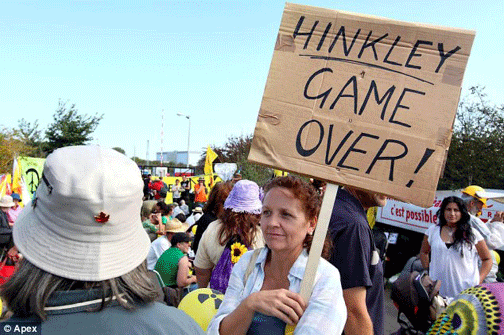
the Government will have to
put more taxpayer cash in and guarantee the debt.
Sizewell C was also likely to be put on ice unless British ministers came up with a big extra dollop of taxpayers’ money.
A series of cost overruns and delays are undermining the UK’s nuclear power revival
Jonathan Leake, 28 January 2024
For the future of Britain’s energy security it was a crucial decision,
and one that lay in the hands of France’s biggest power supplier.
However, not a single minister or civil servant was present when the
directors of EDF decided the fate of the UK’s two biggest nuclear
projects in their Paris boardroom on Tuesday. The finances of Hinkley Point
C and Sizewell C, the nuclear power stations which might one day supply
14pc of Britain’s electricity were top of the agenda. Shortly after the
meeting ended, Luc Remont, EDF’s managing director, and his colleagues
summoned their media managers to organise a briefing for analysts and
journalists.
Hinkley Point C, they were told, stood no chance of firing up
in 2027, as once promised. Its first reactor would come online around 2031
while the second has no date promised at all. Costs have surged again to
£46bn, a far cry from the £9bn EDF suggested when pushing the idea to
politicians around 2007 or the £24bn proposed when contracts were signed
in 2016.
Sizewell C was also likely to be put on ice unless British
ministers came up with a big extra dollop of taxpayers’ money.
Meanwhile, as EDF’s directors and French civil servants decided Britain’s nuclear
future in Paris, Andrew Bowie, the minister responsible for new nuclear
projects, was on his feet in parliament, talking up the UK’s prospects.
For Claire Coutinho, the Energy Secretary, the news was infuriating. Not
only had a decision vital to the UK been taken in Paris but it came just
days after she unveiled the Government’s long-awaited Nuclear Roadmap. A
statement rushed out that evening made clear that Coutinho blamed the
French for Hinkley’s extra costs and delays. “Hinkley Point C is not a
government project and so any additional costs or schedule overruns are the
responsibility of EDF and its partners and will in no way fall on
taxpayers,” a spokesman for her department said.
The comments irritated the French enough to hold a second round of media briefings, this time involving EDF’s owners, the French government. The UK, it was made clear,
would have to offer up billions of pounds more in taxpayers’ money if
Sizewell C was ever to be built. Coutinho subsequently pledged an extra
£1.8bn of taxpayers’ money for the project.
Meanwhile, EDF has refused
to up its stake from 20pc and Bowie has admitted he now needs to raise
£20bn of private finance, most likely meaning the Government will have to
put more taxpayer cash in and guarantee the debt.
Simon Taylor, professor of finance at Cambridge University, who specialises in the economics of nuclear energy, believes EDF’s reactor designs have some fundamental
flaws. “The EPR or European Pressurised Reactor were designed to be
incredibly safe, and to reassure people, after the Chernobyl disaster of
1986 but have turned out to be just much more difficult to build than
anyone had expected,” he says.
Amid a blame game between France and the
UK, the biggest loser remains the British taxpayer. They now face several
more years of reduced energy security and the prospect of power bills hikes
to raise the £20bn-plus bill for Sizewell C.
Telegraph 28th Jan 2024
https://www.telegraph.co.uk/business/2024/01/28/edf-hinkley-point-c-costs-go-nuclear-uk-taxpayer/
EDF, France’s state-owned nuclear company now in a fatal trap, as Hinkley Point C costs soar
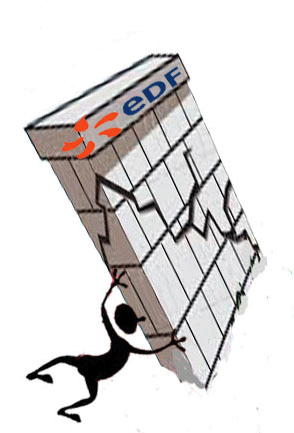
Hinkley Point: endless setbacks at nuclear plant highlight political choice to destroy EDF
On January 22nd, state-owned French utilities group
EDF announced new delays in the construction of two EPR nuclear reactors at
the British plant of Hinkley Point. Originally planned to enter service in
2024, the first of the two reactors is now expected to be, at best,
operational in 2029, or possibly “2030 or 2031”.
Seven years after the project was launched, all the warnings against EDF’s involvement in it
made by the group’s staff have proved be right, writes Mediapart
economics correspondent Martine Orange in this op-ed article.
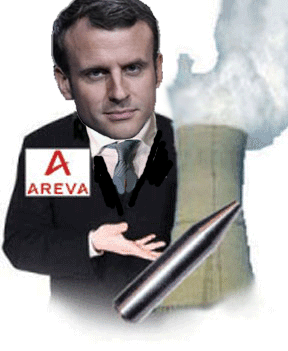
The state-owned group now finds itself in a fatal trap created by Emmanuel
Macron. Following the epic delays with the Olkiluoto nuclear power plant in
Finland, those of Flamanville in France, and those of Taishan in China, the
under-construction plant of Hinkley Point C in south-west England has now
joined the long story of an industrial catastrophe which is the third
generation EPR (pressurised water reactor) first designed by Areva, once
France’s nuclear energy giant.
Mediapart 28th Jan 2024
Are the French going cold on UK nuclear?

‘It would be madness to give Sizewell C the final go-ahead while the questions of whether Hinkley C can be finished, and who pays, are not resolved. Sizewell C is bound to take longer and cost more, but this time it would be we consumers who would bear the risk and pay the price through the “nuclear tax” on our energy bills.’.
The French government, which was previously relaxed about EDF’s forays into UK nuclear, now wants its energy company to work on projects back home in France.
So far, Britain has put £2.5billion into the project in total and taxpayers are the biggest shareholders. Campaigners who vehemently oppose the project are alarmed by the recent comments from Paris, pointing out that if the French back off from Sizewell, taxpayers could be on the hook for huge extra amounts of cash via their bills.
By FRANCESCA WASHTELL , 28 January 2024, https://www.thisismoney.co.uk/money/markets/article-13015713/Are-French-going-cold-UK-nuclear.html
Our nuclear industry is reawakening,’ energy secretary Claire Coutinho
declared in a Government strategy document published earlier this month. In
between invoking Winston Churchill’s enthusiasm for nuclear power and its
ability to help the UK reach net zero, Coutinho added that setting up new
plants would ensure our energy security ‘so we’re never dependent on the
likes of [Vladimir] Putin again’. Fighting talk. But in the space of a
fortnight, Coutinho’s gung-ho attitude has already been dented as a
diplomatic row brews over who should pay for the controversial power
stations.
French state-owned energy company EDF last week lit the blue
touchpaper with the revelation the UK’s flagship Hinkley Point C nuclear
plant in Somerset would be delayed until 2029 at the earliest. The cost, it
added, could spiral to as much as £46billion, from initial estimates of
£18billion.
Few in the industry will have been surprised, particularly as EDF has experienced delays on similar projects in Finland and France. But what was a shock were some incendiary remarks from the French government.
The Elysee Palace began pressing the UK to help plug a funding gap at Hinkley and for good measure cast doubt over its commitment to Sizewell C, the next nuclear power station in the pipeline.
A French Treasury official suggested the Government was trying to leave EDF in the lurch on Hinkley.
The official added that it cannot, at the same time, abandon the French firm to ‘figure it out alone’ on Hinkley and also expect it to plough money into Sizewell. It is, the official said, ‘a Franco- British matter,’ and not one for the French to resolve single-handedly.
This is a bad moment for two critical new nuclear plants – and our broader energy security – to be dragged into a cross-Channel tussle.
The French government, which was previously relaxed about EDF’s forays into UK nuclear, now wants its energy company to work on projects back home in France.
Well-placed UK sources deny the French claims that EDF has been left to shoulder the financing burden alone at Hinkley, or that it has been jettisoned by the British state.
They point to the fact EDF has all along had contractual obligations to shoulder the costs at this stage of the project. The early stages of developing Hinkley were undertaken by EDF along with China General Nuclear.
The Chinese firm has fulfilled its part of the bargain, leaving the onus on the French. ‘It’s all down to the French state,’ a senior industry source told The Mail on Sunday. ‘It’s tough, but they’ve not managed it at all well.’
A Department for Energy Security and Net Zero spokesman said: ‘The Government plays no part in the financing or operation of Hinkley Point C. The financing of the project is a matter for EDF and its shareholders.’
As well as backing Hinkley, EDF several years ago began serious talks with the Government over Sizewell C in Suffolk. Each could power an estimated 6 million homes for 60 years, meaning the two projects are linchpins for meeting future energy demand.
The French group is due to take a 20 per cent stake in Sizewell. The Government has previously indicated it will take 20 per cent. It was hoped the rest would be funded through money from the private sector, such as pension funds and sovereign wealth funds.
So far, Britain has put £2.5billion into the project in total and taxpayers are the biggest shareholders. Campaigners who vehemently oppose the project are alarmed by the recent comments from Paris, pointing out that if the French back off from Sizewell, taxpayers could be on the hook for huge extra amounts of cash via their bills.
The new type of funding structure for Sizewell C means consumers will already face an added tax to help pay for the plant.
Alison Downes of the Stop Sizewell C campaign group said: ‘It would be madness to give Sizewell C the final go-ahead while the questions of whether Hinkley C can be finished, and who pays, are not resolved. Sizewell C is bound to take longer and cost more, but this time it would be we consumers who would bear the risk and pay the price through the “nuclear tax” on our energy bills.’
And another area of the industry is watching the fracas with mounting frustration.
Companies vying to build ‘mini’ stations known as small modular reactors (SMRs) hope this prompts the Government to commit instead to their projects, which are quicker to build and cheaper [?]
The firms include Rolls-Royce SMR, which has already received significant funding from the Government. New nuclear plants of whatever size will almost certainly be part of the UK’s energy mix in the years to come.
The sector had already been championed by Boris Johnson before soaring oil and gas prices in the wake of Russia’s invasion of Ukraine highlighted Britain’s dependence on overseas energy.
Any fisticuffs with France over Hinkley and Sizewell would strain the sector and could fatally damage the level of public. Industry figures are urging ministers to resist stumping up cash the French had agreed to pay.
One senior source said: ‘I hope the Government doesn’t lose its nerve, though there’s no sign of that at the moment. It would be a terrible precedent.’
.
Hinkley Point C woes threaten to break UK and France’s nuclear fusion

Two former EDF executives told the Guardian the odds were stacked against Hinkley from the start. “I would have bet at the time that we would see the costs we have today. And I think they’ll climb higher too,” said one.
Cross-Channel dream is turning sour as EDF’s costs mount and Britain faces a long wait for the power to come on
Jillian Ambrose, 27 Jan 24, https://www.theguardian.com/uk-news/2024/jan/27/hinkley-point-c-woes-threaten-break-uk-france-nuclear-fusion
rench trade unions wield significant political clout. But in the summer of 2016 there was little they could do to stop the French government from investing in what would soon become the most expensive power station in the world.
All six trade union representatives on the board of Électricité de France (EDF) voted against a deal to build a nuclear power station in the UK. It was just weeks after its finance chief, Thomas Piquemal, resigned from the company over fears that Hinkley Point C in Somerset was too great a risk. The project was approved by 10 in favour and seven against.
In the last seven years these fears have proved well founded. EDF revealed this week the latest delay to Hinkley, which may not now open until 2031, well beyond its original decade-long schedule. Its costs have climbed to £35bn in 2015 prices, almost double the original forecast of £18bn in 2016. In today’s money Britain’s first new nuclear plant in 30 years could cost £46bn. The spiralling costs were blamed on inflation, Covid and Brexit.
Hinkley was meant to represent a nuclear renaissance on both sides of the Channel, and further the nuclear ambitions of China. It was an opportunity for EDF, once the world’s leading nuclear developer, to secure a future for its reactor designs in a low-carbon world.
For the UK, the first new nuclear power plant in a generation marked the start of the government’s campaign to replace its ageing fleet of reactors. And China saw it as a way to showcase its nuclear expertise, furthering its ultimate aim of building its homegrown HPR1000 nuclear reactors at Bradwell in Essex.
The deal was struck in 2016 just weeks after the Brexit vote, making Hinkley an opportunity to forge fresh ties between old friends – and create opportunities for new economic alliances too. China General Nuclear Power Group (CGN), a state-run energy company, agreed to take on a third of the project as the first step in a plan to roll out a string of nuclear plants in the UK built with its own reactor design.
The chancellor at the time, George Osborne, argued that Britain should “run towards China” to help boost the UK economy. Within months of the Hinkley deal the French president, Emmanuel Macron, and his Chinese counterpart, Xi Jinping, began talks on strengthening ties between the two nations. These led to trade deals worth about $15bn (£11.8bn) and an order from Beijing for 300 aircraft from Airbus worth tens of billions of euros.
But the rationale for all three nations now looks precarious. Hinkley’s costs have climbed as diplomatic relations between China and the west have soured. By the time the former UK prime minister Boris Johnson vowed to purge China’s Huawei from the UK’s telecoms network over security fears, the notion of Chinese-built nuclear reactors powering British homes had become politically unthinkable. CGN has ruled out any further investment in Hinkley – leaving French taxpayers to pick up the tab.
Two former EDF executives told the Guardian the odds were stacked against Hinkley from the start. “I would have bet at the time that we would see the costs we have today. And I think they’ll climb higher too,” said one.
Philippe Huet, a former head of EDF’s internal auditing in Paris, said the deal was based on political strategy rather than a commercial rationale. The British government offered EDF a contract that would guarantee payment of £92.50 for every megawatt hour of electricity generated by the nuclear plant. It was criticised for being both eye-wateringly expensive for UK bill payers but not nearly enough to cover the risks of constructing the project.
“At the time that it was agreed it was already known that EDF’s estimates understated the cost and schedule of the project. Key decision-makers chose to ignore this because it was too important strategically. As they would say, if a project cannot be profitable it must at least be strategic,” Huet said.
Hinkley is one of many costs facing the French taxpayer after the government renationalised EDF last year. The company’s future investments – in maintaining its existing fleet of nuclear reactors, building new ones, and investing in renewable energy – could exceed €20bn (£17bn) a year, according to Agnès Pannier-Runacher, the country’s energy transition minister.
The French government is reportedly calling on the UK government to provide financial help for both Hinkley and the next planned plant, Sizewell in Suffolk, to keep the struggling nuclear revival afloat. The UK government has been quick to quash any suggestion that Hinkley’s financial fallout will be borne by UK taxpayers. A spokesperson said the government “plays no part in the financing or operation of Hinkley Point C”, which was a matter for EDF and its shareholders.
Huet has predicted that EDF may even try to renegotiate its contract with the government. He estimates it could seek to raise how much it charges per megawatt hour of electricity produced by about 15% to make Hinkley a worthwhile venture.
EDF a total basket case, weighed down by its 50 Billion pound nuclear turkey at Hinkley point
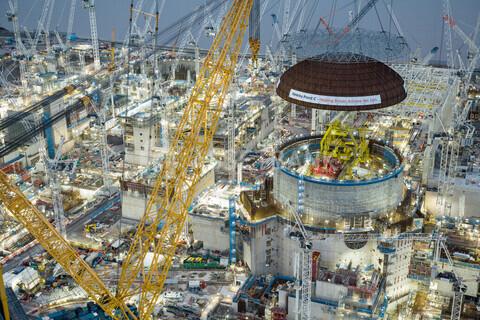
Jonathon Porritt, https://www.jonathonporritt.com/edf-a-total-basket-case-weighed-down-by-its-50-billion-nuclear-turkey-at-hinkley-point/ 25 Jan 24
EdF’s bosses must be thanking their lucky stars that President Macron decided to take complete control of EdF back in 2022. Otherwise, its latest announcements about further delays and cost increases for its new reactors at Hinkley Point would have sent any remaining investors running for the hills.
The scale of those announcements is staggering:
- The price tag for Hinkley Point C has now been reset at £31-34 billion (in 2015 prices), twice the original £18 billion.
- In today’s money, that’s around £46 billion – with further delays and cost hikes (rising to at least £50 billion) all but inevitable.
- EdF’s shortfall in completing Hinkley Point has risen substantially, and could now be as high as £25 billion on its balance sheet.
- EdF has admitted that 2029 is now the earliest Hinkley Point will come online. Fat chance of that.
Which makes Hinkley Point C even more of a bust than EdF’s current worst reactor construction nightmare at Flamanville in France. And significantly worse than its plant at Olkiluoto in Finland, which it just managed to get over the line last year.
So, watch out for the fallout.
Hinkley Point C was meant to be coming online in 2027. All neutral commentators now reckon 2031 (EdF’s so-called ”unfavourable scenario”) is the earliest that will happen. That’s a further four-year delay before its low-carbon electrons (providing 7% of the UK’s electricity) will be available to help the UK meet its various decarbonisation targets.
Add to that the knock-on impact of this on the Government’s/Labour’s hopes for a Hinkley Point look-alike (really!) at Sizewell C. The sales pitch to investors for that has now become even trickier than it was before: “Just look at this beautiful £50 billion turkey: another one just like it could be all yours at a bargain-basement price of, say, £40 billion”.
Which leads to the following conclusions:
EdF is even more screwed than it was before, deeper in debt, with further delays for rolling out its look-alike plant at Sizewell C now inevitable.- The Tory Government is screwed, with no chance of Hinkley Point C (let alone Sizewell C) making any serious short-term contribution to its decarbonisation strategy.
- Labour is screwed – for exactly the same reasons.
- The UK’s Net Zero strategy by 2050 looks less and less viable. And that will soon be tested, again, in the courts.
- All this because of the nuclear obsessions of the UK’s entire political establishment – Labour just as much as the Tories.
Happily, there’s no need to panic: the case for the “renewables + efficiency + storage + smart grids” option just got a whole lot stronger, both economically and politically. We just need the donkeys in Whitehall to give up on their nuclear turkeys. Finally!
France presses UK to help fill multibillion-pound hole in nuclear projects

Call comes day after EDF flagged more delays of construction of power plant at Hinkley Point
Sarah White in Paris and Jim Pickard and Rachel Millard in London, 25 Jan 24, https://www.ft.com/content/3320c06e-7ce3-4a6b-ab22-4b8201a4cfca
The French government is pressing the UK to help plug a multibillion-pound hole in the budget of nuclear power projects being built in Britain by France’s electricity operator EDF. The call for a contribution from the UK is likely to cause tensions between Paris and London, a day after state-owned EDF admitted its construction of a new nuclear power station at Hinkley Point in Somerset would suffer further costly delays, taking the bill to as much as £46bn. The UK has said it will not put cash into the project, which counts EDF as a majority shareholder, and is already backed by a government guarantee on its revenues once it is up and running.
But Paris is pushing for a “global solution” that would also encompass funding issues at another planned UK plant, Sizewell C, said a French economy ministry official and another person close to the talks. “It’s a Franco-British matter,” the French economy ministry official said. “The British government cannot at the same time say EDF has to figure it out alone on Hinkley Point and at the same time ask EDF to put money into Sizewell. We’re determined to find a global solution to see these projects through.”
Sizewell in Suffolk has a different financial set-up to Hinkley. The UK this week said it would inject another £800mn of state funds, bringing its total contribution to £2.5bn at the £20bn plant, where it is the top shareholder. Its partner EDF has no obligation to put more money in. French officials said discussions on various options had begun several months ago with British counterparts, although they acknowledged London had flagged budgetary constraints that would have to be taken into account. In the UK, a government official played down the talks, adding that on Hinkley Point: “Costs will be the responsibility of EDF.”
An EDF executive told the BBC on Wednesday that the French company picks up “the tab for the cost overruns”. EDF on Tuesday warned Hinkley Point would not now be completed until 2029 at the earliest, four years later than its original start date, while the two reactors could cost up to £46bn to build at today’s prices, compared with a £18bn budget in 2016.
Other factors might play into the discussions, however. Under Prime Minister Rishi Sunak, Britain took the political initiative to eject Chinese group CGN as an investor in Sizewell — leaving that project in need of fresh private capital, but also prompting CGN to pull back from Hinkley, where it is a 33.5 per cent shareholder. The Chinese group has fulfilled its contracted payments on Hinkley but has no obligation to fund over-costs and stopped doing so a few months ago.
“The French don’t have many levers here but the CGN issue is a very real one,” a third person close to the talks said. Finding private investors to make up the Hinkley shortfall may be tough, several people close to the group said, although formulas such as state guarantees could be discussed. EDF is only just coming out of a period of financial turmoil, and has big investments to make at home, too, in the coming decades. It was fully renationalised last year
“Our goal here . . . is for what’s happening at Hinkley Point, with the delays and the issue with the Chinese partner’s decision, not to impact EDF’s financial trajectory excessively,” the French economy ministry official said. However, one UK nuclear industry figure said that EDF’s plight at Hinkley was the consequence of signing up to a deal with the UK government a decade ago, which at the time was criticised for being too generous to the French group. Under a so-called contract for difference signed with the state, construction costs are not covered but future electricity production is backed up by subsidies in case power prices fall below a certain threshold.
1 This Month


Tell the Ukrainian Government to Drop Prosecution of Peace Activist Yurii Sheliazhenko

Petition to revoke the licensing of the Near Surface Nuclear Disposal Facility (NSDF) at Chalk River. https://www.ourcommons.ca/petitions/en/Petition/Details?Petition=e-7247


of the week – STOP SMALL MODULAR REACTORS IN CANADA
To see nuclear-related stories in greater depth and intensity – go to https://nuclearinformation.wordpress.com
-
Archives
- March 2026 (183)
- February 2026 (268)
- January 2026 (308)
- December 2025 (358)
- November 2025 (359)
- October 2025 (376)
- September 2025 (258)
- August 2025 (319)
- July 2025 (230)
- June 2025 (348)
- May 2025 (261)
- April 2025 (305)
-
Categories
- 1
- 1 NUCLEAR ISSUES
- business and costs
- climate change
- culture and arts
- ENERGY
- environment
- health
- history
- indigenous issues
- Legal
- marketing of nuclear
- media
- opposition to nuclear
- PERSONAL STORIES
- politics
- politics international
- Religion and ethics
- safety
- secrets,lies and civil liberties
- spinbuster
- technology
- Uranium
- wastes
- weapons and war
- Women
- 2 WORLD
- ACTION
- AFRICA
- Atrocities
- AUSTRALIA
- Christina's notes
- Christina's themes
- culture and arts
- Events
- Fuk 2022
- Fuk 2023
- Fukushima 2017
- Fukushima 2018
- fukushima 2019
- Fukushima 2020
- Fukushima 2021
- general
- global warming
- Humour (God we need it)
- Nuclear
- RARE EARTHS
- Reference
- resources – print
- Resources -audiovicual
- Weekly Newsletter
- World
- World Nuclear
- YouTube
-
RSS
Entries RSS
Comments RSS
 nuclear-news