France’s nuclear waste disposal methods – costly and unsafe
No easy way to dispose of nuclear waste
TheDay.comBy Los Angeles Times 9/21/2009 By Frank Von HippelThe Yucca Mountain nuclear waste repository project is now comatose, if not dead. And that puts us back at square one on a crucial question: What are we going to do with all the radioactive waste being discharged by U.S. nuclear power reactors?Many conservatives on Capitol Hill favor the French “solution”: spent-fuel reprocessing. But reprocessing isn’t a solution at all: It’s a very expensive and dangerous detour. Continue reading
Nuclear power, tax-payer subsidised, and not popular in France
 European Expert: U.S. Policymakers Are ‘As Wrong As They Can Be’ About The French Experience With Nuclear Power Marignac Says
REUTERS WASHINGTON, Sept. 15 /PRNewswire-
Nuclear power in France is not popular. The pursuit of the nuclear program in France is a permanently undemocratic choice. Contrary to the image presented in the United States, the French population is no more in favor of nuclear power than the European average – indeed a majority is opposed to the building of new plants. Surveys repeatedly show that the public lacks confidence in the institutional promoters of nuclear power. Continue reading
France has no solution for nuclear wastes
European Expert: U.S. Policymakers Are ‘As Wrong As They Can Be’ About The French Experience With Nuclear Power Marignac Says
REUTERS WASHINGTON, Sept. 15 /PRNewswire-
“…………………French nuclear power is not “safer” . . . and the nation does not have a long term solution to waste storage. The operators of the 200 nuclear facilities in France declare a very large number of events – considered relevant for safety – every year. EDF alone declares between 10,000 and 12,000, of which 700 to 800 are deemed “incidents” or “significant events”. Continue reading
Myth that nuclear power promotes ‘energy security’
European Expert: U.S. Policymakers Are ‘As Wrong As They Can Be’ About The French Experience With Nuclear Power Marignac Says
REUTERS WASHINGTON, Sept. 15 /PRNewswire
“………– Nuclear power in France has not promoted energy independence. Nuclear power in France is a major presence, providing 76 percent of electricity produced in 2008. However, electricity accounted for only 20.7 percent of the final energy consumption in France that year. Excluding electricity exports, the overall contribution of nuclear power to France’s final energy consumption is only in the range of 14 percent. Continue reading
AREVA’s flagship nuclear reactors – costs are out of control
European Expert: U.S. Policymakers Are ‘As Wrong As They Can Be’ About The French Experience With Nuclear Power Marignac Says
REUTERS WASHINGTON, Sept. 15 /PRNewswire-USNewswire/
………………..The French EPR Reactor is a new reactor design developed by the company Areva in cooperation with the German firm Siemens. Serious doubts have been raised about the safety and cost of the EPR. Experience in the construction at the two sites where EPRs are being built, in Finland (Olkiluoto 3) and France (Flamanville 3), has revealed serious and fundamental weaknesses in design, problems during construction phases and soaring costs. Continue reading
US govt warned on failure of France’s nuclear system
European Expert: U.S. Policymakers Are ‘As Wrong As They Can Be’ About The French Experience With Nuclear Power Marignac Says “Far From Being a Model, France Should be a Powerful Cautionary Tale for the U.S. about the Folly of a Headlong Rush into More Nuclear Power” Continue reading
AREVA’s profits wiped out by new nuclear reactor troubles
OL3 EPR wipes out AREVA profits
Nuclear Reaction 5 Sept 09
The OL3 nuclear European Pressurized Reactor (EPR), being built by French nuclear giant AREVA at Olkiluoto in Finland, is in such desperate financial trouble it has single-handedly wiped out the company’s half year profits. Continue reading
Nuclear risks rise for French workers
French nuclear workers see risks as conditions worsen
* EDF subcontracts 80 percent of nuclear maintenance
* Nuclear workers say they are under mounting time pressure
* Safety margin is narrowing, expert says
* EDF denies it cuts corners, says subcontracts by choice
Forbes Reuters FEATUREBy Muriel Boselli
PIERRELATTE, France, Aug 31 (Reuters) – Worsening working conditions, inadequate pay rises, pressure to work faster and safety concerns — these are the familiar grievances of a disaffected work force.
When such complaints arise in France’s most sensitive industry — nuclear power — alarm bells start ringing.
Cyril Bouche and his colleagues at the Tricastin nuclear plant in the rolling hills of the Drome region say the state-owned utility EDF, which runs France’s 58 nuclear reactors and has been expanding into the United States and Britain, is not only cutting costs, but also cutting corners.
The 39-year old, who works for one of EDF’s many subcontracting firms, says working conditions at the plant — hit by a series of incidents that shook public trust in 2008 — have deteriorated over the past five to 10 years.
“Today France is selling reactors abroad but it should first put its own house in order,” said Bouche, the only one of 10 workers interviewed by Reuters who was prepared to be identified.
The French government has put forward state ownership of its nuclear sector as a guarantee of its safety, but former monopoly EDF subcontracts 80 percent of the maintenance at its nuclear reactors to firms such as Vinci, Areva ( ARVCF.PK – news – people ), GDF Suez or Bouygues ( BOUYF.PK – news – people )………….
Independent experts including Yves Marignac, executive director of the information agency Wise-Paris, say safety margins in French nuclear power plants are shrinking as plants age, economic pressure mounts and trained staff retire.
FEATURE-French nuclear workers see risks as conditions worsen – Forbes.com
Conflict on African continent hampers mining industries
Conflict on continent hampers mining industries Mining Weekly
By:Megan Wait 10 July 09Foreign nations’ and companies’ interests in African resources also lead to negative effects. Many foreign companies on the continent are primarily extractive. This means that the countries are seen as suppliers of raw materials, which are exported for processing to other countries. This prevents the esta- blishment of manufacturing and service industries in these countries, which inhibits job creation. The export taxes also create expenses for the country, which is chroni- cally strapped for revenue.Meanwhile, French nuclear company Areva’s subsidiary, uranium explorer UraMin, reports that the company, although at peace with the government, is concerned about its uranium-excavating project Bakouma, in the Central African Republic (CAR)……………………………….The negative perception of the political, societal and economic situation in Africa, weak leadership and poor governance, and the lack of regional coherence and identity create structural problems that continue the cycle of poverty and insecurity.
The nuclear option [Areva]
The nuclear option – AREVA
appomattox’s posterous 2 July 09 “………………………………”Though Niger is the fourth-largest producer of uranium in the world, it sees almost none of the wealth. Because of a long-standing contract, the French consortium* pays only 5.5 percent of its revenue in taxes, and most of it goes to subsidize elites in the dusty capital of Niamey. Almost three-quarters of the people cannot read, and those who survive to the age of forty-five are living on statistically borrowed time. Niger was recently named the most deprived country on earth by the United Nations, ranked dead last among the world’s sovereign nations on a comprehensive scale called the Human Development Index, which charts life expectancy, education, and standard of living…””Uranium: War, Energy, and the Rock that Shaped the World,” by Tom Zoellne……………..…………..President Nicolas Sarkozy has been active in trumpeting his country’s know-how to win French companies new business abroad…Areva needs between eight and 10 billion euros by 2012 to fund its investment program, notably to develop its third-generation EPR nuclear reactor. It also needs an estimated two billion euros to buy out Siemens’ stake in Areva NP, its reactor subsidiary.” ………………….
…………..Areva needs between eight billion and 10 billion euros (11.2 billion and 14.0 billion dollars) by 2012 to fund its investment program, notably to develop its third-generation EPR nuclear reactor. The company also needs an estimated two billion euros to buy out Siemens’ stake in Areva NP, its reactor subsidiary.
http://www.google.com/hostednews/afp/article/ALeqM5i7L4s3lyWXxYV0rTTNpBou6r7Jeg
In other words, it appears Areva is in deep financial doings, and ownership of the company is being diluted from a state-run operation to privatization – a movement that seems to annoy the French government.While financial doings are deep (albeit perhaps not troublesome, depending on the availability of investors), the climate in Africa poses some problems:
“After a visit in late March from French President Nicholas Sarkozy to Niger, residents in the uranium-exporting desert country continue questioning whether AREVA, a company primarily owned by the French government, will honour its promise to protect communities from mining hazards.” On the other side of that coin, Areva faces problems with water shortages in its mining and milling processes.
The nuclear option [Areva]: Virginia Business – News – appomattox’s posterous
France imports UK electricity as plants shut
July 3, 2009 France imports UK electricity as plants shut TIMESONLINE
France is being forced to import electricity from Britain to cope with a summer heatwave that has helped to put a third of its nuclear power stations out of action.
With temperatures across much of France surging above 30C this week, EDF’s reactors are generating the lowest level of electricity in six years, forcing the state-owned utility to turn to Britain for additional capacity.
Fourteen of France’s 19 nuclear power stations are located inland and use river water rather than seawater for cooling. When water temperatures rise, EDF is forced to shut down the reactors to prevent their casings from exceeding 50C.
Going Nuclear: Is France Really the Example to Follow?
* June 15, 2009, 2:20 PM ETGoing Nuclear: Is France Really the Example to Follow? The Wall Street Journal, by Keith johnson “…………………..
One of the biggest potential hurdles to the Republican Party’s newfound love of nuclear power is that in France, the government is nearly inseparable from its energy industry. The biggest power company, Electricite de France, is state-owned. Nuclear-engineering groups like Areva are extensions of government industrial policy.
That cozy relationship clears away many of the obstacles facing nuclear power—especially financing—
Going Nuclear: Is France Really the Example to Follow? – Environmental Capital – WSJ
AREVA and the nuclear illusion
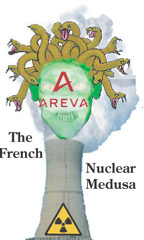 Areva’s difficulties and the nuclear illusion
The View From Brittany June 3 2009Areva is no ordinary company. It is the nuclear arm of the French state, in charge with the building and the supplying of French nuclear plants. Even though it is technically a corporation, it is owned by the Commissariat à l’Énergie Atomique, a public agency whose director is appointed by the French President who has occasionally sold nuclear plants on its behalf.
Areva, supposedly the “jewel” of the French industry is in real troubles. Even though it sells more than ever, its benefits have plummeted and it has been forced to cancel a mining project in Canada. According to the “Réseau Sortir du Nucléaire”, Areva needs 3 billions euros, mostly because of the costly failure the Olkiluoto EPR has proven to be. The Finnish third generation nuclear plant, which should have been put online this year has been delayed due to technical difficulties and costs are sky-rocketing – 5.4 billions instead of the original 3 billions. Moreover, South Africa has recently cancelled the building of 12 nuclear plants while the “sells” announced by the French presidency (4 plants in Italy and 2 in India) remain virtual – nobody know how they are going to be funded.
Areva is presently clamouring for public funds. It will probably get them, no matter how loud we, and others, protest. France, trapped as it is by its own nuclear strategy, simply cannot afford to lose the control of its uranium supply.
That is hardly the whole story, however. What this affair highlight is how problematic is nuclear power at the eve of catabolic collapse. A nuclear plant is very costly and takes a long time to build. Besides, it is of absolutely no use as long as it is not completed. The end result is that to launch a nuclear program you have to immobilize a lot of capital – human, natural and financial – without any hope of anything looking like a return of investment for quite a long time……………………Areva’s difficulties pose, however, another, often overlooked question : what will nuclear plants will become after the nuclear industry fails. In a number of countries, it may happen sooner than one thinks……………….And then what ?
Dismantling a nuclear plant and disposing of the wastes are very costly operation. Will the impoverished societies of forty years from now be able to afford them ? One can seriously doubt it. In fact, in a situation of worsening energy and capital shortage, one can expect them to operate their ageing nuclear plants to very end – the way the Ukrainian government did with Chernobyl – then let them decay away.
The result, needless to say, won’t be good for the neighbourhood,……………. This, by the way, can have interesting geopolitical consequences in countries such as France which are littered with nuclear plants.
The activists who, in the late seventies, have made sure no nuclear plant would ever be built in Brittany may have won their far descendants more than what they thought.
http://theviewfrombrittany.blogspot.com/2009/06/arevas-difficulties-and-nuclear.html
Sarkozy to meet Iran’s foreign minister
Sarkozy to meet Iran’s foreign minister Jun 2, 2009
PARIS (Reuters) – French President Nicolas Sarkozy will meet Iran’s foreign minister on Wednesday to discuss Tehran’s nuclear program, in rare talks between a leader of a major power and a senior Iranian politician…………………………
Bilateral encounters at such a senior level between Iran and one of the countries involved in the nuclear issue are highly unusual. It will be the first time Sarkozy has met a top Iranian minister since he took office in 2007.
Iran’s Foreign Ministry spokesman was not immediately available for comment.
The West accuses Iran of secretly developing atomic weapons. Iran, the world’s fifth-largest oil exporter, denies the charge and says it only wants nuclear power to generate electricity………………………………..Sarkozy is due to meet U.S. President Barack Obama on Saturday in France and Iran is certain to be on the agenda.
Sarkozy to meet Iran’s foreign minister Wednesday | International | Reuters
French nuclear utility deep in debt
EDF confronts $34.2 billion debt pile
Troubled French utility, Electricite de France, which acquired half of U.S. utility, Constellation Energy, in December, has already offloaded part of its ownership of British Energy, which it also acquired last year. EDF is staggering under a $34.2 billion debt pile and has sold 20% of British Energy – the British nuclear operator – to Centrica. EDF will also try to raise $1.4 billion through retail bonds. For more on EDF’s financial struggles, read here and here. Furthermore, new nuclear build in the UK may be in jeopardy as EDF is demanding government subsidies there to go forward. Read more here.
1 This Month
26 September – International Day for the Total Elimination of Nuclear Weapons





PLEASE OPPOSE HR 8255 AND S.3639 – bills would accelerate satellite deployment, with no environmental review or safeguards – https://ncstd5li.quorum.us/campaign/169331/
To see nuclear-related stories in greater depth and intensity – go to https://nuclearinformation.wordpress.com
-
Archives
- September 2026 (281)
- August 2026 (330)
- July 2026 (355)
- June 2026 (287)
- May 2026 (306)
- April 2026 (356)
- March 2026 (251)
- February 2026 (267)
- January 2026 (308)
- December 2025 (358)
- November 2025 (359)
- October 2025 (375)
-
Categories
- 1
- 1 NUCLEAR ISSUES
- business and costs
- climate change
- culture and arts
- ENERGY
- environment
- health
- history
- indigenous issues
- Legal
- marketing of nuclear
- media
- opposition to nuclear
- PERSONAL STORIES
- politics
- politics international
- Religion and ethics
- safety
- secrets,lies and civil liberties
- spinbuster
- technology
- Uranium
- wastes
- weapons and war
- Women
- 2 WORLD
- ACTION
- AFRICA
- Atrocities
- AUSTRALIA
- Christina's notes
- Christina's themes
- culture and arts
- Events
- Fuk 2022
- Fuk 2023
- Fukushima 2017
- Fukushima 2018
- fukushima 2019
- Fukushima 2020
- Fukushima 2021
- general
- global warming
- Humour (God we need it)
- Nuclear
- RARE EARTHS
- Reference
- resources – print
- Resources -audiovicual
- Weekly Newsletter
- World
- World Nuclear
- YouTube
-
RSS
Entries RSS
Comments RSS

