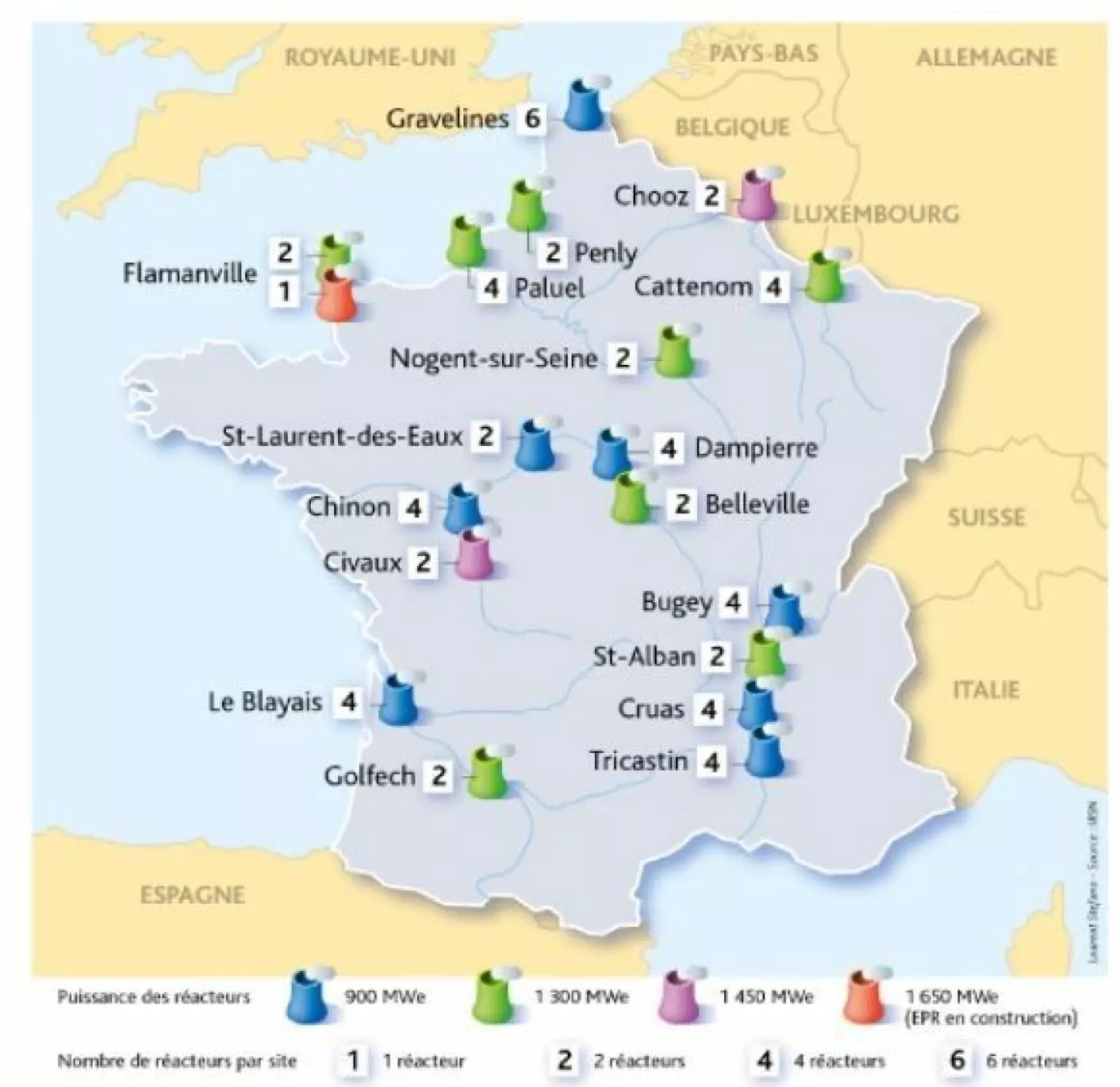
Where are France’s nuclear reactors and what is planned for more?
the six new sites will by no means triple French production, particularly since the older plants will increasingly be closed for repair and maintenance.
President Macron wants to triple atomic energy production by 2050
Richard Henshell, Saturday 20 April 2024
France is the third biggest producer of nuclear energy in the world and hopes to triple production by 2050. We look at where the country’s nuclear sites are and at President Macron’s plans for more.
Nuclear power represents up to 70% of the electricity produced in France at 282 Terawatt-hours (TWh), behind only China (395TWh) and the US (772TWh) and far ahead of the UK (42TWh).
However, many of its plants are approaching the end of their life-cycle. The majority of France’s 56 reactors date from the 1980s, and only two have been built since the year 2000.
In order to meet the requirements of the 2015 Paris Climate Accords, President Macron announced his plans to reinvest in France’s ageing nuclear plants during last year’s COP28 climate meeting in Dubai.
“Nuclear energy is back,” said Mr Macron (in English), adding that it was time to recognise the “essential role that nuclear energy can play in efforts to reach zero carbon dioxide emissions on a global level”.
“We will triple our capacity to produce nuclear energy between 2020 and 2050,” he said.
France’s 56 reactors are shared between 19 sites. Another reactor is scheduled to power up at Flamanville this summer, bringing the total to 57 reactors.
There are also plans to construct six new reactors at three existing plants:
- Two at Penly (Seine-Maritime) for 2035
- Two at Gravelines (Nord) for 2038
- Two at Le Bugey (Ain) for 2042
Construction is scheduled to start in summer 2024 on first of these new reactors in Penly, which like the others, will use the powerful new EPR-2 design. The estimated total cost for the six reactors is around €67.4 billion.
However, the six new sites will by no means triple French production, particularly since the older plants will increasingly be closed for repair and maintenance.
Indeed, in December 2021, the discovery of cracks in the emergency cooling systems of France’s four newest reactors led to them being shut down for over a year
Regardless, Mr Macron announced in February 2022 that France’s older plants could conceivably operate far into the future – beyond their 60th year or until they are no longer capable of producing electricity, or no longer safe.
EDF confirms cracks on 1.3 GW Paluel 2 reactor
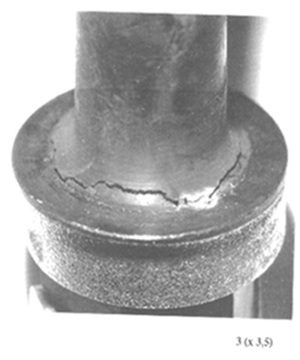
(Montel) EDF has found cracks on its Paluel 2 (1.3 GW) nuclear reactor in the north of France, a company spokeswoman told Montel on Friday, confirming prior comments by the firm’s executive director Cedric Lewandowski.
Reporting by: Caroline Pailliez, 05 Apr 2024, https://montelnews.com/news/df0e8352-e018-4d1d-af96-63266d385d3c/edf-confirms-corrosion-cracks-on-paluel-2-1-3-gw-reactor
Questioned by a parliamentary committee late on Thursday, Lewandowski said the French state-run firm had “recently” found traces of corrosion at its Blayais 4 (910 MW) and Paluel 2 reactors. He gave no further details.
Contacted by Montel, an EDF spokeswoman confirmed the firm had found cracks at the Paluel unit but refused to provide any other details such as when and where the corrosion was found or whether repairs were underway.
“The possibility of carrying out this type of repair on shutdowns scheduled for 2024 is included in our production forecasts,” she added.
Paluel 2 has been offline for maintenance and refueling since 2 February. The outage was initially scheduled to last 98 days but EDF warned last week the shutdown could be extended up to a “total of 135 days”.
The reactor is currently due to return to service on 10 May.
The news comes after EDF confirmed last month that a 30-day outage extension at its Blayais 4 (910 MW) reactor was due to corrosion.
“No surprise”
Lewandowski told the committee in the upper house that the “recent discovery” of corrosion at Blayais 4 and Paluel 2 “came as no surprise”.
Having checked France’s newest reactors, which it said were most susceptible to corrosion, the firm was now probing older units, such as at Blayais and Paluel, he said, adding EDF knew it would also find cracks of “lesser importance” on those units.
Corrosion was “still with us” and “would be until 2025” when the firm was due to complete its probe of France’s 56 reactors, he said.
“Fortunately, we are now in the process of mastering it… Our construction sites are getting faster and faster, our ability to understand the phenomenon is now almost total.”
EDF warned in December it might have to extend one in three planned outages for around 30 days on average at 13 reactors this year and 13 reactors in 2025, based on the probability of finding corrosion on units yet to be examined.
The issue has dogged the company, with reactor outages jumping 47% in 2022 due to problems at numerous units, with output plunging to a 33-year low of 279 TWh.
Edited by: Chris Eales, Robin Newbold
EDF Names New Head of Nuclear Plant Projects Amid Cost Overruns
Francois de Beaupuy, Bloomberg News, 29 Mar 24, https://www.bnnbloomberg.ca/edf-names-new-head-of-nuclear-plant-projects-amid-cost-overruns-1.2053220
Bloomberg) — Electricite de France SA appointed a new head of nuclear plant projects as the utility struggles with the construction of new reactors in the UK and prepares plans to build at least six new atomic units in France.
Thierry Le Mouroux, a member of EDF’s executive committee, will become senior executive vice president with responsibility for the group’s Projects and Construction Directorate from April 1, the company said in a statement on Friday.
Xavier Ursat, the executive in charge of new nuclear projects and engineering, will become senior executive vice president with responsibility for the Strategy, Technologies, Innovation and Development Directorate. This will “act as project owner for nuclear construction projects” and drive nuclear development abroad, EDF said.
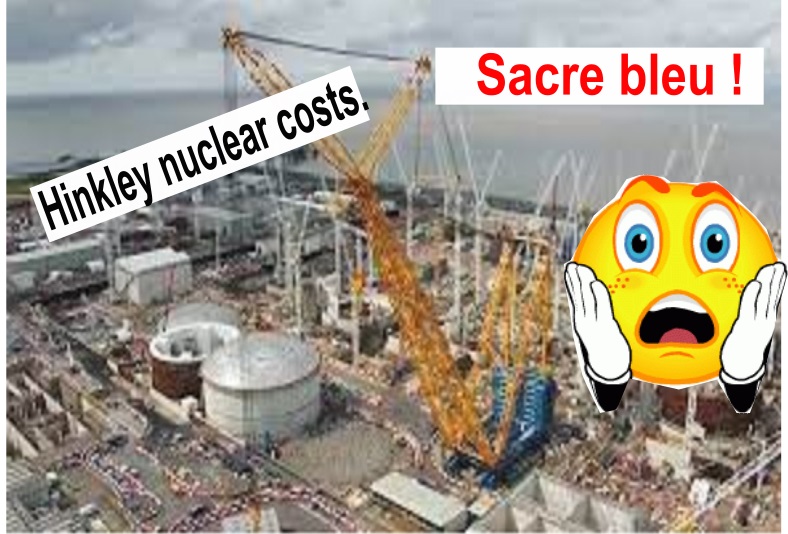
The appointments, part of a broader reshuffle at the executive committee, come as Chief Executive Officer Luc Remont is under pressure to boost the debt-laden company’s performance to cope with the ballooning cost of its Hinkley Point C nuclear project in the UK and the prospect of soaring capital expenditure to build new atomic plants in France.
“We are currently seeing an unprecedented recovery in nuclear power, which brings considerable challenges for EDF,” Remont said in the statement. “Our organization and the way we work is evolving to deliver further improvements in performance and ensure that our nuclear projects are successful.”
Earlier this year, EDF raised the budget of the two reactors it’s building at Hinkley Point in the UK to as much as £47.9 billion ($60.4 billion), citing labor shortages, supply chain issues, and longer-than-expected cable and pipe-fitting works.
It’s also working to complete the basic design of six new reactors to be built in France, which could cost about €67.4 billion ($72 billion), and is seeking to develop a so-called small modular reactor by the start of the next decade.
France will help Brazil develop nuclear-powered submarines, Macron says
President Emmanuel Macron and counterpart Luiz Inacio Lula da Silva on Wednesday celebrated the launch of Brazil’s third French-designed submarine, which will help secure the country’s immense coastline, dubbed the “Blue Amazon.”
France 24 By:NEWS WIRES|: Video by:Angela DIFFLEY 27/03/2024
The two men highlighted the importance of their countries’ defense partnership during a time of major global unrest, at a ceremony at Brazil’s ultra-modern naval base in Itaguai near Rio de Janeiro…
Despite differences, notably on the Ukraine war, Macron said “the great peaceful powers of Brazil and France” had “the same vision of the world.”…………………………………..
The construction of the submarines was outlined in a 2008 deal between Lula and former French president Nicolas Sarkozy, which also included the purchase of 50 Caracal helicopters.
The fourth submarine, the Angostura, will be launched in 2025.
France skirts around nuclear sub
Brazil is also planning to build its first nuclear-powered submarine, the Alvaro Alberto, a project that has suffered significant delays, mainly due to budget constraints.
The French naval defense manufacturer Naval Group is supporting the design and construction of the submarine, except for the nuclear boiler which is being designed by the Brazilians.
Brasilia is however trying to convince Paris to increase technology transfers to help it integrate the reactor into the submarine and sell it equipment linked to nuclear propulsion.
France has been reticent to transfer such technology due to the challenges of nuclear proliferation.
“If Brazil wants to have access to knowledge of nuclear technology, it is not to wage war. We want this knowledge to assure all countries that want peace that Brazil will be at their side,” said Lula.
Macron told Brazil “France will be at your side” during the development of the nuclear-powered submarines, without announcing specific assistance.
“I want us to open the chapter for new submarines… that we look nuclear propulsion in the face while being perfectly respectful of all non-proliferation commitments,” he said……………………… https://www.france24.com/en/americas/20240327-france-to-help-brazil-develop-nuclear-technology-for-submarines
2
For the EPR, the objective of loading fuel before the end of March is no longer tenable.
Officially, the loading of fuel on the Flamanville EPR (Manche) is still
planned by EDF before the end of March 2024. Officially, there is nothing
new to know about the Flamanville EPR (Hague). No new delay (even slight)
to announce, nor “white smoke” to be seen. However, the deadlines are
getting closer, and the calendar no longer matches.
La Presse de la Manche 19th March 2024
Nuclear Deterrence At Sea – France Begins Work On ‘Cutting Edge’ Nuke-Powered Ballistic Missile Submarine
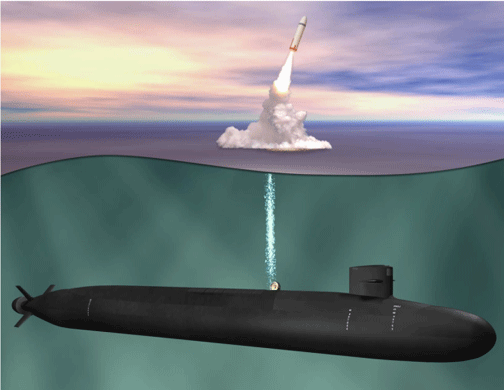
By EurAsian Times Desk -March 21, 2024
The steel cutting of the first third-generation French SSBN took place at Naval Group’s shipyard in Cherbourg on March 20th. This symbolic gesture marks the start of hull production for these submarines, which will ensure France’s nuclear deterrence posture until the end of the 21st century.
Among the most complex systems, SSBNs are the cornerstones of France’s strategic oceanic force (FOST) and ensure that nuclear deterrence remains at sea.
Launched in February 2021, the SNLE 3G program for the French Navy brings together the armed forces, the French defense procurement agency (Direction Générale de l’Armement – DGA), which is responsible for overall project management, the French Atomic Energy Commission (CEA), for the nuclear boilers, and Naval Group, which is responsible for overall project management of the submarines, in association with TechnicAtome for the nuclear boilers………………………………………………………………………………………………………………………….. https://www.eurasiantimes.com/nuclear-deterrence-at-sea-france-starts-constructing/
Nuclear weapons: France to restart tritium production with EDF
By Paul Messad | Euractiv France, 20 Mar 24
France’s Minister for the Armed Forces, Sébastien Lecornu, announced on Monday (18 March) a new production cycle for tritium, which is essential for the manufacture of nuclear weapons, using state utility EDF’s two civilian reactors.
Lecornu visited the Civaux nuclear power plant in south-west France, which will produce the tritium for the military.
The tritium will be manufactured on the premises of the Commissariat à l’énergie atomique (CEA), the French nuclear scientific and industrial research establishment.
To manufacture tritium, it is necessary to treat lithium-containing material with radiation, by exposing it to the neutron fluxes present inside the core of a reactor.
Tritium, whose gaseous form is practically non-existent, naturally, can be extracted from the irradiated material.
This hydrogen isotope (1 proton, 2 neutrons, and hydrogen-3) is particularly vulnerable to disintegrating spontaneously. As a result, any stockpile is halved in 12 years and disappears almost entirely after a century.
But it is vital for the production of nuclear weapons, particularly hydrogen bombs and neutron bombs, for which it is the main explosive.
The French army and EDF have come up with this “collaboration” to ensure the availability of sufficient stocks of tritium “as part of the continuity and credibility of France’s nuclear deterrent”, according to the annex to the press release.
According to the Federation of American Scientists, France currently has 290 active warheads, the fourth largest, after China with 500, the US with 3,700, and Russia with 4,400…………………………………………………….
Discussions between the French armed forces ministry and EDF on this subject have been underway for more than 25 years, in anticipation of the closure in 2009 of the two reactors intended solely for the production of tritium located in Marcoule, in south-east France, after more than 50 years in operation.
The parties finally selected Civaux, one of France’s most powerful and newest nuclear power stations. It was selected because it was capable of operating for a very long time, Dutheil said……………………
despite the reassurances of the various parties involved, any signed agreement between the French government, CEA, and EDF, will not specify a date – to define the legal and contractual scope of the activities, a press release states.
Dutheil stated, that later this year EDF will submit a dossier to the Autorité de sûreté nucléaire, the French nuclear safety authority, which will examine the feasibility of the project.
As a result of this timetable, the first test irradiation of lithium will not take place until before 2025, when the plant’s reactors are scheduled to be shut down for maintenance.
[Edited by Rajnish Singh] https://www.euractiv.com/section/politics/news/nuclear-weapons-france-to-restart-tritium-production-with-edf/
Deadlines, costs, production: France’s nuclear company EDF in a moment of truth
By Paul Messad | Euractiv France, Mar 18, 2024
EDF, the French state-owned energy giant faces criticism for rising costs and delays in its nuclear projects, its existing reactors have also been encountering problems. Euractiv looks at the implications of these challenges for EDF and the wider nuclear energy industry.
January 23, 2023: EDF, Europe’s leading energy company, announces a further extension of the costs and construction times of its two 3rd generation pressurized water reactors (EPR) located at Hinkley Point in England. The budget could increase by 70 to 90% compared to initial estimates and the start-up could be four to six years late.
……….the delays are “not likely to undermine the confidence of the British government in its nuclear strategy” , defends SFEN. Proof of this would be its reinvestment of more than a billion pounds sterling in two other reactors built by EDF in England, at Sizewell.
For others, on the contrary, the Anglo-Saxon situation is symptomatic of the challenge faced by the largest nuclear operator in the world, in whose confidence is eroded as projects progress, while it aims, in particular, at the construction of six, then 14 EPRs in France, and one (or even four in total) in the Czech Republic for which the authorities are awaiting guarantees.
Especially since another project tarnishes the image of the French giant. On the continent, EDF is in fact building an EPR in France, in Flamanville (Normandy). But as in England, construction is experiencing significant delays (12 years) and additional costs (+470%). The start-up of the reactor planned for “mid-2024” could even be further delayed .
……………………..In France, the government intends to get started since it plans to build six EPRs — and possibly eight others. Estimated costs and deadlines for the first six: 52 billion euros and a first commissioning in 2035.
For once, according to Les Échos , costs have already been revised upwards… by 30%. When questioned, the CEO of EDF, Luc Rémont, “does not confirm any figures” .
“We will be there when we have made all the optimizations [engineering design, component manufacturing, etc., Editor’s note] ,” he explained on the sidelines of the Franco-Czech nuclear summit organized in Prague. on March 8 and 9.
The deadlines, already “very demanding” , he agreed at the end of November, have since been postponed to 2040.
This back and forth annoys the Minister of the Economy and Energy. “EDF must learn to keep its costs and its schedule ,” criticized Bruno Le Maire at the beginning of March in Le Monde .
Czech Republic, Poland, Slovakia…
It must be said that EDF is playing on its international reputation.
In Prague, Mr. Rémont accompanied the President of the Republic, Emmanuel Macron, who came to defend EDF’s candidacy for the construction of one, or even four reactors in total, in the Czech Republic.
However, the country’s authorities have emphasized their commitment to respecting deadlines and costs.
“We are interested in the lowest possible price, the highest possible guarantees that the plant will be built on time ,” Jozef Síkela, Czech Minister of Industry and Trade, told Euractiv .
Clearly, it is not because EDF is the only European company in the running that it will be chosen. Worse, the company is walking on eggshells, competing, as in 2009 on the reactor issue in the United Arab Emirates, by a subsidiary of the South Korean KEPCO.
“Fifteen years later, the Flamanville EPR […] is still not in service. Three of the South Korean reactors in Abu Dhabi are there and the last one very soon [with delay, Editor’s note]” , reminded the former representative of EDF to the European institutions (1987 to 2000) Lionel Taccoen, resumed on
The situation may seem all the more worrying as EDF is also interested in building reactors in the Netherlands, Bulgaria , Slovenia, Slovakia and Poland where the French firm was recently defeated .
In addition, the Czech authorities have left the door open for the American Westinghouse to propose a new offer. The latter has also won several contracts for reactors in Europe in recent years. …………………….
The other dark spot on EDF’s picture lies in the management of its existing fleet and in particular the annus horribilis 2022 where, in the midst of the energy crisis, production has fallen back to pre-1990 levels .
“The year in which France should have shone is exactly the year in which we had a 50% reduction in the fleet,” argued to Euractiv at the end of January Xavier Daval, vice-president of the Renewable Energies Union, the main actors’ union. of the sector in France.
We will now have to wait until 2027, according to EDF , to once again reach production levels slightly higher than those of 1995 (around 360 TWh over the year), far from the 400-420 TWh reached between 2002 and 2015.
As if more was needed, EDF discovered at the beginning of March new “indications” of corrosion , a nightmare of 2022, on one of the reactors in the park.
Nevertheless, the company and the nuclear industry benefit more than ever from government support. France, like the fifteen other European states, which are part of the “nuclear alliance”, supports the emergence of 30 to 45 large reactors by 2050 . Will EDF be the main architect? https://www.euractiv.com/section/energy-environment/news/frances-edf-faces-uphill-battle-as-europes-demand-for-nuclear-reactors-grows/
Exposing myths about building French nuclear power
How French nuclear construction times and costs have been getting longer and longer – for a long time
DAVID TOKE, MAR 16, 2024, https://davidtoke.substack.com/p/exposing-myths-about-building-french
It has been standard in the UK to talk about the wonders of the French nuclear programme and how if only we copied them nuclear power would get cheaper and cheaper. The story has gone ‘If only we built a series of nuclear power plant like they did’. But it turns out that the idea that the French nuclear programme was ever getting any cheaper was a myth.
In the UK Government policy documents would use their own language to describe nuclear prospects. Special terms are used that are not usually used to discuss other energy developments. These include the acronym ‘FOAK’ which stands for ‘First of a Kind’. In other words the first plant will be relatively more expensive than the plants of the same model that followed them. Another term used of course is ‘overnight’ costs – that is a wonderful piece of euphemism given that nuclear power plants are anything but built overnight. Its use obscures the fact that very large interest costs mount up during the time that the plant is being constructed, costs which are not included in the total cost estimates. That is because the plant in the spreadsheet is being built overnight (?!).
But when we examine the actual ‘overnight’ costs of French nuclear power, as reported, they have always been increasing. Look at the analysis by Arnulf Grubler published in the journal Energy Policy in 2010: [graph on original]
Grubler’s analysis did not include the length of time taken to construct the latest French nuclear power plant at Flamanville. This is an EPR (the same design as is being built at Hinkley C and planned for Sizewell C. Construction of the Flamanville EPR began in 2007 but it has still not been completed. Hence the Figure below includes the time taken to build Flamanville up until now, with the proviso that the plant still has not been completed.
It should be understood that, broadly speaking, the cost of building reactors is proportionate to the amount of construction time. So the cost has gone up, and in recent years cost has been going up at a rapid rate,.
In my forthcoming book ‘Energy Revolutions – Profiteering versus Democracy’ I outliner four reasons for the increasing difficulties of building nuclear power plants:
‘First is the fact that nuclear power plant designers have incorporated safety features designed to minimise the consequences of nuclear accidents, but in doing so the plants have become much more complicated and difficult to build without great expense.
A second reason is that large construction projects of whatever type, at least in the West, tend to greatly overrun their budgets. In the West, improvements in health and safety regulations to protect construction workers have no doubt played a part in this.
A third factor is that, in the West at least, the cheap industrialised labour force that dominated the industrial economies of the past and which could be used to develop nuclear programmes (in the way that France did in the 1980s) has ceased to exist.
A fourth factor is simply that renewable energy technologies, especially wind and solar power, can be largely manufactured offsite in a modular fashion and their costs have rapidly fallen, leaving nuclear power increasingly uncompetitive.’ (page 30)
This book shows how we can move forward to an energy system powered by renewable energy rather than nuclear power or ‘carbon capture’ fossil fuels. It reveals how selective public ownership and targeted interventions, as part of an energy democracy programme will protect consumer interests better than the chaotic energy supply system that failed consumers so expensively in the recent energy crisis. We want no more of that!
Essentially, the idea of using nuclear power as a significant measure to engineer the global energy transition is at best a tremendous waste of resources. It is not just France that is seeing its nuclear power programme stall. It is a global phenomenon. Renewable energy is, by contrast, expanding at ever-incredible rates. As can be seen from the following graphs which is taken from my book ‘Energy Revolutions’. [on original]
La Hague reprocessing plant: expansion and continued operation until at least 2100

Last week, the Élysée Palace confirmed that the French reprocessing
plant at La Hague is to be expanded. Extensive investments are planned in
this context. There have already been plans since 2020 to build another
storage pool on the plant site.
At La Hague, there is still radioactive
waste from Germany, which may be returned this year. It was actually just a
side note: The Conseil de Politique Nucléaire (Nuclear Policy Council),
which was founded in 2023 and met at the Elysée Palace last Monday,
confirmed the prospect of major investments at La Hague in order to extend
the lifespan of the facilities until at least 2100.
Corresponding press
reports were confirmed by the Elysée Palace on Tuesday: The Council had
“confirmed the major guidelines of French policy on the nuclear fuel cycle,
which combines reprocessing, reuse of spent fuel and closing the cycle”,
the La Hague site would “be the subject of major investment”. No specific
timetables or amounts were mentioned in this context.
GRS 12th March 2024
And Israel? Macron to propose ‘Olympic ceasefire’ for Ukraine conflict
17 Mar 2024 , https://www.sott.net/article/489864-And-Israel-Macron-to-propose-Olympic-ceasefire-for-Ukraine-conflict
French President Emmanuel Macron has said he will propose a ceasefire between Russia and Ukraine during the Summer Olympic Games, set to take place in Paris between July 26 and August 11.
In an interview with Ukrainian media on Saturday, Macron was asked whether France, as the host of the games this year, will follow tradition and seek “a ceasefire during the Olympics.” The journalist was apparently referring to the Olympic Truce, a period of conflict cessation which historically began seven days before the games and ended seven days after so that the athletes could safely travel to and from the Olympics.
“It will be requested,” the French leader responded.
“The rule of the host country is to move in step with the Olympic movement,” the French leader said when asked about his views on the situation in which Russian athletes are allowed to participate under a neutral flag.
“This is a message of peace. We will also follow the decision of the Olympic Committee,” he added.
Comment: Will Israeli athletes also be forced to attend under a neutral flag or be banned altogether by the IOC?
The International Olympic Committee (IOC) originally banned Russian and Belarusian athletes from competing internationally, following the escalation of the military conflict in Ukraine in February 2022. Last year, however, the blanket ban was reconsidered by the organization, and conditions were set to allow individuals, but not the teams, to participate provided that they do so under a neutral flag.
The decision prompted an outcry from Kiev, with President Vladimir Zelensky calling for a complete boycott of the games. However, Ukraine later softened its stance and permitted its athletes to compete as long as the Russians and Belarusians were only present as neutral athletes.
While Moscow condemned the IOC’s requirements, calling them “unreasonable, legally void and excessive”, the head of the Russian Olympic Committee, Stanislav Pozdnyakov, confirmed on Thursday that this year’s Olympics in Paris would not be shunned, despite the restriction.
“We will never take the path of boycotting (the Games). We will always support our athletes,” he told RIA Novosti.
Comment: The French president would likely want to buy some time so that the Western partners have more time to rearm Ukraine and train yet another army. That wish for a ceasefire is unlikely to be granted by Russia.
One wonders why the French president wasn’t asked about a ceasefire in Israel.
Macron has in the recent weeks done made sure to get some time in the limelight, but it hasn’t quite worked out and he might have shown himself to be delusional if not also untrustworthy. See also:
Macron leads the way to Western civilization’s suicideMajority disagree with Macron’s comments on sending NATO troops to Ukraine – poll
There is no such thing as a “nuclear waste-eating” reactor
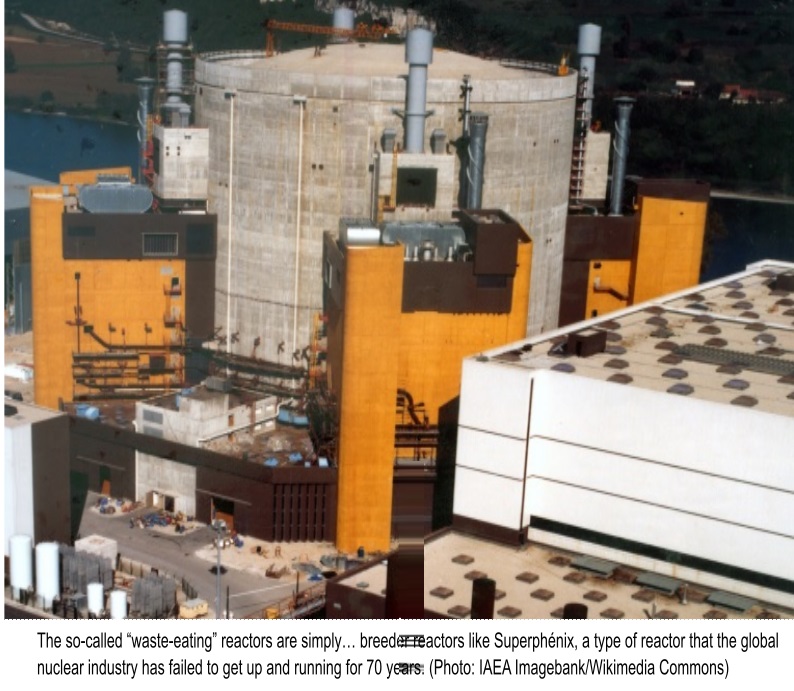
Contrary to popular belief, the French nuclear industry is by no means “triumphant”, “the best in the world” or “at the cutting edge of technology”: in fact, EDF (bankrupt), Areva (renamed Orano after filing for bankruptcy) and CEA (subsidized by public money) are constantly making fools of themselves and leaving the French with astronomical bills.
A magic reactor killed by environmentalists?
By Stéphane Lhomme by beyondnuclearinternational, https://beyondnuclearinternational.org/2024/03/17/a-magic-reactor-killed-by-environmentalists/
On the contrary, a “nuclear waste-eating reactor” does not exist
Appearing as a guest on several TV channels (BFM, Cnews, etc.), a certain Fabien Bouglé managed to fool both viewers and journalists (most of whom are totally ignorant about nuclear power) with a series of fibs, each more enormous than the last. Here are a few clarifications.
There is no such thing as a “nuclear waste-eating” reactor
The smooth-talking Bouglé left his ignorant interlocutors stunned and bewildered as he talked about “waste-eating” reactors that would have already solved the radioactive waste issue if an infamous green lobby, “betraying France to Germany” (sic!), hadn’t “prevented” the advent of such reactors.
So, like throwing a log on the fire, all you have to do is put the radioactive waste produced by today’s power plants into a “magic” reactor, and the waste will disappear.
Mr. Bouglé finally divulged his “secret”: the so-called “waste-eating” reactors are simply… breeder reactors: a type of reactor that the global nuclear industry has failed to operate for 70 years, like Superphénix in France! And, even if it did work, it would in no way eliminate radioactive waste. What’s more, less than 1% of nuclear fuel (the most radioactive waste) could theoretically have its lifespan reduced, but without disappearing and while becoming even more radioactive! In the nuclear industry, as elsewhere, miracles do not exist.
The Astrid project was not “on the way to success” and was not “taken over by Bill Gates”
Despite its pretty name, the Astrid reactor project was nothing more than a little Superphénix: a sodium-cooled breeder reactor. Look at the “progress”: 40 years after the launch of Superphénix (1240 MW), the CEA wanted to make another attempt with a reactor half as powerful (600 MW), before giving up altogether.
Japan’s Monju fast-breeder reactor was definitively shut down after countless failures, a terrible fire and sodium leaks; Germany’s Kalkar fast-breeder reactor was never commissioned; and the USA has abandoned the sector. Only Russia manages to keep its BN800 hobbling along… but it doesn’t perform any of the miracles expected of it (producing “more fissile material than it consumes”, “eating” radioactive waste and other nonsense).
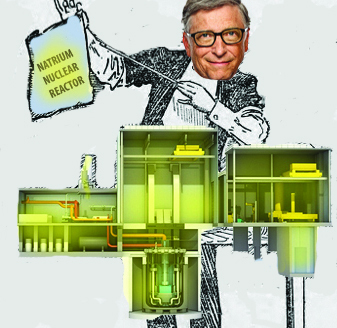
As for Bill Gates, he’s one of the dummies who, in recent years, have announced various types of miraculous reactors, always claiming to be able to produce electricity “cheaply, safely and with little waste” (blah blah blah). Beginning in 2006, Bill Gates and his company Terrapower first tried to make a “travelling wave” reactor work, then a “molten salt” one, both abandoned after wasting billions. Now Gates is dreaming of developing… a sodium-cooled fast-neutron reactor: back to Superphénix and 70 years of failure for the global nuclear industry.
France’s nuclear woes are caused by… France’s nuclear woes!
The “evil anti-nuclear environmentalists” and the so-called “traitors in the pay of Germany” denounced by Inspector Bouglé have nothing to do with the disasters of French nuclear power: EDF, Areva (now Orano) and the CEA are doing just fine on their own! For example:
- Industrial and financial disasters at the EPR sites in Finland, Flamanville and England: 15 to 20 years (instead of four and a half) to build a reactor costing 20 billion Euros instead of 3 billion, and with serious defects.
- The unprecedented scandal of the thousands of defective parts (including the famous Flamanville EPR vessel) produced by Areva in its Le Creusot plants.
- Catastrophic and ruinous flops at the Iter (fusion) and RJH reactor sites.
- Stress corrosion (up to 32 reactors out of 56 shut down at the same time in 2022)
And so on.
Contrary to popular belief, the French nuclear industry is by no means “triumphant”, “the best in the world” or “at the cutting edge of technology”: in fact, EDF (bankrupt), Areva (renamed Orano after filing for bankruptcy) and CEA (subsidized by public money) are constantly making fools of themselves and leaving the French with astronomical bills.
The Fessenheim closure is not the cause of electricity shortages in France and imports from Germany
Mr. Bouglé claims that France was an exporter to Germany before the closure of Fessenheim and that it has suddenly become an importer because of the plant’s closure in 2020. He’s talking nonsense.
In reality, there are exchanges (in both directions) between the two countries throughout the year. When the balance sheet is drawn up on December 31, France is still an importer from Germany (*), and has been for over 25 years (**), long before Fessenheim was shut down.
This phenomenon is mainly due to the absurd choice of electric heating, developed on a massive scale in France to “justify” nuclear power: as soon as it gets cold, electricity consumption is such that it far exceeds the capacity of the French nuclear fleet, even when it’s working properly!
It’s also worth noting the ridiculous claim that life was wonderful in France with 58 reactors, and that it has suddenly gone into crisis with “only” 56 reactors, which in reality is an insane number. For the record, during the stress corrosion crisis, France was saved by importing massive amounts of electricity from neighboring countries, which have only a few reactors, if any at all.
(*) Of course, we can criticize the fact that a significant proportion of Germany’s electricity is generated by coal-fired power plants (even if the share of renewables is increasing exponentially), but the fact is that it’s this “dirty” electricity that heats France every winter, and French nuclear enthusiasts don’t go so far as to refuse this electricity and stay in the cold and dark!
(**) Except, very narrowly, in 2011: following the Fukushima disaster, Germany immediately shut down 8 reactors. But by 2012, France was once again a net importer from Germany.
The joke about waste-eating reactors
Let’s start by noting that nuclear reactors continually produce insane quantities of radioactive waste of various kinds, from nuclear fuel to the tools and clothing used in power plants, which are contaminated… and can’t be “eaten”!
But let’s concentrate on the most radioactive, the spent fuel that comes out of the reactor core after use.
Spent fuel comprises four types of element: plutonium, uranium, fission products and minor actinides. Note that the vast majority of radioactivity is contained in these last two categories.
To attempt reuse this waste fuel, separation work must already be carried out in a gigantic plant such as La Hague. These operations require huge amounts of electricity and using large quantities of terribly corrosive and dangerous chemicals: a far cry from the “clean” energy that could “save the planet”.
– Plutonium
Listening to Mr. Bouglé, the uninformed viewer (and the ignorant journalist) think that all they have to do is recover this fuel and put it in the so-called “waste-eating reactor”, which will make this waste disappear… while producing electricity! Jackpot, bravo and thanks for everything. But Santa Claus doesn’t exist, and it’s all poppycock. And here’s why.
It is used by the military for their atomic weapons. Some of this plutonium can be recovered to make fuel (known as “mox”) for use in today’s power plants, which exacerbates the consequences of an accident when it occurs. Various studies show that this option reduces only slightly the amount of uranium needed from mining. But in no case is this plutonium “eaten” or “incinerated”; it is almost entirely recovered after use.
– Uranium
The uranium resulting from these separation operations, known as “reprocessed uranium”, can theoretically be reused in place of mined uranium, but in reality, this option poses a number of technical problems. EDF has been trying to use it for years in its Cruas power plant (Ardèche), after re-enrichment… in Russia (thanks Putin!). But this remains very marginal, and in no case is this uranium “eaten” or “incinerated”; it is almost entirely recovered after use.
– Fission products
There’s nothing we can do with them, except vitrify them and store them for millennia!
– Minor actinides
These are the only elements of radioactive waste that could theoretically have their lifespan reduced in breeder reactors… while becoming even more radioactive! But even if such a “feat” were to happen (provided we finally manage to operate breeder reactors properly), minor actinides would not be “eaten”, “incinerated” or “disintegrated”. In fact, they are vitrified like fission products and have to be stored for millennia.
Conclusion
Of course, there is no technology that can “eat” nuclear waste. At most, it is theoretically possible (but not in practice) to degrade a tiny fraction of it, and even then, at the cost of new radioactive and chemical contamination and very high energy consumption.
Once and for all, let’s remember that there will never be a nuclear miracle, be it with magic reactors, or by replacing uranium with thorium (the thorium sector is also that of fast-breeder reactors!), or with fusion, or by calling old projects that have never worked “4th generation” or “SMR”.
Stéphane Lhomme is Director of the Nuclear Observatory.
French president Emmanuel Macron tells Putin ‘WE are a nuclear power and WE are ready’ in latest WW3 rhetoric.

- A stern Macron chastised Putin for threatening the use of nuclear devices
- It comes after Putin told state TV ‘weapons exist to be used’ earlier this week
Having nuclear weapons ‘imposes on us the responsibility never to escalate,’ Macron said, in a dig at the constant reminders issued by top Russian officials and media personalities of their nuclear arsenal.
His statements come amid a hardening of Paris’ stance towards Moscow after Macron abandoned his longstanding efforts to maintain a closer bond with Putin.
Britain and France are Europe’s only nuclear powers, but even their collective power is a fraction of that employed by Russia, which has the world’s largest and most varied collection of nuclear weapons by some margin – even larger than that in Washington’s vast stockpiles.
Speaking with French and Ukrainian media, Macron chastised Putin for threatening the use of nuclear devices and reminded him France also has an advanced weapons programme……………………………………………………………………………………………………………………..
For Tatiana Kastoueva-Jean, Russia specialist at the French Institute of International Relations (IFRI), the change in Macron’s stance towards Putin triggered this reaction from Russia.
‘There is incomprehension (in Russia) over how someone who wants to discuss with Russia, to be the mediator, turns into someone who takes the lead of the toughest camp opposing it,’ she said. https://www.dailymail.co.uk/news/article-13201319/French-president-Emmanuel-Macron-declares-nuclear-power-ready-response-Putins-threats-using-nukes-Kremlin-says-France-signalled-deeper-involvement-Ukraine.html
Cold turkeys: The demise of nuclear power

Jim Green, Mar 12, 2024, https://reneweconomy.com.au/cold-turkeys-the-demise-of-nuclear-power-in-australias-aukus-partner-countries/
When announcing the AUKUS agreement in 2021, then Prime Minister (and secret energy minister) Scott Morrison said: “Let me be clear: Australia is not seeking to establish … a civil nuclear capability.” He also said that “a civil nuclear energy industry is not a requirement for us to go through the submarine program.”
However, Coalition Senators argued in a report last year that Australia’s “national security” would be put at risk by retaining federal legislation banning nuclear power and that the “decision to purchase nuclear submarines makes it imperative for Australia to drop its ban on nuclear energy.”
So, let’s see how nuclear power is faring in our AUKUS partners, the UK and the US.

This is a story about conventional, large reactors. All that needs to be said about ‘small modular reactors’ in the UK and the US is that none exist and none are under construction.
This is a story about conventional, large reactors. All that needs to be said about ‘small modular reactors’ in the UK and the US is that none exist and none are under construction.
The UK

The last power reactor start-up in the UK was 29 years ago — Sizewell B in 1995.
Over the past decade, several proposed new nuclear power plants have been abandoned (Moorside, Wylfa, Oldbury) and the only project to reach the construction stage is Hinkley Point C, comprising two French-designed EPR reactors.
In the late 2000s, the estimated construction cost for one EPR reactor in the UK was £2 billion (A$3.9 billion). When construction of two EPR reactors at Hinkley Point commenced in 2018 and 2019, the cost estimate for the two reactors was £19.6 billion.
The current cost estimate for the two reactors has ballooned to £46 billion (A$89 billion) or £23 billion (A$44.5 billion) per reactor. That is 11.5 times higher than the estimate in the late 2000s. Further cost overruns are certain. This is an example of the Golden Rule of Nuclear Economics: Add a Zero to Nuclear Industry Estimates.
The UK National Audit Office estimates that taxpayer subsidies for Hinkley Point — primarily in the form of a guaranteed payment of £92.50 (A$180) per megawatt-hour (2012 prices), indexed for inflation, for 35 years — could amount to £30 billion (A$58 billion) while other credible estimates put the figure as high as £48.3 billion (A$94 billion).
Delays

The delays associated with Hinkley Point have been as shocking as the cost overruns. In 2007, French utility EDF boasted that Britons would be using electricity from an EPR reactor at Hinkley Point to cook their Christmas turkeys in 2017. In 2008, the UK government said the reactors would be complete “well before 2020”.
But construction of the two reactors didn’t even begin until 2018 and 2019, respectively, at which time completion was expected in 2026. Now, completion is expected in 2030 or 2031.
Undoubtedly there will be further delays and if the reactors are completed, it will be more than a quarter of a century after the 2007 EDF boast that Britons would finally be using electricity from Hinkley Point to cook their Christmas turkeys.
Construction will take well over 10 years; planning and construction over 25 years. Yet in Australia, the Coalition argues that Australians could be cooking Christmas turkeys with nuclear power 10 years from now.
‘Something of a crisis’
Nuclear industry lobbyist Tim Yeo said in 2017 that the UK’s nuclear power program faced “something of a crisis”. The following year, Toshiba abandoned the planned Moorside nuclear power project near Sellafield despite generous offers of government support — a “crushing blow” according to Yeo.
Then in 2019, Hitachi abandoned the planned Wylfa reactor project in Wales after the estimated cost of the twin-reactor project had risen by 50 percent.
Hitachi abandoned the project despite an offer from the UK government to take a one-third equity stake in the project; to consider providing all of the required debt financing; and to consider providing a guarantee of a generous minimum payment per unit of electricity.
Long gone was the 2006 assertion from then UK industry secretary Alistair Darling that the private sector would have to “initiate, fund, construct and operate” nuclear power plants.
The UK Nuclear Free Local Authorities noted that Hitachi joined a growing list of companies and utilities backing out of the UK nuclear new-build program:
“Let’s not forget that Hitachi are not the first energy utility to come to the conclusion that new nuclear build in the UK is not a particularly viable prospect. The German utilities RWE Npower and E-on previously tried to develop the site before they sold it on Hitachi in order to protect their own vulnerable energy market share in the UK and Germany.
“British Gas owner Centrica pulled out of supporting Hinkley Point C, as did GDF Suez and Iberdrola at Moorside, before Toshiba almost collapsed after unwise new nuclear investments in the United States forced it to pull out of the Sellafield Moorside development just a couple of months ago.”
Sizewell C

The UK government hopes to progress the Sizewell C project in Suffolk, comprising two EPR reactors, and is once again offering very generous support including taking an equity stake in the project and using a ‘regulated asset base‘ model which foists financial risks onto taxpayers and could result in taxpayers paying billions for failed projects — as it has in the US.
If recent experience is any guide, the government will struggle to find corporations or utilities willing to invest in Sizewell regardless of generous government support.
(The same could be said for plans for small modular reactors or mid-sized reactors envisaged by Rolls-Royce — it is doubtful whether private finance can be secured despite generous taxpayer subsidies.)
Many reactors have been permanently shut down in the UK: the IAEA lists 36 such reactors. Since the Sizewell B reactor startup in 1995, there have been 24 permanent reactors shut-downs and zero startups.
Repeat: since the last reactor startup in the UK, there have been 24 shut-downs!
The capacity of the nine remaining reactors (5.9 gigawatts — GW) is less than half of the peak of 13 GW in the late 1990s. Nuclear power’s contribution to electricity supply has fallen from 22 percent in the early 2000s to 14.2 percent.
Meanwhile, the UK government reports that renewable power sources accounted for 44.5 percent of total UK generation in the third quarter of 2023, a higher share than fossil fuels and around three times more than nuclear’s share.
What to make of the conservative UK government’s goal of quadrupling nuclear capacity to 24 GW by 2050? It is deeply implausible. The facts speak for themselves. Two dozen reactor shutdowns and zero startups since 1995.
The Hinkley Point project has been extremely slow and extremely expensive. The Sizewell C project is uncertain. Other proposals — including proposals for small modular reactors — are even more uncertain and distant.
Unsurprisingly, the extraordinary cost overruns and delays associated with Hinkley Point have complicated plans to advance the proposed Sizewell C project.
In 2010, the UK government announced that Sizewell was one of the locations slated for new reactors. Fourteen years later, construction is some years away and it remains uncertain if the project will reach the construction stage. EDF and the UK government are seeking to raise a further £20 billion from new investors. All reasonable offers considered.
France

The Sizewell C project is equally complicated across the channel due to EDF’s massive debts and its plan to replace the EPR design with an EPR2 design, about which little is known except that safety will be sacrificed on the altar of economics. EDF’s debt as of early 2023 was €64.5 billion (A$107 billion) and it was fully nationalised later in 2023 due to its crushing debts.
In addition to its adventures across the channel, EDF has a “colossal maintenance and investment programme to fund” in France as the Financial Times noted in October 2021.
As in the UK, there has not been a single reactor startup in France since the last millennium. The only current reactor construction project is one EPR reactor under construction at Flamanville. The current cost estimate of €19.1 billion (A$31.6 billion) is nearly six times higher than the original estimate of €3.3 billion (A$5.5 billion).
Construction of the Flamanville reactor began in 2007 and it remains incomplete 17 years later. Planning plus construction have taken over a quarter of a century. Yet the Coalition argues that Australians could be cooking Christmas turkeys with nuclear power 10 years from now.
France’s nuclear industry was in its “worst situation ever“, a former EDF director said in 2016 — and the situation has worsened since then. Another former EDF director said in early 2024 that the French nuclear industry is “on a slow descent to hell” and he has “fierce doubts about EDF’s ability to build more reactors.”
The US

The V.C. Summer project in South Carolina (two AP1000 reactors) was abandoned in 2017 after the expenditure of around US$9 billion (A$13.6 billion). Construction began in 2013 and the project was abandoned in 2017.
The project was initially estimated to cost US$11.5 billion; when it was abandoned, the estimate was US$25 billion (A$38 billion).
Largely as a result of the V.C. Summer disaster, Westinghouse filed for bankruptcy in 2017 and its parent company Toshiba only avoided bankruptcy by selling its most profitable assets. Both companies decided that they would no longer take on the huge risks associated with reactor construction projects. A year earlier, Westinghouse said its goal was to win overseas orders for at least 45 AP1000 reactors by 2030.
Criminal investigations and prosecutions related to the V.C. Summer project are ongoing: the fiasco is known as the ‘nukegate’ scandal.
Vogtle

With the abandonment of the V.C. Summer project in South Carolina, the only remaining reactor construction project in the US was the Vogtle project in Georgia (two AP1000 reactors).
Construction of the Vogtle reactors began in 2013 and the expected completion dates of 2016 and 2017 were pushed back seven years to 2023 and 2024. In 2014, Westinghouse claimed a three-year construction schedule for AP1000 reactors but the Vogtle reactors took 10 and 11 years to complete.
The first licence application for the Vogtle project was submitted in 2006 so planning and construction took 17 years in addition to the time spent before the 2006 application.
The latest cost estimate for the Vogtle project is $34 billion (A$51 billion), more than twice the estimate when construction began (US$14–15.5 billion). The project only survived because of multi-billion-dollar taxpayer bailouts.
In 2006, Westinghouse said it could build an AP1000 reactor for as little as US$1.4 billion (A$2.1 billion) — 12 times lower than the latest Vogtle estimate of US$17 billion (A$25.5 billion) per reactor. Another example of the Golden Rule of Nuclear Economics: Add a Zero to Nuclear Industry Estimates.
Corruption scandals

In 2005, the US Nuclear Energy Institute claimed that Westinghouse’s estimate of US$1,365 per kilowatt “has a solid analytical basis, has been peer-reviewed, and reflects a rigorous design, engineering and constructability assessment.”
In fact, the estimate was out by an order of magnitude and the Institute’s involvement in a raft of corruption scandals has been exposed. No doubt the Dutton Coalition would happily parrot whatever lies the Institute chose to feed them, and no doubt the Murdoch/Sky/AFR echo-chamber would happily amplify those lies.
During the ill-fated ‘nuclear renaissance’, the US Nuclear Regulatory Commission received applications to build 31 reactors, but only the Vogtle and V.C. Summer projects reached the construction stage and only the twin-reactor Vogtle project was completed. Two out of 31 ain’t bad. Well it is, actually.
Thirteen reactors have been permanently shut down since 2013 with many more closures in the pipeline. The US has one of the oldest reactor fleets in the world with a mean age of 42.1 years. The mean age of the 29 reactors closed worldwide from 2018‒2022 was 43.5 years.
Around 20 unprofitable, ageing reactors have been saved by nuclear bailout funding but their future is precarious. In addition to the V.C. Summer corruption scandal, nuclear bailout programs are mired in corruption scandals (see here, here, here and here and if you’re still not convinced see here, here, and here).
Dr. Jim Green is the national nuclear campaigner with Friends of the Earth Australia and a member of the Nuclear Consulting Group.
Nuclear: the bill for EDF’s future EPR2 reactors is already skyrocketing

EDF has significantly increased the cost of its program to build six new
EPR2 nuclear reactors, the newspaper Les Echos reported on Monday, citing
new estimates from the company. According to Les Echos, EDF now
estimates the cost of its program to build six new EPR2 nuclear reactors at
67.4 billion euros, compared to 51.7 billion euros in an estimate made
public at the start of 2022, an amount expected to be subject to regular
updates. That’s a jump of 30%.
La Tribune 4th March 2024
Le Figaro 4th March 2024
https://www.lefigaro.fr/flash-eco/le-cout-du-nouveau-nucleaire-francais-s-envole-20240304
-
Archives
- February 2026 (199)
- January 2026 (308)
- December 2025 (358)
- November 2025 (359)
- October 2025 (376)
- September 2025 (258)
- August 2025 (319)
- July 2025 (230)
- June 2025 (348)
- May 2025 (261)
- April 2025 (305)
- March 2025 (319)
-
Categories
- 1
- 1 NUCLEAR ISSUES
- business and costs
- climate change
- culture and arts
- ENERGY
- environment
- health
- history
- indigenous issues
- Legal
- marketing of nuclear
- media
- opposition to nuclear
- PERSONAL STORIES
- politics
- politics international
- Religion and ethics
- safety
- secrets,lies and civil liberties
- spinbuster
- technology
- Uranium
- wastes
- weapons and war
- Women
- 2 WORLD
- ACTION
- AFRICA
- Atrocities
- AUSTRALIA
- Christina's notes
- Christina's themes
- culture and arts
- Events
- Fuk 2022
- Fuk 2023
- Fukushima 2017
- Fukushima 2018
- fukushima 2019
- Fukushima 2020
- Fukushima 2021
- general
- global warming
- Humour (God we need it)
- Nuclear
- RARE EARTHS
- Reference
- resources – print
- Resources -audiovicual
- Weekly Newsletter
- World
- World Nuclear
- YouTube
-
RSS
Entries RSS
Comments RSS
 nuclear-news