Finland’s underground nuclear waste facility in construction, seeks licence

On 30 December 2021, Posiva Oy submitted to the Government an operating
licence application referred to in the Nuclear Energy Act for an
encapsulation plant and a disposal facility for spent nuclear fuel.
The facility is currently under construction in Olkiluoto, Eurajoki. Posiva has
been preparing for the disposal of spent nuclear fuel for more than 40
years. Its encapsulation plant is located above ground, and the fuel
repository of underground disposal facility is located in the bedrock at a
depth of approximately 400-430 metres.
Posiva is applying for an operatinglicence for a period from March 2024 to the end of 2070. According to theapplication, most of the spent nuclear fuel of Posiva’s owners, i.e.
Teollisuuden Voima Oyj’s Olkiluoto nuclear power plant and Fortum Power
and Heat Oy’s Loviisa nuclear power plant would be disposed of in
Posiva’s facility between 2024 and 2070. The disposal of all the spent
nuclear fuel of the Posiva owners is expected to be completed until the
late 2120s according to the present nuclear power operation plans.
Ministry of Economic Affairs 30th Dec 2021
https://tem.fi/en/posivas-operating-licence
The design fault in the Taishan nuclear reactor could affect other EPR reactors, including Finland’s Olkiluoto station.
Finnish Nuclear Safety Authority STUK has given its approval to start the
reaction nuclear and low power tests for the EPR OL3 reactor built with a
lot of difficulties by the Areva Siemens consortium in Olkiluoto.
The start took place on Tuesday 21 December 12 years behind the initial project and
with a budget multiplied by 3. The serious malfunctions that affected the
Taishan 1 EPR reactor in China show that this technology is not developed.
Information transmitted to CRIIRAD by a whistleblower indicate that the
nuclear fuel assemblies for the Taishan 1 reactor were severely damaged
during the second irradiation cycle. This situation is probably related to
a fault in design that is reasonably expected to affect other RPEs.
CRIIRAD 22nd Dec 2021
Finland’s Olkiluoto EPR nuclear reactor starting up, 12 years late
Nuclear: start-up of the Finnish EPR 12 years late. The EPR nuclear
reactor in Olkiluoto, Finland, started up overnight for the first time.
Between delays and financial problems, the work started in 2005 was strewn
with pitfalls for the French Areva. The EPR must supply 15% of the
consumption of the Nordic country.
Les Echos 21st Dec 2021
Finland’s Olkiluoto nuclear plant to power up 12 years late
Finland’s Olkiluoto nuclear plant to power up 12 years late news 24 17 Dec 21, Finland’s long-delayed Olkiluoto 3 nuclear reactor will begin powering up this month and start producing electricity in January next year, the plant’s operator announced on Thursday………………
the French-developed EPR reactor model, touted as offering higher power and better safety, has been plagued by delays and cost overruns, leading to bitter compensation disputes between TVO and Areva.
Other EPR builds in France and the UK have also been beset with delays, with Hinkley Point in southwest England pushing back its planned electricity production by half a year to mid-2026.
Costs have swelled by around 500 million ($705 million, 580 million euros) to as much as 23 billion. https://www.news24.com/fin24/International/finlands-olkiluoto-nuclear-plant-to-power-up-12-years-late-20211217
Finland’s nuclear power project collapsing – unprofitable and unnecessary
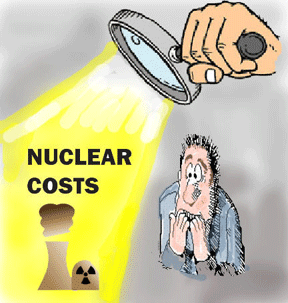
Doubts about nuclear power plant construction in Finland. The planned Hanhikivi nuclear power plant could be on the verge of collapse.
It is unclear whether there will be any need for the plant’s electricity at all.
The costs are running away, the schedule for the start of construction and commissioning has been revised and postponed several times. The planning documents are so inadequate that the project is not yet ready for approval even after a six-year approval process.
And most of the independent analyzes assume that the project can neither become profitable nor that
there is even a need for what is to be produced here. It recently revealed that there is also a huge funding gap, and now the military is raising concerns about national security.
Taz 18th Nov 2021
Finland’s Greens remain anti-nuclear, despite antics of a breakaway group


‘Which greens, there’s two? One carrying the original Green message, of the 1970s, egalitarian, social democracy, adopted by all other European countries.Green League – The Greens” Known throughout Europe, as the European Greens• Finnish: Vihreä liitto• Swedish: Gröna förbundet
— Paul RichardsNuclear Fuel Cycle Watch Australia, 11 Nov 21, Finland greens are reported to have switched to pro-nuclear power
The other, pro-nuclear group, broke away, branding itself green. Much like the Liberal Party, in Australia, who are hard-right, neocon and neoliberal.Liberal by brand, conservative by demonstrated values. A long con, that thoroughly confuses the Republican idiocracy in the US. A group, who think liberals are, communists. https://www.facebook.com/groups/1021186047913052
Finland’s Greens turn a lovely shade of nuclear yellow, as they back nuclear power as ”sustainable”
—Finland lobbies nuclear energy as a sustainable source https://www.euractiv.com/section/politics/short_news/finland-lobbies-nuclear-energy-as-a-sustainable-source/ By Pekka Vanttinen | EURACTIV.com, 11 Oct 2021
Following a previously secret decision, the Finnish government will lobby the European Union to declare nuclear power as a sustainable energy source.
Wind and solar have been approved as sustainable by the EU, but decisions on gas and nuclear have so far not been made. Even if plants are emission-free, nuclear is currently considered only a low-carbon energy source due to emissions caused by mining and transport.
Finland has four nuclear plants, and the fifth is nearing completion after years of postponements because of technical complexities. The future of nuclear energy remains important for the country. Its industry is highly energy-intensive, and Finland has a target of being carbon neutral by 2035. Currently, 30% of Finland’s energy is produced by nuclear energy.
As reported by the Finnish Broadcasting Company (YLE), the government’s alignment to lobby nuclear as a sustainable source marks a near U-turn within the Green Party sitting in the current five-party cabinet. Traditionally the party has been fiercely anti-nuclear and has resigned from previous governments over the issue. Its views have become more pragmatic, and the Greens now claim to have a technology-neutral attitude when it comes to fighting climate change.
Finland lobbied EU to declare nuclear power sustainable after unpublished cabinet decision.

Finland lobbied EU to declare nuclear power sustainable after unpublished cabinet decision supported by Greens, Uutiset, 9 Oct 21,
The EU Commission decides this autumn if nuclear power will be classified as sustainable.
Finland’s government has agreed to lobby the EU to declare nuclear power a sustainable energy source, but kept the decision secret.
If nuclear power gets the so-called ‘green label’, financing for nuclear projects will be easier to come by and the terms of any loans will be softer than for other energy projects…..
Finland’s decision was reached at a meeting of ministers on 9 July, but not announced publicly. Yle’s sources say that parliament’s Grand Committee, which sets the parameters of Finland’s EU policy, has not been informed of the change.
Yle requested the memo from the meeting, which was provided after publishing a report on the decision on Thursday.
Finance Minister Annika Saarikko (Cen) said that she did not see a reason to keep Finland’s view on nuclear power secret, and that the decision was reached in order to influence the EU decision-making process.
The EU has already granted solar and wind power projects the green ‘sustainable’ stamp of approval, but postponed decisions on gas and nuclear…..
Greens emphasise that there are still different views on nuclear within the party, but it has now adopted a ‘technology neutral’ stance on fighting climate change, according to Yle’s sources…..
On Thursday Iltalehti reported that Prime Minister Sanna Marin (SDP) raised the matter of nuclear policy with EU Commission President Ursula von der Leyen in Helsinki on Monday https://yle.fi/uutiset/osasto/news/finland_lobbied_eu_to_declare_nuclear_power_sustainable_after_unpublished_cabinet_decision_supported_by_greens/12135621
Ho hum … the umpteenth delay for Finland’s Olkiluoto 3 nuclear reactor
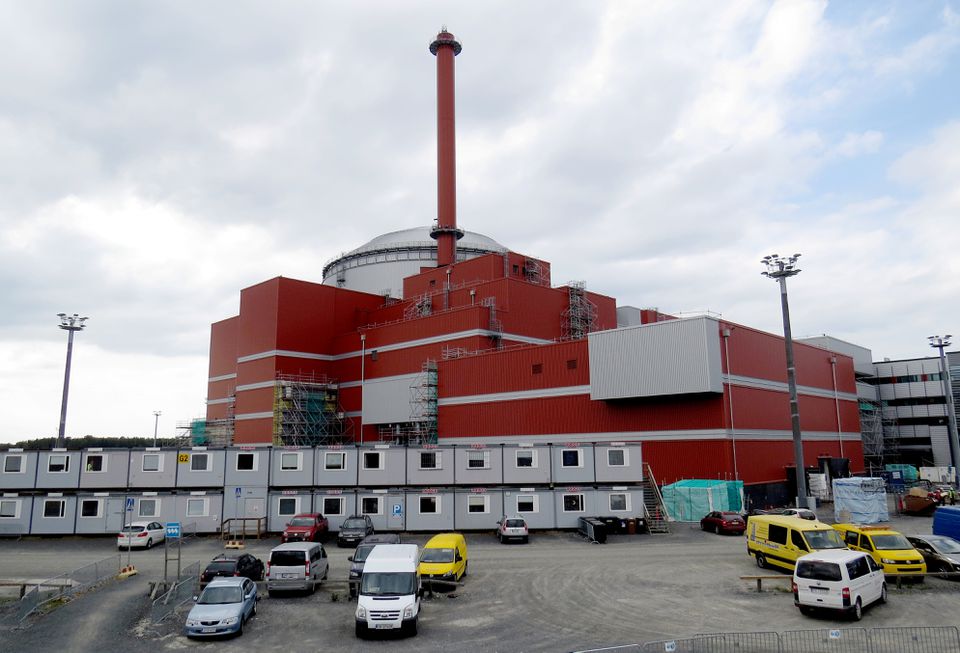
Finland’s Olkiluoto 3 nuclear reactor faces another delayBy Nora Buli OSLO, Aug 23 (Reuters) – The start of Finland’s much-delayed Olkiluoto 3 nuclear reactor has been pushed back by a further three months, with full power production now scheduled for June 2022, operator TVO said in a statement late on Friday.
“Teollisuuden Voima Oyj (TVO) has received additional information from the plant supplier Areva-Siemens consortium that the regular electricity production of the OL3 EPR plant unit will be further postponed for three months due to extended turbine overhaul and inspection works,” TVO said.
Olkiluoto 3 was meant to be finished in 2009 but the project has been beset by a series of setbacks……. https://www.reuters.com/business/energy/finlands-olkiluoto-3-nuclear-reactor-faces-another-delay-2021-08-23/
Further delay, more costs, for Finland’s nuclear power station, Fennovoima
Helsinki Times 4th May 2021, THE NUCLEAR POWER PROJECT of Fennovoima in Pyhäjoki, North Ostrobothnia,
is set to be delayed further, writes YLE. The Finnish consortium of power
and industrial companies stated last week that its effort to ensure the
design and licencing materials meet the Finnish standards has taken longer
than expected, predicting that a building permit for the plant could be
secured by mid-2022 instead of 2021.
The construction would therefore start
in the summer of 2023 and the plant start commercial operation in 2029. The
timetable is set forth in a supplement attached last week to the building
permit application the consortium filed with the Ministry of Employment and
the Economy in 2015. Fennovoima, the supplement reveals, has also raised
its cost estimate for the project from 6.5–7.0 to 7.0–7.5 billion
euros, citing its own operational and administrative costs.
Delays, increased costs and geopolitical uncertainties throw doubt on construction of nuclear power station in Finland.
Nuclear power plant construction in north Finland faces delay, increased costs and geopolitical uncertainties
Costs for the partly Russian-owned controversial plant will be €1 billion more than previously estimated. Barents Observer, By Thomas Nilsen , April 29, 2021
“Further deterioration of political and commercial relations between the EU, the USA and Russia could lead to more sanctions between the parties. Such deteriorated international affairs and sanctions could influence the project’s schedule and financing, in particular,” Fennovoima writes in its updated construction license application to Finnish authorities on Wednesday.
Work on the site in Pyhäjoki south of Oulu is in full swing despite final permission for the reactor itself at Hanhikivi 1 nuclear power plant is not yet granted.
The original application was delivered in 2015, but as Fennovoima sees “changes in boundary conditions,” an updated application was made. Among other things, the application includes an additional survey on the power plant’s impact on the marine environment and fishery during operation.
Other changes are related to security and preparedness arrangements and design solutions, although, no changes to the key principles of the power plant, Fennovoima underlines…….
Russia’s state-owned nuclear corporation holds a 34% stake in the plant. For Moscow, export of civilian nuclear power reactors is both a commercial revenue and a source of symbolic technology pride.
Last week, government officials in the Czech Republic said they were kicking Rosatom out of the play for bidding at a planned new reactor for the Dukovany nuclear power plant. The move came amid the diplomatic turmoil between Prague and Moscow following a 2014 blast in a weapons storage which Czech intelligence blames Russian military spies for being involved.
Like with the Czech nuclear power plant, also Fennovoima’s Hanhikivi 1 reactor is planned to receive uranium fuel supplies from Russia…….. https://thebarentsobserver.com/en/nuclear-safety/2021/04/construction-nuclear-power-plant-runs-delay-costs-increase-and-geopolitical#.YIp3J6ITqk0.twitter
84% of Finland’s population support signing up to the U.N. Nuclear Weapons Ban Treaty
 It is time to end our reliance on nuclear weapons Nuclear non-proliferation is a fundamentally European issue which is not yet part of any EU agenda https://ecfr.eu/article/it-is-time-to-end-our-reliance-on-nuclear-weapons/, Erkki Tuomioja, – View from the Council 2 November 2020, Finland did not participate in the negotiations leading up to the treaty, and it did not vote for it. Public opinion is, however, in favour of the treaty, with one poll showing that 84 per cent of Finns would support signing up. Three parties in Finland’s coalition government also want the country to join. Foreign ministry officials have argued in hearings of the Finnish parliament’s Foreign Relations Committee that joining would weaken the Non-Proliferation Treaty (NPT) – a faulty reasoning that the Committee unanimously rejected.
“The prohibition treaty is an important reinforcement to the half-century-old Non-Proliferation Treaty, which, though remarkably successful in curbing the spread of nuclear weapons to more countries, has failed to establish a universal taboo against the possession of nuclear weapons. The five nuclear-armed nations that had nuclear weapons at the time of the NPT’s negotiation — the United States, Russia, Britain, France and China — apparently view it as a licence to retain their nuclear forces in perpetuity. Instead of disarming, they are investing heavily in upgrades to their arsenals, with plans to retain them for many decades to come. This is patently unacceptable.”
It is precisely the frustration at the lack of progress with nuclear disarmament – to which the nuclear weapons states committed themselves in the grand bargain to get the non-nuclear countries to accept the NPT treaty signed in 1968 – that gave decisive impetus to the prohibition treaty. Obviously, without the participation of the nuclear weapons states, not one nuclear weapon will be dismantled. But without pressure from the non-nuclear weapons states in the form of this treaty, neither will they engage in serious efforts at disarmament. Nuclear weapons states will instead continue the present trend of modernising existing and developing new nuclear weapons systems.
Support in NATO countries for doing away with all weapons of mass destruction is growing, as evidenced by the signatories to the statement above. This is important because one argument made in Finland and Sweden, although it is rarely made in public, for opposing joining the prohibition treaty is the displeasure the US would show at such a step, which could hinder the deepening of these countries’ partnership relations with NATO. Given the growing demand in non-nuclear NATO countries to sign the treaty this is just as spurious as the NPT argument against joining.
The time has come for all states in the world to bring an end to the misguided, illegitimate, and immoral reliance on nuclear weapons. An all-out nuclear war is a threat to human life as a whole and would immediately bring about all the disasters we are trying to avoid with our efforts to curtail climate change and implement the Sustainable Development Goals of Agenda 2030.
No responsible leader disputes this. Yet we continue to conduct exercises in preparation for a nuclear war. The risk of accidental or miscalculated nuclear weapon use may today be even greater than at the height of the cold war. The Treaty on the Prohibition of Nuclear Weapons is, as the statement quoted says, “a beacon of hope in a time of darkness”.
There is one nuclear weapons state in the EU (formerly two) and 21 EU member states in NATO, but nuclear weapons and related issues have never formed part of the EU’s agenda. This is a fundamentally European issue, given the likelihood that Europe would face the greatest level of destruction in the event of a conflict and because of the European preference for achieving change through rules-based processes. All EU member states should address it and join the treaty banning all nuclear weapons. Three member states in the EU have already done so; others should follow them.
Erkki Tuomioja is ECFR member and former Minister for Foreign Affairs in Finland.
Finland, stuck with increasingly costly Olkiluouti nuclear nightmare, plans and even worse expense, with small nucler reactors!
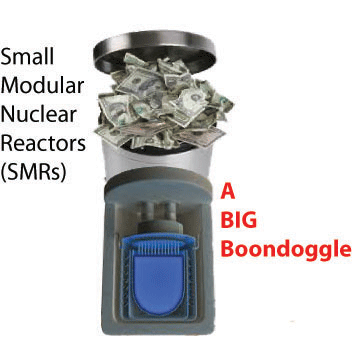 Taz 26th Oct 2020, The European pressurized water reactor Olkiluoto 3 has long since developed into a Finnish BER – at least twelve years too late, three times as expensive as planned. And it’s far from being online. The same goes for the
new Hanhikivi project: years behind before construction began .
But the Finnish nuclear lobby is already planning another nuclear energy adventure: the construction of so-called Small Modular Reactors (SMR). Paul Dorfman of the UK UCL Energy Institute and co-author of an SMR study by the Nuclear
Consulting Group estimates that small reactors would provide increasingly expensive energy due to the cost of materials and personnel : the massive investments that would be required to create a supply chain so that replacing the economies of scale of large reactors with the advantage of series production would make the investment risk for SMR even higher than for standard reactors.
Finland’s new nuclear reactor hit by valve leak
|
Finland’s new nuclear reactor hit by valve leak, SwissInfo Ch MAY 25, 2020 HELSINKI (Reuters) – Finland’s long-delayed Olkiluoto 3 (OL3) nuclear reactor was hit by another setback after the nation’s safety watchdog reported valve problems in a component involved in the cooling process.
The reactor in western Finland was built by a consortium of France’s Areva and Germany’s Siemens and had been due to start producing electricity in November this year. “A leak was observed in the mechanical control valve of one of the pressuriser safety valves,” nuclear watchdog STUK said in a statement on Monday, adding that a full investigation is required before it can issue a nuclear fuel loading permit. “This is very serious,” STUK’s head of inspection, Iiro Paajanen, told Reuters, adding that the leak was in part of the reactor’s primary circuit and involved in its cooling. However, Areva said the issue is unlikely to cause further delay for the reactor, which was originally due to be completed in 2009. ….. Although Finland’s government issued an operating permit for the 1.6 gigawatt reactor in March 2019, OL3 needs final approval from STUK to load fuel and start production. “At present, the plant unit still has several outstanding issues before a loading permit can be issued,” STUK wrote in its January-April safety report. Reporting by Anne Kauranen and Tarmo Virki; Editing by Alexander Smith and David Goodman) https://www.swissinfo.ch/eng/finland-s-new-nuclear-reactor-hit-by-valve-leak/45783642 |
|
Latest delay in Olkiluoto nuclear fuel loadings leads to Fitch revising outlook to negative
|
Fitch 20th April 2020, Fitch Ratings has revised Teollisuuden Voima Oyj’s (TVO) Outlook to
Negative from Stable and affirmed the Long-Term Issuer Default Rating (IDR) at ‘BBB-‘. The Negative Outlook reflects the latest announced delay of fuel
loading, a critical milestone, at the third 1,600 MW nuclear plant Olkiluoto 3 (OL3) project caused by overall slow progress of works as well as disruption due to the coronavirus outbreak. There is a risk that the settlement agreement signed with the supplier consortium (Areva NP, Areva GmbH, Siemens AG (A/Stable) and Areva Group’s parent Areva SA) in March
2018 would not protect TVO from financial impacts should the start of power production be delayed beyond June 2021, because the consortium has not yet assigned a new date for the fuel loading. After this date, TVO would not be entitled to penalty payments from the supplier consortium under the settlement agreement anymore. |
|
-
Archives
- February 2026 (199)
- January 2026 (308)
- December 2025 (358)
- November 2025 (359)
- October 2025 (376)
- September 2025 (258)
- August 2025 (319)
- July 2025 (230)
- June 2025 (348)
- May 2025 (261)
- April 2025 (305)
- March 2025 (319)
-
Categories
- 1
- 1 NUCLEAR ISSUES
- business and costs
- climate change
- culture and arts
- ENERGY
- environment
- health
- history
- indigenous issues
- Legal
- marketing of nuclear
- media
- opposition to nuclear
- PERSONAL STORIES
- politics
- politics international
- Religion and ethics
- safety
- secrets,lies and civil liberties
- spinbuster
- technology
- Uranium
- wastes
- weapons and war
- Women
- 2 WORLD
- ACTION
- AFRICA
- Atrocities
- AUSTRALIA
- Christina's notes
- Christina's themes
- culture and arts
- Events
- Fuk 2022
- Fuk 2023
- Fukushima 2017
- Fukushima 2018
- fukushima 2019
- Fukushima 2020
- Fukushima 2021
- general
- global warming
- Humour (God we need it)
- Nuclear
- RARE EARTHS
- Reference
- resources – print
- Resources -audiovicual
- Weekly Newsletter
- World
- World Nuclear
- YouTube
-
RSS
Entries RSS
Comments RSS
 nuclear-news