Anxiety over’Belarus nuclear reactor starting up: Lithuania buys iodine tablets
 Lithuania to purchase 4 mln iodine tablets to use in case of BelNPP accident, Belsat, 28 June 19 The Lithuanian Ministry of Health will spend about one million euros on 4 million iodine tablets to be used in case of an accident at the Belarusian NPP. This year they should be distributed to residents of the Belarusian-Lithuanian borderland and Vilnius, ru.delfi.lt reports.
Minister of Internal Affairs of Lithuania Eimutis Misiūnas assures that the state institutions are ready for a possible accident at the nuclear power plant in Astravets. But he is not hiding the fact that the agency lacks coordination….
According to him, in case of “the worst scenario”, when the wind blows from east to west, Lithuania will have to evacuate about 20 thousand people in the 30 km zone of the nuclear power plant. Misiūnas believes that this is unlikely, as such weather conditions happen on average 16 days per year.
The first power unit of BelNPP will start operating in autumn. https://belsat.eu/en/news/lithuania-to-purchase-4-mln-iodine-tablets-to-use-in-case-of-belnpp-accident/
Breathtaking series on Chernobyl nuclear catastrophe
(Foxtel Showcase 12 June 8.30 pm and 10.30 pm)
Chernobyl: horrifying, masterly television that sears on to your brain. This breathtaking series throws us right into the hellish chaos of the nuclear disaster – and its terrors are unflinching and unforgettable, Guardian, Rebecca Nicholson, 29 May 2019 After three of its five episodes aired, the miniseries Chernobyl found its way to the top of IMDB’s top 250 TV shows in history list. While the fan-voted chart might seem hyperbolic, given that the drama had only just crossed the halfway point, it is not undeserving of the honour. Chernobyl is masterful television, as stunning as it is gripping, and it is relentless in its awful tension, refusing to let go even for a second. That old ‘don’t spoil the ending’ joke about Titanic will inevitably be rebooted here, but it is confident enough to withstand any familiarity with the story.
Chernobyl’s “liquidators” suffered acute, and long-term health effects
|
How Did Radiation Affect the ‘Liquidators’ of the Chernobyl Nuclear Meltdown? https://www.livescience.com/65563-chernobyl-radiation-effects-body.html These liquidators, who worked between 1987 and 1990, were exposed to high levels of radiation, on average around 120 millisievert (mSv), according to the World Health Organization. That’s over a thousand times more powerful than a typical chest X-ray, which delivers 0.1 mSv of radiation. And some of the very first responders were exposed to levels astronomically higher than that. So, what happens to the human body when exposed to such high levels of radiation? [5 Weird Things You Didn’t Know About Chernobyl] It’s like walking into a giant, powerful X-ray machine shooting radiation everywhere, said Dr. Lewis Nelson, chairman of emergency medicine at Rutgers New Jersey Medical School. Except, in this case, most of the radiation consisted of an even more damaging type of radiation than X-rays, called gamma-rays. This radiation, as it passes through the body, is ionizing. This means that it removes electrons from atoms in the body’s molecules, breaking chemical bonds and damaging tissues. Very high levels of ionizing radiation cause “radiation sickness.” At Chernobyl, 134 liquidators quickly developed radiation sickness, and 28 of them died from it. These people were exposed to radiation levels as high as 8,000 to 16,000 mSv, or the equivalent of 80,000 to 160,000 chest X-rays, according to the World Health Organization. Radiation sickness mostly manifests in the gastrointestinal tract and the bone marrow, Nelson said. Those areas have rapidly dividing cells, which means that instead of being tightly coiled and a little more protected, the DNA is unraveled so that it can be copied. That makes it more susceptible to the radiation (this is also why radiation therapy works to target cancer cells, which also rapidly divide). Within a couple of hours of the exposure, people with radiation sickness develop symptoms such as diarrhea and vomiting, Nelson said. When cells cannot properly divide, the mucosa or tissue lining of the GI tract also break downs, releasing cells and the bacteria that live in the gut (including in the stool) into the bloodstream. This would make even a healthy person sick, Nelson said. But because the radiation is also stopping the bone marrow from producing infection-fighting white blood cells, the body can’t fight those infections. People who have radiation sickness therefore have a weakened immune systemand frequently die of blood poisoning, or sepsis, within a couple of days, he said. High levels of radiation can also cause burns and blisters on the skin, which show up minutes to a few hours after the exposure and look just like a sunburn, Nelson said. While the GI-tract symptoms and burns happen almost immediately to a couple of hours after exposure to the radiation, the bone marrow survives for a couple of days. This means there is a latency period, when the person might even seem to improve, before showing symptoms of sepsis. The people who survived radiation sickness from Chernobyl took years to recover, and many of them developed cataracts because the radiation damaged the eye lenses, according to the World Health Organization. Lower exposuresBut much of the health focus around Chernobyl survivors has focused on the long-term consequences of the radiation exposure in these areas. The main consequence, for them, is an elevated risk of cancer. “But remember, the cancer risk is something you see 10 years down the road, so you have to live for 10 more years in order to see [that],” Nelson said. So the cancer risk is generally more of a concern for those who survived Chernobyl but were exposed to lower levels of radiation. The data on this risk is murky, with very approximate numbers, but it is estimated that 270,000 people in the Ukraine, Russia and Belarus who wouldn’t have otherwise developed cancers did develop these illnesses. This mainly manifested as thyroid cancer, directly caused by radioactive particles of iodine-131 released by the explosion. The thyroid needs iodine in order to produce hormones that regulate our metabolism. But if it doesn’t have enough of the healthy, nonradioactive iodine found in many foods, it absorbs the radioactive iodine, and this can eventually lead to thyroid cancer. This is why in the HBO series “Chernobyl,” people take iodine pills; filling those stores of iodine in the thyroid prevents it from absorbing the radioactive iodine. These radioactive particles, which also include others such as cesium-137 enter the body through contact with the skin or through the mouth and nose. In Chernobyl, these particles were thrown into the air, carried by winds and later fell back down in surrounding areas, contaminated crops and water, and the people who ate them. |
|
Lithuania wants Belarus to convert its Russian-built nuclear power plant to gas
Lithuania to ask Belarus to switch nuclear plant to gas VILNIUS (Reuters) 6 Mar 19, – Lithuanian prime minister Saulius Skvernelis will ask Belarus to convert its Russian-built nuclear power plant to gas provided by Lithuania’s liquefied natural gas (LNG) terminal and a planned gas link between Lithuania and Poland.
The nearly-completed nuclear plant has long been viewed as a threat to its safety and national security by Lithuania, which says it is not built to the highest safety standards, an allegation which is denied by Belarus.
Astravets, which is near the border with Lithuania, is being built by Russia’s Atomstroyexport and financed with a $10 billion loan from by Moscow. It expects to have the first of its two 1.2 gigawatt VVER 1200 reactors online this year and the next one in 2020.
“It’s up to Belarus to make a choice: to keep on having an energy sector which depends on the policies of a single country, or to make a strategic change,” Skvernelis said on Monday, without naming Russia, the dominant supplier of energy to Belarus.
“Lithuania could be a good example and a useful partner for Belarus,” he added.,………
Reporting by Andrius Sytas; Editing by Alexander Smith https://www.reuters.com/article/us-baltics-energy/lithuania-to-ask-belarus-to-switch-nuclear-plant-to-gas-idUSKCN1QL163
If USA US deploys nuclear weapons in Europe RUSSIA and Belarus will consider a joint military response
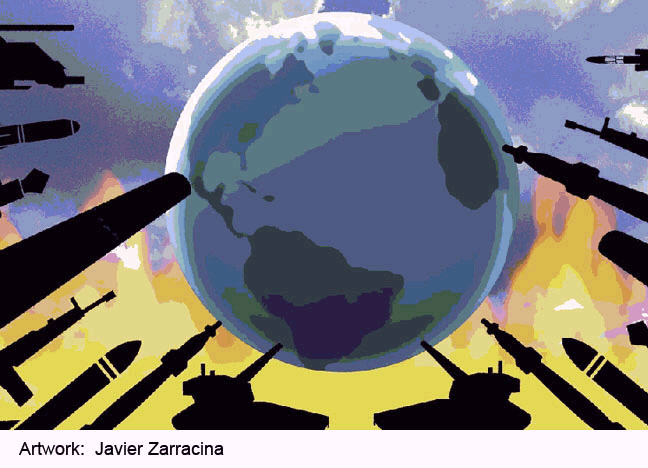 ‘Things will turn NASTY’ Belarus leader issues warning after collapse of nuclear treaty https://www.express.co.uk/news/world/1090969/belarus-news-inf-treaty-world-war-3-russia-v-usa-nato
RUSSIA and Belarus will consider a joint military response if the US deploys weapons in Europe after pulling out of the Intermediate-range Nuclear Forces (INF) Treaty.
But Donald Trump has pulled the US out of the accord after accusing Russia of committing repeated violations and Mr Lukashenko fears the security of Belarus could be compromised as a result.
He said: “It is a catastrophe, particularly for us.
“I am afraid the Americans will grab the fleeting opportunity and deploy the missiles in Europe after breaking the treaty. “If they do, things will turn nasty for us, too. Because together with Russia, we will have to think of reciprocal measures.”
He continued: “It would be unavoidable if this happened. It would be even worse if, God forbid, missiles were deployed in Ukraine.
“This is why I am wholeheartedly against dissolving the Intermediate-Range Nuclear Forces Treaty.
“We pursue a peace-loving policy. We don’t need scuffles between major powers, from which, judging from history, we’ve always suffered.
“This is why we don’t need this slaughter, this fight, particularly now around the Intermediate-Range Nuclear Forces Treaty.”
Mr Lukashenko said he believes NATO is keen to deploy missiles in Europe.
He said: “It seems to me that although NATO claims they are not going to deploy these missiles in Europe, they are running a bluff.
“Otherwise, why would they withdraw? Why did they have to destroy this treaty?
“They should have come to terms with China and make it part of the treaty if China was the focus of it.”
TOR-M2 air defense missile systems to protect Belarus nuclear power plant
December 2018 Global Defense Security army news industryPOSTED, 08 DECEMBER 2018 A battery of Tor-M2 SAM (Surface-To-Air defense missile system) produced by Concern Almaz-Antey will enter in service with the 1146th Guards surface-to-air missile regiment deployed near a Belarusian nuclear power plant, which is under construction, Major General Igor Golub, the commander of the Air and Air Defense Forces of the Belarusian Armed Forces, said.
“Russia will supply another battery of Tor-M2 surface-to-air missile systems soon. They will come in service with the 1146th Guards surface-to-air missile regiment,” the commander quoted by the Belorusskaya Voennaya Gazeta military newspaper said.
Previous reports said that Concern Almaz-Antey had handed over a shipment of Tor-M2 surface-to-air missiles to the Belarusian Defense Ministry ahead of time. They had been assembled a month ahead of schedule. Belarus has received the fifth SAM shipment.
The 1146th surface-to-air regiment was revived in Belarus in 2017. The four-battery regiment is armed with Tor-M2 surface-to-air missiles. It protects the Belarusian airspace in the northwest covering the Belarusian nuclear power station.
The Tor-M2 is an upgraded version of the Tor-M1 short-range air defense missile system. The TOR-M2/M2E is designed by the Russian Defense Company Almaz-Antey. The TOR-M2 / M2E is designed to destroy aircraft, helicopters, aerodynamic UAVs, guided missiles and other components of high precision weapons flying at medium, low and extremely low altitudes in adverse air and jamming environment. The Tor-M2 missile system can be mounted on wheeled or tracked chassis.
The Tor-M2 can simultaneously engage up to 48 processed targets and ten tracked targets.The TOR-M2 can engage a target at the range from 1,000 to 12,000 m and to an altitude from 10 to 10,000 m.
Mushrooms contaminated with radioactive cesium 137 stopped by France, – shipment from Belarus
 France stops large shipment of radioactive Belarus mushrooms, Geert De Clercq, PARIS (Reuters), 30 Nov 17 – France has stopped a large shipment of Belarus mushrooms contaminated with low-level radioactivity probably from Chernobyl and not linked to a radioactive cloud that appeared in southern Russia last month, officials said on Thursday.
Earlier, the head of French nuclear regulator ASN Pierre-Franck Chevet told the French senate that traces of cesium had been found on imported mushrooms from Russia and did not mention Belarus.
A spokesman for French nuclear safety institute IRSN said that a few days ago customs officials found that a 3.5 tonne shipment of Belarus mushrooms coming through Frankfurt, Germany was contaminated with cesium 137, a radioactive nuclide that is a waste product of nuclear reactors…….https://www.reuters.com/article/us-russia-nuclearpower-accidentedf/france-stops-large-shipment-of-radioactive-belarus-mushrooms-idUSKBN1DU1CW
Spectre of Chernobyl nuclear disaster rises again, regarding new nuclear power station in Belarus
Russian-built nuclear plant revives Chernobyl fears, Power station taking shape on Belarus border feeds anxiety in Lithuania and beyond, Ft.com by Richard Milne in Buivydziai and Vilnius and Henry Foy in Ostrovets, 20 Sept 17 Buivydziai is a typical Lithuanian village. A sleepy place with fewer than 300 inhabitants, it has a church, a couple of shops and a school that takes in children from the surrounding countryside. But three years ago, a new neighbour began to take shape. Looming on the horizon just 20km away are the massive cooling towers of a nuclear power station being built near the small Belarusian town of Ostrovets. In a region still scarred by the complex legacy of the Soviet Union and the devastating human consequences of the Chernobyl disaster three decades ago, Belarus’ decision to build a Russian-financed power station on its border with the EU has become a source of deep anxiety. In Buivydziai, Zenobija Mikelevic, the school’s deputy head, says unease about the power plant and changing demographics have already taken their toll, with some families packing up and leaving. “Every year, our school gets fewer and fewer children. I’m a mother of three and my children don’t want to live here,” she says.
Poland joins Lithuania in criticism of Belarusian nuclear plant
Poland speaks out harshly against Belarusian nuclear plant, Poland has lent its voice to a growing chorus of countries that won’t buy power from the Belarusian Nuclear Power Plant that Moscow is building in Ostrovets because it considers the project to be unsafe, RIA Novosti reported, Bellona, August 9, 2017 by Charles Digges, Poland has lent its voice to a growing chorus of countries that won’t buy power from the Belarusian Nuclear Power Plant that Moscow is building in Ostrovets because it considers the project to be unsafe, RIA Novosti reported.
Warsaw joins Lithuania in its dour appraisal of the project despite recent assurances from the International Atomic Energy Agency that the plant meets safety norms.
Saying Warsaw “has a different opinion” than the IAEA, Polish Foreign Minister Witold Waszczykowski told reporters “We won’t change our position on buying energy from this atomic station.”
“I think that at its foundation lies unsafe technology, and a lack of safety led to Chernobyl,” he said, adding “We are against this nuclear station and don’t plan to cooperate and buy its energy.”
Waszczykowski’s remarks Tuesday were the latest of the stinging rebukes from Eastern Bloc nations against the Belarusian nuclear plant, which have been running on high volume in recent months.
The VVER-1200 nuclear plant, built on a whopping export credit from Russian state nuclear corporation Rosatom, is expected to come online in 2020.
In April, Vilnius passed a law against buying energy from what its parliament termed “unsafe nuclear power plants in third countries,” and forbidding utilities from transferring energy from such plants through the country’s territory.
The legislation’s clear target, however, is the Belarusian plant, which is going up a mere 40 kilometers from the Lithuanian capital, from which its rising cooling towers are visible on a clear day.
Since May, Lithuania has mounted a campaign among its diplomats throughout Europe to heap criticism on the plant to anyone willing to listen.
Tomas Tomilinas, a Lithuanian parliamentarian recently told Bellona that his country’s opposition to the plant was nothing less than a question of national security.
“Here there cannot be any compromises in questions of guaranteeing the safety of our country and its capital Vilnius,” Tomilinas told Bellona. “We absolutely disagree with the choice of site for the plant and are unsatisfied with answers from the Belarusian side on a whole host of safety issues and incidents that have already occurred during construction.”
Anxieties about the plant have simmered among Belarus’s neighbors since 2010, but redoubled since the plant’s construction site saw a series of clumsy mishaps……..http://bellona.org/news/nuclear-issues/2017-08-poland-speaks-out-harshly-against-belarusian-nuclear-plant
Belarus’ nuclear station – a Faustian bargain with Russia
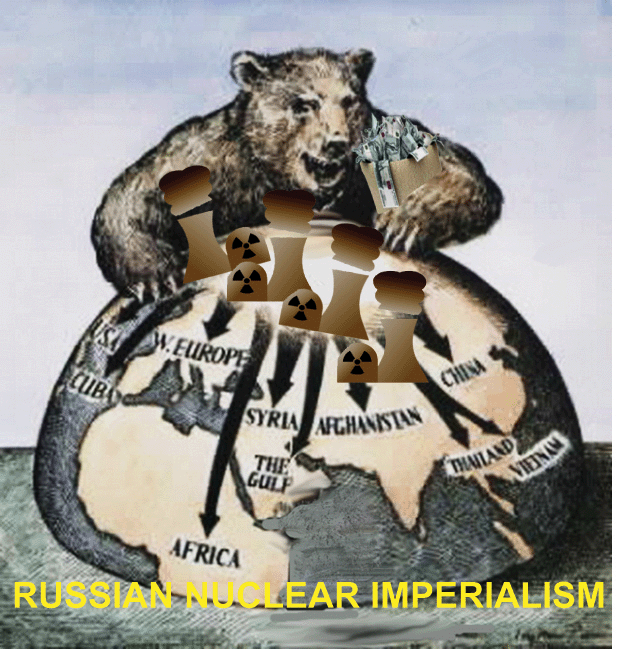 Poland speaks out harshly against Belarusian nuclear plant Poland has lent its voice to a growing chorus of countries that won’t buy power from the Belarusian Nuclear Power Plant that Moscow is building in Ostrovets because it considers the project to be unsafe, RIA Novosti reported, Bellona, August 9, 2017 by Charles Digges, “………Since the early 2000s, many in the West see Russia’s ambitions to built nuclear plants abroad as attempt to cast Moscow’s apron strings into the European Union.
By fully financing reactor builds, they say, the Kremlin is offering a Faustian bargain: energy independence in exchange for long-term debt and Moscow friendly politics.
The Moscow-leaning government of Viktor Orban in Hungary is a good example. Budapest relies on a Soviet-built nuclear power plant for 50 percent of its electricity, and recently signed a €12 billion deal for a second Russia-built plant. Budapest is now also less likely to pester Moscow over sensitive issues like Russia’s covert war in Ukraine.
That’s because Moscow has a habit of settling political disputes by shutting off the power and heat in places where it has built infrastructure. Disputes between Russia and Ukraine, which remain bitter, led to cuts in Europe’s gas supply from Russia during the winter in 2006 and 2009.
Lithuania’s law against the Ostrovet’s plant is Vilnius’s attempt to opt out of being a hostage to Moscow’s new zero-sum nuclear energy policy, and Poland seems to agree.
These boycotts against buying nuclear power have been enormously effective in shutting down other unpopular nuclear builds in the region.
A Russian nuclear plant in the Kaliningrad enclave was quietly shelved in 2011 when Poland declared it wouldn’t help out with financing.
Lithuania’s own plans for a nuclear power plant took a more tortured route. Since 2009, the country has been trying, unsuccessfully, to kindle investment interest in its own Visaginas nuclear power plant to replace the Soviet-built Ignalina station.
A decisive blow against that project came, however, when Poland, as it had done in Kaliningrad retracted financing offers. http://bellona.org/news/nuclear-issues/2017-08-poland-speaks-out-harshly-against-belarusian-nuclear-plant
Lithuanians alarmed over Belarus’s construction of its first nuclear power plant – a disaster in waiting
Open Democracy 10th Aug 2017, Three decades after the Chernobyl nuclear accident in Ukraine, Belarus is
building its first nuclear power station. Concerns about the project’s
safety aren’t deterring the authorities. Speaking near the site of the
Chernobyl nuclear disaster on the 31st anniversary of the accident this
April, Belarusian president Alexander Lukashenka remarked that “both
Belarusians and Ukrainians know that the Chernobyl catastrophe knows no
borders”, in reference to the fact that 70% of the radioactive dust
created in the 1986 chemical explosion descended on Belarus.
Following the same logic, the authorities of neighbouring Lithuania are trying to raise
the alarm about Belarus’s construction of its first nuclear power plant,
which they believe to be the next nuclear disaster in waiting.
One of the major complaints concerns the choice of location. Set near the small town
of Astravets, less than 50km from Vilnius, the site also falls within an
earthquake-prone area.
Lithuanian authorities allege that Belarus did not
conduct a cross-border environmental impact assessment, in breach of the
Espoo Convention, and that in an event of a large-scale accident at the
nuclear plant, the Lithuanian capital, as well as a third of the
country’s population, could face catastrophic consequences.
https://www.opendemocracy.net/od-russia/lidia-kurasinska/new-chernobyl-at-your-doorstep
Europe should not turn a blind eye to the developing nuclear threat in Belarus
Belarus nuclear plant: A disaster waiting to happen https://euobserver.com/opinion/138079 By SIJBREN DE JONG, THE HAGUE, 31. MAY, Just over 30 years after the Chernobyl nuclear disaster, which saw Belarus lose a quarter of its territory due to nuclear contamination, the former Soviet republic is set to see its first nuclear power station enter operation in one and a half year’s time from now.
The location in the Belarusian town of Astravets – a mere 50 kilometres from Lithuania’s capital Vilnius – is understandably giving its neighbour the jitters. To make matters worse, the construction of the plant has been mired by a series of mishaps and incidents, sparking major concerns over the safety of the installation.
With Belarusian authorities not budging and full inspections remaining elusive, the Lithuanian government has resorted to taking active steps to protect the country against the plant.
Playing the silent game In August last year, news emerged that a crane had dropped the 330 tonne heavy reactor from a height of 4 metres during a test lift. If dropping a nuclear reactor was not bad enough in itself, the Belarusian authorities’ attempts to deny or otherwise keep silent on the matter for weeks on end sparked eerie memories of how the Soviets handled the Chernobyl disaster of 1986.
“We never get any information, or we hear something only a month after it happened”, says Darius Degutis, Lithuania’s ambassador at large for the issues related to the Astravets Nuclear Power Plant.
Russian state-owned company Rosatom, the nuclear plant’s main contractor, is complicit in playing the “silent game” by first denying that the accident caused any damage to the reactor shell, only to change its story afterwards by offering to replace the shell. Adding to the concerns was another incident in February 2017, whereby the second reactor hit a power pillar during transport.
The incident could have caused significant tension and deformation, thus impacting on the safety of the reactor vessel. However, rather than properly investigating the impact, the vessel was hoisted into position on 1 April of this year.
Move along, nothing to see here In order for the international community to be fully informed about the safety standards employed in the plant’s construction, the Lithuanian government has pressed for the International Atomic Energy Agency’s (IAEA) Site and External Events Design (SEED) mission to be invited for a full-scope review.
A full-scope review consists of a six-step assessment, involving reviews and inspections on site selection, environmental impact, design safety and numerous other aspects. A major problem thus far is that the Belarusian authorities limited the scope of the IAEA’s mission only to an assessment of the plant design’s safety.
This means that major verification steps pertaining to the choice of location, local geology and the plant’s environmental impact were skipped.
According to Degutis, the location at Astravets is “known to have been seismically active in the past and no proper international assessment of the site’s location was ever carried out”.
Other failures relate to the measuring of the population density around the site. In doing so, Belarusian officials only assessed population density on the Belarusian side of the border, thus not taking into account that this density on the Lithuanian side is far higher and a third of the country’s population would be at risk in case of a meltdown.
By limiting the scope of the IAEA’s mission, the nuclear watchdog cannot comment on these kinds of issues. To make matters worse, the Belarusian government declared that it would itself perform the plant’s risk and safety assessment.
Given how the numerous incidents at the plant have been handled so far, it is questionable as to whether the Belarusian authorities can be trusted with performing these stress tests in full accordance with European specifications.
Acquiescence is not an option After having attempted for several years to get the IAEA’s SEED mission full access to the site, the Lithuanian authorities have started to resort to different measures to guard themselves against the plant.
In April of this year, the Lithuanian parliament adopted a law that forbids the purchase of electricity generated from a third country power plant that is constructed or operates in violation of international environmental and nuclear safety requirements.
Earlier this month, Lithuania, Estonia and Latvia also agreed to link their power systems to other EU members and, in that way, disconnect from the Soviet-era electricity network.
Given that Belarus repeatedly signalled its intention to sell part of the electricity produced at Astravets in other European countries, the Baltic States have effectively deprived the plant from access to European electricity markets.
Although such actions qualify as last-resort measures, both decisions are entirely defensible when viewed in light of the continuous mishaps witnessed at Astravets. With the memories of Chernobyl still looming large, Europe should not turn a blind eye to this developing nuclear threat and firmly support Lithuania in its quest for full access to the site.
The Crude World monthly column on Eurasian (energy) security and power politics in Europe’s eastern neighbourhood is written by Sijbren de Jong, a strategic analyst with The Hague Centre for Strategic Studies (HCSS), specialised in Eurasian (energy) security and the EU’s relations with Russia and the former Soviet Union
Consequences of Chernobyl
 Hidden Radiation Secrets of the World Health Organization, CounterPunch MAY 2, 2017
“………..WHO held a Chernobyl Forum in 2004 designed to “end the debate about the impact of Chernobyl radiation” whilst WHO maintains that 50 people died.
Here’s the final conclusion of that Chernobyl Forum ‘04: The mental health of those who live in the area is the most serious aftereffect, leading to strong negative attitudes and exaggerated sense of dangers to health and of exposure to radiation. Mental health was thus identified as the biggest negative aftereffect.
Because that conclusion is so brazenly bizarre, the Chernobyl Forum ‘04 must’ve been part of an alternative universe, way out there beyond the wild blue yonder, maybe the Twilight Zone or maybe like entering a scene in Jan Švankmajer’s Alice, a dark fantasy film loose adaptation of Lewis Carroll’s Alice in Wonderland.
Here’s reality: Chernobyl Liquidators fought the Chernobyl disaster. Eight hundred thousand (800,000) Liquidators from the former USSR, largely recruits from the army, with average age of 33, fought the Chernobyl disaster.
According to an interview (2016) with a Liquidator, “We were tasked with the deactivation of the third and fourth reactors, but we also helped build the containment sarcophagus. We worked in three shifts, but only for five to seven minutes at a time because of the danger. After finishing, we’d throw our clothes in the garbage” (Source: Return to Chernobyl With Ukraine’s Liquidators, Aljazeera, April 25, 2016).
“Estimates of the number of liquidators who died or became ill as a result of their work vary substantially, but the men of the 633rd say that out of the 259 from their group, 71 have died. Melnik says that 68 have been designated as invalids by a state committee, which investigates their health and determines whether or not their diseases are attributable to Chernobyl… Dr Dimitry Bazyka, the current director-general of the National Research Centre for Radiation Medicine in Kiev, says that approximately 20,000 liquidators die each year,” Ibid.
As for total deaths, the Chief Medical Officer of the Russian Federation reported that 10% of its Chernobyl Liquidators were dead by 2001. The disaster occurred in 1986 with 80,000 dead within 16 years. Authorities out of Ukraine and Belarus confirmed Russian death numbers. Yet, WHO claims 50 died.
Eighty-thousand (80,000) Liquidators, as of 16 years ago, dead from Chernobyl, and that body count, according to Ms Katz, leaves out the people most contaminated by Chernobyl, meaning evacuees and also 57% of the fallout for Chernobyl came down outside of the USSR, Belarus, and Ukraine, and in 13 European countries 50% of the countryside was dangerously contaminated.
As for studies of the radiation impact of Chernobyl: “Thousands of independent studies in Ukraine, Belarus, and the Russian Federation and in many other countries, that were contaminated to varying degrees by radionuclides, have established that there has been significant increase in all types of cancer, in diseases of the respiratory, gastrointestinal, urogenital, endocrine immune, lymph node nervous systems, prenatal, perinatal, infant child mortality, spontaneous abortions, deformities and genetic anomalies….” (Katz)
Hence, WHO’s handling and analysis and work on Chernobyl leaves the curious-minded speechless, open-mouthed, agape, and confounded……..http://www.counterpunch.org/2017/05/02/hidden-radiation-secrets-of-the-world-health-organization/
Solar farm planned for Chernobyl nuclear site
Solar Plant to Launch at Chernobyl Nuclear Site VOA, https://learningenglish.voanews.com/a/solar-plant-chernobyl-nuclear-site/3828303.html Oksana Ligostova and Ruslan Deynychencko reported this story for VOA. Jonathan Evans adapted the report for Learning English. 27 Apr 17 Hai Do was the editor.Thirty years after the world’s worst nuclear disaster, Chernobyl is about to become a solar farm.
Officials in Ukraine plan to build a solar energy plant at the Chernobyl nuclear site. The announcement comes during the week of the 31st anniversary of the Chernobyl nuclear accident.
The Chernobyl accident occurred on April 26, 1986. The incident would become the world’s worst nuclear accident. 32 people died and dozens of others suffered painful radiation burns.
Until recently, the government of Ukraine has largely ignored the area.
Ostap Semerak is Ukraine’s minister of ecology. He spoke with VOA about the planned solar project.
“Today, almost a year after we have started the work, I can announce the first private investment project working in the Chernobyl zone to build a small solar energy plant.”
Semerak says more than 50 national and international companies have expressed interest in building the solar plant. He adds that when completed, the project will produce about half the power produced by the Chernobyl nuclear plant.
Belarus march against nuclear power on Chernobyl anniversary
 http://
 normangeestar.net/2017/04/29/belarus-march-against-nuclear-power-on-chernobyl-anniversary/ ClickLancashire Young Ukrainians hold candles during a ceremony near the memorial for “liquidators” who died during cleaning-up works after the Chernobyl nuclear power plant disaster.
“Today, nearly a year after we have started the work, I can announce the first private investment project working in the Chernobyl zone to build a small solar energy plant”, Ostap Semerak, Ukraine’s minister of ecology, said in an exclusive interview with VOA.
It’s projected to be completed in May. In 1986, more than 120,000 people were evacuated after an explosion at the plant.
In the years since the disaster, the radiation levels in the area near the plant have decreased enough where people can visit the area. The government recently lowered the cost of rent and streamlined renting procedures.
In 1990, Soviet Government acknowledged the need for global assistance against the explosion at Chernobyl Nuclear Power Plant following which the United Nations General Assembly (UNGA) adopted resolution for worldwide cooperation to address and mitigate the consequences at the Chernobyl nuclear power plant. A 30km exclusion zone remains in place.
1 This Month

of the week – Shut Down Drone Warfare!


Tell the Ukrainian Government to Drop Prosecution of Peace Activist Yurii Sheliazhenko

Petition to revoke the licensing of the Near Surface Nuclear Disposal Facility (NSDF) at Chalk River. https://www.ourcommons.ca/petitions/en/Petition/Details?Petition=e-7247
To see nuclear-related stories in greater depth and intensity – go to https://nuclearinformation.wordpress.com
-
Archives
- April 2026 (44)
- March 2026 (251)
- February 2026 (268)
- January 2026 (308)
- December 2025 (358)
- November 2025 (359)
- October 2025 (376)
- September 2025 (257)
- August 2025 (319)
- July 2025 (230)
- June 2025 (348)
- May 2025 (261)
-
Categories
- 1
- 1 NUCLEAR ISSUES
- business and costs
- climate change
- culture and arts
- ENERGY
- environment
- health
- history
- indigenous issues
- Legal
- marketing of nuclear
- media
- opposition to nuclear
- PERSONAL STORIES
- politics
- politics international
- Religion and ethics
- safety
- secrets,lies and civil liberties
- spinbuster
- technology
- Uranium
- wastes
- weapons and war
- Women
- 2 WORLD
- ACTION
- AFRICA
- Atrocities
- AUSTRALIA
- Christina's notes
- Christina's themes
- culture and arts
- Events
- Fuk 2022
- Fuk 2023
- Fukushima 2017
- Fukushima 2018
- fukushima 2019
- Fukushima 2020
- Fukushima 2021
- general
- global warming
- Humour (God we need it)
- Nuclear
- RARE EARTHS
- Reference
- resources – print
- Resources -audiovicual
- Weekly Newsletter
- World
- World Nuclear
- YouTube
-
RSS
Entries RSS
Comments RSS
 nuclear-news