Julian Assange’s father calls on Australia’s Prime Minister Scott Morrison to help this Australian citizen
 Assange’s father calls extradition process ‘disgrace’ https://telanganatoday.com/assanges-father-calls-extradition-process-disgrace?fbclid=IwAR1a7bQ0W_Xcgc9EIeGaAHVP7Zmm2cM6nNV65ZXtkhCwNUlarqIYTJVw6xo1 July 20, The 80-year-old is organizing public events in Australia despite the ongoing coronavirus pandemic and hopes to travel to London in August to support Assange during his extradition trial.
Sydney: WikiLeaks founder Julian Assange’s father, John Shipton, is fighting tirelessly for the release and return of his son, who is facing an extradition trial in London for publishing classified information, a process he described as abuse.
“We maintain that the extradition request is a fraud in the English court… It’s a fraud in the English legal system, it’s a case of abuse of process, it is a disgrace,” Shipton, who travelled from Melbourne to Sydney to campaign for his son’s release, told Efe news in an interview.
The 80-year-old is organizing public events in Australia despite the ongoing coronavirus pandemic and hopes to travel to London in August to support Assange during his extradition trial which, he says, is being carried out under “dire” circumstances.
In May 2019, the UN Special Rapporteur on Torture, Nils Melzer, said, after visiting Assange in the Belmarsh prison along with two medical experts, that he showed “all symptoms typical for prolonged exposure to psychological torture, including extreme stress, chronic anxiety and intense psychological trauma”.
Assange has spent almost a decade in confinement, first under house arrest in a British town and then at the Ecuadorian embassy in London between 2012 until 2019, when Ecuador withdrew his political asylum status.
Shipton has urged the Australian government to mediate with the UK administration for the release of his son, who is wanted in the US on 18 charges of espionage and computer intrusion, for which he could be sentenced to prison for up to 175 years.
“I believe the government can, if it wishes to, assist us in bringing Julian home. I believe that (it) is very simple for the Prime Minister (Scott Morrison) to pick up the phone and ring (his UK counterpart) Boris Johnson and say Julian Assange is an Australian citizen in dire circumstances.
“This will resolve this immediately and that’s easily possible,” he told Efe news during the interview.
Misinformation about Energy Economics, from nuclear companies and their propagandists
 It is generally accepted in the energy industry that the cost of new nuclear is several times that of wind and solar, even when the latter are backed up by storage.
The nuclear lobby, however, has been insisting to the parliamentary inquiry that wind and solar are four to seven times the cost of nuclear, and to try and prove the point the lobby has been making such extraordinary and outrageous claims that it makes you wonder if anything else they say about nuclear – its costs and safety – can be taken seriously.
Supplementary Submission to the Victorian Parliament’s Standing Committee on Environment and Planning
Inquiry into Nuclear Prohibition Friends of the Earth Australia www.nuclear.foe.org.au
June 2020 – Extract
“……..MISINFORMATION REGARDING ENERGY ECONOMICS BY NUCLEAR COMPANIES AND ENTHUSIASTS
Highly questionable economic claims made by nuclear companies and enthusiasts are addressed in:
- submission #40 by Friends of the Earth Australia to the NSW nuclear inquiry[1]
- submission #64 to the NSW nuclear inquiry (see esp. sections 3.5 and 3.6)[2]
An important article by Giles Parkinson ‒ an energy expert and former business and deputy editor of the Australian Financial Review ‒ is particularly helpful in this regard. An excerpt is reproduced below but we encourage members of the Committee to read the full, referenced article. The article is focused on submissions to the federal nuclear inquiry[3] but many of the same claims have been presented to the NSW and Victorian inquiries.
Why the nuclear lobby makes stuff up about the cost of wind and solar
[1] https://www.parliament.nsw.gov.au/lcdocs/submissions/66217/0040%20Friends%20of%20the%20Earth.pdf
[3] https://www.aph.gov.au/Parliamentary_Business/Committees/House/Environment_and_Energy/Nuclearenergy
Giles Parkinson, 23 Oct 2019, ‘Why the nuclear lobby makes stuff up about the cost of wind and solar’, https://reneweconomy.com.au/why-the-nuclear-lobby-makes-stuff-up-about-cost-of-wind-and-solar-46538/
It is generally accepted in the energy industry that the cost of new nuclear is several times that of wind and solar, even when the latter are backed up by storage. The GenCost 2018 report from the CSIRO and the Australian Energy Market Operator (AEMO) puts the cost of nuclear at two to three times the cost of “firmed renewables”.
The nuclear lobby, however, has been insisting to the parliamentary inquiry that wind and solar are four to seven times the cost of nuclear, and to try and prove the point the lobby has been making such extraordinary and outrageous claims that it makes you wonder if anything else they say about nuclear – its costs and safety – can be taken seriously.
RenewEconomy has been going through the 290-something submissions and reading the public hearing transcripts, and has been struck by one consistent theme from the pro-nuclear organisations and ginger groups: When it comes to wind, solar and batteries, they just make stuff up.
A typical example is the company SMR Nuclear Technology – backed by the coal baron Trevor St Baker – which borrows some highly questionable analysis to justify its claim that going 100 per cent renewables would cost “four times” that of replacing coal with nuclear.
It bases this on modelling by a consultancy called EPC, based on the south coast of NSW, apparently a husband and wife team, Robert and Linda Barr, who are also co-authors of “The essential veterinarian’s phone book”, a guide to vets on how to set up telephone systems. of wind at A$157/MWh (before transmission costs), which is about three times the current cost in Australia, and A$117/MWh for solar, which is more than double.
The costs of wind and solar are not hard to verify. They are included in the GenCost report, in numerous pieces of analysis, and even in public announcements from companies involved, both buyers and sellers. St Baker could have helped out, as his company has signed two big solar contracts (for the Darlington and Vales Point solar farms) and we can bet he won’t be paying A$117/MWh.
Apart from costs, the EPC scenarios for 100 per cent renewables are also, at best, imaginative. For some reason they think there will only be 10GW of solar in a 100% renewables grid and just 100MW of battery storage. Big hint: There is already 12GW of solar in the system and about 300MW of battery storage. But we discovered that assuming wind and solar do not or won’t exist, and completely ignoring distributed energy, are common themes of the nuclear playbook.
The delivered cost of energy from wind and solar in the EPC modelling of a 100 per cent renewables grid? A hilariously outrageous sum of A$477/MWh (US$330/MWh).
Contrast this with SMR Nuclear Technology’s claims about the cost of a modern small modular reactor – US$65/MWh – even though it admits the technology “has not been constructed”, and which leading nuclear expert Ziggy Switkowski points out won’t likely be seen for at least another decade. …
Moltex, which says it is “developing” some sort of fission technology (it says it has a design but hasn’t actually built anything) uses the same trick as EPC to paint a daunting picture of renewable and storage costs, in this case by multiplying the cost of batteries by the total amount of electricity consumed in a single day. “Australia consumes 627 Gigawatt hours of electricity per day, and so the battery storage required to cover just one 24 hour period would cost A$138 billion,” it proclaims. It is such an incredibly stupid and misleading claim that it simply takes the breath away. …
But that’s what the nuclear industry feels it needs to do to make its yet-to-be invented technology sound feasible and competitive.
Let’s go to StarCore, a Canadian company that says it, too, wants to manufacture small modular reactors, and claims renewables are “seven times” the cost of nuclear, and which also has a fascination with the Nyngan solar farm. It uses the cost of Nyngan to make the bizarre claim that to build 405 of them would cost A$68 billion, and then compares this to what it claimed to be the “zero upfront capital costs” of one of StarCore’s plants.
Say what? Does the nuclear plant appear just like that? Solar and wind farms also usually have long-term power purchase agreements, but they still have to be built and someone has to provide the capital to do so. Nuclear with a zero capital cost? Really, you couldn’t make this stuff up.
Down Under Nuclear Energy, headed by a former oil and gas guy and a former professor at the University of Western Australia who specialises in mathematical social science and economics, also bases its solar costs on the Nyngan solar farm and makes this bizarre claim about battery storage: “The precipitous decline in solar technology is highly unlikely to be replicated in batteries, a technology already approaching 150 yrs of maturity,” it says.
Hey, here’s some breaking news. Costs of battery storage have already mirrored solar’s fall, down 80 per cent in last decade and utilities like Transgrid predict another 60 per cent fall over next 10-15 years.
And most large-scale storage batteries use lithium, an abundant resource, and this is battery technology that was actually invented just over 40 years ago by the winners of this year’s Nobel Prize for Chemistry. As the Nobel citation says: “(Co-winner Stanley) Wittingham developed the first fully functional lithium battery in the 1970s.” Not 1870.
Women in Nuclear and the Australian Workers Union both quote the Industry Super report on nuclear, which we debunked a while back, which puts the cost estimates of wind and solar plants at 10 times their actual cost.
The “capital cost” of the Dundonnel wind farm in Victoria, for instance, is put at A$4.2 billion (try A$400 million) according to their bizarre calculations, while the Darlington solar farm is put at $5.8 billion (try A$350 million). It’s pure garbage and the fact that it is being quoted really does beggar belief. …
But all the nuclear submissions have one common trait. They assume that the deployment of renewables is stopped in its tracks, either now or sometime soon. It’s more wish than analysis, but in that they will have found a willing fellow traveller in federal energy minister, Angus Taylor “there is already too much wind and solar on the grid” Taylor, who thought it a good idea to have the inquiry.
But the reality is that the rest of the energy industry wants to move on. They know that the grid can be largely decarbonised within the next two decades from a combination of renewables and storage. That’s a simple truth that the nuclear lobby cannot accept, and they’ve passed up the opportunity to have an open and honest debate by promoting utter garbage about renewables, to the point where it would be difficult to believe much of anything else they say.
Australia’s uranium and the Fukushima nuclear catastrophe
Follow the Yellowcake Road, https://wordpress.com/read/feeds/72759838/posts/2780892164, A journey from Tokyo to Mirrar country, By Alexander Brown 28 June 20,
On 19 July 2019 I boarded a plane in Tokyo and headed to Cairns for two weeks of fieldwork connected with my research on transnational activism in the Asia-Pacific. My purpose was to learn about the pathways via which uranium travels from Australia to Japan and the resistance movements and grassroots connections which have formed along the way.
Prior to the Fukushima disaster, Australia supplied approximately one third of Japan’s uranium needs, something I first became aware of when anti-nuclear activists from Australia came to Japan in 2012 for the Global Conference for a Nuclear Power Free World.
Since that time I have pondered the nature of the nuclear relationship between my birthplace and my second home in Japan. After delving into the history of this relationship from my dusty office in Tokyo, it was time to make the physical journey along the yellowcake road and see where it might take me.
In Cairns I met with local Japanese-Australian people who organise Smile with Kids, a registered charity which brings junior high school students from Fukushima prefecture, whose lives have been disrupted in multiple ways by the March 2011 earthquake, tsunami and nuclear disaster, for a ten-day visit to Cairns.
The children’s visit happened to coincide with a visit to the city by Peace Boat, a cruise ship with a difference which holds peace and sustainable development education activities onboard during its global and regional voyages.
The ship is part of an NGO which campaigns around these issues and has played a significant role in fighting nuclear power in post-Fukushima Japan. Local activists took advantage of this fortuitous timing to organise a welcome event for Peace Boat passengers and staff at which the Fukushima children spoke about their experiences growing up in the wake of the nuclear disaster.
In Cairns the children stay with local homestay families and take part in an extensive educational programme. One day I accompanied them on a visit to the Cairns cenotaph, where a Cairns-based Japanese man gave a short talk on Australian’s war history and its conflict with Japan in the Second World War.
The following day they went to Spring Dew Farm, an organic farm located in the Atherton Tablelands which practices natural farming methods. The farmer is a Japanese-Australian man who took part in an eight-month walk across Australia and Japan in 2003 and 2004 visiting uranium mines and nuclear installations in protest at the devastation wrought by the nuclear industry and in an effort to connect movements and memories in the two countries. After the children had prepared a meal using vegetables they had freshly-harvested from the farm, he spoke to them about the walk.
In Canberra I dove into the archives to unearth the history of anti-nuclear resistance in Australia and the ways it has been entwined with Japan’s nuclear energy needs and with anti-nuclear social movements. I wanted to see how witnesses testifying before the Ranger Uranium Environmental Inquiry between 1975 and 1977 understood the geography of the proposed Ranger uranium mine intended to be built in the Alligator Rivers region east of Darwin.
The results of my research confirmed what other sources had suggested: uranium mining advocates made much of anticipated demand from Japan to justify their desire to mine, while anti-nuclear activists pointed to growing anti-nuclear sentiment there. Connections between movements in the two countries were still embryonic at that time, but I found some evidence that connections were already forming which would later develop more fully in subsequent waves of anti-nuclear activism.
In Darwin I developed an understanding of how uranium mining for the Japanese market fits into the broad sweep of Northern Territory history, its imbrication with Asia and the white man’s ongoing search for a quick buck at the expense of Aboriginal land rights.
A local activist took me out to Kakadu where I was privileged to meet briefly with Yvonne Margarula, Senior Traditional Owner of the Mirrar people. I then spent two hours talking with staff at the Gundjeihmi Aboriginal Corporation, the body established by the Mirrar to manage their royalties from the Ranger uranium mine and maintain ‘a balance between sustainable development, traditional practice and living culture on their land’.
Here I learned about the centrality of the Japanese uranium market to the Ranger uranium mine and to the Mirrar’s own understanding of their struggle. We finished the day with a drive past the Ranger mine, where I peered into the deep hole created by the now defunct mine. The hole is now being filled with tailings from the storage dam as part of the clean-up effort. Thanks to the long Indigenous-led struggle, signs are good that Ranger will be cleaned up to a high standard.
I concluded my trip by attending the Independent and Peaceful Australia Network (IPAN) conference in Darwin. This organisation is made up of a patchwork of groups who are working to maintain and rebuild the struggle for peace across Australia and the region. The network was established in response to the US pivot to Asia and Australia’s role in this, such as via the establishment of a permanent ‘rotation’ of US marines in Darwin.
The diverse currents of the peace movement represented at the conference included everything from Christian groups to former diplomats and academics to the Maritime Union of Australia, a Greens senator, local Indigenous elders and many others, all infused with an anti-racist and internationalist outlook.
Amidst all of this diversity it might seem difficult to find the common, but at our protest action outside the Darwin military base where 2,500 US troops are now permanently ‘rotated’, I was reminded that praxis can often provide a way to resolve contradictions between people with differing perspectives.
A series of fortuitous timings structured my trip, giving me a lesson in the importance of chance, synchronicity and goodwill when conducting fieldwork in unfamiliar terrain. I had a basic plan and some contacts in each port of call, but I still had concerns about whether I would find the story I wanted to tell.
As I followed the yellowcake road, however, I uncovered a rich tapestry of people, places and things which weave Australia and Japan together in the atomic age and gained just the inspiration I needed to tell the story of the way uranium mining and the quest for energy resources have connected our two island nations in the nuclear age.
Australia’s govt rushes nuclear waste Bill through Lower House, but this story is not over.

The federal government’s radioactive waste laws the House of Representatives today, however they failed to win broad support or approval.
Importantly, Labor joined with Greens, Centre Alliance and independents to vote against the contested push to move Australia’s radioactive waste from ANSTO’s secure Lucas Heights facility in southern Sydney to a site near Kimba in regional South Australia.
While accepting the need for improved radioactive waste management, Labor MPs highlighted deep concerns with the government’s approach and called for further detail and review.
Concerns included:
- The double handling of problematic and long-lived Intermediate Level Waste (ILW) through the unnecessary transport from an above-ground extended interim storage facility at ANSTO to an above-ground extended interim storage at a less resourced regional facility.
- The continuing opposition of the region’s Barngarla Traditional Owners.
- The lack of a rationale for a new set of waste laws.
- The government’s decision not to de-couple consideration of the different waste streams (ILW and Low Level Waste). Labor urged the government to allow wider project consideration, including through a current Senate review.
The Greens spoke strongly against the plan – as did Zali Steggall. Andrew Wilkie and Centre Alliance’s Rebekah Sharkie also voted against the legislation – further details in the Hansard transcript and voting record attached fyi
From here – among other things – we need to work to highlight and detail the unresolved concerns via the Senate review (still tracking to report at the end of July) and the subsequent Senate consideration and vote on these laws.
Today the government has had a short-term political win at the expense of building consensus or credibility – we saw a political numbers exercise but we did not see agreement, evidence or responsibility. The government’s plan is deeply deficient and more people are seeing and acknowledging this – this story will grow and change the approach to radioactive waste management.
Global ‘hot spots’. Australia very vulnerable to droughts, as planet heats
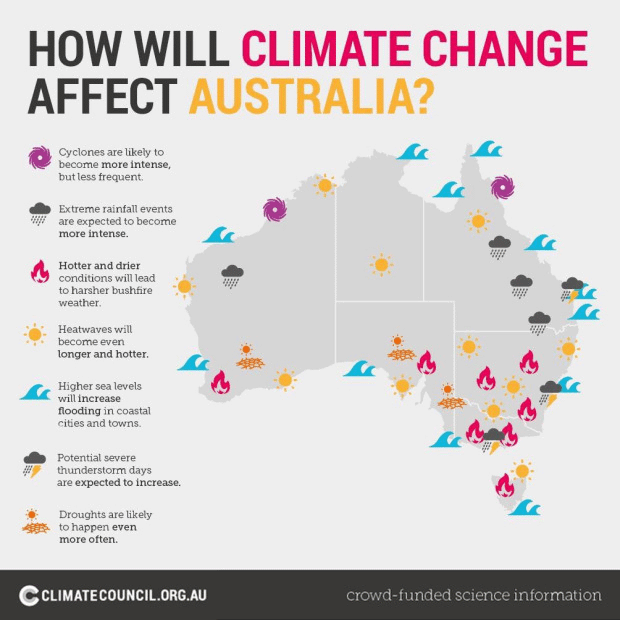
Australia among global ‘hot spots’ as droughts worsen in warming world, The Age, By Peter Hannam, June 1, 2020 The world’s major food baskets will experience more extreme droughts than previously forecast as greenhouse gases rise, with southern Australia among the worst-hit, climate projections show.
Scientists at the Australian National University and the University of NSW made the findings after running the latest generation of climate models used by the Intergovernmental Panel on Climate Change (IPCC). Future drought changes were larger and more consistent, the researchers found.
“Australia is one of the hot spots along with the Amazon and the Mediterranean, especially,” said Anna Ukkola, a research fellow at the ARC Centre of Excellence for Climate Extremes and lead author of the paper published in Geophysical Research Letters.
For southern Australia, the shift to longer, more frequent and more intense droughts up to 2100 will be due to greater variability in rainfall rather than a reduction in average rainfall. For the Amazon, both mean rain and variability changes…….
One reason for the prediction of worse droughts is that the latest models assume the climate will respond more than previously understood to increased atmospheric levels of carbon dioxide and other greenhouse gases.
Australia’s vulnerability to big shifts in annual rainfall already challenge the country’s farming sector, while also leaving much of the country’s south more at risk of bad bushfire seasons – such as last summer’s – as forests dry out.
The CSIRO has long forecast a large reduction in stream flows in the Murray-Darling Basin, for instance, as reduced cool-season rainfall combines with higher temperatures. Such a trend appears to have already begun.
While a more moderate emissions trajectory will still produce more intense, frequent and longer lasting droughts in most of the world’s mid-latitude regions than current conditions, the shift will be less than if carbon emissions remain near the top of forecasts. ……..https://www.theage.com.au/environment/climate-change/australia-among-global-hot-spots-as-droughts-worsen-in-warming-world-20200601-p54ydh.html
Australia, and the world, underestimate how many die due to global heating

|
Experts Warn Climate Change Is Already Killing Way More People Than We Record, Science Alert ,CARLY CASSELLA, 25 MAY 2020
People around the world are already dying from the climate crisis,and yet all too often, official death records do not reflect the impact of these large-scale environmental catastrophes. According to a team of Australian health experts, heat is the most dominant risk posed by climate change in the country. If the world’s emissions remain the same, by 2080 Australian cities could see at least four times the number of deaths from increasing temperatures alone. “Climate change is a killer, but we don’t acknowledge it on death certificates,” says physician Arnagretta Hunter from the Australian National University. That’s a potentially serious oversight. In a newly-published correspondence, Hunter and four other public health experts estimate Australia’s mortality records have substantially underreported heat-related deaths – at least 50-fold. While death certificates in Australia do actually have a section for pre-existing conditions and other factors, external climate conditions are rarely taken into account. Between 2006 and 2017, the analysis found less than 0.1 percent of 1.7 million deaths were attributed directly or indirectly to excessive natural heat. But this new analysis suggests the nation’s heat-related mortality is around 2 percent. “We know the summer bushfires were a consequence of extraordinary heat and drought and people who died during the bushfires were not just those fighting fires – many Australians had early deaths due to smoke exposure,” says Hunter……. “Death certification needs to be modernised, indirect causes should be reported, with all death certification prompting for external factors contributing to death, and these death data must be coupled with large-scale environmental datasets so that impact assessments can be done.” …… Such action, they say, is imperative. Not only for Australia but many other countries in the world. The United Kingdom has documented some problems with accurately filling out death certificates, and cities in several parts of the world are on track for similar heat-related mortality rates as Australia. But there are some places that will need to do more than just update their current system. In the tropics, there’s little valid mortality data on the more than 2 billion people who live in this heat-vulnerable region. And that makes predicting what will happen to these communities in the future much trickier. “Climate change is the single greatest health threat that we face globally even after we recover from coronavirus,” says Hunter. “We are successfully tracking deaths from coronavirus, but we also need healthcare workers and systems to acknowledge the relationship between our health and our environment.” In an unpredictable world, if we want to know where we’re going, we have to know where we’ve been. Figuring out how many of us have already died from climate change will be key to that process. We can’t ignore it any longer. The correspondence was published in The Lancet Planetary Health. https://www.sciencealert.com/official-death-records-are-terrible-at-showing-how-many-people-are-dying-from-the-climate-crisis |
|
|
Misleading and inaccurate information provided by Australia’s authorities on National Radioactive Waste Management
 Peter Remta – submission to Senate Committee on National Radioactive Waste Management Amendment (Site Specification, Community Fund and Other Measures) Bill 2020 [Provisions] Submission 65 more https://antinuclear.net/2020/05/23/peter-remta-misleading-and-inaccurate-information-provided-by-authorities-on-national-radioactive-waste-management/
“………. EXPLANATORY MEMORANDUM The explanatory memorandum accompanying the Bill simply repeats many of the inaccurate and misleading comments and information provided by the Department of Industry Innovation and Science and ANSTO to the communities of the initially accepted sites in South Australia since the beginning of the nomination process under the existing legislation.
………I must stress that the serious and unacceptable manner in which quite inaccurate information has been disseminated on behalf of the government on such an important issue both now and during the nomination and selection process has only caused more concern and community dissension and I suggest will lead to a greater general apprehension of starting a nuclear industry in Australia
Explanatory memorandum assertions :
1. While the concept of a single and purpose-built nuclear waste facility is a desired objective as outlined at the start of the explanatory memorandum it will be difficult to achieve as is now proposed.
To begin with it is wrong to say that this facility will support nuclear science and technology since it fails to meet the safety prescriptions for a facility of that nature.
It is also wrong to link the provision of nuclear medicine to the proposed storage and disposal of waste at the facility as the various entities generating waste from medical and research activities will continue relying on their own disposal methods and will not necessarily use a government run business for that purpose.
2. Most importantly it is a totally false and misleading proposition to suggest that the failure to establish the facility as proposed by the government will somehow lead to a reduction in nuclear medical services and treatment and the government should quickly correct that serious misconception since this has been a rather distressing concern for the community at Kimba and generally. It is therefore disingenuous to give that impression that this will be a central
facility for all nuclear waste in Australia.
3. While existing waste is held in numerous locations around the country there is no legal or other requirement that this waste would be disposed of at the facility and it is therefore disingenuous to give the impression that this will
be a central facility for all waste in Australia.
4. The reference to meeting with the international obligations under the Joint Convention4 ignores the safety code requirements promulgated some 12 years later under which it would be very difficult to establish the proposed
facility.
5. The suggestion of acquiring additional land for such things as all weather road access is only another example of the intrinsically unsuitable nature of the chosen site and the lack of planning and the necessary technical knowledge for construction of the facility.
6. The process of identifying a suitable location being a 40 year effort again shows the inability of the government or simply ignores that the current process in a proper manner only began after 2012 under the existing legislation.
7. To suggest proper and successful consultations with community members is a test of normal intelligence having regard to the strong and spirited opposition to the facility from the outset by the community generally and the fact that a concerned Aboriginal group has litigated its opposition to an appeal to the Federal Court5 and may now resort to a referral to the United Nations Human Rights Council.
8. The financial aspects of the government’s proposals lack frankness and justification when it has been claimed variously that the amount so far spent in selecting the site is $55 million or $85 million over the past five years but with a constant refusal to provide any details as to how that money has been spent or applied.
Surely there should be proper public disclosure of this quantum of expenditure when compared to the usual outcry where there is only a fraction of that amount involved if there is no reasonable explanation given. Moreover this should be gauged against the persistent refusal of the government to pay for an independent assessment and scrutiny of its
proposals by the members of the Kimba community who oppose the facility.
9. The statement as to compatibility with human rights is again with respect rather nonsensical when the government was incapable of holding a proper and valid ballot (albeit through the District Council of Kimba) which totally ignored the inclusion of an opposing argument contrary to the recognised and applicable principles of human rights. That ballot and the previous one as well as some claimed community surveys failed to meet the principles of informed consent which places a high standard of compliance on both the government and the District Council.
This becomes even worse by excluding the Aboriginal peoples from the ballotIf the government were genuine then it should hold another ballot with a more appropriate and wider base for voting and with the prior provision of all pertinent
information including the arguments or case against the facility. This goes back to providing a proper assessment and scrutiny of the government’s proposals by the opposing members of the Kimba community which has never been
the case.
Regrettably the compatibility statement is more prescriptive in its content instead of actually dealing with the facts of the situation and circumstances that occurred and which have been presented in the statement in a most favourable light for the government. when under the most basic of constitutional and democratic rights they
should have been included in that process…………
Sections on NAPANDEE FINANCIAL ASPECTS INFORMATION, BALLOTS, and INFORMED CONSENT LEGAL ACTIONS MANAGEMENT of FACILITY INTERNATIONAL OBLIGATIONS TECHNICAL ASSESSMENT [these will be published here separately, later]
…. CONCLUDING COMMENTS and RECOMMENDATIONS Continue reading
Australian politician John Barilaro gets it so wrong about small nuclear reactors
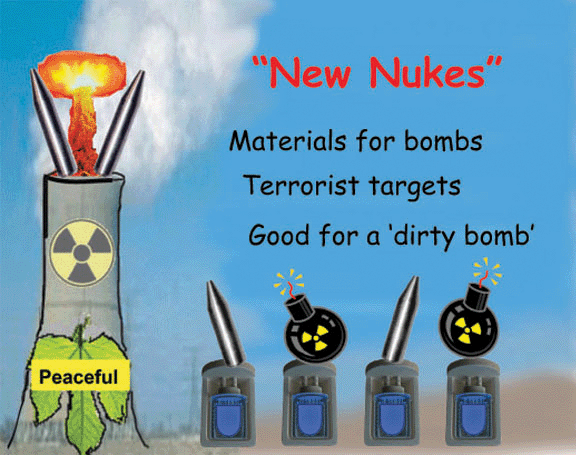
But there is as yet no sign of anything being oven-ready to come to the marketplace, let alone 15 up and running. But there remain some rather disturbing connections between small reactor projects and nuclear weapons proliferation. And Rolls-Royce does offer up one of the most glaring examples. Part of the company’s current sales pitch to the British government includes the argument that a civil small-reactor industry in the UK “would relieve the Ministry of Defence of the burden of developing and retaining skills and capability” for its weapons programme. It may be true. But it is not really Atoms for Peace, , is it?
https://electricalreview.co.uk/features-mm/13082-mystic-meg-from-down-under
Latest climate models suggest global heating could be worse than we thought
 Just how hot will it get this century? Latest climate models suggest it could be worse than we thought, The Conversation, May 18, 2020 , Michael Grose, Climate Projections Scientist, CSIRO, Julie Arblaster, Associate Professor, Monash University Climate scientists use mathematical models to project the Earth’s future under a warming world, but a group of the latest models have included unexpectedly high values for a measure called “climate sensitivity”.
Climate sensitivity refers to the relationship between changes in carbon dioxide in the atmosphere and warming.
The high values are an unwelcome surprise. If they’re right, it means a hotter future than previously expected – warming of up to 7℃ for Australia by 2100 if emissions continue to rise unabated.
The lingering horror of the nuclear bomb tests at Maralinga, South Australia
|
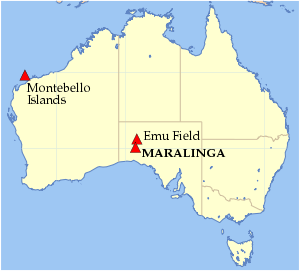
Maralinga is 54 kilometres north-west of Ooldea, in South Australia’s remote Great Victoria Desert. Between 1956 and 1963 the British detonated seven atomic bombs at the site; one was twice the size of the bomb dropped on Hiroshima. There were also the so-called “minor trials” where officials deliberately set fire to or blew up plutonium with TNT — just to see what would happen. One location called “Kuli” is still off-limits today, because it’s been impossible to clean up. I went out to the old bomb sites with a group of Maralinga Tjarutja people, who refer to the land around ground zero as “Mamu Pulka”, Pitjantjatjara for “Big Evil”. “My dad passed away with leukaemia. We don’t know if it was from here, but a lot of the time he worked around here,” says Jeremy Lebois, chairperson of the Maralinga Tjarutja council. Thirty per cent of the British and Australian servicemen exposed to the blasts also died of cancer — though the McClelland royal commission of 1984 was unable to conclude that each case was specifically caused by the tests. It’s not until you stand at ground zero that you fully realise the hideous power of these bombs. Even after more than 60 years, the vegetation is cleared in a perfect circle with a one kilometre radius. “The ground underneath is still sterile, so when the plants get down a certain distance, they die,” explains Robin Matthews, who guided me around the site. The steel and concrete towers used to explode the bombs were instantly vaporised. The red desert sand was melted into green glass that still litters the site. Years ago it would have been dangerous to visit the area, but now the radiation is only three times normal — no more than what you get flying in a plane. The Line of FireAustralia was not the first choice for the British, but they were knocked back by both the US and Canada. Robert Menzies, Australia’s prime minister at the time, said yes to the tests without even taking the decision to cabinet first. David Lowe, chair of contemporary history at Deakin University, thinks Australia was hoping to become a nuclear power itself by sharing British technology, or at least to station British nuclear weapons on Australian soil. “In that period many leaders in the Western world genuinely thought there was a real risk of a third world war, which would be nuclear,” he says. The bombs were tested on the Montebello Islands, at Emu Field and at Maralinga. At Woomera in the South Australian desert, they tested the missiles that could carry them. The Blue Streak rocket was developed and test-fired right across the middle of Australia, from Woomera all the way to the Indian Ocean, just south of Broome. This is known as “The Line of Fire” The Line of Fire from Woomera to Broome is, funnily enough, the same distance from London to Moscow,” Mr Matthews says. Just as the Maralinga Tjarutja people were pushed off their land for the bomb tests, the Yulparitja people were removed from their country in the landing zone south of Broome. Not all the Blue Streak rockets reached the sea. Some crashed into the West Australian desert. The McClelland royal commission showed that the British were cavalier about the weather conditions during the bomb tests and that fallout was carried much further than the 100-mile radius agreed to, reaching Townsville, Brisbane, Sydney and Adelaide. “The cavalier attitude towards Australia’s Indigenous populations was appalling and you’d have to say to some extent that extended towards both British and Australian service people,” Professor Lowe says. There are also questions over whether people at the test sites were deliberately exposed to radiation. “You can’t help but wonder the extent to which there was a deliberate interest in the medical results of radioactive materials entering the body,” Professor Lowe says. “Some of this stuff is still restricted; you can’t get your hands on all materials concerning the testing and it’s quite likely both [British and Australian] governments will try very hard to ensure that never happens.” Project SunshineWe do know that there was a concerted effort to examine the bones of deceased infants to test for levels of Strontium 90 (Sr-90), an isotope that is one of the by-products of nuclear bombs. These tests were part of Project Sunshine, a series of studies initiated in the US in 1953 by the Atomic Energy Commission. They sought to measure how Sr-90 had dispersed around the world by measuring its concentration in the bones of the dead. Young bones were chosen because they were particularly susceptible to accumulating the Sr-90 isotope. Around 1,500 exhumations took place, in both Britain and Australia — often without the knowledge or permission of the parents of the dead. Again, it was hard to prove conclusively that spikes in the levels of Strontium 90 during the test period caused bone cancers around the world. The Maralinga tests occurred during a period that Professor Lowe describes as “atomic utopian thinking”. “Remember at that time Australians were uncovering pretty significant discoveries of uranium and they hoped that this would unleash a vast new capacity for development through the power of the atom,” he says. Some of the schemes were absurdly optimistic. Project Ploughshare grew out of a US program which proposed using atomic explosions for industrial purposes such as canal-building. In 1969 Australia and the US signed a joint feasibility study to create an instant port at Cape Keraudren in the Kimberley using nuclear explosions. The plan was dropped, but it was for economic not environmental or social reasons. The dream (or was it a nightmare?) of sharing nuclear weapons technology with the British was never realised. All Australia got out of the deal was help building the Lucas Heights reactor. The British did two ineffectual clean-ups of Maralinga in the 1960s. The proper clean-up between 1995 and 2000 cost more than $100 million, of which Australia paid $75 million. It has left an artificial mesa in the desert containing 400,000 cubic metres of plutonium contaminated soil. The Maralinga Tjarutja people received only $13 million in compensation for loss of their land, which was finally returned to them in 1984. As we were leaving the radiation zone, the Maralinga Tjarutja people spotted some kangaroos in the distance. Over the years some of the wildlife has started to return. Mr Lebois takes it as a good sign. “Hopefully, hopefully everything will come back,” he says. |
|
Doctors again call on Australian govt about Julian Assange’s precarious health, risk of coronavirus
Almost 200 medical doctors say Julian Assange’s health is at increased risk from coronavirus, https://www.thecanary.co/global/world-news/2020/03/18/almost-200-medical-doctors-say-julian-assanges-health-is-at-increased-risk-from-coronavirus/ John McEvoy 18th March 2020 On 18 March, almost 200 medical doctors wrote to Australian foreign minister Marise Payne to warn that Julian Assange’s health is at increased risk from the new coronavirus.
“Mr Assange could die in prison”
This is the latest in a number of letters sent by Doctors for Assange to express concern over the WikiLeaks publisher’s deteriorating health.
On 22 November, the group signed an open letter addressed to UK home secretary Priti Patel, saying: “we have real concerns, on the evidence currently available, that Mr Assange could die in prison”.
In a follow-up letter published on 4 December, the doctors wrote:
When the UK, as a Permanent Member of the United Nations Security Council, repeatedly ignores not only the serious warnings of the United Nations Special Rapporteur on Torture, but also its unequivocal investigative and remedial obligations under international and human rights law, the credibility of the UK’s commitment to human rights and the rule of law is fatally undermined.
Fertile breeding grounds”
The latest letter, signed by medical doctors from countries including the UK, Australia, Sweden, and the US, was written in light of the recent coronavirus pandemic.
The letter reads:
We wrote to you on December 15 2019 that Julian Assange’s life is at risk due to nearly a decade of human rights abuse including arbitrary detention, psychological torture and medical neglect. Now, with the president of the Prison Governor’s Association warning that prisons provide “fertile breeding grounds” for coronavirus, Julian Assange’s life and health are at heightened risk due to his arbitrary detention during this global pandemic. That threat will only grow as the coronavirus spreads. …
We therefore stand by our previous calls for the Australian Government to urgently intervene to protect the life, health and human rights of its citizen Julian Assange, before it is too late, whether due to coronavirus or any number of catastrophic health outcomes.
Coronavirus is the latest threat to Assange’s life, adding onto years of arbitrary punishment and psychological torture.
This week’s uranium report- prices fall again, Australia’s “nuclear future” going nowhere
 Uranium Week: The Nuclear Debate https://www.fnarena.com/index.php/2020/03/11/uranium-week-the-nuclear-debate-3/ Mar 11 2020
Moves are afoot once again in Australia to lift bans on both uranium mining and nuclear power. The uranium spot price has slipped once more.
-U3O8 spot prices fall again
-Nuclear debate reopens in Australia
-History suggests it will be no easy road
By Greg Peel This week’s uranium report could simply be left as “nothing happened”. At least nothing of major uranium industry implication. The same issues remain in place, so rather than rake over old ground yet again, as to why uranium prices are in the doldrums, this week we’ll zoom in Australia’s nuclear dilemma.
For the record, industry consultant TradeTech reported ten transactions completed in the uranium spot market last week totalling 1mlbs U3O8 equivalent. As buyers were again largely MIA, prices fell gradually during the week. TradeTech’s weekly spot price indicator has fallen -US50c to US$24.40/lb.
Term price indicators remain at US$28.25/lb (mid) and US$33.00 (long).
How to React?
The nuclear power debate has heated up in Australia once more. Driving fresh debate is the pending shutdown of ageing coal-fired power stations that provide Australia’s base load electricity. The federal government wants to build new coal-fired power stations. This policy already had its critics but as a result of this season’s bushfire disaster, an electoral groundswell is calling for the government to recognise climate change and act accordingly before it’s too late.
Australians are now generally opposed to both coal-fired power and new thermal coal mines. But not all Australians. The country is the world’s largest exporter of coal. The coal mining industry employs thousands, and thousands more are supported indirectly by that industry. The surprise victory for the coal-friendly Coalition at last year’s federal election was in part due to support from Queensland-based electorates, Queensland being Australia’s premier coal producing state.
Nuclear power has long been proposed as an alternative source to meet Australia’s electricity needs, if for no other reason Australia boasts the world’s largest known reserves of uranium. But from Three Mile Island to Chernobyl and Fukushima, successive governments have considered nuclear power to be electoral suicide. The debate is now back on again nevertheless, to lift bans on uranium mining and build nuclear reactors.
Australia is a federation of six sovereign states and two federal territories. Of those six states, four have bans on uranium mining. Tasmania has no known commercial uranium deposits, leaving South Australia as the only state with operating uranium mines. Of those four operating mines, two are currently under care & maintenance pending improved uranium prices, leaving only BHP Group’s ((BHP)) Olympic Dam and the foreign-owned Beverley in operation. A fifth mine – Ranger in the Northern Territory — is currently producing uranium but only from stockpiled ore.
Over a decade ago, the then Queensland premier decided to lift the state’s ban on uranium mining. So swift and brutal was the backlash from the coal lobby, the premier very quickly changed his mind. In the interim, one Western Australia state government lifted the ban on uranium mining, only to have the next government ban it again. Two mines under construction on the basis of the prior policy were exempted.
The Australian federal government previously limited the number of allowable uranium mines, but that policy has since been abandoned. The federal government is currently content to restrict the number of countries Australia can export uranium to.
Last week the New South Wales deputy premier supported a bill in state parliament to overturn a nuclear power ban, after a parliamentary inquiry recommended that the law prohibiting uranium mining and nuclear facilities should be repealed. The bill has the support of the Minerals Council of Australia, and the Australian Workers Union, which supports uranium mining and nuclear power for the jobs both will create. But the AWU’s stance puts it at odds with the Australian Council of Trade Unions, which has long been anti-uranium for what we might call Fukushima reasons.
And support for uranium mining and nuclear power is not split down party lines at either federal or state level. The debate is splitting parties.
A lifting of state uranium mining bans would likely not achieve much in the near term. The marginal cost of new production well exceeds current uranium trading prices. To not build nuclear reactors, on the other hand, when the issue of Australia’s future base load power and electricity prices is paramount, and Australia has abundant uranium resources, is seen by supporters as pure folly.
The debate will rage on, but in the short term at least, likely go nowhere.
Proponents of Small Nuclear Reactors need a reality check – about the STAGGERING COST
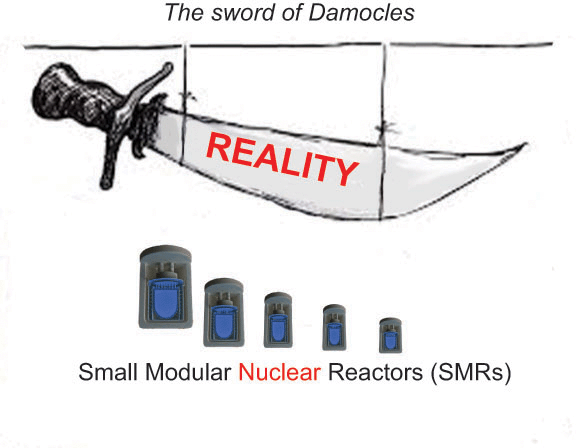 a reality check is in order. A handful of small reactors is under construction but they have been subject to huge cost overruns and delays. William Von Hoene, senior vice-president of Exelon ‒ the largest operator of nuclear power plants in the US ‒ says that no more large reactors will be built in the US and that the cost of small reactors is “prohibitive”.
Rolls-Royce sharply reduced its small-reactor investment to “a handful of salaries” in 2018 and is threatening to abandon its R&D altogether unless the British government agrees to an outrageous set of demands and subsidies.
|
Supporters of nuclear need a reality check: it’s staggeringly expensive, https://www.smh.com.au/environment/climate-change/supporters-of-nuclear-need-a-reality-check-it-s-staggeringly-expensive-20200308-p547wv.html, By Jim Green March 10, 2020 The NSW Parliament’s State Development Committee released its report into nuclear power last week. Conservative committee members recommended repeal of state laws banning uranium mining and nuclear power, while Labor members want to retain the legal bans.
What the conservatives and other supporters of nuclear power ignore is that it has priced itself out of the energy debate. Its costs are staggering and the worldwide pattern for the industry is one of stagnation and decline. In the US, the cost of the only two reactors under construction has skyrocketed to between $20.4 billion and $22.6 billion for one reactor. In 2006, Westinghouse said it could build a reactor for 10 times less than that amount. Another project in the US, a twin-reactor project in South Carolina, was abandoned in 2017 after the expenditure of at least $13.4 billion. Over in New Mexico, the world’s only deep underground nuclear waste repository was closed for three years following a chemical explosion in an underground nuclear waste barrel in 2014. In Britain, the estimated cost of the only two reactors under construction is $25.9 billion each. In the mid-2000s, the estimated cost was almost seven times lower. The British National Audit Office estimates that taxpayer subsidies for the project will amount to $58 billion. The cost of the only reactors under construction in France and Finland has nearly quadrupled and now stands at $17.7 billion to $20 billion per reactor. Both projects are 10 years behind schedule. Tomorrow, Japan will commemorate the ninth anniversary of the meltdowns, fires and explosions at the Fukushima nuclear plant. The Japanese government’s estimate of clean-up and compensation costs is over $300 billion, and rising. Insiders and lobbyists freely acknowledge that the nuclear power industry is in crisis and that worldwide decline is certain. But its Australian supporters are unfazed. Their only sideways nod to reality is to argue that even if large, conventional reactors are too expensive, the emerging “small modular reactors” would be a good fit for Australia. Continue reading |
Australia’s former foreign minister calls on Australian govt to intervene to release Julian Assange
As anger mounts over Assange’s persecution, former foreign minister Carr calls for moral appeals to Australian government, WSWS, By Richard Phillips, 6 March 2020
Popular opposition to the ongoing imprisonment and state persecution of WikiLeaks publisher Julian Assange is increasing following last week’s extradition hearing in Britain. The four-day show trial, which blatantly violated Assange’s basic legal rights and subjected him to even more psychological torture, has deeply shocked many people and intensified the determination of those fighting for Assange’s release.
Addressing a public meeting last week in the New South Wales (NSW) parliament, Bob Carr, a former federal foreign minister and state Labor premier from 1995–2005, denounced the bogus espionage charges against Assange and warned that if extradited to the US, he would die.
Carr and other speakers, including Assange’s Australian lawyer Greg Barns and former SBS television journalist Mary Kostakidis, insisted, however, that those defending Assange should concentrate on lobbying state and federal MPs.
This orientation, they suggested, would pressure the Liberal-National Coalition government and Foreign Minister Marisa Payne to ask Washington to release the WikiLeaks publisher.
Carr called for Payne to have a “friendly chat” with Mike Pompeo, the former CIA chief and current US Secretary of State, and offered some talking points…….
Carr said nothing about Pompeo’s threatening denunciations of WikiLeaks as a “non-state hostile intelligence service,” his visit to Sydney last August when he demanded greater Australian involvement in Washington’s aggressive confrontations with Beijing and Iran, or his role as former CIA chief.
As for Payne, she rejected any defence of Assange, declaring in the Senate a day earlier that the WikiLeaks publisher would receive a fair trial and disparaging UN Special Rapporteur on Torture Nils Melzer’s reports on the decade-long persecution of Assange.
Carr’s opposition to the US-led vendetta against Assange, which he first voiced in May, appears to constitute a remarkable political turn around. Eight years ago, as foreign minister in the Labor government of Prime Minister Julia Gillard—from early 2012 to September 2013—Carr, like other federal Labor MPs and the party as a whole, was virulently hostile to Assange…….
The demonisation of Assange by Australia’s political establishment and the corporate media, which is part and parcel of its commitment to the US alliance, has not convinced tens of thousands of ordinary Australians. Important layers of workers, young people, students and middle-class people have taken up Assange’s defence as part of a growing international movement. …… https://www.wsws.org/en/articles/2020/03/06/carr-m06.html
Flinders University, South Australia: collusion with nuclear power promotion, Prof Pam Sykes, and the scam of “hormesis”

The Industry Push to Force Nuclear Power in Australia, Part 1 of A Study of the “Report of the inquiry into the prerequisites for nuclear energy in Australia” Australian Parliamentary Committee 2020.by nuclearhistory, February 29, 2020“………….The most recent nuclear collaboration between Australia and a nuclear power for nuclear purposes commenced in the year 2000. At that time a US Department of Energy Contractor named Bobby Scott, based at Los Alamos and at Lovelace Respiratory Research Laboratory, New Mexico, came to Adelaide carrying contract documents. The documents were to be signed by the US DOE and involved personnel of Flinders University. Bobby Scott is a well known (to people in the field) as a leading advocate for the theory of radiation hormesis. The contract to be signed was the first of a number. From the time of the signing of that contract, Flinders University engaged in very strong advocacy of the expansion of nuclear industry in South Australia. Prof Pam Sykes was flown from Adelaide to Los Almos and undertook training and seminars in Hormesis. The concept that radioactive substances are, in her words, “like vitamins”.
I have fully explained that this unproven theory flies in the face of reality in terms of radiological safety and data from monitoring of dose and disease all over the world, including, contrary to the claims of the school hormesis, the naturally high background radiation regions of Iran and India. In those parts of Iran and India, (the five northern provinces in Iran, and Kerala in India) some cancer rates are among the highest in the world. Further, in those Iranian provinces breast cancer in teenage women is more common than it is even in the West. And so on. There are five types of cancer in northern Iran which have very high rates. In south western Kerala, the rates of female thyroid cancer is very, very high.
Contrary the to statements made by the school of hormesis, headquartered at Los Alamos, USA and Flinders University Adelaide. From 2000 on, Flinders University promoted the idea of radioactive substances such as uranium and its decay products and the fission products as being “like vitamins”, necessary for life. By 2011 the university was promoting the idea that an expansion of the state’s uranium mines would be good for the health of South Australians, because the natural background here is “too low” for good health. Presumably the transport of tons of additional uranium ore by train from the mines to the ports in open railway trucks would result in faint clouds of radionuclide “vitamins” being dispersed over the whole population of the state in precisely the right theoretical dose, taking into account, somehow, automatically, the age, gender and health status of each South Australian. (I didn’t write what Sykes did, so don’t blame me.). In 2011 the US DOE funded Flinders University put its pedal to the metal and flew into the debate, labelling South Australians who disagreed with it’s position in words which were insulting and which labelled us as lunatics, radiophobes and totally ignorant of radiological safety principles, cowardly, and devoid of reason. Read it here: https://news.flinders.edu.au/blog/2011/07/14/radiation-response-a-meltdown-in-reason/
1 This Month

Protect Sazan Island from the Trump family! https://secure.avaaz.org/campaign/en/protect_sazan_island_from_the_trump_family_loc/?bqFCVab&v=174511&cl=22707147157&_checksum=5e9dde668860e8231c33699735e16a1fbf22ab2cb01da50c999fe8732b9775ef&utm_source=email&utm_medium=blast_email&utm_campaign=174511
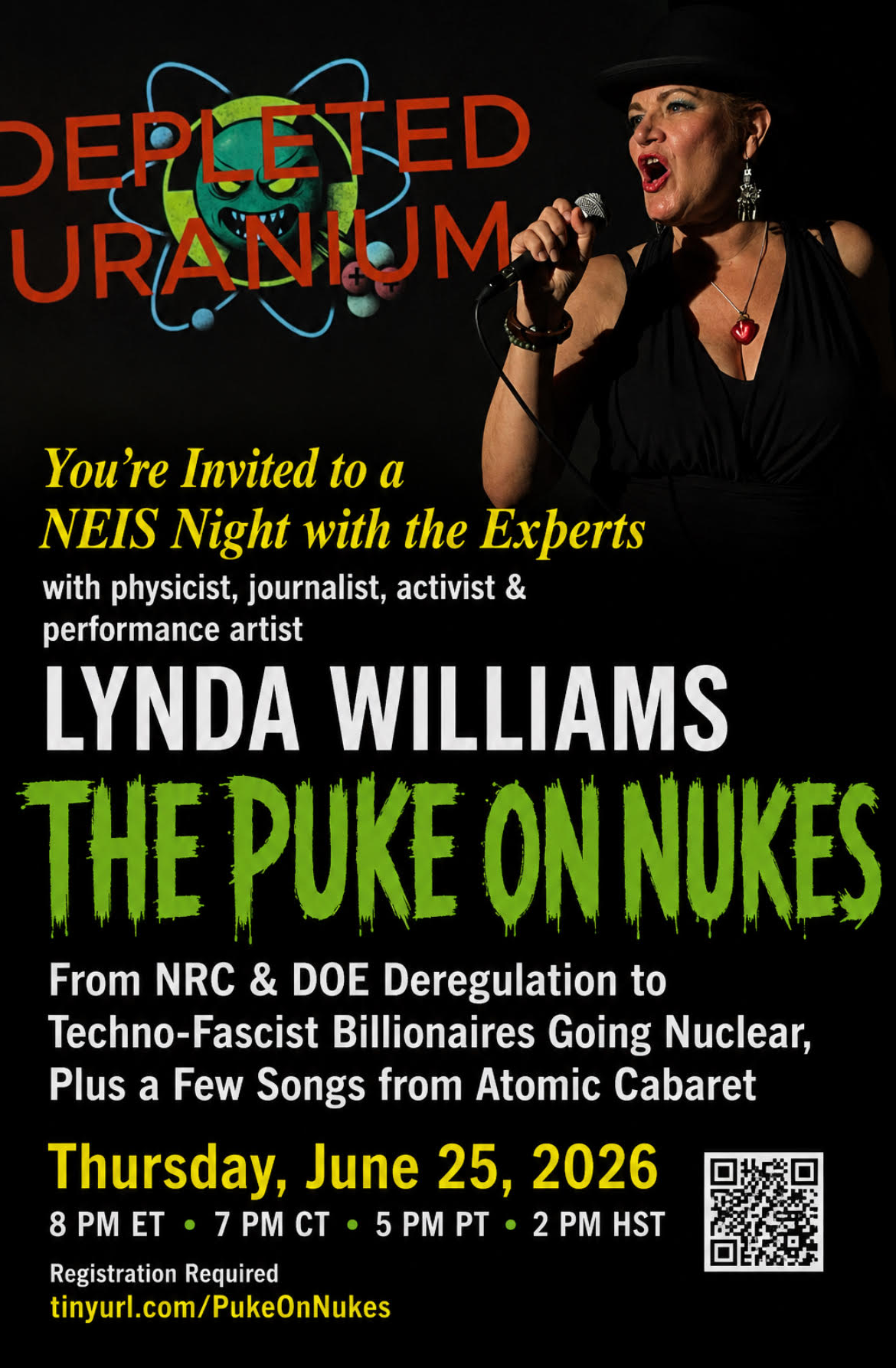
25 June- THE PUKE ON NUKES
Thursday, June 25, 2026
7pm Central Time (8pm ET, 6pm MT, 5pm PT) UTC – 5
From NRC & DOE Deregulation to Techno-Fascist Billionaires Going Nuclear, Plus a Few Songs from Atomic Cabaret REGISTER
26 June – Radiation Trainwreck at the NRC / Join the Protect Better Campaign – https://us02web.zoom.us/meeting/register/4ZlZ5_qLSHGiLSCg8FF6Bg#/registration


Cuba Is Not a Failed State – It Is a Besieged State
PETITION: “Global Appeal to Endorse Palestinian Right of Return of Refugees”
To see nuclear-related stories in greater depth and intensity – go to https://nuclearinformation.wordpress.com
-
Archives
- June 2026 (162)
- May 2026 (306)
- April 2026 (356)
- March 2026 (251)
- February 2026 (268)
- January 2026 (308)
- December 2025 (358)
- November 2025 (359)
- October 2025 (376)
- September 2025 (257)
- August 2025 (319)
- July 2025 (230)
-
Categories
- 1
- 1 NUCLEAR ISSUES
- business and costs
- climate change
- culture and arts
- ENERGY
- environment
- health
- history
- indigenous issues
- Legal
- marketing of nuclear
- media
- opposition to nuclear
- PERSONAL STORIES
- politics
- politics international
- Religion and ethics
- safety
- secrets,lies and civil liberties
- spinbuster
- technology
- Uranium
- wastes
- weapons and war
- Women
- 2 WORLD
- ACTION
- AFRICA
- Atrocities
- AUSTRALIA
- Christina's notes
- Christina's themes
- culture and arts
- Events
- Fuk 2022
- Fuk 2023
- Fukushima 2017
- Fukushima 2018
- fukushima 2019
- Fukushima 2020
- Fukushima 2021
- general
- global warming
- Humour (God we need it)
- Nuclear
- RARE EARTHS
- Reference
- resources – print
- Resources -audiovicual
- Weekly Newsletter
- World
- World Nuclear
- YouTube
-
RSS
Entries RSS
Comments RSS
 nuclear-news