Weapons corporations infiltrate Australian schools and charities, promoting war-mongering to our youth

REPUTATION LAUNDERING,
https://declassifiedaus.org/2022/03/31/reputation-laundering/ DeclassifiedAUS2 The weapons companies spruiking the ‘benefits and opportunities’ of the wars in Ukraine and Yemen and tensions in the South China Sea are infiltrating our schools., MICHELLE FAHY, 31 MARCH 2022
A Lockheed Martin missile blows up a school bus in Yemen, while in Australia the company gains kudos by sponsoring the National Youth Science Forum.
BAE Systems supports the education of kids in Australia, while being complicit in the killing of thousands of children in Yemen.
Lockheed Martin, the world’s largest weapons-maker, is raking in billions from ongoing wars like the four-week Russian invasion of Ukraine, and the eight-year long Saudi-led war in Yemen.
A Lockheed Martin laser-guided bomb blew up a bus full of Yemeni school children in 2018, killing 40 children and injuring dozens more.
Meanwhile, in Australia, Lockheed Martin was busy cultivating kudos with kids as major sponsor of the National Youth Science Forum, a registered charity originally set up by Rotary.
Then there’s US missile-making giant Raytheon which now has a significant new manufacturing facility in Australia. It has continued to supply the Saudi-led coalition with weapons for the Yemen war, despite extensive evidence pointing to war crimes arising from its missiles being used to target and kill civilians.
In January 2022, a Raytheon missile killed at least 80 people and injured over 200 in a so-called precision strike in Sa’adah in Yemen.
Within days of this horrific incident, Raytheon’s CEO was telling investors that rising tensions represented “opportunities for international sales” and he fully expected to “see some benefit” from “the tensions in Eastern Europe [and] the South China Sea”.
There’s no mention in Australia’s media of the big profits Raytheon is making from the Yemen war, which has now entered its eighth year, killed or injured at least 19,000 civilians, and possibly many more, and also caused the deaths of tens of thousands of children through starvation, due to disruption of food supplies and militarily-enforced trade blockade.
Instead, we’ve seen pictures of Aussie school kids having fun with the Australian snowboarding Paralympian who Raytheon Australia hired to front the launch of its Maths Alive! educational exhibition.
And we also heard about Raytheon’s sponsorship of Soldier On and the Invictus Games, despite the irony of a weapons company using its support of injured military personnel as a public relations exercise.
There’s a name for this cynical behaviour by corporations: ‘reputation laundering’.
Weapons companies are now ‘Innovators’
The world’s weapons producers have also taken to promoting themselves as ‘innovators’ in the areas of science, technology, engineering and maths, called STEM.
This enables them to target children and young people as future employees (see, for example, BAE Systems Australia, Boeing Defence Australia, and Saab Australia), often with the willing partnership of respected institutions. Many Australian universities now have MOUs, joint ventures, strategic partnerships, or other forms of collaboration with the weapons industry.
This enthusiastic support of STEM serves a double purpose: reputation laundering, and a socially acceptable way to promote the weapons industry as a future employer directly to children and their parents.

Promoting STEM education is essential to creating a well-trained workforce for key industries of the future, particularly those that can tackle the existential risks associated with climate change. The concern with the weapons industry’s activities in this domain is the way it is using STEM to target children as young as primary school age for weapons-making careers, often with the support of government.
The spin and glamour being associated with Australia’s increased militarism is a concern on several levels, particularly as the marketing omits pertinent information: weapons and warfare aren’t mentioned.
Nor is there information about how children might use their STEM skills to enhance the ‘lethality’ of their employer’s products.
Nor about a future in which the need for human involvement in the ‘kill chain’ is eliminated by creating autonomous robots to make life and death decisions instead. (This is not science fiction, these research and development programs are already happening.)
Working for companies involved with nuclear weapons isn’t discussed, either.
Instead, a world of euphemism has been created: ‘advanced technology systems, products and services’, ‘high end technology company’, ‘leading systems integrator’, ‘security and aerospace company’, ‘defence technology and innovation company’.
It is also likely to be weapons company marketing material if the phrase ‘solving complex problems’ appears, especially if accompanied by claims of ‘making the world safer.
None of these euphemisms conjures up realistic images of the bloody and brutal destruction the world is witnessing in the world’s latest war in Ukraine.
The ways global weapons giants have cultivated relationships with organisations of good purpose in Australia is highlighted in the following examples.
Lockheed Martin and the National Youth Science Forum
The National Youth Science Forum was created by Rotary, which remains involved. The Forum, now a not-for-profit organisation overseen by a board, has numerous programs, the flagship program being for Year 12 students interested in a career in science.
“The ban treaty embodies the collective moral revulsion of the international community,” according to the Director of the Centre for Nuclear Non-Proliferation and Disarmament at the Australian National University, Professor Ramesh Thakur.
Lockheed Martin and the Gallipoli Sponsorship Fund
In 2020, Lockheed Martin Australia became the first corporate sponsor of the Gallipoli Scholarship Fund and provides $120,000 to fund 12 Lockheed Martin Australia bursaries for the educational benefit of descendants of Australian military veterans.
Lockheed Martin is providing these Australian educational bursaries through to the end of 2023, with an opportunity to extend.
Referring to Lockheed Martin as a “defence technology and innovation company”, the Gallipoli Sponsorship Fund’s website also does not disclose Lockheed’s status as the world’s dominant weapons-maker nor its position as a major nuclear weapons producer.
BAE Systems and The Smith Family
This example illustrates that public pressure can and does make a difference.
The UK’s largest weapons-maker, BAE Systems, has been working inside Saudi Arabia supporting the Saudi-led coalition’s role in Yemen since the start of the war.
A BAE maintenance employee was quoted in 2019 saying, “If we weren’t there, in 7 to 14 days there wouldn’t be a jet in the sky.” BAE Systems has sold nearly £18 billion worth of weaponry to the Saudis since the war in Yemen started in 2014.
Yet in Australia, BAE Systems started a $100,000 partnership with The Smith Family in August 2020, sponsoring a STEM education program for under-privileged children.
BAE’s role helping the Saudis prolong one of the world’s worst humanitarian crises in Yemen was pointed out numerous times to The Smith Family, a children’s charity, after news broke of its BAE sponsorship.
The Smith Family initially resisted but after increasing pressure and activism from peace organisations and many complaints from the public, The Smith Family soon dropped its controversial ‘partnership’ with BAE Systems Australia, mere months after it had started.
Morally indefensible positions
Benign-sounding sponsorships of Australian school children such as these might appear less self-serving if weapons companies behaved consistently and stopped supplying weapons to those nations known to be serial abusers of human rights.
Saying they are merely doing the bidding of their governments in supplying the Saudis, and other abusive and repressive regimes, as these companies have, is not a morally defensible position.
It is particularly not defensible in the face of evidence of ongoing war crimes being committed using their weaponry.
MICHELLE FAHY is an independent writer and researcher, specialising in the examination of connections between the weapons industry and government, and has written in various independent publications. She is on twitter @FahyMichelle, and on Substack at UndueInfluence.substack.com An earlier version of this article was published in Michael West Media in November 2020.
Australia’s Parliament has little control over military matters, and Prime Ministers kow tow to USA and the White Anglosphere to go to war

Australia is an “active, eager participant in the US-led order” and restricting the Australian parliament’s control over the military has been “… a decision taken by the Australian government — at a bipartisan level — and implemented by senior policy planners.
Meanwhile the Australian parliament has “deliberately restricted its own powers on intelligence matters”
,Australia has ”reaffirmed its whiteness in its commitment to expansion of the “Five Eyes” intelligence sharing arrangements between the US, Britain, Canada, Australia and New Zealand and, of course, to the controversial 2021 AUKUS nuclear submarine deal, which was nurtured in great secrecy”
White and might is right: the secrets which push us into other people’s wars, https://www.michaelwest.com.au/the-dirty-secret-that-pushes-australia-into-other-peoples-wars/ By Zacharias Szumer|April 2, 2022 Is playing deputy to America’s sheriff the reason Australian war powers remain unreformed? It’s clear that our politicians remain muddled on this critical issue, writes Zacharias Szumer.
For decades, minor parties in Australia have introduced bills seeking to give parliament greater control over military deployments. In the debates and inquiries that have followed, a wide range of objections have been raised.
We are told that, as military deployments are often made on the basis of confidential information, this information cannot be publicly disclosed to the parliament. Another common objection is that parliamentary decision-making would reduce the flexibility and speed needed to carry out military operations safely and effectively.
Most of the opposition to war powers reform, received as part of Michael West Media’s ongoing survey of politicians, follows similar lines. You can see myriad responses here.
However, some experts think there might be another reason — one that Australian pollies may be uncomfortable acknowledging.
Kowtowing to empires
Clinton Fernandes, professor of international and political studies at the University of NSW and former Australian army intelligence officer, contends that the bipartisan reluctance to infringe upon this executive prerogative should be understood within Australia’s ”sub-imperial” geopolitical strategy.
In basic terms, Australia has sought to integrate itself into the global strategy of great powers — firstly the British and, from 1942 onwards, the United States. In a 2020 article, Fernandes argues that this sub-imperial strategy has meant the “effective exclusion of the legislative and judicial branches of government from Australia’s national-security policy”.
Fernandes does not believe that Australian politicians and policy officials have been forced against their will into this position. Rather, he argues that Australia is an “active, eager participant in the US-led order” and restricting the Australian parliament’s control over the military has been “… a decision taken by the Australian government — at a bipartisan level — and implemented by senior policy planners.
“Australian strategic planners understand that this means a reduction in sovereignty, but they accept it because it achieves a higher objective — upholding US imperial power.”
In addition to limiting parliament’s control over military deployments, Fernandes argues that Australia’s position as a “sub-imperial power” also limits parliamentary oversight of intelligence gathering. In the US, “intelligence committees and judiciary committees in the Senate and House of Representatives are regularly briefed about all authorised intelligence-collection programs, and relevant members of Congress receive detailed briefings prior to each re-authorisation,” Fernandes says.
Five Eyes and whiteness
Meanwhile the Australian parliament has “deliberately restricted its own powers on intelligence matters” through measures such as the Intelligence Services Act 2001 which ‘prevents the Parliamentary Joint Committee on Intelligence and Security from ‘reviewing the intelligence gathering and assessment priorities’ or ‘reviewing particular operations that have been, are being or are proposed to be undertaken’ by ASIS, ASIO and the other intelligence agencies, and likewise ‘the sources of information, other operational assistance or operational methods’ available to the agencies”.
Dr Greg Lockhart, an historian and Vietnam War veteran, supports Fernandes’ argument, but stresses the importance of seeing Australia’s sub-imperial strategy through the lens of a wider “cultural self-deception” around racial anxieties. “Fear of the ‘yellow peril’ meant that our Anzac expeditionary strategic reflex was from its inception race-based,” he says. ‘It was also primarily defensive; it depended on “great and powerful” white friends for protection in our region; it has always depended on being in the Anglosphere”.
Dr Lockhart argues that, although the overtly racist rhetoric of the White Australia policy is largely a thing of the past, “our strategic culture is still inseparable from the Anglosphere, from wherein we have never needed to reassess its whiteness”.
Recently, he says, Australia has ”reaffirmed its whiteness in its commitment to expansion of the “Five Eyes” intelligence sharing arrangements between the US, Britain, Canada, Australia and New Zealand and, of course, to the controversial 2021 AUKUS nuclear submarine deal, which was nurtured in great secrecy”.
“And with secrecy comes deception. Sounding like a US proxy in the Pacific while asserting Australian ‘sovereignty’, Scott Morrison’s government “announces it is in ‘lockstep’ with “our allies”, while trumpeting the threat of China’s communism, territorial expansion, abuse of human rights, or its implied role as the origin of Covid 19 — anything but the anxiety about Chinese numbers, ethnic difference, and independent power that has shadowed Australian history since the 1800s – and that now determines the security culture’s mindless dependence on the US.’’
Seen in this wider cultural context, Lockhart believes that “the Constitution was never going to impose legislative or judicial restraints on the autocratic war powers of the sub-imperial state. Since the First World War in 1914, almost every Anzac expedition has been a British or American imperial one. The exceptions are the Pacific campaign in 1942-1945 and Timor in 1999-2000. And in all those imperial campaigns the decision for war has been made undemocratically by the prime minister acting in secret conclave with only a handful of advisers”.
Parliamentary war powers
Fernandes and Lockhart aren’t alone in suggesting that there’s a relationship between strategic objectives and parliamentary control, or lack thereof, over the military. In their encyclopaedic 2010 study of war powers around the world, scholars Wolfgang Wagner, Dirk Peters and Cosima Glahn noted that several Central and Eastern European states — Bulgaria, the Czech Republic, Hungary and Slovakia — abolished parliamentary approval for war in the process of joining the US-led North Atlantic Treaty Organisation (NATO).
The authors argue that ‘’NATO accession apparently amplified the trade-off between creating legitimacy through procedures of ex ante parliamentary control and gaining efficiency through lean, executive-centred decision-making. From NATO’s perspective, having the governments of some member state tied by domestic parliamentary veto power must seem highly unattractive.’’
However, many of the more powerful NATO countries have far more wide-ranging parliamentary war powers than Australia or the aforementioned junior NATO partners. Although contested, the US War Powers Resolution significantly limits the President’s freedom to order military action without congressional authorisation.
For almost two decades in Germany, all major military deployments have been put to parliament for a vote. In the UK too, a parliamentary convention of seeking approval for military deployments in the House of Commons has also evolved over the past two decades.
Today’s thought: Australia, Liberal and Labor, mindlessly toes the USA propaganda line.

UKraine President Volodymyr Zelensky addressed the Australian Parliament – to enthusiastic applause, a standing ovation. Fair enough. He’s a brave guy, with a good cause.
Did any of those donkeys in the Parliament understand that Zelensky has been trying to negotiate a peace deal with Russia? A deal that would involve Ukraine NOT joining NATO, and would involve fair treatment and some autonomy for the ethnic Russian areas in the Donbas, and recognition of Crimea as part of Russia. (nb. Crimea was not ”annexed” by Russia. They overwhelmingly voted to join Russia).
Do Australia’s sycophantic politicians understand that Joe Biden refuses to join in those negotiations? Do they understand that this war could have been prevented by the USA? That this is another, more sophisticated version of the proxy wars that USA has been orchestrating for decades?
Anthony Albanese, spineless opponent of the Liberal’s blustering bully Scott Morrison, joined in the fervour, comparing Putin to Hitler. All agreed that Australia must send more weapons so Ukraine – must join USA in continuing its lucrative preferably endless fight against Russia – a fight to the last Ukrainian!
Julian Assange’s family tirelessly advocate for his freedom
https://independentaustralia.net/politics/politics-display/julian-assanges-family-tirelessly-seek-his-freedom,16208 By John Jiggens | 31 March 2022,
The fight for Julian Assange’s freedom goes on in the face of Western intransigence, writes Dr John Jiggens.
FRESH FROM attending the marriage of his son Julian Assange to partner Stella Moris, Assange’s continent-hopping father, John Shipton, will address the Palm Sunday rally in Brisbane on 10 April and attend a Q&A at a preview screening of the film Ithaka.
Produced by Julian’s brother Gabriel Shipton, Ithaka was directed by multi-award-winning director Ben Lawrence. The yet-to-be-released documentary will be a special thank-you to Julian’s many Queensland supporters.
Filmed over two years across the UK, Europe, the U.S. and Australia, Ithaka follows John Shipton’s punishing schedule to save his son.
We witness John embark on a European odyssey to rally a global network of supporters, advocate to politicians and cautiously step into the media’s glare, where he is forced to confront the events that made Julian a global flashpoint.
In marked contrast to the war in Ukraine, the Iraqi war was covered by journalists embedded with the invading forces.
Civilian deaths were dismissed as “collateral damage”.
When WikiLeaks showed us what “collateral damage” looked like from the perspective of Iraqi civilians, releasing a video of a massacre by an Apache helicopter gun crew of Iraqi civilians and two Reuter journalists, Julian Assange called it Collateral Murder.
This intervention played an important role in ending the illegal UK, U.S. and Australian invasion of a sovereign nation, and because of this, the war criminals he exposed are destroying Julian Assange with the consent of the Australian Government, claiming he is the criminal.
But Assange was a hero for peace.
For the Apache helicopter crew, the civilians on the ground were dehumanised. Like boys playing a computer game, they exclaimed “light ‘em up!” as they blew apart their victims from their unseen platform a mile in the sky.
When a good samaritan stopped to help those still living, he and his children were ruthlessly machine-gunned. The crew blamed their father, saying he shouldn’t have brought children to a war zone.
Ithaka tracks John Shipton’s journey alongside Julian’s then-fiancée, Stella Moris, as they join forces to advocate for Julian.
Stella and Julian’s marriage was a rare joyful moment for this embattled family. The mainstream media, of course, presented it as a bizarro celebrity wedding. Knowing which details to ignore, they focussed on the bride and groom’s clothes, rather than the politics.
We learned that Julian, his brother Gabriel, and Stella and Julian’s two sons, Gabriel and Max, wore tartan kilts in honour of their Scottish heritage.
Vivienne Westwood, a long-time supporter, designed and made Stella a full-length wedding dress, which was adorned with graffiti and one of Westwood’s signature corsets.
The largest contingent of the wedding party were prison guards and one of them was given the task of being the official photographer. Before saying “I do”, Stella was searched multiple times and had to pass through security scanners and sniffer dogs.
She was patted down in her wedding gown and fingerprinted four times.
Two of the couple’s six guests, U.S. journalist Chris Hedges and Scottish journalist Craig Murray (who was to be one of the witnesses) were denied entry. They stayed outside with 150 supporters.
Craig Murray, who was the British Ambassador to Uzbekistan until he was fired for exposing the CIA black sites and torture centres in that country, was told that he could not enter because he would “endanger the security of the prison”.
As Stella admitted:
“It’s not the wedding we would have planned.”
She also said:
“But we’re choosing to take control of our lives. We’re doing it for love, for each other, for our sons and because Julian’s life has been put on hold for long enough, robbing him of years with his family.”
Belmarsh’s Governor Jenny Louis ordered the couple’s family out of the prison the minute the service was over and Julian was taken back to his cell, knowing he may never get to live with his family.
As their own bizarro wedding present, the UK Supreme Court dismissed Assange’s appeal against the High Court’s decision to allow his extradition to the USA.
With Julian facing a 175-year sentence if extradited to the U.S., his family members are confronting the prospect of losing Julian forever to the abyss of the U.S. justice system.
Dr John Jiggens is a writer and journalist currently working in the community newsroom at Bay-FM in Byron Bay.
Y
Australian Radioactive Waste Agency – a couple of English nuclear waste officials conning the Australian public?

This should send shivers up any Australian’s spine! Nuclear Fuel Cycle Watch Australia, https://www.facebook.com/groups/1021186047913052 Kazzi Jai 28 Mar 22
This has scary echoes of Maralinga…..
We have the newly appointed CEO of Australian Radioactive Waste Agency – Sam Usher – who comes from the UK after working at Dounreay and Sellafield, and is now appointed to the newly created role of the CEO of ARWA in Australia, but has returned back to the UK to come back mid year…..doing a Memorandum of Understanding….. with the CEO David Peattie of Nuclear Decommissioning Authority Cumbria!
Sellafield is in Cumbria UK by the way…..
Despite the Memorandum of Understanding NOT being released to the Australian Public….we have an English man from Cumbria, doing a deal with an English man from Cumbria regarding AUSTRALIA’S INTERESTS!
And it will ALL LAND IN THE TINY COUNTRY TOWN OF KIMBA – in a TOTALLY ALL ABOVE GROUND NUCLEAR DUMP!
NO, NO, NO! ….They say – The nuclear dump won’t take nuclear waste generated from overseas!
Really? Then what is the SUBSTITUTED NUCLEAR WASTE or what they now call RADIOACTIVELY EQUIVALENT NUCLEAR WASTE called which landed in Port Kembla a couple of weekends ago in a second TN-81 CASK!
Whatever name you want to call it – it IS Nuclear Waste generated from overseas – from nuclear power and nuclear weapons generation from overseas! It is not our nuclear waste – it is overseas generated waste!
As much as ARWA wants to appear “established” it isn’t. It still remains bluff and bravado – acting as if everything is going as it should…..but it isn’t, and may never get there.
Jellyfish would inevitably force Australia’s nuclear submarines into shutdown, if fleet based in Brisbane

 | |||
Jellyfish would ‘inevitably’ force nuclear submarines into shutdown if fleet based in Brisbane, expert says
Leading marine scientist says Moreton Bay, one of three sites shortlisted, is bad choice due to risk to reactors if jellyfish sucked in. Guardian, Ben Smee in Brisbane, @BenSmee, Fri 11 Mar 2022 .
Australia’s nuclear-powered submarines would “inevitably” be forced into an emergency reactor shutdown by swarms of jellyfish if the fleet was based in Brisbane, a leading marine scientist says.
The Australian government this week released a shortlist of three sites – Brisbane, Newcastle and Wollongong – as a potential east-coast home port for the nuclear submarine fleet, which will arrive in about 2036 under the Aukus partnership with the US and the UK.
The Queensland government has been cagey when asked whether it supports a base in Brisbane, a position described as “very strange” by the federal defence minister, Peter Dutton, whose electorate is in Brisbane…………
Jellyfish expert Lisa-ann Gershwin, a leading marine biologist, says Brisbane is “close to the absolute worst place” for a nuclear submarine base, due to the conditions in Moreton Bay and the frequent jellyfish blooms.
In 2006, the US nuclear-powered supercarrier USS Ronald Reagan was forced into an emergency reactor shutdown in Brisbane after it sucked more than 800kg of jellyfish into its condensers, hindering coolant from reaching the main reactors.
Picture if you will America’s biggest, most expensive, most fearsome, awesome supercarrier is on its maiden voyage,” Gershwin said.
“It comes into the port of Brisbane and it sucks in thousands of jellyfish. It was a very embarrassing situation for the American navy. Luckily there was no major accident, nothing happened, nothing exploded.
“But when you’re dealing with nuclear anything, you’ve got to be [more cautious].”
The phenomenon of jellyfish shutdowns is surprisingly common in any power plant that sucks in water as a coolant
Gershwin says any base for a submarine with an in-built nuclear reactor could not be enclosed like Moreton Bay, which is sheltered by Moreton Island and North Stradbroke Island.
“Jellyfish act like plastic,” Gershwin said.
“If you’ve ever seen a pool filter that’s got a plastic wrapper caught, it clogs up … and floods all over the place because it’s not going through the filter. The water gets stopped by this ‘plastic’ and then the water can’t pass by that. Emergency shutdowns of power plants happen all the time, very frequently.”
Gershwin said that if Brisbane was used to base nuclear submarines, a jellyfish shutdown would be “inevitable”………
You’ve got to be really careful about where you put these things. Anywhere that you’ve got warm water, you’re going to have jellyfish. Moreton Bay is just sucked in with jellyfish.”
Brisbane ranked eighth of the sites considered by Defence as a potential submarine base in 2011, with Sydney listed as the best choice.…………. https://www.theguardian.com/australia-news/2022/mar/11/jellyfish-nuclear-submarine-emergency-reactor-shutdown-brisbane-base-moreton-bay-australia
Australia’s rushed nuclear submarine plan- irrelevant, as China’s technology will outpace it.
Australia’s hasty nuclear submarine plan to be outpaced by China’s development: experts, Global Times, By Liu Xuanzun and Leng Shumei: Feb 08, 2022 In an attempt to contain China, Australian Defense Minister recently said that Australia could get the first nuclear submarine under the framework of AUKUS before 2038. However, Chinese military experts said on Tuesday that this delivery schedule is too hasty and China’s rapid development during this period will outpace the Australian one……………..
When the AUKUS agreement was announced, an 18-month process was launched by all members to figure out the best way to deliver Australia nuclear submarines, according to the report by the Sydney Morning Herald.
“From a technological perspective, it is possible that Australia could get its first nuclear submarine by 2038 since the US and the UK are indeed capable of building this kind of submarine,” Zhang Junshe, a senior research fellow at the Naval Research Academy of the People’s Liberation Army, told the Global Times on Tuesday.
However, the question remains on exactly what kind of nuclear submarine Australia will get.
If, for example, the US is willing to sell its off-the-rack Virginia-class submarine or transfer its technology and production lines to Australia, then, 2038 is possible. But, if the three countries are thinking about a customized or a completely new submarine, which is more likely in this case due to the high sensitivity of this kind of military hardware, it will likely take longer, analysts said.
“2038 sounds hasty to design and build a new nuclear submarine for a country with no experience, even with technology transfer,” a Chinese military expert who requested to remain anonymous told the Global Times on Tuesday.
Australia is not a nuclear power and the plan by the US and the UK to grant Australia nuclear-powered submarines increases the risks of nuclear proliferation and an arms race, experts said.
“From a political point of view, the three countries would also have to face the pressure from the international community to meet that schedule,” Zhang said, adding that “even if Australia does get the nuclear submarine, it will not be such a big threat to China, since war cannot be won with just one or two types of weapons.”
“2038 sounds hasty to design and build a new nuclear submarine for a country with no experience, even with technology transfer,” a Chinese military expert who requested to remain anonymous told the Global Times on Tuesday.
Australia is not a nuclear power and the plan by the US and the UK to grant Australia nuclear-powered submarines increases the risks of nuclear proliferation and an arms race, experts said.
“From a political point of view, the three countries would also have to face the pressure from the international community to meet that schedule,” Zhang said, adding that “even if Australia does get the nuclear submarine, it will not be such a big threat to China, since war cannot be won with just one or two types of weapons.”…………………………..
China did not militarize the South China Sea, as all Chinese presence in the region serves only to safeguard national sovereignty and territorial integrity, the expert said, noting that countries from outside of the region like the US, which have been sending warships and warplanes, are the real ones responsible for the militarization in the South China Sea.
No excuse. Australia’s nuclear regulator must not approve the government’s planned nuclear waste dump in a FLOOD-PRONE FARM.

Kimba flooding https://www.onlineopinion.com.au/view.asp?article=21824, By Peter Remta – 3 February 2022 The years of touting by the federal government and the responsible ministers of Kimba in South Australia as the perfect and inarguably superior location for the proposed national radioactive waste management facility have dramatically and quite suddenly disappeared. There is no doubt that the severe flooding caused by the recent heavy rains in South Australia which included the Kimba district is a serious and essential reason for immediately aborting the proposed management facility at Napandee farm near Kimba as the selected facility location |
From expert advice it is quite clear that Kimba as a whole – and not just Napandee – is far too dangerous to become the location for the holding of nuclear waste particularly as the results of the present flooding may take up to ten years to overcome without any further flooding
This is especially the case as nuclear isotopes are dispersed and travel freely in water which can affect and contaminate all the surrounding land for many centuries making it completely unusable
There cannot be any excuse by claiming that this flooding may be a once in a lifetime unexpected event as there had been extensive previous floods in the Eyre Peninsula over sixty years ago
More importantly the nature of the proposed facility is that it must be a completely safe and competent environment to hold nuclear waste for several centuries which the federal government claims to be the case as part of its planning
The government as the proponent of the Kimba nuclear waste facility cannot deny knowledge of floods – and also fires – as risks for the purposes of the safety requirements for management of nuclear waste in Australia
The advice by overseas experts is that these two major risks are far more pertinent to Australia than other countries with nuclear waste and consequently the regulatory bodies should or must include these risks within the Australian waste management framework and other applicable prescriptions and standards for the long-term management of Australia’s radioactive waste.
This must obviously include the storage or disposal of nuclear waste at suitably located and established facilities
l informed ARPANSA some eighteen months ago about the formal inclusion of these risks in its safety codes and the requirement for the long overdue start of the safety case for Kimba but the response was that it was not necessary at that stage
The prescriptive requirement is for a safety case for any nuclear installation be started at the very beginning as to why a specific site is considered worthy of investigation
The safety case is then updated as the site characterisation proceeds and if the site fails to live up to initial expectations then it should be abandoned.
This process is an important part of public engagement and if one waits until the end of the process then the argument for safety is less credible and the chance to generate public support has been lost (1)
It seems to be a case of falling asleep at the wheel as mentioned previously by the Hon. George Gear with regard to the regulatory role of ARPANSA (2)
Irrespective of the colourful presentations and nicely sounding spin by the Australian Nuclear Science and Technology Organisation (ANSTO) and even to some extent by ARPANSA there is no doubt that this is a serious breach of the safety requirements that should have been applied to Kimba at the outset
I think that ARPANSA will shortly hear from the UN Special Rapporteurs involved with this situation so that they can properly protect the human rights of the Kimba community.
It will be interesting to see how specifically ARPANSA and ANSTO will deal with the lack of a safety case from the beginning of the government’s proposals as this seems a major failing in proper and necessary safety regulation
As also previously pointed out the federal government should have given the Kimba community the opportunity and with the necessary funding for getting an independent assessment and review of the government’s proposals particularly as there had been so much vehement opposition to the proposed facility
I am not in any way suggesting that this would have stopped the flooding but there should have been proper and early regulation and oversight of the risks of floods and other calamities whether natural or man-made in a much stronger manner
It is now quite obvious that the Kimba region is completely unsuitable and inappropriate for the establishment of the national waste facility and ARPANSA as the regulator should immediately stop anything further being by or on behalf of the government to pursue the establishment of the facility
This should include the withdrawal and cancellation of ministerial declaration to select Napandee as the site for the proposed facility even if the necessary legislative changes may need to await the next parliament
At least this may give the community of Kimba and in fact the whole Eyre Peninsula some comfort and respite from their long-standing concerns.
Options for Australia’s nuclear submarines – all of them impractical

Nuclear-powered submarines for Australia: what are the options? The Strategist , 20 Jan 2022, Pete Sandeman The political and strategic ramifications of the AUKUS pact involving the US, UK and Australia continue to reverberate, but the details of how Australia will acquire nuclear-powered submarines (SSNs) have often been overlooked. There are daunting technical, industrial and financial challenges on the long road to joining that club.
Even the acquisition of conventional submarines isn’t easy and projects completed on time and budget are rare. Nuclear propulsion adds another layer of complexity and cost, and the engineering challenge has been described as more demanding than building the space shuttle. There are good reasons why SSN ownership is limited to a small group of elite nations—the US, Russia, China, the UK, France and India. (With considerable French assistance, Brazil is on track to have its first nuclear boat in the late 2020s.)
………. Some commentators suggest that Australia’s first boats at least could be bought off UK or US production lines. Alternatively, old or ‘surplus’ submarines could be leased until new vessels are available. These assumptions are at odds with the US Navy’s and Royal Navy’s struggles with bringing new boats into service and maintaining ageing vessels.
…….Defence Minister Peter Dutton has said the RAN is considering leasing boats from the USN or RN but that’s far from a certainty. The RN is already severely short of active boats—nominally down to six SSNs, and able to field two or three on a good day. The USN is trying to maintain its existing force, struggling to build enough new Virginia-class SSNs while its Los Angeles-class boats are phased out. However supportive of Australia the UK may be, it has no suitable boats available to lease. The US has a far bigger fleet with 28 Los Angeles boats still active, but its force is already overcommitted and Washington is unlikely to offer anything, except perhaps a recently retired boat as a static training vessel.
Neither the US nor UK keeps submarines ‘in reserve’. The UK has already expensively extended the 1980s-vintage Trafalgar-class boats well past their 30th birthdays. None of the growing collection of decommissioned hulks could be returned to service with all the funds and will in the world. Their nuclear fuel is spent, and they would need colossally expensive refits and refuelling. More critically, submarines have finite hull lives. Every dive fatigues the pressure hull and pipework to a point where safe diving becomes severely restricted or the boat becomes unseaworthy. Older boats become increasingly hard to maintain and struggle to retain their all-important minimal acoustic signature.
The US has a more effective submarine dismantling program than the UK and its LA-class boats are gradually being scrapped. The inactive boats that remain intact are equally tired and some were withdrawn from service prematurely to avoid the cost of mid-life refuelling. There’s a slim chance that one or two of these boats could see further service with the RAN but only at enormous expense, and refitting them would put more strain on overburdened US industrial capacity.
………. Some suggest the Astute’s the best solution, optimistically proposing that the first couple be built in the UK before technology transfer enables the remaining six to be made in Australia. …… Unfortunately, there are almost insurmountable obstacles to the class ever numbering more than seven.
In the UK, completion of the remaining Astute-class boats is finely balanced with the construction of the Dreadnought-class ballistic missile submarines (SSBNs) and there’s not space in the shipyard or skilled people available to add additional boats….
People didn’t prepare for nuclear submarine exports and AUKUS was a bolt from the blue.
Assuming money was no object, new engineers could be recruited and the Barrow facilities could be enlarged, the project would still be in trouble because the Astute’s PWR-2 reactor no longer meets modern safety benchmarks and production has almost ceased……
Even if additional PWR-2 reactors could be acquired and the Astute boats could be constructed in Australia, they’d be semi-obsolete when they began to arrive in service by the late 2030s.
………….. Although the USN benefits from an established design and an industrial base that’s vastly more efficient than that of the RN, the yards and supply chain will need to expand significantly to fulfil the ambitious plans to grow the USN fleet. A recent report to Congress noted that ‘observers have expressed concern about the industrial base’s capacity for executing such a workload without encountering bottlenecks or other production problems in one or both of these programs’.
The USN also has issues maintaining its existing submarines. …………………..
When the AUKUS announcement was made, the Australian government promised to acquire at least eight nuclear submarines to be built by ASC in South Australia. There’s limited submarine building experience left at ASC since the Collins boats were completed in the early 2000s. The deal with the French to build Attack-class boats included technology transfer to regenerate the skills base. Whatever SSN design is selected, greater assistance will be needed from the UK or US. With limited nuclear infrastructure, Australia is unlikely to be able to enrich uranium to fuel the reactors. It’s likely that the reactor compartments will have to be imported pre-fabricated from the US or UK. The entire submarine enterprise will require Australia to establish a new safety and regulatory framework.
………. Former prime minister Malcolm Turnbull said of the AUKUS deal: ‘There is no design, no costing, no contract. The only certainty is that we won’t have new submarines for 20 years, and their cost will be a lot more than the French subs.’ This is broadly correct. The eventual acquisition of SSNs is possible, but there are many potential showstoppers. The single biggest factor will probably be just how much the US government is willing to prioritise industrial assistance to the RAN at the expense of growing and supporting its own submarine fleet. The US has only ever exported nuclear technologies to Britain and must amend its laws to do the same for Australia.
A couple of elderly SSNs might be available for lease in the 2030s, but realistically it will be the 2040s before the RAN has sufficient SSNs to exert a strategic effect. The geopolitical situation could be vastly different then, and growing Chinese power and influence won’t wait for others to attain parity. The Australian public will also have to buy in to a project needing political commitment for decades and the RAN will have to lean heavily on allies and provide an enormous budget to cover the true financial costs of nuclear ownership.
Pete Sandeman is the main writer and editor of the UK site Navy Lookout, which he founded in 2007. He is a regular contributor to Warships International Fleet Review magazine and a member of the UK’s Independent Defence Media Association. This is an edited version of a piece he wrote for Navy Lookout. https://www.aspistrategist.org.au/nuclear-powered-submarines-for-australia-what-are-the-options/
Australia continues to lead the world for solar installations.

Rooftop solar took a hit in 2021 with the industry growing a third less than expected thanks to lockdowns and supply chain disruptions, despite still showing strong growth overall. More than 3m households and small businesses across the country now have solar panel systems installed, with the milestone reached in November. According to registration data provided by solar consultancy company SunWiz, 3.24GW of new solar capacity was added across the country last year, representing 10% growth on the previous year.
These figures include small rooftop systems of less than 100MW registered by homeowners and small businesses, and do not include large, industrial-scale solar installations. Queensland now has the most installed capacity, with 4,483MW, closely followed by New South Wales (4,256MW) and Victoria (3,839MW). Australia continues to lead the world for solar installations with a total installed capacity of just under 17GW.
nationwide.
Guardian 19th Jan 2022
A mutual suicide pact: Australia’s undeclared nuclear weapons strategy

A mutual suicide pact: Australia’s undeclared nuclear weapons strategy, Pearls and Irritations, By Michael McKinleyJan 20, 2022 As the world’s nuclear arsenals build even more killing power, the need for Australia to abandon this perilous defence arrangement only increases.
The conventional wisdom has it that in the matter of nuclear weapons Australia is an exemplary international citizen. According to the Standard Version, it diligently supports the various nuclear arms control and disarmament regimes, and adheres to the position which regards nuclear weapons as instruments of nuclear deterrence and thus of the stable relations between major powers. Nuclear war-fighting is eschewed. Virtue is asserted. Res ipsa loquitor. The problem is that both claims are not only false, but embedded within what passes for defence policy with increasing willed ignorance, deceit and dishonesty.
At issue is the Australia’s unqualified general support for the various postures the US adopts and the particular role which it provides through the joint Australia-US facilities at Pine Gap and Northwest Cape. Their status as integral components in US global nuclear strategy – and thus nuclear targets in the event of major, peer-to-peer-war challenges the concept of government by consent of the governed.
The arrangements and agreements between Canberra and Washington have never been made public; indeed, successive governments have been industrious in their attempts to close off anything resembling national dialogue or debate on them.
This, of course, is a traditional and dishonourable tradition. Its origins are to be found in the official dishonesty surrounding Australia granting the British government the right to conduct a series of nuclear weapons tests at Maralinga, Emu Plains and the Montebello Islands from 1952 to 1963.
Unabated, it has coarsened the legal and ethical fabric of the nation’s security and foreign policy ever since to the point where the obvious has to be restated because, essentially, it no longer gives cause for shame, outrage, or anger.
Consider just six issues on which policymakers and mainstream national security commentators and scholars have been mute.
Diplomacy, it seems, has been substituted for by bellicose statements by high-level military and civilian personnel which exhibit, little more than its relegation to an irrelevance beyond its cosmetic utility.
Second, there is proliferation by stealth. The US initiative to modernise its nuclear arsenal by installing the burst-height compensating super-fuze has extraordinary implications. It effectively triples the killing power of its ballistic missiles and, as described by three of America’s most respected weapons analysts (Hans Kristensen, Matthew McKinzie and Theodore Postol) in the Bulletin of the Atomic Scientists the situation is one in which the US has developed “the capacity to fight and win a nuclear war by disarming enemies with a surprise first strike.”
Third, the advent of weapons with warheads described as “variable yield,” “low yield,” “clean” (sic), or “mini nukes” has encouraged declarations at the highest levels in the US that, under certain circumstances, nuclear weapons have “tactical” utility. And they are a matter of pride: as the head of US Strategic Command told a congressional committee in 2020, these innovations made him “proud to be an American.”
Fourth, this embrace of tactical nuclear weapons cannot be separated from the explicit intention to envisage nuclear weapons as inescapably enmeshed in the overarching concept of deterrence. Put another way, for Admiral Richard, and those of a like mind, there is no meaningful distinction to be made between conventional and nuclear deterrence: they comprise a single entity, the former being dependent on the latter for its intellectual and strategic credibility.
By extension the fifth comes into focus: the US to continuing to reserve to itself the right to a nuclear first strike. In 2020, in testimony before the Senate Armed Services Committee, General Tod Wolters, commander of US European Command and Supreme Allied Commander Europe, went so far as to enthuse over it with this endorsement: “I’m a fan of flexible first use policy.”
Sixth and finally, there is nuclear deterrence itself. The term is employed in polite conversation as though it was simply a technical description; in reality, however, it is an obscenity and this becomes obvious when its explicit principle is confronted.
In simple terms it is a mutual suicide pact to the preserve the status quo of the time. Richard Tanter on this site has accurately described Australia’s position within the alliance and under the nuclear umbrella as one which it expects the US to commit genocide in the name of the country’s defence.
An important point is missed here: this understanding or expectation has never been put to the Australian people. ……………… https://johnmenadue.com/a-mutual-suicide-pact-australias-undeclared-nuclear-weapons-strategy/
Australia-UK talks – all about nuclear submarines and military co-operation against China.

Nuclear submarines and closer interaction with British military to dominate Australian talks with UK, ABC, By defence correspondent Andrew Greene Closer military cooperation and possible basing of British defence assets in Australia will be discussed when ministers from both nations hold long-awaited face-to-face talks in Sydney this week.
Key points:
- British and Australian ministers will discuss the nuclear submarine deal and emerging security threats
- This will be the countries’ first in-person AUKMIN meeting since before the pandemic
- Scott Morrison will host the British ministers at Kirribilli House ahead of the talks
The British foreign and defence secretaries are due to arrive on Thursday ahead of their formal AUKMIN talks with their Australian counterparts on Friday.
This year’s Australia–United Kingdom Ministerial Consultations is expected to be dominated by the recent AUKUS nuclear submarine deal, as well as growing concerns over China’s power in the Indo-Pacific. ……………………….. https://www.abc.net.au/news/2022-01-19/nuclear-submarines-dominate-australia-uk-talks/100765474
AUKUS an unwelcome guest at the table of nuclear disarmament.

AUKUS is emblematic of a belligerence that is at odds with moral and ethical demands for the future. It posits a vision of military aggression and confrontation that increase the risk of war and war turning nuclear; and concedes authoritarianism and lack of debate as defining principles for the present
AUKUS an unwelcome guest at the table of nuclear disarmament, Pearls and Irritations,
By Sanjay BarboraJan 16, 2022 Despite many shortcomings, the Non-Proliferation Treaty remains a symbol of an inconsistent effort to ensure a world without threats of nuclear war.
The 2022 Review Conference (RevCon) of the Parties to the Nuclear Non-Proliferation Treaty (NPT) which was to meet from January 4 to 28 in New York has been postponed because of the resurgent virus. Consultations are under way to set a new meeting time.
………………As governments and civil society consider their priorities for the review conference, what then are we to expect? This question assumes greater significance for Australia, as the country’s leaders respond to the changing climate following the hastily announced AUKUS trilateral pact for the supply of nuclear-powered submarines to Australia in 2021.
Three closely related aspects ought to be considered by the country’s decision makers as they address the review conference. They are (a) Australia’s commitment to international obligations, (b) security implications of the proposed AUKUS submarines, and (c) reactions within civil society, either as they exist now or as may be anticipated in the future.
………………. In the past, Australia’s stated position was to aim for greater accountability from the Nuclear Weapons States (NWS), while widening the scope of non-nuclear weapons states (NNWS) to pursue the development of domestic nuclear energy. However, this position was undermined by its active opposition to and attempts to derail the Treaty on the Prohibition of Nuclear Weapons (TPNW) adopted by the UN General Assembly in 2017.
A decision to acquire nuclear-powered submarines under the AUKUS partnership would threaten this fraught history with further uncertainties. It would offer the United States an even greater say in Australian foreign policy in the Asia-Pacific-Indian Ocean region.
The specious defence that eight-nuclear propelled submarines do not constitute a breach of Australia’s commitment to nuclear disarmament and non-proliferation has two obvious problems.
Firstly, politicians and political commentators have made it clear that current tensions with China have played a substantial role in the current government’s decision to override earlier agreements for creating domestic capacities to build submarines with French support.
Secondly, this dystopian vision of a future world of nuclear showdowns could encourage governments of other NNWS in the region and elsewhere to follow a similar disingenuous narrative for nuclear militarisation.
In any case, the pathway from civil use to military weaponisation remains an issue of concern, that any sovereign country might follow. This could undo several decades of Australian diplomacy that sought to place the country as a reliable partner for securing peaceful policies and development in the Asia-Pacific-Indian Ocean region.
AUKUS is emblematic of a belligerence that is at odds with moral and ethical demands for the future. It posits a vision of military aggression and confrontation that increase the risk of war and war turning nuclear; and concedes authoritarianism and lack of debate as defining principles for the present…………..
The NPT Review Conference, therefore offers an opportunity to revive Australian civil society’s responsibility to reiterate its commitment to regional and global peace and a world free of nuclear weapons.
Professor Sanjay Barbora, Tata Institute of Social Sciences, India, is a Research Affiliate with the University of Melbourne’s Initiative for Peacebuilding. This article was stimulated by a closed-door roundtable discussion, “Would AUKUS undermine the NPT?” hosted by the Initiative for Peacebuilding on December 10. https://johnmenadue.com/aukus-an-unwelcome-guest-at-the-table-of-nuclear-disarmament/
The Australian media colludes with USA, UK and Australian governments’ persecution ofJulian Assange -”Crikey journal” typifies this
After seven years of arbitrary detention followed by three years of solitary confinement and other tortures in London’s Belmarsh Prison, Assange thinks of suicide constantly. That the U.S. is slowly killing this Australian journalist, partner and father before our eyes for exposing war crimes while the Australian Government does nothing and the majority of our press either remains silent or – when they say anything at all – write flippant and inaccurate stories about him demonstrates just how broken this country’s media is.
Australian media must stand up for Assange’s freedom, https://independentaustralia.net/life/life-display/australian-media-must-stand-up-for-assanges-freedom,15918 By Matilda Duncan | 10 January 2022, For far too long the Australian media has remained silent in the face of Julian Assange’s persecution and that must change, writes Matilda Duncan.
LAST MONTH, Crikey’s legal correspondent Michael Bradley wrote a bizarre analysis of Julian Assange’s impending extradition to the U.S. without any regard for basic facts.
It’s worth examining, as it typifies the failures and absurdities of Australian press responses to Assange going back a decade — filled with lies, smears and false narratives that prevent the public from understanding the significance and substance of his case.
In writing about one of the gravest threats to press freedom in years, Bradley went as far as to include a cringeworthy – if not downright pernicious, given Assange recently suffered a stroke and is in precarious health – reference to a Monty Python quote being inscribed on Assange’s tombstone that ‘he’s not the Messiah, he’s a very naughty boy’.
You couldn’t make this stuff up.
In allowing his thoughts to remain mired in diversionary debates and myths about WikiLeaks and Assange, Bradley completely misses the point of the U.S. extradition case and fails to mention the dire threat to investigative journalism around the world it presents.
He does not confront or condemn the alarming legal precedent of the United States charging a foreign national, one of our citizens, with espionage under U.S domestic law — despite Assange not being a U.S. citizen and WikiLeaks not being a U.S.-based publication.
Continue readingThe Australian government is complicit with USA and UK, imperilling the health of Julian Assange, may well cause his death.
AUKUS alliance driving Assange to his death, https://independentaustralia.net/life/life-display/aukus-alliance-driving-assange-to-his-death,15904, By John Jiggens | 6 January 2022, The actions of the U.S., UK and Australia are imperiling the health of Julian Assange and could result in the tragic death of the publisher, writes John Jiggens.
THE NEWS THAT Julian Assange has suffered a stroke while detained in London’s Belmarsh Prison has strengthened the fears of Assange supporters that the AUKUS alliance is comfortable with the WikiLeaks’ founder’s death at their hands.
But would an Australian Government be complicit in a plot against one of its own citizens?
Consider these recent stories.
In September 2021, Yahoo! News revealed that Mike Pompeo, who was the CIA Director in 2017, became party to a scheme to kidnap Assange from the Ecuadorean Embassy or to assassinate him.
The Yahoo! investigation was based on conversations with 30 former U.S. officials. Among those interviewed, eight provided details on plans to kidnap Assange.
Greg Barns SC, a barrister and advisor to Julian Assange, told Bay FM:
“It was like something out of a James Bond film, except sadly, it was very true. There was a clear plan to take Assange out. We now have the Australian Government on notice that one of its citizens was the subject of a conspiracy to murder plot by the CIA.”
Further, he remarked:
The conduct of the CIA was outrageous, unlawful and represents a complete breach of the so-called alliance or friendship between Australia and the United States.
The CIA acts essentially as a criminal enterprise. It is state-sanctioned criminality. To be overtly planning to murder someone in any circumstances would amount to a conspiracy to murder for anyone else and the persons would face very serious criminal charges.
The Yahoo! report prompted prominent Assange supporters to write to Prime Minister Scott Morrison, asking if the Australian Government accepted the behaviour of an ally plotting to murder an Australian citizen and questioning whether Australian intelligence agencies participated in the plot or were notified about it.
Five weeks passed while Morrison’s office composed a 100-word reply.
It acceped no responsibility or accountability whatsoever. Indeed, Morrison’s reply did not deny Australian involvement or knowledge of the plot.
Instead it passed the buck, advising:
Concerns about the legality or propriety of the activities of Australian intelligence agency are best directed to the IGIS, the Inspector General of Intelligence and Security.’
During the UK High Court extradition appeal in October, the Courier Mail ran another story, titled ‘Assange snubbed Aussie help 29 times, says Payne’.
Why, in the middle of Assange’s High Court hearing, was Foreign Minister Marise Payne using her friends in the Murdoch media to portray Assange as un-Australian, snubbing her patriotic ‘’Aussie help’’?
Assange’s father John Shipton commented:
“I get no help from Marise Payne in any way whatsoever. Saying I have been snubbed 29 times by Julian is to defend her. It’s only to defend her. It’s nothing to do with Julian.”
The family have continually asked for Payne and Morrison to actively engage with Australia’s UK and U.S. allies. They see extradition as an outrageous surrender of Australian sovereignty and they expect that Morrison and Payne should tell UK Prime Minister Boris Johnson and U.S. President Joe Biden so.
Shipton, who has travelled to 50 countries to garner support for Julian, said:
“Everywhere I go, people ask where is the Australian Government in this? What is the substance of Australia in its relationship with the UK that it allows this show trial to go on without comment?”
1 This Month

Protect Sazan Island from the Trump family! https://secure.avaaz.org/campaign/en/protect_sazan_island_from_the_trump_family_loc/?bqFCVab&v=174511&cl=22707147157&_checksum=5e9dde668860e8231c33699735e16a1fbf22ab2cb01da50c999fe8732b9775ef&utm_source=email&utm_medium=blast_email&utm_campaign=174511
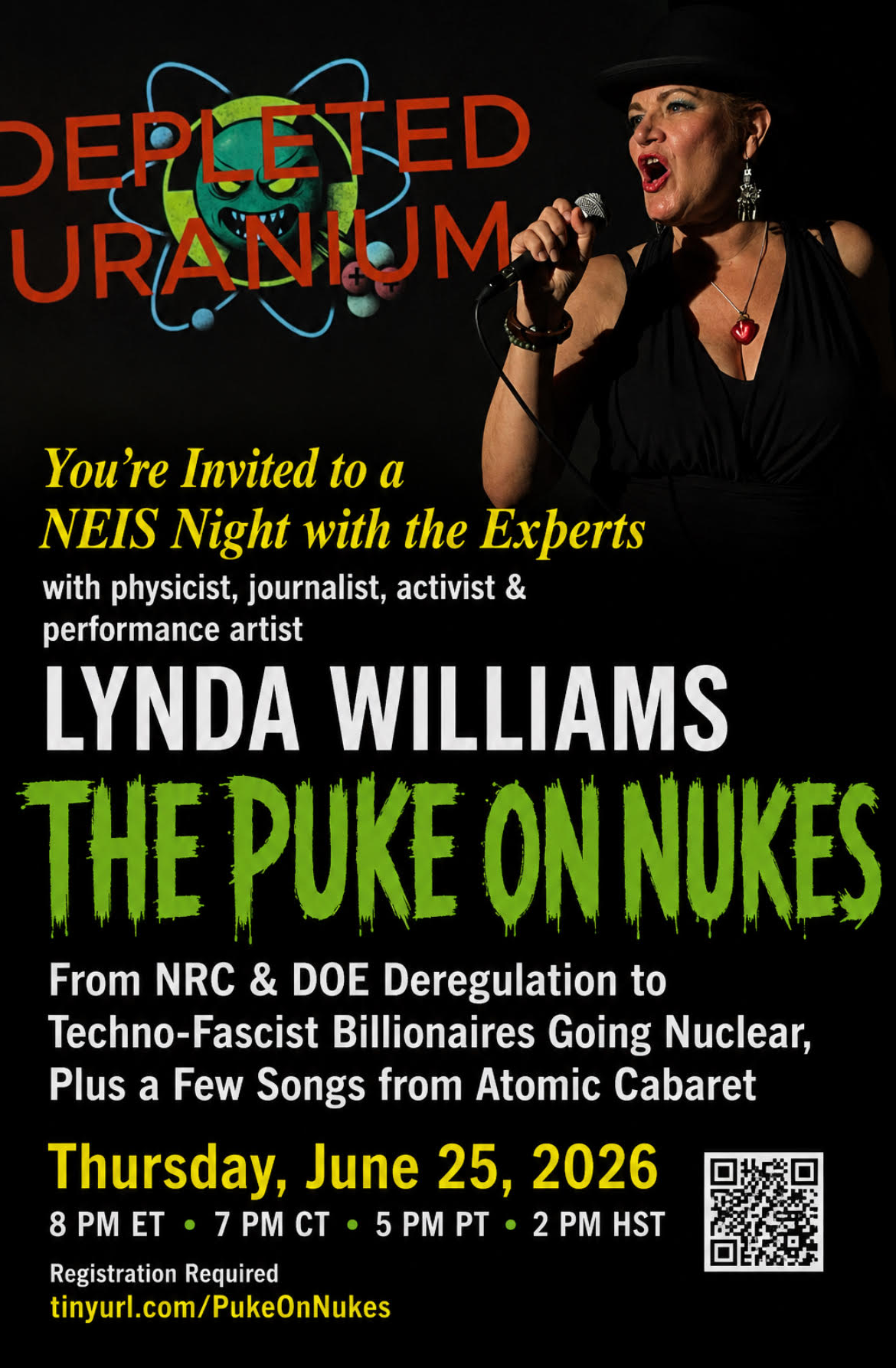
25 June- THE PUKE ON NUKES
Thursday, June 25, 2026
7pm Central Time (8pm ET, 6pm MT, 5pm PT) UTC – 5
From NRC & DOE Deregulation to Techno-Fascist Billionaires Going Nuclear, Plus a Few Songs from Atomic Cabaret REGISTER
26 June – Radiation Trainwreck at the NRC / Join the Protect Better Campaign – https://us02web.zoom.us/meeting/register/4ZlZ5_qLSHGiLSCg8FF6Bg#/registration


Cuba Is Not a Failed State – It Is a Besieged State
PETITION: “Global Appeal to Endorse Palestinian Right of Return of Refugees”
To see nuclear-related stories in greater depth and intensity – go to https://nuclearinformation.wordpress.com
-
Archives
- June 2026 (162)
- May 2026 (306)
- April 2026 (356)
- March 2026 (251)
- February 2026 (268)
- January 2026 (308)
- December 2025 (358)
- November 2025 (359)
- October 2025 (376)
- September 2025 (257)
- August 2025 (319)
- July 2025 (230)
-
Categories
- 1
- 1 NUCLEAR ISSUES
- business and costs
- climate change
- culture and arts
- ENERGY
- environment
- health
- history
- indigenous issues
- Legal
- marketing of nuclear
- media
- opposition to nuclear
- PERSONAL STORIES
- politics
- politics international
- Religion and ethics
- safety
- secrets,lies and civil liberties
- spinbuster
- technology
- Uranium
- wastes
- weapons and war
- Women
- 2 WORLD
- ACTION
- AFRICA
- Atrocities
- AUSTRALIA
- Christina's notes
- Christina's themes
- culture and arts
- Events
- Fuk 2022
- Fuk 2023
- Fukushima 2017
- Fukushima 2018
- fukushima 2019
- Fukushima 2020
- Fukushima 2021
- general
- global warming
- Humour (God we need it)
- Nuclear
- RARE EARTHS
- Reference
- resources – print
- Resources -audiovicual
- Weekly Newsletter
- World
- World Nuclear
- YouTube
-
RSS
Entries RSS
Comments RSS
 nuclear-news