Fifty two nations call for global arms embargo on Israel
Turkiye is leading the call for the embargo despite its ongoing trade with, and oil deliveries to, Israel
The Cradle, NOV 4, 2024
The Foreign Ministry of Turkiye sent the UN a letter signed by 52 nations and two organizations calling for a halt in military transfers to Israel, stating the Israeli army is committing genocide against Palestinians in Gaza.
Turkish Foreign Minister Hakan Fidan called for the arms embargo on Israel while speaking at a news conference in Djibouti on 1 November.
While attending the Turkiye–Africa collaboration meeting, Fidan announced that the group letter was sent to the UN and that it must be “repeated at every opportunity that selling arms to Israel means participating in its genocide.”
Ahmet Yildiz, Turkiye’s permanent ambassador to the UN, stated that Israel’s actions have pushed the region to the brink of war……………………………………………..more https://thecradle.co/articles/fifty-two-nations-call-for-global-arms-embargo-on-israel
Turkey needs to acquire nuclear arms to stop Israel, urges Erdogan’s chief fatwa giver
September 19, 2024, Abdullah Bozkurt/Stockholm, Nordic Monitor
Hayrettin Karaman, the 90-year-old Islamic jurist and chief fatwa (religious edict) giver for Turkish President Recep Tayyip Erdogan and a prominent ideologue for the Turkish Muslim Brotherhood, has said Turkey must pursue nuclear capabilities to counter Israel and establish deterrence against its adversaries.
In an article published September 8 in the Islamist Yeni Şafak daily, Karaman argued that Turkey’s current efforts are insufficient to stop Israel. He urged that “either the Islamic world must unite and collaborate with China and Russia, or Turkey must move forward by acquiring nuclear warheads and weapons.”…………………………………………………………………………………………………
Recalling his 1995 trip to Israel and Palestine, Karaman said he personally observed how Jews envision a “Greater Israel,” known as the “promised land” (Arz-ı Mev’ud). He claimed that Jews are advancing toward this goal with support from the West.
The so-called “promised land” conspiracy allegedly extends to parts of southeastern Turkey. President Erdogan has echoed this claim in public speeches, alleging that Israel seeks to annex Turkish territory. Erdogan has also praised Hamas, saying the group defends not only the rights of Palestinians but also those of Turks…………………………………………………………………………………………………………………………………………………….. more https://nordicmonitor.com/2024/09/turkey-needs-to-acquire-nuclear-arms-to-stop-israel-urges-erdogans-chief-fatwa-giver/
NATO Ally Sounds Alarm on ‘Risks’ of Nuclear War With Russia
https://www.newsweek.com/nato-ally-turkey-hakan-fidan-sounds-alarm-nuclear-risks-russia-1946854 30 Aug 24
Turkish Foreign Minister Hakan Fidan issued a warning about the “risks” of nuclear war with Russia, according to Russian state news agency Tass.
The Russia-Ukraine war has raged on for more than two years after Russian President Vladimir Putin ordered the “special military operation” in Ukraine in February 2022. Although Moscow aimed for a quick victory over its Eastern European neighbor, viewed as having a much smaller military, its spirited defense effort bolstered by Western aid, has blocked it from making substantial gains.
Recent weeks have seen Ukraine launch its own counteroffensive into Kursk—marking the first time Russian territory has been seized since World War II.
The conflict, however, has long raised concerns about whether Russia could deploy nuclear weapons. Putin has repeatedly made eyebrow-raising statements about nuclear weapons amid the ongoing war as Moscow has more nuclear warheads than any other country, according to the International Campaign to Abolish Nuclear Weapons (ICANW).
On Friday, Fidan raised concerns about whether nuclear weapons would eventually be used in Ukraine. Turkey is notably a key ally to the United States and member of the North Atlantic Treaty Organization (NATO), though Turkish President Recep Tayyip Erdoğan has at times broken from the West on Ukraine.
“Unfortunately, a war in the heart of Europe between Russia and Ukraine is in its third year. It risks escalating into a war involving the use of nuclear weapons,” Fidan said during a TRT Haber broadcast, Tass reported.
He added that there is “nothing more humane than the demand to stop the war” and that negotiations need to take place to “prevent our region from being further devastated by war.”
Newsweek has reached out to the Russian, Turkish and Ukrainian foreign ministries for comment via email
His remarks come after Sergey Naryshkin, director of Russia’s Foreign Intelligence Service (SVR) on Thursday accused the U.S. of “trying to bring imbalance to the system of international security” in the nuclear sphere.
In June, Putin said the possibility of Russia using nuclear weapons amid the war should “not be taken lightly” by the West.
“For some reason, the West believes that Russia will never use it…We have a nuclear doctrine, look what it says,” the Russian leader said, referring to his country’s policy of allowing nuclear weapon usage if “the very existence of the state is put under threat.”
“If someone’s actions threaten our sovereignty and territorial integrity, we consider it possible for us to use all means at our disposal,” Putin added. “This should not be taken lightly, superficially.”
The U.S. has been a key ally to Ukraine amid the conflict, with the Biden administration, along with many other world leaders, saying the invasion was unprovoked and lacks justification. Washington has given billions of dollars in military aid to Kyiv that has proven crucial to its defense efforts.
Ukraine’s Kursk offensive sparked nuclear concerns from Russia, which earlier this month accused Ukraine of attempting to attack a nuclear power plant using drones.
Concern about Turkey’s Akkuyu Nuclear Power Plant
https://www.ekathimerini.com/opinion/1207709/nuclear-concern/ 1 Apr 23, The announcement by Turkish President Recep Tayyip Erdogan that nuclear fuel will be loaded into the first power unit of the Akkuyu Nuclear Power Plant on April 27 this year should set the alarm bells ringing in the international community and Western allies in particular.
It must be ensured that the nuclear power plant in Mersin Province, on Turkey’s southern coast, will be used only for peaceful purposes and that the unstable leadership of Greece’s neighbor across the Aegean will not be tempted by its aspirations for the role of regional superpower, developing into an even more threatening risk factor.
The issue should not only concern Greece. https://www.ekathimerini.com/opinion/1207709/nuclear-concern/
Concerns over the construction of a nuclear power plant in Akkuyu, Turkey, due to its proximity to the 7.8 magnitude earthquake’s epicentre.
Deadly Turkey earthquake stirs debate over nuclear plant construction.
Activists have raised concerns over the construction of a nuclear power
plant in the southern city of Akkuyu, Mersin Province due to its proximity
to the 7.8 magnitude earthquake’s epicentre.
The New Arab 16th Feb 2023
https://www.newarab.com/news/turkey-quake-stirs-debate-over-nuclear-plant-construction
Fears of ‘catastrophic’ nuclear horror as Turkey’s reactor rocked by horror earthquake
Turkey’s Akkuyu Nuclear Power Plant is facing a major risk, an expert has
warned, as the death toll of the disastrous earthquake racks up. The
disaster in Turkey and Syria has so far left 11,224 confirmed dead, with
the World Health Organisation warning that the final death toll could be as
high as 20,000.
Rescue teams in Turkey and Syria worked through the night
to recover more bodies from the rubble of thousands of buildings destroyed.
Following the disaster, an expert told Express.co.uk that Turkey’s nuclear
power plant, which lies just 16 miles away from an earthquake fault and is
currently under construction, could be at risk.
Express 8th Feb 2023
NATO member sending banned cluster bombs to Ukraine – media
https://www.rt.com/news/569679-ukraine-t%C3%BCrkiye-cluster-munitions/ 11 Jan 23, Türkiye has been supplying Kiev with weapons that are banned in many countries, sources told Foreign Policy magazine
Ukraine has been receiving consignments of controversial cluster munitions from Türkiye, Foreign Policy magazine has reported. Kiev had been asking Washington for the Cold-War-era weapons for months.
The shipments have been taking place since November, current and former US and European officials told the outlet. It was unclear how many of the munitions had been received, or whether they had yet been used on the battlefield.
The weapons in question are called dual-purpose improved conventional munitions, or DPICMs. They were designed during the Cold War era, when NATO was planning to deploy them against a large-scale Soviet invasion of Europe. The rounds are filled with dozens of submunitions, intended to strike personnel and light-armored targets, scattering over a large area for increased lethality.
Like many other cluster munitions, DPICMs tend to produce long-lasting hazards, as some submunitions can fail to detonate and have the potential to maim or kill somebody years after being deployed.
US law prohibits the exportation of any cluster weapons with a failure rate over a certain threshold. The same regulations require guarantees that cluster munitions will not be used in areas where civilians may be present. Washington has repeatedly rejected requests from Kiev for the supply of DPICMs.
Most European NATO members are signatories of the 2008 Convention on Cluster Munitions (CCM), which bans this type of weapons. Türkiye is not one of them, but has observer status in the Geneva-based organization that oversees the implementation of the treaty. It has indicated that it abides by the rules, though it’s not obliged to.
According to Foreign Policy, the weapons supplied to Ukraine were manufactured during the Cold War under a co-production agreement with the US. Turkish companies made 155mm and 122mm cluster artillery rounds, the magazine claimed.
Neither Russia nor Ukraine are parties to the CCM, and both have reportedly used their Soviet-made cluster munitions in their armed conflict. In March, a Tochka-U missile with a cluster payload killed more than 20 people and injured dozens more in the city of Donetsk. Moscow blamed Kiev for the attack, but this was denied. International watchdog Human Rights Watch (HRW) later stated that it could not investigate the incident.
“Ukraine already has a massive problem on its hands, and it’s only magnifying it by introducing this weapon,” Mark Hiznay, a senior researcher in the Arms Division for HRW, told Foreign Policy, commenting on Kiev’s effort to get more cluster weapons.
Russian state firm signs $9.1bn loan deal to fund nuclear plant in Turkey

Rosatom, which has been wiring money to Ankara to shore up Turkey’s depleted foreign currency reserves, signs deal with Gazprombank, Ragip Soylu, Antalya, Turkey, 16 September 2022
A Russian state-owned company signed a $9.1bn loan deal with Gazprombank in August to fund the construction and development of Turkey’s Akkuyu nuclear power plant, according to the official documents.
In a public announcement on Wednesday, Rosatom Corp published the deal signed on 3 August, which opens a line of credit to finance Akkuyu Nuclear JSC, its subsidiary in Turkey………………………..
Bloomberg reported last month that Rosatom had decided to wire $15bn to Turkey for the construction of the $20bn Akkuyu nuclear power plant, citing officials who said that an initial $5bn had already been received…………………
The Turkish government is in dire need of foreign funding as a result of its rapidly evaporating foreign currency reserves.
Rosatom is expected to rapidly spend up to $2bn on overdue payments to subcontractors. The company told Bloomberg that it would indeed transfer some funds to Turkey, but an amount much lower than that declared by Turkish officials………….more https://www.middleeasteye.net/news/russia-turkey-gazprombank-akkuyu-plant-loan-fund
Turkey’s nuclear plans threaten Eastern Mediterranean ecosystems
Turkey’s nuclear plans threaten East Med ecosystems, ekathimerini.com, Elias G. Hadjikoumis, 10 Dec 21, Turkey has had plans to establish nuclear power plants since the 1970s, and these plans have become a key aspect of the country’s goal of economic development and growth. The Akkuyu Nuclear Power Plant (ANPP) is the first. Turkey and Russia ratified the agreement to construct the plant in May 2010. The agreement indicated that Akkuyu NGS Elektrik Uretim Corp, a subsidiary of Rosatom, would construct, own and operate the plant. The nuclear power plant is to comprise four reactors. While the major construction activities began in March 2018, the first reactor unit is expected to be operational in 2023 and the remaining units in 2026. Once complete, the plant is seen covering 10% of the country’s total electricity supply. Turkey also intends to build two nuclear power plants on the Black Sea coast to meet energy demands. Although the plants would give the country clean [?] energy and make it energy-independent, there are numerous negative environmental effects associated with the generation of nuclear energy, and these pose a threat to Turkey’s neighboring countries as well as Turkey itself.
Nuclear is considered a clean source of energy because no carbon dioxide is emitted during operation, however, all activities related to building and running a plant lead to the production of high amounts of CO2, including the current construction and plant development processes at Akkuyu. Additionally, the plant will use uranium as its main source of fuel, whose extraction processes release great amounts of CO2 into the atmosphere.
The power plant is located close to the Eastern Mediterranean, a region which comprises a vast set of coastal and marine ecosystems that deliver valuable benefits to all its coastal inhabitants. The region is set to experience negative environmental changes because of the huge amounts of water that will be required to cool the plant’s reactors. Pumping the seawater used to cool the four reactors back into the sea could lead to an 80% increase in water temperatures (2 to 5 degrees Celsius). The temperature rise would affect the area’s marine diversity. Environmentalists expect a decline in the number of fish because the high temperatures would probably kill most of them and reduce the egg-laying capacity of the rest. The high temperatures will also make the marine environment uninhabitable for a colony of Mediterranean monk seals and a very rare species of sea daffodil (Pancratium maritimum).
ANPP will affect countries around Turkey, especially Cyprus and Greece. Greece has already raised the alarm due to the lack of significant evaluation of the project and any protective measures for the environment and its neighbors. In fact, there were claims that the evaluation process for the plant was never concluded in Turkey. It is said that the government was influenced to hasten and conclude the evaluation process to favor its establishment in the specified site, which many consider unsafe because of the seismic activity in the area.
The European Parliament has called on the Turkish government to halt construction of the plant, citing the location of the construction site in a region prone to severe earthquakes. According to the European Parliament, the location of the site in a region prone to earthquakes poses a threat to Turkey and the entire Mediterranean region. The facility is situated 16 miles from the Ecemis fault line at the meeting point of the Eurasian and African tectonic plates. The fault was initially believed to be inactive when the nuclear plant’s site license was issued in 1976. However, scientific studies published in recent decades have shown that the fault is active. A nuclear engineering professor from an Istanbul university, one of the original nuclear engineers who signed the site license in 1976, indicates that the current construction is based on ignorant planning
and may pose a considerable threat to the Mediterranean region……………..
So far, no consultations have been held with neighboring countries. Commenting on the issue, a representative of the European Commission indicated that Turkey was not a party to international conventions, requiring countries to consult their neighbors over the environmental effects of major projects. The EU representative emphasized that Turkey is expected to align its legislation with EU requirements on such projects………
the greatest concern in the development of ANPP is radioactive waste in the East Medn region. Turkey has not yet signed the Joint Convention on the Safety of Spent Fuel Management and on the Safety of Radioactive Waste Management which came into effect in June 2001. Burying radioactive waste in the region would make it uninhabitable and in the event of an accident, the radioactive leak would be catastrophic to the environment. Local observers have already raised these issues. The observers argue that there has not been any clear explanation as to how Rosatom will dispose of the radioactive byproduct material generated by the nuclear plant. They fear that the site may even become a Russian nuclear dumpsite.
In conclusion, the nuclear project is a threat to Turkey and its neighbors. Its location in earthquake-prone areas and its anticipated negative environmental impact mean that the international community should put it on hold until a further assessment is carried out to determine its environmental viability. The project should be placed on hold because Turkey is not a signatory of international conventions and hence not obliged to consult with neighboring nations. The lack of consultations means that Turkey does not adequately account for the negative externalities arising from the plant on neighboring countries such as Greece and Cyprus.
Further assessment is needed to determine the effect of the plant on marine life and the potential negative effects owing to the vulnerability of Turkey and the Mediterranean region to earthquakes. The project was initiated and started even before a full commission and evaluation had been done and Turkey’s energy policies and prospects have a short overview, increasing the likelihood of an accident or lack of appropriate measures to contain any accidents in the region. The international community should take a strict position vis-a-vis the project, asking for close and consistent monitoring of all the nuclear development activities and future operations of the plant. https://www.ekathimerini.com/opinion/1173463/turkey-s-nuclear-plans-threaten-east-med-ecosystems/
Fire at Akkuyu Nuclear Power Plant
Last minute… Fire panic at Mersin Akkuyu Nuclear Power Plant. It has
been reported that a fire broke out in the Akkuyu Nuclear Power Plant,
which is under construction in Mersin. Speaking about the fire, CHP’s Ali
Mahir Basarir said, “This nuclear power plant has been the scourge of
Mersin and Turkey.”
Cumhuriyet 31st Oct 2021
Dire problems at Turkey’s Akkuyu nuclear Project
Yesil Gazette 27th Jan 2021, Problems around Akkuyu NPP are so dire that, even the supporters of nuclearenergy must object’ If Such accidents occur during the construction phase
of nuclear facilities that require maximum safety, it means that risks of
Akkuyu Project are beyond general nuclear risks. When we see that facts are
hidden from public it is obvious that problems around Akkuyu NPP is so dire
that even the advocates of nuclear energy must object ‘says nukleersiz.org
Coordinator Pinar Demircan. The uncertainty about the explosion that broke
the windows of the houses and cars in the surrounding, which took place in
the evening of Tuesday, January 19 at the Akkuyu Nuclear Power Plant (NPP)
* – which is under construction in the Gulnar district of Mersin –
continues.
Turkey’s aspirations to become a nuclear weapons power
|
Will Turkey become a nuclear weapon power with Pak’s covert support? The Siasat Daily By IANS| 3rd January 2021 New Delhi: A rogue nexus involving Pakistan and Turkey, with China looking the other way, maybe taking root to fulfil Ankaras ambition to emerge as the worlds next nuclear weapon power.
Suspicions about Pakistan’s covert support for Turkish nukes has been aroused by a recent meeting of the Turkey-Pakistan High-Level Military Dialogue Group (HLMDG). The assemblage took place on December 22-23, 2020. Pakistan’s Defence Secretary Lt. Gen. (Retd.) Mian Muhammad Hilal Hussain led the delegation from Islamabad, while Deputy Chief of Turkish Army General Selcuk Bayraktaroglu headed the Turkish team, says an article published by the website zeenews.india.com.
There are other indications that collaboration on nuclear delivery systems was the hot topic discussed during the meeting. The visitors from Islamabad met top Turkish Army generals and bureaucrats dealing with missile production and aerial military hardware. The hosts included Professor Ismail Demir head of Presidency of Turkish Defence Industries and Temil Kotil, CEO of Turkish Aerospace Limited (TAI). The Pakistani defence delegation also visited top Turkish defence companies including Bakyar (UAV OEM), TAI, HAVELSAN and ASELSAN. Staunch strategic allies Analysts say that the insider meetings in Turkey took place within a rapidly evolving geopolitical context. Islamabad and Ankara have become staunch strategic allies, a partnership sealed by personal bonds between Turkey’s ambitious President, Recep Tayyip Erdogan and Pakistan’s military backed Prime Minister Imran Khan. It is no secret that Erdogan hopes to emerge as the pre-eminent Islamic leader, marginalising established heavyweights such as Mohamed bin Sultan, the Crown prince of Saudi Arabia………..
On his part, Erdogan has made no secret about his nuclear ambitions—a gateway for the fulfilment of his self-espoused dream of elevating Turkey’s status to the heights of the Ottoman empire.
In September 2019, he said: “Some countries have missiles with nuclear warheads, not one or two. I, however, am not supposed to have missiles with nuclear warheads. This, I cannot accept… And right next to us, there is Israel, right? With everything, it is frightening.”…….. https://www.siasat.com/will-turkey-become-a-nuclear-weapon-power-with-paks-covert-support-2059645/
|
|
Environmental problems, and legal holdup for Russia’s $20 billion nuclear power project in Turkey
Russia’s $20 billion nuclear power project located in Mersin on Turkey’s Mediterranean coast has long come under fire over safety and environmental concerns, including claims of large cracks in the concrete foundations due to loose and unstable ground in the area.
Officials broke ground on the Akkuyu power plant in 2018, which is set to be Turkey’s first nuclear power station and is due to come online in 2023 – the 100th anniversary of the Republic of Turkey.
But engineers and workers began ringing alarm bells over a potential nuclear disaster soon after its inception, and a group of NGOs filed a lawsuit with a Turkish court demanding for construction to be halted…….
A Turkish court in the southern province of Mersin ruled on Friday to accept a request by the NGOs for relevant ministries and the National Security Council (MGK) to be able to intervene in the project, Cumhuriyet newspaper reported.
The court said the case would be reported to the MGK, which has no obligation to intervene in construction, but may now choose to do so. Lawyers involved in the case hd also said that the Russian power power plant could pose a national security threat to Turkey.
The court also gave the green light to a request by the NGOs for the involvement of a number of Turkish ministries in the case, including the Health Ministry, the Treasury and Finance Ministry, as well as the Food, Agriculture and Livestock Ministry.
How this latest development will play out in the ambitious Russian-Turkish joint-venture remains to be seen. But it arrives at a time of ongoing tensions between Ankara and Moscow over Idlib province in northwest Syria, where the two countries back opposing sides……https://ahvalnews.com/nuclear-energy/turkeys-russian-nuclear-power-project-hits-legal-hurdle
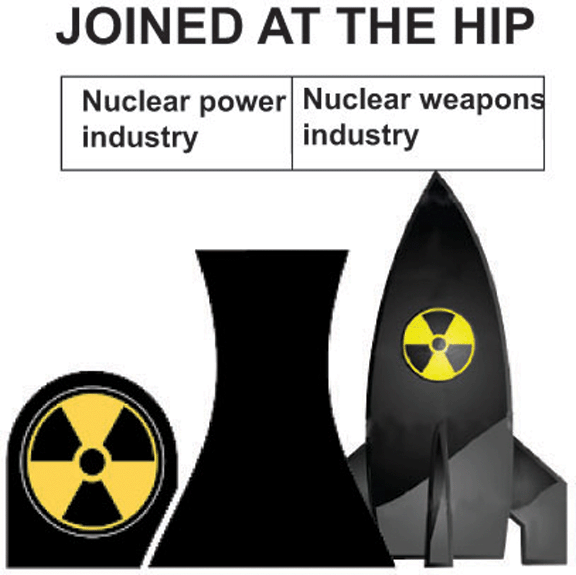
British small nuclear reactors to help Turkey to get nuclear weapons?
 Fears over nuclear Turkey after Rolls Royce reactor deal, Morning Star,
 MARCH 25, 2020 ENGINEERING firm Rolls-Royce has struck a deal with Turkey for the production of nuclear mini-reactors, sparking fears that the British company and its international consortium partners are helping pave the way for Ankara to develop a nuclear bomb…..
the plans have raised fears that Turkey’s authoritarian President Recep Tayyip Erdogan could use the development as a step towards the country becoming a nuclear-armed power.
As previously reported in the Morning Star, Turkey’s secret nuclear programme includes plans to acquire weapons of mass destruction (WMDs), including nuclear missiles.
Writing in a pro-government newspaper in 2017, Mr Karaman said: “We need to consider producing these weapons, rather than purchasing them, without losing any time and with no regard to words of hindrance from the West.”
There are already some 70 US-owned nuclear warheads said to be based at Incirlik airbase near the southern of Adana.
In previous deals with Russia and a Japanese-French consortium, the door was left open for the development of nuclear weapons after Turkey rejected offers to include the provision of uranium and the return of the spent fuel rods used in the reactors.
The development has parallels with the Indian missile capability developed after the testing of plutonium produced in the Canadian-supplied Cirus reactor, which first raised the issue that nuclear technology supplied for peaceful purposes could be diverted to weapons production. https://morningstaronline.co.uk/article/b/fears-over-nuclear-turkey-after-rolls-royce-reactor-deal
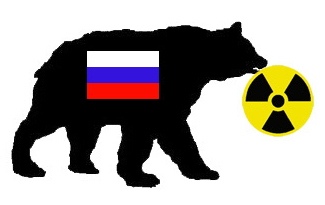
Russia’s nuclear company Rosatom in financial trouble trying to fund nuclear project in Turkey

 Turkey’s first nuclear plant delayed by funding problems – energy expert https://ahvalnews.com/turkey-energy/turkeys-first-nuclear-plant-delayed-funding-problems-energy-expert, Nov 30 2019 Turkey’s first nuclear plant delayed by funding problems – energy expert https://ahvalnews.com/turkey-energy/turkeys-first-nuclear-plant-delayed-funding-problems-energy-expert, Nov 30 2019
Completion of Turkey’s first nuclear power station is likely to be delayed as the Russian company building it is struggling to secure funding, former diplomat and Bosphorus Energy Club head Mehmet Öğütçü told Turkish daily Sözcü. A small part of the plant in Akkuyu, southern Turkey, may be opened for political reasons in 2023, the centenary of the founding of the Turkish Republic, Öğütçü said. But Russian state-owned Rosatom is having difficulties financing the project, which is expected to cost between $20 billion and $25 billion, he said, adding that Western companies were avoiding Akkuyu over concerns about nuclear armament. A Turkish consortium pulled out of the project last year, citing a failure to reach commercial terms with Rosatom, which owns a 51 percent stake in the project. A report by the main opposition Republican People’s Party this month criticised the terms of the government’s deal with Rosatom, which has been guaranteed a price of 12.35 U.S. cents per kilowatt hour in a 15-year power purchase agreement. |
|
1 This Month

of the week – Shut Down Drone Warfare!


Tell the Ukrainian Government to Drop Prosecution of Peace Activist Yurii Sheliazhenko

Petition to revoke the licensing of the Near Surface Nuclear Disposal Facility (NSDF) at Chalk River. https://www.ourcommons.ca/petitions/en/Petition/Details?Petition=e-7247
To see nuclear-related stories in greater depth and intensity – go to https://nuclearinformation.wordpress.com
-
Archives
- March 2026 (244)
- February 2026 (268)
- January 2026 (308)
- December 2025 (358)
- November 2025 (359)
- October 2025 (376)
- September 2025 (257)
- August 2025 (319)
- July 2025 (230)
- June 2025 (348)
- May 2025 (261)
- April 2025 (305)
-
Categories
- 1
- 1 NUCLEAR ISSUES
- business and costs
- climate change
- culture and arts
- ENERGY
- environment
- health
- history
- indigenous issues
- Legal
- marketing of nuclear
- media
- opposition to nuclear
- PERSONAL STORIES
- politics
- politics international
- Religion and ethics
- safety
- secrets,lies and civil liberties
- spinbuster
- technology
- Uranium
- wastes
- weapons and war
- Women
- 2 WORLD
- ACTION
- AFRICA
- Atrocities
- AUSTRALIA
- Christina's notes
- Christina's themes
- culture and arts
- Events
- Fuk 2022
- Fuk 2023
- Fukushima 2017
- Fukushima 2018
- fukushima 2019
- Fukushima 2020
- Fukushima 2021
- general
- global warming
- Humour (God we need it)
- Nuclear
- RARE EARTHS
- Reference
- resources – print
- Resources -audiovicual
- Weekly Newsletter
- World
- World Nuclear
- YouTube
-
RSS
Entries RSS
Comments RSS
 nuclear-news