South Korea desperately buying time, as another 750 tonnes add yearly to its nuclear waste stack

it’s really stupid to just keep on making the stuff
As Nuclear Waste Piles Up, South Korea Faces Storage Crisis, Scientific American, 14 Oct 14“……….The 23 nuclear reactors in Asia’s fourth-biggest economy add a total of 750 tonnes of spent fuel every year to the 13,300 tonnes that filled 71 percent of its wet and dry storage capacity as of last year, according to reactor operator Korea Hydro and Nuclear Power Co Ltd, owned by state-run Korea Electric Power Corp.
That means storage could fill by 2021, with some pools in danger of reaching capacity by the end of 2016.
Seoul hopes to win time by stacking spent fuel more densely in those concrete-covered pools next to reactor buildings, and by moving waste to pools at 11 new power plants that are set to be built by 2024.
But experts warn that leaving spent fuel in water could be fraught with danger, even in a country that is not anywhere near as seismically active as Japan. They note that the buildings that house pools are typically not as strong as those that hold reactors, which have steel vessels inside concrete domes.
“Spent fuel in a concrete building next to reactor buildings is vulnerable to missile or other attacks from the outside,” said one expert, who declined to be identified due to the sensitivity of the matter.
He said that stacking fuel more densely would compound any risk as it would reduce air circulation.
“Air circulation helps lower chances of spent fuel meltdown if water drains or water-cooling pumps are broken when hit by natural disaster or terror attack.”http://www.scientificamerican.com/article/as-nuclear-waste-piles-up-south-korea-faces-storage-crisis/
South Korea’s nuclear unsafety – 684 Accidents and Failures over 37 Years

 Korean Nuclear Power Plants Exposed to 1,843 Hacks over Five Years– Business Korea 10 OCTOBER 2014The number of hacking attempts against nuclear power plants in Korea was found to have reached 1,843 during the last five years. Experts are calling for special cybersecurity measures for nuclear power stations under the circumstances
…..684 Accidents and Failures over 37 Years
With the situation as it is, the general public’s concerns over aging nuclear power plants as well as hacking attempts are on the rise. The total number of nuclear power generation accidents and breakdowns in Korea has reached 684 since the commercial operation of Gori 1 back in 1978. Out of those, 130 have happened in the oldest facility.
“The government is just repeating that nuclear power generation is a safe way of power supply,” Democratic United Party lawmaker Moon Byung-ho explained, continuing, “However, it would be well advised to reexamine its safety, security, sustainability, and economic advantages by taking this as an opportunity and shutting down the oldest nuclear power stations for a paradigm shift.” http://www.businesskorea.co.kr/article/6718/security-unawareness-korean-nuclear-power-plants-exposed-1843-hacks-over-five-years#sthash.iaBiCo9G.dpuf
City of Samcheok, South Korea, votes NO to nuclear power
 South Korean town votes no to nuclear plant WP, By Associated Press October 9 SEOUL, South Korea — Voters in a South Korean city have rejected plans to build a nuclear power plant in a referendum the government says has no legal effect.
Thursday’s vote in Samcheok, on South Korea’s east coast, went as expected following this year’s election of a mayor who wants the government to scrap nuclear plant……..“I will persuade the national government based on this result,” the Samcheok mayor, Kim Yang-ho, told Yonhap News Agency. “I hope the government’s policy will reflect Samcheok citizens’ real opinion.”……..
Some 85 percent of the 28,867 residents who cast ballots said no, according to a volunteer committee set up to administer the referendum after election authorities refused. Out of 42,488 who registered to take part, turnout was 68 percent……http://www.washingtonpost.com/world/asia_pacific/south-korean-town-votes-no-to-nuclear-plant/2014/10/09/1d3d23ce-5023-11e4-877c-335b53ffe736_story.html
Looks like global warming is stopping nuclear power, rather than the other way round
Heavy Rain in South Korea Kills Five, Shuts Nuclear Plant Officials Say Five People Still Missing WSJ, By
JEYUP S. KWAAK 25 Aug 14, SEOUL-Heavy rainfall on Monday killed at least five people and shut down a nuclear reactor in South Korea, pushing the country’s populous southeast region to a near-standstill. …… A 650-megawatt nuclear reactor in Busan, about 330 kilometers (204 miles) southeast of Seoul, was also suspended on Monday after rising water flowed into the facilities, the national nuclear-power-plant operator Korea Hydro & Nuclear Power Co. Ltd said. The reactor remained shut down as of Tuesday morning…….http://online.wsj.com/articles/heavy-rain-in-south-korea-kills-five-shuts-nuclear-plant-1409023982
South Korea – getting “full up” with nuclear radioactive trash
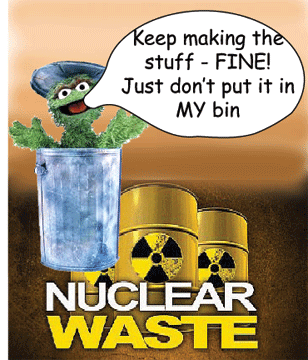
they must just stop making this trash!
South Korea running out of space for nuclear waste http://www.abc.net.au/news/2014-08-18/south-korea-running-out-of-space-for-nuclear-waste/5679626 South Korea is running out of space to store its spent nuclear fuel, with some of its storage facilities set to reach capacity by 2016, according to an independent body that advises the government on nuclear issues.
A Public Engagement Commission, consisting of nuclear experts, professors, and officials, was set up in October 2013 to take account of public opinion on spent nuclear fuel issues and feed into policy decisions.
Commission chairman Hong Doo-seung says it is urgent to find more storage sites for spent fuel.
“We will have to stop nuclear power generation if we fail to find additional temporary space, Continue reading
South Korea’s preparation for pre-emptive nuclear strike against North Korea
 FROM THE POPE TO WAR GAMES IN SOUTH KOREA ORGANISING NOTES, BRUCE GAGNON , AUGUST 19, 2014
Global Network board member Sung-hee Choi, long time activist on Jeju Island, wrote today:
Recently, Pope Francis has visited Korea from Aug. 14 to 18. He left us many moving messages of peace and justice, but the South Korean (ROK) conservative Park Geun-Hye government started the World-biggest war exercise Ulji Freedom Guardian (In government drill, about 480,000 personnel join. In military drill, about 50,000 Korean soldiers and 30,000 US soldiers) started along with the United States on his leaving day. It ends on Aug. 21.
The exercise targets North Korea and the strategy includes preemptive nuclear strike against her. The exercise will be a passage for the US to push for the US-Japan-ROK trilateral military alliance and Missile Defense system. http://space4peace.blogspot.com.au/2014/08/from-pope-to-war-games-in-south-korea.html
Radiation-polluted steel returned to Japan from South Korea
South Korea to return 20 kg Japanese steel scrap due to radiation contamination Aug 11, 2014 By Meeyoung Cho SEOUL (Reuters) – South Korea plans to return some steel scrap imported from Japan due to radiation contamination, the first returned shipment since Seoul heightened nuclear safety checks in 2012, the country’s nuclear watchdog said in a statement on Monday.
The Nuclear Safety and Security Commission detected caesium 137 at a higher than allowed level in 20 kilogrammes of steel scrap out of a total 20 tonnes imported earlier this month, said a spokeswoman at the agency…….http://af.reuters.com/article/worldNews/idAFKBN0GB0IA20140811
Opposition to nuclear power is strengthening in South Korea
S. Korea faces strong opposition to nuclear power SEJONG, June 15 (Yonhap) — The South Korean government is facing a renewed opposition against nuclear power plants sparked by the recent tragic sinking a passenger ferry while the need for what is considered the cheapest source of power is growing, government officials said Sunday.
The opposition against nuclear power plants gained a new momentum on raised public awareness for safety following the April 16 sinking of the passenger ferry, Sewol, in which 292 people have been confirmed dead with 12 still unaccounted for.
Those who have long opposed nuclear power are again pointing their fingers at nuclear power plants as the most hazardous facilities, which, they claim, could cause a far greater and more devastating tragedy than the ferry sinking should there be any accident, according to the government officials, who spoke on condition of anonymity.
Such a sentiment was also seen in recent remarks by Rep. Park Young-sun, floor leader of the main opposition New Politics Alliance for Democracy, who said, “Nuclear power plants are now said to be the largest threat to safety in our society after the sinking of the Sewol.”
Already, environmental groups are demanding the government decommission a nuclear reactor at Wolseong Nuclear Power Plant, which is currently undergoing review for a possible extension of its lifespan. The initial 30-year lifespan of the reactor located some 400 kilometers southeast of Seoul expired in November 2012……
South Korea and China in agreement on threat of North Korea’s nuclear activities
China agrees North Korea’s nuclear activities a serious threat, says South Mon May 26, 2014 SEOUL (Reuters) – South Korea and China agreed on Monday that recent nuclear activity by North Korea posed a serious threat to the peace and stability of the region and Pyongyang must not conduct a nuclear test, Seoul said after a meeting of their top diplomats.
Renewed activity at North Korea’s nuclear test site has indicated Pyongyang may be preparing a fourth nuclear test in contravention of U.N. sanctions.
Analysis have suggested the North may be close to miniaturising a nuclear warhead to mount on a missile, alarming regional powers that have for two decades tried to rein in Pyongyang’s atomic programme.
Chinese Foreign Minister Wang Yi held talks with his South Korea counterpart Yun Byung-se to discuss the North’s nuclear programme, as well as an upcoming visit by Chinese President Xi Jinping to Seoul this year, South Korea’s foreign ministry said.
“The two ministers agreed to step up cooperation based on the united position that they object to the North’s nuclear test and that recent nuclear activities by the North pose a serious threat to the peace and stability of the Korean peninsula and the region,” the ministry said.
China, North Korea’s lone major ally, is usually very guarded in its opinion on Pyongyang’s nuclear programme, usually expressing its desire for a nuclear-free “Korean peninsula” and careful not to be seen to be taking sides…….http://af.reuters.com/article/worldNews/idAFKBN0E61LJ20140526
South Korea offers aid to North Korea
South Korea proposes aid for North if it halts nuclear arms programme First Post, Mar 29, 2014 SEOUL (Reuters) – South Korean President Park Geun-hye proposed a broad range of economic aid for impoverished North Korea on Friday if it agrees to give up its nuclear programme. It was not immediately clear how the North would respond to the proposal, made in a speech in Dresden, Germany, but it has repeatedly rejected the idea of abandoning its nuclear programme, which it says is a necessary deterrent against U.S. hostility.
…………. http://www.firstpost.com/world/south-korea-proposes-aid-for-north-if-it-halts-nuclear-arms-programme-1455913.html?utm_source=ref_article
South Korea cutting back on nuclear expansion plans
 S. Korea scales back nuclear expansion plans The West Australian, 11 Dec 13, Seoul (AFP) – South Korea is scaling back its commitment to nuclear energy after safety concerns prompted a series of reactor shutdowns, officials said Tuesday……The Ministry of Trade, Industry and Energy said it has accepted recommendations from a government advisory group in September to scale back the nuclear expansion plans…..
Safety concerns that were already high in the wake of the 2011 Fukushima crisis in Japan have been heightened by revelations of widespread corruption and faulty equipment.
Nuclear reactors have been abruptly shut down 128 times over the past decade because of malfunctioning parts, officials admitted in October. Public prosecutors have charged about 100 people after discovering that documents relating to some parts in 20 working reactors, and eight under construction, had been forged…….http://au.news.yahoo.com/thewest/world/a/20257649/s-korea-scales-back-nuclear-expansion-plans/
6 Nuclear reactors now shut down in South Korea
S.Korea nuclear reactor hit by automatic shutdown; six units now off First Post World, 29 Nov 13, SEOUL (Reuters) – A “safety-related action” automatically shut down one of its 23 nuclear reactors on Thursday, South Korea’s nuclear operator said, bringing the tally of those closed to six and hiking chances of possible power blackouts this winter……. “We are now looking into the cause of the shutdown and it is not yet clear when the reactor will restart,” said a spokesman at operator Korea Hydro & Nuclear Power. Operation of the 587-megawatt Kori No. 1 reactor, over 300 km southeast of Seoul, was suspended early on Thursday morning. The reactor, which started operation in 1978, had recently returned from nearly 180 days of scheduled maintenance through October 5, according to KHNP’s website. (www.khnp.co.kr). The unit’s license to operate was extended another 10 years in end-2007, another KHNP spokesman noted……
Scandal-ridden South Korea wants a piece of the UK nuclear action!
 Scandal-hit Korean group makes UK nuclear bid, Ft.com, 19 Nov 13 By Guy ChazanA Korean nuclear company that has been rocked by a domestic safety scandal is close to becoming a major investor in the UK – a development that could hit public confidence in the country’s much-vaunted nuclear renaissance. Korea Electric Power, or Kepco, is in talks to join the NuGen consortium, which has an option to build a reactor near Sellafield in Cumbria……
Some UK industry figures have expressed concern.
“Why would you want anyone with that kind of safety record?” said one person with knowledge of the NuGen negotiations. He said it risked “damaging the public perception of nuclear in the UK”.
But such concerns are likely to grow as more and more overseas state-owned groups enter the British marketplace. “If major pieces of UK energy infrastructure – not just nuclear – are owned by investors from afar, it’s going to give rise to a level of public disquiet that we haven’t seen so far,” said Nick Pidgeon, head of the Understanding Risk Research Group at Cardiff University.
The NuGen development highlights how reliant the UK is on foreign investors for its nuclear renaissance. Continue reading
Radiation fears severely damaging South Korea’s seafood traders
Fish Is Off the Menu in South Korea Over Radiation Fears Koreans Avoid Seafood Over Fears of Fukushima Contamination, WSJ, By KWANWOO JUN 14 Nov 13, SEOUL—”There have been no buyers yet,” said fish trader Choi Mi-ja as the clock ticked toward 3 p.m., some 10 hours after her store at the Noryangjin Fisheries Wholesale Market opened for the day.“In 26 years in this business, I’ve never seen anything like this before,” Ms. Choi added, standing by tanks where live, locally bred flatfish and Russian-imported king crabs were displayed.
Ms. Choi’s predicament provides a taste of the psychological impact of Japan’s nuclear crisis on South Korea’s seafood industry. Sales of marine products have plummeted in recent months as three out of every four Koreans say they have cut back on fish consumption following leaks of radioactive water from the Fukushima Daiichi nuclear power plant in Japan.
The fears come despite Seoul imposing some of the toughest restrictions on seafood imports from Japan. Since September, it has blocked all fishery imports from eight prefectures surrounding the Fukushima Daiichi plant, on Japan’s Pacific coast.
Around 80% of seafood consumed in South Korea is caught locally, where there is no evidence of any impact from the nuclear disaster. Despite the facts, many Koreans are shunning seafood……..http://online.wsj.com/news/articles/SB10001424052702303289904579196893701088208
South Korea could find nuclear power much more costly
Nuclear power could be more costly than thought, The Hankyorheh, S. Korea, : Nov.12,2013 Analysis shows that if full range of costs is factored in, nuclear energy is not as low-cost an option as the gov’t says By Hwangbo Yeon, staff reporter
A newreport suggests that nuclear power would lose its price competitiveness if taxes on power sources like coal and liquefied natural gas (LNG) were collected more fairly and costs of transmission grid construction and social risks were assessed.
If such a price structure is realized, it stands to undermine claims of the superior cost-effectiveness of nuclear power, which the government has used to argue for its expansion.
The report on a price recalculation scenario for different power generation facilities was presented at a recent Power Industry Research Association seminar by Hanbat National University professor Cho Young-tak…….
The cost-effectiveness reversal becomes even more conspicuous when nuclear power accident risk costs and price variations from the introduction of shale gas are also factored in. The price of nuclear power rises from as low as 95 won to as much as 143 won when conditions such as damage payment costs (based on the compensation levels for the Fukushima Daiichi Nuclear Power Plant disaster in Japan) and a 25% drop in gas import costs due to shale gas are taken into account. This range is well ahead of the 88-102 won for coal and 92-121 won for LNG.
1 This Month


Website of the Week

New book – https://www.amazon.com/dp/1923372157?utm_source=substack&utm_medium=email
Now until to February 10, 2026 Radioactive waste storage in France: the debate is finally open! How to participate?
-
Archives
- January 2026 (127)
- December 2025 (358)
- November 2025 (359)
- October 2025 (377)
- September 2025 (258)
- August 2025 (319)
- July 2025 (230)
- June 2025 (348)
- May 2025 (261)
- April 2025 (305)
- March 2025 (319)
- February 2025 (234)
-
Categories
- 1
- 1 NUCLEAR ISSUES
- business and costs
- climate change
- culture and arts
- ENERGY
- environment
- health
- history
- indigenous issues
- Legal
- marketing of nuclear
- media
- opposition to nuclear
- PERSONAL STORIES
- politics
- politics international
- Religion and ethics
- safety
- secrets,lies and civil liberties
- spinbuster
- technology
- Uranium
- wastes
- weapons and war
- Women
- 2 WORLD
- ACTION
- AFRICA
- Atrocities
- AUSTRALIA
- Christina's notes
- Christina's themes
- culture and arts
- Events
- Fuk 2022
- Fuk 2023
- Fukushima 2017
- Fukushima 2018
- fukushima 2019
- Fukushima 2020
- Fukushima 2021
- general
- global warming
- Humour (God we need it)
- Nuclear
- RARE EARTHS
- Reference
- resources – print
- Resources -audiovicual
- Weekly Newsletter
- World
- World Nuclear
- YouTube
-
RSS
Entries RSS
Comments RSS
 nuclear-news