How nuclear submarines could pave the way for nuclear weapons in South Korea
Bulletin, By Sharon Squassoni | December 12, 2025
Share
The mystique of nuclear-powered submarines has been captured by at least half a dozen popular Hollywood films. Some have centered on the drama of undersea warfare and the risk of global nuclear apocalypse should the nuclear-tipped missiles aboard most of them be launched. Others confront the issues of rogue submarine commanders or the dilemmas of decision-making when out of communication with national leadership. One or two, including Kathryn Bigelow’s K-19 Widowmaker, portray real-world disasters of a reactor meltdown aboard submarines. (Bigelow is also the director of the new film, A House of Dynamite, which depicts the last 20 minutes before a nuclear-armed missile of unknown origin falls on an American city.)
The underlying message of these fictional works is that nuclear submarines—powered by reactors and armed with atomic missiles—are a tightrope act. One misstep could endanger many, many lives.
The United States’ recent nuclear submarine deal with South Korea is a tightrope act for a different reason. Lost in the noise about nuclear submarines, the Trump administration has agreed to let South Korea enrich uranium and reprocess commercial nuclear spent fuel. This step—which could give South Korea a virtual or latent nuclear weapons capability—is needlessly destabilizing.
US nuclear technology exports. In the last five years, the United States has made deals with Australia and South Korea to hasten the day when some countries will deploy nuclear-powered submarines that don’t carry nuclear missiles. Under the 2021 AUKUS deal (a partnership between Australia, the United Kingdom, and the United States), Australia will build nuclear-powered submarines using UK reactors and US highly enriched uranium fuel at the latest estimated cost of $368 billion. And in October, South Korea scored a political coup in convincing US President Donald Trump to allow its pursuit of nuclear-powered submarines.
South Korea has sought nuclear-powered submarines for more than 30 years. Sparked by the first international crisis over North Korea’s nuclear weapons program, Seoul has dabbled in the relevant technologies in an on-again, off-again fashion. Past forays included a 1994 directive to the Korean Atomic Energy Research Institute to design a nuclear-powered submarine (cancelled in 1998) and the so-called “362” covert task force formed in 2003 that reportedly utilized Russian help to design a submarine reactor. This task force was disbanded in 2004 after South Korean officials revealed that scientists had enriched uranium without declaring it to the International Atomic Energy Agency.
More recently, Moon Jae-in campaigned on South Korea acquiring nuclear-powered submarines in 2017, and Korean officials since 2020 have suggested that their next generation of submarines would be nuclear-powered. Speculation persists over whether South Korean efforts to develop small modular reactors fueled with 19.5 percent high-assay low-enriched uranium could be adapted or modified for naval applications.
Many details about South Korea’s nuclear submarines are still unknown— when, where, and how they will be built. Those details will matter a great deal in terms of the proliferation implications. Allowing South Korea to indigenously produce its own nuclear submarines could be riskier than if South Korea were to purchase US subs or the reactors that go into these subs.
Nuclear-powered vs. nuclear-armed. Nuclear-powered submarines make total sense to nuclear weapon states, which weigh the risks and costs of these vehicles against the benefits of stealth, range, and having a platform for assured, nuclear retaliation. (In theory, such submarines can enhance stability because they provide assured destruction in case an opponent seeks advantage by striking first—the so-called delicate balance of terror.) Already engaged in high-cost and high-risk nuclear projects, nuclear-powered submarines are not a huge step up for countries with nuclear weapons.
For countries without nuclear weapons, however, the costs far outweigh the benefits.
Per unit, a single modern diesel-electric attack submarine with air-independent propulsion costs between $500 million and $900 million. A modern nuclear-powered attack submarine will cost between $3 billion and $4 billion each, based on the current cost of Virginia-class nuclear attack submarines in the United States, a country with experience in building such ships. This is on top of the considerable investment in shipbuilding that countries like South Korea and Australia would have to make. For instance, South Korea has vowed to invest $350 billion in the United States, of which half will be spent on US shipbuilding…………………………………………………………………………………………………………………………………………… https://thebulletin.org/2025/12/how-nuclear-submarines-could-pave-the-way-for-nuclear-weapons-in-south-korea/
South Korea’s nuclear submarine gamble raises prospect of underwater arms race in Asia.

Reuters, 5 Dec 25
- Summary
- South Korea’s nuclear subs could pressure Japan to develop similar capabilities
- Seoul’s ambitions align with US objectives to counter China’s influence
- North Korea warns Seoul’s plan could trigger “nuclear domino” effect
SEOUL/WASHINGTON/TOKYO, Dec 5 (Reuters) – South Korea’s pursuit of nuclear-powered submarines is gaining traction following President Donald Trump’s endorsement, ending decades of U.S. resistance in a move that could reshape Asia’s security landscape and escalate an underwater arms race.
Seoul has long sought to join the elite group of nations operating nuclear submarines to counter North Korea. Trump’s approval removed a key barrier by granting access to fuel under a nuclear agreement between the countries.
Still, South Korea’s rapidly developing programme could irk China and pressure Japan to develop similar capabilities, analysts and former military officials say.
“Submarines are highly effective attack systems. An arms race in the region is inevitable,” said Choi Il, a retired South Korean Navy submarine captain.
Seoul argues nuclear propulsion is crucial to counter North Korea’s undersea threats, including submarine-launched ballistic missiles. It has repeatedly said it will not acquire nuclear weapons and respects the non-proliferation regime.
South Korean President Lee Jae Myung on Wednesday described the deal as a major achievement from his meeting with Trump and said it would enhance security flexibility and defence autonomy.
North Korea claims to be developing similar capabilities, with state media showing leader Kim Jong Un inspecting what it said was a nuclear-powered submarine in March.
How advanced its programme is remains uncertain, but some analysts suspect Pyongyang is receiving Russian assistance, a possibility that South Korea’s military has said it is closely monitoring. Russia and North Korea have said they are beefing up defence cooperation, but have not provided details on technical cooperation on defence……………………………………………………… https://www.reuters.com/world/china/south-koreas-nuclear-submarine-gamble-raises-prospect-underwater-arms-race-asia-2025-12-05/
US, South Korea to ‘move forward’ on building nuclear-powered submarines
South Korean President Lee Jae Myung says the US supports Seoul’s bid to secure uranium enrichment and spent nuclear fuel reprocessing capabilities.
By Kevin Doyle and News Agencies 14 Nov 2025, https://www.aljazeera.com/news/2025/11/14/us-south-korea-to-move-forward-on-building-nuclear-powered-submarines
The United States and South Korea have released details of a trade agreement that includes a $150bn Korean investment in the US shipbuilding sector, and both countries agree to “move forward” on building nuclear-powered submarines.
Under the agreement, President Lee Jae Myung said on Friday that South Korea will build nuclear-powered submarines as part of a new partnership with Washington on shipbuilding, artificial intelligence and the nuclear industry.
A fact sheet released by the White House said the US gave approval for Seoul to build nuclear-powered submarines and that South Korea will invest an additional $200bn in US industrial sectors in addition to the $150bn in shipbuilding.
South Korea’s official Yonhap news agency said Seoul’s investment was in return for Washington’s lowering of trade tariffs on Korean goods to 15 percent from 25 percent.
“One of the greatest variables for our economy and security – the bilateral negotiations on trade, tariffs and security – has been finalised,” President Lee said at a news conference on Friday, adding the two countries had agreed to “move forward with building nuclear-powered submarines”.
“The United States has given approval for the ROK [Republic of Korea] to build nuclear-powered attack submarines,” Lee said.
Seoul also secured “support for expanding our authority over uranium enrichment and spent-fuel reprocessing”, he said.
The joint fact sheet outlining the deal said both sides would “collaborate further through a shipbuilding working group” to “increase the number of US commercial ships and combat-ready US military vessels “.
Yonhap also reported that South Korea is seeking to acquire “four or more 5,000-ton conventionally armed, nuclear-powered submarines by the mid-2030s “.
South Korea’s development of nuclear-powered vessels would provide a significant boost to its naval and defence industries, allowing Seoul to join a select group of countries with such technological capabilities, analysts say.
China had already voiced concern over a Washington-Seoul deal on nuclear submarine technology.
Such a partnership “goes beyond a purely commercial partnership, directly touching on the global nonproliferation regime and the stability of the Korean Peninsula and the wider region,” China’s Ambassador in Seoul Dai Bing told reporters on Thursday.
North Korea did not immediately comment on the development, but is likely to respond. Pyongyang has consistently accused Washington and Seoul of building up military forces on the North’s borders in preparation for an invasion one day.
Details remain murky on where the nuclear submarines will be built.
US President Donald Trump said on social media last month that “South Korea will be building its Nuclear Powered Submarine in the Philadelphia Shipyards, right here in the good ol’ U.S.A”.
However, Seoul’s national security adviser Wi Sung-lac said on Friday that “from start to finish, the leaders’ discussion proceeded on the premise that construction would take place in South Korea”.
“So the question of where construction will take place can now be considered settled,” Wi said.
Donald Trump says South Korea can build nuclear-powered submarines in US
Donald Trump has said he has given South Korea permission to build
nuclear-powered submarines in Philadelphia, in an announcement that could rattle China as the US president prepares to meet Xi Jinping. “South
Korea will be building its Nuclear Powered Submarine in the Philadelphia
Shipyards, right here in the good ol’ U.S.A.,” Trump wrote on the Truth
Social platform on Thursday during his visit to the US ally and ahead of a
summit with President Xi. Trump said the US-South Korea military alliance
was “stronger than ever” so he had “given them approval to build a
Nuclear Powered Submarine”.
FT 30th Oct 2025,
https://www.ft.com/content/a6ee6741-5a66-41b1-80b6-5e01e4a823a5
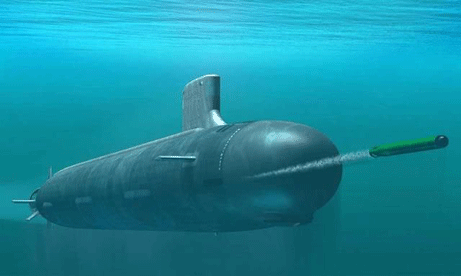
US President Donald Trump says South Korea has approval to build nuclear-powered submarine
30 Oct 25, https://www.abc.net.au/news/2025-10-30/south-korea-permission-to-build-nuclear-submarines/105951210
In short:
Korea has been given permission by Donald Trump to build a nuclear powered submarine.
The permission is a dramatic move that would admit South Korea to a small group of nations that possess this type of vessel.
The US president met with leader on his ongoing tour of Asia.
US President Donald Trump says he has given South Korea approval to build a nuclear-powered submarine, a dramatic move that would admit Seoul to a small club of nations possessing such vessels.
Mr Trump, who has been meeting with South Korean President Lee Jae Myung and other regional leaders during his visit, also said Seoul had agreed to buy vast quantities of US oil and gas.
The submarine will be built in a Philadelphia shipyard, where South Korean firms have increased investment, Mr Trump wrote on social media.
Mr Trump and Mr Lee finalised details of a fraught trade deal at a summit in South Korea on Wednesday.
Mr Lee had also been seeking US permission for South Korea to reprocess nuclear fuel.
Nuclear restrictions easing?
Seoul is barred from reprocessing without US consent, under a pact between the countries.
“I have given them approval to build a nuclear-powered submarine, rather than the old-fashioned and far less nimble, diesel-powered submarines that they have now,” Mr Trump wrote on his Truth Social platform.
South Korea’s Industry Ministry said its officials had not been involved in any detailed discussions about building the submarines in Philadelphia.
While South Korea has a sophisticated shipbuilding industry, Mr Trump did not spell out where the propulsion technology would come from for a nuclear-powered submarine, which only a handful of countries possess.
The US has been working with Australia and Britain on a project for Australia to acquire nuclear-powered submarines, involving technology transfers from the United States.
The US has so far only shared that technology with Britain, back in the 1950s.
Mr Lee said when he met Mr Trump on Wednesday that allowing South Korea to build several nuclear-powered submarines equipped with conventional weapons would significantly reduce the burden on the US military.
He also asked for Mr Trump’s support to make substantial progress on South Korea being allowed to reprocess spent nuclear fuel, or on uranium enrichment.
This is not allowed under the nuclear agreement between the two countries, even though South Korea possesses nuclear reactors to generate power.
Approval raises questions
Mr Lee’s predecessors had wanted to build nuclear-powered submarines, but the US had opposed this idea for decades.
Daryl Kimball, executive director of the Washington-based Arms Control Association, said the issue of South Korea acquiring such submarines “raises all sorts of questions.”
“As with the AUKUS deal, (South Korea) is probably looking for nuclear propulsion services suitable for subs, including the fuel, from the US,” he said.
Mr Kimball said such submarines usually involved the use of highly-enriched uranium and would “require a very complex new regime of safeguards” by the International Atomic Energy Agency, which has a key role in implementing the Treaty on the Non-Proliferation of Nuclear Weapons (NPT).
“It remains technically and militarily unnecessary for South Korea to acquire the technology to extract weapons-usable plutonium from spent fuel or to acquire uranium enrichment capabilities, which can also be used to produce nuclear weapons,” he said.
“If the United States seeks to prevent the proliferation of nuclear weapons worldwide, the Trump administration should resist such overtures from allies as strongly as it works to deny adversary access to these dual-use technologies.”
Jenny Town, who heads 38 North, a Korea-focused research group in Washington, said it was inevitable that South Korean demands for US cooperation on nuclear issues would grow, given recent allegations about Russian technical cooperation to help nuclear-armed North Korea make progress towards acquiring nuclear-powered submarines.
Kim Dong-yup, a North Korea studies professor at Kyungnam University, said the Lee-Trump summit had formalised a “transaction scheme of security guarantees and economic contributions” for maintaining the extended deterrence and alliance in exchange for South Korea’s increased defence spending and nuclear-powered subs and US investments.
“In the end, this South Korea-US summit can be summarised in one word: the commercialisation of the alliance and the commodification of peace,” he said.
“The problem is that the balance of that deal was to maximise American interests rather than the autonomy of the Korean Peninsula.”
South Korea would accept a Trump-Kim deal to freeze nuclear programme, president tells BBC
BBC, Jean Mackenzie, Seoul correspondent, 22 Sept 25
South Korea’s president has said he would agree to a deal between Donald Trump and Kim Jong Un in which North Korea agreed to freeze production of its nuclear weapons, rather than get rid of them.
Lee Jae Myung told the BBC North Korea was producing an additional 15-20 nuclear weapons a year and that a freeze – as “an interim emergency measure” – would be “a feasible, realistic alternative” to denuclearisation for now.
North Korea declared itself a nuclear power in 2022 and vowed to never relinquish its weapons.
“So long as we do not give up on the long-term goal of denuclearisation, I believe there are clear benefits to having North Korea stop its nuclear and missile development,” Lee Jae Myung said.
“The question is whether we persist with fruitless attempts towards the ultimate goal [of denuclearisation] or we set more realistic goals and achieve some of them,” Lee added.
President Lee, who entered office in June, wants to establish peaceful relations with North Korea and reduce tensions, which flared under his predecessor Yoon Suk Yeol, who was impeached for trying to impose martial law last year.
The South Korean leader has been vocal about wanting President Trump to resume nuclear talks with Kim, which broke down in 2019 during Trump’s first term, after the US asked the North to dismantle its nuclear facilities.
In a speech to parliament on Sunday, the North Korean leader suggested he would be willing to negotiate with Trump – but only if the US dropped its demand for the North to denuclearise.
Lee told the BBC that he thought it possible that Trump and Kim could come back together, given they “seem to have a degree of mutual trust”. This could benefit South Korea and contribute to global peace and security, he added.
In a speech to parliament on Sunday, the North Korean leader suggested he would be willing to negotiate with Trump – but only if the US dropped its demand for the North to denuclearise.
Lee told the BBC that he thought it possible that Trump and Kim could come back together, given they “seem to have a degree of mutual trust”. This could benefit South Korea and contribute to global peace and security, he added.
The BBC sat down with the South Korean president at his office in Seoul, ahead of his trip to the United Nations General Assembly in New York on Monday.
South Korea currently holds the presidency of the UN Security Council, but Lee would not be drawn on whether the body was failing South Korea, because for years both China and Russia have blocked attempts to impose further sanction the North over its nuclear programme.
“While it’s clear the UN is falling short when it comes to creating a truly peaceful world, I still believe it is performing many important functions,” Lee said, adding that reforming the Security Council was “not very realistic”.
Asked whether China was now enabling North Korea’s nuclear weapons programme, Lee said it was “impossible to know”, but based on his current knowledge this was not his understanding………………………………………………………………………………………………………………………. https://www.bbc.com/news/articles/cwy91w0e1z2o
KHNP And Westinghouse ‘Holding Talks’ Over Nuclear JV For US And Europe
By David Dalton, 22 August 2025, https://www.nucnet.org/news/khnp-and-westinghouse-holding-talks-over-nuclear-jv-for-us-and-europe-8-5-2025
Companies may cooperate on new build as they try to put legal dispute behind them.
Korea Hydro & Nuclear Power (KHNP) and Westinghouse are holding talks to set up a joint venture for US and European projects as they try to move on from a legal settlement that has been criticised by politicians in Seoul, multiple press reports have said.
The UK daily Financial Times (subscription required) reported that KHNP’s chief executive will travel to Washington on Saturday to meet executives from Pennsylvania-based Westinghouse.
The proposed joint venture could pave the way for South Korean groups to expand in the US, where president Donald Trump has pledged to quadruple nuclear energy capacity by 2050.
“The two countries are expected to discuss ways to cooperate on nuclear power, including building nuclear power plants in the US,” a South Korean Democratic Party lawmaker told The Korea Economic
The move comes after KHNP was awarded a 26 trillion won (€16bn, $18.6bn) contract in June to build two nuclear power plants at Dukovany in the Czech Republic, following the resolution in January of a long-running dispute over nuclear technology rights with Westinghouse.
Unconfirmed reports have said KHNP ceded leadership of nuclear projects in Europe to Westinghouse when it settled the dispute in order to secure the Dukovany contract.
As a result, KHNP is said to be barred from entering the nuclear markets of European Union member states – except the Czech Republic – the US, the UK, Japan and Ukraine.
Thi means it is restricted to pursuing projects in Southeast Asia, Central Asia, the United Arab Emirates, Saudi Arabia, South America and Turkey, reports said.
According to press reports, KHNP and its parent company Korea Electric Power Corporation also agreed to pay Westinghouse $825m in goods, services and royalties per exported reactor over the next 50 years.
Westinghouse had accused the South Korean company of infringing on its intellectual property, claiming KHNP’s APR1000 and APR1400 plant designs use its licensed technology.
The January settlement removed a major hurdle for a KHNP-led consortium to sign the final Dukovany contract in June.
KHNP has withdrawn from bidding for nuclear deals in the Netherlands, Slovenia and Sweden in the past year. The company also said this week it had pulled out of a potential Polish project.
South Korea’s state-run nuclear power firm barred from North America, Europe over intellectual property dispute: Report
Korea Hydro & Nuclear Power president confirms South Korean company closed its operations in Poland
Berk Kutay Gokmen |19.08.2025 https://www.aa.com.tr/en/asia-pacific/south-koreas-state-run-nuclear-power-firm-barred-from-north-america-europe-over-intellectual-property-dispute-report/3663824
South Korea’s state-run nuclear power firm has been banned from bidding for new power plant projects in North America and Europe over an intellectual property (IP) dispute, the Seoul-based Yonhap News reported on Tuesday.
Korea Hydro & Nuclear Power (KHNP) faces the IP dispute under its agreement with the US energy firm Westinghouse, signed in January, according to industry sources.
The sources mentioned that the KHNP cannot sign for new nuclear power plant deals in North America and the UK, Japan, Ukraine, and EU nations, excluding the Czech Republic.
The agreement was signed after Westinghouse accused the KHNP of infringing on its IP, claiming that the plant designs of the South Korean company utilize its licensed technology.
The deal had cleared a major obstacle for the KHNP-led Korean consortium to finalize a 26 trillion won ($18.7 billion) contract in June to build two nuclear power units in the Czech Republic.
The report came as the KHNP President Whang Joo-ho confirmed on Tuesday that the company had closed operations in Poland.
“After the new Polish administration took office … the country decided to drop the state-owned enterprise projects (in the nuclear power sector),” Whang said.
Poland became the fourth European country where the KHNP confirmed its business closure, following Sweden, Slovenia, and the Netherlands.
The Journey Beyond Nukes Begins with an Apology

Robert C. Koehler 7 April 25 https://abombtribunal.campaignus.me/34/?q=YToxOntzOjEyOiJrZXl3b3JkX3R5cGUiO3M6MzoiYWxsIjt9&bmode=view&idx=158534555&t=board
When the powerful speak, mushroom clouds emerge – oh so easily. Power is about conquest; winning the war, getting what you want no matter the cost.
For instance, Israel should nuke Gaza. “Do whatever you have to do.” Thus declared Sen. Lindsey Graham last year in a Meet the Press interview, comparing the current genocide in Palestine to the U.S. decision to end World War II by A-bombing Hiroshima and Nagasaki. “That was the right decision,” he said, spewing out the historical abstraction that still rules the world.
Nothing is more sacred than self-defense! And nothing is more necessary for that than nuclear weapons, at least for the countries that possess them. To think beyond this abstraction – to cry out against the pain of the victims and declare their use is potential human suicide – violates the political norm of the powerful and is easily categorized by the media, often sarcastically, as naïve.
And thus we’re stuck in a MAD world, apparently: a world under unending threat of mutually assured destruction. If you have a problem with that, you’re probably a weakling singing “Kumbaya.”
Or so the global war machine wants us to believe, reducing humanity’s anti-nuke – antiwar – sanity to a hollow hope.
It is in this context that I heard Sim Jintae and Han Jeong-Soon speak at a small event the other day in suburban Chicago, sponsored by an organization called – brace yourself – The International People’s Tribunal to hold the U.S. accountable for dropping A-bombs. The two speakers (via translator) are Korean victims of the bombs the U.S. dropped on Hiroshima neaarly eight decades ago. Sim Jintae is a first-generation survivor: He was 2-years-old when the bomb was dropped. Han Jeong-Soon is a second-generation survivor – the child of survivors of the inferno, who has suffered throughout her life from the after-effects of the bombing. Their message: Nuclear war lasts forever!
Well, that’s part of their message. Note: The movement they represent is Korean. A little known fact about the bombings of Hiroshima and Nagasaki is that thousands of Koreans were what you might call doubly victimized by the horror, This was during an era when Japan had colonial control over Korea, and some 100,000 Koreans had been forcibly moved to Japan to do wartime labor. Many of them, including Sim Jintae’s parents, had been working in a munitions factory in Hiroshima.
About 40,000 Koreans died in the bombings. Those who survived suffered the after-effects in silence . . . until they reclaimed one another and found a collective voice. This is the voice I heard last week at the event I attended, and it resonated as loud as – perhaps louder than – the pro-nuke media and their supplicants. Their collective voice emerges from reality, not abstraction. My God, I hope it’s louder than that Lindsey Graham, and so many other politicians.
Here is the voice of Han Jeong-Soon. Born in Korea fourteen years after the destruction of Hiroshima – her parents had also been forced laborers there, living a few kilometers from the epicenter of the bomb blast – she suffered all her life from birth defects: heart problems, chest pain, lung issues. She had multiple surgeries. She suffered on her own . . . until she saw a film about the bombing in 2004. Then:
“I realized my pain was not only my pain but other people’s pain,” she told us. She began organizing other second-generation survivors, and began telling the world: “My war has not ended. No war should be allowed or tolerated. No to all war.”
Is this the voice that will drown out the military-industrial complex? The People’s Tribunal is demanding, as the starting point of the human journey beyond war, for the United States to apologize for dropping atomic bombs on Hiroshima and Nagasaki. This was an action that instantly expanded the scope of hell the human race could inflict on itself.
When I heard that word, “apologize,” in the context of first- and second-generation Korean A-bomb victims – victims who were denied necessary health care, by both Japan and the United States – what I heard was a soul scream: a demand that the perpetrator grasp and acknowledge the full extent of the harm it caused, and in so grasping, vow never to use such a monstrous weapon again . . . and, indeed, vow to transcend war itself.
The International People’s Tribunal put it this way:
“The A-Bomb Tribunal aims to establish the illegality of the U.S. atomic bombings in 1945 to secure the basis for condemning all nuclear threats and use as illegal today. The fact that the atomic bombings of Hiroshima and Nagasaki were illegal under the international laws in 1945 means that the use and threat of nuclear weapons today are also illegal.
“The A-Bomb Tribunal aims to overcome the nuclear deterrence theory that justifies the use and threat of nuclear weapons by nuclear-weapon states, and contribute to the realization of denuclearization of the Korean Peninsula and a nuclear-free world.”
Let us listen to those who have suffered the most. Let us hear the cry of their throbbing souls and begin to understand that the time has come for us to create a world beyond dominance and war. Indeed, let us begin listening to one another and, in so doing, learn that we all matter. This is the true nature of power.
Impeachment of Yoon Suk-yeol threatens South Korea’s nuclear energy policy momentum
Impeachment turmoil may disrupt the trajectory of Korea’s nuclear sector
Chosun Biz, 4th April 2025, By Jin Sang-hoon
The Constitutional Court has cited the impeachment of President Yoon Suk-yeol, making it likely that the energy policy centered on nuclear power promoted by the former president will lose momentum.
The Yoon Suk-yeol government, established in May 2022, has abandoned the nuclear phase-out policy pursued during the previous Moon Jae-in administration and has been implementing an energy policy centered around nuclear power again. In July 2022, the decision was made to resume the construction of the Shin Hanul Units 3 and 4 nuclear power plants, which began construction in September last year, and the procedure for the continued operation of 10 nuclear plants, including the Hanul Units 1 and 2, which will reach their designed lifespan by 2030, has also begun.
In early 2018, the proportion of nuclear power in total electricity generation was 23.4%, but under the Yoon Suk-yeol government, it rose to 29.6% in 2022. There was also an ambitious push to win overseas nuclear power contracts, resulting in securing two nuclear power plants in the Czech Republic worth 24 trillion won. In the case of the Czech Dukovany nuclear power project, the detailed coordination between Korea Hydro & Nuclear Power and the Czech authorities has been completed, leaving only the final contract.
However, the decision to impeach the former president has made it uncertain whether the nuclear-centered energy policy will continue. Since intergovernmental nuclear contracts are made at the government level, it is crucial to see how determined the government is in pushing forward.
With the early presidential election following the impeachment of the former president, if the Democratic Party comes to power, the nuclear power policy may be reversed again. The government has established the 11th Basic Plan for Electricity Supply and Demand, which includes forecasts for electricity demand and supply plans up to 2038, believing that three large new nuclear power plants are necessary. However, as the Democratic Party demands a reduction in new nuclear power plants and an expansion of the share of renewable energy, the plan for large new nuclear plant construction has been reduced to two.
An anonymous energy industry official noted, “During the Moon Jae-in administration, a large budget was invested in renewable energy, leading to the emergence of many solar-related businesses and stakeholders in local areas,” adding, “If the Democratic Party comes to power and they demand support again, the budget for nuclear power could be reduced.”…………………… https://biz.chosun.com/en/en-policy/2025/04/04/3U66VMSXWZDU5CHQUD5PS75NHY/
The great trek for justice
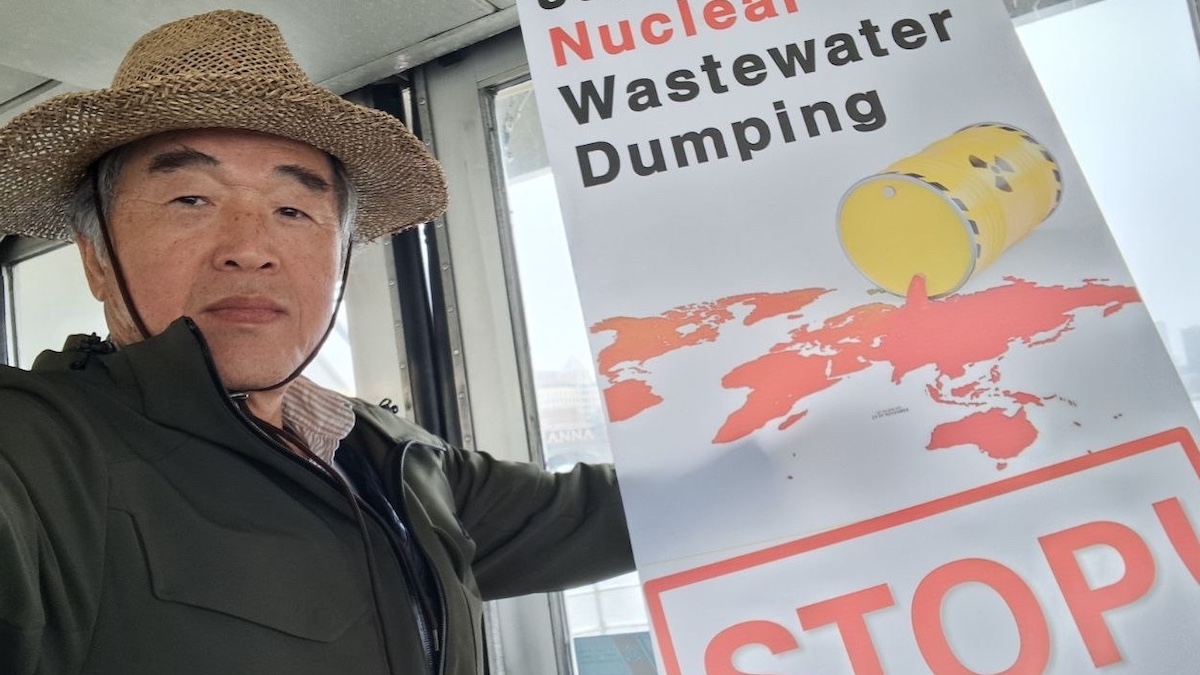
At the heart of the matter for Lee is the devastating and continued destruction of the ecosystems on which all of us — human and animals — depend. The Fukushima radioactive water dump is just one of the most recent examples.
, by beyondnuclearinternational, https://beyondnuclearinternational.org/2025/03/30/the-great-trek-for-justice/
Won-Young Lee has walked from his homeland in South Korea to Tokyo. Now he’s on the march in the US, writes Linda Pentz Gunter
How far would you walk for a cause? In the case of South Korean anti-nuclear activist, Won-Young Lee, that distance has no limit.
Lee, 67, and the director of the Korea Land Future Research Institute and the Public Reporting Center for the Dangers of Nuclear Power Plants (PRCDN), will arrive in Washington, DC on April 8, having walked there from the United Nations in New York City, a journey he began on March 19. The distance is about 260 miles.
His cause this time is to draw attention to the continued dumping of highly radioactive waste water from the stricken Fukushima Daiichi nuclear power plant in Japan into the Pacific Ocean. This is not Mr. Lee’s first walk, but he chose the dates deliberately to span the time between the 2011 Fukushima nuclear disaster that began on March 11 and the April 26, 1986 Chornobyl reactor explosion in Ukraine.
This latest walk falls under the umbrella of what Lee has titled the “New Silk Road for Life and No-Nukes. Walking Planet Earth With Joy.” Together, the walks constitute a marathon that have taken Lee and other walkers through vast areas of the Asian continent, including Vietnam, Laos, Thailand, Malaysia, India and Nepal and on through Uzbekistan, Azerbaijan, and Georgia and through numerous countries in Europe. Lee himself has traversed 6,125 miles on foot.
He has been inspired, he says, by Gandhi’s ‘Salt March’ “that led to India’s independence,” and was also started, Lee says, “by a small number of people,” that grew into ever greater numbers.
That will of the people manifested again in 2023, during a trek of almost 1,000 miles undertaken by South Korean and Japanese citizens from Seoul, South Korea to Tokyo, Japan with stops that included one in Hiroshima.
Currently, as Lee marches resolutely from Manhattan to DC, he has encountered others who are equally inspired, often from Japan. Yoko Akashi, who marched with him in New Jersey, wrote that “even though we’re only two walking highways and shopping streets, people waved, honked cars and wanted to know more because they’re concerned.”
All of this is done with unbounded optimism. The purpose of the current walk is not only to engage with populations along the route but to try, once it reaches its destination in the nation’s capital, to convince members of Congress and even the White House, that the water dumping at Fukushima needs to stop.
“By marching, we can gain the support of citizens, get citizens to join the march, and as the procession gets longer, citizens can pressure politicians,” asserts Lee.
We have published numerous articles on our news site — Beyond Nuclear International — arguing against the dumping of at least 1.3 million tons of radioactive water from Fukushima into the Pacific, a procedure that will go on for years, even decades.
One of the more recent ones, by Tilman Ruff, sums up many of the arguments. Another earlier one from GENSUIKIN, also lays out the specific risks.
Lee’s organization has turned to the cartoon format to produce a booklet telling the story. It’s entitled STOP! Fukushima Nuclear Wastewater Dumping and can be downloaded from the PRCDN website in English here.
I met with Lee and a group of Korean activists on Capitol Hill in February, during a press conference led by Congressman Brad Sherman (CA-32), a senior member of the House Foreign Affairs Committee, to urge for the passage of his bipartisan legislation, the Peace on the Korean Peninsula Act.
The bill calls for swift and substantial diplomatic engagement in order to achieve a formal end to the Korean War – America’s longest war.
During the event, Lee expressed his hopes for a political change of policy over the dumping (I am afraid I did not share his optimism.) In a statement before his New York to Washington march began, Lee expressed the view that stopping the dumping was in the hands of the US president. “He is the only person to whom the Japanese prime minister bows his head,” Lee wrote. “If the US president asks the Japanese prime minister to stop, the dumping can be stopped.”
At the heart of the matter for Lee is the devastating and continued destruction of the ecosystems on which all of us — human and animals — depend. The Fukushima radioactive water dump is just one of the most recent examples.
“Humanity has a responsibility to respect the survival of all living things in the ecosystem as well as its own future generations,” said a declaration put out before the latest walk launched. And yet, “the Japanese government is intentionally dumping potentially fatal nuclear contaminants into the sea.”
Both the International Atomic Energy Agency (IAEA) and the United Nations come in for deservedly harsh criticism as well. In the cartoon booklet, the IAEA is referred to as “Japan’s Brazen Enabler”. The UN, says the declaration, is “ignoring the spirit of the World Charter of Nature (1982), drawn up by themselves and the Earth Charter (2000), made by agreement at the Rio Environmental Conference, and are simply watching the destruction of our ecosystem.” Striking an uncharacteristically pessimistic note, it adds: “All of these things show that our international community is completely broken. At this rate, there is no hope for humanity.”
In conclusion, the march declaration offers the following:
- The Japanese government, which has intentionally put humanity and the Earth’s ecosystem at great risk, must immediately stop dumping nuclear contaminated water and apologize to all living things on Earth.
- The U.S. government and the IAEA, which support Japan’s ocean dumping of nuclear contaminated water, should immediately withdraw their support and seek safe measures for all living things on Earth.
- The UN and the International Community must acknowledge and reflect on dereliction of their duty to stop Japan from dumping nuclear contaminated water into the ocean.
- Global citizens, keep in mind that if we turn a blind eye to these errors, we are committing a crime to our descendants, and let us actively punish any country or power that intentionally commits such crimes.
- Global citizens, let us be aware of our responsibility to protect the dignity of all life in the global village, and set the right guideposts.
Headline photo Won-Young Lee courtesy of the subject.
Linda Pentz Gunter is the international specialist at Beyond Nuclear and writes for and edits Beyond Nuclear International. Her forthcoming book, Hot Stories. Reflections from a Radioactive World, will be published later this year.
Alarmed by Trump, South Korea mulls Japan-style nuclear option
Prominent voices seek capacity to reprocess spent nuclear fuel or enrich uranium and be able potentially to make bombs.
ASIA TIMES, by Daniel SneiderMarch 15, 2025
……………………………………………………………………………………………………………………………………………… The most striking evidence of South Korean alarm over the treatment of allies is the widening discussion of the need to have an independent nuclear arms capability. Conservatives have long advocated that option, but the debate has now moved into progressive circles where prominent voices are calling for South Korea to develop nuclear latency – the capacity to reprocess spent nuclear fuel or enrich uranium to be able to potentially possess fissile material for making bombs.
The Japanese model?
For now, South Korea hopes it can follow the path set by Japanese Prime Minister Shigeru Ishiba and offer Trump concessions ranging from trade, supply chain investment, and cooperation on shipbuilding to promoting South Korea’s role as an asset in a confrontation against China.
At the moment, South Korea does not have an effective government, pending the imminent decision of the Constitutional Court on the impeachment of South Korean President Yoon Suk Yeol. But whatever follows, the South Korean president will have to deal with Trump.
Assemblyman Wi believes the best they can hope for is a smooth and non-confrontational meeting modeled on that of Ishiba, which yielded a joint statement that reaffirmed the US-Japan alliance along the lines of previous statements with the Joe Biden administration.
………………………………………………………………………………….. I think President Trump thinks North Korea is unfinished business left over from the first Trump administration. We have to prepare for the worst.”
Nuclear latency
“The worst” includes the withdrawal of United States Forces Korea (USFK) from South Korea and a withholding of the US nuclear umbrella.
Regardless of how important the U.S.-ROK alliance is now, “there may come a time when it is difficult to rely on the US for our security,” former Minister of Foreign Affairs Yoon Young-kwan wrote in an op-ed published this month. “In preparation for that time, we should strengthen our national defense capabilities, including potential nuclear capabilities, and prepare to handle the deterrence of North Korea with our own strength.”
Progressives are more reticent to endorse nuclear weapons outright, but some have thrown their weight behind nuclear latency – a conscious imitation of the model pursued by Japan to have a full fuel cycle capability. South Korea could, theoretically, reprocess the spent fuel from its power reactors to extract bomb-grade plutonium or, alternatively, have the capacity to enrich uranium, potentially up to bomb-grade levels.
South Korea has long sought to revise the so-called 123 agreement for nuclear cooperation with the United States, which has restricted its ability to have a full fuel cycle. The agreement was only recently reaffirmed, in January at the close of the Biden administration.
In an important column published on March 4 in the progressive newspaper Kyunghyang Shinmun, former Minister of Unification Lee Jong-seok, another close advisor to presidential aspirant Lee Jae-myung, argued that nuclear latency can be achieved within the framework of the Nuclear Non-Proliferation Treaty and with the consent of the United States.
“China, Russia and North Korea, our neighboring countries, are nuclear weapon states, and Japan has already demonstrated its potential,” Lee wrote. “In this situation, it is rather unnatural that South Korea, a nuclear power, cannot reprocess or enrich uranium due to the restrictions of the Korea-US Nuclear Energy Agreement.”
Others in Seoul advocate defecting from the 123 agreement if the United States reduces USFK forces on the peninsula, says Kim Joon-hyung, a Rebuilding Korea Party lawmaker and former senior diplomat.
Kim is a critic of the U.S. alliance but is personally opposed to nuclear latency. “I don’t agree with nuclear proliferation,” he said. “Even if we have nuclear weapons, I don’t think we have security. Small conflicts may become more common. The Korean Peninsula is too small – high tech conventional weapons are enough. Japan will go nuclear and relations with China and Russia will worsen.”
Others are concerned about the isolation that South Korea could experience if it goes down this road. Cho Hyun, a former senior diplomat and progressive foreign policy advisor, helped negotiate the 123 agreement during the Bill Clinton administration. “The right wing thinks we should have our own nuclear development,” Cho told me in Seoul. “We don’t think it is realistic. Some progressives want to request the US for full fuel cycle like Japan. I am against this.”
As the nuclear latency argument rapidly gains support among progressive circles, revising the 123 agreement may become a bargaining chip for South Korea in negotiations with the Trump administration.
At least some inside the administration, though likely not Trump-appointed officials, have become aware of this, prompting media reports that the U.S. Department of Energy is considering labeling South Korea a “sensitive country,” a designation for countries who might be considering going nuclear.
For South Korea, this may only be the start of many shocks to come.
Daniel C. Sneider is a non-resident distinguished fellow at the Korea Economic Institute of America and a lecturer in East Asian studies at Stanford University. https://asiatimes.com/2025/03/alarmed-by-trump-south-korea-mulls-japan-style-nuclear-latency/#
Movements across the world call for an end to all US military exercises on the Korean peninsula
The call to cancel the military exercises takes on increased urgency given the military accident last week when South Korean jets bombed their own citizens in the region bordering North Korea during the preparation of yet another joint military exercise with the US.
March 12, 2025 by Abdul Rahman, people’s dispatch
Pressure continues to grow against the ongoing Freedom Shield 25, a joint military exercise between the US and South Korea.
The International People’s Assembly (IPA) and International League of Peoples Struggle (ILPS) joined Nodutdol, an anti-imperialist Korean diaspora group, in launching a joint statement calling for the Freedom Shield military exercises to be cancelled, claiming it is drumming up threats of war on the Korean peninsula. The anti-imperialist and anti-war platforms bring together hundreds of people’s movements and organizations across the world.
“Freedom Shield 25 has dire implications for regional and global peace and stability. As part of Washington’s New Cold War against China, the NATO bloc and its Asian and Oceanian partners are escalating in East Asia, using the Korean peninsula as a staging ground. Freedom Shield poses a most immediate threat to the stability of the region, but its effects also extend far beyond,” the statement reads……………………………………………………………………………………………………………………………………. more https://peoplesdispatch.org/2025/03/12/movements-across-the-world-call-for-an-end-to-all-us-military-exercises-on-the-korean-peninsula/
South Korea increases support for domestic nuclear industry
The Ministry of Trade, Industry and Energy has announced KRW150 billion
(USD103 million) of financial support this year to companies within South
Korea’s nuclear power industry – an increase of KRW50 billion compared with
last year.
World Nuclear News 10th Feb 2025,
https://www.world-nuclear-news.org/articles/south-korea-increases-support-for-domestic-nuclear-industry
1 5 January -Virtual presentation: Korean atomic bomb victims seek justice – and the outlawing of nuclear weapons – through the people’s tribunal
Join us on January 15 at 5 pm PT/8pm ET, the People’s Tribunal Organizing Committee will present on the upcoming 2026 International People’s Tribunal and the responsibility of the U.S.A. for the 1945 atomic bombings and for ensuring redress (apology) to Korean victims.
Over 100,000 Koreans were forcibly removed from their homeland by the Japanese during the 1930s and brought to Hiroshima and Nagasaki during the Japanese occupation of Korea. It is not well known that over 70,000 of those Koreans became victims of the world’s first atomic bomb attacks on August 6th and 9th of 1945. Panelists from SPARK and Veterans for Peace will present on the upcoming 2026 International Tribunal, current progress, and its goals.
This virtual presentation is co-hosted by Korea Peace Now Grassroots Network and WILPF Jane Adam’s Branch. RSVP at bit.ly/janpt
For more information, please visit:
Instagram Post Link
International People’s Tribunal on 1945 US Atomic Bombings https://abombtribunal.campaignus.me/
1 This Month
10 March A LIVE WEBINAR THE REAL EFFECTS OF NUCLEAR POWER
What the Industry Isn’t Telling Us
1:00 PM Mountain, 2 pm Central, 3 pm Eastern. Live on the Keepers of the Water Facebook page



18 March Webinar @ 1 PM EST: An Assessment of SMR Projects: The Case of Canada
register for the zoom:
https://us02web.zoom.us/webinar/register/WN_o8BIIOUvQ2ONJR1nta65DQ#/registration


of the week – STOP SMALL MODULAR REACTORS IN CANADA
To see nuclear-related stories in greater depth and intensity – go to https://nuclearinformation.wordpress.com
-
Archives
- March 2026 (99)
- February 2026 (268)
- January 2026 (308)
- December 2025 (358)
- November 2025 (359)
- October 2025 (376)
- September 2025 (258)
- August 2025 (319)
- July 2025 (230)
- June 2025 (348)
- May 2025 (261)
- April 2025 (305)
-
Categories
- 1
- 1 NUCLEAR ISSUES
- business and costs
- climate change
- culture and arts
- ENERGY
- environment
- health
- history
- indigenous issues
- Legal
- marketing of nuclear
- media
- opposition to nuclear
- PERSONAL STORIES
- politics
- politics international
- Religion and ethics
- safety
- secrets,lies and civil liberties
- spinbuster
- technology
- Uranium
- wastes
- weapons and war
- Women
- 2 WORLD
- ACTION
- AFRICA
- Atrocities
- AUSTRALIA
- Christina's notes
- Christina's themes
- culture and arts
- Events
- Fuk 2022
- Fuk 2023
- Fukushima 2017
- Fukushima 2018
- fukushima 2019
- Fukushima 2020
- Fukushima 2021
- general
- global warming
- Humour (God we need it)
- Nuclear
- RARE EARTHS
- Reference
- resources – print
- Resources -audiovicual
- Weekly Newsletter
- World
- World Nuclear
- YouTube
-
RSS
Entries RSS
Comments RSS
 nuclear-news