People of Kashmir – stuck in a dangerous, potentially nuclear, conflict
In Kashmir, we’re stuck in the middle of a potentially nuclear conflict but the world looks away, ABC News, By Umar Lateef Misgar 9 Mar 19, When Adil Dar rammed a car stuffed with explosives into a paramilitary convoy in Indian-administered Kashmir last month, I didn’t make much of the news.
I was travelling across northern India at the time. Having been born and brought up amid a conflict that has defined the life of every young Kashmiri for the past three decades it just seemed more of the same: military cordons, gunfights, curfews, blown-up houses, maiming and the death of our friends and acquaintances.
But the magnitude of this attack by Dar, a 22-year-old Kashmiri, crept up on me through numbers and images. It was the worst attack against Indian forces since the armed insurgency erupted in Kashmir in the late 1980s.
At least 40 Indian paramilitary personnel had been killed, setting off a chain of events that almost brought South Asia to the brink of an all-out nuclear war.
I felt heartbroken by the loss of life that had occurred.
The Indian media instantly began to whip up a frenzy against the Kashmiris, doubling down on efforts to demonise an entire people.
The Indian population’s anger was focused against Kashmiri civilians, students and migrant businessmen, who were attacked by mobs. As many as 2000 of them were forced to flee from different Indian cities…….
I have lived in India as a student and travelled across the country throughout my life, but I have never felt as threatened as during this recent visit.
Constantly dehumanised in the Indian media as well as politics, Kashmiris have been undermined and permanently relegated as dispensable other in the Indian consciousness. Even the India’s parliamentary opposition, led by the Indian National Congress party that finds its roots in the anti-colonial struggles of the subcontinent, didn’t even dare to speak a word against this wave of anti-Kashmiri hate-crimes………
Amid rising tensions, both the countries mobilised their armed forces, leading to the worst tension in 20 years. Diplomats succeeded in persuading the two nuclear-armed nations to back-off. For now.
It is local Kashmiris whose lives were disrupted by this military posturing and brinkmanship. Civilians across the de-facto border that divides Indian and Pakistani-administered Kashmir, suffered the stress of warplanes hovering above and the impending threat of war………
Deadliest decade
The confrontation between India and Pakistan has slowly de-escalated but people continue to be killed, and while last year was the deadliest in a decade the coming year looks catastrophically bleak.
In the past week 15 people including eight Kashmiri civilians died in shelling and gunfights on the border.
As world attention shifts elsewhere the plight of Kashmiri people remains constant. Our land, our air and our bodies will remain the sites of violent confrontation and electoral bargaining.
Will anyone bat an eye before the next nuclear showdown? https://www.abc.net.au/news/2019-03-09/kashmir-is-stuck-in-the-middle-of-nuclear-tension/10878950
Nuclear threat still hangs over India and Pakistan
|
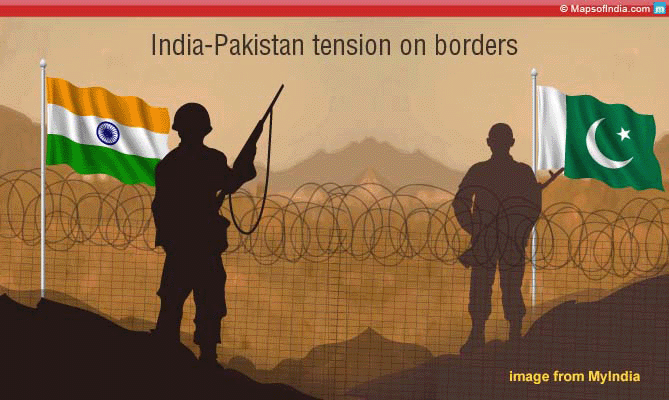
Crisis may be easing, but nuclear threat still hangs over India and Pakistan, Analysis by Brad Lendon, CNN, March 4, 2019 Hong Kong Tensions on the border between India and Pakistan last week pushed the two nuclear-powered South Asian adversaries closer to conflict than at any point in the past two decades.
|
|
|
Punjab Chief Minister Amarinder Singh warns on Pakistan’s readiness to use nuclear weapons
|
Pakistan will not hesitate to go nuclear in war with India: Amarinder Singh, “Whether it was one killed or 100, the message has gone out loud and clear that India will not let the killing of its soldiers and citizens go unpunished,” Singh said. Economic Times , 4 Mar 19, AMRITSAR: Punjab Chief Minister Amarinder Singh on Monday warned that Pakistan would not hesitate to use its nuclear arsenal if it felt it was losing out against India in a conventional war. Pointing out that both India and Pakistan were nuclear powers, he said it was not in either country’s interest to use the weapons of mass destruction but Islamabad could indulge in such a misadventure, if faced with defeat in other battles. ….. https://economictimes.indiatimes.com/news/politics-and-nation/pakistan-will-not-hesitate-to-go-nuclear-in-war-with-india-amarinder-singh/ |
|
|
Imran Khan to consult nuclear chiefs after India’s first air strike on Pakistan in decades
 ABC News 28 Feb 19 Pakistan’s Prime Minister Imran Khan will stage an emergency parliamentary session and meet with the body in control of Islamabad’s nuclear arsenal in response to India’s first air strikes on Pakistan since 1971.
Key points:
- Indian fighter jets struck an area 50 kilometres into Pakistan on Tuesday
- India said the strike was in response to a terrorist attack that killed 44 Indian police
- Pakistan said its own warplanes had scattered Indian jets, forcing them to drop their payload over uninhabited areas
The two nuclear-armed neighbours have fought three wars since partition in 1947, and the majority of them have been over Kashmir — a territory both India and Pakistan claim in full…….https://www.abc.net.au/news/2019-02-27/imran-khan-stages-meetings-response-to-indian-air-strikes/10853290
The possibility of nuclear war between India and Pakistan
COULD THE CONFLICT BETWEEN PAKISTAN AND INDIA LEAD TO NUCLEAR WAR? Experts say it’s unlikely, but Pakistan’s lack of a “No First Use” doctrine for nuclear weapons means it’s not impossible. Pacific Standard, JACK HERRERA, FEB 27, 2019
In 1999, Pakistan’s foreign minister explained why the country refused to adopt a No First Use policy, declaring that Islamabad would use “any weapon” in its arsenal to defend the country. Today, experts believe that, unlike India, Pakistan could plausibly deploy a nuclear weapon in response to a conventional attack. Pakistan maintains a smaller army and less weaponry than India, and would likely be overwhelmed if the Indian military invaded Pakistani territory with its full force. Facing loss of territory and national collapse, Islamabad could decide to launch a nuclear weapon against India in an attempt to even the playing field………
“Never Recognised India, Pakistan As Nuclear Countries,” Says China
https://www.ndtv.com/india-news/china-never-recognised-india-pakistan-as-nuclear-countries-2001316
“China has never recognised India and Pakistan as nuclear countries. Our position on this has never changed,” Chinese Foreign Ministry spokesman Lu Kang told a media briefing in Beijing.
“China has never recognised India and Pakistan as nuclear countries. Our position on this has never changed,” Chinese Foreign Ministry spokesman Lu Kang told a media briefing in Beijing.
He was replying to a question whether China would recognise North Korea as a nuclear state like India and Pakistan as talks between Trump and Kim at the second summit in Hanoi broke down over Pyongyang’s refusal to give up two nuclear processing plants.
China has been blocking India’s entry into the 48-member Nuclear Suppliers Group (NSG) on the ground that New Delhi has not signed the Nuclear Non-Proliferation Treaty (NPT).
After India applied for NSG membership, Pakistan too applied for the same following that China has called for a two-step approach which states that NSG members first need to arrive at a set of principles for the admission of non-NPT states into the NSG and then move forward discussions of specific cases.
Tensions in Kashmir: Pakistan readies for war
 Pakistan readies military, hospitals for war with its nuclear rival India after Pulwama terror attack, Business Insider
Indian and Pakistan relations have again reached a dangerous level.
If Pakistan Attacks With One Nuclear Bomb, India Can Finish Us With 20, Says Pervez Musharraf
Addressing a press conference in UAE, Pakistan’s former president said that Indian and Pakistan relations have again reached a dangerous level. News18.com February 25, 2019, New Delhi: India could “finish” Pakistan with 20 bombs if Islamabad decides to launch even a single nuclear attack on the neighbouring country, former Pakistan president Pervez Musharraf has said.
Addressing a press conference in UAE, Pakistan’s former president further said that if India launched any attack in Kashmir, Pakistan could respond in other areas in Sindh and Punjab and “could teach them a lesson”.
The real nuclear crisis: danger of India-Pakistan nuclear war
 Billions Dead: That’s What Could Happen if India and Pakistan Wage a Nuclear War, This is the real nuclear crisis the world is missing. National Interest, rmed with what they believe is reasonable intelligence about the locations of Pakistan’s strategic forces, highly accurate missiles and MIRVs to target them, and a missile defense that has a shot at cleaning up any Pakistani missiles that survived the first strike, Indian leaders might be tempted to launch a counterforce first strike.
With the world’s attention firmly fixated on North Korea, the greatest possibility of nuclear war is in fact on the other side of Asia.
That place is what could be called the nuclear triangle of Pakistan, India and China. Although Chinese and Indian forces are currently engaged in a standoff, traditionally the most dangerous flashpoint along the triangle has been the Indo-Pakistani border. The two countries fought three major wars before acquiring nuclear weapons, and one minor one afterwards. And this doesn’t even include the countless other armed skirmishes and other incidents that are a regular occurrence.
At the heart of this conflict, of course, is the territorial dispute over the northern Indian state of Jammu and Kashmir, the latter part of which Pakistan lays claim to. Also key to the nuclear dimension of the conflict is the fact that India’s conventional capabilities are vastly superior to Pakistan’s. Consequently, Islamabad has adopted a nuclear doctrine of using tactical nuclear weapons against Indian forces to offset the latter’s conventional superiority………https://nationalinterest.org/blog/buzz/billions-dead-thats-what-could-happen-if-india-and-pakistan-wage-nuclear-war-44682
Climate change brings water shortage to India and Pakistan
 Water wars: Are India and Pakistan heading for climate change-induced conflict? DW , 30 Jan 19,
Across the world, climate change is sparking conflict as people struggle over dwindling resources. The fight over water could quickly escalate between India and Pakistan — and both have nuclear arms.
Yemen, Somalia and Syria are just some of the places where climate change is increasingly regarded as a root cause of violent conflict. But while much of the focus on climate change-attributed conflict has predominantly been on Africa and the Middle East, a potentially even deadlier clash over resources may be looming on the horizon in Asia.
That’s because India and Pakistan — bitter rivals over water — both have nuclear weapons in their arsenal.
The two countries have a long but strained agreement over sharing water from the Indus River and its tributaries. Waters from the Indus, which flow from India and the disputed Kashmir region into Pakistan, were carved up between India and Pakistan under the 1960 Indus Water Treaty (IWT).
Read more: Water scarcity in Pakistan – A bigger threat than terrorism
The IWT divides the six major rivers of the Indus basin between Pakistan and India. Pakistan was granted rights to most of the water in the region’s western rivers — the Indus, Jhelum and Chenab — which flow through Indian-administered Kashmir.
The dispute over the Kashmir region — a flashpoint between India and Pakistan for more than six decades — is hugely intertwined with water security. Both countries claim the whole region, but each only controls a part of it.
While the IWT has managed to survive the wars and other hostilities, it is increasingly being strained to its limit. Pakistan has accused India of throttling its water supply and violating the IWT by constructing dams over the rivers flowing into Pakistan from Kashmir.
“Any country with nuclear weapons, if they’re backed into a corner because they have no water — that’s really dangerous,” said Jeff Nesbit, author and executive director of non-profit climate communication organization Climate Nexus.
‘A matter of survival’
For Sherry Rehman, Parliamentary Leader of the left-wing opposition Pakistan People’s Party (PPP) in the Senate, water security, especially in South Asia, “has become a regional security threat.”
“We are now facing challenges brought about by climate change which were not a primary focus during the negotiations for the Indus Water Treaty,” she told DW.
“It has become a matter of survival,” she continued. “Aside from the lack of formal dialogue, the rhetoric floating around suggesting a possible water war is particularly alarming.”
A treaty under threat
For Pakistan, the Indus waters are a lifeline: most of the country depends on it as the primary source of freshwater and it supports 90 percent of the country’s agricultural industry.
And while Pakistan was considered relatively plentiful with water, a mixture of mismanaged irrigation, water-intensive agriculture and climate change has reduced the Indus to a trickle in parts.
A 2018 report from the International Monetary Fund ranked Pakistan third among countries facing severe water shortages.
When the rapidly-melting glaciers in the Himalayas, which feed the Indus waters, eventually disappear as predicted, the dwindling rivers will be slashed even further…………
Elsewhere in Asia, other conflicts have also been linked to climate change. For instance the unprecedented flooding in Thailand in 2011 which sparked major protests over unfair emergency supplies distribution and ultimately led to a military coup that overthrew the democratically-elected government in 2014. The military junta is still in power to this day.
On a global level, Janani Vivekananda, climate security expert at consultancy Adelphi, is somewhat more hopeful about how the struggle over water will play out.
“The trend is people cooperate rather than fight over water because it’s just too important and I think this is what will happen just out of necessity,” she told DW. “Because there’s too much to lose.” https://www.dw.com/en/water-wars-are-india-and-pakistan-heading-for-climate-change-induced-conflict/a-47203933
Security dangers in South Asia increase as India and Pakistan develop nuclear weapons programmes
Nuclear programmes of India, Pakistan increase risk of security incident in South Asia: US spymaster, Economic Times, Jan 30, 2019 WASHINGTON: There is an increased risk of a nuclear security incident in South Asia due to continued growth and development of Pakistan and India’s nuclear weapons programmes, America’s top spymaster told lawmakers on Tuesday.
The remarks of National Intelligence Director Daniel Coats is part of US intelligence community’s assessment of worldwide threats in the year 2019.
While Pakistan continues to develop new types of nuclear weapons, including short-range tactical weapons, sea-based cruise missiles, air-launched cruise missiles, and longer range ballistic missiles, India this year has conducted its first deployment of a nuclear-powered submarine armed with nuclear missiles, he said.
“The continued growth and development of Pakistan and India’s nuclear weapons programmes increase the risk of a nuclear security incident in South Asia, and the new types .. ……..
How India & Pakistan Deal With The Bomb -“Brokering Peace in Nuclear Environments “
Diplomacy In The Nuclear Age, Kashmir Observer, HAIDER NIZAMANI • Aug 28, 2018, How India & Pakistan Deal With The Bomb
India and Pakistan ‘gatecrashed’ the nuclear club in May 1998. Children who were born right after the nuclear tests, carried out by the two countries in that year, are now able to vote — a generation, particularly in Pakistan, that has grown up on a steady diet of nuclear nationalism that portrays weapons of mass destruction as guarantors of national security and sources of collective pride. In times when the country can showcase little by way of achievements, we always console ourselves by saying that we have nuclear weapons.
Nuclear weapons and their delivery systems are made by experts trained in science and engineering but there is also another ‘nuclear expert’ whose bread and butter is linked to writing about these. There was only a small group of such experts two decades ago but nuclear tests by India and Pakistan have opened up many new spots for them. They are camped mainly in think tanks in New Delhi, Islamabad and Washington DC.
An overwhelming majority of them use the lens of political realism that sees states as key actors who pursue their national interests in competition with each other. Moeed Yusuf also belongs to this tribe of nuclear experts. He defines the crises explored in his book as “exercises in coercion through adversaries seek to enhance their relative bargaining strength vis-à-vis their opponents”………..
limitations of Yusuf’s book Brokering Peace in Nuclear Environments are, in fact, the limitation of realist theory that focuses on state actors and their actions and does not delve into the social, economic, political and strategic factors that cause those actions and determine their direction and outcome. Additionally, many Indian and Pakistan security experts consciously or unwittingly end up echoing official versions as the true versions of history. In many parts, Brokering Peace in Nuclear Environments also follows the same path which makes its analysisa bit lopsided and its prescriptions a little too Pakistan-centric.
Its strength, however, is the large number of interviews that Yusuf has conducted with policymakers, especially from the United States and Pakistan, who played key roles during the three crises mentioned above. For this reason alone, if for nothing else, his book should be seen as a good addition to the academic literature available on war and peace between India and Pakistan. https://kashmirobserver.net/2018/feature/diplomacy-nuclear-age-35464
Imran Khan and Pakistan’s nuclear bomb
 Managing Pakistan’s Bomb: Learning on the job, Bulletin of the Atomic Scientisrs, By Pervez Hoodbhoy, Zia Mian, August 17, 2018 “…….the biggest and most important challenge Imran Khan will confront as prime minister is something he did not mention at all in his speech—how to manage the Bomb. The lives and well-being of Pakistan’s 200 million citizens and countless millions in India and elsewhere depend on how well he deals with the doomsday machine Pakistan’s Army and nuclear complex have worked so hard to build.
To be fair, it is not clear that Imran Khan will have much choice regarding nuclear policy. For Pakistani politicians, the options largely come down to either support the Bomb, or keep quiet about it. Like other prime ministers before him, Imran Khan may go and have his picture taken with the missiles that will carry nuclear warheads and pose with the scientists and engineers that make them and the military units that plan and train to fire them.
Imran Khan’s two-decade-long political career overlaps with the creation of Pakistan’s nuclear arsenal, but he has had very little to say about the Bomb. When he has spoken, it has been as a Bomb supporter…….
Imran Khan also has courted the support of Abdul Qadeer Khan (no relation), the man most closely identified in Pakistani minds with the country’s Bomb. ……..
This history suggests that Imran Khan may be likely to support the continued build-up of Pakistan’s nuclear arsenal. It is estimated that the arsenal now is on the order of 150 nuclear weapons, with Pakistan being able soon to deliver these weapons from airplanes (either via bombs or cruise missiles), on land-based ballistic missiles and cruise missiles, and on cruise missiles launched from submarines…….https://thebulletin.org/2018/08/managing-pakistans-bomb-learning-on-the-job/?utm_source=Bulletin%20Newsletter&utm_medium=iContact%20email&utm_campaign=August24
Missile defense systems bad for India-Pakistan nuclear détente
Asia Times, By MOHAN GURUSWAMY AUGUST 24, 2018 It has been reported that theDefense Acquisitions Council (DAC), chaired by Indian Defense Minister Nirmala Sitharaman, has approved the “acceptance of necessity” (AoN) for the acquisition of the National Advanced Surface to Air Missile System-II (NASAMS-II) worth around US$1 billion from the United States. However, in 2002 the US had vetoed India’s bid to acquire the Israeli Arrow-2 missile interceptor system.
Consequently, India’s Defense Research and Development Organization began developing the Prithvi Air Defense (PAD), which will provide long-range high-altitude interception during an incoming ballistic missile’s mid-course phase as well as interception during the terminal phase. At various times these systems had different monikers, such as ballistic missile defense (BMD) or anti-ballistic missile system (ABM).The people who decide on such things reside in New Delhi and understandably their safety gets priority. So it is the National Capital Region that will get the expensive and exaggerated sense of protection such systems tend to generate.But no air defense system can be deemed impenetrable. The Americans and Russians realized long before the Cold War ended that the costs involved were prohibitive, even for them. But the idea was seductive
……….We need to learn from how nuclear-weapons strategies evolved during the Cold War, instead of mimicking US and Soviet follies. The notion of deterrence between the US and USSR was based on no escape from MAD.
Cold War follies peaked with the two antagonists together deploying almost 70,000 warheads each aimed at a specific target. At the height of this madness almost every open ground was targeted as possible tank-marshaling or military-logistics areas.
Hence the last thing India wants is to get into a numbers game with Pakistan or China. Credibility depends on reducing the uncertainty of use from the opposite perspective. The Indian PAD missile defense system only increases them.
India and Pakistan have ensured a modicum of confidence by not mating the warheads and delivery systems, giving a vital period to roll back the unleashing of Armageddon. But now both countries will have to evolve a launch-on-warning doctrine.
Clearly, the two South Asian nuclear powers have a local version of MAD in place. The Pakistani doctrine “commits itself” to use battlefield nuclear weapons if an Indian conventional assault threatens its essential nationhood, and hence it has steadfastly refused to accept the notion of “no first use” (NFU). The Indian doctrine emphasizes NFU but also makes it explicit that any Pakistani use of nuclear weapons on India or its forces will be responded to with a massive retaliation.
India may have fewer nuclear weapons, not because it cannot make more, but because what it has is enough to ensure the complete annihilation of Pakistan, which is geographically a much smaller country.
For its part, China has moved on from NFU to a doctrine now called “credible minimum deterrence.” But how much is credible?
Mercifully, nuclear doctrines these days are couched in such abstractions since MAD requires a degree of predictability, ironically ensured by opacity. The United States’ “single integrated operational plan” (SIOP) began with the ominous words that its objective, after the outbreak of a general war with the then Soviet Union, was to turn it into a “smoking, radiating ruin.” This was written by its certifiable US Air Force chief, General Curtis Lemay Jr, based on whom the character played by George C Scott in the Stanley Kubrick classic Dr Strangelove was created.
But it was people like Lemay who gave MAD credibility. Since no one of a sane frame of mind would even contemplate the enormity of the disaster of a nuclear war, uncertainty of use was a key element of MAD. It has been written that Soviet leader Leonid Brezhnev used to have sleepless nights thinking of a man like Richard Nixon with his finger on the button.
India’s nuclear strategy documents in detail who the nuclear command would devolve to in the unlikely event of a decapitating first strike on New Delhi with the aim of eliminating its national leadership. It is said that the chain of nuclear command keeps descending to a major-general, a modern-day Raja Parikshit so to say, who will perform the final obsequies.
At last count India had more than 600 military officers at that level. Decapitating all of them is a near statistical and physical impossibility. It would take tens of thousands to precision nuclear weapons to annihilate India’s military chain of command, and it can be speculated whether even America or Russia could achieve that, let alone Pakistan.
Ironically, the evocative acronym MAD is an eminently sensible doctrine. Good sense should tell us: Enough of this madness, and leave MAD alone. http://www.atimes.com/missile-defense-systems-bad-for-india-pakistan-nuclear-detente/
Nuclear terrorism, “dirty bombs” and Pakistan’s measures to prevent this
 Pakistan’s Nuclear Safety and Security https://moderndiplomacy.eu/2018/08/14/pakistans-nuclear-safety-and-security/ August 14, 2018 By Wyn Bowen and Matthew Cottee discuss in their research entitled “Nuclear Security Briefing Book” that nuclear terrorism involves the acquisition and detonation of an intact nuclear weapon from a state arsenal. The world has not experienced any act of nuclear terrorism but terrorists expressed their desires to gain nuclear weapons. The International Atomic Energy Agency (IAEA) has observed many incidents of lost, theft and unauthorized control of nuclear material. The increased use of nuclear technology for peaceful purposes has intensified the threat that terrorist can target these places for acquiring nuclear materials. They cannot build a nuclear weapon because production of a nuclear weapon would require a technological infrastructure. Thus, it is the most difficult task that is nearly impossible because the required infrastructure and technological skills are very high which even a strong terrorist group could not bear easily, but they can build a dirty bomb
1 This Month

of the week – Shut Down Drone Warfare!


Tell the Ukrainian Government to Drop Prosecution of Peace Activist Yurii Sheliazhenko

Petition to revoke the licensing of the Near Surface Nuclear Disposal Facility (NSDF) at Chalk River. https://www.ourcommons.ca/petitions/en/Petition/Details?Petition=e-7247
To see nuclear-related stories in greater depth and intensity – go to https://nuclearinformation.wordpress.com
-
Archives
- March 2026 (237)
- February 2026 (268)
- January 2026 (308)
- December 2025 (358)
- November 2025 (359)
- October 2025 (376)
- September 2025 (257)
- August 2025 (319)
- July 2025 (230)
- June 2025 (348)
- May 2025 (261)
- April 2025 (305)
-
Categories
- 1
- 1 NUCLEAR ISSUES
- business and costs
- climate change
- culture and arts
- ENERGY
- environment
- health
- history
- indigenous issues
- Legal
- marketing of nuclear
- media
- opposition to nuclear
- PERSONAL STORIES
- politics
- politics international
- Religion and ethics
- safety
- secrets,lies and civil liberties
- spinbuster
- technology
- Uranium
- wastes
- weapons and war
- Women
- 2 WORLD
- ACTION
- AFRICA
- Atrocities
- AUSTRALIA
- Christina's notes
- Christina's themes
- culture and arts
- Events
- Fuk 2022
- Fuk 2023
- Fukushima 2017
- Fukushima 2018
- fukushima 2019
- Fukushima 2020
- Fukushima 2021
- general
- global warming
- Humour (God we need it)
- Nuclear
- RARE EARTHS
- Reference
- resources – print
- Resources -audiovicual
- Weekly Newsletter
- World
- World Nuclear
- YouTube
-
RSS
Entries RSS
Comments RSS
 nuclear-news