Saudi Arabia, nuclear-armed Pakistan sign mutual defence pact
Saudi Arabia and nuclear-armed Pakistan signed a formal mutual defense pact on Wednesday, in a move that significantly strengthens a decades-long
security partnership amid heightened regional tensions. The enhanced
defense ties come as Gulf Arab states grow increasingly wary about the
reliability of the United States as their longstanding security guarantor.
Israel’s attack on Qatar last week heightened those concerns.
Reuters 17th Sept 2025,
https://www.reuters.com/world/asia-pacific/saudi-arabia-nuclear-armed-pakistan-sign-mutual-defence-pact-2025-09-17/
Pakistan nuclear weapons, 2025

Bulletin, By Hans M. Kristensen, Matt Korda, Eliana Johns, Mackenzie Knight-Boyle | September 4, 2025
Pakistan continues to slowly modernize its nuclear arsenal with improved and new delivery systems, and a growing fissile material production industry. Analysis of commercial satellite images of construction at Pakistani army garrisons and air force bases shows what appear to be newer launchers and facilities that might be related to Pakistan’s nuclear forces, although authoritative information about Pakistan’s nuclear units is scarce.
We estimate that Pakistan has produced a nuclear weapons stockpile of approximately 170 warheads, which is unchanged since our last estimate in 2023 (see Table 1). The US Defense Intelligence Agency projected in 1999 that Pakistan would have 60 to 80 warheads by 2020 (US Defense Intelligence Agency (1999, 38), but several new weapon systems have been fielded and developed since then, which leads us to a higher estimate. Our estimate comes with considerable uncertainty because neither Pakistan nor other countries publish much information about the Pakistani nuclear arsenal.
With several new delivery systems in development, four plutonium production reactors, and an expanding uranium enrichment infrastructure, Pakistan’s stockpile has the potential to increase further over the next several years. The size of this increase will depend on several factors, including how many nuclear-capable launchers Pakistan plans to deploy, how its nuclear strategy evolves, and how much the Indian nuclear arsenal grows. We estimate that the country’s stockpile could potentially grow to around 200 warheads by the late 2020s. But unless India significantly expands its arsenal or further builds up its conventional forces, it seems reasonable to expect that Pakistan’s nuclear arsenal will not grow significantly, but might level off as its current weapons programs are completed.
………………………………….. Analyzing Pakistan’s nuclear forces is particularly fraught with uncertainty, given the lack of official state-originating data. The Pakistani government has never publicly disclosed the size of its arsenal and does not typically comment on its nuclear doctrine. Unlike some other nuclear-armed states, Pakistan does not regularly publish any official documentation explaining the contours of its nuclear posture or doctrine. Whenever such details emerge in the public discourse, they usually originate from retired officials commenting in their personal capacities. The most regular official source on Pakistani nuclear weapons is the Inter Services Public Relations (ISPR), the media wing of the Pakistan Armed Forces, which publishes regular press releases for missile launches and occasionally couples them with launch videos.
Occasionally, other countries offer official statements or analysis about Pakistan’s nuclear forces. ……………………………………………………………………
Pakistan’s nuclear doctrine
Pakistan has historically maintained a deliberately ambiguous nuclear doctrine, including through refusal to endorse or reject a no-first-use policy.
…………………………..Within its broader philosophy of “credible minimum deterrence,” which seeks to emphasize a defensive and limited but flexible nuclear posture, Pakistan operates under a nuclear doctrine that it calls “full spectrum deterrence.” This posture is aimed mainly at deterring India, which Pakistan identifies as its primary adversary.
…………………………..Pakistan’s nuclear posture—particularly its development and deployment of tactical nuclear weapons—has created considerable concern in other countries, including the United States, which fears that it increases the risk of escalation and lowers the threshold for nuclear use in a military conflict with India.
…………………………..Nuclear security, command-and-control, and crisis management
Over the past decade-and-a-half, the US assessment of nuclear weapons security in Pakistan appears to have changed considerably from confidence to concern, particularly because of the introduction of tactical nuclear weapons in the Pakistani arsenal. ……………………………………………………………………..
2025 India-Pakistan conflict
In May 2025, India and Pakistan engaged in a brief conflict, during which India launched conventional missile strikes against several Pakistani military facilities. The conflict, which lasted days, included an escalatory exchange of fire from both sides following the April 22 terrorist attack in Pahalgam, Indian-administered Kashmir.
In the aftermath of the conflict, the Pakistan Air Force (PAF) and the Military Engineer Services—which conducts construction and maintenance operations for all branches of the Pakistani military—issued a series of public procurement contracts for post-strike repairs at a variety of military bases, indicating which facilities suffered damage due to the conflict (Mishra 2025). ……………………
……………………….One study concluded that although the “mutual possession of nuclear weapons heavily conditioned the response of both sides” and “overt nuclear signaling was lower than in many prior India-Pakistan crises, … the crisis underscores that South Asia is one of the most likely theaters for nuclear war, even if that prospect was not imminent in this instance” (Clary 2025).
Fissile materials, warheads, and missile production
Pakistan has a well-established and diverse fissile material production complex that is expanding. This includes four heavy-water plutonium production reactors at the Khushab Complex, three of which were completed in the past 15 years. ………………………………………….
We estimate that Pakistan currently is producing sufficient fissile material to build 14 to 27 new warheads per year, although we estimate that the actual warhead increase in the stockpile probably averages around 5 to 10 warheads per year.[2]…………………………………………..
Nuclear-capable aircraft and air-delivered weapons…………………………………………………………………………………..
Land-based ballistic missiles…………………………………………………………………………….
Land-based missile garrisons…………………………………………………………………………..
Ground- and sea-launched cruise missiles…………………………………………………………………….. https://thebulletin.org/premium/2025-09/pakistan-nuclear-weapons-2025/?utm_source=ActiveCampaign&utm_medium=email&utm_content=Pakistan%20s%20nuclear%20arsenal&utm_campaign=20250904%20Thursday%20Newsletter%20%28Copy%29
Too Cruel to Even Imagine—Nuclear War in Densely Populated Areas
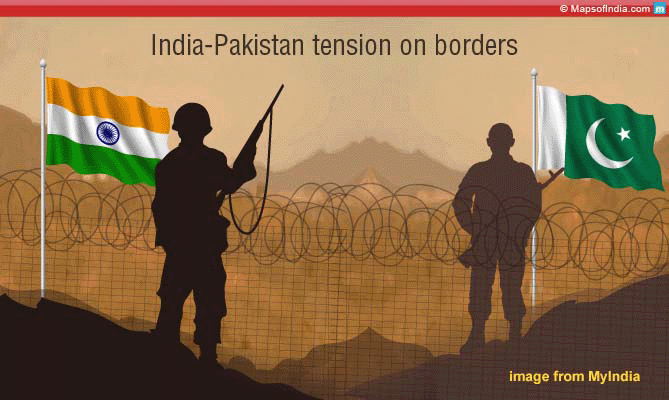
in South Asia, by Bharat Dogra 12/05/2025, https://countercurrents.org/2025/05/too-cruel-to-even-imagine-nuclear-war-in-densely-populated-areas/
Nuclear war should never happen as it is the most destructive thing imaginable. While nuclear weapon war anywhere is so destructive that this cannot be accepted, it is at its most cruel in more densely populated areas. No one can question this reality, but despite this we have the most dreadful and frightening situation of escalating conflict between India and Pakistan, two nuclear weapon countries which possess a total of about 340 nuclear weapons, according to recent estimates, and are also included among the most densely populated countries of the world, in terms of people living per one square km.
While the average world population density for the entire world is 60, it is 331 for Pakistan and 483 for India. In several cities and the most densely populated city districts of these countries, the population density can be easily over 5,000, going up to around 55,000 in the most densely populated city district (Karachi Central). While war even with conventional weapons can be very highly destructive in such conditions, in the context of nuclear weapons, even smaller and tactical ones, this is too cruel even to be imagined. Yet the possibility cannot be brushed aside and must be considered as a real life possibility, a relatively low possibility but nevertheless real possibility, whenever the two countries are involved in escalating conflict situations.
Eric Schlosser, a well-known writer on nuclear weapons, has spoken at length to top officials and commanders at various stages of planning and control of nuclear weapons. In addition he has close contacts with peace movements struggling for a world free from nuclear weapons. He has written that these very different persons share a very strong and sincere desire to avoid actual use of nuclear weapons.
The reason why both these sections share this strong belief is that both groups are well-informed about what actual use of nuclear weapons means. This makes them tremble about the implications.
In the specific context of India and Pakistan, the two nuclear weapon countries of South Asia, Schlosser has written, “The latest studies suggest that a relatively small nuclear exchange (relative to the total number of nuclear weapons that exist in world) would have long-term effects across the globe. A war between India and Pakistan, involving a hundred atomic bombs like the kind dropped in Hiroshima, could send five million tons of dust into the atmosphere, shrink the ozone layer by as much as fifty per cent, drop worldwide temperatures to their lowest point in a thousand years, create worldwide famines and cause more than a billion casualties.”
Thus it is clear that apart from killing millions of people immediately, war with nuclear weapons can lead to unprecedented environmental catastrophe which can kill an even larger number of people while also destroying other life-forms like never before. If the nuclear weapon exchange is between two countries alone, people particularly of neighbouring countries will also suffer very serious consequences without being involved in any dispute at all.
Some strategists have argued that there can be a less catastrophic role for nuclear weapons in the form of tactical nuclear weapons. As not just peace movements but several independent experts have pointed out, this is a highly flawed and mistaken view. A nuclear war started with tactical weapons can easily spill into a full-blown nuclear war if the opposing side also has nuclear weapons. Secondly, use of even tactical nuclear weapons can be very destructive, even for the using country!
Pakistan in particular has been keen to develop tactical nuclear weapons in recent times as it feels that this can be one way of checking and defeating an invasion by a country with superior conventional war capability and bigger economic resources. However saner scientific voices in Pakistan have warned that if Pakistan uses tactical weapons against an invading army on its land, its own military and civilian losses can be very high due to the highly destructive impacts of these weapons.
In the much earlier days of the cold war the NATO had stocked a lot of tactical nuclear weapons in West Germany to check a possible Soviet invasion. A war game Carte Blanche was played out to see the possible impacts in case of a Soviet invasion. It was realized only then that German civilian deaths from the use of tactical nuclear weapons on its own land can be higher than total German civilian deaths in the Second World War! Such is the destructive power of these weapons.
Moreover when tactical nuclear weapons have to be prepared for use then control has to be more dispersed and scattered. This increases the possibility that persons with fanatic or fundamentalist leanings can also gain access to this control. Hence the possibilities of terrorists gaining access to such control also increase at least to some extent. The Pakistani authorities including armed forces have time and again faced evidence-based criticism for supporting terror-groups and this combination of terror groups and nuclear weapons can prove very dangerous in a national as well as international context. From time to time attacks by such terror groups, some of whom also break free from the control of the authorities to a lesser or greater extent, have led to crisis situations nationally and internationally.
It is not at all justified to be under the false impression that tactical weapons provide some form of safer nuclear weapons. Let no one create such a false impression as such a delusion can be extremely catastrophic for millions and millions of people.
Let us face the reality. All evidence points to the fact that nuclear weapons should never be used. In fact even accidental use of nuclear weapons or accidents relating to nuclear weapons can be very destructive. Hence ultimately the only safe option if we care for life on earth is to give up all nuclear weapons and all weapons of mass destruction once and for all at the level of the entire world. The more you study and explore this issue, no matter which side you belong to, the only honest conclusion can be that tomorrow if not today we have to do away with nuclear weapons if we want to save life on earth; so why not make a beginning today itself.
The discussion here has been in the context of South Asia, but of course the consequences of an exchange of nuclear weapons between the USA and Russia or between the USA and China will be even more destructive, much more devastating for the world as these countries have more weapons and their destructive capacity is higher. As a part of world, South Asia will also suffer very harmful impacts from this. Hence the only safe future for us and for our children is on the path which is entirely free from nuclear weapons and entirely free of all weapons of mass destruction.
As for the immediate issue at hand, the maximum efforts need to be made to prevent further escalation of ongoing India-Pakistan conflict and also to end this conflict as early as possible.
How bloody conflict 4,000 miles away could spark nuclear Armageddon killing billions
The “Army of the Righteous” terror group has been accused of slaughtering 22 Indian tourists holidaying in the Baisaran valley – which is pushing India and Pakistan to the brink of conflict
12:23, 02 May 2025, Ryan Fahey News Reporter, https://www.mirror.co.uk/news/world-news/how-bloody-conflict-4000-miles-35158973
While the West is focused on how close Vladimir Putin is to pushing the red button, the real threat of Armageddon could be brewing in South Asia.
In April, suspected Islamist Pakistani militants shot dead 22 Indian tourists holidaying in the Baisaran valley, which is now pushing India and Pakistan – both nuclear-armed countries – to the brink of a nuclear confrontation. The gunmen are said to have prowled through the group of tourists, picking off any individual unable to recite Islamic verses. It’s being viewed by Indians as the worst massacre since the 2008 Mumbai bombings.
India’s security services are also being blamed for failing to realise the looming threat as the public outcry for retribution continues to grow. Indian national identity and foreign policy expert Dr Manali Kumar said the relations between the two countries are at a critically low point and “just short of war”. However, any overt acts of war would see a swift response from Pakistan, which would likely push the two sides into an escalating conflict that would be impossible to reverse once started.
India has an active army of 1.2million, with an additional 250,000 individuals split between the navy and air force, while Pakistan has less than 700,000 – but experts believe the two sides are far more evenly matched than it would seem.
Defence experts say that Pakistan could still “inflict significant damage and cause massive casualties”, according to the MailOnline.
Where the most concerning comparison comes is when looking at the nuclear arsenals of each country. Both Pakistan and India are understood to have around 170 warheads heads each, according to the Arms Control Association. While India has agreed to a “no first use” nuclear pact”, Pakistan does not adhere to the same moral restriction.
And if the apocalypse did happen in South Asia, 125 million people would be dead in a matter of days, researchers warned back in 2019.
India has accused Pakistani nationals – said to be members of the same “Army of the Righteous” terror group responsible for Mumbai – of carrying out the April 22 killing spree. Pakistan has denied involvement, and has already warned it would respond to any military aggression on the basis of “baseless and concocted allegations”.
The reason India has conflated the Pakistani government with the terror group is that they are said to have links to Pakistan’s Inter-Services-Intelligence (ISI) agency.
In the Bulletin of Atomic Scientists in 2019, researchers said that there would be “tens of millions” of immediate victims if a nuke was launched in South Asia. It would have devastating environmental impacts, causing famines that could affect billions of people across the world.
“The direct effects of this nuclear exchange would be horrible; the authors estimate that 50 to 125 million people would die, depending on whether the weapons used had yields of 15, 50, or 100 kilotons,” the article read.
“The ramifications for Indian and Pakistani society would be major and long-lasting, with many major cities largely destroyed and uninhabitable.
“Smoke and radioactive particles would ‘spread globally within weeks… cooling the global surface, reducing precipitation and threatening mass starvation.”
India and Pakistan: Nations on brink of ‘nuclear war’
news.com.au 2 May 25
Two tough-talking leaders. Two nations struggling with internal turmoil. Both armed with nuclear weapons.
It’s quickly adding up to be a zero-sum crisis.
India and Pakistan are again on the brink of war after a terrorist attack in the troubled state of Kashmir killed 26 tourists — mostly Hindu Indians — and triggered a deadly blame game between the disgruntled neighbours.
“India will identify and punish every terrorist and their backers. We will pursue them to the ends of the earth. India’s spirit will never be broken by terrorism. Terrorism will not go unpunished.”
These words, proclaimed by Indian Prime Minister Narendra Modi, were spoken in English.
As such, it was a message intended for a global audience.
For its part, Pakistan was dismissive.
“In the absence of any credible investigation and verifiable evidence, attempts to link the Pahalgam attack with Pakistan are frivolous, devoid of rationality and defeat logic,” reads a statement from the Office of Pakistan’s Prime Minister Shehbaz Sharif.
Beneath the bluster, the plight of Kashmir is already being forgotten.
The Hindu-ruled (but mostly Muslim) Principality of Kashmir was given the choice of becoming a semi-independent state of either Pakistan or India by the retreating British Empire in 1947.
It chose India in the face of tribal incursions from Pakistan.
SponsoredNew rules of recruitment in 2025
Two tough-talking leaders. Two nations struggling with internal turmoil. Both armed with nuclear weapons.
It’s quickly adding up to be a zero-sum crisis.
India and Pakistan are again on the brink of war after a terrorist attack in the troubled state of Kashmir killed 26 tourists — mostly Hindu Indians — and triggered a deadly blame game between the disgruntled neighbours.
“India will identify and punish every terrorist and their backers. We will pursue them to the ends of the earth. India’s spirit will never be broken by terrorism. Terrorism will not go unpunished.”
Loaded: 100.00%
Click to unmute
You are watching
Pakistan’s huge nuke call amid crisisContinue watchingSHARE

Pakistan’s huge nuke call amid crisis
Pakistan’s defence minister has addressed…See more
These words, proclaimed by Indian Prime Minister Narendra Modi, were spoken in English.
As such, it was a message intended for a global audience.
For its part, Pakistan was dismissive.
“In the absence of any credible investigation and verifiable evidence, attempts to link the Pahalgam attack with Pakistan are frivolous, devoid of rationality and defeat logic,” reads a statement from the Office of Pakistan’s Prime Minister Shehbaz Sharif.
Beneath the bluster, the plight of Kashmir is already being forgotten.
The Hindu-ruled (but mostly Muslim) Principality of Kashmir was given the choice of becoming a semi-independent state of either Pakistan or India by the retreating British Empire in 1947.
It chose India in the face of tribal incursions from Pakistan.
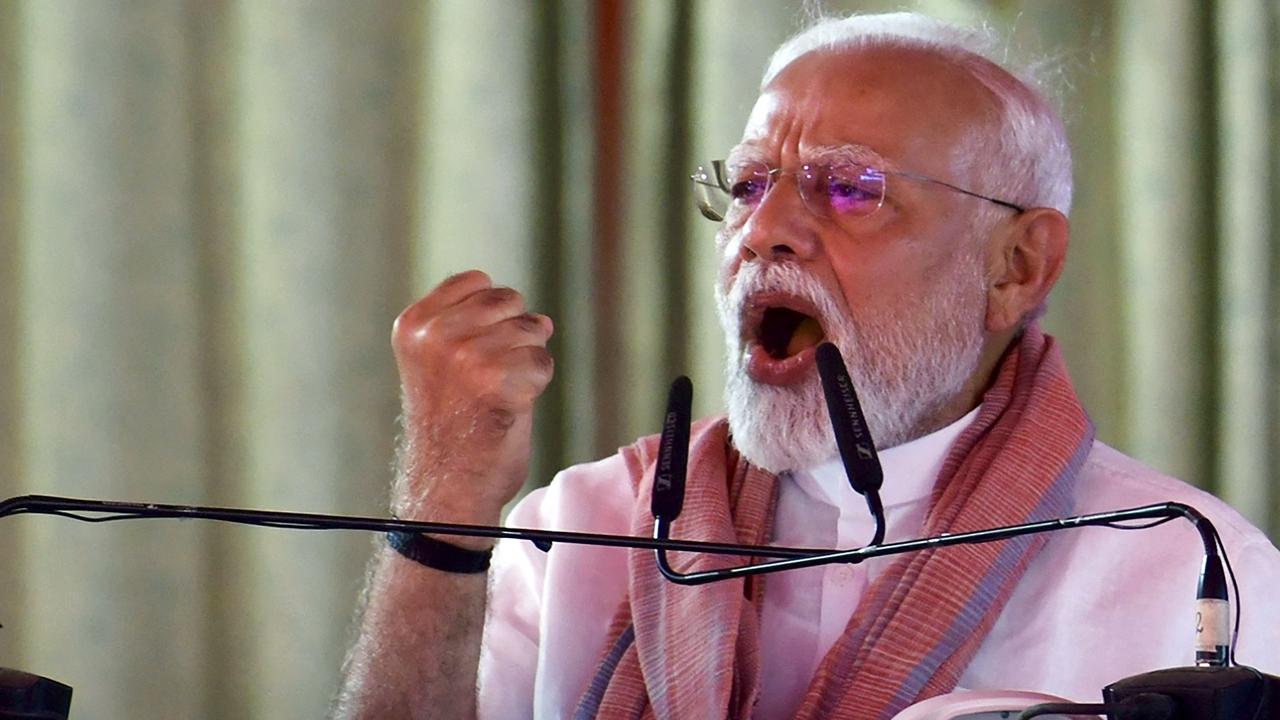
India’s Prime Minister Narendra Modi, said that their ‘spirit will not be broken’ by terrorism.. Picture: Sachin KUMAR / AFP
But Prime Minister Modi has, in recent years, suspended the region’s special freedoms and allowed his Hindu nationalist supporters to impose their ways on the culturally distinct populace.
“India’s hard-line policies under Modi and the imposition of direct central rule on Kashmir have fuelled deep alienation in the Muslim-majority region,” argues Yale University lecturer Sushant Singh.
That backlash, he adds, has triggered much broader tensions that has been simmering beneath the surface for decades.
“With Modi’s rhetoric leaving little room for compromise, Pakistan’s military leadership under pressure to respond forcefully to any Indian strike, and China’s growing involvement in the region, events in Kashmir risk triggering uncontrollable escalation,” he said.
Kashmir Conundrum
“At the heart of the Kashmir crisis is a combustible mix of religious nationalism, authoritarian governance, and unresolved political grievances,” explains Mr Singh.
Mr Modi stripped Kashmir, India’s only Muslim-majority state, of its constitutional privileges in 2019.
Local elections have been suspended. Curfews, media controls and political arrests have become commonplace.
“The reality on the ground remains one of pervasive fear and violence,” adds Mr Singh.
“Kashmir has endured recurring militant attacks, including the killing in Pahalgam, and the continued imposition of draconian laws and heavy security deployments.”
Responsibility for the Pahalgam attack has been claimed by a group calling itself The Resistance Front (TRF), which analysts believe to be an offshoot of Pakistan’s Lashkar-e-Taiba militant group.
The TRF has accused Indian Hindus of a co-ordinated campaign to establish settlements in Kashmir and overwhelm its indigenous population.
PM Modi has seized on the TRF’s Pakistani ties to label the incident as a cross-border attack backed by Islamabad.
He’s expelled Pakistani diplomats. He’s closed the border. He’s ordered the suspension of the Indus Waters Treaty.
ashmir is inseparable from his broader political strategy, in which he projects strength as a Hindu nationalist strongman, promises violent retribution against enemies, and seeks to rally domestic support through exploiting moments of national security crisis,” Mr Singh states.
Pakistan’s Power Plays
Islamabad has condemned suspension of the Indus water agreement as an “act of war”.
It has also closed its airspace to Indian flights and suspended all bilateral treaties, including a 1972 peace treaty that laid out a path towards a normalised relationship between the two nations.
But Pakistan is in the grip of a severe internal crisis……………………………………………………………………………………………………………………………….. https://www.news.com.au/technology/innovation/military/india-and-pakistan-nations-on-brink-of-nuclear-war/news-story/2f6d318483fdad71eebf466349123137
Danger of an India-Pakistan war and Canada’s Reactors
Normand Lester, Journal de Montréal, 27 avril 2025, https://www.journaldemontreal.com/2025/04/27/danger-de-guerre-indo-pakistanaise-et-nos-candu
An individual with dual Canadian and Pakistani citizenship has just been arrested in the USA for attempting to acquire technology for Pakistan’s nuclear weapons program and smuggle it through Canada.
The case comes to light as tension mounts between India and Pakistan following the massacre of 26 Indian tourists in the disputed region of Kashmir. New Delhi accuses Pakistan of being responsible. The latter denies being behind the attack. India has annexed Muslim-majority Kashmir, which is claimed by Pakistan. China is a major ally of Pakistan, while India has close defense ties with the United States.
Clashes between the two armies increased, raising fears of a large-scale military conflict. Peace has never really been restored since 1947, when the British Indian Empire was violently partitioned into two independent states: Muslim-majority Pakistan and Hindu-majority India. The war of religious partition is thought to have claimed between one and two million lives, and led to the massive displacement of between 12 and 20 million people.
A-bomb: thanks to Canada
India and Pakistan have already fought two major wars, in 1965 and 1971, before acquiring nuclear weapons… with the help of Canada. Any war between them could therefore turn into a nuclear exchange.
Since then, India and Pakistan have experienced a major border skirmish in 1999, which left at least 1,000 people dead.
After donating one nuclear reactor to India in 1956, Ottawa heavily subsidized the purchase of another by India in 1963. As part of this purchase, Canada trained 271 Indian scientists, engineers and technicians, who went on to develop New Delhi’s atomic bomb.
In 1971, Canada built a 137-megawatt CANDU nuclear reactor in Karachi, Pakistan. The contract also included a heavy water production facility. Three years later, in 1974, India detonated its first nuclear device, dubbed the “Smiling Buddha”, using plutonium from the reactor donated by Ottawa in 1956.
According to experts, Canadian reactors are ideal for producing weapons-grade plutonium, and Ottawa hasn’t even asked India to comply with the safeguards required by the International Atomic Energy Agency (IAEA).
Canada sneaks away
U.S. Secretary of State Henry Kissinger then roundly criticized Canada, telling the media that the Indian nuclear explosion had been carried out using material diverted from a Canadian reactor lacking the appropriate safeguards.
With its guilt exposed, Canada quietly withdrew from the Indian CANDU project. It also stopped supplying uranium to Karachi, and withdrew from the Pakistani project. This did not prevent it from carrying out its first nuclear test in 1998.
If India and Pakistan ever wage nuclear war on each other, Canada will have to assume – in part – the moral responsibility.
Deaths mount as Pakistan swelters in heatwave

As the temperatures rose in southern Pakistan, so did the body count. The
Edhi ambulance service says it usually takes around 30 to 40 people to the
Karachi city morgue daily. But over the last six days, it has collected
some 568 bodies – 141 of them on Tuesday alone. It is too early to say
exactly what the cause of death was in every case. However, the rising
numbers of dead came as temperatures in Karachi soared above 40C (104F),
with the high humidity making it feel as hot as 49C, reports said. People
have been heading to hospitals seeking help.
BBC 27th June 2024
Pakistan issues flood alert and warns of heavy loss of life due to glacial melting
A Pakistani province is warning of heavy loss of life due to glacial melting
Riaz Khan Independent 20th April 2024
A Pakistani province has issued a flood alert due to glacial melting and
warned of heavy loss of life, officials said Saturday. The country has
witnessed days of extreme weather, killing scores of people and destroying
property and farmland. Experts say Pakistan is experiencing heavier rains
than normal in April because of climate change. In the mountainous
northwest province of Khyber Pakhtunkhwa, which has been hit particularly
hard by the deluges, authorities issued a flood alert because of the
melting of glaciers in several districts.
more https://www.independent.co.uk/climate-change/news/pakistan-flooding-climate-change-latest-b2531924.html
‘Pakistan advanced nuclear weapons programme despite economic challenges’
Pakistan is reported to have 170 nuclear warheads as of January 2023
By: Pramod Thomas, 17 Apr 24, https://www.easterneye.biz/pakistan-nuclear-programme-india-us/
DESPITE economic challenges, Pakistan continued upgrading its nuclear capabilities, driven by its ongoing tensions with India, top US intelligence official told Congress.
The remarks by Lt Gen Jeffrey Kruse, director of the Defence Intelligence Agency came during a Congressional hearing on China on Monday (15).
Kruse told lawmakers that Pakistan has sought international support, including from the UN security council, to resolve its dispute with India about Kashmir.
Separately, Islamabad and New Delhi have maintained an uneasy ceasefire along the shared Line of Control since February 2021, he said.
“Pakistan has sustained its nuclear modernisation efforts despite its economic turmoil. Terrorist violence against Pakistani security forces and civilians also rose last year,” he said.
According to the Stockholm International Peace Research Institute, Pakistan is reported to have 170 nuclear warheads as of January 2023.
Cash-strapped Pakistan is banking on close allies like China and Saudi Arabia for loans to tide over its economic woes. Moreover, Pakistan’s finance minister Muhammad Aurangzeb is now in Washington to discuss a new loan package with the International Monetary Fund.
Pakistan’s contentious relationship with India continues to drive its defence policy, Kruse told US lawmakers.
However, cross-border violence between the countries has decreased since their February 2021 recommitment to a ceasefire, he said.
“Islamabad is modernising its nuclear arsenal and improving the security of its nuclear materials and nuclear C2 (command and control). In October, Pakistan successfully tested its Ababeel medium-range ballistic missile,” he said.
In 2023, militants killed around 400 security forces, a nine-year high, and Pakistani security forces have conducted almost daily counterterrorism operations during the past year.
Islamabad and New Delhi have a long history of strained relations, primarily due to the Kashmir issue as well as the cross-border terrorism emanating from Pakistan.
In 2019, Pakistan downgraded its diplomatic ties with New Delhi after the Indian government abrogated Article 370 of the constitution, revoking the special status of Jammu and Kashmir and bifurcating the state into two union territories.
India has been maintaining that it desires normal neighbourly relations with Pakistan while insisting that the onus is on Islamabad to create an environment that is free of terror and hostility for such an engagement.
New Delhi has also asserted that the constitutional measures taken by the Indian government to ensure socio-economic development and good governance in the Union Territory of Jammu and Kashmir are matters internal to India.
India, Pakistan exchange list of nuclear installations under 1988 bilateral pact
LiveMint, 01 Jan 2024,
The pact signed by India and Pakistan in 1988 prohibits the two countries from attacking each other’s atomic facilities.
India and Pakistan on Monday exchanged a list of their nuclear installations under a bilateral pact signed in 1988 and came into force in 1991 that prohibits the two countries from attacking each other’s atomic facilities………………..
India and Pakistan on Monday exchanged a list of their nuclear installations under a bilateral pact signed in 1988 and came into force in 1991 that prohibits the two countries from attacking each other’s atomic facilities.
The exchange of the list came amid frosty ties between the two countries over the Kashmir issue as well as cross-border terrorism.
Both countries have not had any formal talks since they ended the composite dialogue in the aftermath of the 2008 Mumbai attacks carried out by Lashkar-e-Taiba (LeT), a Pakistan-based terror group, in which 166 people were killed and several injured.
The political leadership of both countries made several attempts to resume the contact. However, they were derailed by a string of terror attacks on Indian soil by Pakistan-based terror groups. https://www.livemint.com/news/india/india-pakistan-exchange-list-of-nuclear-installations-under-1988-bilateral-pact-11704107726908.html
The World’s Only Muslim Nuclear Power Warns Israel’s War in Gaza Must Stop
NewsWeek, Oct 27, 2023
Pakistan’s permanent representative to the United Nations has outlined to Newsweek his country’s position on the ongoing war between Israel and Palestinian factions led by Hamas, expressing the need for a ceasefire and warning of regional instability if an already devastating conflict deepens further.
“This is an obligation that devolves on all member states to prevent an escalation of the conflict,” Ambassador Munir Akram told Newsweek. “We would have hoped that the conflict had not taken place, but it has, and now we have to stop it, to halt the fighting and to avoid the suffering that is happening and is likely to happen if this conflict goes on.”
While the Islamic Republic he represents, one of the world’s most populous countries and the only Muslim-majority nation to possess nuclear weapons, may be thousands of miles away from the frontlines of the Gaza Strip, Akram identified a direct connection between Pakistan and the Palestinian cause. This link was made all the more tangible by parallels he drew between the Israeli-Palestinian conflict and the Indian-Pakistani dispute over the divided territory of Kashmir, to which Pakistanis commemorate a “Black Day” on Friday.
With local health officials in Hamas-run Gaza now counting deaths in excess of 7,000 as a result of Israeli airstrikes since an unprecedented Hamas-led October 7 assault on Israel in which authorities said 1,400 people were killed, Akram argued that “this is not something that should be acceptable to any civilized nation or people and we oppose it, therefore we hope it would stop.”
He added: “There is an additional layer of obligation on us as an Islamic country.”
“We feel that we have an obligation, an emotional commitment to Palestine and to the freedom of the Palestinian people,” Akram said. “It is a principle to which we are committed politically because of Kashmir. We are heavily invested in that principle, and we would like to see the triumph of that principle of self-determination.”
Common History
The Israeli-Palestinian and Kashmir conflicts are linked by history as well, both having been born out of the collapse of British colonial rule three-quarters of a century ago in the years immediately following World War II.
When the British Raj was dissolved in 1947, the previously united Indian subcontinent was divided into the new nations of India and Pakistan, with Pakistan also controlling modern-day Bangladesh until 1971. The partition resulted in massive bloodshed, especially between Hindus and Muslims on both sides of the new border. The two new states quickly went to war over the middle ground of Kashmir, which today is divided along what’s known as the Line of Control………………………………………………………………………………….. more https://www.newsweek.com/pakistan-warns-israel-war-gaza-must-stop-munir-akram-1838448 #nuclear #antinuclear #NoNukes #Israel #Palestine
Loud Explosion Heard In Pakistan’s Dera Ghazi Khan City With Nuclear Facility; Officials Say ‘Sonic Boom’
The loud thud in the vicinity of Dera Ghazi Khan town in southern Punjab caused panic and soon it started trending on social media.
BQ Prime 6 Oct 23
Pakistan authorities on Friday said that the sound of a loud explosion in Punjab province could be due to a sonic boom as there was no information of a bombing incident or an act of sabotage. The loud thud in the vicinity of Dera Ghazi Khan town in southern Punjab caused panic and soon it started trending on social media. Videos circulating on X showed people vacating the area even as rescue teams and police personnel were moving around.
Pakistan’s nuclear research site is in the neighbourhood…………………….
Pakistan’s new nuclear brinkmanship
Recently, Pakistan’s strategic planners have hinted to a shift in Pakistan’s nuclear doctrine, which seems to be quite radical.
Deccan Herald, Abhinav Narayan Jha, 23 September 2023
In July, when India celebrated the 24th Vijay Diwas of the 1999 Kargil War, the nuclear question between the two arch-rivals got refreshed. Both sides are said to have reportedly weighed the nuclear option then.
Pakistan was reported to have moved ballistic missiles toward the border. American officials and security experts had in 2000 claimed that India, too, had prepared nuclear-tipped ballistic missiles. If true, this was the closest India and Pakistan had ever come to a nuclear exchange.
Recently, Pakistan’s strategic planners have hinted to a shift in Pakistan’s nuclear doctrine, which seems to be quite radical. On the 25th anniversary of Pakistan’s nuclear tests, Lt General Khalid Kidwai (retd), adviser to Pakistan’s National Command Authority, sent ripples across the strategic and security community in Asia and the West when he revisited Pakistan’s nuclear strategy. Kidwai, who was the first and longest-serving Director-General of Pakistan’s Strategic Plans Division, touched on two important things: First, he referred to “Full Spectrum Deterrence” (FSD); second, he referred to “Zero meters to 2,750 kilometres”. Both phrases suggest a makeover of Pakistan’s nuclear doctrine.
Read more at: https://www.deccanherald.com/opinion/pakistan-s-new-nuclear-brinkmanship-2697746
U.S. HELPED PAKISTAN GET IMF BAILOUT WITH SECRET ARMS DEAL FOR UKRAINE, LEAKED DOCUMENTS REVEAL
Pakistan’s embattled military regime further dependent on the IMF, the U.S., and the production of munitions for the war in Ukraine to sustain itself through a crisis that shows no sign of resolution.
The U.S.-brokered loan let Pakistan’s military postpone elections, deepen a brutal crackdown, and jail former Prime Minister Imran Khan.
The Intercept, Ryan Grim, Murtaza Hussain, September 17 2023
SECRET PAKISTANI ARMS sales to the U.S. helped to facilitate a controversial bailout from the International Monetary Fund earlier this year, according to two sources with knowledge of the arrangement, with confirmation from internal Pakistani and American government documents. The arms sales were made for the purpose of supplying the Ukrainian military — marking Pakistani involvement in a conflict it had faced U.S. pressure to take sides on.
The revelation is a window into the kind of behind-the-scenes maneuvering between financial and political elites that rarely is exposed to the public, even as the public pays the price. Harsh structural policy reforms demanded by the IMF as terms for its recent bailout kicked off an ongoing round of protests in the country. Major strikes have taken place throughout Pakistan in recent weeks in response to the measures.
The protests are the latest chapter in a year-and-a-half-long political crisis roiling the country. In April 2022, the Pakistani military, with the encouragement of the U.S., helped organize a no-confidence vote to remove Prime Minister Imran Khan. Ahead of the ouster, State Department diplomats privately expressed anger to their Pakistani counterparts over what they called Pakistan’s “aggressively neutral” stance on the Ukraine war under Khan. They warned of dire consequences if Khan remained in power and promised “all would be forgiven” if he were removed.
Since Khan’s ouster, Pakistan has emerged as a useful supporter of the U.S. and its allies in the war, assistance that has now been repaid with an IMF loan. The emergency loan allowed the new Pakistani government to put off a looming economic catastrophe and indefinitely postpone elections — time it used to launch a nationwide crackdown on civil society and jail Khan.
“Pakistani democracy may ultimately be a casualty of Ukraine’s counteroffensive,” Arif Rafiq, a nonresident scholar at the Middle East Institute and specialist on Pakistan, told The Intercept.
Pakistan is known as a production hub for the types of basic munitions needed for grinding warfare. As Ukraine grappled with chronic shortages of munitions and hardware, the presence of Pakistani-produced shells and other ordinances by the Ukrainian military has surfaced in open-source news reports about the conflict, though neither the U.S. nor Pakistan has acknowledged the arrangement.
Records detailing the arms transactions were leaked to The Intercept earlier this year by a source within the Pakistani military. The documents describe munitions sales agreed to between the U.S. and Pakistan from the summer of 2022 to the spring of 2023. Some of the documents were authenticated by matching the signature of an American brigadier general with his signature on publicly available mortgage records in the United States; by matching the Pakistani documents with corresponding American documents; and by reviewing publicly available but previously unreported Pakistani disclosures of arms sales to the U.S. posted by the State Bank of Pakistan.
The weapons deals were brokered, according to the documents, by Global Military Products, a subsidiary of Global Ordnance, a controversial arms dealer whose entanglements with less-than-reputable figures in Ukraine were the subject of a recent New York Times article.
Documents outlining the money trail and talks with U.S. officials include American and Pakistani contracts, licensing, and requisition documents related to U.S.-brokered deals to buy Pakistani military weapons for Ukraine.
The economic capital and political goodwill from the arms sales played a key role in helping secure the bailout from the IMF, with the State Department agreeing to take the IMF into confidence regarding the undisclosed weapons deal, according to sources with knowledge of the arrangement, and confirmed by a related document.
To win the loan, Pakistan had been told by the IMF it had to meet certain financing and refinancing targets related to its debt and foreign investment — targets that the country was struggling to meet. The weapons sales came to the rescue, with the funds garnered from the sale of munitions for Ukraine going a long way to cover the gap.
Securing the loan eased economic pressure, enabling the military government to delay elections — a potential reckoning in the long aftermath of Khan’s removal — and deepen the crackdown against Khan’s supporters and other dissenters. The U.S. remained largely silent about the extraordinary scale of the human rights violations that pushed the future of Pakistan’s embattled democracy into doubt………………………………………..
Bombs for Bailouts
On May 23, 2023, according to The Intercept’s investigation, Pakistani Ambassador to the U.S. Masood Khan sat down with Assistant Secretary of State Donald Lu at the State Department in Washington, D.C., for a meeting about how Pakistani arms sales to Ukraine could shore up its financial position in the eyes of the IMF.
……………………………………………………………………………………………………………………………………………… In an interview with The Intercept at the Capitol on Tuesday, Van Hollen said that his knowledge of the U.S. role in facilitating the IMF loan came directly from the Biden administration………………………………………………………..
Eleventh-Hour IMF Deal
…………………………………………………………………….. The secret arms deal for Ukraine would allow Pakistan to add nearly another billion dollars to its balance sheet ………………………………………………………………………………..
As The Intercept previously reported, Lu, the senior State Department official, said in a meeting with then-Pakistani Ambassador Asad Majeed Khan two weeks after the invasion that it was the belief of the U.S. that Pakistan had taken a neutral position solely at Khan’s direction, adding that “all would be forgiven” if Khan was removed in the no-confidence vote. Since his ouster, Pakistan has firmly taken the side of the U.S. and Ukraine in the war.
……………………………………………………………………………..After orchestrating Khan’s removal, the military embarked on a campaign to eradicate his political party through a wave of killings and mass detentions. Khan himself is currently imprisoned on charges of mishandling a classified document and facing some 150 additional charges — allegations widely viewed as a pretext to stop him from contesting future elections.
………………………………………………………..The absence of other foreign support left Pakistan’s embattled military regime further dependent on the IMF, the U.S., and the production of munitions for the war in Ukraine to sustain itself through a crisis that shows no sign of resolution. https://theintercept.com/2023/09/17/pakistan-ukraine-arms-imf/
Pakistan has 170 nuclear warheads, and may increase it to 200 by 2025, say American atomic scientists
LiveMint. 15 Sep 2023
Top American nuclear scientists have estimated that Pakistan currently possesses roughly 170 nuclear warheads, and this number could potentially increase to approximately 200 by the year 2025, based on the current rate of expansion.
As reported by PTI citing the Nuclear Notebook column published in the Bulletin of the Atomic Scientists on September 11, “We estimate that Pakistan now has a nuclear weapons stockpile of approximately 170 warheads. The US Defense Intelligence Agency projected in 1999 that Pakistan would have 60 to 80 warheads by 2020, but several new weapon systems have been fielded and developed since then, which leads us to a higher estimate.”……………………………………………………………………………………………………………………
Even when the document listed fissile materials production and inventory from available sources in the public domain, the scientists put out a disclaimer: “Calculating stockpile size based solely on fissile material inventory is an incomplete methodology that tends to overestimate the likely number of nuclear warheads.”
“We estimate that Pakistan currently is producing sufficient fissile material to build 14 to 27 new warheads per year, although we estimate that the actual warhead increase in the stockpile probably averages around 5 to 10 warheads per year,” they further said………………………………………………………………………
Commenting on the 2017’s medium-range ballistic missile called Ababeel that Pakistan said is “capable of carrying multiple warheads, using multiple independent reentry vehicle (MIRV) technology,” the Nuclear Notebook observed, “Development of multiple-warhead capability appears to be intended as a countermeasure against India’s planned ballistic missile defense system. Its status remains unclear as of July 2023.”
Pointing out that the total number and location of Pakistan’s nuclear-capable missile bases and facilities remains unknown, the document said, “Analysis of commercial satellite imagery suggests that Pakistan maintains at least five missile bases that could serve a role in Pakistan’s nuclear forces.”………………………………….
Admitting that little is publicly known about warhead production, the scientists said: “But experts have suspected for many years that the Pakistan Ordnance Factories near Wah, northwest of Islamabad, serve a role. One of the Wah factories is located near a unique facility with six earth-covered bunkers (igloos) inside a multi-layered safety perimeter with armed guards.” https://www.livemint.com/news/world/pakistan-has-170-nuclear-warheads-and-may-increase-it-to-200-by-2025-says-american-atomic-scientists-11694753125105.html
1 This Month


Petition to revoke the licensing of the Near Surface Nuclear Disposal Facility (NSDF) at Chalk River. https://www.ourcommons.ca/petitions/en/Petition/Details?Petition=e-7247


of the week – STOP SMALL MODULAR REACTORS IN CANADA
To see nuclear-related stories in greater depth and intensity – go to https://nuclearinformation.wordpress.com
-
Archives
- March 2026 (163)
- February 2026 (268)
- January 2026 (308)
- December 2025 (358)
- November 2025 (359)
- October 2025 (376)
- September 2025 (258)
- August 2025 (319)
- July 2025 (230)
- June 2025 (348)
- May 2025 (261)
- April 2025 (305)
-
Categories
- 1
- 1 NUCLEAR ISSUES
- business and costs
- climate change
- culture and arts
- ENERGY
- environment
- health
- history
- indigenous issues
- Legal
- marketing of nuclear
- media
- opposition to nuclear
- PERSONAL STORIES
- politics
- politics international
- Religion and ethics
- safety
- secrets,lies and civil liberties
- spinbuster
- technology
- Uranium
- wastes
- weapons and war
- Women
- 2 WORLD
- ACTION
- AFRICA
- Atrocities
- AUSTRALIA
- Christina's notes
- Christina's themes
- culture and arts
- Events
- Fuk 2022
- Fuk 2023
- Fukushima 2017
- Fukushima 2018
- fukushima 2019
- Fukushima 2020
- Fukushima 2021
- general
- global warming
- Humour (God we need it)
- Nuclear
- RARE EARTHS
- Reference
- resources – print
- Resources -audiovicual
- Weekly Newsletter
- World
- World Nuclear
- YouTube
-
RSS
Entries RSS
Comments RSS
 nuclear-news