Daily radiation exposure of Fukushima’s schoolchildren
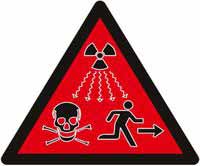 Children and teachers at a fifth of the 1,600 schools in Fukushima are receiving at least 20 millisieverts of radiation per year, said Nakate, according to readings from the government. That’s the limit for a nuclear power plant worker, according to Japan’s nuclear safety commission.
Children Don Masks, Hats in Fukushima as Radiation Looms, Bloomberg, By Takahiko Hyuga and Shigeru Sato – May 11, 2011 Students at theShoyo Junior High School in Fukushima are wearing masks, caps and long-sleeved jerseys to attend classes as their exposure to radiation is on pace to equal annual limits for nuclear industry workers. Continue reading
Northern Japan: bank problems as business clients fear radiation
“This is such a tragedy for the people of Fukushima, particularly our youth,” said Toyo System’s Shoji, who has two children. “Radioactive contamination has literally jeopardized the seeds and soil of our future growth.”
Nuclear Fear Snags Loan Push by Fukushima Banks as Clients Flee Radiation, Bloomberg, By Shigeru Sato and Shingo Kawamoto – May 11, 2011 “……Daito and larger rivals in the prefecture, Toho Bank Ltd. (8346) and Fukushima Bank Ltd., are three of the worst five performers on Japan’s 83-member Topix Banks Index (TPNBNK) since the March 11 quake and tsunami. They are struggling to keep customers and prevent loans from souring…… Continue reading
Students boycott their own convocation ceremony in anti-nuclear protest
 TISS students protest against Ramesh – Hindustan Times, 11 may 11“……The students – some carrying placards, others sporting yellow-and-black t-shirts with anti-nuke slogans, several more sporting black bands – greeted the minister by raising slogans when he arrived at the TISS Deonar Campus to deliver the convocation address Wednesday afternoon.”We are protesting against the 9,900-MW Jaitapur Nuclear Power Project in Ratnagiri in Maharashtra and other mega-projects in Orissa and Jharkhand. Thousands of common people are being displaced or uprooted there,” said Pranab Doley, an organiser of the protest.
He said that since the student community is feeling strongly about these huge developmental projects, they decided to boycott their own convocation ceremony in which they would have been presented their coveted degree certificates at the hands of the minister…..
TISS students protest against Ramesh – Hindustan Times
Graduating students show opposition to Jaitapur nuclear plant
TISS students greet Ramesh with anti-nuke placards,TNN | May 12, 2011,MUMBAI: As students of the Tata Institute of Social Science (TISS) walked up to the podium to get their medals during the 71st convocation ceremony from the chief guest, they handed him pocket-sized anti-nuclear placards in return.
For, the chief guest was Union environment minister Jairam Ramesh and the students were staging a silent protest against the Jaitapur nuclear power plant in Maharashtra and the Posco steel project in Orrisa. While about 30 graduating students boycotted the convocation ceremony, several others wore anti-nuclear Tshirts and badges.
Students of TISS have been very active on the Jaitapur issue and five were also arrested two weeks ago when they participated in a protest yatra from Tarapur to Jaitapur.
TISS students greet Ramesh with anti-nuke placards – The Times of India
Secret plan for dumping nuclear waste in Mongolia

 Japan, U.S. negotiating construction of nuclear waste facility in Mongolia, Mainichi Daily News 10 May 11 ULAN BATOR, Mongolia — Japan’s Ministry of Economy, Trade and Industry and the U.S. Department of Energy have secretly been advancing plans to construct the world’s first international storage and disposal facility for spent nuclear fuel in Mongolia, it has been learned. Continue reading
Fukushima nuclear reactor No1 has dangerous radiation level
| Dangerous Radiation Level at Fukushima No 1 Reactor Detected |
| Moscow, May 10 (IANS/RIA Novosti) Tokyo Electric Power Co. (TEPCO), detected a potentially dangerous radiation level at the damaged No.1 reactor of crippled Fukushima nuclear power plant, Kyodo news agency said Monday.
The recent 9.0-magnitude quake and tsunami in Japan triggered a number of explosions at the Fukushima No. 1 nuclear power plant, which caused the worst nuclear crisis since Chernobyl in 1986. The radiation levels in the building exceed expected levels reaching as high as 700 millisieverts per hour. A level of radiation at 500 millisieverts per hour may cause cancer, while an acute radiation sickness begins with a dose of 1 sievert and chronic radiation sickness – from 1.5 sievert. A group of nine specialists from the plant’s operator, TEPCO, entered the No. 1 reactor building at the Fukushima nuclear power plant early in the morning on Monday and spent 30 minutes there, measuring radiation levels. Japanese officials earlier reported that radiation levels had dropped inside the building after ventilators were installed last week to filter out radioactive substances…… http://www.daijiworld.com/news/news_disp.asp?n_id=101529&n_tit=Dangerous+Radiation+Level+at+Fukushima+No+1+Reactor+Detected |
Tepco shares plunge, – Fukushima compensation more than $100 billion?
Tepco wants government help for compensation payments BBC News 10 May 11 ……Total compensation claims are yet to be known, but analysts say they may be more than $100bn (£61bn). Engineers are still struggling to contain damage at the Fukushima Daiichi plant in northeastern Japan.
The government of Prime Minister Naoto Kan is now under pressure to review Japan’s energy policy, which has been heavily dependent on nuclear power.
…… Shares in Tepco have plunged since the 11 March quake and subsequent tsunami.
Japanese media has reported that Tepco may have to raise electricity prices in order to help pay for payments….. http://www.bbc.co.uk/news/world-asia-pacific-13330263
Don’t trust nuclear power people’s story on Fukushima disaster
“It’s very important to have scientists who are not already paid by the nuclear power industry,” …”If they are the same people from Euratom and national authorities they use today, why would they say anything different to what they say all the time?”
Deadly Silence on Fukushima, (VIDEO) Huffington Post , Vivian Morris, : 05/ 9/ I received the following email a few days ago from a Russian nuclear physicist friend who is an expert on the kinds of gases being released at Fukushima. Here is what he wrote:
About Japan: the problem is that the reactor uses “dirty” fuel. It is a combination of plutonium and uranium (MOX). I suspect that the old fuel rods have bean spread out due to the explosion and the surrounding area is contaminated with plutonium which means you can never return to this place again. It is like a new Tchernobyl. Personally, I am not surprised that the authority has not informed people about this. Continue reading
Japan’s richest man pushes for move away from nuclear energy
Masayoshi Son, the founder of Softbank and Japan’s richest man, said last month that he would donate about $12 million to start a research foundation for renewable energy. Continued reliance on atomic energy, he told a news conference, “would be a sin against our children, grandchildren and future generations.”
Japan’s Nuclear Future in the Balance, New York Times, by ANDREW POLLACK, May 9, 2011 TOKYO — The accident at the Fukushima Daiichi power plant has done more than spew radiation into the air and sea and force tens of thousands of people to evacuate their homes. It has blown a big hole in Japan’s energy policy, which had assumed that nuclear power would supply a growing part of the country’s needs….. Continue reading
US Japan nuclear marketing scheme, with secret plans for Mongolian waste dump
 Negotiations on building the facilities were kept secret as it was feared that if the plans came to light at the negotiation stage, then China and Russia — countries through which the fuel could pass — might interfere and protests could erupt from Mongolian residents.
Japan, U.S. negotiating construction of nuclear waste facility in Mongolia, Mainichi Daily News 10 May 11 ULAN BATOR, Mongolia –“…….the marketing of nuclear plants is big business — a single reactor sells for hundreds of billions of yen. The Japanese government regards the overseas sale of nuclear power plants as a pillar of the nations’ growth strategy. It has already tied a deal with Vietnam and is in negotiations with India and Turkey. However, Russia and other countries have gone a step ahead by marketing their reactors and the collection of spent nuclear fuel together as a set, which has put Japan and the U.S. on the back foot. Continue reading
Close Hamaoka Nuclear Plant – call by Japan’s Prime Minister
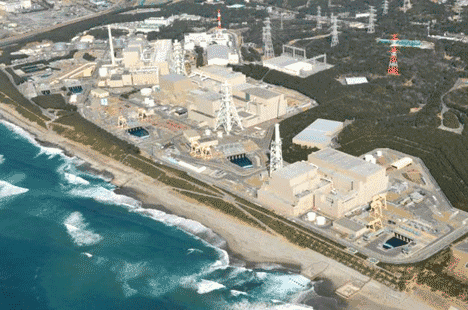 Japan PM Wants Another Nuclear Plant Closed Over Quake Fears, ABC News, By AKIKO FUJITA, TOKYO May 6 2011, Japan urged a power company today to temporarily shut down operations at another nuclear plant that straddles a major fault line for fear it would not survive a major earthquake and tsunami.
Prime Minister Naoto Kan said during a news conference today that he requested the suspension of reactors at the Hamaoka nuclear plant over safety concerns, citing a study that said there was an 87 percent chance of a magnitude 8.0 earthquake striking central Japan within the next 30 years.
The Hamaoka plant is located in Shizuoka, 155 miles west of Tokyo, and sits on an active earthquake fault. Officials estimate the shutdown could last two years…..Japan Wants Another Nuclear Plant Suspended Out of Quake Fears – ABC News
Toxic radioactive effects of thorium, uranium in rare earths
 Environmental groups have long criticised rare earths mining for spewing toxic chemicals and radioactive thorium and uranium into the air, water and soil, which can cause cancer and birth defects among residents and animals…..
 China pays price for world’s rare earths addiction, By Allison Jackson (AFP) – Google News, 7 May 11, BAOTOU, China — Peasant farmer Wang Tao used to grow corn, potatoes and wheat within a stone’s throw of a dumping ground for rare earths waste until toxic chemicals leaked into the water supply and poisoned his land.Farmers living near the 10-square-kilometre expanse in northern China say they have lost teeth and their hair has turned white while tests show the soil and water contain high levels of cancer-causing radioactive materials. Continue reading
Japan radiation monitoring – new comprehensive open source
 Radiation monitoring in Japan goes crowd, open source, CNET, by Eric Mack, May 6, 2011 A new open and crowdsourced initiative to deploy more geiger counters all over Japan looks to be a go. Safecast, formerly RDTN.org, recently met and exceeded its $33,000 fund-raising goal on Kickstarter, which should help Safecast send between 100 and 600 geiger counters to the catastrophe-struck country.
The data captured from the geiger counters will be fed into Safecast.org, which aggregates radiation readings from government, nonprofit, and other sources, as well as into Pachube, a global open-source network of sensors. Safecast is one of the larger crowdsourced monitoring efforts, not unlike a similar effort in the United States that predated the Japanese disaster.
For the last month, the Safecast crew and volunteers have been collaborating with universities in Japan and driving their geiger counters around the country and taking measurements. Safecast’s early monitoring trips north of Tokyo returned some disturbing findings, including elevated radiation levels in a kindergarten classroom….Radiation monitoring in Japan goes crowd, open source | Crave – CNET
Japan’s most dangerous nuclear power plant
Hamaoka, Japan’s Most Infamous Nuclear Plant? WSJ May 6, 2011, The Hamaoka nuclear power plant may not be as well known around the world as Fukushima Daichi, crippled by the March 11 disasters. But the complex that Prime Minister Naoto Kan ordered closed down Friday is extremely well known in Japan. In fact, it’s infamous.
The plant, operated by Chubu Electric Power Co., is sited on Japan’s east coast, about 200 kilometers southwest of Tokyo, by Omaezaki city in Shizuoka prefecture. Omaezaki is known for its fishing and its green tea. And also for being sited pretty much, some say, on the fault line in the area that would be hit by the next, historically overdue “Tokai earthquake” – a long-feared “Big One” that could wreak havoc in the Kanto region that includes the capital…..Hamaoka, Japan’s Most Infamous Nuclear Plant? – Japan Real Time – WSJ
Pakistan’s nuclear weapons and the al Qaeda threat
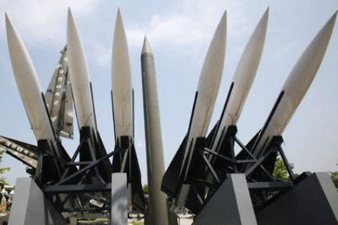 Estimates vary on the size of Pakistan’s and India’s nuclear arsenals, although analysts suggest India has 70-120 nuclear weapons while Pakistan has 60-120. These can be delivered by aircraft, or by missiles, which both countries have been developing and testing.
Factbox: Pakistan’s nuclear capability Reuters 6 May 11, Back in the 1990s, bin Laden said acquiring nuclear weapons was a “religious duty” of Muslim states and the leader of al Qaeda in Afghanistan in 2009 said the group hoped to seize and use Pakistan’s arsenal. Continue reading
1 This Month
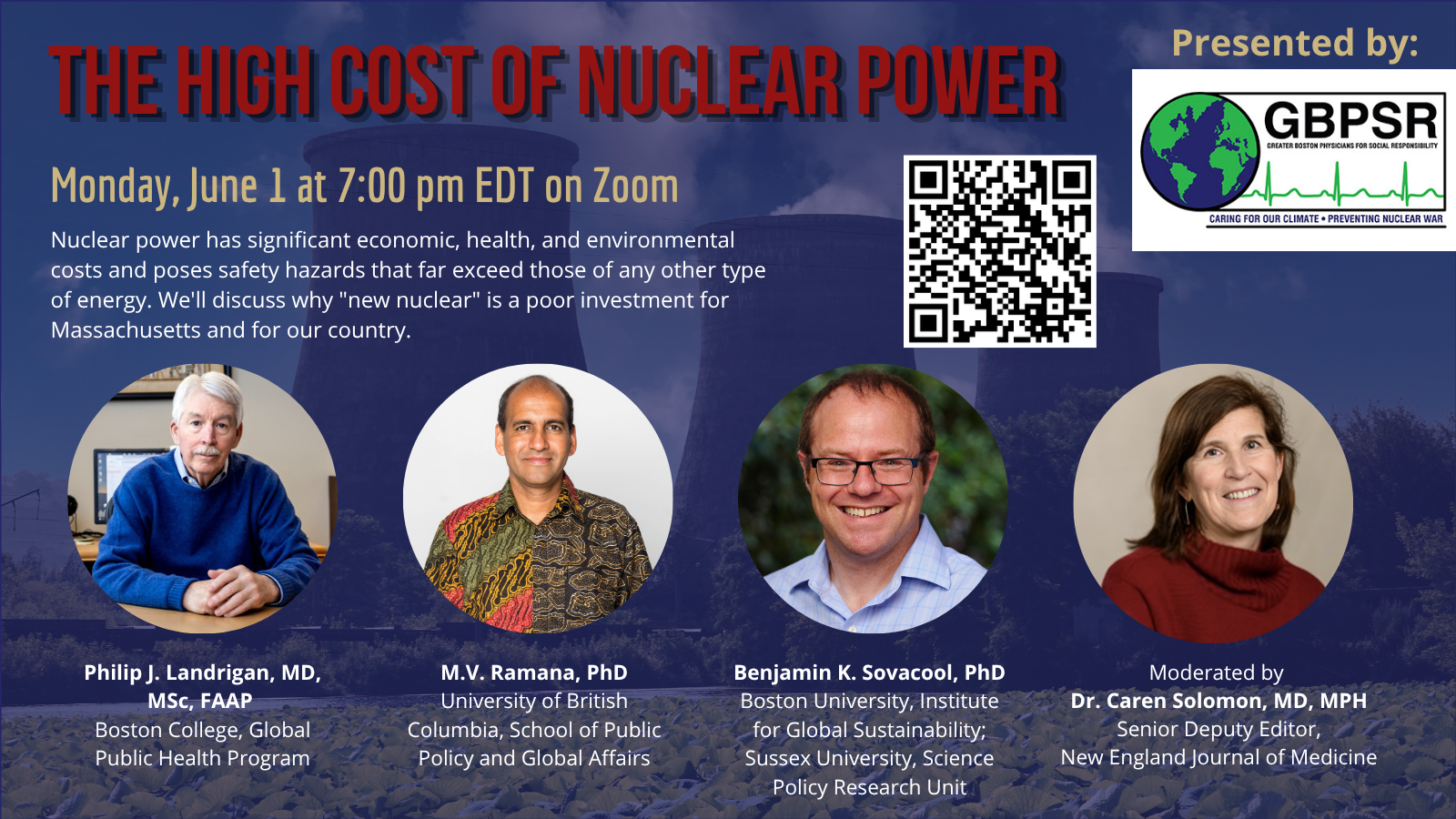
1 June Webinar – The High Cost of Nuclear Power – Register


of the week– Nuclear Reactor Information Task Force
To see nuclear-related stories in greater depth and intensity – go to https://nuclearinformation.wordpress.com
-
Archives
- May 2026 (262)
- April 2026 (356)
- March 2026 (251)
- February 2026 (268)
- January 2026 (308)
- December 2025 (358)
- November 2025 (359)
- October 2025 (376)
- September 2025 (257)
- August 2025 (319)
- July 2025 (230)
- June 2025 (348)
-
Categories
- 1
- 1 NUCLEAR ISSUES
- business and costs
- climate change
- culture and arts
- ENERGY
- environment
- health
- history
- indigenous issues
- Legal
- marketing of nuclear
- media
- opposition to nuclear
- PERSONAL STORIES
- politics
- politics international
- Religion and ethics
- safety
- secrets,lies and civil liberties
- spinbuster
- technology
- Uranium
- wastes
- weapons and war
- Women
- 2 WORLD
- ACTION
- AFRICA
- Atrocities
- AUSTRALIA
- Christina's notes
- Christina's themes
- culture and arts
- Events
- Fuk 2022
- Fuk 2023
- Fukushima 2017
- Fukushima 2018
- fukushima 2019
- Fukushima 2020
- Fukushima 2021
- general
- global warming
- Humour (God we need it)
- Nuclear
- RARE EARTHS
- Reference
- resources – print
- Resources -audiovicual
- Weekly Newsletter
- World
- World Nuclear
- YouTube
-
RSS
Entries RSS
Comments RSS
 nuclear-news