Nuclear Suppliers discriminated in favour of India, in order to sell USA nuclear reactors
 India is now in the privileged position of being the only known country with nuclear weapons which is not a party to the Nuclear Non Proliferation Treaty but is permitted to carry on nuclear commerce with the rest of the world. The discrimination is in India’s favour, not against it..

 Nuclear policy and process dumped at the drop of a hat, The Drum, Paul Barratt, 21 Nov 11 “………India is not a party to the NPT, has never been, has developed a nuclear weapons capability as a non-member of the Treaty, and accordingly, is in an entirely different position from China vis a vis Australian uranium export policy.
As part of a deal to enable India to gain access to US and other nuclear technologies, President Manmohan Singh and then President George W. Bush issued a joint statement in July 2005 to the effect that India would separate its civil and military nuclear activities and place all its civil facilities under IAEA safeguards, in return for which the United States would work toward full civil nuclear cooperation with India. An IAEA Safeguards agreement was signed in 2008, and India was granted an exemption by the Nuclear Suppliers Group, an export control group that had been established mainly inresponse to India’s first nuclear test in 1974. Continue reading
Nuclear power falling behind, as China grows its wind power
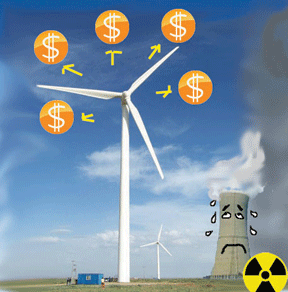 In China, and globally, wind power will stay well ahead of nuclear for decades and replace it altogether…..
 China’s path to renewable superpower, Climate Spectator, Matthew Wright, 23 Nov 11 Comparing China’s wind and nuclear power sectors reveal much about the fortunes of new and old energy technologies.
Wind power in China is growing at a blinding pace. China commenced construction of its first wind turbines in 2005 and in just six years has installed 58GW worth of wind power, which now contributes 128TWh to its grid. …
What’s remarkable about China’s wind sector is the speed and scale of its expansion. Wind generators are up and operating within nine months of breaking ground. Continue reading
Fukushima: 11 evacuated cities and towns, but their people will vote in elections
All of the parties and groups involved in the Fukushima assembly election said last month that they wanted nuclear power to be phased out……
For as long as they remain uninhabitable and their residents dispersed, the future of the contaminated areas will be clouded by uncertainty. …

 Japan’s nuclear disaster towns hold remote local elections Guardian UK, 20 Nov 11 Evacuated residents from Okuma and Futaba in Fukushima plant exclusion zone ballot for regional assemblies from afar They have been deserted for eight months, and could stay that way for years, their former inhabitants now scattered around north-east Japan.
But the towns of Okuma and Futaba, located in the shadow of the Fukushima Daiichi nuclear power plant, have shown that civic life must go on, even in the wake of a major nuclear accident. In one of the more surreal episodes of world democracy, tens of thousands were eligible to vote on Sunday for regional assemblies and mayors in towns that have all but ceased to exist. Continue reading
The hidden nature of cancer caused by ionising radiation
 Future cancers from Fukushima plant may be hidden, Google News, By MALCOLM RITTER, 21 Nov 11 “……The idea that Fukushima-related cancers may go undetected gives no comfort to Edwin Lyman, a physicist and senior scientist with the Union of Concerned Scientists, a group that advocates for nuclear safety. He said that even if cancers don’t turn up in population studies, that “doesn’t mean the cancers aren’t there, and it doesn’t mean it doesn’t matter.” Continue reading
India should make Nuclear Suppliers Group fully liable for accident costs
Jeremy Leggett urges India to claim full nuclear liability from suppliersTimes of India Laxmi Ajai Prasanna, TNN | Nov 20, 2011, THIRUVANANTHAPURAM: “India should make the Nuclear Suppliers’ Group face the full liability costs in case of an eventuality,” says Jeremy Leggett, an international climate campaigner and Greenpeace UK’s chief scientist and author of ‘Half Gone oil, gas, hot air and the global energy crisis’.
Taking his stance on the ‘Civil Nuclear Liability Act’ introduced in the Indian Parliament, he says, “Voicing for total liability cap will deter the investment bankers to face up the huge economic responsibility. That way India could safeguard its interest for clean and green energy and avert the recurrence of a Fukushima-type disaster.” In an interview to TOI here on Saturday, Leggett’s message for India in the context of exploring and utilising alternative energy sources was to ‘Catch up and shine fast’.
When told that the Indian government has toned down the right to recourse in the legality of the ‘Civil Liability Act’ conceding to the pressures of the nuclear lobby, Leggett says, “I am 57 now and realised that things don’t happen as expected, nuclear energy though not a safe option, is given the nod by the policy makers and decision makers of the government supported by fragile leaders…….
Japan’s anti nuclear Occupy movement determined to make Japan nuclear free
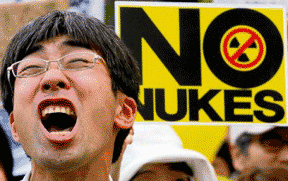 Anti-nuclear protestors sit tight at Japanese ministry, BUSINESS RECORDER NOVEMBER 18, 2011 TAKEHIKO KAMBAYASHA Anti-nuclear activist Tadao Eda says he and other citizens will continue their sit-in at the Industry Ministry for as long as Japan is running nuclear power stations despite the ongoing crisis at a damaged plant in the north-east.
“Japan needs drastic changes in energy policy by scrapping all the nuclear reactors,” Eda says from his tent erected in a corner of the ministry’s grounds two months ago. “We won’t allow the government to restart idled reactors” after they are shut down for maintenance, he says.
All of Japan’s 11 reactors still in operation, are scheduled to be shut down for servicing by April, he says. If the government withholds permission for them to restart, Japan would be free of nuclear power. Continue reading
Time to stop India’s media disinformation and spin on USA-India nuclear deal
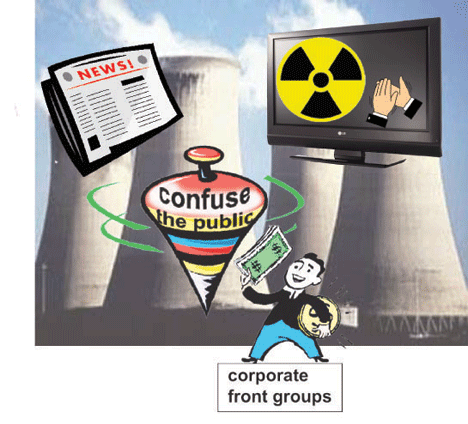 Stop this spin on nuclear liability law! Rediff, 18 Nov 11 Maybe, Justice Markandey Katju, chairman of the Press Council of India has a point – India needs a media regulatory framework. Katju pointed out how ill-equipped are our journalists intellectually and otherwise to handle complex issues. Take, for instance, the new rules that have been formulated by the government on the nuclear liability law.
India’s anti nuclear activists are still patriotic Indians
 Anti-nuclear stand is not anti-national: activist, Manorama Online, November 17, 2011 Chennai: “Being anti-nuclear power does not mean one is anti-national,” an anti-Kudankulam Nuclear Power Project (KNPP) activist said Thursday referring to police cases slapped on protesters and the allegations of foreign backing for the stir.
Outside safeguards, India pursues plutonium production, enriched uranium, nuclear missiles
 This power play fails to charm, The Age, M.V. Ramana, November 18, 2011“……… in the past few years, the Indian government has continued with its production of plutonium for weapons purposes at the 100-megawatt Dhruva reactor. It has also kept many of its power reactors outside of International Atomic Energy Agency safeguards, and even by 2014, when it is supposed to put a total of 14 heavy-water reactors under safeguards, eight reactors will be available for potentially military purposes.
Also outside IAEA safeguards is the prototype fast breeder reactor that is under construction and that could produce about 140 kilograms of high-quality, weapon-grade plutonium, sufficient for nearly 30 Nagasaki-type bombs, every year. In 2010, the International Panel on Fissile Materials estimated India had stockpiled 300 to 700 kilograms of weapon-grade plutonium and 3300 to 3900 kilograms of reactor-grade plutonium.
India is also expanding its capacity to enrich uranium, reportedly for use in a nuclear submarine reactor. Recent Google Earth images suggest that new centrifuge halls, roughly twice the size of the existing facility, are being built.
Last year the chief of the navy said India would soon have an operational triad of aircraft, land-based missiles and (nuclear-powered) submarine-launched missiles for delivery of nuclear warheads.
Pakistan and China are expected to react to this by further developing their own arsenals and military strategies….http://www.theage.com.au/opinion/politics/this-power-play-fails-to-charm-20111117-1nl17.html#ixzz1e7A9KnGx
How USA can financially rip off India – cutting through the ‘spin’
The hard reality is that the government has watered down the nuclear liability law to accommodate the US business interests….
The watering down has been done in close consultation with Washington and the latter’s rhetoric in the most recent weeks shows that it is simply thrilled with what the mandarins in the PMO have been doing behind closed doors.
India delivers, it’s Obama’s turn now, Rediff.com, 18 Nov 11 Timing is three-fourths in international diplomacy. The spectacular display of 3 happy coincidences on the eve of PM Manmohan Singh’s pow-vow with US President Barack Obama in Bali is near-perfect in timing:
India tows America’s line, making Nuclear Liability Law ineffective
 India caved in to foreign pressure on nuclear liability’ Times of India, IANS | Nov 17, 2011, NEW DELHI: India caved in to foreign pressure by diluting the right to seek recourse from foreign suppliers as per the rules notified under the Civil Nuclear Liability Act, said Greenpeace on Thursday.
“The government has undone the efforts put in by thousands of individuals and organisations that fought for a stringent Liability Act. The lessons learnt from Bhopal tragedy have clearly not made any difference to the government. For them foreign interest is paramount and much above wellbeing of its peoples,” she said. India had Wednesday notified the implementation rules for the civil nuclear liability law… http://timesofindia.indiatimes.com/home/environment/developmental-issues/-India-caved-in-to-foreign-pressure-on-nuclear-liability/articleshow/10773027.cms
India’s Bhopal survivors angry at weakening of Nuclear Liability Law
The liability rules set by the Indian government are aimed at speeding up foreign investment in new nuclear power stations ..
Ministers had been under pressure to insist on strong liability rules to ensure those affected by any future nuclear accident would be properly compensated and the companies responsible take full responsibility.
Campaigners warned of “another Bhopal”, after the tragedy at the Union Carbide chemical plant where a poisonous gas leak killed several thousand people and injured several hundred thousand. They say full compensation was not paid while contamination of the water supply continues to cause birth defects and disabilities.
Under the Rules of the Civil Liability for Nuclear Damages Act, published on Thursday, nuclear suppliers can cut deals to restrict the duration of warranties, after which they would not be liable for accidents. “The lessons learnt from the Bhopal tragedy have clearly not made any difference to the government. For them foreign interest is paramount and much above well being of its people,” said Karuna Raina of Greenpeace
USA’s new military base in Australia seen as threatening by some in China
The Global Times, a tabloid owned by the Communist Party’s People’s Daily newspaper, hit hard upon the theme of besiegement. It quoted a People’s Liberation Army major general as saying that the expanded U.S. training and deployment base inAustralia was one of a series of U.S. installations to “encircle China from the north to the south of the Asia-Pacific region.”….
Beijing is wary of Obama’s assertive China policy Taiwan news, By CHRISTOPHER BODEEN Associated Press 2011-11-18 President Barack Obama‘s sudden moves to contest rising Chinese power are setting this capital on edge, even if in public the response has been muted. Continue reading
For the first time, Japan bans radiation contaminated rice
Japan issues ban on Fukushima rice contaminated by radiation, Vancouver Sun, AFP November 17, 2011 TOKYO — Japan on Thursday announced its first ban on rice produced near the crippled Fukushima nuclear power plant after samples showed
radioactive contamination well above legal limits.
The findings will further worry nervous consumers, already fretting over the safety of domestic produce, despite its previous solid safety reputation. Authorities in Fukushima prefecture say rice produced near the stricken atomic power plant contained caesium they measured at 630 becquerels per kilogram (2.2 pounds). The government safety limit is
500 becquerels.
Chief Cabinet Secretary Osamu Fujimura ordered Fukushima Governor Yuhei Sato to restrict shipments of rice from Onami — from where the samples were sourced — according to an agricultural ministry
official…..
Environmental campaign group Greenpeace said Thursday it had detected radiation in fish sold at Japanese supermarkets, although radiation levels were still well below the government safety limit of 500 becquerels.
According to its own research carried out between October 12 and November 8 in eastern Japan, 47.3 becquerels of cesium per kilogramme were discovered in cod while traces of radiation were also found in other fish, including tuna. http://www.vancouversun.com/business/Japan+issues+Fukushima+rice+contaminated+radiation/5726394/story.html#ixzz1e6mhWM7x
USA prepared to act on any nuclear proliferation activities by North Korea
Obama: US will act vs NKorea nuke proliferation Google News, (AP) –17 Nov 11 CANBERRA, Australia (AP) — President Barack Obama said Thursday that the United States will act firmly against any nuclear proliferation activities by North Korea. Continue reading
1 This Month
23-25 October – on Zoom – World BEYOND War’s annual global conferenc


Shut down the radiation-damaged Heysham nuclear reactors now
To see nuclear-related stories in greater depth and intensity – go to https://nuclearinformation.wordpress.com

Say No to NASA’s Reckless Nuclear Reactor on the Moon
Say No to NASA’s Reckless Nuclear Reactor on the Moon

-
Archives
- October 2026 (219)
- September 2026 (339)
- August 2026 (330)
- July 2026 (355)
- June 2026 (287)
- May 2026 (306)
- April 2026 (356)
- March 2026 (251)
- February 2026 (267)
- January 2026 (308)
- December 2025 (358)
- November 2025 (359)
-
Categories
- 1
- 1 NUCLEAR ISSUES
- business and costs
- climate change
- culture and arts
- ENERGY
- environment
- health
- history
- indigenous issues
- Legal
- marketing of nuclear
- media
- opposition to nuclear
- PERSONAL STORIES
- politics
- politics international
- Religion and ethics
- safety
- secrets,lies and civil liberties
- spinbuster
- technology
- Uranium
- wastes
- weapons and war
- Women
- 2 WORLD
- ACTION
- AFRICA
- Atrocities
- AUSTRALIA
- Christina's notes
- Christina's themes
- culture and arts
- Events
- Fuk 2022
- Fuk 2023
- Fukushima 2017
- Fukushima 2018
- fukushima 2019
- Fukushima 2020
- Fukushima 2021
- general
- global warming
- Humour (God we need it)
- Nuclear
- RARE EARTHS
- Reference
- resources – print
- Resources -audiovicual
- Weekly Newsletter
- World
- World Nuclear
- YouTube
-
RSS
Entries RSS
Comments RSS

