Japanese towns Okuma, Futaba to disappear because of nuclear radiation
many spots in the two towns where annual levels of exposure to radiation would be 100 millisieverts or higher. This is at least five times higher than the level deemed safe for human habitation.
 2 towns at risk of disappearing / Okuma, Futaba face uncertain future due to nearby crippled N-plant Yasushi Kaneko / Daily Yomiuri 9 Jan 12, How will the government help the estimated 25,000 people who lived in areas where residency likely will be prohibited for an extended period due to the crisis at the Fukushima No. 1 nuclear power plant?
In particular, Okuma and Futaba towns in Fukushima Prefecture will face extreme hardship because most of their residential areas fall in those areas. The crippled nuclear plant is located in the two towns. Continue reading
India’s Chief Ministers urged to support the people, not foreign nuclear corporations

 Kudankulam: 3 women CMs urged to take steps to rescind all nuke deals DNA, Jan 9, 2012, Chennai PTI An anti-nuclear forum spearheading the stir against Kudankulam Nuclear Power Plant today requested women chief ministers of Tamil Nadu, Uttar Pradesh and West Bengal to take steps to rescind all nuclear deals the Centre has signed with US, Russia, France and other nations.
In a letter to them, the People’s Movement Against Nuclear Energy urged ‘the three popular and bold leaders’ tobring it up at the coming chief ministers’ conference and take steps to rescind all such agreements signed with these three countries and other nations.
Alleging that these are affecting Indian fishermen, farmers, Dalit workers and other deprived sections, it said the country’s nuclear performance has been “quite dismal, insignificant and wasteful.”
“Even after spending so much money, resources, time and national energies for the past 63 years, they produce hardly 2.5% electricity and have done little for the betterment of our people,” the letter said. PMANE also alleged that the nuclear department meddles in national politics and that ‘invigorating this department further would lead only to slavery and not salvation.”
“As women leaders with motherly concern for the people who enjoy people’s trust and huge political mandate, you are the hopes of our country’s youth and children,” the letter signed by PMANE convenor SP Udayakumar said. http://www.dnaindia.com/india/report_knpp-3-women-cms-urged-to-take-steps-to-rescind-all-nuke-deals_1635185
India: determination of People’s Movement Against Nuclear Energy (PMANE)
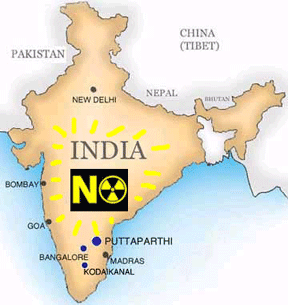 demanded that the Centre cancel nuclear deals with all countries, including USA, Russia, France and Japan. “People should not be made scapegoats for the sake of multinational companies,”
Will lay permanent siege to Koodankulam plant if it goes critical: PMANE, The Asian Age, Jan 07, 2012 | Madurai An anti-nuclear forum spearheading the ongoing stir against Koodankulam Nuclear Power Plant on Saturday said it would intensify the agitation by laying a ‘permanent siege’ to the plant if it goes critical.
“The government should respect the sentiments of the local people. If they don’t, they will not hesitate to lay a permanent siege of the plant,” S P Udhaykumar, convenor of the People’s Movement Against Nuclear Energy (PMANE) told reporters here. He said there is no compromise on PMANE’s stand that the Centre should shelve the project. Continue reading
Kim Jong Un – an unknown quantity in charge of North Korea’s nukes
Understanding the youngest man who can launch a nuclear weapon Kim was ‘dim’ and a Chicago Bulls fan to his Swiss schoolmates Gulf News, By Malcolm MoorePublished: 00:00 January 7, 2012 Shanghai: Officially aged 29, but probably only 26 or 27, he is the youngest man in history with the power to launch a nuclear weapon.
But the man who appears to have risen smoothly to become North Korea’s “Supreme Military Commander”, the title bestowed on him on Friday and confirmed by the country’s ruling politburo on Thursday, is a worrying blank to most of the outside world…. Inside North Korea, the country’s secretive regime has begun honing propaganda messages about the new leader…. http://gulfnews.com/news/world/other-world/understanding-the-youngest-man-who-can-launch-a-nuclear-weapon-1.962297
Japan: taxpayers to take on nuclear costs, companies to keep profits?
Fukushima exposes contradictions / Nuclear crisis prompts govt to rethink private companies’ operation of N-plants Hiroshi Ikematsu / Yomiuri Shimbun, 7 Jan 12
The government’s moves to overhaul the state’s nuclear policy were prompted by serious contradictions discovered in that policy, as a result of the nuclear crisis at the Fukushima No. 1 nuclear power plant.
Although the Law on Compensation for Nuclear Damage stipulates that electric companies have unlimited liability in the case of accidents, the government had no choice but to support Tokyo Electric Power Co.’s efforts to pay compensation for damage caused by the Fukushima crisis. Therefore, the government plans to overhaul the law, including a review of utilities’ unlimited liability.
If it does so, however, entrusting utility companies with the operation of cost-efficient nuclear power plants, the companies may just siphon off profits and push the risk of accidents onto the
state……. http://www.yomiuri.co.jp/dy/national/T120106005620.htm
Wind power may transform Mongolia’s energy supply
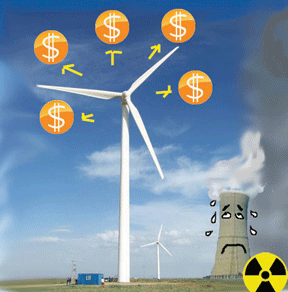 The group has six wind-power plant projects that are due to bring 1,000 megawatts online in the country by 2020. In the U.S., that would be enough to power about 800,000 homes. In Mongolia’s economy, it would stretch much further.
Mongolia’s Renewables Belittle World’s Nuclear Supply, Bloomberg, By Yuriy Humber Jan 5, 2012 Untapped mineral riches are fueling Mongolia’s ambition to compete with Australia and Brazil in Asia. The nation’s resource-based economy grew 21 percent last quarter alone.
This largesse obscures a potential aboveground treasure also awaiting investors.
The world’s most sparsely populated nation has the potential to generate 2.6 million megawatts of wind, solar, geothermal and hydropower, based on data collected by the U.S. National Renewable Energy Laboratory and the Mongolian National Renewable Energy Center.
That’s a fantastic figure. It’s seven times the capacity of all the world’s operable nuclear reactors combined, according to world nuclear association data. In contrast, Mongolia’s current power capacity is less than that of one large coal plant, just 878 megawatts.
That’s what Newcom Group’s acting Chief Executive Office Byambasaikhan Bayanjargal recently told investors in Hong Kong. Of that, close to 40 percent of the potential is in wind, and Bayanjargal is eager to harness it….. Continue reading
North Korea talking tough on nuclear weapons
 N. Korea Vows to Reinforce Nuclear Program After South’s Offer , By Sangwon Yoon, Jan. 6 (Bloomberg) — North Korea responded to South Korean President Lee Myung Bak’s offer of “a window of opportunity” for inter-Korean dialog with a vow to “further reinforce” its status as a nuclear-weapons state……
“As long as the enemy is persistent in his moves for aggression, the DPRK will further reinforce the position of the nuclear-weapons state to protect its dignity and sovereignty,” it said. DPRK as an acronym of North Korea’s formal name, the Democratic People’s Republic of
Korea.
The committee responded to Lee’s New Year message, which expressed the possibility of a “new era” in inter-Korean relations if the North shows sincerity in denuclearizing.
The committee statement was the North’s first message on the status of the North’s nuclear weapons program since Kim Jong Il died and his son Kim Jong Un was installed as leader……
http://www.businessweek.com/news/2012-01-05/n-korea-vows-to-reinforce-nuclear-program-after-south-s-offer.html
Corruption to continue in Japan’s nuclear industry?
the official who ordered the cover-up of the data is now responsible for working out safety measures at nuclear plants
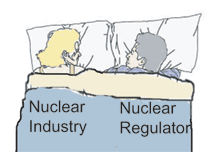
 Cover-up of estimated costs to dispose of radioactive waste raises serious questions, Mainichi Daily News, By Tadashi Kobayashi, Kenji Shimizu and Seiichi Ota, Mainichi Shimbun 2 Jan 2012, Revelations that officials from the Agency for Natural Resources and Energy concealed the estimated costs of disposing of spent nuclear fuel highlights the distorted logic of government officials who stick to reprocessing radioactive waste even by lying.
The cover-up is essentially similar to a case in which some high-ranking government officials hid a 2002 Russian diplomatic document in which Moscow offered to accept spent nuclear fuel from Japan, in that both helped promote the reprocessing of radioactive waste at a plant in Rokkasho, Aomori Prefecture. Continue reading
74% of Japanese want to close nuclear power, but govt tied to nuclear industry
 Japanese Don’t Want a Nuclear Future: The Ticker, Bloomberg, William Pesek, 5 Jan “……..In a June Asahi newspaper poll, 74 percent favored Japan over time decommissioning all 54 reactors. Actions by the government, reinforced by Prime MinisterYoshihiko Noda‘s press conference today, suggest the opposite is afoot. Japanese want a nuclear-free future, and yet the government is back to coddling the power industry.
Why the disconnect? Japan’s nuclear-industrial complex is every bit as powerful as the nexus of business and the military in the U.S. There’s just too much money involved, and Japan’s “nuclear village” is circling the wagons. The moment Noda’s predecessor, Naoto Kan, announced plans to rein in the industry’s incestuous ties with government bureaucrats, his premiership was over. Continue reading
Japan’s nuclear power industry gave money to nuclear regulators
Nuclear safety panel given donations, 9 News 2 Jan 12, Almost one-third of commissioners and examiners at Japan’s nuclear safety commission received donations from the country’s nuclear power industry, the Asahi Shimbun reported on Sunday.
The daily said the governmental commission’s neutrality could be brought into question at a time when the safety of nuclear reactors in Japan was in doubt after a March 11 earthquake and tsunami disaster…..

Two of the organisation’s five permanent commissioners and 22 of its 84 outside examiners received donations from companies and industrial organisations related to nuclear power, in five years to March 2011, Asahi said.
The donations totalled about Y85 million ($1.08 million), the daily said. Of them, 11 received donations from nuclear reactor manufacturers and, or, power utilities and nuclear fuel companies which are examined by the commission, Asahi said.
The commission is authorised to guide the state and power utilities from a neutral position.
Haruki Madarame, chairman of the commissioners, received four million yen from Mitsubishi Heavy Industries between 2006 and 2009 when he was a professor at the University of Tokyo before assuming the commission’s post last April, Asahi said….. http://news.ninemsn.com.au/world/8397277/nuclear-safety-panel-given-donations
Ionising radiation and thyroid cancer
 Vital Signs: Thyroid questions answered. The Daily Progress January 01, 2012 The terrible earthquake in Japan, and the resulting nuclear meltdowns, again have placed thyroid cancer in the news. There is a very close link between radiation exposure and thyroid cancer, and it is likely that Japan will see a sharp increase in aggressive thyroid cancers in the coming years, as was the case in Russia after the Chernobyl disaster in 1986.
Here in the United States, there was an increase in thyroid cancer following the nuclear testing in the 1950s in the Southwest. Though we have ceased such open-air testing, there are still numerous ways to be exposed to radiation, such as by receiving radiation therapy for cancer. And there is also a natural incidence of thyroid cancer unrelated to radiation exposure.
January is Thyroid Awareness Month, so it’s an apt time to discuss the thyroid, thyroid cancer and other thyroid conditions……. There are aggressive forms of thyroid cancer unrelated to radiation exposure, but they are very rare and typically occur in older males…. http://www2.dailyprogress.com/lifestyles/2012/jan/01/vital-signs-thyroid-questions-answered-ar-1575329/
As radioactivity lingers, most of Japan’s evacuees not returning home
 “We can’t go home even if we want to, out of consideration for our children,”
More than half of nuclear radiation zone evacuees in Japan have yet to return home, The Australian Eye, By Nigel Shelbourne, December 31, 2011 FUKUSHIMA, Japan _ Fifty-four percent of evacuees from areas between 20 and 30 kilometers (12.5 and 18.6 miles) of the Fukushima No. 1 nuclear power plant in Japan have yet to return home, three months after the government lifted its emergency evacuation preparation zones. Continue reading
Pakistan, India, exchange nuclear site information and hold peace talks
 Pakistan, India swap nuclear lists Courier Mail, AFP January 02, PAKISTAN and India have exchanged lists of their nuclear sites. The two countries did so under an accord which prohibits both sides from attacking these locations, the foreign ministry in Islamabad said
yesterday.
Under the 1988 agreement, the nuclear-armed neighbours are required to submit the lists of all their respective nuclear installations and facilities – civilian and military – on January 1 every year.
“In accordance with the aforesaid agreement, a list of requisite facilities in Pakistan was given to the Indian high commission official at the foreign office today,” a statement from Pakistan’s
foreign ministry said.
The Indian side also handed over its list to the Pakistan high commission official at the ministry of external affairs in New Delhi, it added…… As part of the resumed dialogue process, experts from the two countries recently held peace talks in Islamabad on nuclear
confidence-building measures… http://www.couriermail.com.au/ipad/pakistan-india-swap-nuclear-lists/story-fn6ck55c-1226234513906
Speculation on who will control North Korea’s nuclear weapons
Who Is in Charge of N.Korea’s Nuclear Weapons? Chosin Ilbo, 2 Jan 11 “…..A South Korean intelligence officer said the North Korean military attaches the greatest importance to the nuclear arms, and Kim Jong-un is now in charge of them. The regime is believed to have about 50 kg of plutonium extracted and up to 10 nuclear bombs, and there was some anxiety abroad who would control them in the power vacuum after former leader Kim Jong-il died.
But some experts say the 29-year-old Kim Jong-un has no military background and cannot really be in charge of the nuclear arms. He is nominally only a vice chairman of the commission, appointed alongside Ri Yong-ho, the chief of General Staff. One South Korean government official speculated that Ri probably controls the regime’s weapons of mass destruction, including any nuclear bombs.
Others believe the commission is collectively in control because it includes all the top military brass. They believe that the first thing the regime did after Kim Jong-il’s death was to ensure control of the nuclear weapons. …..
http://english.chosun.com/site/data/html_dir/2011/12/26/2011122601337.html
Japan’s nuclear industry is a black hole of criminal corruption.
 When asked what were the major differences between the yakuza and TEPCO the same Senator paused for a minute. “The primary difference between TEPCO and the yakuza is they have different corporate logos.” He explained, “They both are essentially criminal organizations that place profits above the safety and welfare of the residents where they operate; they both exploit their workers
 The Yakuza and the Nuclear Mafia: Nationalization Looms for TEPCO Atlantic Wire, JAKE ADELSTEIN, 31 Dec 11, Tokyo Electric Power Company (TEPCO), the monolithic corporation that controls all electric power in Greater Tokyo, and runs the Fukushima Daichii nuclear plant that experienced a triple meltdown following the March 11 earthquake, is on the brink of nationalization according to Japanese government sources.
The official reason is that the firm may not be able to handle the massive compensation payments it owes to victims of the meltdown without going bankrupt.
Unofficially, the firm has such long-standing ties to anti-social forces, including the yakuza—that some members of the Diet, Japan’s national legislature, feel the firm is beyond salvation and needs to be taken over and cleaned up. A Japanese Senator with the Liberal Democratic Party stated on background, “TEPCO’s involvement with anti-social forces and their inability to filter them out of the work-place is a national security issue. It is one reason that increasingly in the Diet we are talking de facto nationalization of the company. Nuclear energy shouldn’t be in the hands of the yakuza. They’re gamblers and an intelligent person doesn’t want them to have atomic dice to play with.”
In June we reported that yakuza were working at the Fukushima nuclear power plant as cleanup crews and manual labor, but the post-meltdown yakuza ties were only the tip of the iceberg. This month, a new book was published, Yakuza and The Nuclear Industry: Diary of An Undercover Reporter Working at the Fukushima Plant (ヤクザと原発-福島第一潜入記-鈴木-智彦) in which a former yakuza fan magazine editor Tomohiko Suzuki reports on the nuclear business-industrial-political and media complex in Japan known as the “nuclear mafia” and Japan’s actual mafia: the yakuza. The book is already generating controversy and renewed examination of Japan’s “dark empire” and its ties to the underworld. It presents more solid pieces of evidence that Japan’s nuclear industry is a black hole of criminal malfeasance, incompetence, and corruption. Continue reading
1 This Month
23-25 October – on Zoom – World BEYOND War’s annual global conferenc


Shut down the radiation-damaged Heysham nuclear reactors now
To see nuclear-related stories in greater depth and intensity – go to https://nuclearinformation.wordpress.com

Say No to NASA’s Reckless Nuclear Reactor on the Moon
Say No to NASA’s Reckless Nuclear Reactor on the Moon

-
Archives
- October 2026 (219)
- September 2026 (339)
- August 2026 (330)
- July 2026 (355)
- June 2026 (287)
- May 2026 (306)
- April 2026 (356)
- March 2026 (251)
- February 2026 (267)
- January 2026 (308)
- December 2025 (358)
- November 2025 (359)
-
Categories
- 1
- 1 NUCLEAR ISSUES
- business and costs
- climate change
- culture and arts
- ENERGY
- environment
- health
- history
- indigenous issues
- Legal
- marketing of nuclear
- media
- opposition to nuclear
- PERSONAL STORIES
- politics
- politics international
- Religion and ethics
- safety
- secrets,lies and civil liberties
- spinbuster
- technology
- Uranium
- wastes
- weapons and war
- Women
- 2 WORLD
- ACTION
- AFRICA
- Atrocities
- AUSTRALIA
- Christina's notes
- Christina's themes
- culture and arts
- Events
- Fuk 2022
- Fuk 2023
- Fukushima 2017
- Fukushima 2018
- fukushima 2019
- Fukushima 2020
- Fukushima 2021
- general
- global warming
- Humour (God we need it)
- Nuclear
- RARE EARTHS
- Reference
- resources – print
- Resources -audiovicual
- Weekly Newsletter
- World
- World Nuclear
- YouTube
-
RSS
Entries RSS
Comments RSS

